


 Скачать презентацию RFID — Testing and Certification Speaker Alejandro
7155faca15e8b7a3df2b2e334c384fa6.ppt
- Количество слайдов: 20
 RFID - Testing and Certification Speaker : Alejandro Torrecilla CENTRO DE TECNOLOGÍA DE LAS COMUNICACIONES, S. A. – CETECOM Spain C/Severo Ochoa 2, 29590 Campanillas (Málaga) - SPAIN Phone: +34 95 261 91 23; Fax: +34 95 261 91 13 email: alejandro. torrecilla@cetecom. es URL: www. cetecom. es RFID and Telecommunication Services DATA BASE forum 25 th May 2004 1
 Index Overview of RFID technology Regulatory testing & approvals Regulatory concerns Essential information Testing requirements Approval requirements RFID certification CETECOM involvement in RFID technology RFID and Telecommunication Services DATA BASE forum 25 th May 2004 2
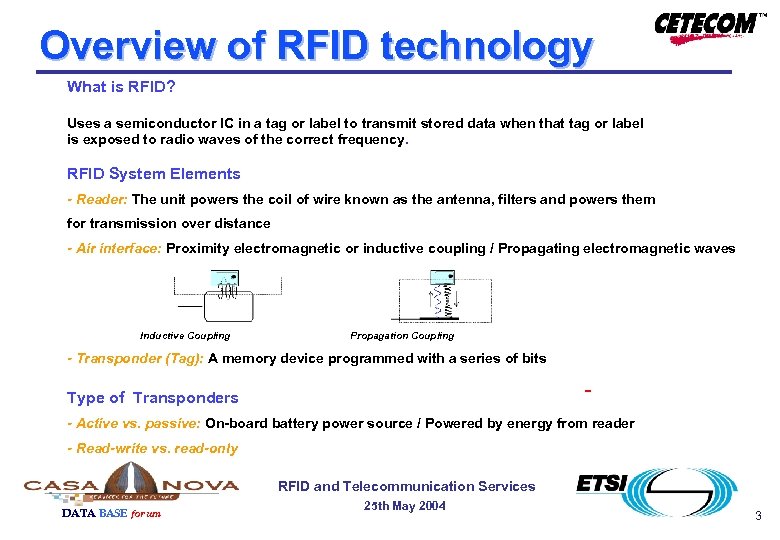 Overview of RFID technology What is RFID? Uses a semiconductor IC in a tag or label to transmit stored data when that tag or label is exposed to radio waves of the correct frequency. RFID System Elements - Reader: The unit powers the coil of wire known as the antenna, filters and powers them for transmission over distance - Air interface: Proximity electromagnetic or inductive coupling / Propagating electromagnetic waves Inductive Coupling Propagation Coupling - Transponder (Tag): A memory device programmed with a series of bits Type of Transponders - Active vs. passive: On-board battery power source / Powered by energy from reader - Read-write vs. read-only RFID and Telecommunication Services DATA BASE forum 25 th May 2004 3
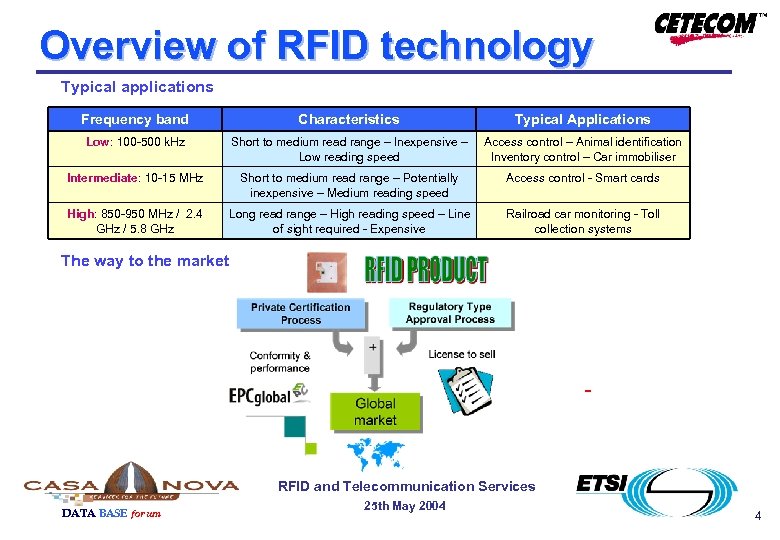 Overview of RFID technology Typical applications Frequency band Characteristics Typical Applications Low: 100 -500 k. Hz Short to medium read range – Inexpensive – Low reading speed Access control – Animal identification Inventory control – Car immobiliser Intermediate: 10 -15 MHz Short to medium read range – Potentially inexpensive – Medium reading speed Access control - Smart cards High: 850 -950 MHz / 2. 4 GHz / 5. 8 GHz Long read range – High reading speed – Line of sight required - Expensive Railroad car monitoring - Toll collection systems The way to the market RFID and Telecommunication Services DATA BASE forum 25 th May 2004 4
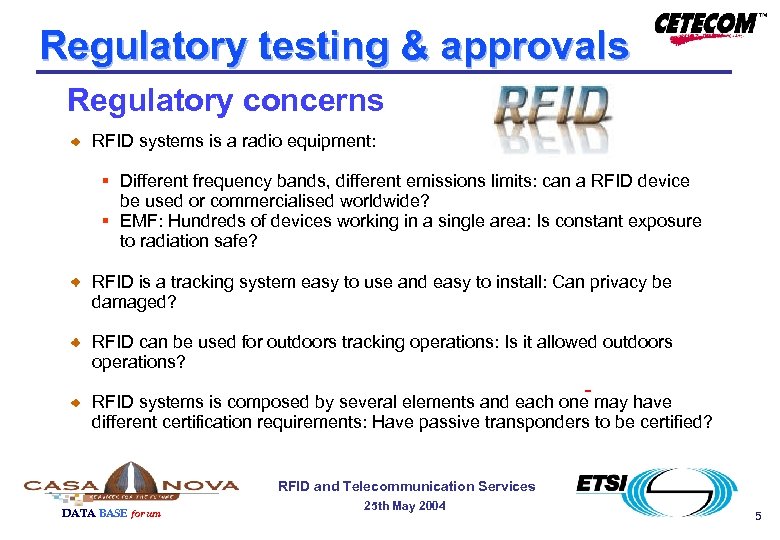 Regulatory testing & approvals Regulatory concerns RFID systems is a radio equipment: § Different frequency bands, different emissions limits: can a RFID device be used or commercialised worldwide? § EMF: Hundreds of devices working in a single area: Is constant exposure to radiation safe? RFID is a tracking system easy to use and easy to install: Can privacy be damaged? RFID can be used for outdoors tracking operations: Is it allowed outdoors operations? RFID systems is composed by several elements and each one may have different certification requirements: Have passive transponders to be certified? RFID and Telecommunication Services DATA BASE forum 25 th May 2004 5
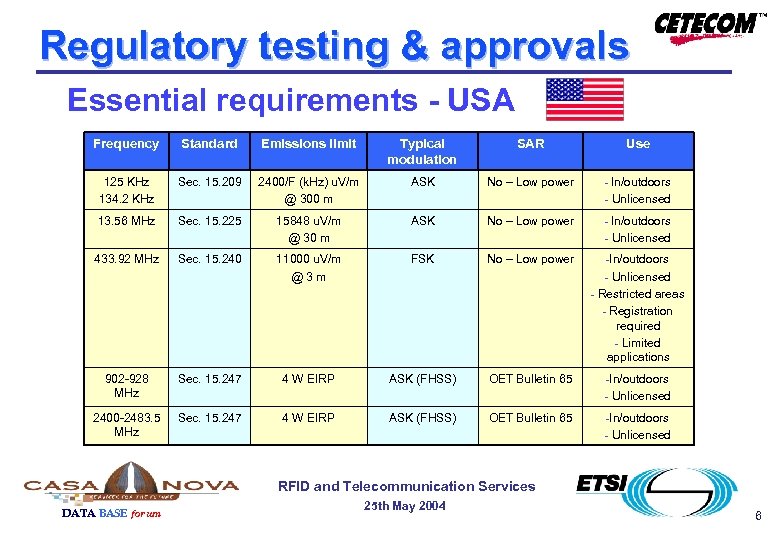 Regulatory testing & approvals Essential requirements - USA Frequency Standard Emissions limit Typical modulation SAR 125 KHz 134. 2 KHz Sec. 15. 209 2400/F (k. Hz) u. V/m @ 300 m ASK No – Low power - 13. 56 MHz Sec. 15. 225 15848 u. V/m @ 30 m ASK No – Low power - 433. 92 MHz Sec. 15. 240 11000 u. V/m @3 m FSK No – Low power -In/outdoors 4 W EIRP ASK (FHSS) 902 -928 MHz Sec. 15. 247 2400 -2483. 5 MHz Sec. 15. 247 4 W EIRP Use In/outdoors - Unlicensed - Restricted areas - Registration required - Limited applications - ASK (FHSS) OET Bulletin 65 -In/outdoors - Unlicensed RFID and Telecommunication Services DATA BASE forum 25 th May 2004 6
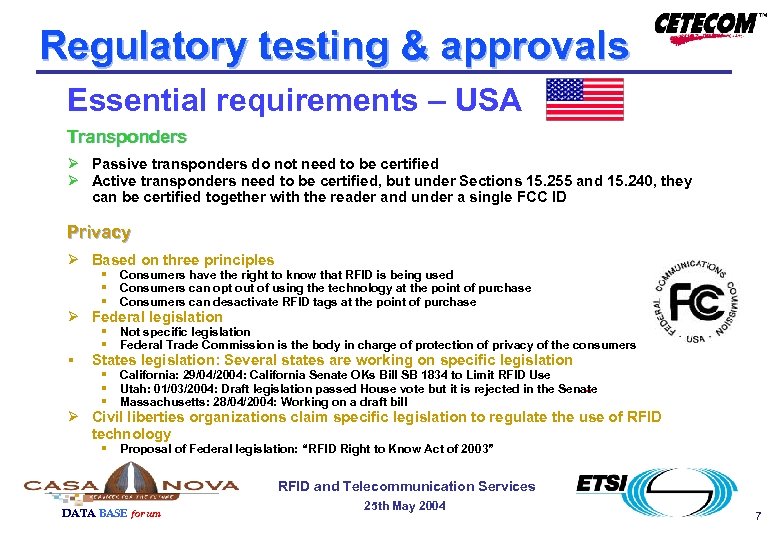 Regulatory testing & approvals Essential requirements – USA Transponders Ø Passive transponders do not need to be certified Ø Active transponders need to be certified, but under Sections 15. 255 and 15. 240, they can be certified together with the reader and under a single FCC ID Privacy Ø Based on three principles § § § Consumers have the right to know that RFID is being used Consumers can opt out of using the technology at the point of purchase Consumers can desactivate RFID tags at the point of purchase § § Not specific legislation Federal Trade Commission is the body in charge of protection of privacy of the consumers § § § California: 29/04/2004: California Senate OKs Bill SB 1834 to Limit RFID Use Utah: 01/03/2004: Draft legislation passed House vote but it is rejected in the Senate Massachusetts: 28/04/2004: Working on a draft bill § Proposal of Federal legislation: “RFID Right to Know Act of 2003” Ø Federal legislation § States legislation: Several states are working on specific legislation Ø Civil liberties organizations claim specific legislation to regulate the use of RFID technology RFID and Telecommunication Services DATA BASE forum 25 th May 2004 7
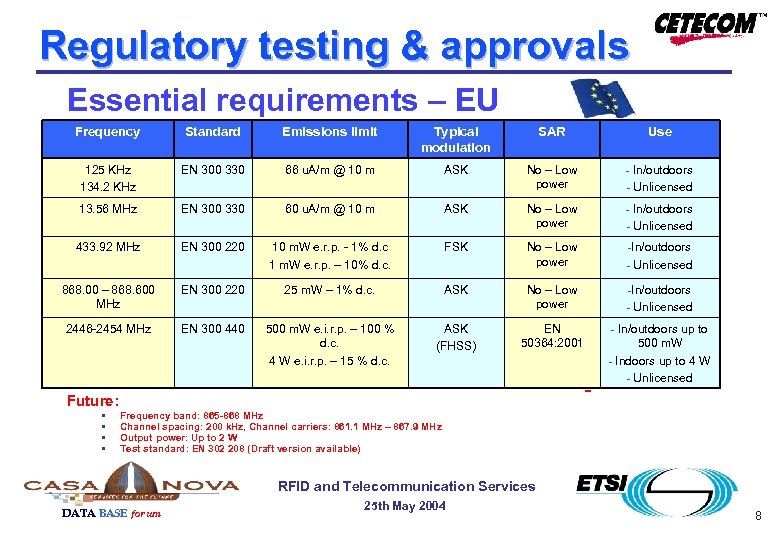 Regulatory testing & approvals Essential requirements – EU Frequency Standard Emissions limit Typical modulation SAR 125 KHz 134. 2 KHz EN 300 330 66 u. A/m @ 10 m ASK No – Low power - 13. 56 MHz EN 300 330 60 u. A/m @ 10 m ASK No – Low power - 433. 92 MHz EN 300 220 10 m. W e. r. p. - 1% d. c 1 m. W e. r. p. – 10% d. c. FSK No – Low power -In/outdoors 25 m. W – 1% d. c. ASK 868. 00 – 868. 600 MHz EN 300 220 2446 -2454 MHz EN 300 440 500 m. W e. i. r. p. – 100 % d. c. 4 W e. i. r. p. – 15 % d. c. ASK (FHSS) In/outdoors - Unlicensed - No – Low power Unlicensed -In/outdoors - EN 50364: 2001 Unlicensed In/outdoors up to 500 m. W - Indoors up to 4 W - Unlicensed - Future: § § Use Frequency band: 865 -868 MHz Channel spacing: 200 k. Hz, Channel carriers: 861. 1 MHz – 867. 9 MHz Output power: Up to 2 W Test standard: EN 302 208 (Draft version available) RFID and Telecommunication Services DATA BASE forum 25 th May 2004 8
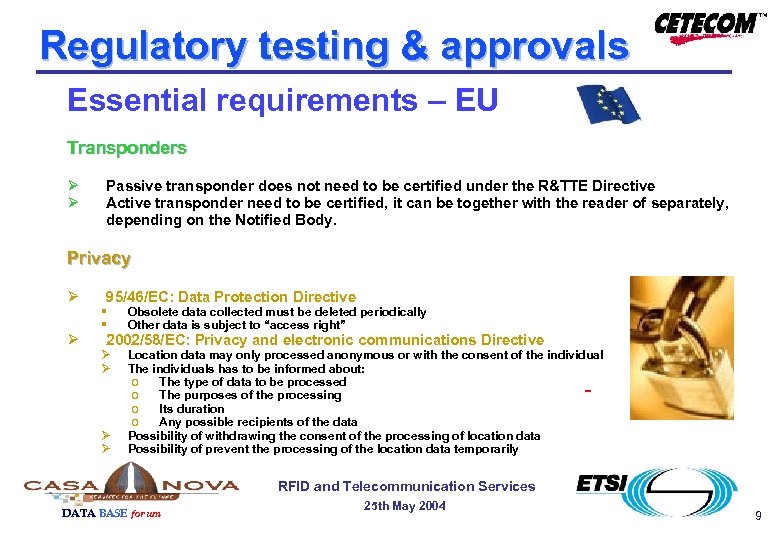 Regulatory testing & approvals Essential requirements – EU Transponders Ø Ø Passive transponder does not need to be certified under the R&TTE Directive Active transponder need to be certified, it can be together with the reader of separately, depending on the Notified Body. Privacy Ø Ø 95/46/EC: Data Protection Directive § § Obsolete data collected must be deleted periodically Other data is subject to “access right” Ø Ø Location data may only processed anonymous or with the consent of the individual The individuals has to be informed about: o The type of data to be processed o The purposes of the processing o Its duration o Any possible recipients of the data Possibility of withdrawing the consent of the processing of location data Possibility of prevent the processing of the location data temporarily 2002/58/EC: Privacy and electronic communications Directive Ø Ø RFID and Telecommunication Services DATA BASE forum 25 th May 2004 9
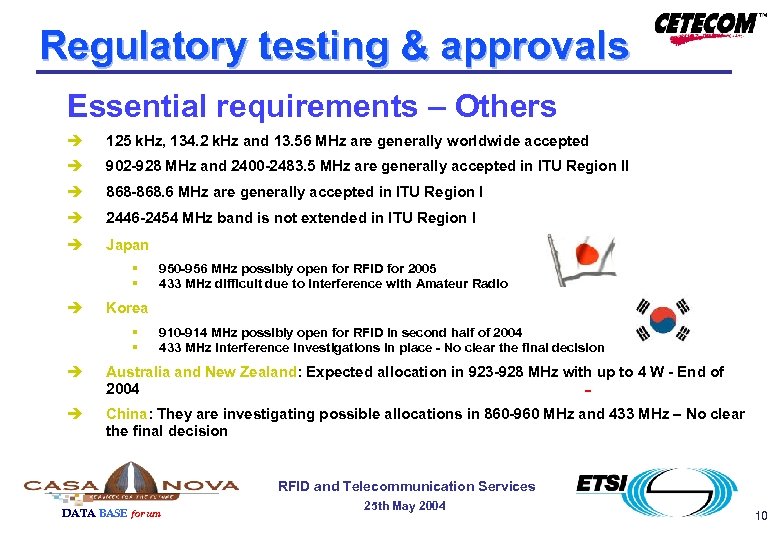 Regulatory testing & approvals Essential requirements – Others è 125 k. Hz, 134. 2 k. Hz and 13. 56 MHz are generally worldwide accepted è 902 -928 MHz and 2400 -2483. 5 MHz are generally accepted in ITU Region II è 868 -868. 6 MHz are generally accepted in ITU Region I è 2446 -2454 MHz band is not extended in ITU Region I è Japan § § è 950 -956 MHz possibly open for RFID for 2005 433 MHz difficult due to interference with Amateur Radio Korea § § 910 -914 MHz possibly open for RFID in second half of 2004 433 MHz interference investigations in place - No clear the final decision è Australia and New Zealand: Expected allocation in 923 -928 MHz with up to 4 W - End of 2004 è China: They are investigating possible allocations in 860 -960 MHz and 433 MHz – No clear the final decision RFID and Telecommunication Services DATA BASE forum 25 th May 2004 10
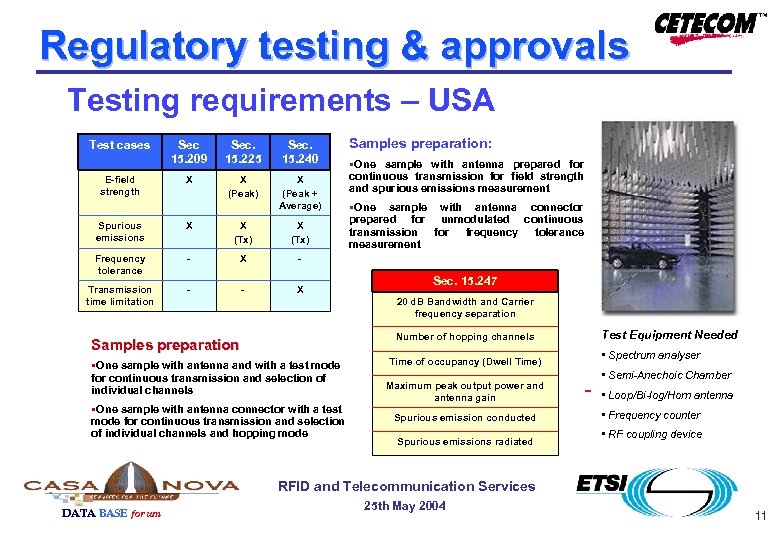 Regulatory testing & approvals Testing requirements – USA Test cases E-field strength Sec 15. 209 Sec. 15. 225 Sec. 15. 240 X X (Peak) X (Peak + Average) Spurious emissions X X (Tx) Frequency tolerance - X - - X §One sample with antenna prepared for continuous transmission for field strength and spurious emissions measurement §One sample with antenna connector prepared for unmodulated continuous transmission for frequency tolerance measurement - Transmission time limitation Samples preparation: Sec. 15. 247 20 d. B Bandwidth and Carrier frequency separation Number of hopping channels Samples preparation §One sample with antenna and with a test mode for continuous transmission and selection of individual channels §One sample with antenna connector with a test mode for continuous transmission and selection of individual channels and hopping mode Time of occupancy (Dwell Time) Maximum peak output power and antenna gain Spurious emission conducted Spurious emissions radiated Test Equipment Needed • Spectrum analyser • Semi-Anechoic Chamber • Loop/Bi-log/Horn antenna • Frequency counter • RF coupling device RFID and Telecommunication Services DATA BASE forum 25 th May 2004 11
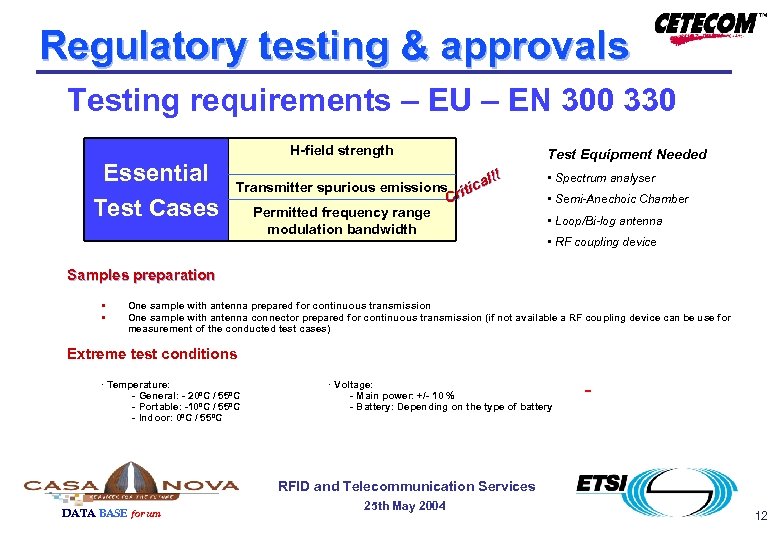 Regulatory testing & approvals Testing requirements – EU – EN 300 330 H-field strength Essential Test Cases Test Equipment Needed !! cal ti Cri Transmitter spurious emissions Permitted frequency range modulation bandwidth • Spectrum analyser • Semi-Anechoic Chamber • Loop/Bi-log antenna • RF coupling device Samples preparation § § One sample with antenna prepared for continuous transmission One sample with antenna connector prepared for continuous transmission (if not available a RF coupling device can be use for measurement of the conducted test cases) Extreme test conditions · Temperature: - General: - 20ºC / 55ºC - Portable: -10ºC / 55ºC - Indoor: 0ºC / 55ºC · Voltage: - Main power: +/- 10 % - Battery: Depending on the type of battery RFID and Telecommunication Services DATA BASE forum 25 th May 2004 12
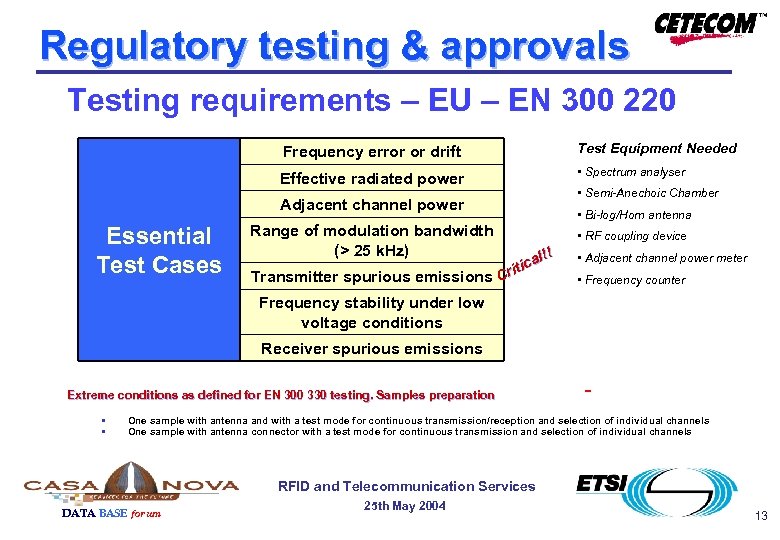 Regulatory testing & approvals Testing requirements – EU – EN 300 220 Frequency error or drift Test Equipment Needed Effective radiated power • Spectrum analyser Adjacent channel power Essential Test Cases Range of modulation bandwidth (> 25 k. Hz) l!! ica t Transmitter spurious emissions Cri • Semi-Anechoic Chamber • Bi-log/Horn antenna • RF coupling device • Adjacent channel power meter • Frequency counter Frequency stability under low voltage conditions Receiver spurious emissions Extreme conditions as defined for EN 300 330 testing. Samples preparation § § One sample with antenna and with a test mode for continuous transmission/reception and selection of individual channels One sample with antenna connector with a test mode for continuous transmission and selection of individual channels RFID and Telecommunication Services DATA BASE forum 25 th May 2004 13
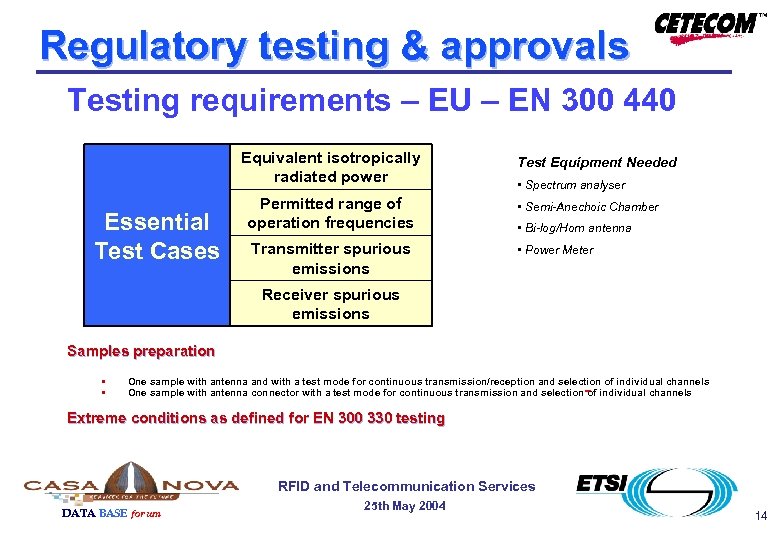 Regulatory testing & approvals Testing requirements – EU – EN 300 440 Equivalent isotropically radiated power Essential Test Cases Test Equipment Needed • Spectrum analyser Permitted range of operation frequencies • Semi-Anechoic Chamber Transmitter spurious emissions • Power Meter • Bi-log/Horn antenna Receiver spurious emissions Samples preparation § § One sample with antenna and with a test mode for continuous transmission/reception and selection of individual channels One sample with antenna connector with a test mode for continuous transmission and selection of individual channels Extreme conditions as defined for EN 300 330 testing RFID and Telecommunication Services DATA BASE forum 25 th May 2004 14
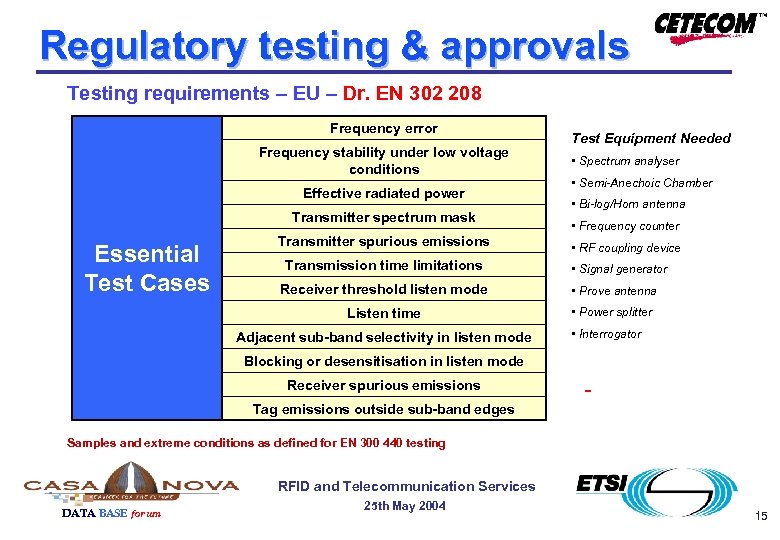 Regulatory testing & approvals Testing requirements – EU – Dr. EN 302 208 Frequency error Frequency stability under low voltage conditions Effective radiated power Transmitter spectrum mask Essential Test Cases Transmitter spurious emissions Transmission time limitations Test Equipment Needed • Spectrum analyser • Semi-Anechoic Chamber • Bi-log/Horn antenna • Frequency counter • RF coupling device • Signal generator Receiver threshold listen mode • Prove antenna Listen time • Power splitter Adjacent sub-band selectivity in listen mode • Interrogator Blocking or desensitisation in listen mode Receiver spurious emissions Tag emissions outside sub-band edges Samples and extreme conditions as defined for EN 300 440 testing RFID and Telecommunication Services DATA BASE forum 25 th May 2004 15
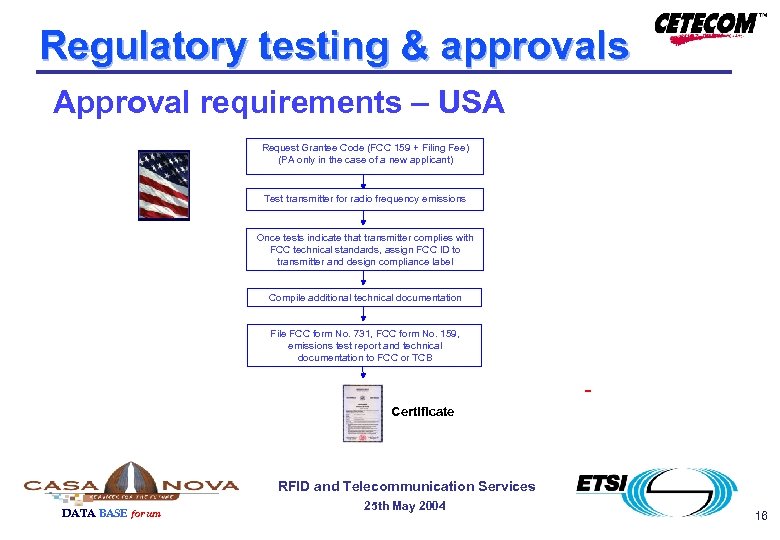 Regulatory testing & approvals Approval requirements – USA Request Grantee Code (FCC 159 + Filing Fee) (PA only in the case of a new applicant) Test transmitter for radio frequency emissions Once tests indicate that transmitter complies with FCC technical standards, assign FCC ID to transmitter and design compliance label Compile additional technical documentation File FCC form No. 731, FCC form No. 159, emissions test report and technical documentation to FCC or TCB Certificate RFID and Telecommunication Services DATA BASE forum 25 th May 2004 16
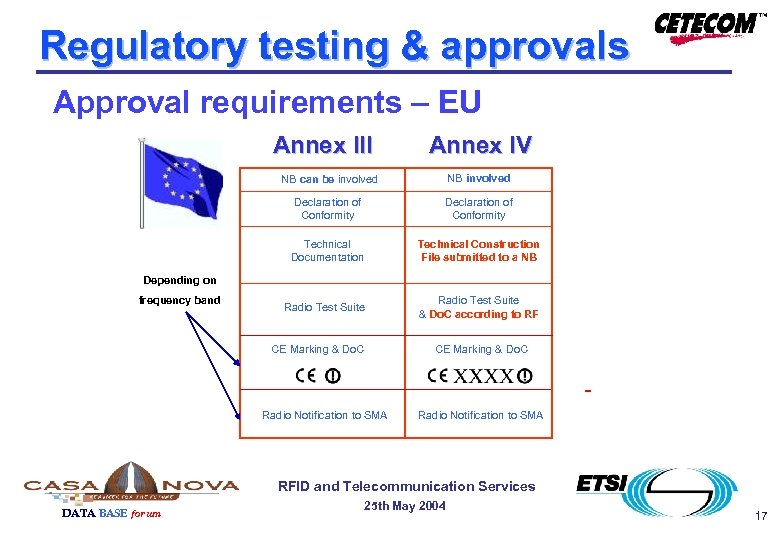 Regulatory testing & approvals Approval requirements – EU Annex III Annex IV NB can be involved NB involved Declaration of Conformity Technical Documentation Technical Construction File submitted to a NB Radio Test Suite & Do. C according to RF Depending on frequency band CE Marking & Do. C Radio Notification to SMA RFID and Telecommunication Services DATA BASE forum 25 th May 2004 17
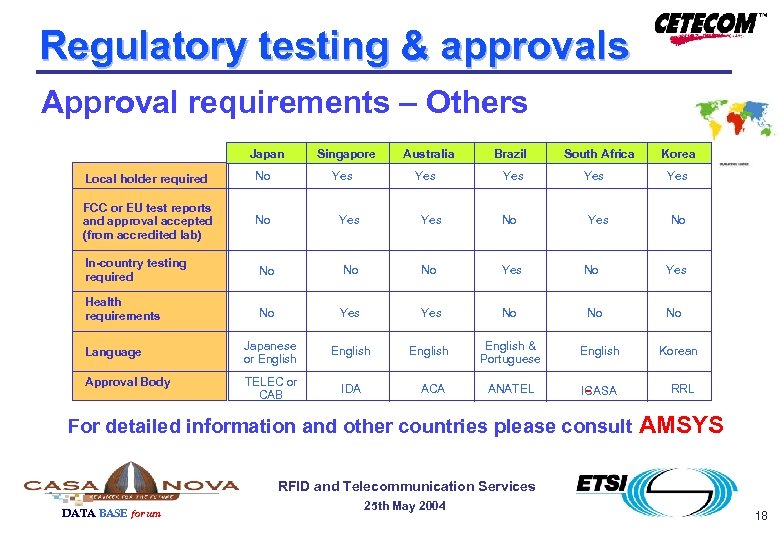 Regulatory testing & approvals Approval requirements – Others Japan Singapore Australia Local holder required No Yes FCC or EU test reports and approval accepted (from accredited lab) No Brazil Yes Yes No South Africa Korea Yes Yes In-country testing required No No No Yes Health requirements No Yes No Japanese or English & Portuguese English TELEC or CAB IDA ANATEL ICASA Language Approval Body ACA No No No Yes No Korean RRL For detailed information and other countries please consult AMSYS RFID and Telecommunication Services DATA BASE forum 25 th May 2004 18
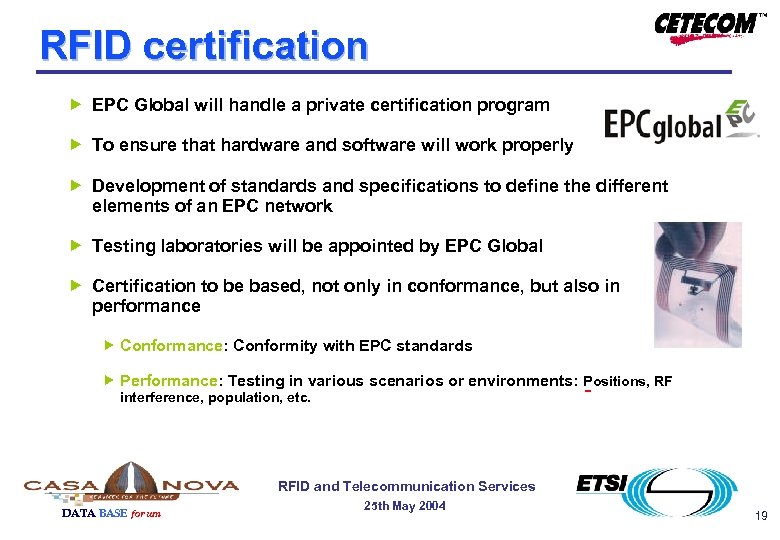 RFID certification EPC Global will handle a private certification program To ensure that hardware and software will work properly Development of standards and specifications to define the different elements of an EPC network Testing laboratories will be appointed by EPC Global Certification to be based, not only in conformance, but also in performance Conformance: Conformity with EPC standards Performance: Testing in various scenarios or environments: Positions, RF interference, population, etc. RFID and Telecommunication Services DATA BASE forum 25 th May 2004 19
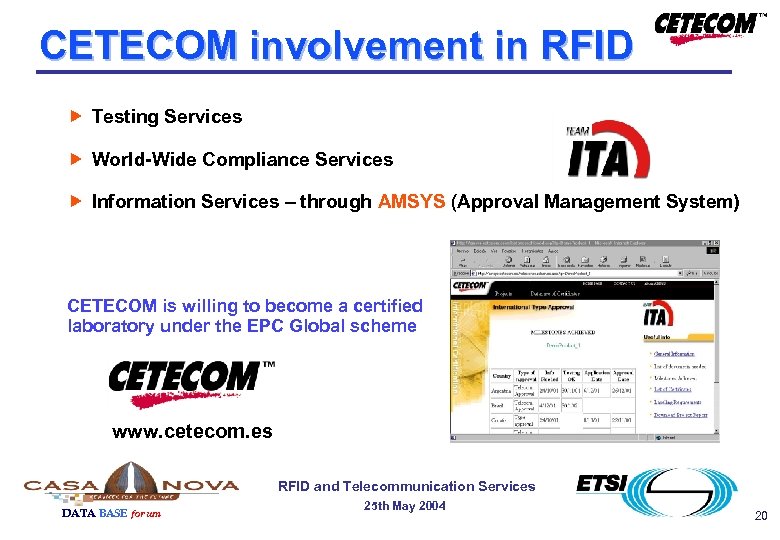 CETECOM involvement in RFID Testing Services World-Wide Compliance Services Information Services – through AMSYS (Approval Management System) CETECOM is willing to become a certified laboratory under the EPC Global scheme www. cetecom. es RFID and Telecommunication Services DATA BASE forum 25 th May 2004 20