


 Скачать презентацию RFID Overview Greg Leeming Intel Corporation 11 8 2004
e7b269caac2b7f47a33c0caf12b89f94.ppt
- Количество слайдов: 40
 RFID Overview Greg Leeming Intel Corporation 11/8/2004
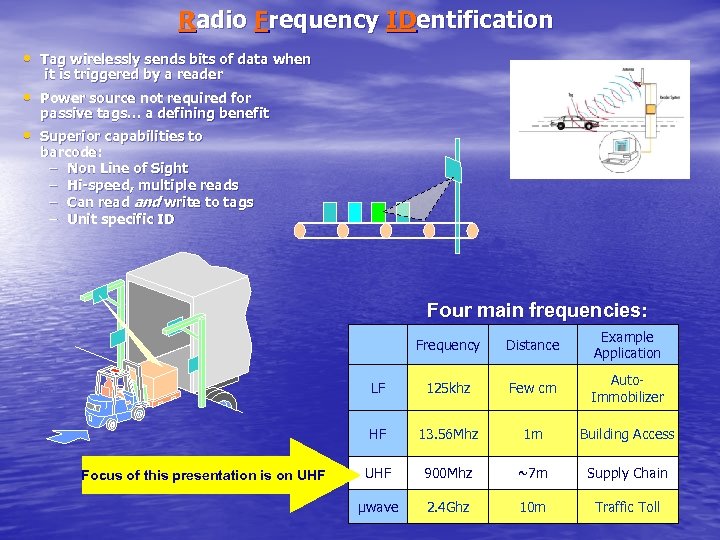 Radio Frequency IDentification • Tag wirelessly sends bits of data when it is triggered by a reader • Power source not required for passive tags… a defining benefit • Superior capabilities to barcode: – Non Line of Sight – Hi-speed, multiple reads – Can read and write to tags – Unit specific ID Four main frequencies: Frequency Example Application LF 125 khz Few cm Auto. Immobilizer HF Focus of this presentation is on UHF Distance 13. 56 Mhz 1 m Building Access UHF 900 Mhz ~7 m Supply Chain μwave 2. 4 Ghz 10 m Traffic Toll
 Presentation Objectives: • Explain technical principles behind RFID • Provide overview of RFID technology • Discuss: – Forces driving the adoption of RFID – Challenges RFID deployment must overcome – The future
 Agenda • RFID history • Technical principles • Tag overview • Reader overview • Adoption challenges • The UHF market • The future? ?
 RFID History • First Bar code patents – 1930 s • First use of RFID device – 2 nd world war – Brittan used RFID-like • • • technology for Identify- Friend or Foe Harry Stockman October 1948 Paper – Communication by means of reflected power ( The proceedings of the Institute of Radio Engineers) First RFID Patent - 1973 Auto-ID center founded at MIT – 1999 – Standardization effort taken over by EPC Global (Electronic Product Code) • Current thrust primarily driven by Wal-Mart and Do. D – Automate Distribution: • • • Reduce cost (man power, shipping mistakes) Increase sales (keep shelves full) Do. D Total Asset Visibility Initiative Source of data: EDN – October 2004 - “Reading Between the Lines” Brian Dipert
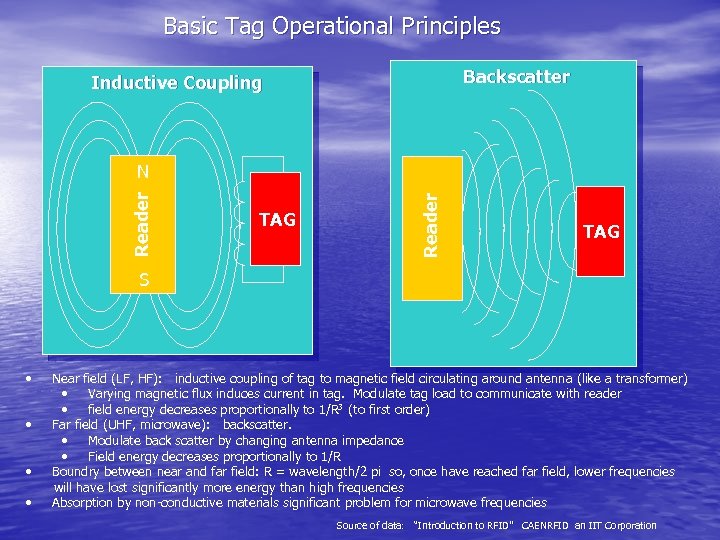 Basic Tag Operational Principles Backscatter Inductive Coupling TAG Reader N TAG S • • Near field (LF, HF): inductive coupling of tag to magnetic field circulating around antenna (like a transformer) • Varying magnetic flux induces current in tag. Modulate tag load to communicate with reader • field energy decreases proportionally to 1/R 3 (to first order) Far field (UHF, microwave): backscatter. • Modulate back scatter by changing antenna impedance • Field energy decreases proportionally to 1/R Boundry between near and far field: R = wavelength/2 pi so, once have reached far field, lower frequencies will have lost significantly more energy than high frequencies Absorption by non-conductive materials significant problem for microwave frequencies Source of data: “Introduction to RFID” CAENRFID an IIT Corporation
 Tags
Tags
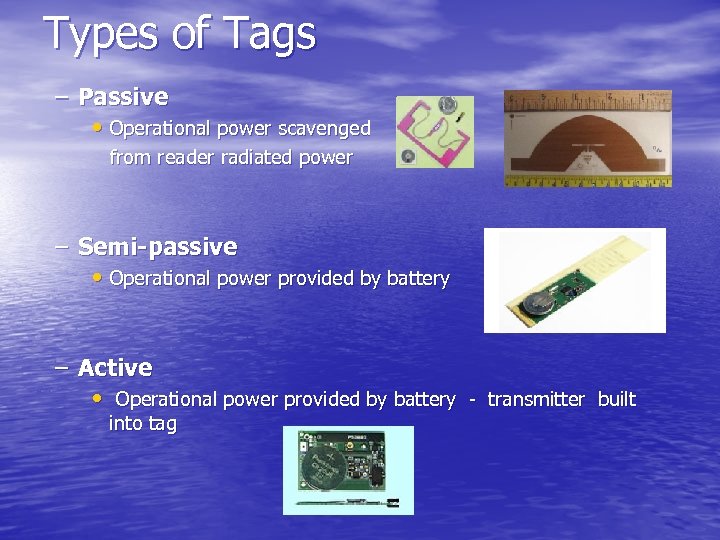 Types of Tags – Passive • Operational power scavenged from reader radiated power – Semi-passive • Operational power provided by battery – Active • Operational power provided by battery - transmitter built into tag
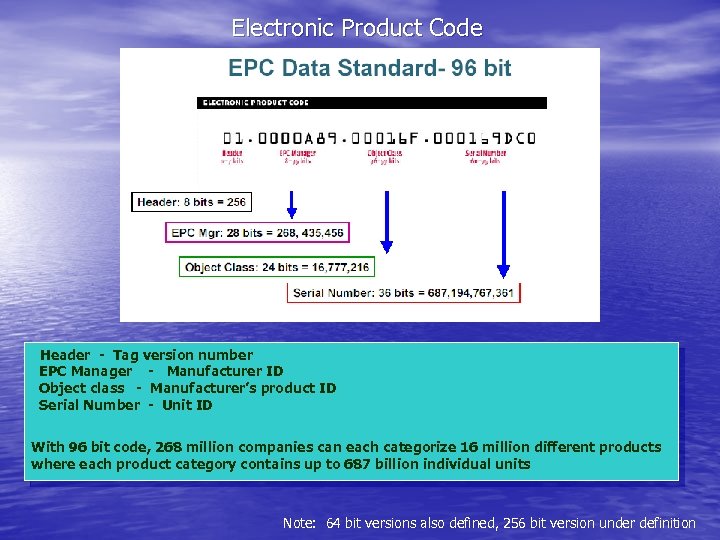 Electronic Product Code Header - Tag version number EPC Manager - Manufacturer ID Object class - Manufacturer’s product ID Serial Number - Unit ID With 96 bit code, 268 million companies can each categorize 16 million different products where each product category contains up to 687 billion individual units Note: 64 bit versions also defined, 256 bit version under definition
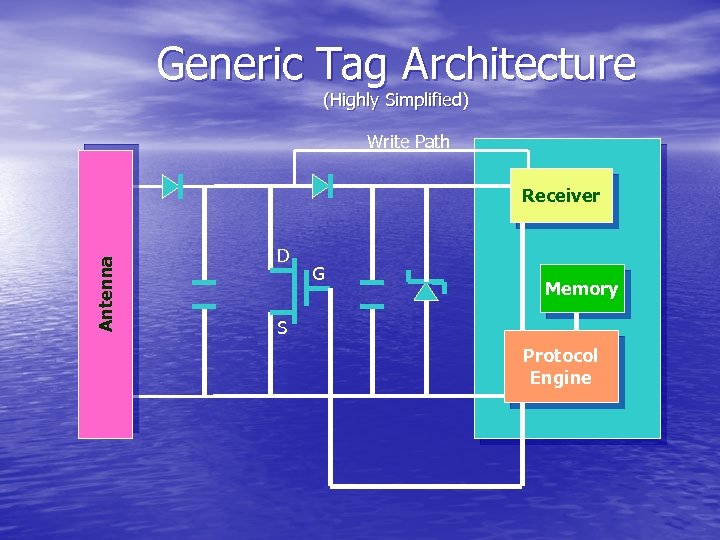 Generic Tag Architecture (Highly Simplified) Write Path Antenna Receiver D G Memory S Protocol Engine
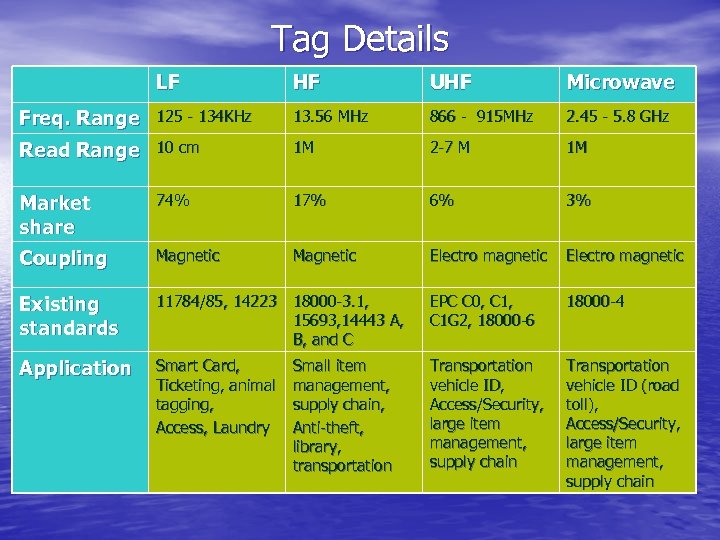 Tag Details LF HF UHF Microwave Freq. Range 125 - 134 KHz 13. 56 MHz 866 - 915 MHz 2. 45 - 5. 8 GHz Read Range 10 cm 1 M 2 -7 M 1 M Market share 74% 17% 6% 3% Coupling Magnetic Electro magnetic Existing standards 11784/85, 14223 18000 -3. 1, 15693, 14443 A, B, and C EPC C 0, C 1 G 2, 18000 -6 18000 -4 Application Smart Card, Ticketing, animal tagging, Access, Laundry Transportation vehicle ID, Access/Security, large item management, supply chain Transportation vehicle ID (road toll), Access/Security, large item management, supply chain Small item management, supply chain, Anti-theft, library, transportation
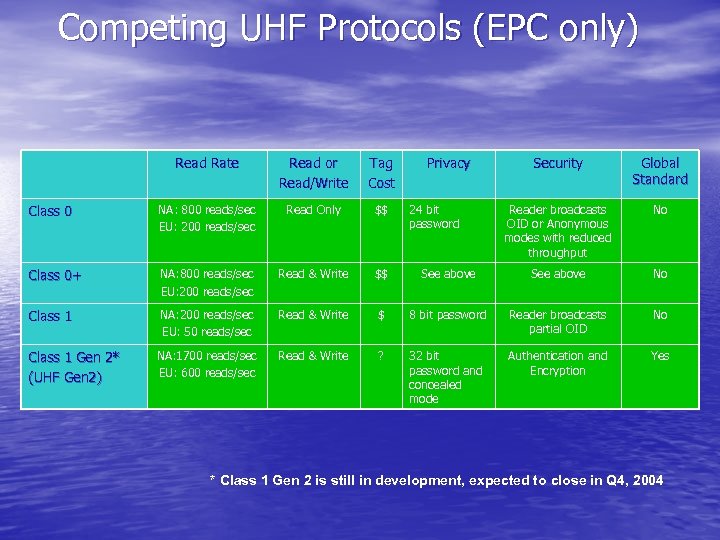 Competing UHF Protocols (EPC only) Read Rate Read or Read/Write Tag Cost Class 0 NA: 800 reads/sec EU: 200 reads/sec Read Only $$ Class 0+ NA: 800 reads/sec EU: 200 reads/sec Read & Write $$ Class 1 NA: 200 reads/sec EU: 50 reads/sec Read & Write Class 1 Gen 2* (UHF Gen 2) NA: 1700 reads/sec EU: 600 reads/sec Read & Write Privacy Security Global Standard Reader broadcasts OID or Anonymous modes with reduced throughput No See above No $ 8 bit password Reader broadcasts partial OID No ? 32 bit password and concealed mode Authentication and Encryption Yes 24 bit password * Class 1 Gen 2 is still in development, expected to close in Q 4, 2004
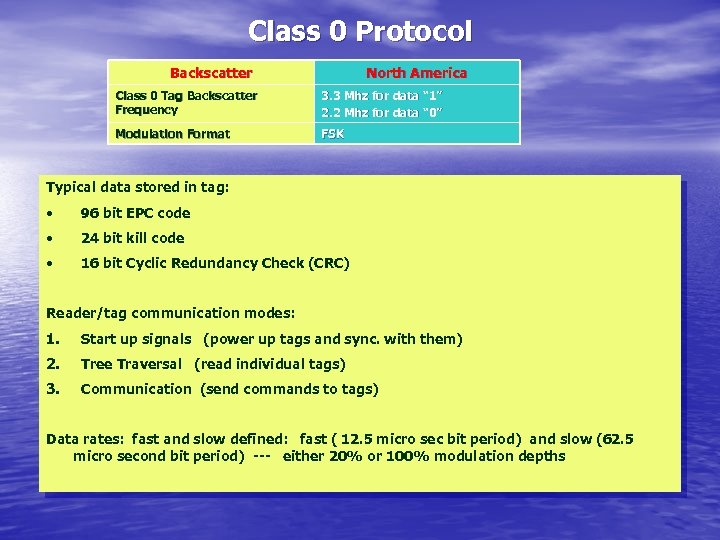 Class 0 Protocol Backscatter North America Class 0 Tag Backscatter Frequency 3. 3 Mhz for data “ 1” 2. 2 Mhz for data “ 0” Modulation Format FSK Typical data stored in tag: • 96 bit EPC code • 24 bit kill code • 16 bit Cyclic Redundancy Check (CRC) Reader/tag communication modes: 1. Start up signals (power up tags and sync. with them) 2. Tree Traversal (read individual tags) 3. Communication (send commands to tags) Data rates: fast and slow defined: fast ( 12. 5 micro sec bit period) and slow (62. 5 micro second bit period) --- either 20% or 100% modulation depths
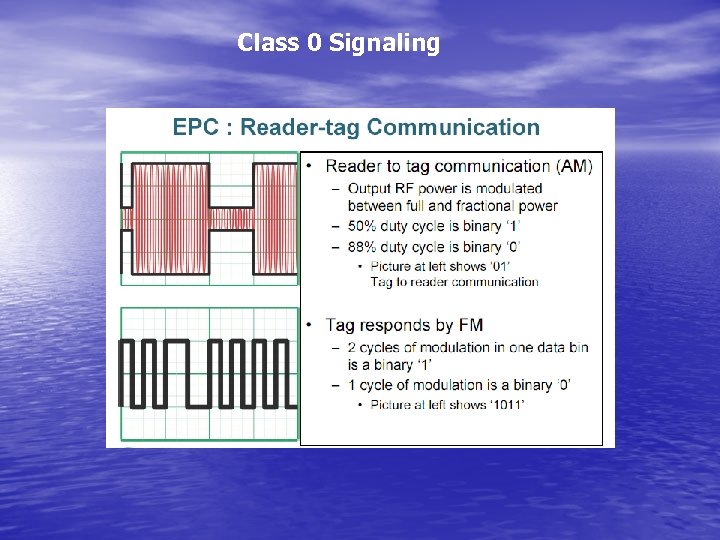 Class 0 Signaling
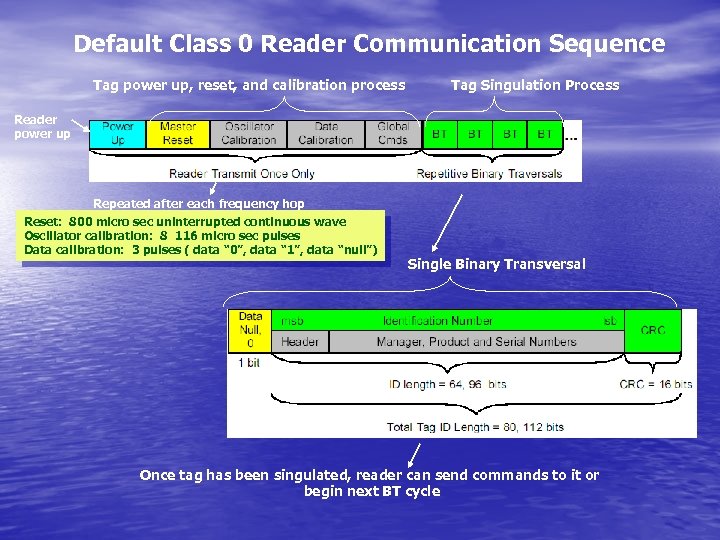 Default Class 0 Reader Communication Sequence Tag power up, reset, and calibration process Tag Singulation Process Reader power up Repeated after each frequency hop Reset: 800 micro sec uninterrupted continuous wave Oscillator calibration: 8 116 micro sec pulses Data calibration: 3 pulses ( data “ 0”, data “ 1”, data “null”) Single Binary Transversal Once tag has been singulated, reader can send commands to it or begin next BT cycle
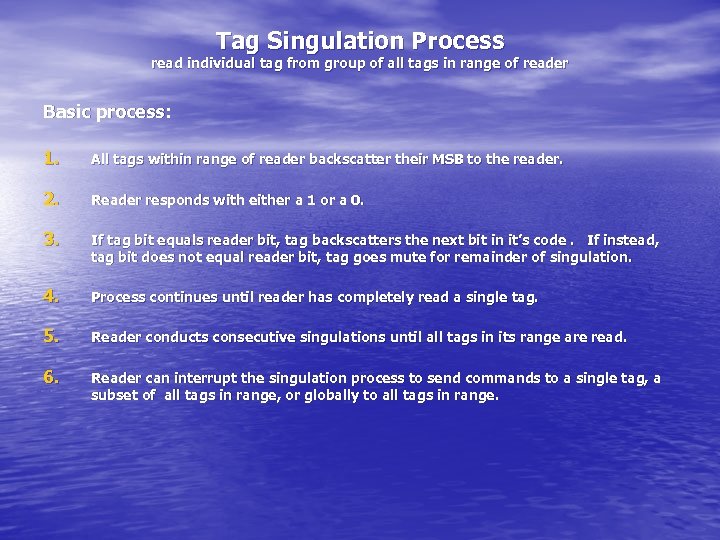 Tag Singulation Process read individual tag from group of all tags in range of reader Basic process: 1. All tags within range of reader backscatter their MSB to the reader. 2. Reader responds with either a 1 or a 0. 3. If tag bit equals reader bit, tag backscatters the next bit in it’s code. If instead, tag bit does not equal reader bit, tag goes mute for remainder of singulation. 4. Process continues until reader has completely read a single tag. 5. Reader conducts consecutive singulations until all tags in its range are read. 6. Reader can interrupt the singulation process to send commands to a single tag, a subset of all tags in range, or globally to all tags in range.
 Readers
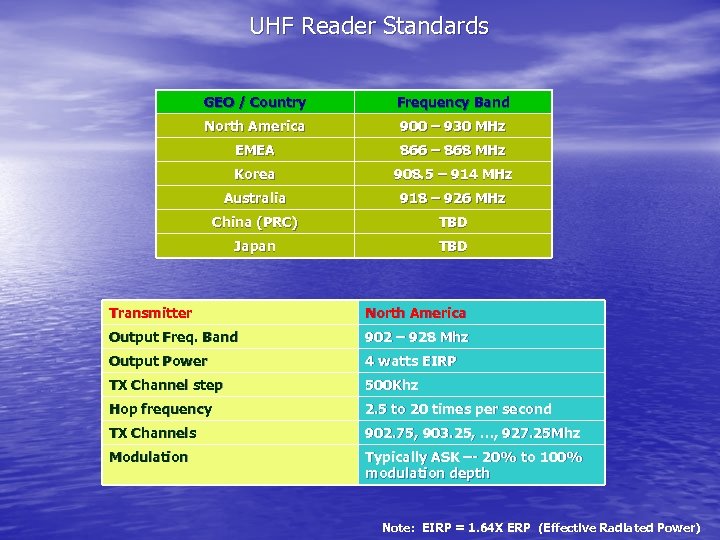 UHF Reader Standards GEO / Country Frequency Band North America 900 – 930 MHz EMEA 866 – 868 MHz Korea 908. 5 – 914 MHz Australia 918 – 926 MHz China (PRC) TBD Japan TBD Transmitter North America Output Freq. Band 902 – 928 Mhz Output Power 4 watts EIRP TX Channel step 500 Khz Hop frequency 2. 5 to 20 times per second TX Channels 902. 75, 903. 25, …, 927. 25 Mhz Modulation Typically ASK –- 20% to 100% modulation depth Note: EIRP = 1. 64 X ERP (Effective Radiated Power)
 Reader Implementation Challenges • Reader must deliver enough power from RF field to power the tag • Reader must discriminate backscatter modulation in presence of carrier at same frequency • 70 db magnitude difference between transmitted and received signals • Interference between readers • Hugh volume of tag data – readers need to filter data before releasing to enterprise network
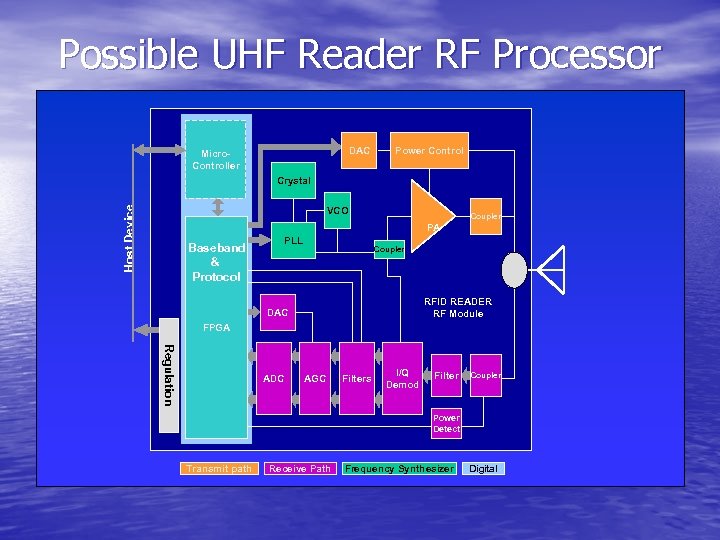 Possible UHF Reader RF Processor DAC Micro. Controller Power Control Host Device Crystal VCO Coupler PA Baseband & Protocol PLL Coupler RFID READER RF Module DAC FPGA Regulation ADC AGC Filters I/Q Demod Filter Coupler Power Detect Transmit path Receive Path Frequency Synthesizer Digital
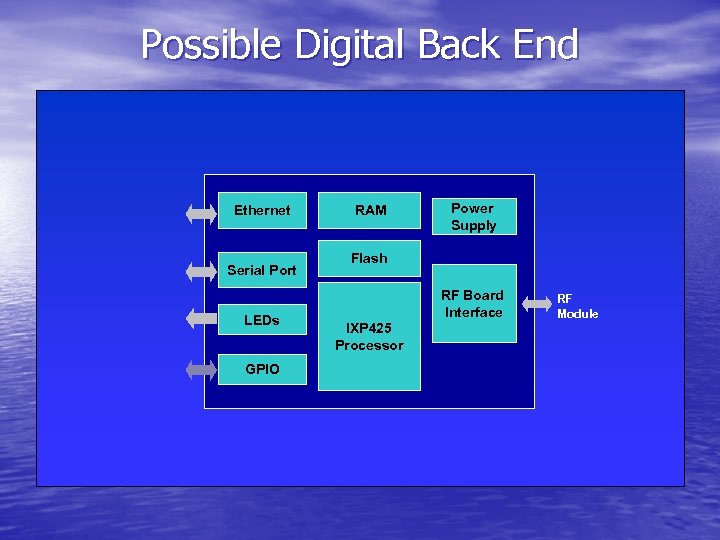 Possible Digital Back End Ethernet Serial Port LEDs GPIO RAM Power Supply Flash RF Board Interface IXP 425 Processor RF Module
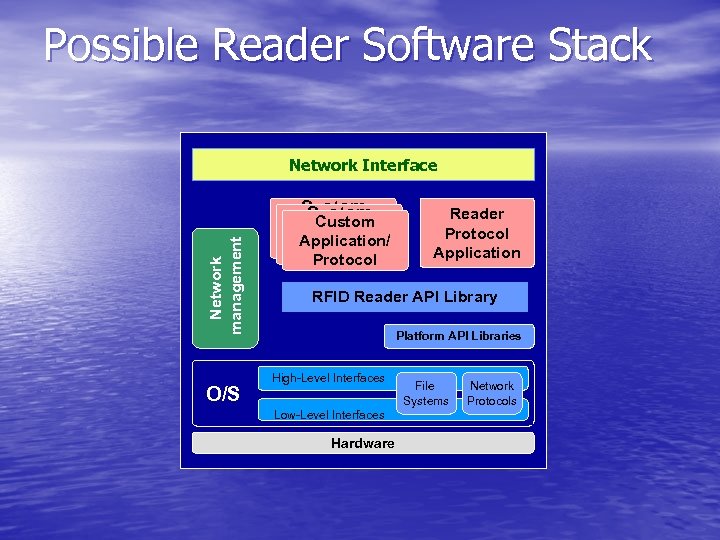 Possible Reader Software Stack Network management Network Interface O/S Custom Application/ Protocol Reader Protocol Application RFID Reader API Library Platform API Libraries High-Level Interfaces Low-Level Interfaces Hardware File Systems Network Protocols
 The RFID Market
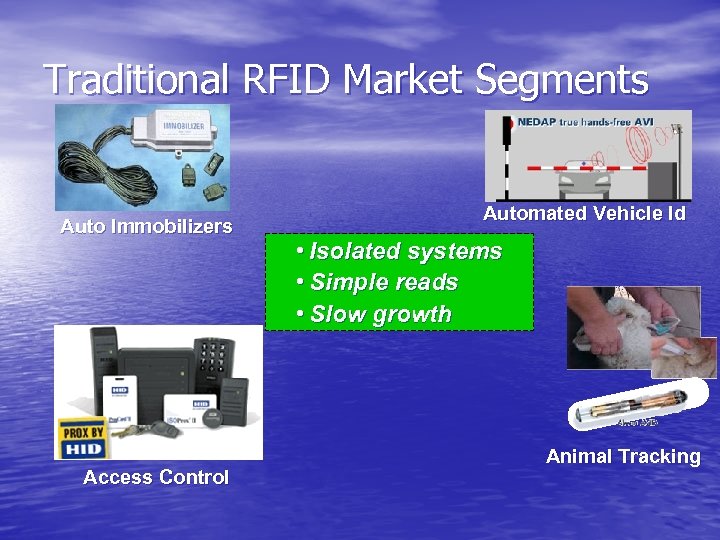 Traditional RFID Market Segments Auto Immobilizers Access Control Automated Vehicle Id • Isolated systems • Simple reads • Slow growth Animal Tracking
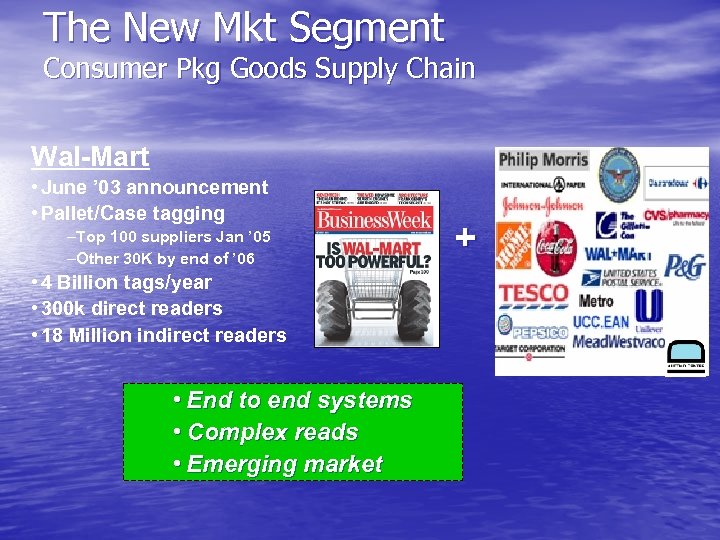 The New Mkt Segment Consumer Pkg Goods Supply Chain Wal-Mart • June ’ 03 announcement • Pallet/Case tagging -Top 100 suppliers Jan ’ 05 -Other 30 K by end of ’ 06 • 4 Billion tags/year • 300 k direct readers • 18 Million indirect readers • End to end systems • Complex reads • Emerging market +
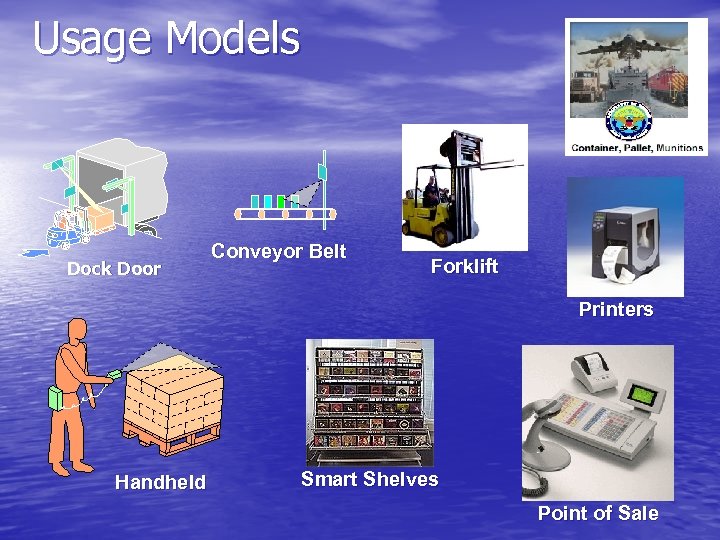 Usage Models Dock Door Conveyor Belt Forklift Printers Handheld Smart Shelves Point of Sale
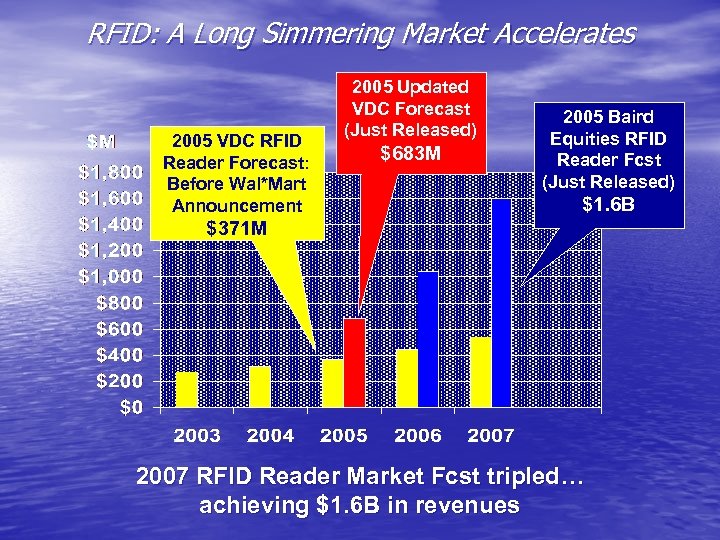 RFID: A Long Simmering Market Accelerates 2005 VDC RFID Reader Forecast: Before Wal*Mart Announcement 2005 Updated VDC Forecast (Just Released) $683 M 2005 Baird Equities RFID Reader Fcst (Just Released) $1. 6 B $371 M 2007 RFID Reader Market Fcst tripled… achieving $1. 6 B in revenues
 Market Drivers: Where is the Bang for the Buck • Retailers (such as Wal. Mart) operate on very small margins (typically less that 5%) • Cost reduction or profitability increase of 1% equates to huge advantage over competitors: – Can be achieved through: v Reduction of distribution inefficiency: less shipping mistakes (are expensive to correct) efficient restocking: keep retail shelves full v Automation: reduction of manpower costs v Reduction of theft and fraud • Do. D total Asset Visibility initiative: – Supplying an army is a costly, logistical nightmare • RFID promises to reduce the chaos
 RFID Adoption Challenges – Is the timing right? ? • Cost: – Tags - currently 50 cents – need to be 5 cents or less – Readers – currently thousands of dollars – need to be hundreds of dollars – Implementation – distribution centers relatively low tech – need networking, power, etc. • Cost benefit - must be significant enough to justify RFID cost: – Retailers operate with small margins ( < 5%). If RFID can increase operational efficiency by 1% = major competitive advantage • Read accuracy: – accuracy not established – needs to approach 100%: • Metal containers, liquids, Etc. impact tag readability • Taq/reader orientation: polarization effects • Reader configuration: cooperative networks of readers • Interference from other readers and other radiators • Design Robustness: – Needs to be robust enough to survive/function in warehouse environments • Security: – Read security, Data security, etc. • Privacy: – See next slide
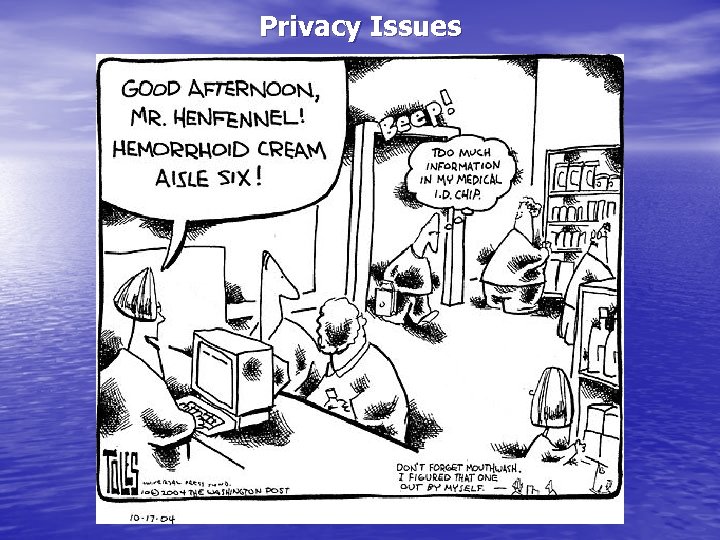 Privacy Issues
 The Future • What fundamental changes does RFID herald in? • What are the probable consequences of these changes?
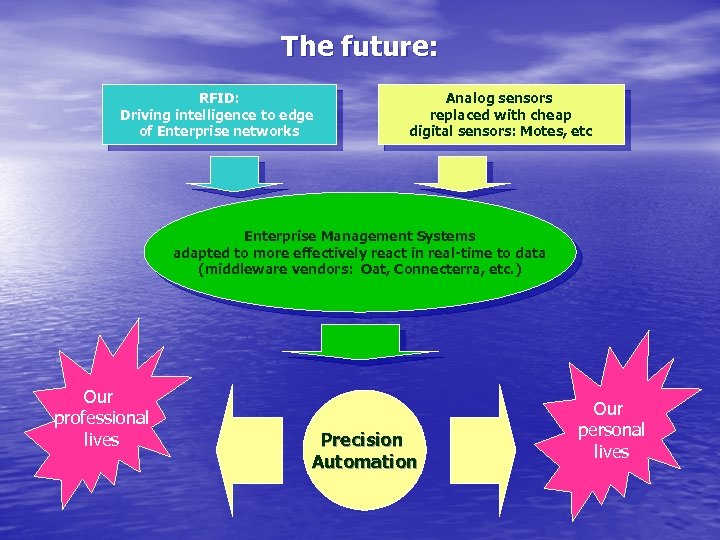 The future: RFID: Driving intelligence to edge of Enterprise networks Analog sensors replaced with cheap digital sensors: Motes, etc Enterprise Management Systems adapted to more effectively react in real-time to data (middleware vendors: Oat, Connecterra, etc. ) Our professional lives Precision Automation Our personal lives
 Questions? ?
 Backup
 RFID Antennas: • • Gate antennas (orthogonal use) Patch antennas Circular polarized Omni directional antennas Stick antennas (directional) Di-pole or multi-pole antennas Linear polarized Adaptive, beam-forming or phased-array element antennas
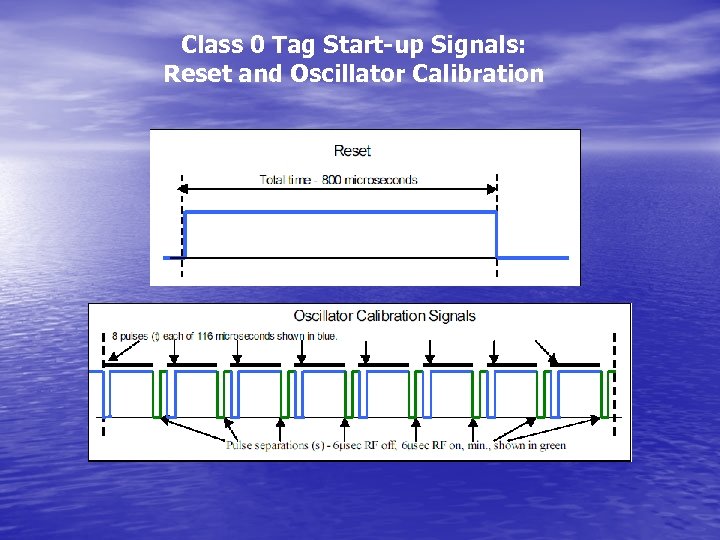 Class 0 Tag Start-up Signals: Reset and Oscillator Calibration
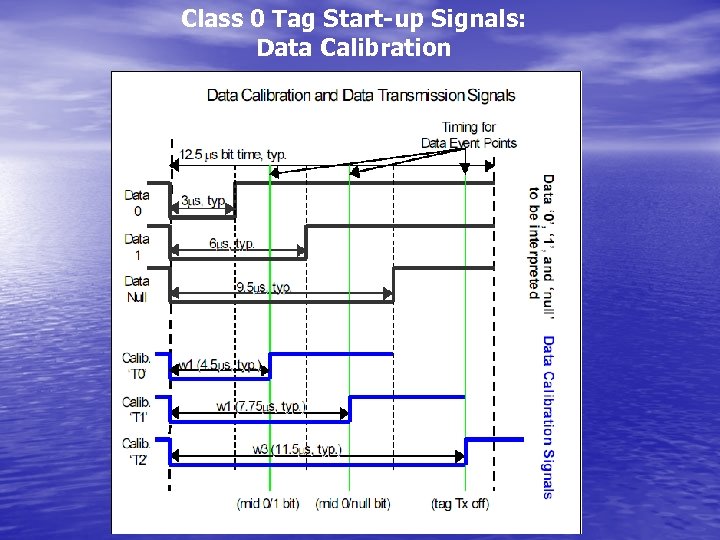 Class 0 Tag Start-up Signals: Data Calibration
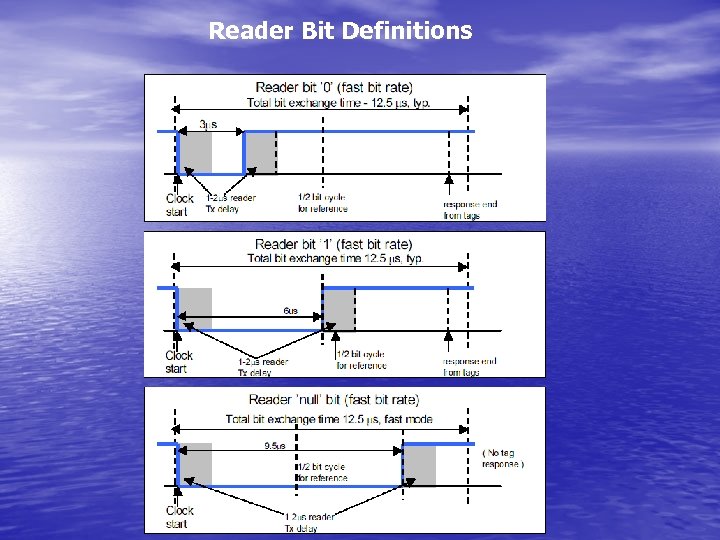 Reader Bit Definitions
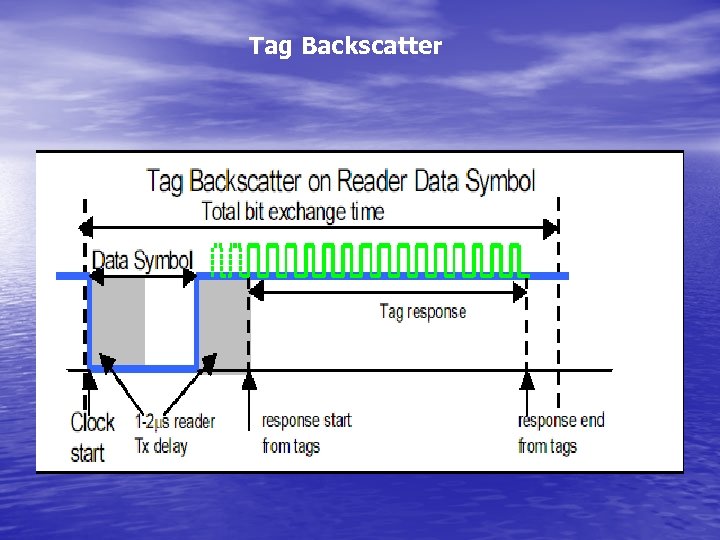 Tag Backscatter
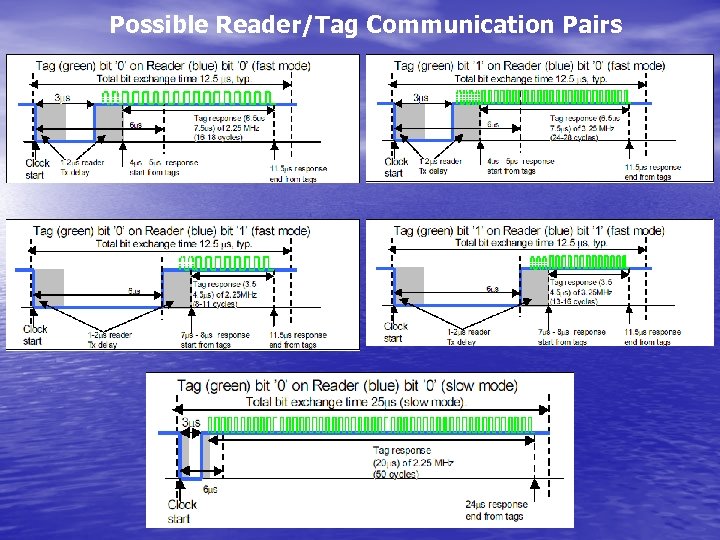 Possible Reader/Tag Communication Pairs