


 Скачать презентацию RFID June 17 2009 Dr Erick C Jones
8337aabbf3a5cfc732b1a9d22b0334a2.ppt
- Количество слайдов: 43
 RFID June 17, 2009 Dr. Erick C. Jones University of Nebraska-Lincoln
 Contents • Rf. SCL Lab Introduction • RFID Overview – Applications – How It Works • Readers • Antennas • Tags – Challenges • Questions
 Rf. SCL Lab Introduction
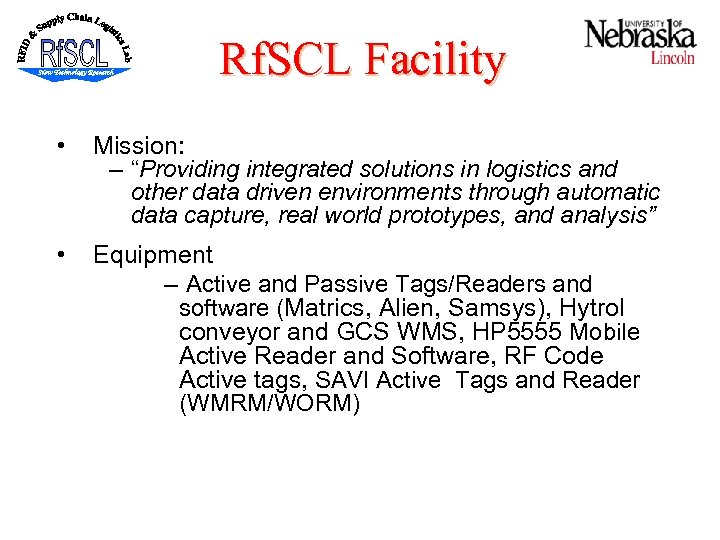 Rf. SCL Facility • Mission: – “Providing integrated solutions in logistics and other data driven environments through automatic data capture, real world prototypes, and analysis” • Equipment – Active and Passive Tags/Readers and software (Matrics, Alien, Samsys), Hytrol conveyor and GCS WMS, HP 5555 Mobile Active Reader and Software, RF Code Active tags, SAVI Active Tags and Reader (WMRM/WORM)
 Rf. SCL Team (Fall 2009) • Faculty – Dr. Erick C. Jones (Director) – Dr. Mike Riley (Associate Director) • Graduate Students – Dwight Mosbey (DM)- Ph. D – Liyuan Zhang(LZ), - Ph. D – Casey Richards(CR), -Ph. D – Maurice Cavitt(MC)- Ph. D – Jonathan Carlson(JC), – Nancy Kong(NK), – Jian (Hank) Han(JH) , – Bode Alabi (BA) – Rama Thummalapalli (RT), – Jairo De Jesus(JD) • Undergraduates – As many as I can “afford”
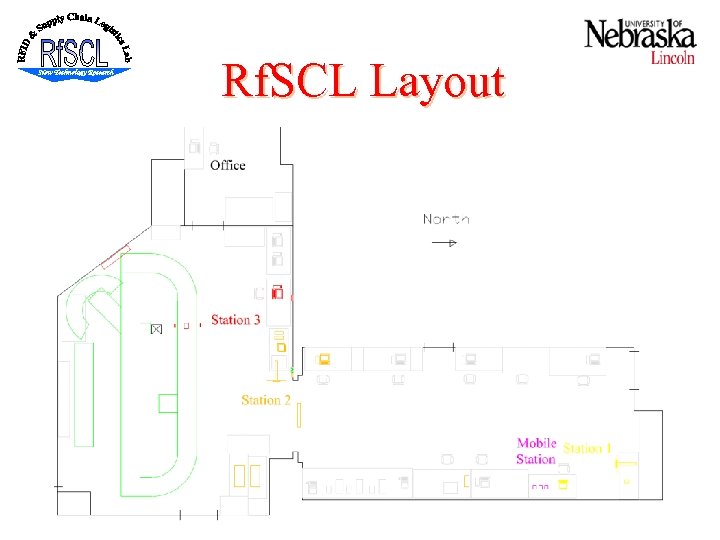 Rf. SCL Layout
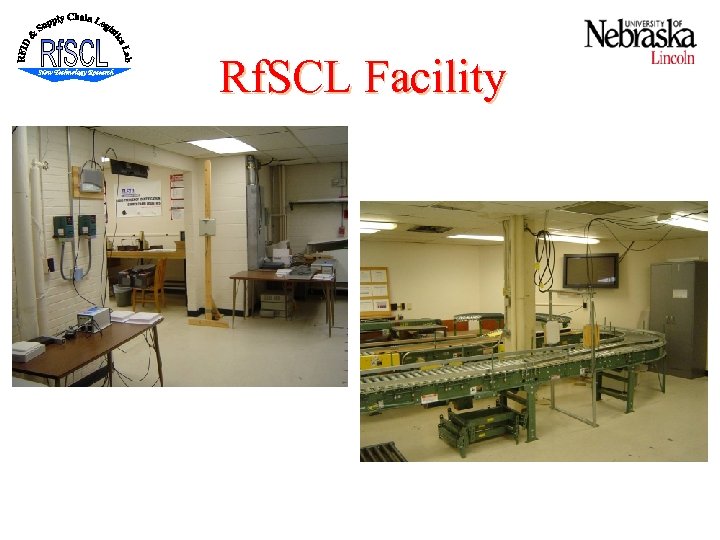 Rf. SCL Facility
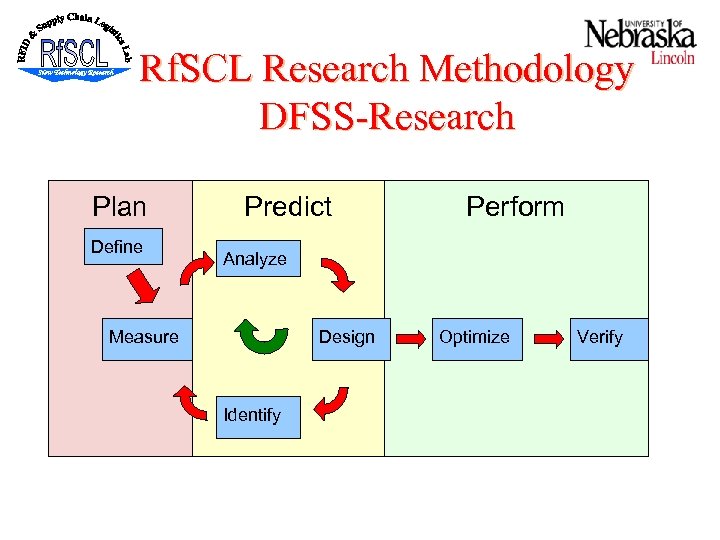 Rf. SCL Research Methodology DFSS-Research Plan Define Predict Perform Analyze Measure Design Identify Optimize Verify
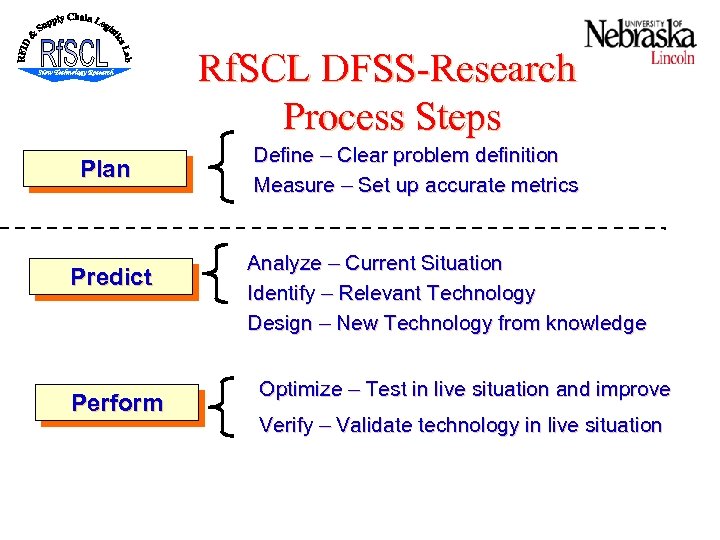 Rf. SCL DFSS-Research Process Steps Plan Predict Perform Define – Clear problem definition Measure – Set up accurate metrics Analyze – Current Situation Identify – Relevant Technology Design – New Technology from knowledge Optimize – Test in live situation and improve Verify – Validate technology in live situation
 Rf. SCL Multi Disciplinary Approach in RFID Research • Applied Research will be attracted to the lab if presented as unified Multi Disciplinary Team on RFID Research • RFID has 3 components • Data Acquisition (IE, CM, Ag. Eng) • Data Transmissions (EE, Communications) • Database Management (CIS, MIS) • A robust applied Research project will incorporate these three components which is best addressed using an multi Disciplinary Team
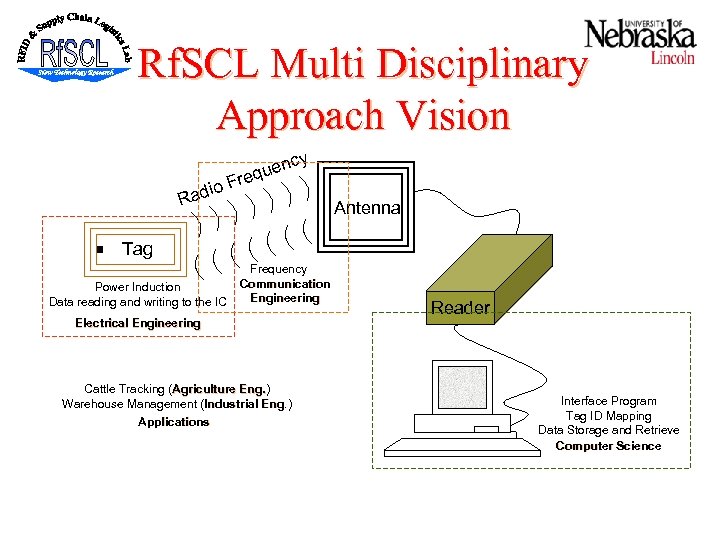 Rf. SCL Multi Disciplinary Approach Vision cy uen Freq adio R Antenna Tag Power Induction Data reading and writing to the IC Frequency Communication Engineering Electrical Engineering Cattle Tracking (Agriculture Eng. ) Agriculture Eng. Warehouse Management (Industrial Eng. ) Industrial Eng Applications Reader Interface Program Tag ID Mapping Data Storage and Retrieve Computer Science
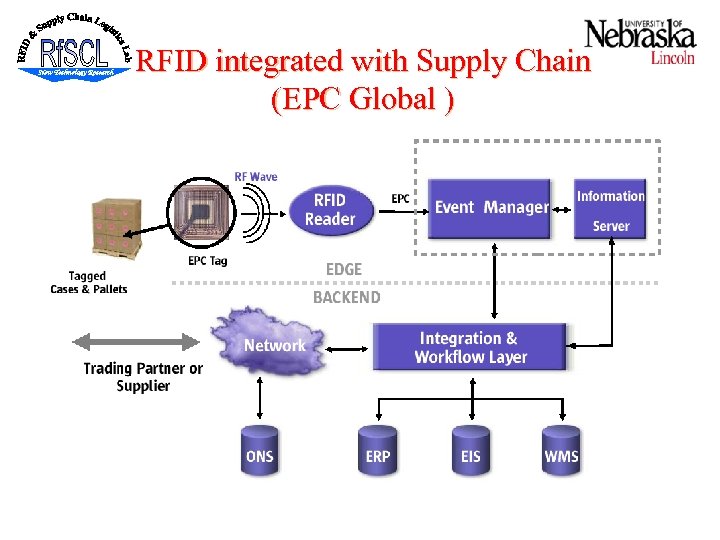 RFID integrated with Supply Chain (EPC Global )
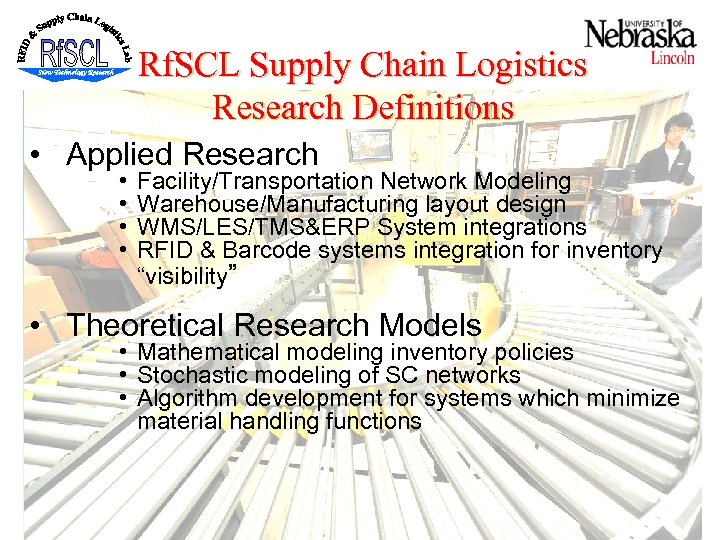 Rf. SCL Supply Chain Logistics Research Definitions • Applied Research • • Facility/Transportation Network Modeling Warehouse/Manufacturing layout design WMS/LES/TMS&ERP System integrations RFID & Barcode systems integration for inventory “visibility” • Theoretical Research Models • Mathematical modeling inventory policies • Stochastic modeling of SC networks • Algorithm development for systems which minimize material handling functions
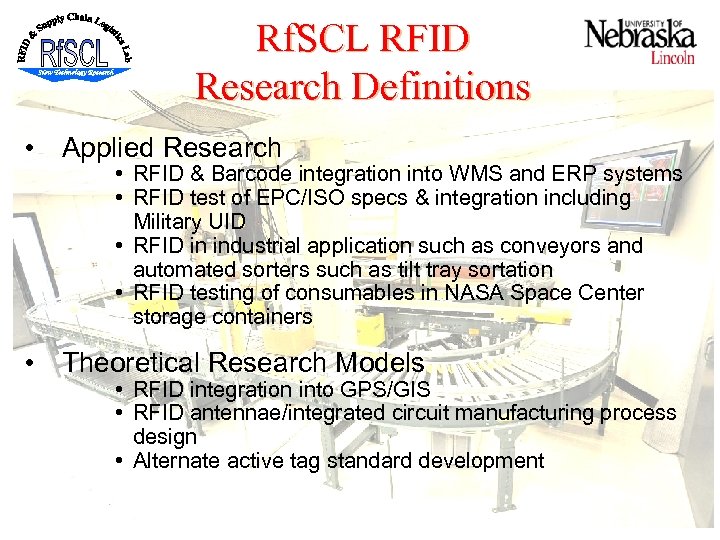 Rf. SCL RFID Research Definitions • Applied Research • RFID & Barcode integration into WMS and ERP systems • RFID test of EPC/ISO specs & integration including Military UID • RFID in industrial application such as conveyors and automated sorters such as tilt tray sortation • RFID testing of consumables in NASA Space Center storage containers • Theoretical Research Models • RFID integration into GPS/GIS • RFID antennae/integrated circuit manufacturing process design • Alternate active tag standard development
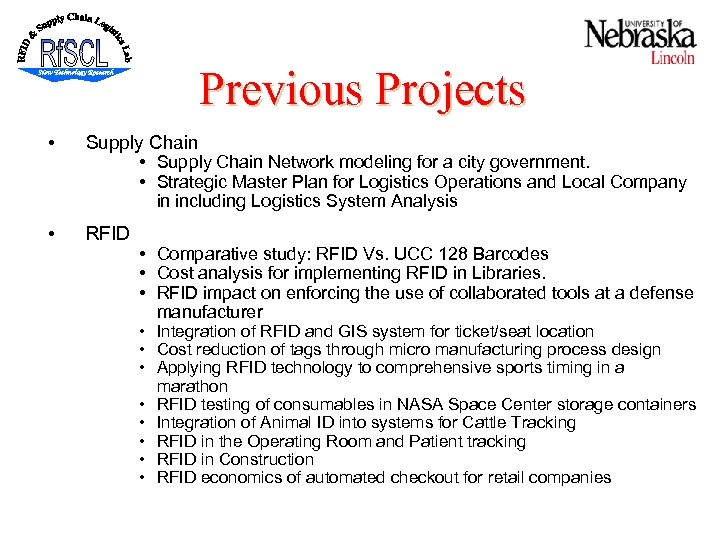 Previous Projects • Supply Chain • Supply Chain Network modeling for a city government. • Strategic Master Plan for Logistics Operations and Local Company in including Logistics System Analysis • RFID • Comparative study: RFID Vs. UCC 128 Barcodes • Cost analysis for implementing RFID in Libraries. • RFID impact on enforcing the use of collaborated tools at a defense manufacturer • Integration of RFID and GIS system for ticket/seat location • Cost reduction of tags through micro manufacturing process design • Applying RFID technology to comprehensive sports timing in a marathon • RFID testing of consumables in NASA Space Center storage containers • Integration of Animal ID into systems for Cattle Tracking • RFID in the Operating Room and Patient tracking • RFID in Construction • RFID economics of automated checkout for retail companies
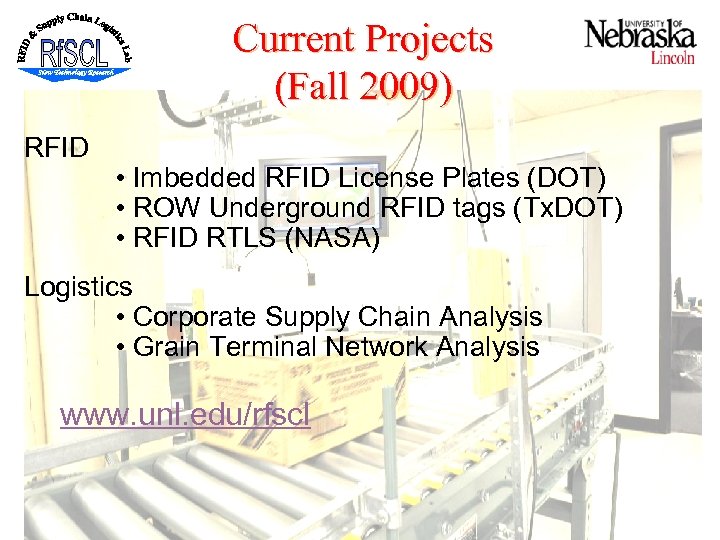 Current Projects (Fall 2009) RFID • Imbedded RFID License Plates (DOT) • ROW Underground RFID tags (Tx. DOT) • RFID RTLS (NASA) Logistics • Corporate Supply Chain Analysis • Grain Terminal Network Analysis www. unl. edu/rfscl
 RFID Overview
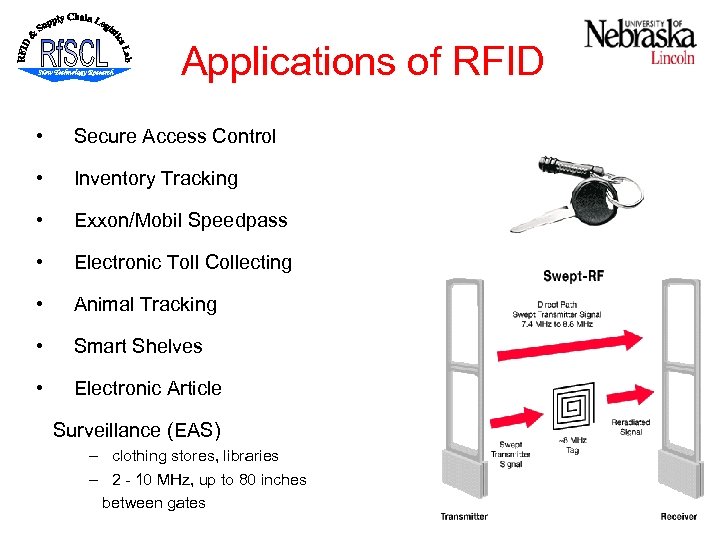 Applications of RFID • Secure Access Control • Inventory Tracking • Exxon/Mobil Speedpass • Electronic Toll Collecting • Animal Tracking • Smart Shelves • Electronic Article Surveillance (EAS) – clothing stores, libraries – 2 - 10 MHz, up to 80 inches between gates
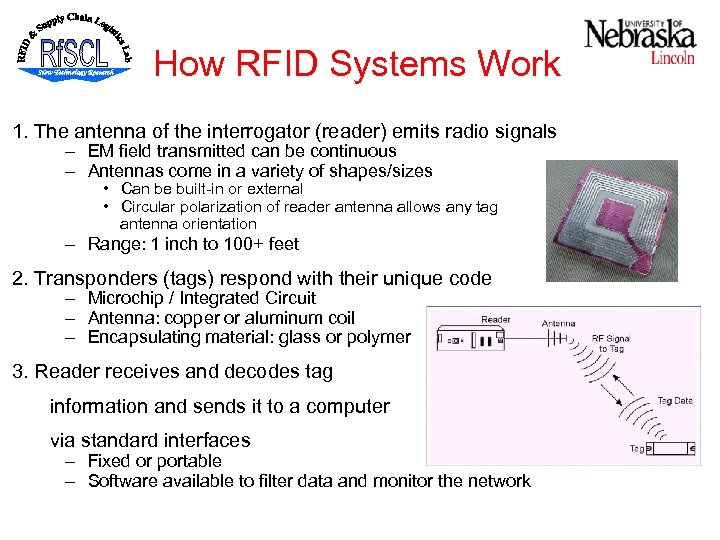 How RFID Systems Work 1. The antenna of the interrogator (reader) emits radio signals – EM field transmitted can be continuous – Antennas come in a variety of shapes/sizes • Can be built-in or external • Circular polarization of reader antenna allows any tag antenna orientation – Range: 1 inch to 100+ feet 2. Transponders (tags) respond with their unique code – Microchip / Integrated Circuit – Antenna: copper or aluminum coil – Encapsulating material: glass or polymer 3. Reader receives and decodes tag information and sends it to a computer via standard interfaces – Fixed or portable – Software available to filter data and monitor the network
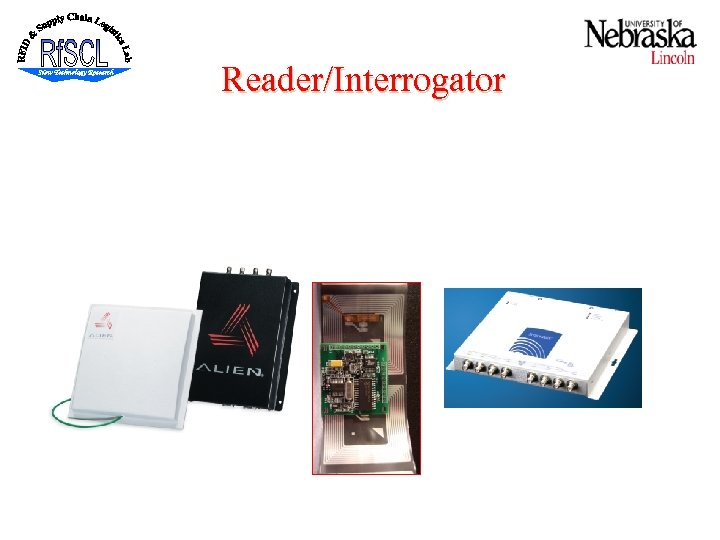 Reader/Interrogator
 Reader • A device that captures and processes tag data then passes the digital data to a computer system • Readers are also known as: • Reader function: – Interrogators – Reader/Writers – Couplers – – – supply power to passive and semi-active tags provide command data to tags capture returned tag signals and process into a digital bit stream output data to another output device or to a computer system write data to the tag
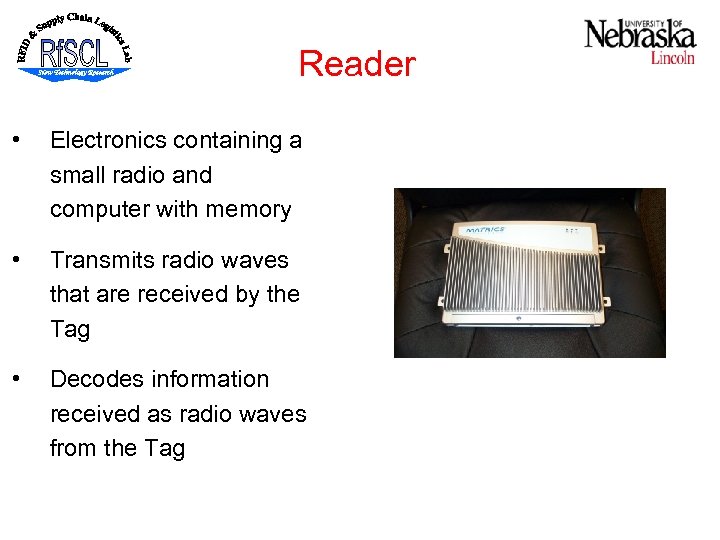 Reader • Electronics containing a small radio and computer with memory • Transmits radio waves that are received by the Tag • Decodes information received as radio waves from the Tag
 Reader In operation, the reader has a very simple purpose: read the tag(s) in its field and pass appropriate data to a host • A reader passes the following information to a host: – – Tag ID Timestamp Antenna ID Reader ID • Data is output from the reader by various interface methods • The host software receiving the reader data makes decisions on what data is logged into the supply chain enterprise software
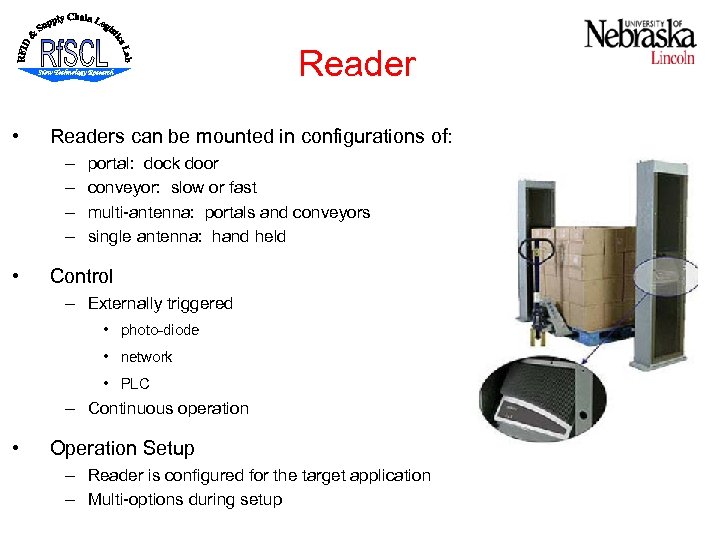 Reader • Readers can be mounted in configurations of: – – • portal: dock door conveyor: slow or fast multi-antenna: portals and conveyors single antenna: hand held Control – Externally triggered • photo-diode • network • PLC – Continuous operation • Operation Setup – Reader is configured for the target application – Multi-options during setup
 Reader In Summary: Readers are radio frequency devices that: • Transmit and Receive RF signals • Contain a control unit to execute commands • Incorporate an interface to transfer data • Another way to look at a reader other than its immediate functionality, is that a reader is a node on a network receiving, aggregating, filtering and transmitting data
 Antenna What is an Antenna? An antenna is a transducer that converts radio frequency electric current to electromagnetic waves that are then radiated into space. • An antenna is said to be vertically polarized (linear) when its electric field is perpendicular to the Earth's surface. An example of a vertical antenna is a broadcast tower for AM radio or the "whip" antenna on an automobile. • Horizontally polarized (linear) antennas have their electric field parallel to the Earth's surface. Television transmissions in the USA use horizontal polarization. – Passive RFID Tags are sensitive to polarization effects.
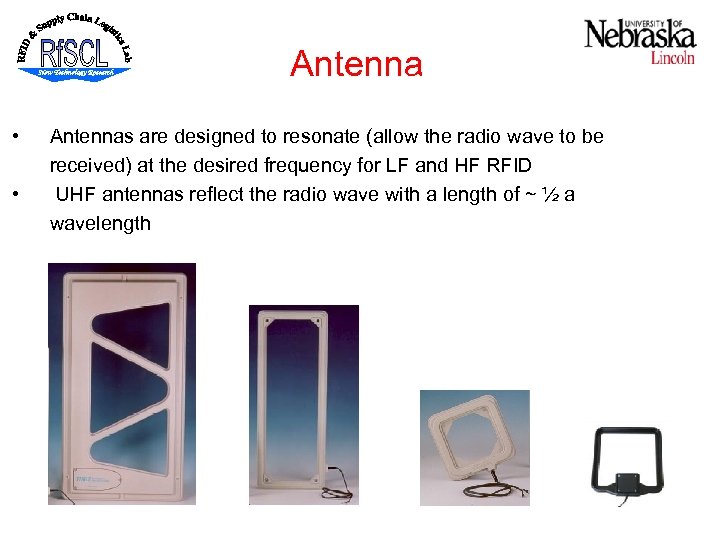 Antenna • • Antennas are designed to resonate (allow the radio wave to be received) at the desired frequency for LF and HF RFID UHF antennas reflect the radio wave with a length of ~ ½ a wavelength
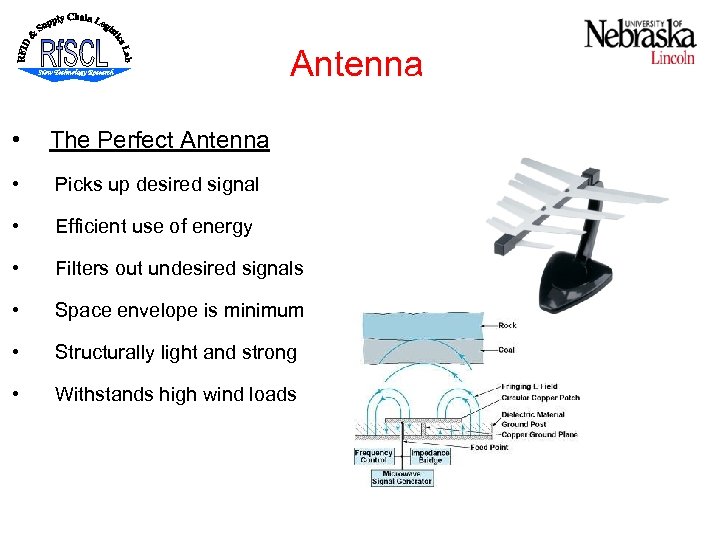 Antenna • The Perfect Antenna • Picks up desired signal • Efficient use of energy • Filters out undesired signals • Space envelope is minimum • Structurally light and strong • Withstands high wind loads
 Tags
Tags
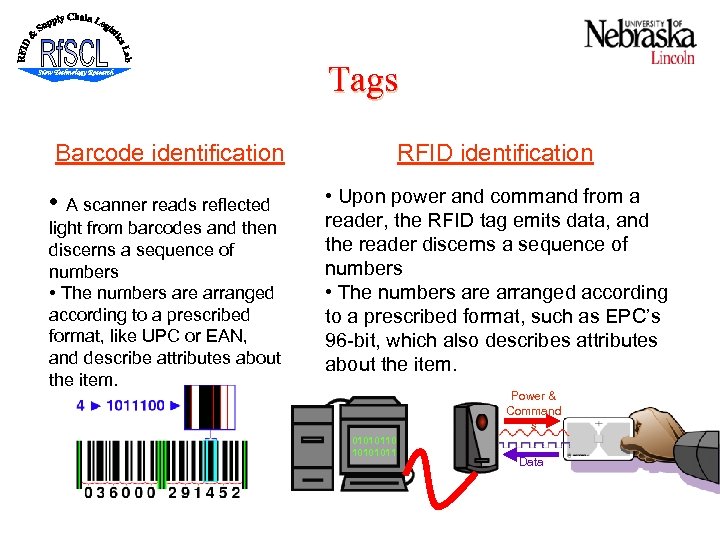 Tags Barcode identification • A scanner reads reflected light from barcodes and then discerns a sequence of numbers • The numbers are arranged according to a prescribed format, like UPC or EAN, and describe attributes about the item. RFID identification • Upon power and command from a reader, the RFID tag emits data, and the reader discerns a sequence of numbers • The numbers are arranged according to a prescribed format, such as EPC’s 96 -bit, which also describes attributes about the item. Power & Command s 01010110 10101011 Data
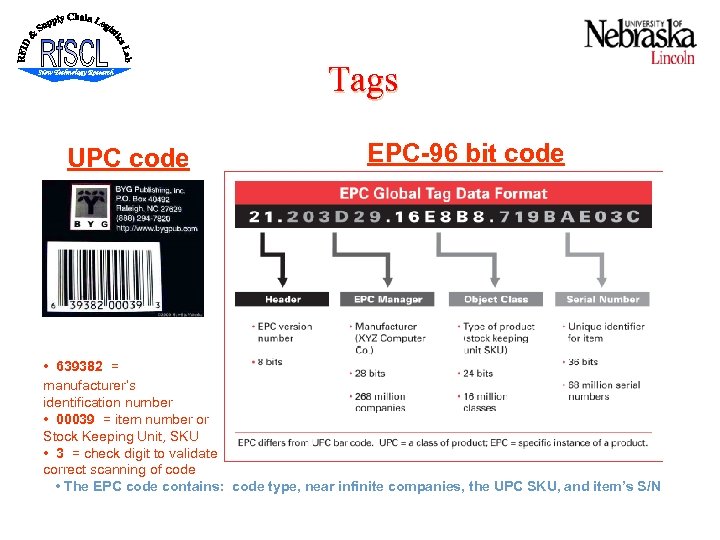 Tags UPC code EPC-96 bit code • 639382 = manufacturer’s identification number • 00039 = item number or Stock Keeping Unit, SKU • 3 = check digit to validate correct scanning of code • The EPC code contains: code type, near infinite companies, the UPC SKU, and item’s S/N
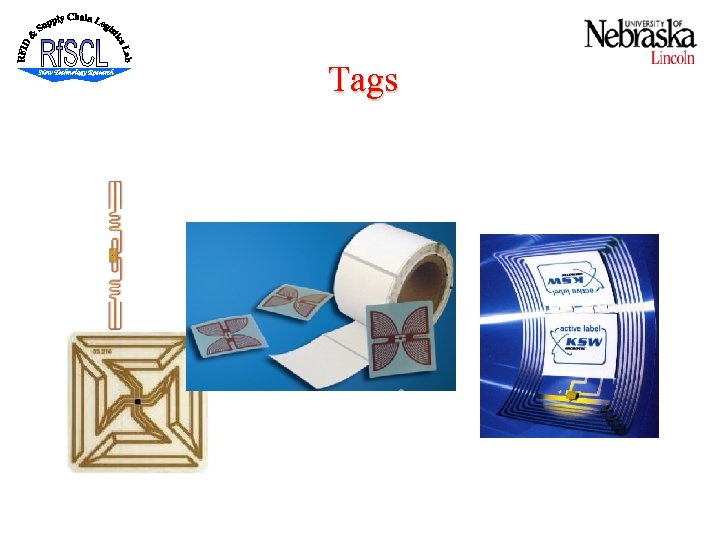
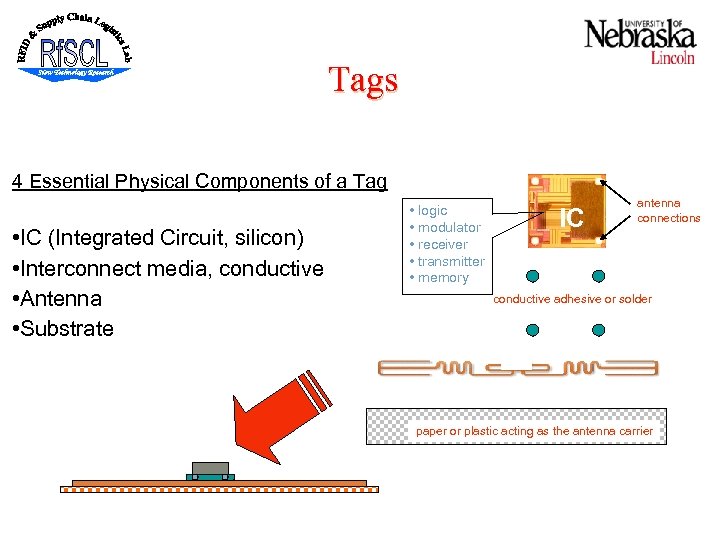 Tags 4 Essential Physical Components of a Tag • IC (Integrated Circuit, silicon) • Interconnect media, conductive • Antenna • Substrate • logic • modulator • receiver • transmitter • memory IC antenna connections conductive adhesive or solder paper or plastic acting as the antenna carrier
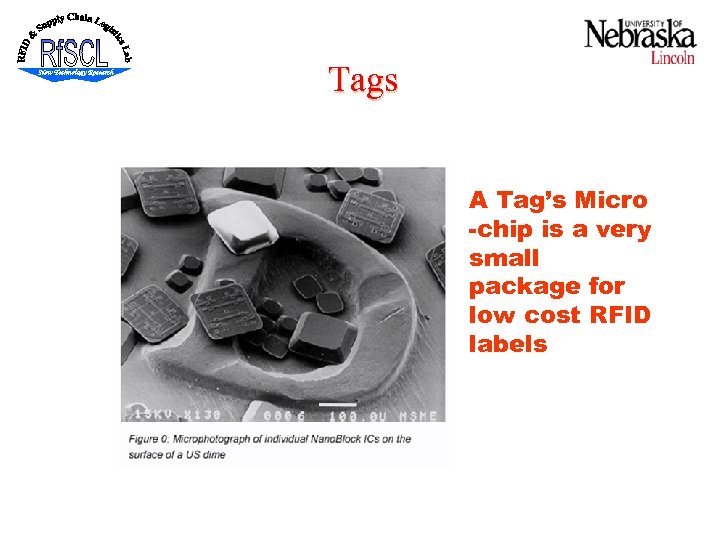 Tags A Tag’s Micro -chip is a very small package for low cost RFID labels
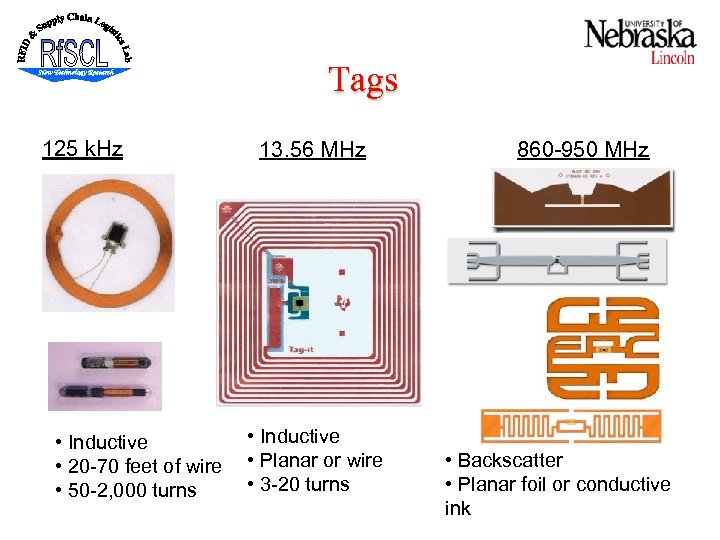 Tags 125 k. Hz • Inductive • 20 -70 feet of wire • 50 -2, 000 turns 13. 56 MHz • Inductive • Planar or wire • 3 -20 turns 860 -950 MHz • Backscatter • Planar foil or conductive ink
 Tags Tag Success Factors • Orientation vs. reader antenna type • Multi-path UHF signals: direct & reflected • Noisy environments: Electro-Magnetic Interference • Moving vs. static tags: time in antenna field Orientation and location of the tag on an item is critical to maximize success
 Tags 1. There are several different types of tags at many different frequencies 2. The two main differences in tags are their frequency and their type 3. These type differences are: – Passive: All power comes from reader – Semi Active: Battery assisted power for the IC operation – Active : Battery power assists IC & transmit power
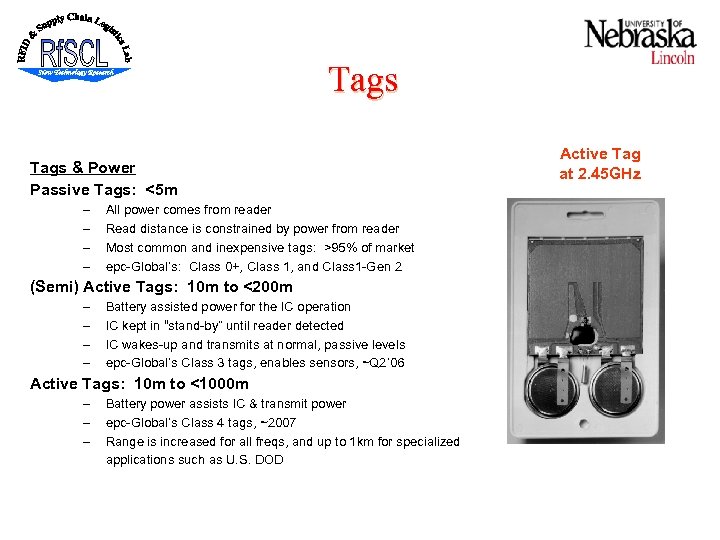 Tags & Power Passive Tags: <5 m – – All power comes from reader Read distance is constrained by power from reader Most common and inexpensive tags: >95% of market epc-Global’s: Class 0+, Class 1, and Class 1 -Gen 2 (Semi) Active Tags: 10 m to <200 m – – Battery assisted power for the IC operation IC kept in “stand-by” until reader detected IC wakes-up and transmits at normal, passive levels epc-Global’s Class 3 tags, enables sensors, ~Q 2’ 06 Active Tags: 10 m to <1000 m – – – Battery power assists IC & transmit power epc-Global’s Class 4 tags, ~2007 Range is increased for all freqs, and up to 1 km for specialized applications such as U. S. DOD Active Tag at 2. 45 GHz
 • • Active vs. Passive Tags Active Tags – – – Battery powered – would require periodic replacement/recharging Typically read/write, up to 1 MB of memory Greater range (30 meters possible with UHF) Limited operational life: depends on operating temp. and battery Ultra Wide Band (UWB) systems use time difference of arrival of transmitted pulses to triangulate position Passive Tags – – Powered by energy transmitted by reader Typically read only, 32 – several Kbytes of memory Virtually unlimited lifetime, lighter, smaller, and cheaper 13. 56 MHz tags powered by inductive coupling • EM field emitted by the reader creates a voltage drop in the coil • Tag modulates the signal (amplitude/frequency/phase) and sends its unique code back to the reader – UHF tags (915 MHz and 2. 45 GHz) powered by propagation coupling • Similar to 13. 56 MHz tags, but since signal travels greater distances, field strength decreases with distance (depends on tag orientation and other factors)
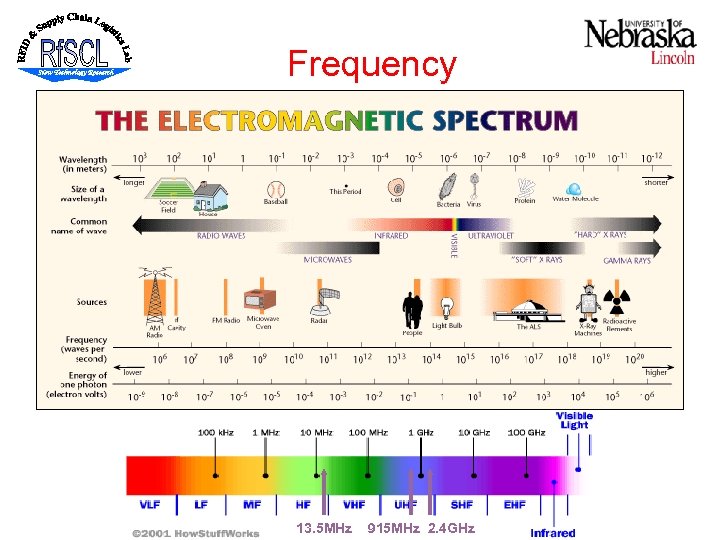 Frequency 13. 5 MHz 915 MHz 2. 4 GHz
 RFID Challenges • Lower Frequencies – Lower cost tags – Higher performance around metals and liquids • Higher Frequencies – More prone to reflection, refraction, and diffraction – High data transfer rate – Longer read ranges – Interference less of a problem with high frequencies • Frequency Hopping Spread Spectrum (FHSS) can be used to avoid interference • Common RFID Frequencies (ISM Band) – 13. 56 MHz • Range up to ~1. 5 m with credit card sized tag – 915 MHz • Typical range up to ~3 m – 2. 45 GHz • Typical Range up to ~5 m • BCR operates at this frequency
 RFID Challenges, cont. • Range – Longer range with larger antenna, higher power, frequency, and cost – Limited by environmental conditions and metal obstacles • Standards – ISO – some standards for some frequencies, e. g. ISO 15693 and ISO 18000 – EPC – Auto-ID Center's Electronic Product Code could replace the UPC as the standard for UHF; 64, 96, 128 bits of information is stored in a specified format, allowing for billions of unique serial numbers – Performance of ISO and EPC-compliant tags should be similar, but sticking to standards increases flexibility of technology in the future
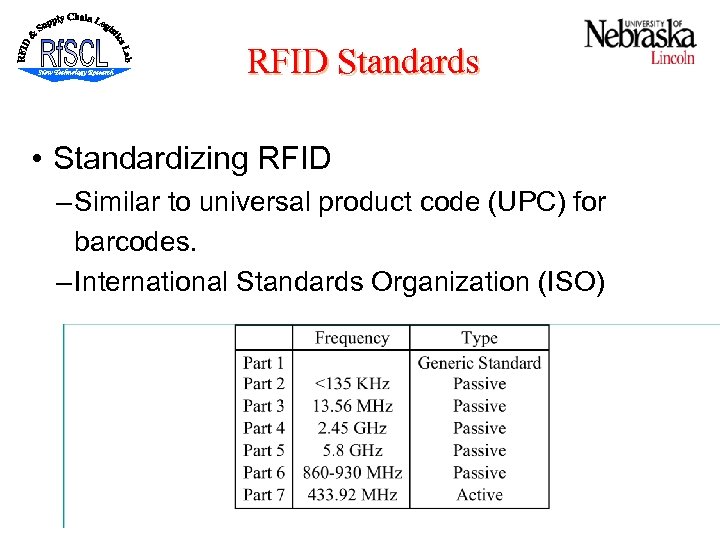 RFID Standards • Standardizing RFID – Similar to universal product code (UPC) for barcodes. – International Standards Organization (ISO)
 Questions? Announcements • RFID in Logistics is in publication • Currently working on book with CRC: Taylor Francis “RFID/AIT in Military Logistics” Erick C. Jones, Ph. D, PE, CSSBB Associate Professor Industrial and Management Systems Engineering University of Nebraska – Lincoln (402) 472 -3695, ejones 2@unl. edu