


 Скачать презентацию Reviving Continuum Mechanics Computation across the undergraduate curriculum
d9ecbe396504ba2310acd1d09f5dcd38.ppt
- Количество слайдов: 15
 Reviving Continuum Mechanics: Computation across the undergraduate curriculum Michael Dennin UC Irvine Special Thanks to Peter Taborek, Bill Heidbrink and Gary Chanan
 Two Cases This poster addresses two issues in the integration of numerical methods into the undergraduate curriculum. One is the integration into a particular course, in this case Continuum Mechanics. The other is the integration into the overall curriculum. There are related issues for both of these problems.
 Continuum Mechanics Challenges facing the course • Lack of analytically solvable problems • Tedious amounts of algebra • Visualization often a problem • Modern techniques are dominated by numerical methods
 Continuum Mechanics Challenges specific to numerical methods • Choice of numerical method • Access to numerical techniques by students • Time devoted to teaching numerical method
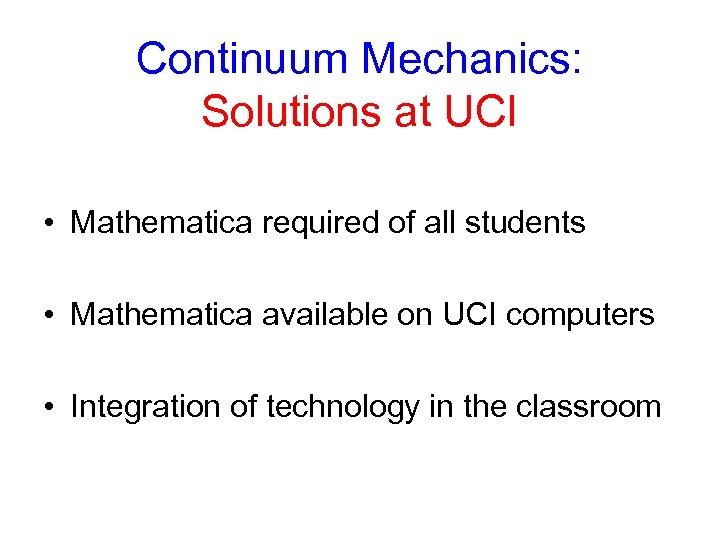 Continuum Mechanics: Solutions at UCI • Mathematica required of all students • Mathematica available on UCI computers • Integration of technology in the classroom
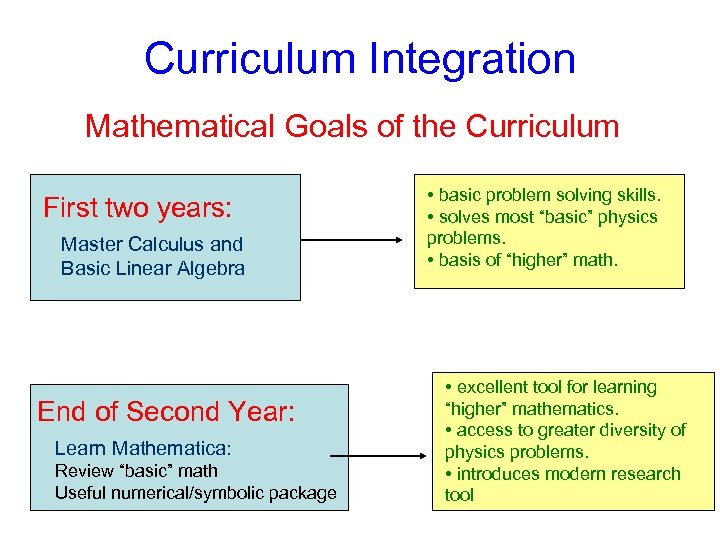 Curriculum Integration Mathematical Goals of the Curriculum First two years: Master Calculus and Basic Linear Algebra End of Second Year: Learn Mathematica: Review “basic” math Useful numerical/symbolic package • basic problem solving skills. • solves most “basic” physics problems. • basis of “higher” math. • excellent tool for learning “higher” mathematics. • access to greater diversity of physics problems. • introduces modern research tool
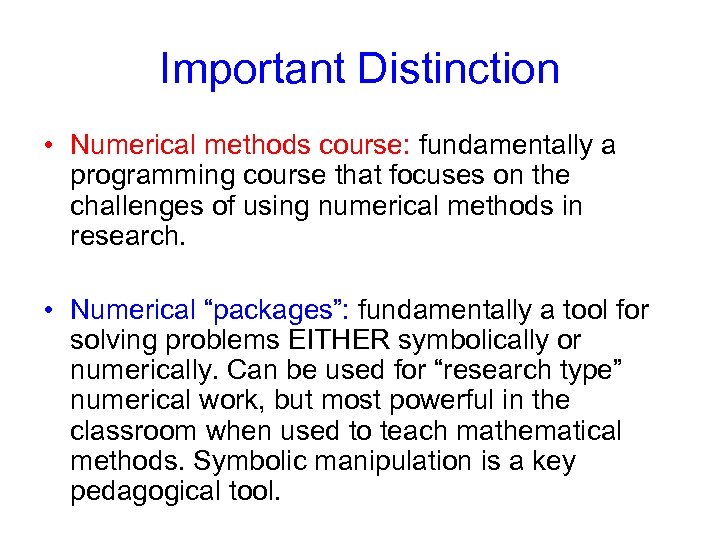 Important Distinction • Numerical methods course: fundamentally a programming course that focuses on the challenges of using numerical methods in research. • Numerical “packages”: fundamentally a tool for solving problems EITHER symbolically or numerically. Can be used for “research type” numerical work, but most powerful in the classroom when used to teach mathematical methods. Symbolic manipulation is a key pedagogical tool.
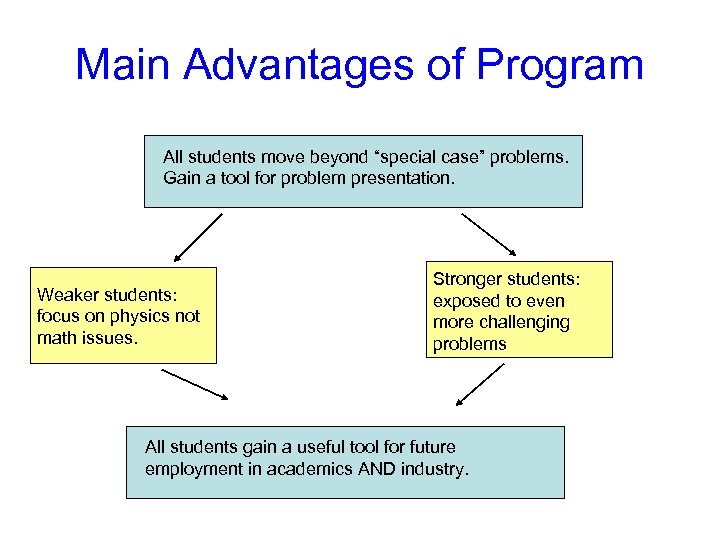 Main Advantages of Program All students move beyond “special case” problems. Gain a tool for problem presentation. Weaker students: focus on physics not math issues. Stronger students: exposed to even more challenging problems All students gain a useful tool for future employment in academics AND industry.
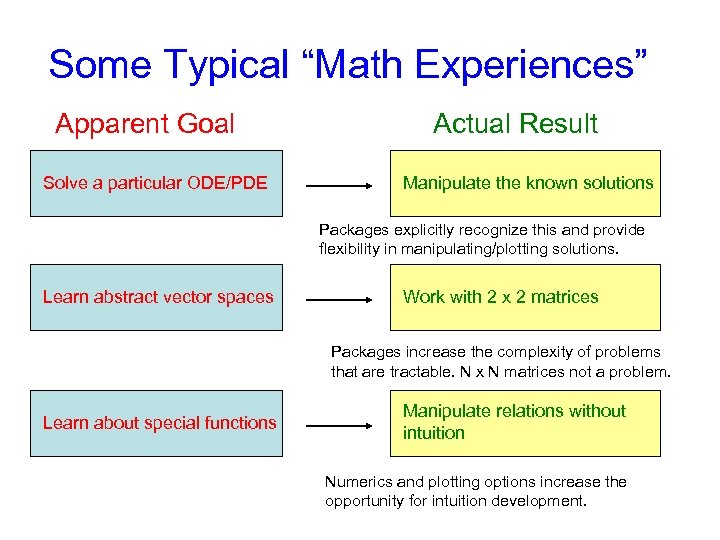 Some Typical “Math Experiences” Apparent Goal Solve a particular ODE/PDE Actual Result Manipulate the known solutions Packages explicitly recognize this and provide flexibility in manipulating/plotting solutions. Learn abstract vector spaces Work with 2 x 2 matrices Packages increase the complexity of problems that are tractable. N x N matrices not a problem. Learn about special functions Manipulate relations without intuition Numerics and plotting options increase the opportunity for intuition development.
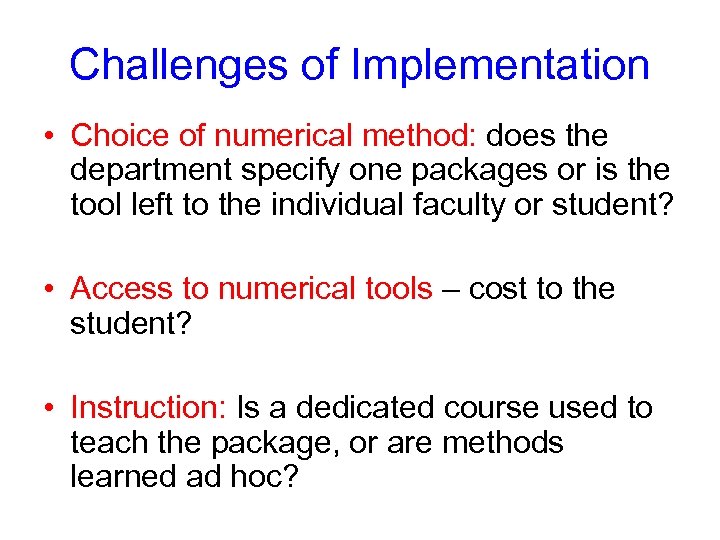 Challenges of Implementation • Choice of numerical method: does the department specify one packages or is the tool left to the individual faculty or student? • Access to numerical tools – cost to the student? • Instruction: Is a dedicated course used to teach the package, or are methods learned ad hoc?
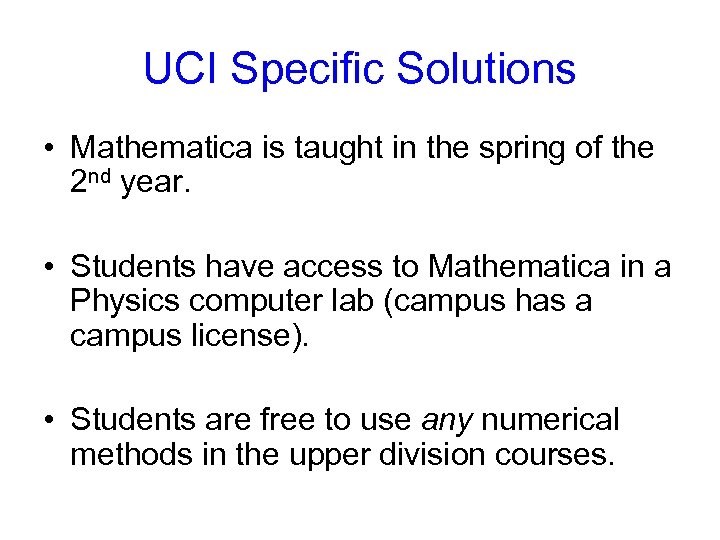 UCI Specific Solutions • Mathematica is taught in the spring of the 2 nd year. • Students have access to Mathematica in a Physics computer lab (campus has a campus license). • Students are free to use any numerical methods in the upper division courses.
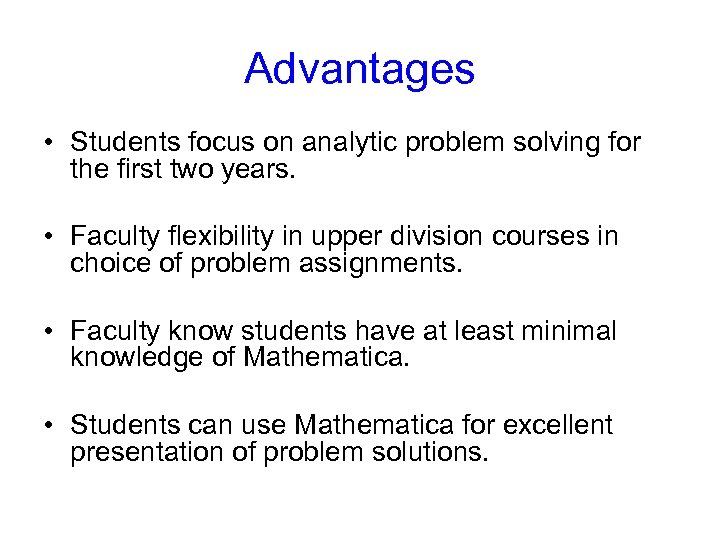 Advantages • Students focus on analytic problem solving for the first two years. • Faculty flexibility in upper division courses in choice of problem assignments. • Faculty know students have at least minimal knowledge of Mathematica. • Students can use Mathematica for excellent presentation of problem solutions.
 Disadvantages • No numerical work in first year, but many introductory concepts are ideal for simple numerical implementation. • Some students rely too heavily on Mathematica for “simple” manipulations. • Too many faculty do not assign numerical problems because “they do not know Mathematica. ”
 Example Student Solution
 Summary • Current state at UCI is anecdotal – we need good research. For example, is it necessary to make plots by hand first to have an understanding of plotting? Can students learned certain mathematical concepts better with symbolic manipulation packages? • Numerical methods are an integral part of physics research, and they need to be taught. It is useful to combine teaching numerical methods as a “research tool” with using it as a pedagogical aid across the curriculum. • Useful resources help with faculty buy in – at UCI, Peter Taborek has published a Mathematica Handbook: http: //mathematicahandbook. com/