


 Скачать презентацию Revisions to Regulation C Home Mortgage Disclosure
0c4c55197b3546fc93ffac10bfd2515f.ppt
- Количество слайдов: 78
 Revisions to Regulation C (Home Mortgage Disclosure)
 AGENDA HMDA – Background & Purpose The Review – Goals & Process The Review – What’s New and Why Transition Rules – 2003 2004 Census 2000 FAQs & Answers Sources of Information Questions? 2
 BACKGROUND & PURPOSE § HMDA data can be used to: § help determine whether institutions are meeting the housing credit needs of their communities § identify possible discriminatory lending patterns and help enforce antidiscrimination laws § help public officials target investments to attract private investment to areas where it is needed 3
 DATA REPORTED BY LENDERS MUST REPORT DATA ABOUT: § EACH APPLICATION OR LOAN § Application date, action taken and date of that action, loan amount, loan type and purpose, and, if the loan is sold, type of purchaser § EACH APPLICANT OR BORROWER § Ethnicity, race, sex, and income § EACH PROPERTY § Location and occupancy status 4
 THE REVIEW : GOALS § Respond to technological and other changes in the mortgage market § Improve quality and utility of data § Minimize undue lender burden § Clarify and simplify the rule 5
 THE REVIEW: PROCESS § Effective date: delayed until January 1, 2004 § Exceptions: telephone applications rule and 2000 Census information, which took effect January 1, 2003 6
 THE REVIEW: WHAT’S NEW & WHY 7
 WHAT’S NEW § Broader coverage: $25 million loan volume test for nondepositories added to current loan percentage test § Why? Ensures coverage of companies “in the business of mortgage lending” that also have large volumes of non-mortgage lending 8
 WHAT’S NEW § Preapprovals § Manufactured Homes § Revised definitions § Home improvement loans § Refinancings 9
 WHAT’S NEW § New racial & ethnic designations § Requirement to ask applicants about their race and national origin in telephone applications (as of January 1, 2003) 10
 WHAT’S NEW § Loan Pricing Information: § Rate Spread § HOEPA Status § Lien Status 11
 Preapprovals A request for preapproval is an application for credit if there is a. . . § Program § Comprehensive analysis of creditworthiness of applicant § Written commitment to lend § Specific amount § Specific time period § Limited conditions 12
 Preapprovals § Report home purchase loans only § Report originations that began as preapproval requests § Report denials of preapproval requests § Optional: report requests that were approved but not accepted § Do not report requests that were withdrawn or incomplete 13
 Preapprovals WHY CAPTURE PREAPPROVALS? § HMDA requires data on “applications” § Preapproval as defined = application § Use of preapprovals growing since early 1990 s § Reflects change in mortgage market 14
 Manufactured Homes WHAT’S NEW? § Lenders must identify applications for loans to purchase manufactured homes § Use HUD standard: ready for occupancy at factory (can include modular homes) § Make reasonable efforts § Report 1 - to 4 -family when unable to determine through reasonable efforts 15
 Manufactured Homes WHY? § Identifying loans involving manufactured homes will help explain higher denial rates and prices 16
 Refinancing What’s new? § New definition for reporting purposes Why? § Clearer definition yields more consistent and reliable data 17
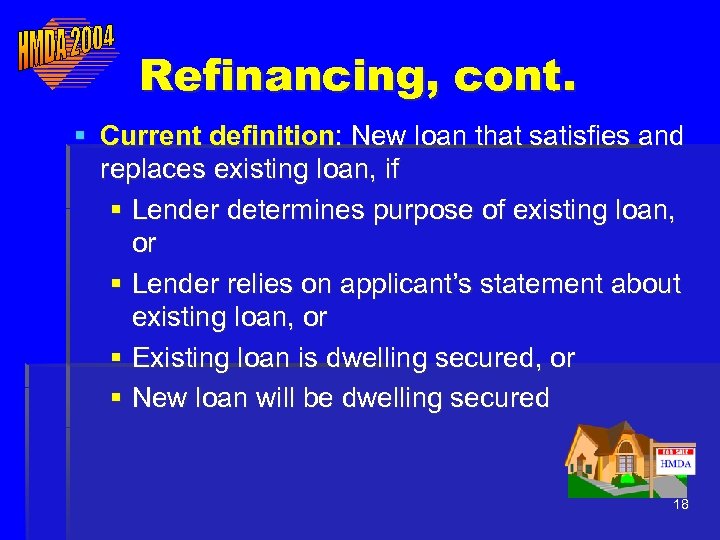 Refinancing, cont. § Current definition: New loan that satisfies and replaces existing loan, if § Lender determines purpose of existing loan, or § Lender relies on applicant’s statement about existing loan, or § Existing loan is dwelling secured, or § New loan will be dwelling secured 18
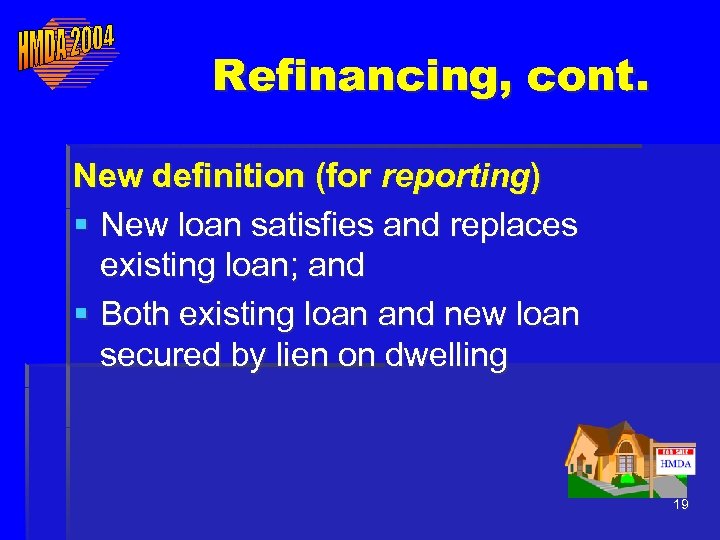 Refinancing, cont. New definition (for reporting) § New loan satisfies and replaces existing loan; and § Both existing loan and new loan secured by lien on dwelling 19
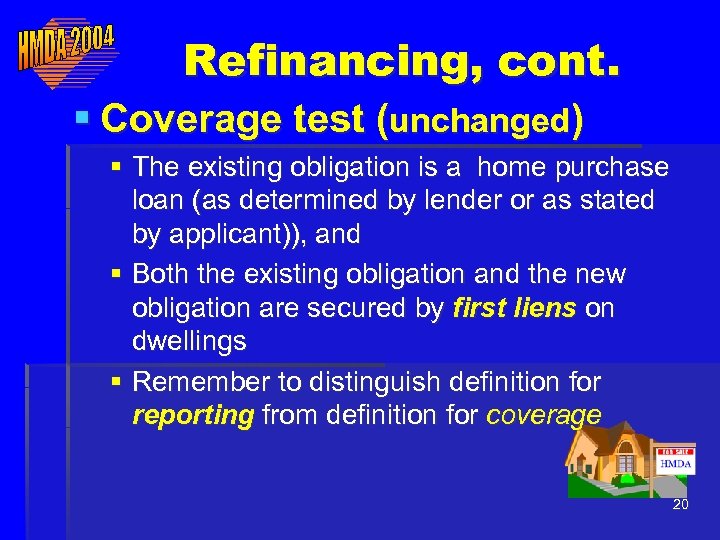 Refinancing, cont. § Coverage test (unchanged) § The existing obligation is a home purchase loan (as determined by lender or as stated by applicant)), and § Both the existing obligation and the new obligation are secured by first liens on dwellings § Remember to distinguish definition for reporting from definition for coverage 20
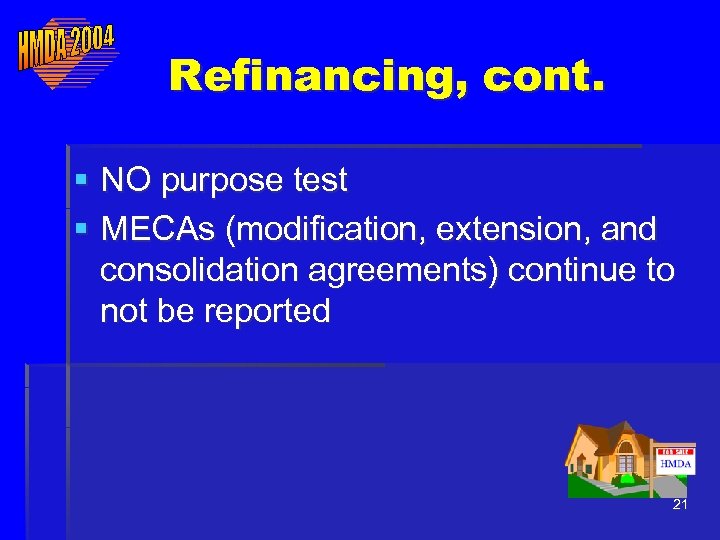 Refinancing, cont. § NO purpose test § MECAs (modification, extension, and consolidation agreements) continue to not be reported 21
 Home Improvement § Current rule: report loan if § Any part of proceeds for home improvement and § Lender classifies loan as home improvement § For unsecured, continue to use current rule (purpose plus classification) 22
 Home Improvement WHAT’S NEW? § New definition for dwelling-secured loans § Report as home improvement loan if any part of proceeds will be used for home improvement WHY? § A clearer definition yields better data 23
 HELOCs § Reporting HELOCs is optional (but be consistent) § HELOCs may be for home purchase or home improvement § Report only amount of line used for HMDA purpose 24
 MULTIPLE PURPOSE LOANS What if ? ? • A borrower refinances, uses cash out to improve home and buy vacation home? • Report as home purchase • The same borrower uses a HELOC to achieve her goals? • Reporting is optional 25
 MULTIPLE PURPOSE LOANS Priorities: § Home purchase trumps home improvement and refinancing § Home improvement trumps refinancing § HELOC trumps all--reporting is optional 26
 ETHNICITY and RACE What’s new? § Applicants will be asked to report race and ethnicity § Applicants may report more than one race § No “other” category Why? § Conform to 1997 OMB guidance 27
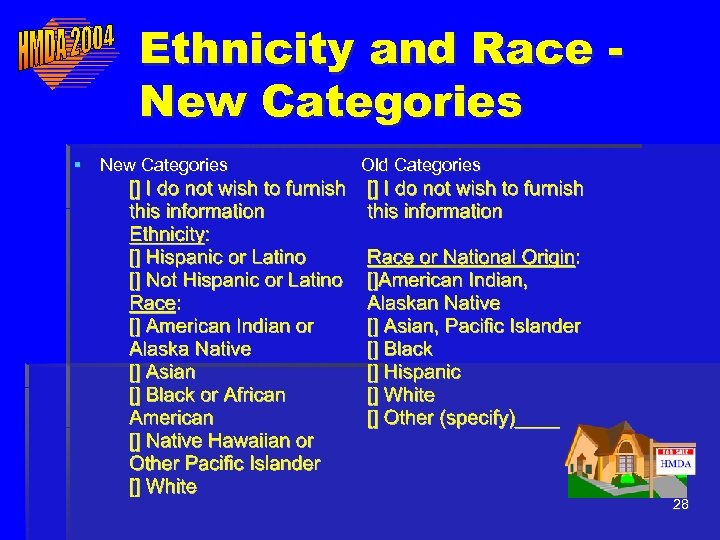 Ethnicity and Race New Categories § New Categories Old Categories 28
 NATIONAL ORIGIN and RACE § Lenders must request information in all applications (mail, telephone, and Internet) § Lenders may not require applicants to provide information § If applicant declines to provide information in a face-to-face application, lenders must identify applicants by visual observation or surname 29
 NATIONAL ORIGIN and RACE § If applicant declines to provide information (by mail, phone, or Internet), do not attempt to identify § Use code 7 (codes 3 & 6 as of January 1, 2004) 30
 True or False ? § Applicant must provide both ethnicity and race. False § If applicant declines to provide data in non-face -to-face, you must collect at closing. False § Telephone joint applicants: you must ask coapplicant. False (Applicant may answer for co-applicant) 31
 ETHNICITY and RACE Sources of information (OMB Website www. whitehouse. gov/omb/fedreg/directive_15. html ) § OMB definitions of race designations § OMB guidance on using data for civil rights enforcement § OMB guidance on using data for trend analysis 32
 OMB Guidance Ø American Indian or Alaska Native. A person having origins in any of the original peoples of North or South America (including Central America), and who maintains tribal affiliation or community attachment. Ø Asian. A person having origins in any of the original peoples of the Far East, Southeast Asia, or the Indian subcontinent including, for example, Cambodia, China, India, Japan, Korea, Malaysia, Pakistan, the Philippine Islands, Thailand, and Vietnam. 33
 OMB Guidance Ø Black or African American. A person having origins in any of the black racial groups of Africa. Terms such as “Haitian” or “Negro” can be used in addition to “Black or African American. ” Ø Native Hawaiian or Other Pacific Islander. person having origins in any of the original peoples of Hawaii, Guam, Samoa, or other Pacific Islands. A Ø White. A person having origins in any of the original peoples of Europe, the Middle East, or North Africa. 34
 OMB Guidance Ø Hispanic or Latino. A person of Cuban, Mexican, Puerto Rican, South or Central American, or other Spanish culture or origin, regardless of race. The term “Spanish origin” can be used in addition to “Hispanic or Latino. ” 35
 Rate Spread What’s new? § Pricing data on mortgage loans Why? Information is critical to § Address fair lending concerns related to loan pricing, and § Better understand the mortgage market, especially the subprime market 36
 Rate Spread, cont. § Report spread between APR and Treasury yield if equals/exceeds thresholds § First lien loans § Subordinate lien loans 3 percentage points 5 percentage points § Thresholds intended to exclude prime loans § If spread below threshold, use “NA” 37
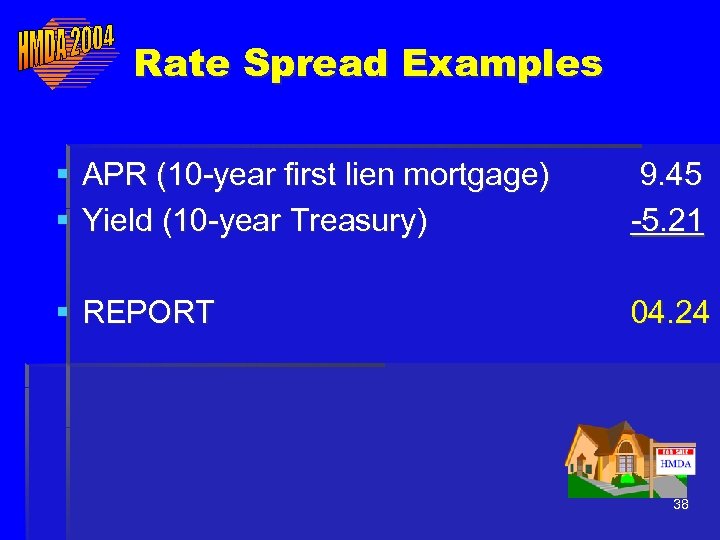 Rate Spread Examples § APR (10 -year first lien mortgage) § Yield (10 -year Treasury) 9. 45 -5. 21 § REPORT 04. 24 38
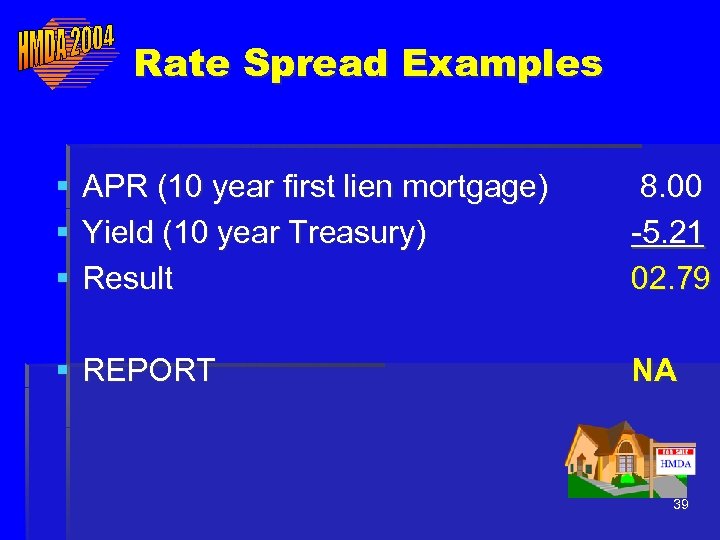 Rate Spread Examples § § § APR (10 year first lien mortgage) Yield (10 year Treasury) Result § REPORT 8. 00 -5. 21 02. 79 NA 39
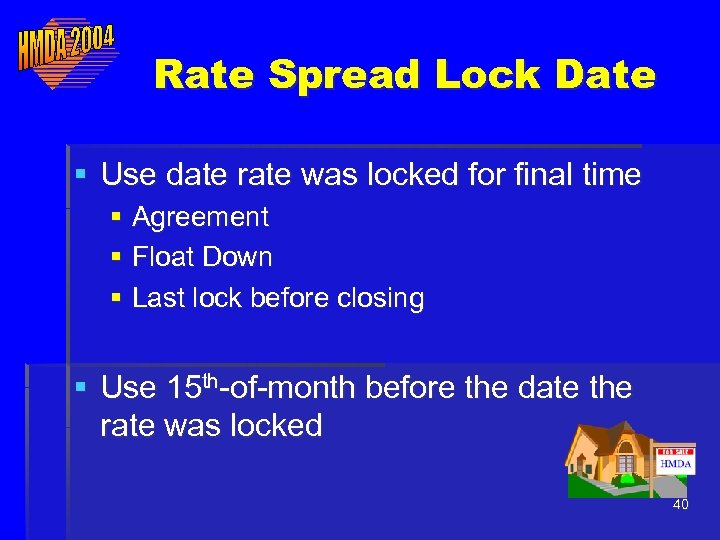 Rate Spread Lock Date § Use date rate was locked for final time § Agreement § Float Down § Last lock before closing § Use 15 th-of-month before the date the rate was locked 40
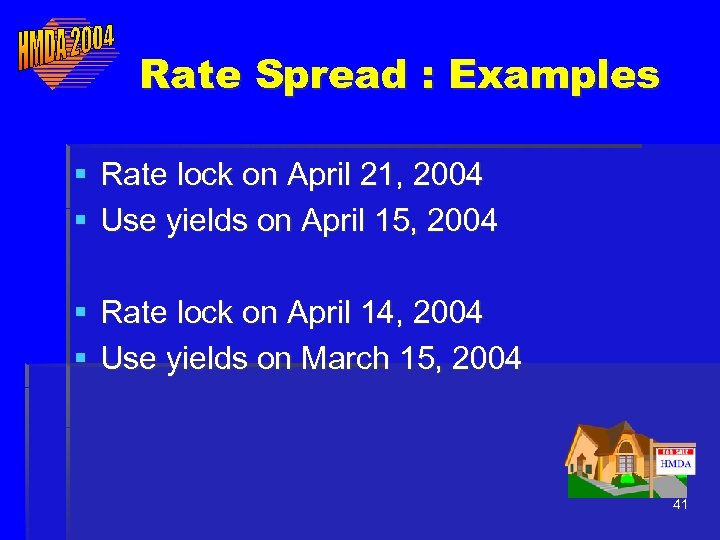 Rate Spread : Examples § Rate lock on April 21, 2004 § Use yields on April 15, 2004 § Rate lock on April 14, 2004 § Use yields on March 15, 2004 41
 Rate Spread : Treasury Securities § To calculate the rate spread, use Board’s calculator on FFIEC website 42
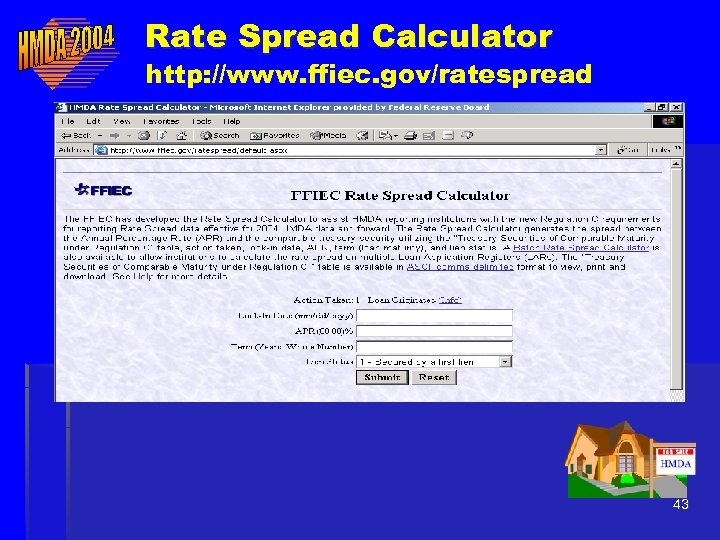 Rate Spread Calculator http: //www. ffiec. gov/ratespread 43
 Rate Spread – Treasury Yields http: /www. ffiec. gov/ratespread § Lenders must use the Treasury yields stated in the Board’s table, “Treasury Securities of Comparable Maturity under Regulation C”. § To find the yield, identify the relevant date in the left-hand column (the 15 th of the month before the date the rate was set for the final time) and follow the row to the yield corresponding to the term of the loan. 44
 Rate Spread § Report “NA” for § purchased loans § unsecured home improvement loans § loans not subject to Regulation Z 45
 Rate Spread : Loan Term § Use only whole numbers for loan term § ARMs: use loan term, not rate period 46
 HOEPA Status : APR Trigger § HOEPA triggers: APR or “points and fees” § 1 st lien loan, APR at consummation exceeds yield on comparable Treasury by 8 percentage points § or § 2 nd lien loan, APR at consummation exceeds yield on comparable Treasury by 10 percentage points--OR 47
 HOEPA Status : Points and Fees Trigger § “Points and fees” trigger § Points and fees exceed greater of 8 percent of “loan amount” or $488 (for 2003) § The dollar figure is adjusted annually by the Board in November or December 48
 HOEPA Status § Report only for originations and purchased loans § Report only for loans subject to Regulation Z § Remember: HOEPA does not apply to residential mortgage transactions 49
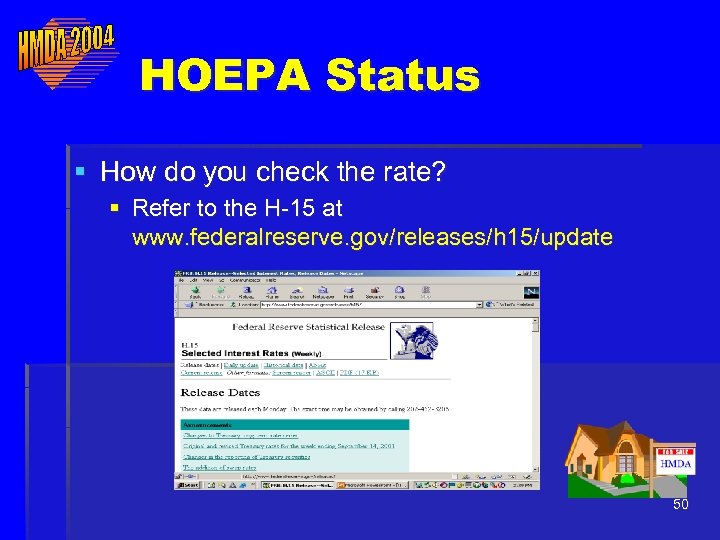 HOEPA Status § How do you check the rate? § Refer to the H-15 at www. federalreserve. gov/releases/h 15/update 50
 HOEPA Status § How do you determine which date to use? § Use the 15 th of the month before the month in which the application was received § Examples: Date of Application April 21, 2004 April 14, 2004 April 15, 2004 Date of Treasury Security March 15, 2004 51
 Lien Status WHAT’S NEW? § Report as first lien, subordinate lien, or unsecured § Report for all loans or applications (except purchases) § Use best information readily available at time of final action 52
 Lien Status, cont. Why? § Information may help explain pricing discrepancies because interest rates (and thus APRs) vary according to lien status 53
 Transition Rules Why? The transition rules … § Reduce burden to “look back” § Apply to applications received in 2003 with final action taken in 2004 § Provide flexibility for information captured at application § Require collection of information captured at final action in 2004 54
 Transition Rules Requests for preapproval § Lenders need not report whether an application taken in 2003 involved a request for preapproval Manufactured housing § Lenders need not report whether an application taken in 2003 involved a manufactured home 55
 Transition Rules Definitions of “home improvement loan” and “refinancing” § Lenders may – at their option– apply the current definitions to applications taken in 2003 with final action taken in 2004 56
 Transition Rules § Lenders will not be required to report the rate spread for loans in which the lock date occurs before January 1, 2004 WHY? § Staff considered using application or consummation date § But rate lock date provides most accurate information 57
 No Transition Rules § If loan closes in 2004, lender must report § HOEPA status § Lien status § Purchaser type WHY? § Information about these items is available at the time of final action – in 2004 58
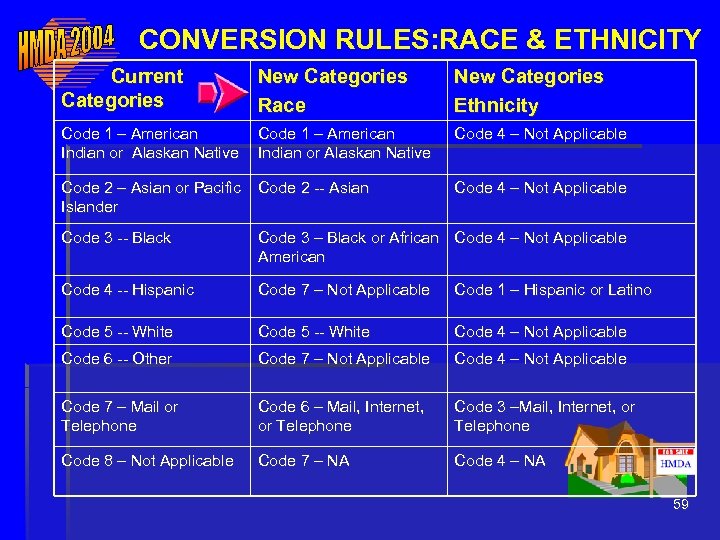 CONVERSION RULES: RACE & ETHNICITY Current Categories New Categories Race New Categories Ethnicity Code 1 – American Indian or Alaskan Native Code 4 – Not Applicable Code 2 – Asian or Pacific Islander Code 2 -- Asian Code 4 – Not Applicable Code 3 -- Black Code 3 – Black or African Code 4 – Not Applicable American Code 4 -- Hispanic Code 7 – Not Applicable Code 1 – Hispanic or Latino Code 5 -- White Code 4 – Not Applicable Code 6 -- Other Code 7 – Not Applicable Code 4 – Not Applicable Code 7 – Mail or Telephone Code 6 – Mail, Internet, or Telephone Code 3 –Mail, Internet, or Telephone Code 8 – Not Applicable Code 7 – NA Code 4 – NA 59
 CENSUS 2000 § Lenders must use census tract numbers and corresponding geographic areas from the 2000 Census for all applications and loans recorded on their 2003 LAR 60
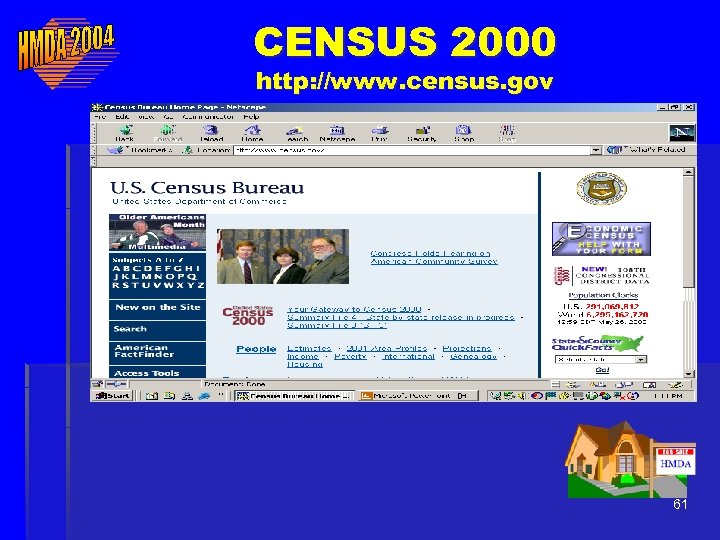 CENSUS 2000 http: //www. census. gov 61
 FAQs & ANSWERS Q. If an applicant declines to provide information about race, ethnicity, or sex in an application taken entirely by telephone, Internet, or mail, should the lender provide the information – for example, based on the applicant’s surname? 62
 FAQs & ANSWERS A. NO. If an applicant declines to provide the information, the lender must use the code for “information not provided in mail, Internet, or telephone application. ” 63
 FAQs & ANSWERS Q. If an applicant declines to provide information about race, ethnicity, or sex in an application taken entirely by telephone, Internet, or mail, and the lender approves the application, may the lender request the information at closing? 64
 FAQs & ANSWERS A. The lender may but need not request the information at closing. If the lender requests the information at closing for some applicants, the lender must request it at closing for all applicants. 65
 FAQs & ANSWERS Q. May a lender use the revised race and ethnicity categories to collect monitoring information before January 1, 2004? 66
 FAQs & ANSWERS A. No. Lenders must not use the revised race and ethnicity categories to collect monitoring information before January 1, 2004. 67
 FAQs & ANSWERS Q. May lenders use the old race and national origin categories on applications received after January 1, 2004? 68
 FAQs & ANSWERS A. No. But if a lender provides an application form with the old race and national origin categories to an applicant prior to January 1, 2004, and the applicant submits the application on that form in 2004, the lender may consider the application as having been received in 2003 so long as the application is dated “ 2003. ” 69
 FAQs & ANSWERS Q. May a lender report the rate spread on purchased loans? A. No. Enter “NA” in the rate spread column. 70
 FAQs & ANSWERS Q. If a lender chooses to report HELOCs, should the lender report the rate spread? A. No. Enter “NA” in the rate spread column. 71
 FAQs & ANSWERS Q. How should a lender report a dwellingsecured loan used to refinance an existing dwelling-secured loan and to make home improvements? 72
 FAQs & ANSWERS A. The lender should report the loan as a home improvement loan, even if it also meets the definition of a “refinancing. ” 73
 FAQs & ANSWERS Q. When the Board revised the reg and commentary, the comment on “MECAs” (modification, extension, and consolidation agreements) was not retained. Why? 74
 FAQs & ANSWERS A. Dropping the comment was inadvertent. The Board’s interpretation remains the same; MECAs are not refinancings under Regulation C. The comment will be restored the next time the commentary is updated. 75
 SOURCES OF INFORMATION § A Guide to HMDA Reporting--Getting it Right! (revised in 2003 and available online at http: //www. ffiec. gov/hmda/guide. htm 76
 SOURCES OF INFORMATION § FRB Division of Consumer and Community Affairs, (202) 452 -2412 or 3667 § Jane Gell, John Wood, Kathleen Ryan, Dan Sokolov 77
 SOURCES OF INFORMATION http: //www. stlouisfed. org/hmdaregcamendments A new web site to help you understand implement the latest changes to HMDA reporting. § The HMDA Regulation C Amendments web site provides timely and relevant information on the Regulation C changes. § Learn all about these critical changes and their effect on 2004 HMDA reporting. 78