 Скачать презентацию Revision to DOE proposal Resource Optimization in Hybrid
2b7eb447a5eed1b6f0730295924b8483.ppt
- Количество слайдов: 22



Revision to DOE proposal Resource Optimization in Hybrid Core Networks with 100 G Links Original submission: April 30, 2009 Date: May 4, 2009 PI: Malathi Veeraraghavan University of Virginia 1
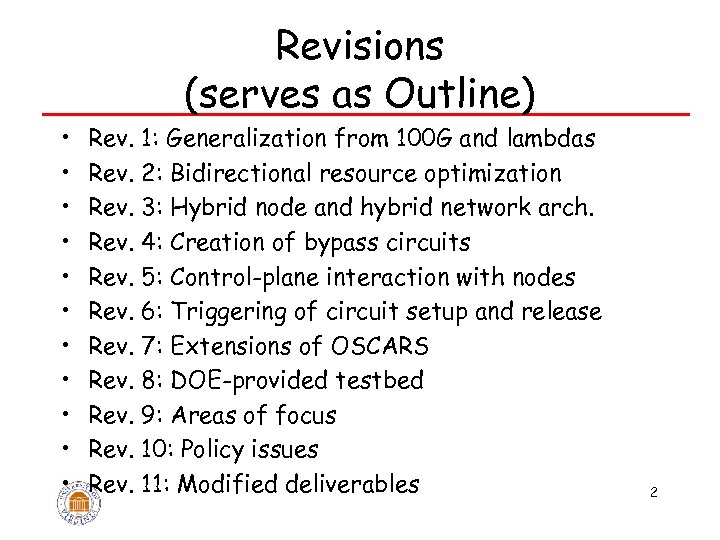
Revisions (serves as Outline) • • • Rev. 1: Generalization from 100 G and lambdas Rev. 2: Bidirectional resource optimization Rev. 3: Hybrid node and hybrid network arch. Rev. 4: Creation of bypass circuits Rev. 5: Control-plane interaction with nodes Rev. 6: Triggering of circuit setup and release Rev. 7: Extensions of OSCARS Rev. 8: DOE-provided testbed Rev. 9: Areas of focus Rev. 10: Policy issues Rev. 11: Modified deliverables 2
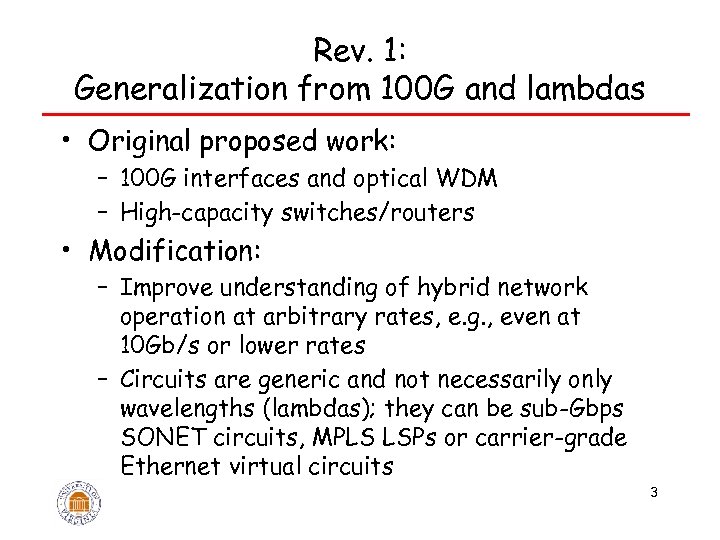
Rev. 1: Generalization from 100 G and lambdas • Original proposed work: – 100 G interfaces and optical WDM – High-capacity switches/routers • Modification: – Improve understanding of hybrid network operation at arbitrary rates, e. g. , even at 10 Gb/s or lower rates – Circuits are generic and not necessarily only wavelengths (lambdas); they can be sub-Gbps SONET circuits, MPLS LSPs or carrier-grade Ethernet virtual circuits 3
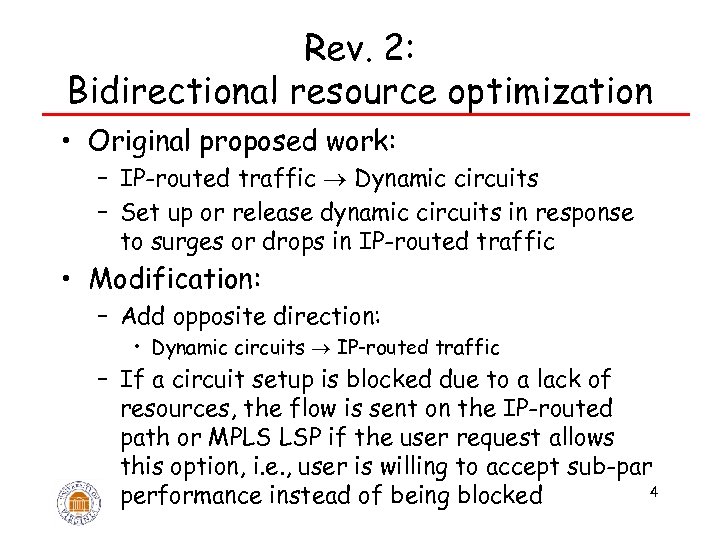
Rev. 2: Bidirectional resource optimization • Original proposed work: – IP-routed traffic Dynamic circuits – Set up or release dynamic circuits in response to surges or drops in IP-routed traffic • Modification: – Add opposite direction: • Dynamic circuits IP-routed traffic – If a circuit setup is blocked due to a lack of resources, the flow is sent on the IP-routed path or MPLS LSP if the user request allows this option, i. e. , user is willing to accept sub-par 4 performance instead of being blocked
Rev. 3: Hybrid node structure • Original proposed work: – Fig. 2 b shows an IP router and a circuit switch at each Po. P with a pooled set of lambdas interconnecting the circuit switches at the Po. Ps • Modification: – A hybrid node could be one entity with support for IP Layer-3 packet forwarding and dynamic circuit switching (layers 2. 5/2/1); see the next slide 5
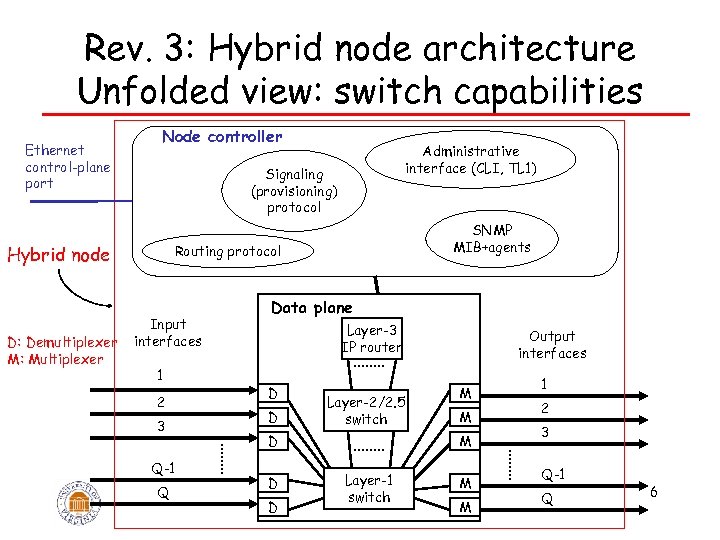
Rev. 3: Hybrid node architecture Unfolded view: switch capabilities Ethernet control-plane port Node controller Signaling (provisioning) protocol SNMP MIB+agents Routing protocol Hybrid node D: Demultiplexer M: Multiplexer Administrative interface (CLI, TL 1) Input interfaces 1 2 3 Q-1 Q Data plane Layer-3 IP router D D Layer-2/2. 5 switch D D D Output interfaces M M M Layer-1 switch M M 1 2 3 Q-1 Q 6
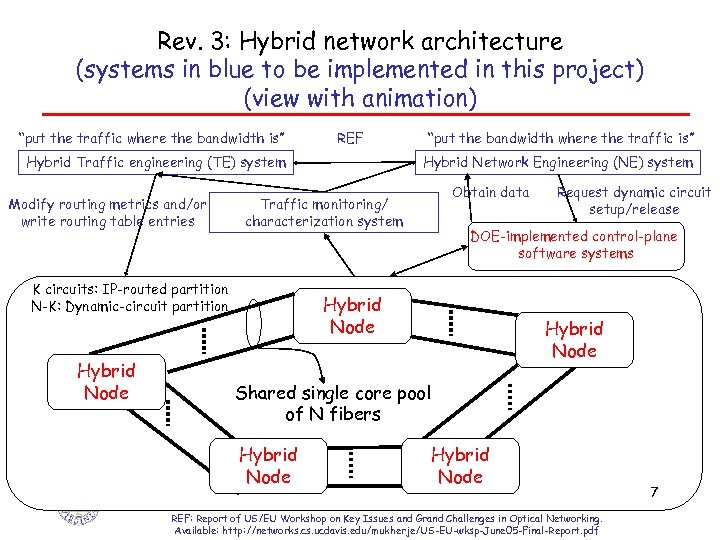
Rev. 3: Hybrid network architecture (systems in blue to be implemented in this project) (view with animation) “put the traffic where the bandwidth is” REF Hybrid Traffic engineering (TE) system Modify routing metrics and/or write routing table entries Hybrid Network Engineering (NE) system Traffic monitoring/ characterization system K circuits: IP-routed partition N-K: Dynamic-circuit partition Hybrid Node “put the bandwidth where the traffic is” Obtain data Request dynamic circuit setup/release DOE-implemented control-plane software systems Hybrid Node Shared single core pool of N fibers Hybrid Node REF: Report of US/EU Workshop on Key Issues and Grand Challenges in Optical Networking. Available: http: //networks. cs. ucdavis. edu/mukherje/US-EU-wksp-June 05 -Final-Report. pdf 7
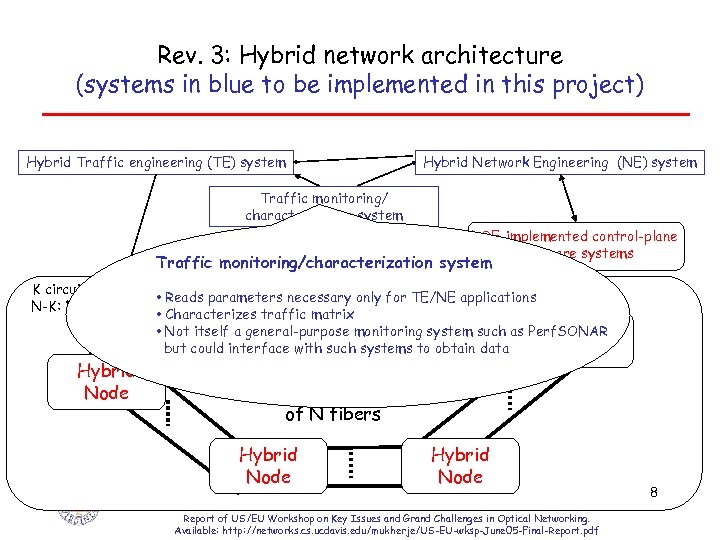
Rev. 3: Hybrid network architecture (systems in blue to be implemented in this project) Hybrid Traffic engineering (TE) system Hybrid Network Engineering (NE) system Traffic monitoring/ characterization system DOE-implemented control-plane software systems Traffic monitoring/characterization system K circuits: IP-routed partition • Reads parameters necessary only for TE/NE applications N-K: Dynamic-circuit partition Hybrid • Characterizes traffic matrix Node Hybrid • Not itself a general-purpose monitoring system such as Perf. SONAR but could interface with such systems to obtain data Node Hybrid Node Shared single core pool of N fibers Hybrid Node Report of US/EU Workshop on Key Issues and Grand Challenges in Optical Networking. Available: http: //networks. cs. ucdavis. edu/mukherje/US-EU-wksp-June 05 -Final-Report. pdf 8
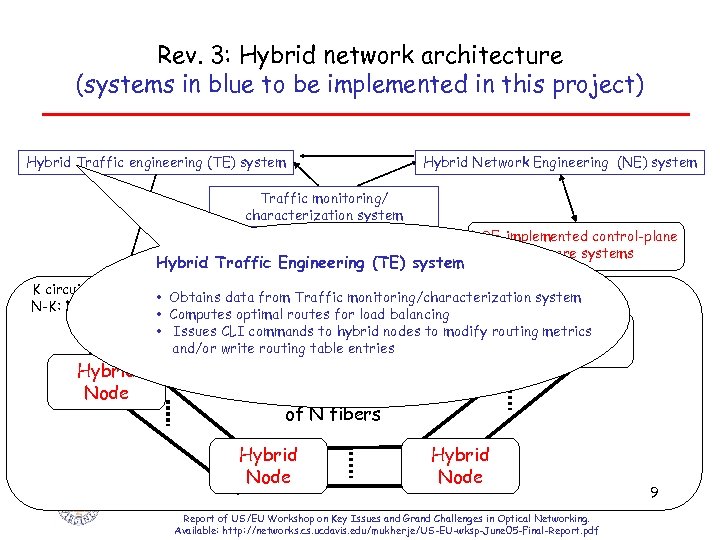
Rev. 3: Hybrid network architecture (systems in blue to be implemented in this project) Hybrid Traffic engineering (TE) system Hybrid Network Engineering (NE) system Traffic monitoring/ characterization system Hybrid Traffic Engineering (TE) system DOE-implemented control-plane software systems K circuits: IP-routed partition • Obtains data from Traffic monitoring/characterization system N-K: Dynamic-circuit partition Hybrid • Computes optimal routes for load balancing Hybrid • Issues CLI commands to. Node nodes to modify routing metrics hybrid and/or write routing table entries Node Hybrid Node Shared single core pool of N fibers Hybrid Node Report of US/EU Workshop on Key Issues and Grand Challenges in Optical Networking. Available: http: //networks. cs. ucdavis. edu/mukherje/US-EU-wksp-June 05 -Final-Report. pdf 9
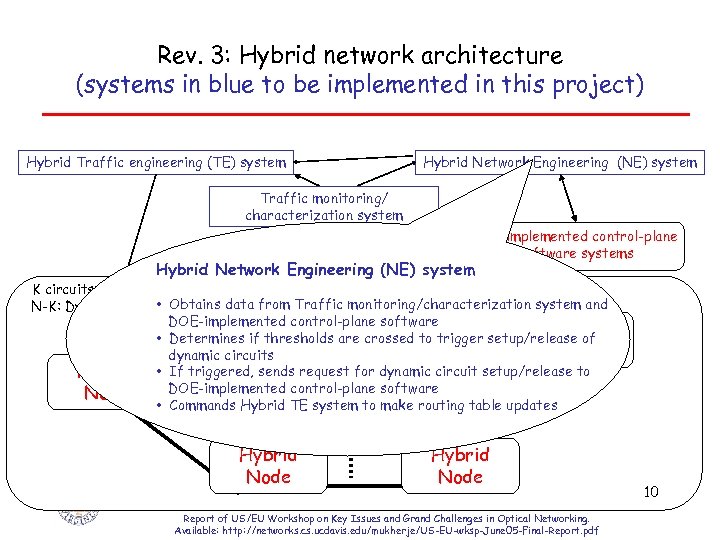
Rev. 3: Hybrid network architecture (systems in blue to be implemented in this project) Hybrid Traffic engineering (TE) system Hybrid Network Engineering (NE) system Traffic monitoring/ characterization system DOE-implemented control-plane software systems Hybrid Network Engineering (NE) system K circuits: IP-routed partition • partition N-K: Dynamic-circuit Obtains data from Traffic monitoring/characterization system and Hybrid DOE-implemented control-plane software Node Hybrid • Determines if thresholds are crossed to trigger setup/release of Node dynamic circuits Hybrid • If triggered, sends request for dynamic circuit setup/release to DOE-implemented control-plane software Shared single core pool Node • Commands Hybrid TE system to make routing table updates of N fibers Hybrid Node Report of US/EU Workshop on Key Issues and Grand Challenges in Optical Networking. Available: http: //networks. cs. ucdavis. edu/mukherje/US-EU-wksp-June 05 -Final-Report. pdf 10
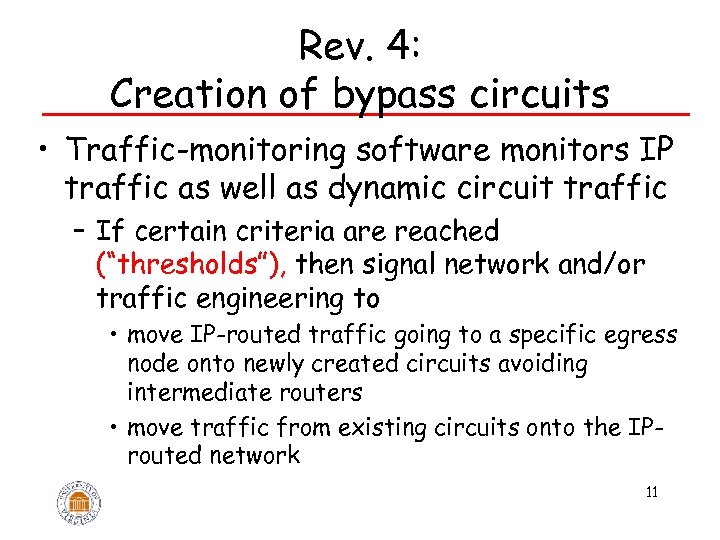
Rev. 4: Creation of bypass circuits • Traffic-monitoring software monitors IP traffic as well as dynamic circuit traffic – If certain criteria are reached (“thresholds”), then signal network and/or traffic engineering to • move IP-routed traffic going to a specific egress node onto newly created circuits avoiding intermediate routers • move traffic from existing circuits onto the IProuted network 11
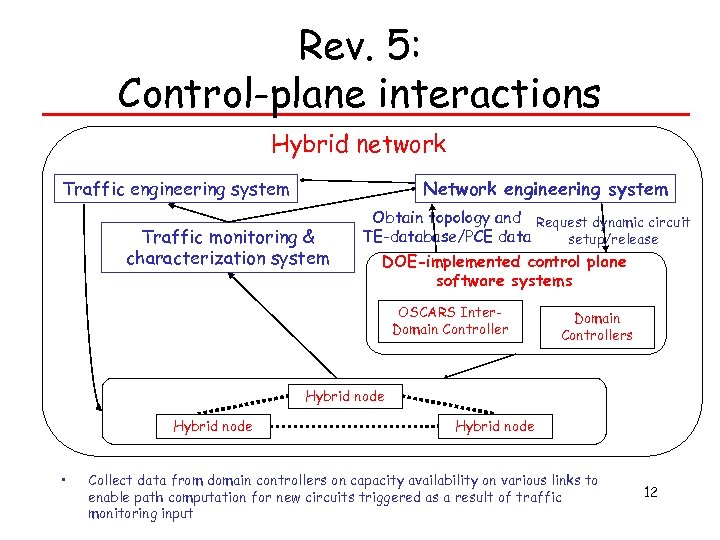
Rev. 5: Control-plane interactions Hybrid network Traffic engineering system Network engineering system Traffic monitoring & characterization system Obtain topology and Request dynamic circuit TE-database/PCE data setup/release DOE-implemented control plane software systems OSCARS Inter. Domain Controllers Hybrid node • Hybrid node Collect data from domain controllers on capacity availability on various links to enable path computation for new circuits triggered as a result of traffic monitoring input 12
Rev. 5: Control-plane messaging • Control-plane messages are carried over the IProuted network • Switch control cards have Ethernet control-plane ports for connection into the IP-routed network • For security, ns 5 or equivalent IPsec devices should be deployed on these control ports 13
Rev. 6: Triggering of circuit setup and release • Determine the criteria and thresholds for triggering dynamic circuit setup in networkengineering module (using input from traffic monitoring + DOE-implemented control-plane software) • Determine the criteria and threshold for triggering circuit release – cannot wait for traffic on a 10 Gb/s circuit to fall to 0 before triggering release – what should the threshold be? • Determine the policies that govern the implementation of thresholds 14
Rev. 7: Extension of OSCARS to Layer 1 -2 networks • OSCARS scheduler was developed for advance reservation of dynamic MPLS (layer 2. 5) LSPs • Extension to Layer 1 -2 networks – Layer-2 (Carrier-Ethernet and SONET) and Layer-1 (optical WDM and fiber) – Develop algorithms suitable for reservations and provisioning of nested and concatenated circuits 15
Rev. 8: DOE-provided testbed • Demonstrate operation of hybrid networks with resource optimizing hybrid TE and hybrid NE software on DOE-provided testbed with 3 to 4 nodes. – Hybrid nodes (provided to us): • IP router (layer 3) + MPLS switch (layer 2. 5) • Layer 1/layer 2 circuit switch • DOE-implemented control-plane software – Implemented by us: • Hybrid TE, Hybrid NE and traffic monitoring/characterization software 16
Rev. 9: Areas of focus • Theoretical framework – Use of traffic engineering and network engineering in hybrid networks for resource optimization • Prototype demonstrations on DOEprovided testbed 17
Rev. 10: Policy issues • Should users be blocked if resources are not available for circuits? • Can users indicate option to avoid being blocked but rather to use IP-routed/MPLS LSP path if Layer 1 or Layer 2 circuit network has no resources? • Should decision be made at the edge or inside the network? • Is the decision driven by TE process or by users or both? 18
Rev. 11: Modified annual deliverables (quarterly on next three slides) • Year 1: Architecture and Analysis • Year 2: Algorithm design and software implementation • Year 3: Prototyping on DOE-provided testbed 19
Year 1 quarterly deliverables • Year 1: Architecture and Analysis – Q 1: Design architectural framework for hybrid networks with automated traffic and network engineering – Q 2: Analyze traffic – Q 3: Study the question of thresholds and triggering – Q 4: Identify requirements for hybrid network and traffic engineering systems 20
Year 2 quarterly deliverables • Year 2: Algorithm design and software implementation – Q 1: Define interactions with DOEimplemented control-plane software – Q 2: Design and implement traffic monitoring and characterization system – Q 3: Design algorithms and implement hybrid traffic engineering system – Q 4: Design algorithms and implement hybrid network engineering system 21
Year 3 quarterly deliverables • Year 3: Prototyping on DOE-provided testbed – Q 1: Test traffic monitoring and characterization system – Q 2: Test hybrid traffic engineering system – Q 3: Test hybrid network engineering system – Q 4: Integration testing - Findings and recommendations 22
Скачать презентацию Revision to DOE proposal Resource Optimization in Hybrid
2b7eb447a5eed1b6f0730295924b8483.ppt