


 Скачать презентацию REVISION LECTURE TERM 1 1 Project survey
Revision Lecture 1 (with Answers)- final.pptx
- Количество слайдов: 11
 REVISION LECTURE TERM 1 1
 Project survey • Some of you have not yet submitted the two online surveys. • All students must submit the survey before 10. 00 AM tomorrow , Friday 5 th Dec. • Marks are also allocated for your surveys.
 Examination guidelines • Write the question number before you answer. ( eg. B 2 B c) …………. . ) • Write your answers clearly. Do not write too small. • Answer all questions in order. If you want to answer a question later, keep some space and go for the next question. • In part A , you can solve multiple questions on the same page if there is enough space.
 PSCs • No Physics PSCs today and tomorrow. • Prepare well for your examination. Best wishes.
 General Problem Solving Steps 1) READ – read the question (several times) carefully 2) DIAGRAM – draw/sketch (a) diagrams even if this is not 3) 4) 5) 6) 7) 8) asked specifically DATA – use the given symbols in SI units and define all new symbols FORMULAS – state all equations used SOLVE – rearrange/combine formulas to obtain an expression for the final answer showing all intermediate steps SUBSTITUTE – put numbers in the final expression NUMERICAL ANSWER – use the calculator at this point CHECK AND BOX – check units, sig figs, and think if the numerical answer is physically reasonable, then box in your answer
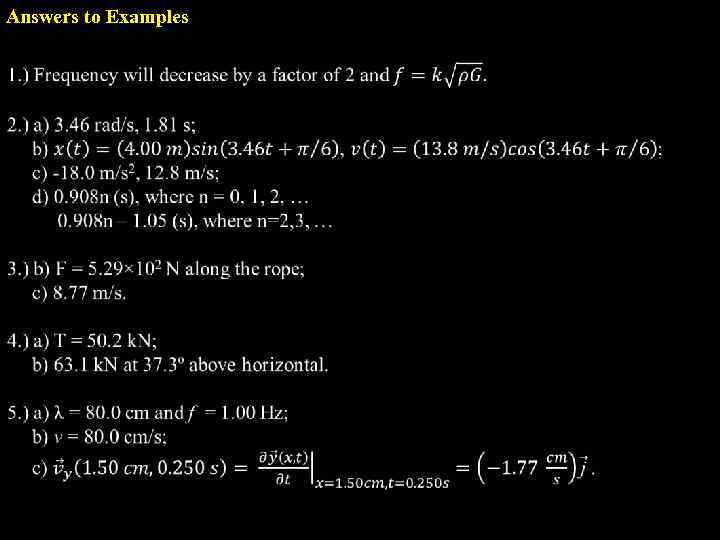
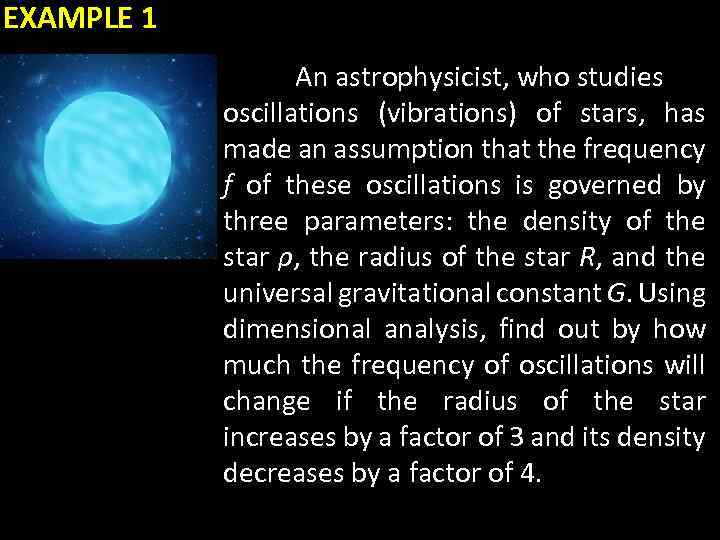 EXAMPLE 1 An astrophysicist, who studies oscillations (vibrations) of stars, has made an assumption that the frequency f of these oscillations is governed by three parameters: the density of the star ρ, the radius of the star R, and the universal gravitational constant G. Using dimensional analysis, find out by how much the frequency of oscillations will change if the radius of the star increases by a factor of 3 and its density decreases by a factor of 4.
 EXAMPLE 2 One end of a spring is fixed to the wall and the other end is attached to a block on a frictionless horizontal surface. Initially the spring is stretched by 2. 00 m and a velocity of 12. 0 m/s in the direction of “further stretching” is given to the block. The spring constant is 24. 0 N/m, and the mass of the block is 2. 00 kg. a. ) Find the angular frequency and the period of the established SHM. b. ) Find expressions of position and velocity of the block as a function of time. Plot x-t. c. ) Calculate the acceleration and speed of the block when the spring is stretched by 1. 50 m. d. ) Find time instances when the potential energy is equal to the quarter of the total? 7
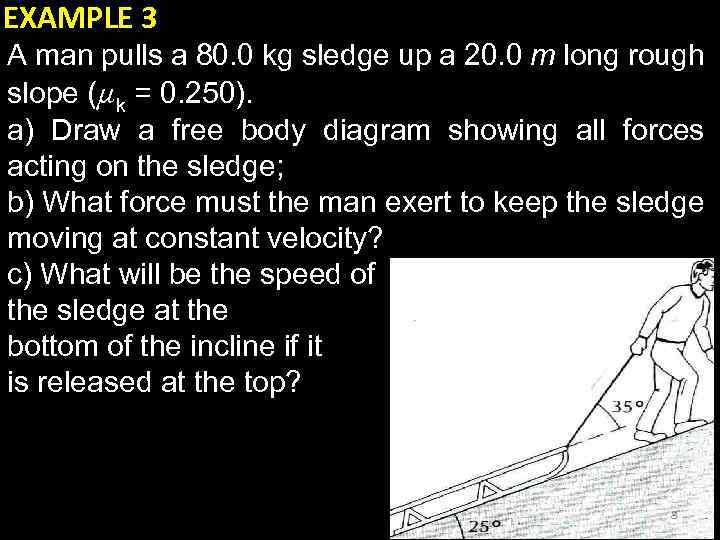 EXAMPLE 3 A man pulls a 80. 0 kg sledge up a 20. 0 m long rough slope (µk = 0. 250). a) Draw a free body diagram showing all forces acting on the sledge; b) What force must the man exert to keep the sledge moving at constant velocity? c) What will be the speed of the sledge at the bottom of the incline if it is released at the top? 8
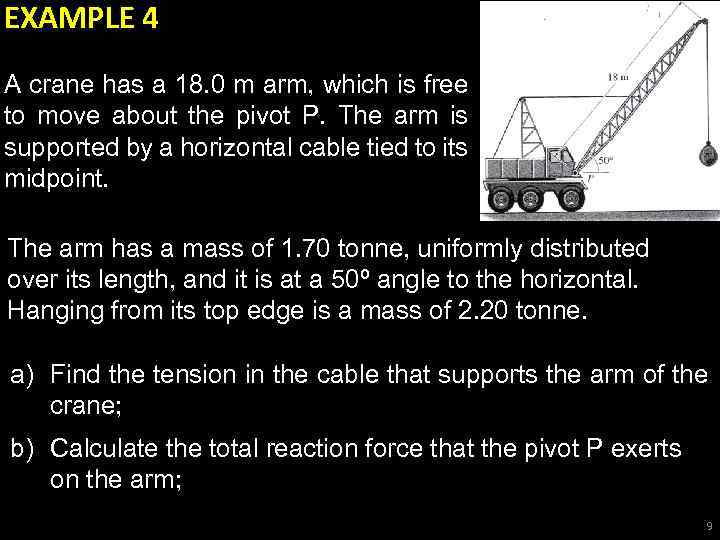 EXAMPLE 4. A crane has a 18. 0 m arm, which is free to move about the pivot P. The arm is supported by a horizontal cable tied to its midpoint. The arm has a mass of 1. 70 tonne, uniformly distributed over its length, and it is at a 50º angle to the horizontal. Hanging from its top edge is a mass of 2. 20 tonne. a) Find the tension in the cable that supports the arm of the crane; b) Calculate the total reaction force that the pivot P exerts on the arm; 9
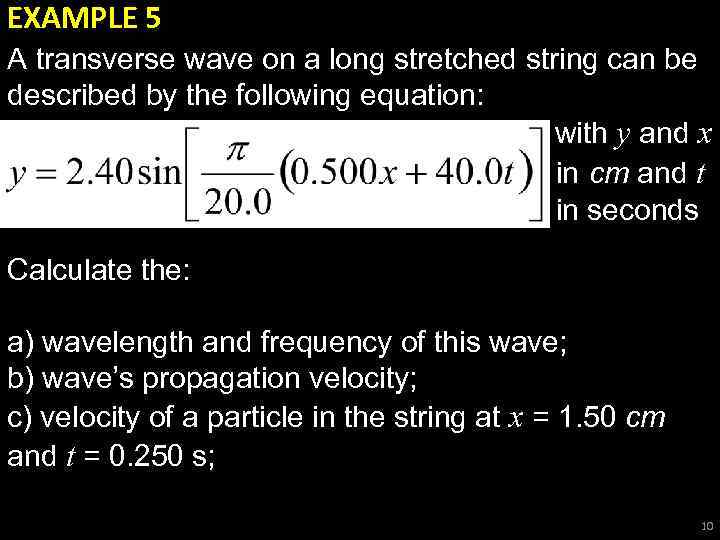 EXAMPLE 5 A transverse wave on a long stretched string can be described by the following equation: with y and x in cm and t in seconds Calculate the: a) wavelength and frequency of this wave; b) wave’s propagation velocity; c) velocity of a particle in the string at x = 1. 50 cm and t = 0. 250 s; 10
 Answers to Examples