 Скачать презентацию REVIEW QUESTIONS WHO ARE SUPERVISORS ROLES RESPONSIBILITIES
f0f53e8dded0505731519894b6b37ea6.ppt
- Количество слайдов: 18



REVIEW QUESTIONS WHO ARE SUPERVISORS ROLES & RESPONSIBILITIES WHY ARE SUPERVISORS’ ROLE IMPORTANT. WHY ARE SUPERVISORS’ TERMED THE “LINKING PIN” FOF 502 – Front office Supervisory Skills
INTRODUCTION The functions, activities and areas of the front office area are geared towards supporting guest transactions and services. To many guests, the front office represents the hotel. The financial transactions a guest makes while staying at a hotel determine the flow of business through the property. The flow of business can be divided into four stages: pre-arrival, Arrival occupancy and departure. Within each stage, important front office tasks related to guest services and guest accounting can be identified analyze. Front office employees need to be aware of services and guest accounting activities throughout the guest stay. Since activities and functions tend to overlap between stages, some properties have revised the traditional guest cycle into pre-sale, point-of-sale and post-sale. For computerized properties this revised sequence tends to improve coordinating among hotel operating departments.
CONT’D Non-automated front office recordkeeping systems rely solely on handwritten forms. A semi-automated front office system uses both handwritten and machine produced forms. Advantages of a semiautomated over a non-automated system include automatically generated neatly printed documents that detail the steps of the transaction. Front office recordkeeping is computer-based in fully automated hotels. The front office prominently located in the lobby area, is where guests register, request information and service, relate complaints, settle their accounts and check out. The functional efficiency of a front desk depends on it’s design and layout. The desk should provide each front desk employee with easy access to the equipment, forms and supplies necessary for the performance of the assigned task. Non-automated and semi-automated front office typically relies upon a collection of mechanical racks and specialty devices designated to produce, store or display front office forms. In fully automated hotel, most traditional front office equipment has been replaced by a front office computer system. A hotel property management system contains sets of computer software packages capable of supporting a variety of activities in front and back office areas.
THE LODGING INDUSTRY – OWNERSHIP AND AFFILIATIONS THERE ARE 5 TYPES OF HOTEL AFFILIATIONS (OWNERSHIP ARRANGEMENTS) owner operated hotels – properties operating without the assistance of a staff of payroll outside the owner and his family e. g. small B&B owner managed – similar to owner operated but the main difference is owner managed hires necessary number of line staff and staff employees to operate the day to day operation while the owner manages e. g. Outrigger Resorts. Independent Hotels – operates separately from any chain affiliation In this type of operation, owner does not manage hotel directly but hires management to manage and operate it. Franchised and Referral Groups – is when a franchisor (that entity that has developed) a particular pattern of doing business grants other entities (franchisees) the right to conduct such a business provided the franchisees follows the pattern. Referrals Groups – consists of independent hotels which have banded together for some common purpose. While they are not alike, they share the consistency in the quality of service to consistently satisfy guest’s expectations. Chain operated hotels – they are chain owned and managed by the chain through a management contract.
LEVEL OF SERVICE Another way to classify lodging or accommodation is by level of guest service. The level of service is usually reflected in a guest’s room rate. Basic issues surrounding services area: The intangibility of service – hotels are not simply in the business of selling tangible products, however it is the intangible services that contribute most to guest’s hospitality experience. Quality Assurance – controlling service variability is a challenge. The consistent delivery of service is the result of a programme of quality assurance. Rating Services: several groups in the United States provide hotel evaluations and rating services for travelers, The best known for these services are by the American Automobile Association (AAA) and Mobil Travel Guide. AAA uses the diamond rating system and Mobil Travel Guide utilizes from 1 to 5 star rank the level of quality accommodation.
HOTEL AND FRONT OFFICE ORGANIZATION For a hotel to run effectively and efficiently, every employee must understand work to achieve the property’s mission. The hotel’s mission statement expresses the underlying philosophy that gives meaning and direction to hotels policies. The hotel mission statement should address the interests of 3 diverse groups: Guests Management Employees A sound mission statement should address guests expectations, reflect managements philosophy and provide hotel employees with a sense of purpose.
CONT’D Once the hotel has defined and formulated its mission statement, the next step is to set goals. A goal is more specific than a mission; it requires a certain level of achievement that can be observed and measured. A properly written goal includes a level of quality, quantity or cost. Eg. Increase the hotel’s average occupancy level by 2% above the previous years level. Strategies are methods a department or division used to achieve its goals. Tactics further define how goals will be achieved. They are day to day operating procedures that implement successful strategies.
CONT’D The goals and strategies of the front office are based on the hotel’s mission statement and overall goals. E. g 1 front office goal might be to encourage more walk-ins to stay at the property in order to meet the front office goal of increasing occupancy percentage. A strategy to accomplish this goal could be for front desk agents to improve their sales presentation by more thoroughly describing the available guestrooms and hotel services.
CONT’D The front office is responsible to for developing and maintaining a comprehensive data base of guest information, coordinating guest services and ensuring guest satisfaction. Larger hotels tend to organize the front office by functional areas in order to enhance control over operations. In a computerized property, each employee may be restricted to accessing only those electronic records pertinent to his or her function.
JOB ANALYSIS job analysis is the process used to collect information about the duties, responsibilities, necessary skills, outcomes, and work environment of a particular job. You need as much data as possible to put together a job description, which is the frequent outcome of the job analysis. Additional outcomes include recruiting plans, position postings and advertisements, and performance development planning within your performance management system.
CONT’D The job analysis may include these activities: reviewing the job responsibilities of current employees, doing Internet research and viewing sample job descriptions online or offline highlighting similar jobs, analyzing the work duties, tasks, and responsibilities that need to be accomplished by the employee filling the position, researching and sharing with other companies that have similar jobs, and articulation of the most important outcomes or contributions needed from the position. The more information you can gather, the easier the actual writing of the job description will be.
![JOB DESCRIPTION [JD] A job description lists a majority of the tasks composing a](https://present5.com/presentation/f0f53e8dded0505731519894b6b37ea6/image-12.jpg "JOB DESCRIPTION [JD] A job description lists a majority of the tasks composing a")
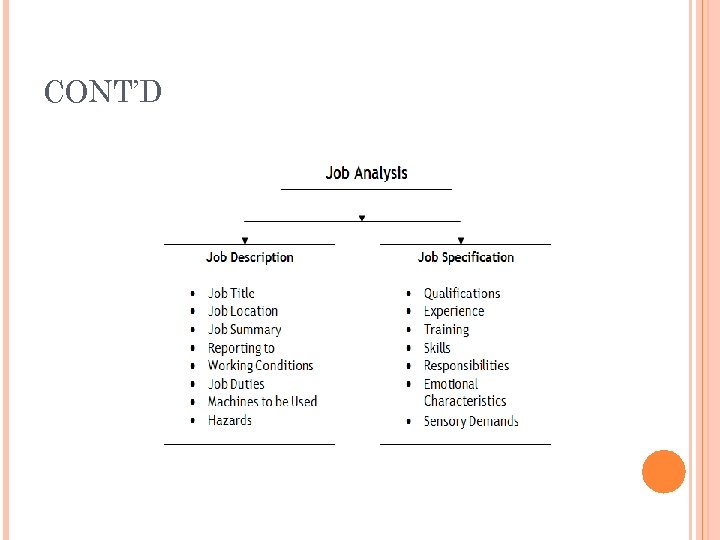
JOB DESCRIPTION [JD] A job description lists a majority of the tasks composing a position. A job description may also outline reporting relationships, responsibilities, working conditions, equipment and materials to be used, and other important information specific to the property. To be most effective, job descriptions should be customized to the operational procedures of a specific lodging property. Job specifications list the personal qualities, skills and traits a person needs to successfully perform the task outlined in a job description
CONT’D Well written job descriptions can also be used to: In evaluating job performance as an aid in training or retraining employees to prevent unnecessary duplication of duties to help ensure that each job task is performed to help determine appropriate staffing levels
![JOB SPECIFICATION [JS] A job specification describes the knowledge, skills, education, experience, and abilities](https://present5.com/presentation/f0f53e8dded0505731519894b6b37ea6/image-14.jpg "JOB SPECIFICATION [JS] A job specification describes the knowledge, skills, education, experience, and abilities")
JOB SPECIFICATION [JS] A job specification describes the knowledge, skills, education, experience, and abilities you believe are essential to performing a particular job. The job specification is developed from the job analysis. Ideally, also developed from a detailed job description, the job specification describes the person you want to hire for a particular job. A job specification cuts to the quick with your requirements whereas the job description defines the duties and requirements of an employee’s job in detail. The job specification provides detailed characteristics, knowledge, education, skills, and experience needed to perform the job, with an overview of the specific job requirements.
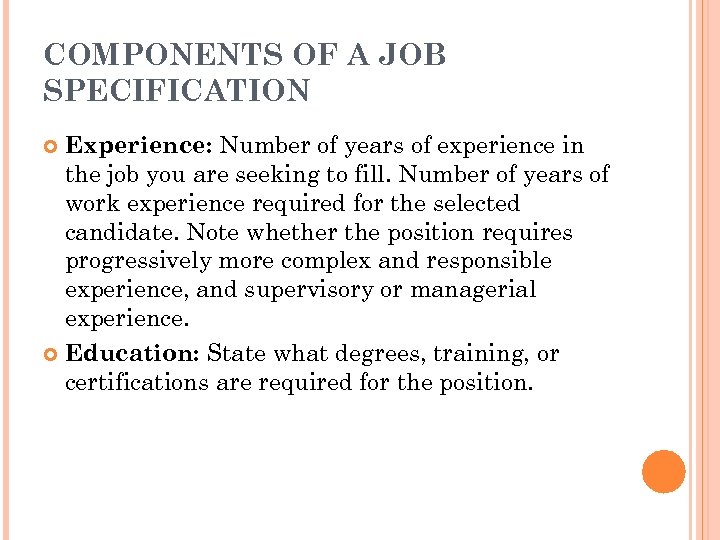
COMPONENTS OF A JOB SPECIFICATION Experience: Number of years of experience in the job you are seeking to fill. Number of years of work experience required for the selected candidate. Note whether the position requires progressively more complex and responsible experience, and supervisory or managerial experience. Education: State what degrees, training, or certifications are required for the position.
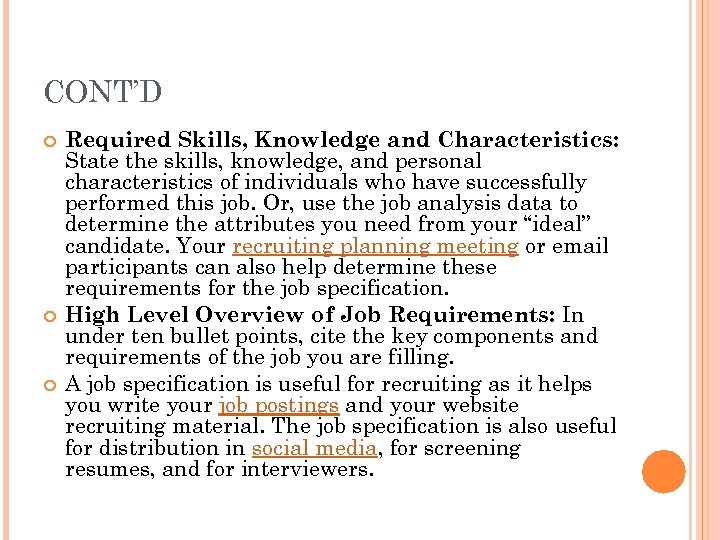
CONT’D Required Skills, Knowledge and Characteristics: State the skills, knowledge, and personal characteristics of individuals who have successfully performed this job. Or, use the job analysis data to determine the attributes you need from your “ideal” candidate. Your recruiting planning meeting or email participants can also help determine these requirements for the job specification. High Level Overview of Job Requirements: In under ten bullet points, cite the key components and requirements of the job you are filling. A job specification is useful for recruiting as it helps you write your job postings and your website recruiting material. The job specification is also useful for distribution in social media, for screening resumes, and for interviewers.
CONT’D
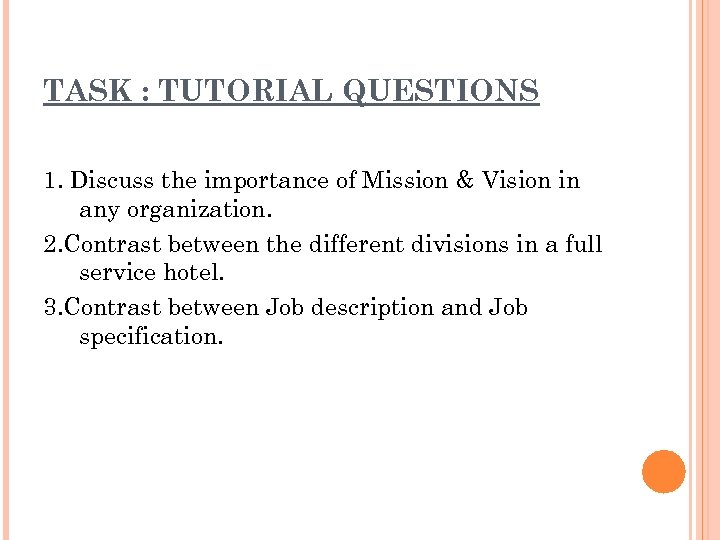
TASK : TUTORIAL QUESTIONS 1. Discuss the importance of Mission & Vision in any organization. 2. Contrast between the different divisions in a full service hotel. 3. Contrast between Job description and Job specification.
Скачать презентацию REVIEW QUESTIONS WHO ARE SUPERVISORS ROLES RESPONSIBILITIES
f0f53e8dded0505731519894b6b37ea6.ppt