


 Скачать презентацию Review of the Recent Developments of Energy Legal
4bf05e1ca8138e59f000c25f77abf3be.ppt
- Количество слайдов: 16
 Review of the Recent Developments of Energy Legal Framework in Taiwanwith the Focus on New Energy Policies & Legislations Dr. Yueh-Hsun Tsai Associate Professor of Law, Graduate School of Sci. & Tech. , National Yulin University of Sci. & Tech. (YUNYECH), Taiwan, R. O. C. Han-Bei Tan Research Assistant, School of Sci. & Tech. , National Yulin University of Sci. & Tech. (YUNYECH), Taiwan, R. O. C. Ding-Jang Chen Founding partner, CC&W attorneys-at-law, Taiwan, R. O. C
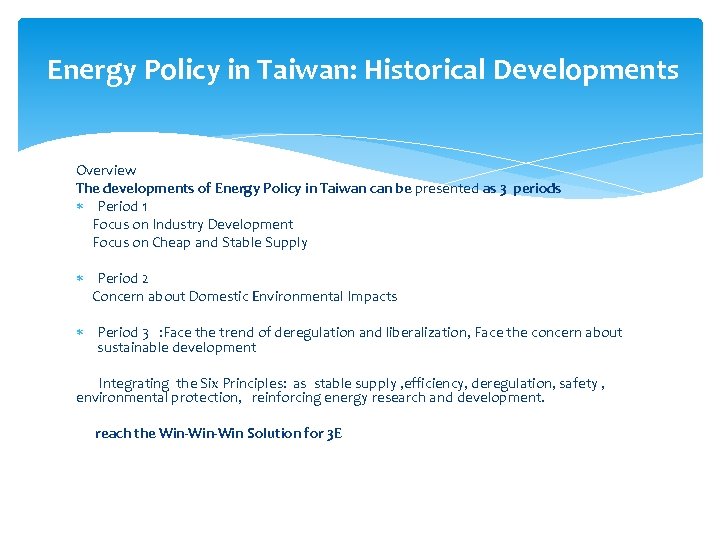 Energy Policy in Taiwan: Historical Developments Overview The developments of Energy Policy in Taiwan can be presented as 3 periods Period 1 Focus on Industry Development Focus on Cheap and Stable Supply Period 2 Concern about Domestic Environmental Impacts Period 3 : Face the trend of deregulation and liberalization, Face the concern about sustainable development Integrating the Six Principles: as stable supply , efficiency, deregulation, safety , environmental protection, reinforcing energy research and development. reach the Win-Win Solution for 3 E
 Energy Policy in Taiwan: Historical Developments Generally speaking, the “Energy Policy and Implementation in Taiwan Area” is the initial formal energy policy in Taiwan. In fact , If we take it seriously, before the formal “Energy Policy and Implementation in Taiwan Area” enacted, the energy police in Taiwan even can be traced back to 1968, when “The Energy Development Principles” announced. At that time, it put the emphasis on developing industry, stable the energy supply with cheaper price and encourage the consumption.
 Energy Policy in Taiwan: Historical Developments--Energy Policy and Implementation in Taiwan Area issued and amended According to the situation around the aboard and the domestic , Taiwan issued and amended the “Energy Policy and Implementation in Taiwan Area” from 1973 Until 1996. Because of developing industry, and of Taiwan is the island lacks of domestic energies and fossil fuels with long-term and high imported energy dependence over 99% , even the policy had been amended for four times( 1979, 1984, 1990, 1996)but the , hardcore goals never changed are cheap and stable supply. Here we show the historical developments on TABLE 1, ’’Policy and Authority Established’’ as you see. It’s obvious: from 1984 the environmental impact issues was concerned , and the policy amended in 1996 put equal emphasis on enhancing energy safety and environmental protection.
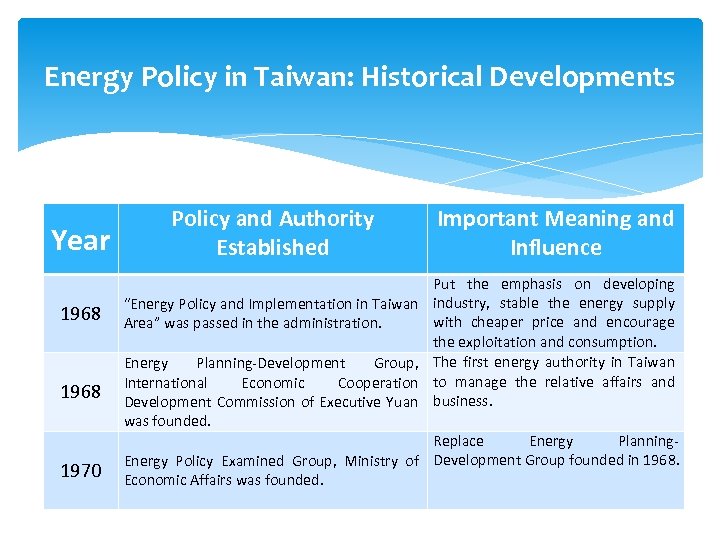 Energy Policy in Taiwan: Historical Developments Year Policy and Authority Established 1968 “Energy Policy and Implementation in Taiwan Area” was passed in the administration. 1968 Energy Planning-Development Group, International Economic Cooperation Development Commission of Executive Yuan was founded. 1970 Important Meaning and Influence Put the emphasis on developing industry, stable the energy supply with cheaper price and encourage the exploitation and consumption. The first energy authority in Taiwan to manage the relative affairs and business. Replace Energy Planning. Energy Policy Examined Group, Ministry of Development Group founded in 1968. Economic Affairs was founded.
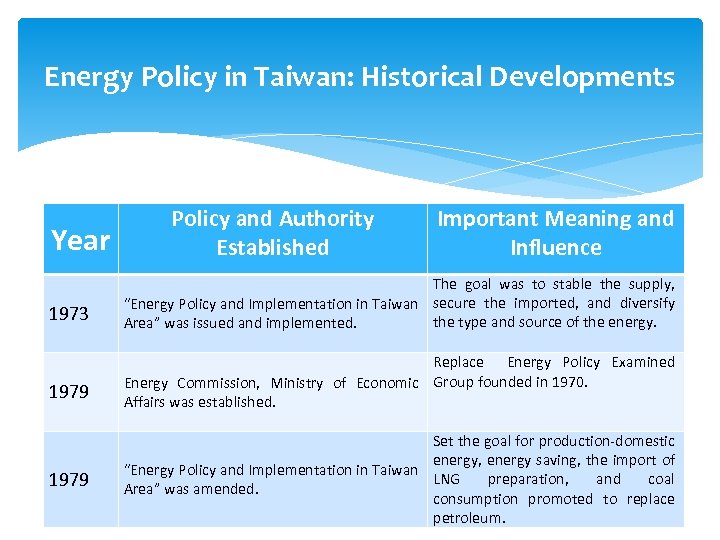 Energy Policy in Taiwan: Historical Developments Year Policy and Authority Established Important Meaning and Influence 1973 The goal was to stable the supply, “Energy Policy and Implementation in Taiwan secure the imported, and diversify the type and source of the energy. Area” was issued and implemented. 1979 Replace Energy Policy Examined Energy Commission, Ministry of Economic Group founded in 1970. Affairs was established. 1979 Set the goal for production-domestic energy, energy saving, the import of “Energy Policy and Implementation in Taiwan LNG preparation, and coal Area” was amended. consumption promoted to replace petroleum.
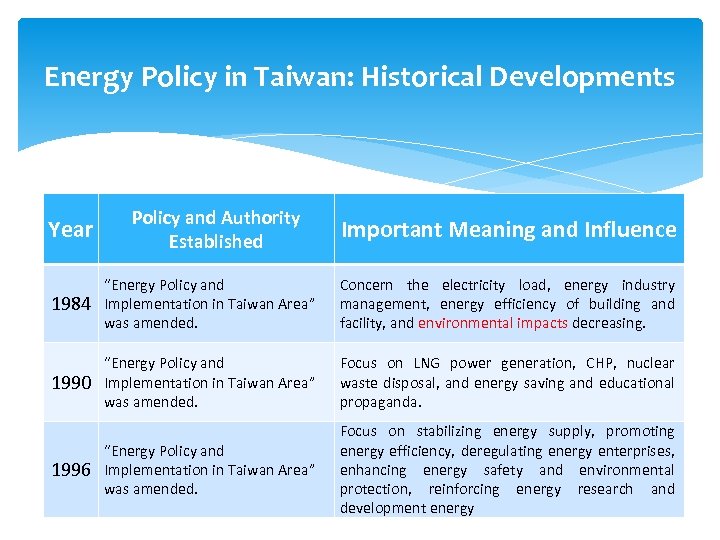 Energy Policy in Taiwan: Historical Developments Year Policy and Authority Established Important Meaning and Influence 1984 “Energy Policy and Implementation in Taiwan Area” was amended. Concern the electricity load, energy industry management, energy efficiency of building and facility, and environmental impacts decreasing. 1990 “Energy Policy and Implementation in Taiwan Area” was amended. Focus on LNG power generation, CHP, nuclear waste disposal, and energy saving and educational propaganda. “Energy Policy and Implementation in Taiwan Area” was amended. Focus on stabilizing energy supply, promoting energy efficiency, deregulating energy enterprises, enhancing energy safety and environmental protection, reinforcing energy research and development energy 1996
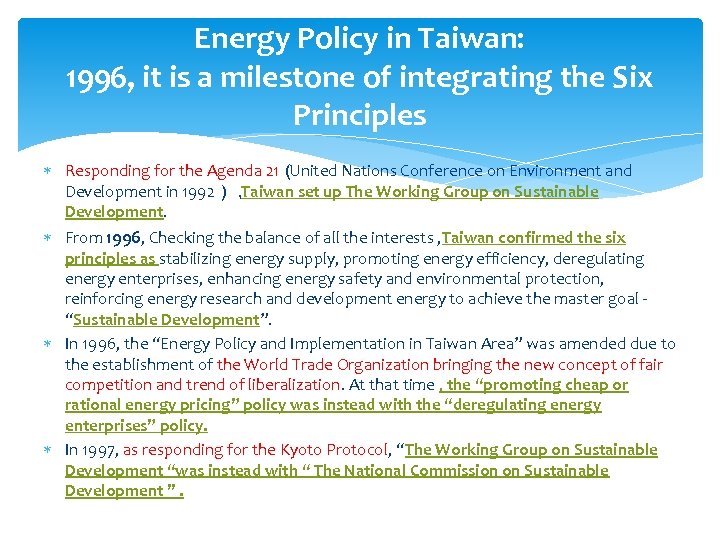 Energy Policy in Taiwan: 1996, it is a milestone of integrating the Six Principles Responding for the Agenda 21( United Nations Conference on Environment and Development in 1992), Taiwan set up The Working Group on Sustainable Development. From 1996, Checking the balance of all the interests , Taiwan confirmed the six principles as stabilizing energy supply, promoting energy efficiency, deregulating energy enterprises, enhancing energy safety and environmental protection, reinforcing energy research and development energy to achieve the master goal “Sustainable Development”. In 1996, the “Energy Policy and Implementation in Taiwan Area” was amended due to the establishment of the World Trade Organization bringing the new concept of fair competition and trend of liberalization. At that time , the “promoting cheap or rational energy pricing” policy was instead with the “deregulating energy enterprises” policy. In 1997, as responding for the Kyoto Protocol, “The Working Group on Sustainable Development “was instead with “ The National Commission on Sustainable Development ’’.
 Energy Policy in Taiwan: The National Energy Conference--Put More Attention on Sustainable Energy Policy In addition, Taiwan hold “National Energy Conference” separately in 1998, 2005, and 2009 in order to response the Kyoto Protocol, the supplementary provision of United Nations Framework Convention on Climate Change of 1997 (UNFCCC), and the relative issues about energy. The Important consensus and objectives of “National Energy Conference”: The National Energy Conferences concluded certain consensus and objectives, like 1. “increase the share of new energies, including solar, wind, biomass, geothermal, ocean, and water, etc. , up to 3% in Taiwan’s total energy supply by 2020”, 2. “reach the target of renewable energy account for 10% in total energies in 2010”, and 3. ‘’combined the relevant policies as “Action Program of Sustainable Energy Policy” through six aspects of energy, industry, transportation, environment, life, and law into practice. In 2008, the Executive Yuan (the cabinet of Taiwan) approved “Framework of Taiwan’s Sustainable Energy Policy” and introduced the policy guidelines of “Improving energy efficiency, Developing clean energy, and Securing stable energy supply” to achieve the policy target, “Win-Win Solution for Energy, Environment and Economy”.
 Energy Legislation in Taiwan: Four Key Energies Laws Currently, Taiwan embraces and executes several laws and regulations with its own features, including of Mining Act, The Electricity Act, Atomic Energy Law, Nuclear-related laws and regulations, Energy Management Act, Petroleum Administration Act, Regulation for Renewable Energy Development, and Natural Gas Business Act. The “Energy Management Act”, ” Regulation for Renewable Energy Development”, and bills of “Regulation for Energy Taxation “, ” Greenhouse Gas Emission Reduction Act” are generally called “Four Key Energies Laws “. for complying with the energy policies targets mentioned above, they will play more important and critical role in the future. The “Energy Management Act” focuses on managing the demand-supply chain of energy, energy efficiency, energy safety , and concerns for impacts on environment and economy.
 Four Key Energies Laws The “Regulation for Renewable Energy Development” contains the incentive programs for producing renewable energies and promoting the R&D. The “Regulation for Energy Taxation “and “Greenhouse Gas Emission Reduction Act”, are still under legislation for years with much debate and impacts on Taiwan. Both Bills are based on market-based approach to reduce emission. The “Regulation for Energy Taxation “is based on the ”Pigou tax” theory. The "Greenhouse Gas Emission Reduction Act" is based on the” tradable-permit approach” so called “ cap and trade”. It purposed as a means to make the "(carbon) emissions transactions” workable to reach carbon reduction targets. Now, (prior to the implementation of "Greenhouse Gas Emission Reduction Act"), Taiwan enforce the “Promoting Principle of Early Action and Offset project " to cope with the needs of voluntary carbon reduction mechanism and the environmental impact assessment case involving carbon reduction commitment.
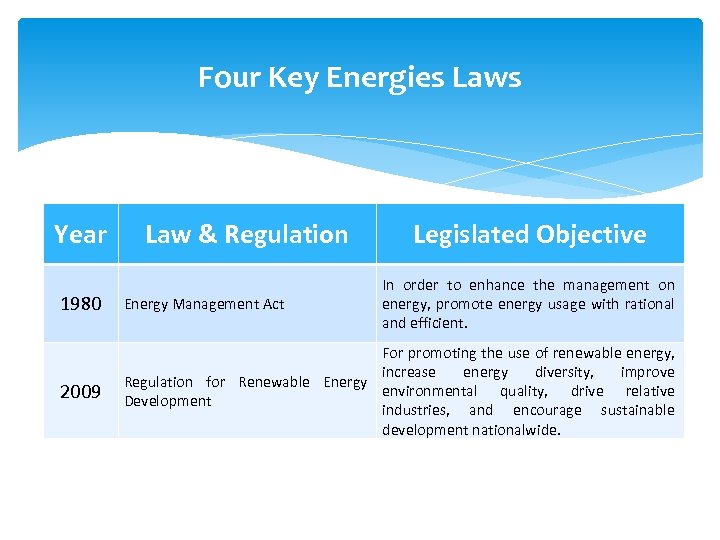 Four Key Energies Laws Year Law & Regulation Legislated Objective In order to enhance the management on energy, promote energy usage with rational and efficient. 1980 Energy Management Act 2009 For promoting the use of renewable energy, increase energy diversity, improve Regulation for Renewable Energy environmental quality, drive relative Development industries, and encourage sustainable development nationalwide.
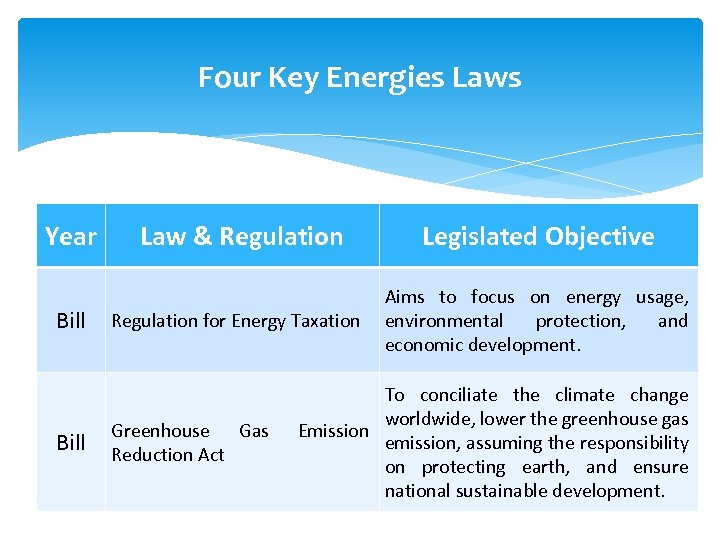 Four Key Energies Laws Year Bill Law & Regulation for Energy Taxation Greenhouse Gas Reduction Act Legislated Objective Aims to focus on energy usage, environmental protection, and economic development. To conciliate the climate change worldwide, lower the greenhouse gas Emission emission, assuming the responsibility on protecting earth, and ensure national sustainable development.
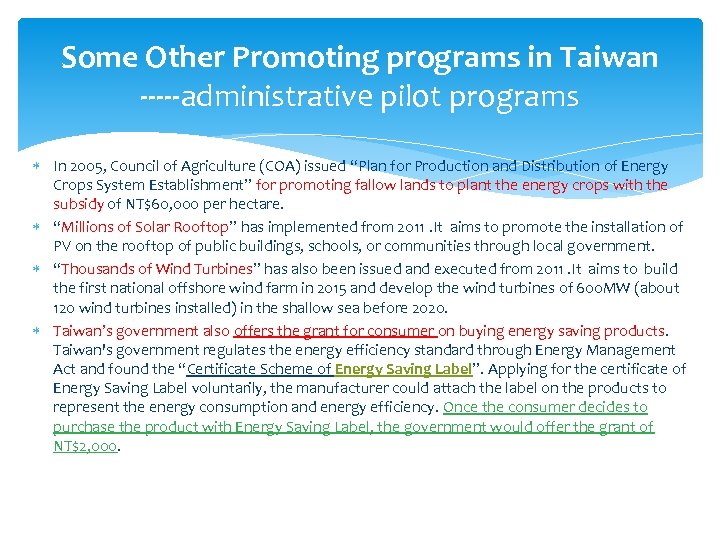 Some Other Promoting programs in Taiwan -----administrative pilot programs In 2005, Council of Agriculture (COA) issued “Plan for Production and Distribution of Energy Crops System Establishment” for promoting fallow lands to plant the energy crops with the subsidy of NT$60, 000 per hectare. “Millions of Solar Rooftop” has implemented from 2011. It aims to promote the installation of PV on the rooftop of public buildings, schools, or communities through local government. “Thousands of Wind Turbines” has also been issued and executed from 2011. It aims to build the first national offshore wind farm in 2015 and develop the wind turbines of 600 MW (about 120 wind turbines installed) in the shallow sea before 2020. Taiwan’s government also offers the grant for consumer on buying energy saving products. Taiwan's government regulates the energy efficiency standard through Energy Management Act and found the “Certificate Scheme of Energy Saving Label”. Applying for the certificate of Energy Saving Label voluntarily, the manufacturer could attach the label on the products to represent the energy consumption and energy efficiency. Once the consumer decides to purchase the product with Energy Saving Label, the government would offer the grant of NT$2, 000.
 Conclusion Background Taiwan (R. O. C. ) is not one of the parties of the United Nations Framework Convention on Climate Change (F. C. C. C. ) , and takes no burden of carbon reduction obligations under the Kyoto Protocol, but the government is still actively promoting the energy policies and legislations under the principles of 3 E. Policy Based on the reviews of the formation of Taiwan's recent energy policy, it could be observed there is lacking of comprehensive and solid legal scheme, heavily relying on administrative pilot programs.
 Conclusion Legislation “Four Key Energies Laws” are regarded as the significant legislation to regulate Taiwan’s energy demand-supply chain with 3 E characters. However, energy-related policies and legislations in Taiwan are often suspended in the congress with debates and discussion for a long time since the consideration on profit and industrial growth. Further, the national development and society welfare also influenced with impacts. Therefore for aiming to achieve the sustainable environment, composing a well legal framework for policy making, laws and regulation legislating, and administrative actions executing shall be equal emphasized currently in Taiwan.