 Скачать презентацию Review of Financial Management by Henry B Prudente
a3bc0b6b20091f679277f7bc7d3e1bcf.ppt
- Количество слайдов: 102



Review of Financial Management by Henry B. Prudente Sources: Financial Management by Van Horne; Corporate Finance by Ross, Westerfield and Jordan; Corporate Finance and Portfolio Management: CFA Program Curriculum Vol. 4
Financial Management Decisions Investment Decision Capital budgeting Concerned with the firm’s long term investments Identify investment opportunities that are worth more to the firm than they cost to acquire Evaluating the size, timing and risk of future cash flows Manage existing assets efficiently; determine a balance between profitability and liquidity
Financial Management Decisions Financing Decision Determining the best financing mix or capital structure How to obtain the financing it needs to support its long term investments How and where to raise money Working Capital Management Managing the firm’s short-term assets Dividend decision
Financial Analysis Refers to the examination of financial data of an entity to determine its profitability, growth, solvency, stability, and effectiveness of management Horizontal analysis Vertical analysis Cost-volume profit analysis
Financial Analysis Comparative Statements Show the increases or decreases in account balances and their corresponding percentages Common size statements A statement wherein each item is expressed in terms of a percentage of a common base number
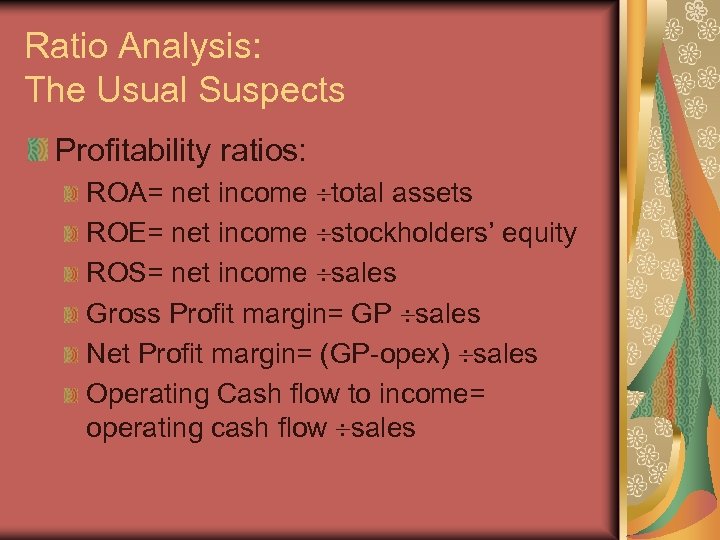
Ratio Analysis: The Usual Suspects Profitability ratios: ROA= net income total assets ROE= net income stockholders’ equity ROS= net income sales Gross Profit margin= GP sales Net Profit margin= (GP-opex) sales Operating Cash flow to income= operating cash flow sales
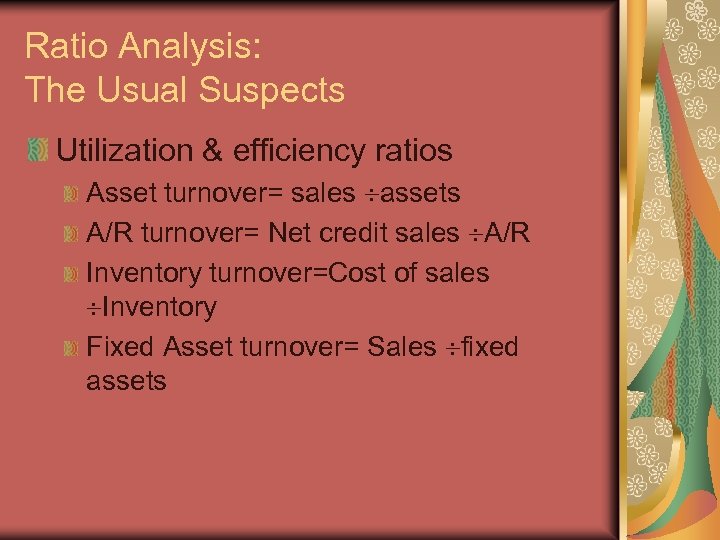
Ratio Analysis: The Usual Suspects Utilization & efficiency ratios Asset turnover= sales assets A/R turnover= Net credit sales A/R Inventory turnover=Cost of sales Inventory Fixed Asset turnover= Sales fixed assets
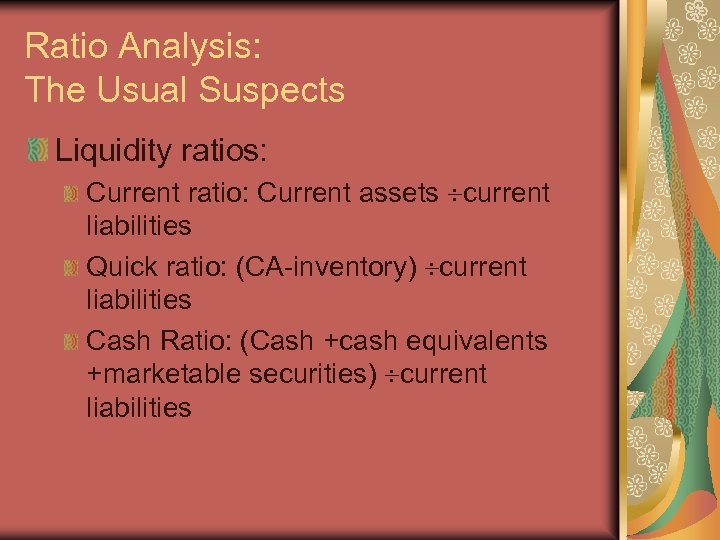
Ratio Analysis: The Usual Suspects Liquidity ratios: Current ratio: Current assets current liabilities Quick ratio: (CA-inventory) current liabilities Cash Ratio: (Cash +cash equivalents +marketable securities) current liabilities
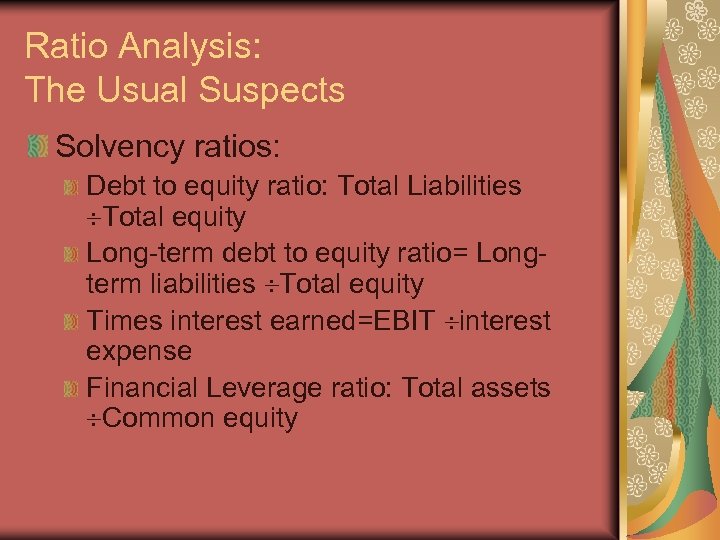
Ratio Analysis: The Usual Suspects Solvency ratios: Debt to equity ratio: Total Liabilities Total equity Long-term debt to equity ratio= Longterm liabilities Total equity Times interest earned=EBIT interest expense Financial Leverage ratio: Total assets Common equity
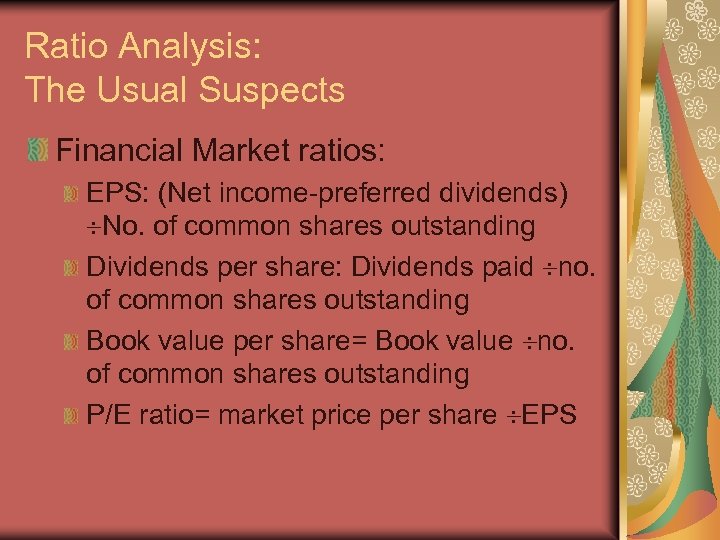
Ratio Analysis: The Usual Suspects Financial Market ratios: EPS: (Net income-preferred dividends) No. of common shares outstanding Dividends per share: Dividends paid no. of common shares outstanding Book value per share= Book value no. of common shares outstanding P/E ratio= market price per share EPS
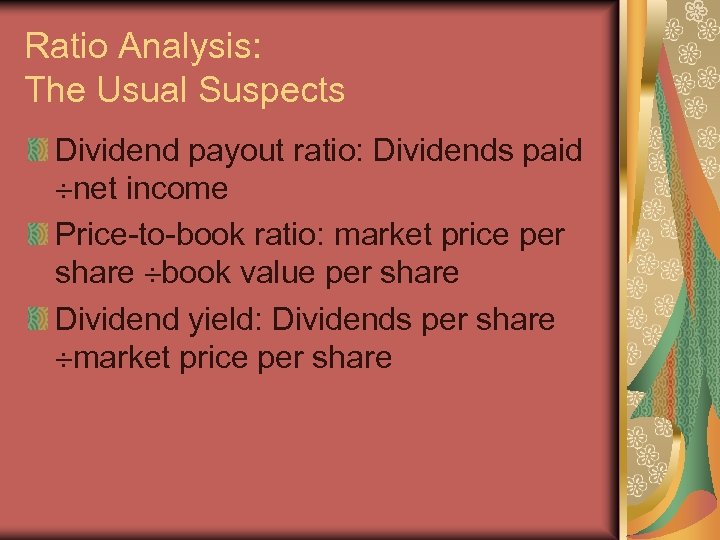
Ratio Analysis: The Usual Suspects Dividend payout ratio: Dividends paid net income Price-to-book ratio: market price per share book value per share Dividend yield: Dividends per share market price per share
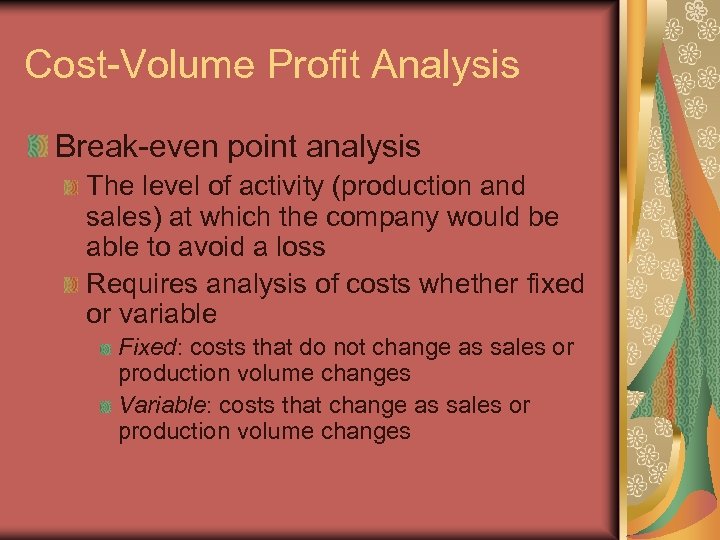
Cost-Volume Profit Analysis Break-even point analysis The level of activity (production and sales) at which the company would be able to avoid a loss Requires analysis of costs whether fixed or variable Fixed: costs that do not change as sales or production volume changes Variable: costs that change as sales or production volume changes
Cost-Volume Profit Analysis Contribution margin The difference between sales and variable cost Break-even point: Sales volume Fixed costs÷Contribution margin per unit Break-even point: Peso sales Fixed costs÷Contribution margin percentage
Asset Management Cash Management Refers to the efficient and effective utilization of cash to attain company objectives Main questions: How long is the cash cycle? How much should be its minimum balance? How much are the expected cash inflows or outflows? How many days does it take to collect receivables? How long does it take to convert receivables into cash? Is there an effective control system in the company?
Cash Management Cash Cycle Refers to the length of time that elapses from the point cash payment is made for purchases to the point of collection from customers/clients to whom goods/services have been sold. Days inventory + average collection period + days payables= no. of days in the cash cycle No of cash cycles in a year=360÷no of days in the cash cycle
Cash Management Minimum cash balance Ensure the availability of cash at all times and that idle cash is avoided. Annual cash requirement÷ 360 days x no of days cover Cash management strategies: Collect receivables as quickly as possible without resorting to high pressure collection techniques Stretch accounts payable without affecting credit rating. Turnover inventory as quickly as possible
Receivables Management Refers to the formulation and administration of plans and policies related to sales on account and ensuring the maintenance of receivables at a predetermined level and improve collectability. Determinants: Terms of sale Paying practices of customers Collection policies and practices Volume of credit sales Credit extensions and practices Cost of capital
Receivables Management Ratio of receivable to net credit sales Receivable turnover Average collection period Aging of receivables
Inventory Management Refers to the formulation and administration of plans and policies to efficiently and satisfactorily meet manufacturing and merchandising requirements and minimize costs relative to inventories. Relevant Costs Ordering costs Costs incurred every time an order is placed Carrying costs The cost of maintaining inventories Stockout costs the total effect of company’s failure to service customers or fill orders
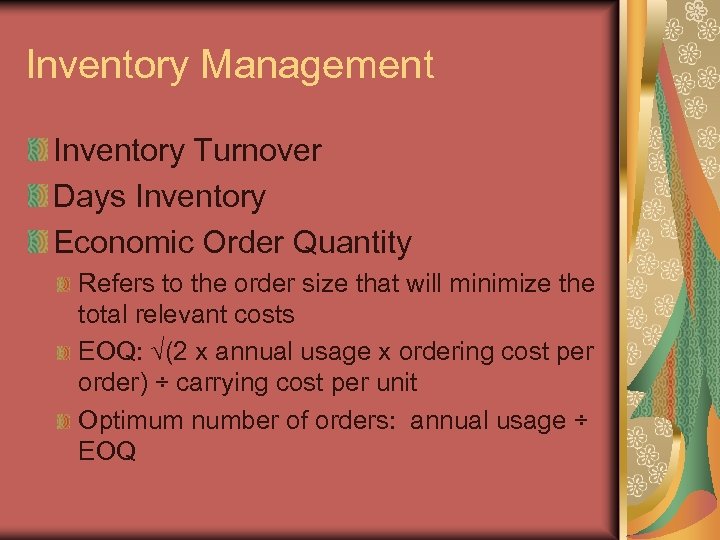
Inventory Management Inventory Turnover Days Inventory Economic Order Quantity Refers to the order size that will minimize the total relevant costs EOQ: √(2 x annual usage x ordering cost per order) ÷ carrying cost per unit Optimum number of orders: annual usage ÷ EOQ
Time Value of Money Refers to the fact that a peso in hand today is worth more than a peso promised in the future Depends on the rate you can earn while investing One must learn to evaluate the trade-off between pesos today and pesos sometime in the future
Future Value Refers to the amount of money an investment will grow to over some period of time at some given interest rate Also can be seen as the cash value of an investment at some time in the future Looks at single period and multiperiod investing
Future Value Investing in a Single Period If you were to invest Php 100 in a time deposit that pays 10% per year, how much would you have in one year? Ans: PRT= Php 110 If you invest for one period at an interest rate of r, your investment will grow to (1+r) per peso invested
Future Value Investing for More Than One Period With a Php 100 investment, what will you have after two years, assuming the interest rate doesn't change? Ans: Php 121 Php 110 x. 10= Php 11; Php 110 + 11= Php 121 The Php 121 has four parts: 1 st: the Php 100 principal, 2 nd: Php 10 interest for the 1 st year, 3 rd: Php 10 interest for the 2 nd year, 4 th: Php 1 interest earned in the 2 nd year on the interest paid in the 1 st year
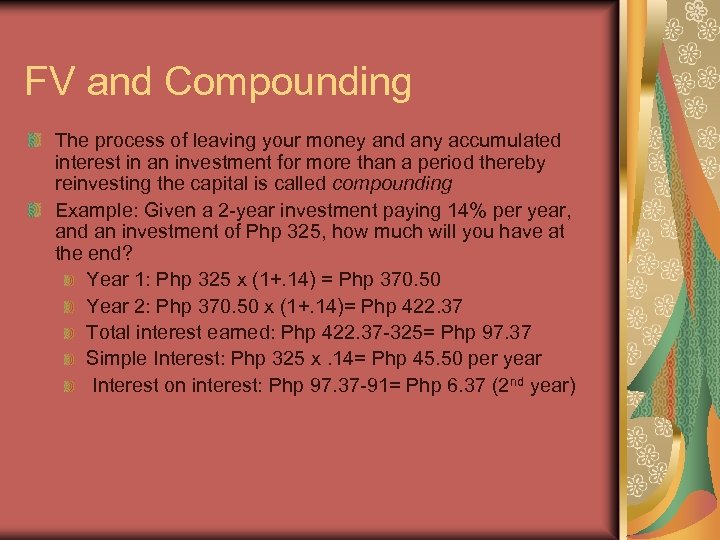
FV and Compounding The process of leaving your money and any accumulated interest in an investment for more than a period thereby reinvesting the capital is called compounding Example: Given a 2 -year investment paying 14% per year, and an investment of Php 325, how much will you have at the end? Year 1: Php 325 x (1+. 14) = Php 370. 50 Year 2: Php 370. 50 x (1+. 14)= Php 422. 37 Total interest earned: Php 422. 37 -325= Php 97. 37 Simple Interest: Php 325 x. 14= Php 45. 50 per year Interest on interest: Php 97. 37 -91= Php 6. 37 (2 nd year)
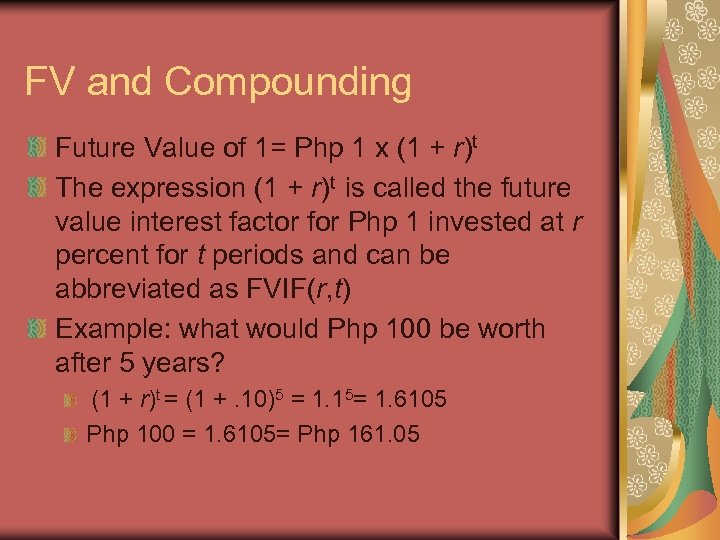
FV and Compounding Future Value of 1= Php 1 x (1 + r)t The expression (1 + r)t is called the future value interest factor for Php 1 invested at r percent for t periods and can be abbreviated as FVIF(r, t) Example: what would Php 100 be worth after 5 years? (1 + r)t = (1 +. 10)5 = 1. 15= 1. 6105 Php 100 = 1. 6105= Php 161. 05
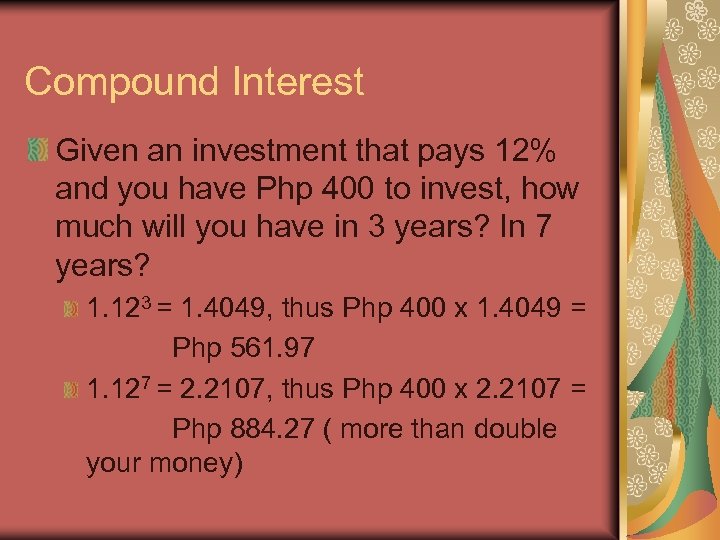
Compound Interest Given an investment that pays 12% and you have Php 400 to invest, how much will you have in 3 years? In 7 years? 1. 123 = 1. 4049, thus Php 400 x 1. 4049 = Php 561. 97 1. 127 = 2. 2107, thus Php 400 x 2. 2107 = Php 884. 27 ( more than double your money)
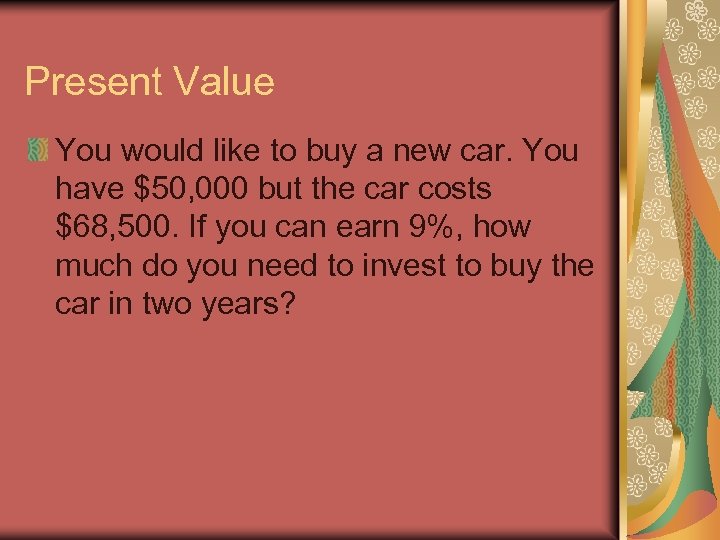
Present Value You would like to buy a new car. You have $50, 000 but the car costs $68, 500. If you can earn 9%, how much do you need to invest to buy the car in two years?
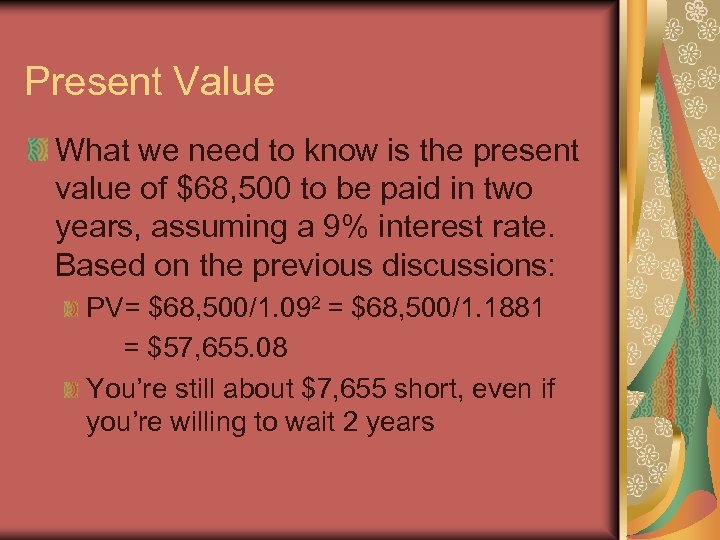
Present Value What we need to know is the present value of $68, 500 to be paid in two years, assuming a 9% interest rate. Based on the previous discussions: PV= $68, 500/1. 092 = $68, 500/1. 1881 = $57, 655. 08 You’re still about $7, 655 short, even if you’re willing to wait 2 years
Capital Budgeting If a firm wants to grow or expand, capital expenditures are a necessity Enhances profitability and stability Capital expenditures (capex) include the acquisition of land, building, equipment, machinery and securities of other companies May include any long-term commitment of funds with the expectation of a future return or benefit
Capital Budgeting Defined as long term planning for future capital expenditures Includes the manner of financing and the sourcing of funds. Steps are: Proposal generation, gathering of relevant data on proposals, evaluation, approval and implementation, control of costs and follow-up
Steps in Capital Budgeting Proposal Generation Management encourages all levels to make suggestions for capital expenditures Gathering of Relevant Data on Proposals Submitted Undertaken for proposal which require additional data for objective evaluation
Steps in Capital Budgeting Evaluation Capex proposals are reviewed to determine whether they are acceptable or not and the economic benefits which may be derived from them. E. g. use of cost-benefit analysis Approval and Implementation Approval for capex is done at different levels depending on the materiality thereof. After approval and funding, capex are made and approved in order to integrate into operations.
Steps in Capital Budgeting Control of Costs and Follow-up Actual costs are recorded, reported and compared with budgeted figures so that in case there are deviations, corrective measures can be implemented, e. g. cost cutting, improvement of benefits or termination of the project
Situations Requiring Capital Budgeting Capital budgeting should be used in all decision-making problems requiring longterm use of funds. Examples are: Investment in a proposed business venture Expansion or maintenance of current production or sales capacity Maintenance, replacement or renewal of existing facilities Continued ownership of an asset or sale and leaseback? Should facilities be leased out or used in operations?
Types of Projects Independent Projects These are projects that do not compete with one another so that the acceptance of one does not eliminate the others for future consideration, e. g. project proposal A is for increasing production capacity for product A while project proposal B is for increasing sales volume for product B in Visayas and Mindanao
Types of Projects Mutually Exclusive projects Those that compete with one another so that the approval or acceptance of one eliminates the others in the group for further consideration e. g. : both proposals X and Y have been presented to increase production capacity for the sole product of the company in the same department.
Cash Flows in Capital Budgeting Cash flows in different alternatives are determined and their values are computed using a common point in time Cash flows are: investment, cash returns, terminal value
Cash Flows Investment This refers to the net outlay of resources at the inception of a business venture or special project. This includes the purchase cost of assets, incidental costs such as freight in and installation costs, working capital management, and market value assets already owned and to be transferred to the venture or project
Cash Flows Cash Returns This refers to the net cash inflows expected to be realized when the business or special project is operational. This is not synonymous to net income for the latter is net of charges not requiring cash outlays (such as depreciation) and those not related to normal operations
Cash Flows Terminal Cash flow This refers to cash inflow that may be realized upon termination of a business venture or project and consists of working capital that is to be expected to be released and the realizable value of assets used.
Economic Life This term refers to the length of period during which economic benefits can be expected from a venture or project. Can also be known as the “estimated useful life” of the asset
Methods of Evaluating Capital Investment Proposals Methods that do not take into account the time value of money: Payback period: this refers to the length of time it would take to recover an investment Formula: Investment ÷ annual cash returns Return on Investment: this indicates the percentage of investment that is expected to be recovered in one year Formula: annual cash returns ÷ investment
Methods of Evaluating Capital Investment Proposals Methods that take into account the time value of money Internal Rate of Return: this refers to the rate of return that a long-term investment earns Procedure: a) Compute for the payback period; b)with the payback period as the present value factor, locate it on an annuity table considering the economic life of the investment. The corresponding interest rate for the column in which it is found is the IRR
Methods of Evaluating Capital Investment Proposals Net Present Value (NPV): This refers to the excess of the present value of cash returns discounted at a chosen cut-off rate over the amount of the investment Formula: Present value of annual cash returns discounted at the cut-off rate minus the investment Profitability Index: this refers to the ratio of the present value of annual cash returns discounted at a chosen cut-off rate to the investment required Formula: PV of annual cash returns discounted at the cut-off rate ÷ Investment
The Cost of Capital For management and investors in a firm, the cost of capital is a critical component in investment decision making. If management can invest in projects that have returns in excess of the cost of capital, then the firm has created value; if returns are below, then value is destroyed.
Cost of Capital Cost of capital calculations depend on estimated and assumed input values, such as a project’s risk characteristics; higher risk means higher cost of capital. The cost of capital is the rate of return the suppliers of capital require as compensation for the use of their funds.
Cost of Capital A company can raise capital by issuing equity, debt, preferred stock and other securities Each source of capital has a separate required rate of return called the component cost of capital.
WACC The weighted average cost of capital (WACC) is the weighted average of the required rates of return of all the capital components the company uses to finance its investments. Weights are the proportion of all the various sources of capital the company uses.
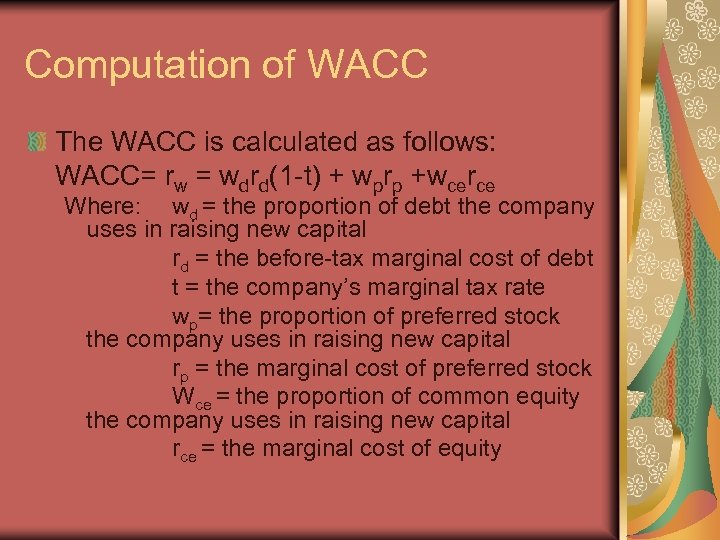
Computation of WACC The WACC is calculated as follows: WACC= rw = wdrd(1 -t) + wprp +wcerce Where: wd = the proportion of debt the company uses in raising new capital rd = the before-tax marginal cost of debt t = the company’s marginal tax rate wp= the proportion of preferred stock the company uses in raising new capital rp = the marginal cost of preferred stock Wce = the proportion of common equity the company uses in raising new capital rce = the marginal cost of equity
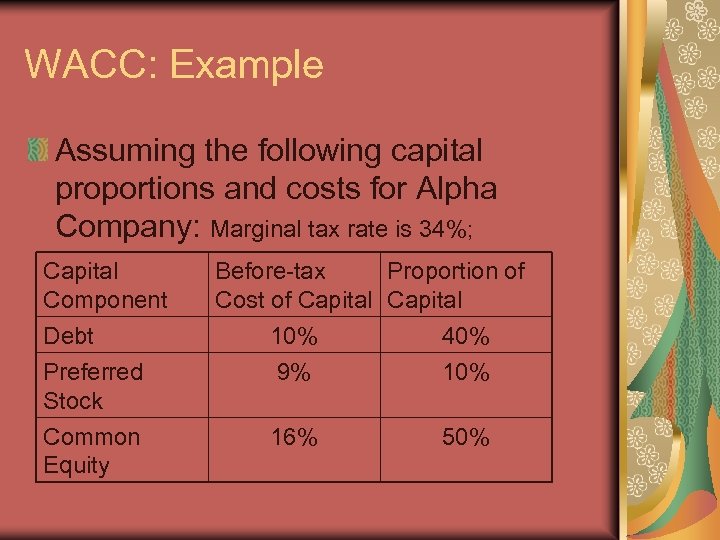
WACC: Example Assuming the following capital proportions and costs for Alpha Company: Marginal tax rate is 34%; Capital Component Debt Preferred Stock Common Equity Before-tax Proportion of Cost of Capital 10% 40% 9% 10% 16% 50%
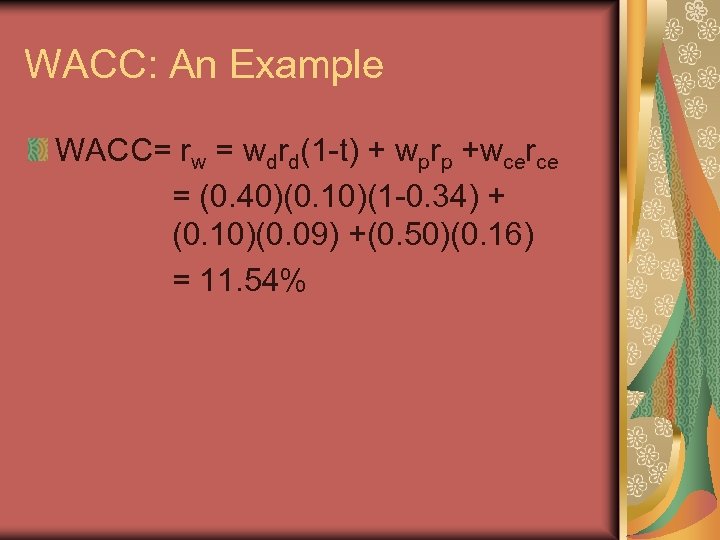
WACC: An Example WACC= rw = wdrd(1 -t) + wprp +wcerce = (0. 40)(0. 10)(1 -0. 34) + (0. 10)(0. 09) +(0. 50)(0. 16) = 11. 54%
Capital Structure and WACC The WACC is useful in determining the firm’s optimal capital structure. The optimal capital structure represents the debt-equity ratio that results in the lowest possible WACC. The value of a firm is maximized when the WACC is minimized.
Capital Market Theory Capital market theory focuses of the development of a model of pricing risky assets. The final product, the Capital Asset Pricing Model (CAPM) will allow you to determine the required rate of return for any risky asset.
Risk and Return These two concepts are directly related: e. g. high risk, high return There are many ways to measure risk, like the use of standard deviation, variance and covariance, and the use of beta, which measures systemic risk. Total risk=Systemic risk + unsystemic risk
Systemic risk is defined as nondiversifiable or unavoidable risk; overall market risks like changes in a nation’s economy, tax reforms by Congress, change in the world energy situation, force majeure. These risks affect securities overall and cannot be diversfied away. Can be measured by the Beta coefficeint
Unsystemic risk is defined as diversifiable or avoidable risk that are unique to a particular company or security like strikes, new entrants in a market, technological advances rendering products obsolete. Can be reduced by diversification of the investment portfolio.
Systemic Vs Unsystemic Risk People dislike risk, that is given a choice between a lottery and its expected value for sure, they choose the expected value. An example of this which we are all familiar with is insurance. If you do not take insurance you are participating in a lottery. An accident would leave you poor, but no accident would be equivalent to winning a lottery. If you buy insurance then you have guaranteed yourself a constant level of wealth, irrespective of the occurrence of an accident. Investors will trade off risk (which they dislike) with higher expected returns (which they like). Different people will have different levels of risk aversion. Investors with low risk aversion will choose more risky portfolios for their higher expected returns, compared to investors with higher risk aversion.
Systemic Vs Unsystemic Risk It is possible to get rid of unsystematic risk by combining many stocks in a portfolio (diversification). Systematic risk which affects all stocks however cannot be reduced by diversification. Investors therefore care only about systematic risk, and require a higher expected return only for bearing larger systematic risk. They do not care about unsystematic risk, and need not be compensated for it. In other words, only systematic risk is priced. The measure of systematic risk is (beta). This is proportional to the correlation of the stock to the market portfolio. The market portfolio is the portfolio of all assets in the economy. So the market portfolio has only systematic risk, and the correlation of a stock with the market portfolio is a measure of the systematic risk of the stock. The of the market portfolio is 1, of the risk-free asset 0 (as the risk-free asset always returns the same amount irrespective of how the market portfolio has performed). Greater the , greater the systematic risk for the stock. Hence greater must be the expected return to get investors to hold the stock.
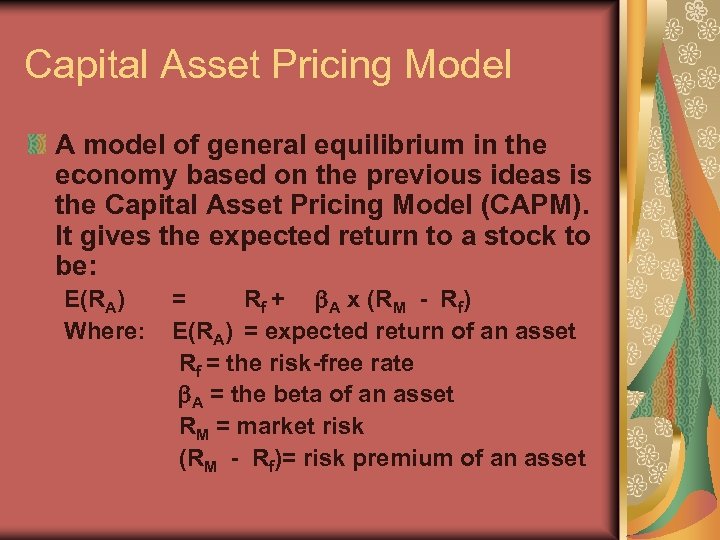
Capital Asset Pricing Model A model of general equilibrium in the economy based on the previous ideas is the Capital Asset Pricing Model (CAPM). It gives the expected return to a stock to be: E(RA) Where: = Rf + A x (RM - Rf) E(RA) = expected return of an asset Rf = the risk-free rate A = the beta of an asset RM = market risk (RM - Rf)= risk premium of an asset
CAPM: What It Shows The CAPM shows that the expected return of an asset depends on three things: The pure time value of money: as measured by the risk-free rate, Rf , this is the reward for merely waiting for your money, without taking any risk. The reward for bearing systemic risk: as measured by the market risk premium (RM Rf), this is the reward the market offers for bearing an average amount of systemic risk in addition to waiting The amount of systemic risk: as measured by A
Efficient Market Hypothesis Security prices adjust rapidly to new information, therefore current security prices fully reflect all available information Assumptions: A large number of profit-maximizing participants analyze and value securities New information regarding securities comes to the market in a random fashion Profit-maximizing investors adjust rapidly to reflect the effect of new information The expected returns in the current price of the security should reflect its risk
Levels of efficiency Weak form Assumes that current stock prices fully reflect all security market information; reflects all past information Semi-strong form Assumes that security markets adjust rapidly to the release of all public information Strong form Assumes security prices fully reflect all information from public and private sources
What are securities? Securities are a group of products offered in the financial markets Traditionally recognized in groups, categories or segments Instruments issued to raise capital (through debt or equity securities) Note: the term “capital” in financial markets refer to both equity and debt capital
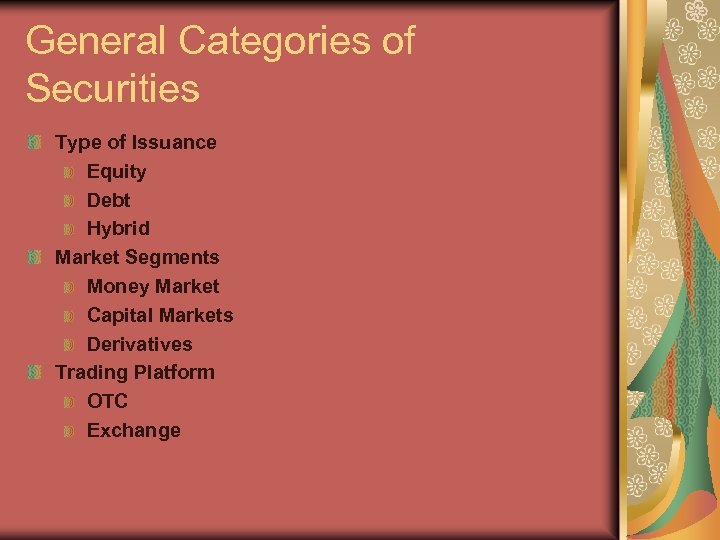
General Categories of Securities Type of Issuance Equity Debt Hybrid Market Segments Money Market Capital Markets Derivatives Trading Platform OTC Exchange
Market Participants Issuers Investors Underwriters Dealers/Brokers Others Registry, Clearing and Settlement Agencies
Market Organizations Primary Market The new issue market, dominated by investment bankers who are experts in new issues Usually new issues are underwritten, a process in which an underwriter purchases a new issue (debt or equity) from an issuing entity (corporation, partnership, or government) at an agreed-upon price then sells the issue to the public
Market Organizations Secondary Market Once issues have been distributed to the public, members of the public may trade the securities among themselves Trading occurs in the secondary market Importance: Provides liquidity (supports primary market) Lowers costs Helps determine market pricing for new issues
Secondary Market Secondary market is organized with trading forums consisting of Exchanges – e. g. . Phil. Stock Exchange, Philippine Dealing and Exchange (PDEX) Corp. Over-the-counter market (OTC) - a network of trading rooms linked by telephone and electronic communications to facilitate trading
Secondary Market Exchanges vs. OTC Location – Liquidity Standardization vs. Flexibility – E. g. , Contracts, Trading hours, Lot sizes Transparency Counterparty Risks
Introduction to Long-Term Debt These are obligations that are to mature beyond one year Examples are mortgages, bonds and stocks (although stocks are technically not considered as debt, they are a form of long-term financing)
Mortgages When real property is used as collateral for an obligation, the contract is a mortgage contract They are also known as notes payable secured by real property (loans range from 70%-90% of the value of collateral) Senior vs. Junior Mortgages
Introduction to Bonds It is defined as a certificate of indebtedness; Also known as a formal, unconditional promise to pay a specified amount of money at a determinable future date and to make periodic interest payments at a stated rate until the principal amount is paid.
Bonds Indenture: the written agreement on bond issues between the issuing company and the bondholder. Bonds vs. Promissory notes: bonds are more formal, they bear the seal of a corporation and they have longer maturity. A promissory note is a whole unit issued to one party; A bond liability is divided into fractional parts and sold to different investors or lenders.
Classifications of Bonds Main classifications: According to tenor: short-term, medium term and long term According to issuing entity: corporate, government According to maturity: straight, serial, convertible, callable According to payment of interest: Coupon bonds, zero-coupon According to coupon interest: fixed, floating According to transferability: bearer, registered, coupon
Components of Bonds There are three main parts to a bond: Face Value Coupon rate Maturity date These parts are integral to the understanding of bond valuation since at its simplest, we use the simple interest formula to compute for the earnings from the bond.
Bond Values A bond issuer has to determine the value of the bonds (or the price at which investors would be willing to buy the bonds), which is dependent their desired rate of return. The value of the bonds is equal to the present value of future cash flows that an investor may expect from the bond, discounted at their desired rate of return
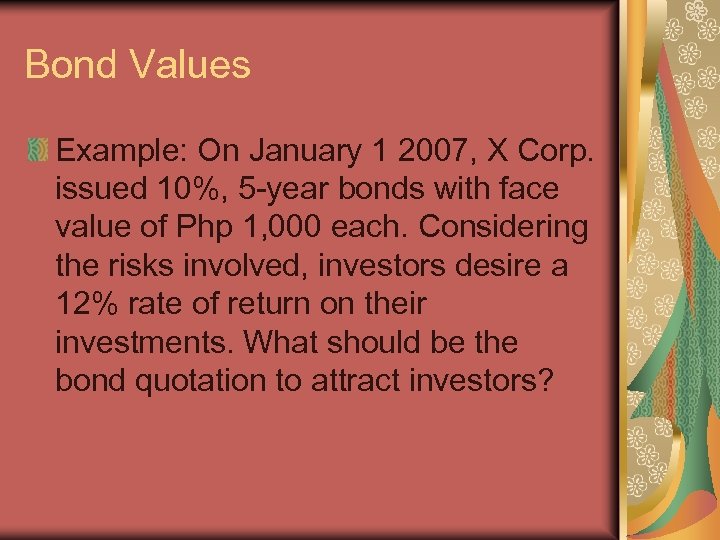
Bond Values Example: On January 1 2007, X Corp. issued 10%, 5 -year bonds with face value of Php 1, 000 each. Considering the risks involved, investors desire a 12% rate of return on their investments. What should be the bond quotation to attract investors?
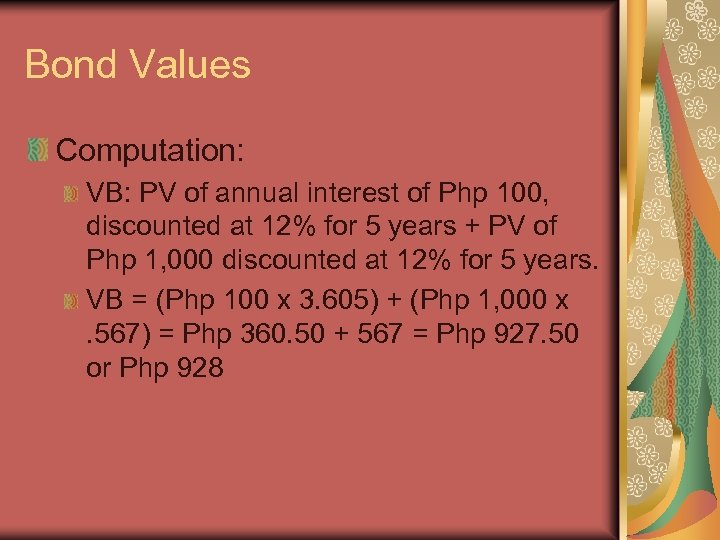
Bond Values Computation: VB: PV of annual interest of Php 100, discounted at 12% for 5 years + PV of Php 1, 000 discounted at 12% for 5 years. VB = (Php 100 x 3. 605) + (Php 1, 000 x. 567) = Php 360. 50 + 567 = Php 927. 50 or Php 928
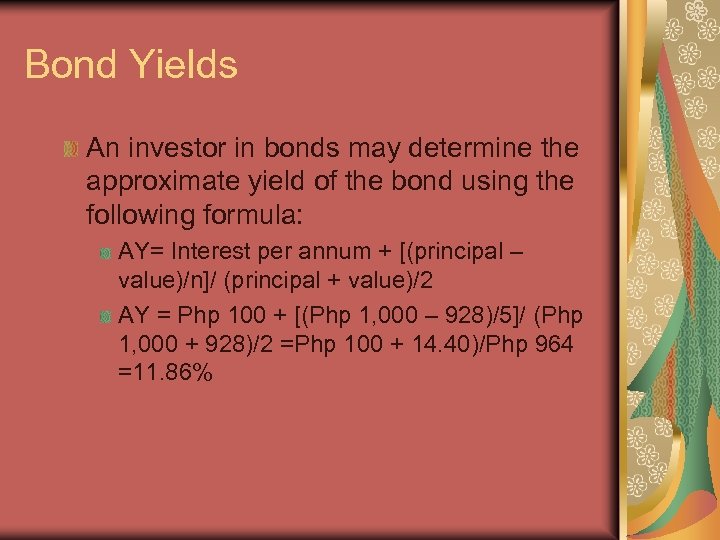
Bond Yields An investor in bonds may determine the approximate yield of the bond using the following formula: AY= Interest per annum + [(principal – value)/n]/ (principal + value)/2 AY = Php 100 + [(Php 1, 000 – 928)/5]/ (Php 1, 000 + 928)/2 =Php 100 + 14. 40)/Php 964 =11. 86%
Discounts and Premiums Bond premiums and discounts: When bonds are sold for higher than face value, the difference is called the bond premium, the reverse case is called a bond discount. Bonds are quoted in percentages , thus if a bond issue is at 96, it means the issue price is 96% of face value.
Discounts and Premiums Example: On January 1, 2006, XXX Corp. issued Php 1, 000 worth of 5 -year 15% bonds with each bond having a face value of Php 10, 000. Interest is payable every December 31 st, with flotation cost amounting to Php 34, 000. Bonds will mature on January 1, 2011.
Discounts and Premiums (Value of whole bond issue x discount) – flotation cost = net proceeds (Php 1, 000 x 96%) – Php 34, 000 = Php 926, 000 Original discount is at Php 40, 000, but with the flotation costs, total discount is at Php 74, 000.
Stocks A corporation’s capital stock may be divided into two or more classes to attract different kinds of investors. Classifications: Common: entitles holder to equal division of profits without any advantage or preference over other classes of stock Preferred: entitles holder to some preferences over other classes of stock
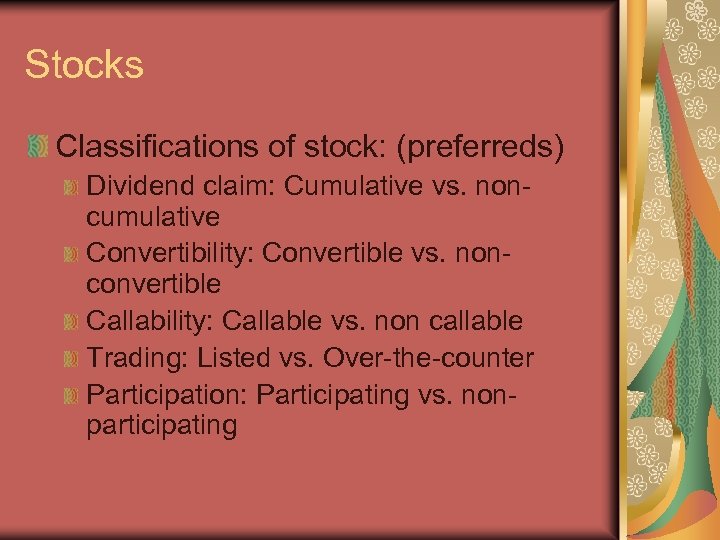
Stocks Classifications of stock: (preferreds) Dividend claim: Cumulative vs. noncumulative Convertibility: Convertible vs. nonconvertible Callability: Callable vs. non callable Trading: Listed vs. Over-the-counter Participation: Participating vs. nonparticipating
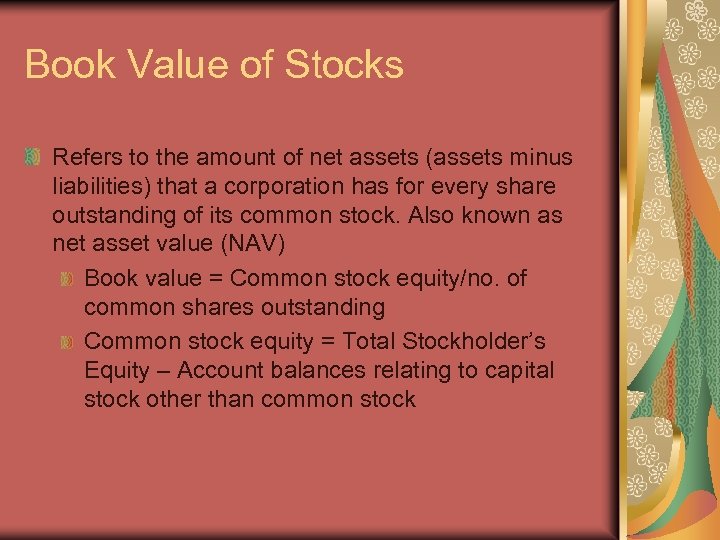
Book Value of Stocks Refers to the amount of net assets (assets minus liabilities) that a corporation has for every share outstanding of its common stock. Also known as net asset value (NAV) Book value = Common stock equity/no. of common shares outstanding Common stock equity = Total Stockholder’s Equity – Account balances relating to capital stock other than common stock
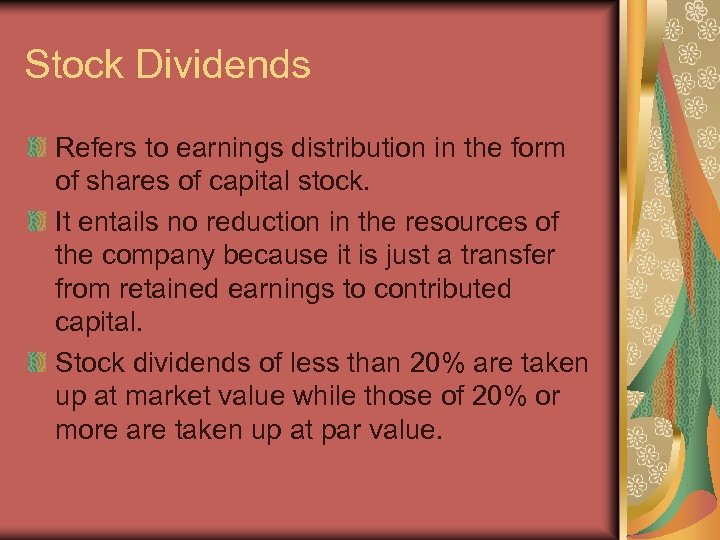
Stock Dividends Refers to earnings distribution in the form of shares of capital stock. It entails no reduction in the resources of the company because it is just a transfer from retained earnings to contributed capital. Stock dividends of less than 20% are taken up at market value while those of 20% or more are taken up at par value.
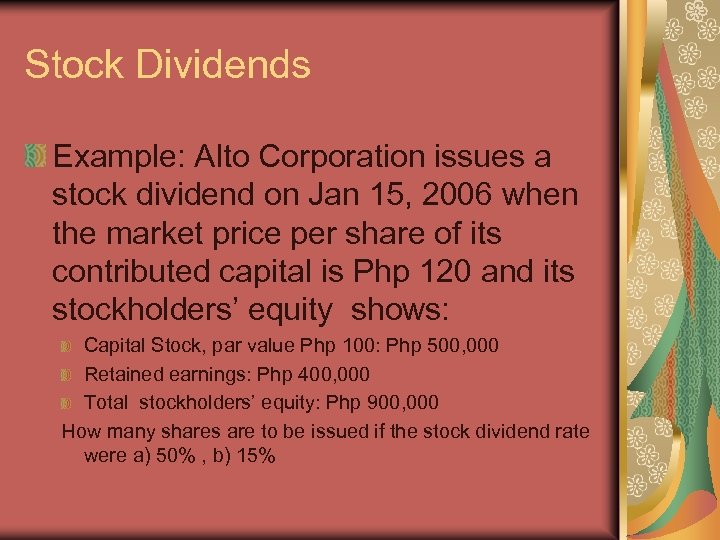
Stock Dividends Example: Alto Corporation issues a stock dividend on Jan 15, 2006 when the market price per share of its contributed capital is Php 120 and its stockholders’ equity shows: Capital Stock, par value Php 100: Php 500, 000 Retained earnings: Php 400, 000 Total stockholders’ equity: Php 900, 000 How many shares are to be issued if the stock dividend rate were a) 50% , b) 15%
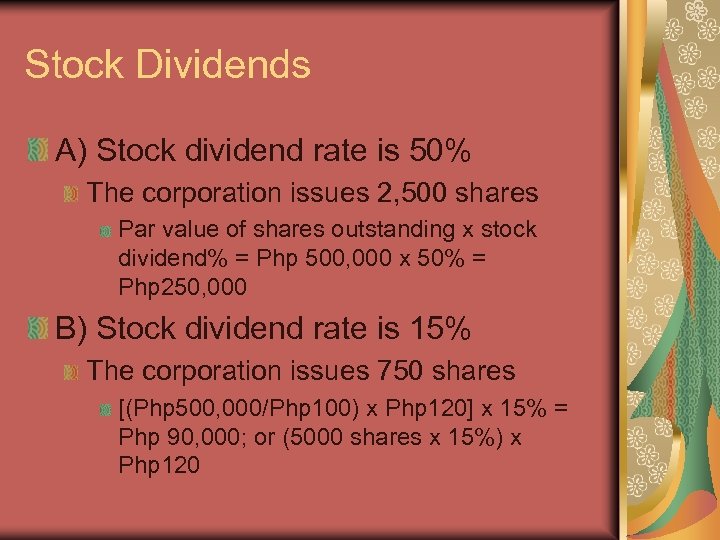
Stock Dividends A) Stock dividend rate is 50% The corporation issues 2, 500 shares Par value of shares outstanding x stock dividend% = Php 500, 000 x 50% = Php 250, 000 B) Stock dividend rate is 15% The corporation issues 750 shares [(Php 500, 000/Php 100) x Php 120] x 15% = Php 90, 000; or (5000 shares x 15%) x Php 120
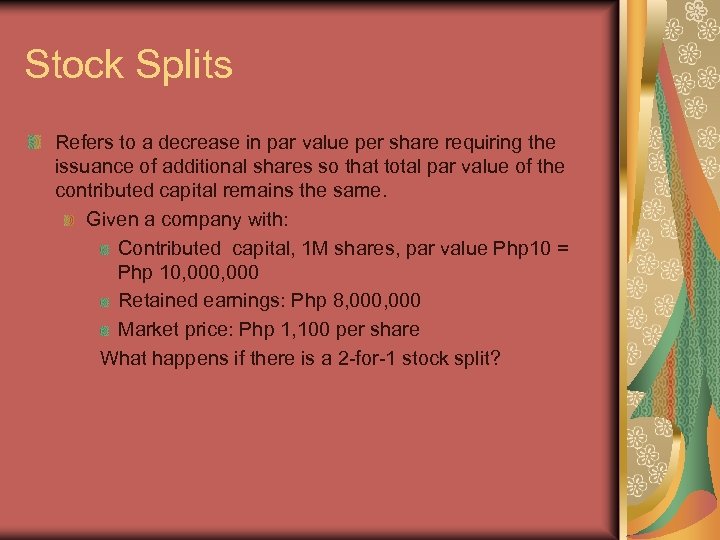
Stock Splits Refers to a decrease in par value per share requiring the issuance of additional shares so that total par value of the contributed capital remains the same. Given a company with: Contributed capital, 1 M shares, par value Php 10 = Php 10, 000 Retained earnings: Php 8, 000 Market price: Php 1, 100 per share What happens if there is a 2 -for-1 stock split?
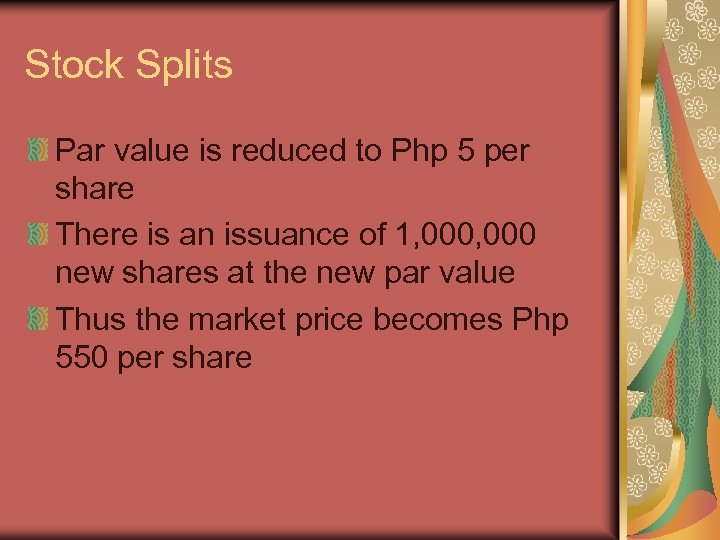
Stock Splits Par value is reduced to Php 5 per share There is an issuance of 1, 000 new shares at the new par value Thus the market price becomes Php 550 per share
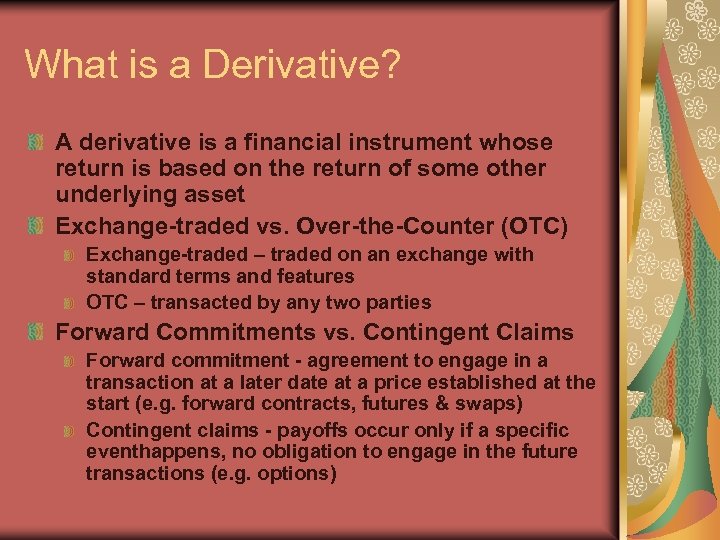
What is a Derivative? A derivative is a financial instrument whose return is based on the return of some other underlying asset Exchange-traded vs. Over-the-Counter (OTC) Exchange-traded – traded on an exchange with standard terms and features OTC – transacted by any two parties Forward Commitments vs. Contingent Claims Forward commitment - agreement to engage in a transaction at a later date at a price established at the start (e. g. forward contracts, futures & swaps) Contingent claims - payoffs occur only if a specific eventhappens, no obligation to engage in the future transactions (e. g. options)
Purposes of Derivatives Price discovery Prices of derivatives today embody information about the likely prices of underlying goods that will prevail at those future expiration dates Risk management / hedging Minimizing risks by combining derivatives with pre-existing business risks Investment and Speculation Gambling on market movements Could lead to large financial profits or losses
Forward Contracts A forward contract is an agreement that the buyer will buy from the seller an underlying asset at a future date at a pre-established price Transactions are private and unregulated and are subject to default risk Buyer = Long, Seller = Short No money changes hands at the start Two possible settlements Delivery: long pays the price and short delivers the asset Cash settlement: long and short just pay the net cash value of the position on the delivery date
Example: Currency Forward Contracts To minimize or eliminate the currency fluctuation risk by locking the exchange rate to buy/sell a certain currency for another currency Example: A local call center company, anticipating to get US$ a month from now could enter into a forward contract to sell US$ for Php one month from now, by pre-agreeing to the price today Settlement could be by delivery or cash-settled (difference only)
Types of Futures Contracts Commodity Futures Currency Futures Treasury Bills/Bonds Futures Euro dollar Futures Stock Market Futures
Features of a Futures Contract Regulated and exchange-traded forward contract Standardized terms and conditions by the exchange: Types of underlying to be traded Expiration dates and how far the expirations go Contract size and price quotation unit Trading hour, location, and pit or electronic trading Clearinghouse provides a guarantee against credit losses, by way of daily settlement or marking to market mechanism through margin maintenance
Characteristics of Futures Contracts Standardized terms and conditions Has the liquidity for the secondary market Protected by the existence of a clearinghouse Need to maintain margin (both for buyer and seller) Fungible: the ability to offset a position (Offsetting: to re-enter the market with an opposite/reverse position, doesn’t matter who will be the counterparty)
Options An option is an instrument that gives a party a right (but not an obligation) to buy/sell from the other party at a fixed price over a period of time Call: an option to buy Put: an option to sell European option - the option that can be exercised only on its expiration day American option - the option that can be exercised on any day through the expiration day
Features of Option Contacts Option price /option premium the price to be paid by the option buyer for the right to exercise Exercise price / strike price at which the option holder can buy/sell the underlying Exercise the option when the option holder uses the right to buy/sell the underlying Expiration date or time to expiration
Types of Options Stock options or equity options Index options Bond options Interest rate options Currency options Options on futures Commodity options
Swaps An agreement to exchange a series of future cash flows Not only single payment like forward contracts Netting: parties exchange the net amount owed (except for currency swaps due to different currency) Generally settled in cash Also private in nature, hence face a default risk Common examples are interest rate and currency swaps
Скачать презентацию Review of Financial Management by Henry B Prudente
a3bc0b6b20091f679277f7bc7d3e1bcf.ppt