


 Скачать презентацию Review of Data Structures l We ve studied concrete
f5da26ad5d3f07c1bce39a4fc1eb25f7.ppt
- Количество слайдов: 12
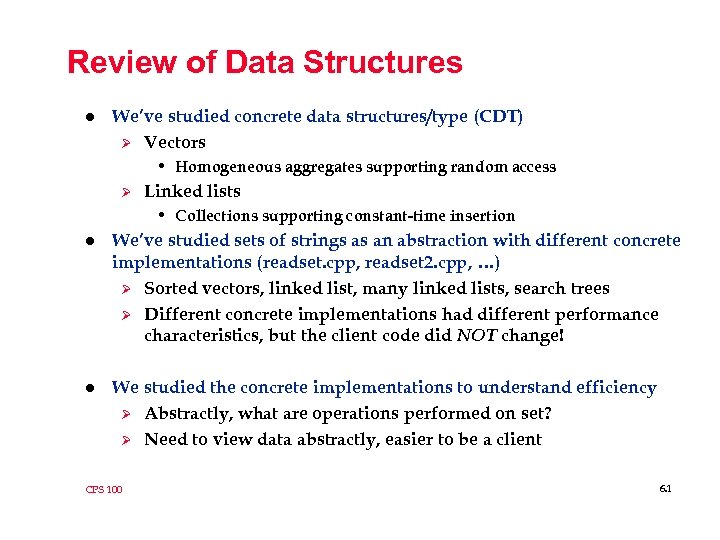 Review of Data Structures l We’ve studied concrete data structures/type (CDT) Ø Vectors • Homogeneous aggregates supporting random access Ø Linked lists • Collections supporting constant-time insertion l We’ve studied sets of strings as an abstraction with different concrete implementations (readset. cpp, readset 2. cpp, …) Ø Sorted vectors, linked list, many linked lists, search trees Ø Different concrete implementations had different performance characteristics, but the client code did NOT change! l We studied the concrete implementations to understand efficiency Ø Abstractly, what are operations performed on set? Ø Need to view data abstractly, easier to be a client CPS 100 6. 1
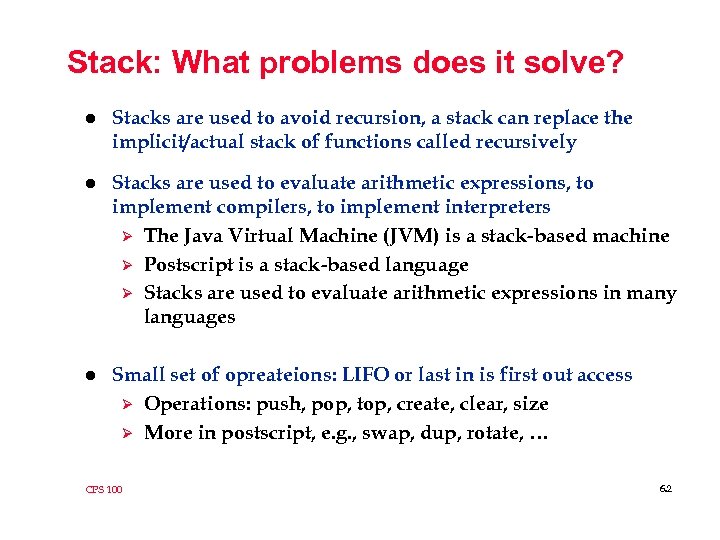 Stack: What problems does it solve? l Stacks are used to avoid recursion, a stack can replace the implicit/actual stack of functions called recursively l Stacks are used to evaluate arithmetic expressions, to implement compilers, to implement interpreters Ø The Java Virtual Machine (JVM) is a stack-based machine Ø Postscript is a stack-based language Ø Stacks are used to evaluate arithmetic expressions in many languages l Small set of opreateions: LIFO or last in is first out access Ø Operations: push, pop, top, create, clear, size Ø More in postscript, e. g. , swap, dup, rotate, … CPS 100 6. 2
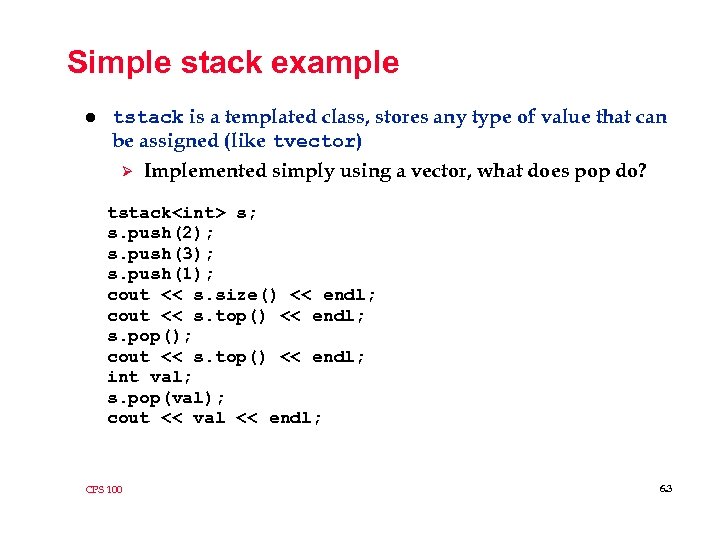 Simple stack example l tstack is a templated class, stores any type of value that can be assigned (like tvector) Ø Implemented simply using a vector, what does pop do? tstack
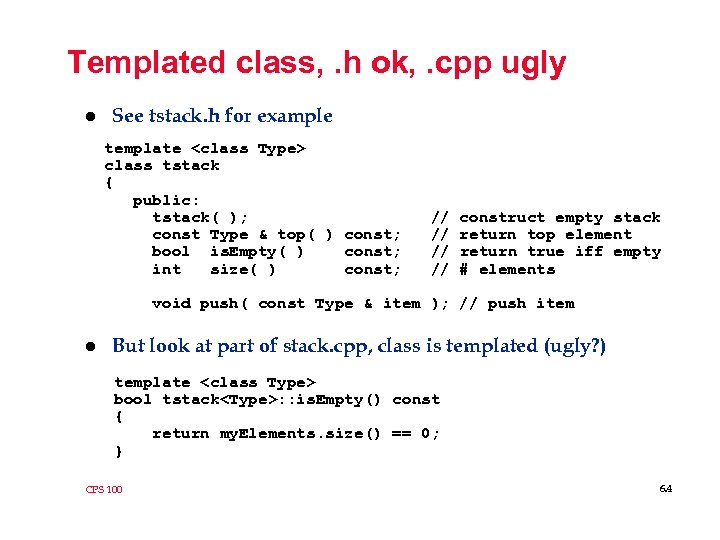 Templated class, . h ok, . cpp ugly l See tstack. h for example template
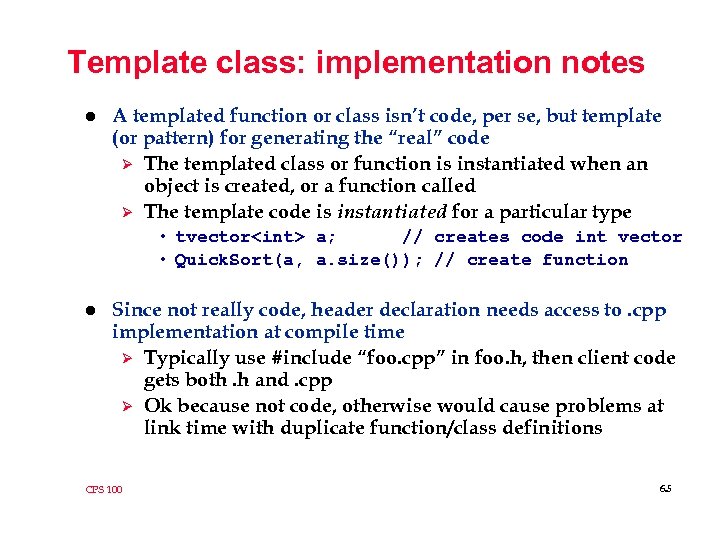 Template class: implementation notes l A templated function or class isn’t code, per se, but template (or pattern) for generating the “real” code Ø The templated class or function is instantiated when an object is created, or a function called Ø The template code is instantiated for a particular type • tvector
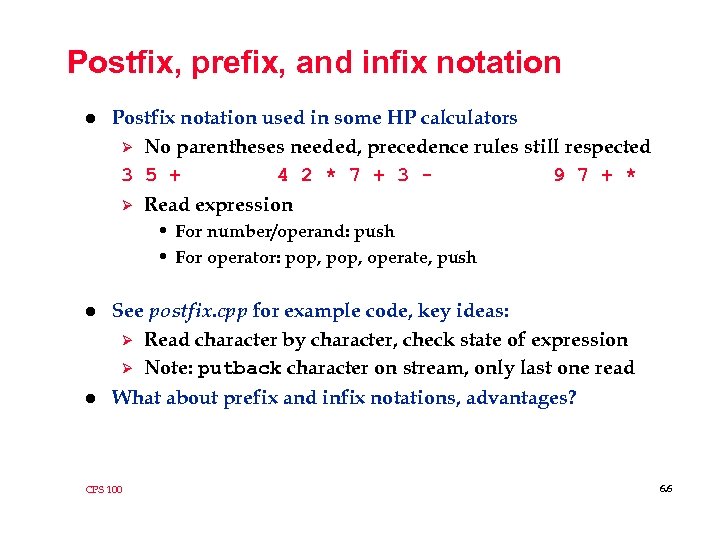 Postfix, prefix, and infix notation l Postfix notation used in some HP calculators Ø No parentheses needed, precedence rules still respected 3 5 + 4 2 * 7 + 3 9 7 + * Ø Read expression • For number/operand: push • For operator: pop, operate, push l l See postfix. cpp for example code, key ideas: Ø Read character by character, check state of expression Ø Note: putback character on stream, only last one read What about prefix and infix notations, advantages? CPS 100 6. 6
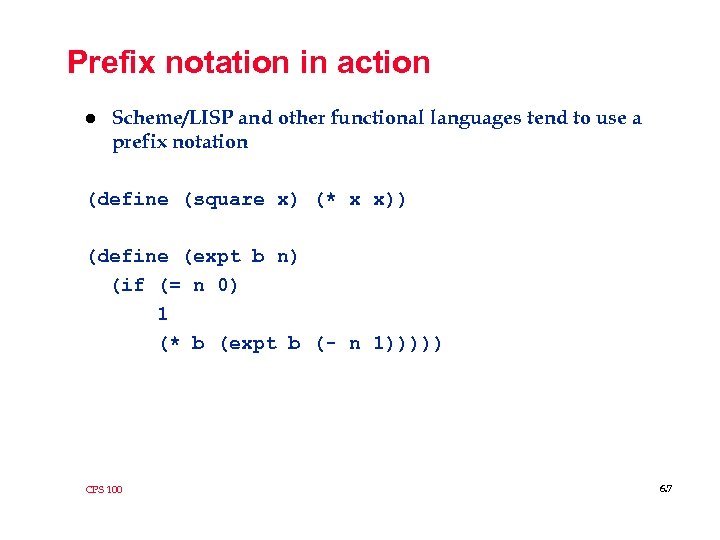 Prefix notation in action l Scheme/LISP and other functional languages tend to use a prefix notation (define (square x) (* x x)) (define (expt b n) (if (= n 0) 1 (* b (expt b (- n 1))))) CPS 100 6. 7
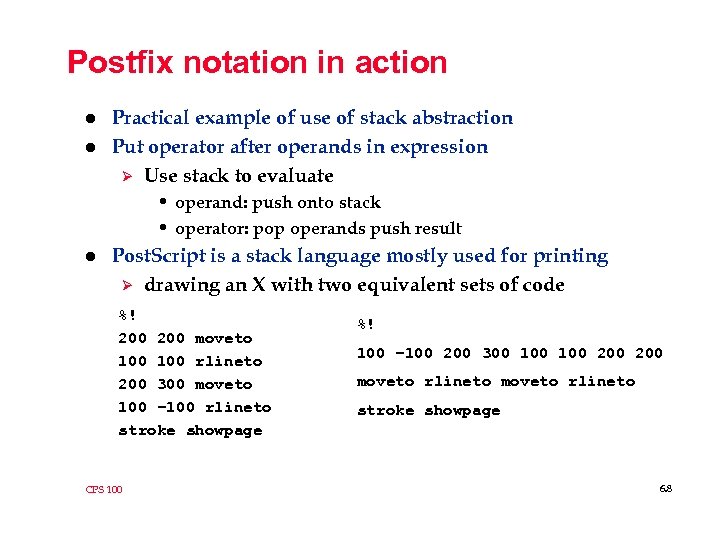 Postfix notation in action l l Practical example of use of stack abstraction Put operator after operands in expression Ø Use stack to evaluate • operand: push onto stack • operator: pop operands push result l Post. Script is a stack language mostly used for printing Ø drawing an X with two equivalent sets of code %! 200 moveto 100 rlineto 200 300 moveto 100 – 100 rlineto stroke showpage CPS 100 %! 100 – 100 200 300 100 200 moveto rlineto stroke showpage 6. 8
 Queue: another linear ADT l FIFO: first in, first out, used in many applications Ø Scheduling jobs/processes on a computer Ø Tenting policy? Ø Computer simulations l Common operations (as used in tqueue. h/tqueue. cpp) Ø Add to back, remove from front • Called enqueue, dequeue, like s. push() and s. pop() • Analog of top() is front() l Also used in level-order tree traversal, similar to pre-order without recursion but using stack Ø See code in treelevel. cpp CPS 100 6. 9
 Stack and Queue implementations l Different implementations of queue (and stack) aren’t really interesting from an algorithmic standpoint Ø Complexity is the same, performance may change (why? ) Ø Use vector or linked list, any sequential structure l Linked list is easy for stack, where to add/remove nodes? l Linked list is easy for queue, where to add/remove nodes? Ø Use circular linked list, why? l Vector for queue is tricky, need ring buffer implementation, add but wrap-around if possible before growing Ø Tricky to get right (see tqueue. h, tqueue. cpp) CPS 100 6. 10
 Using linear data structures l We’ve studied vectors, stacks, queues, which to use? Ø It depends on the application Ø Vector is multipurpose, why not always use it? • Make it clear to programmer what’s being done • Other reasons? l Other linear ADTs exist Ø List: add-to-front, add-to-back, insert anywhere, iterate • Alternative: create, head, tail (see Clist<. . > in tapestry) • Linked-list nodes are concrete implementation Ø Deque: add-to-front, add-to-back, random access • Why is this “better” than a vector? • How to implement? CPS 100 6. 11
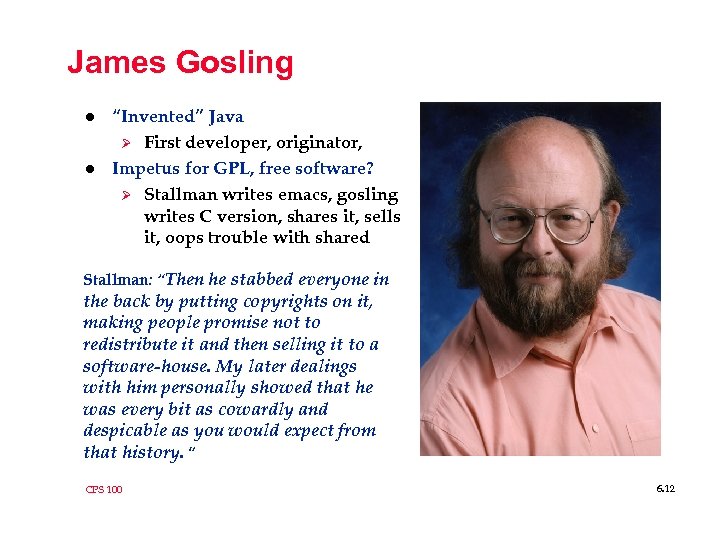 James Gosling l l “Invented” Java Ø First developer, originator, Impetus for GPL, free software? Ø Stallman writes emacs, gosling writes C version, shares it, sells it, oops trouble with shared Stallman: “Then he stabbed everyone in the back by putting copyrights on it, making people promise not to redistribute it and then selling it to a software-house. My later dealings with him personally showed that he was every bit as cowardly and despicable as you would expect from that history. “ CPS 100 6. 12