


 Скачать презентацию Review for Midterm SPAU 3343 Updated Spring 2014
711b421fd8e1d342d3e6e36b66c5dd59.ppt
- Количество слайдов: 65
 Review for Midterm SPAU 3343 Updated Spring, 2014 1
 IPA • International Phonetic Alphabet. • Each symbol represents a single sound. • We can transcribe any sound of any language with IPA. 2
 Linguistics • The scientific study of language. 3
 Phonetics • Part of linguistics. The scientific study of speech sound. – Articulatory phonetics: How speech sounds are articulated. Description and classification of speech sounds. – Acoustic phonetics: How speech sounds are generated and how they are transmitted. The relationship between articulation and acoustic output. – Auditory phonetics: How human ears perceive speech sounds. 4
 Phonology • How speech sounds are used in languages. • Study of systems of speech sounds and the rules which govern them 5
 Speech sounds • Sounds are not the same things as orthography. • The IPA was created to represent actual speech sounds. • IPA was designed to consider grouping of sounds. – Voiced/voiceless – Place of articulation – Manner of articulation • Sounds change based on speech context 6
 Phone • An individual sound of speech; an elementary sound unit. 7
 Phoneme • The smallest sound unit in a language that distinguishes word meanings. 8
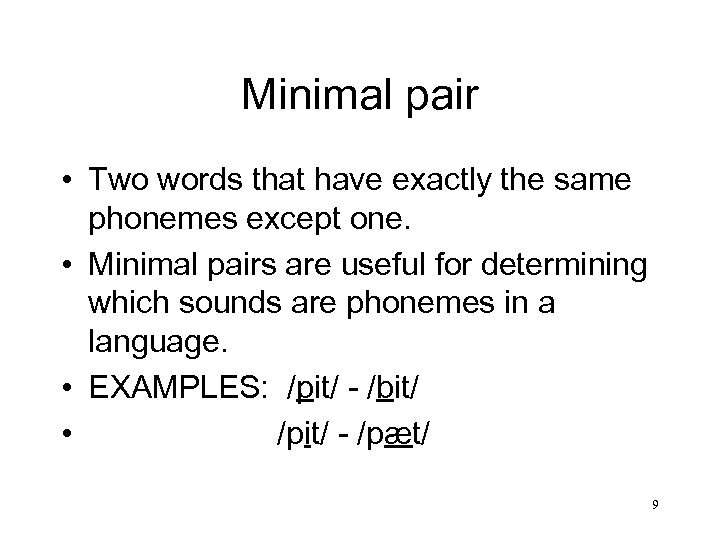 Minimal pair • Two words that have exactly the same phonemes except one. • Minimal pairs are useful for determining which sounds are phonemes in a language. • EXAMPLES: /pit/ - /bit/ • /pit/ - /pæt/ 9
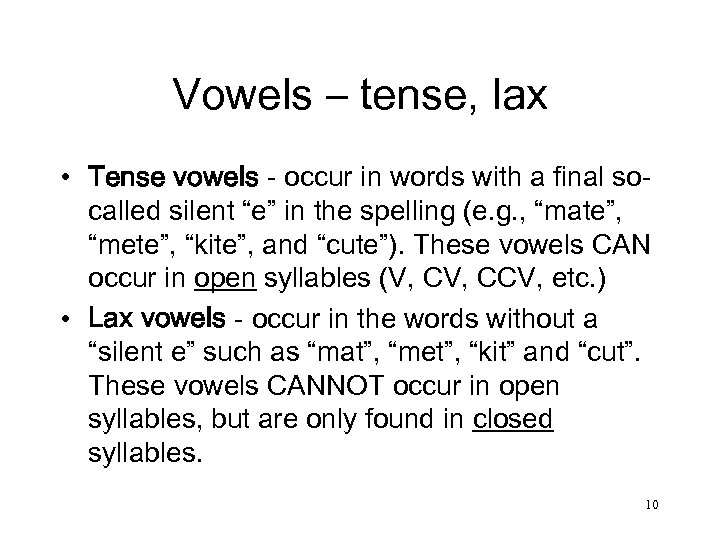 Vowels – tense, lax • Tense vowels - occur in words with a final socalled silent “e” in the spelling (e. g. , “mate”, “mete”, “kite”, and “cute”). These vowels CAN occur in open syllables (V, CCV, etc. ) • Lax vowels - occur in the words without a “silent e” such as “mat”, “met”, “kit” and “cut”. These vowels CANNOT occur in open syllables, but are only found in closed syllables. 10
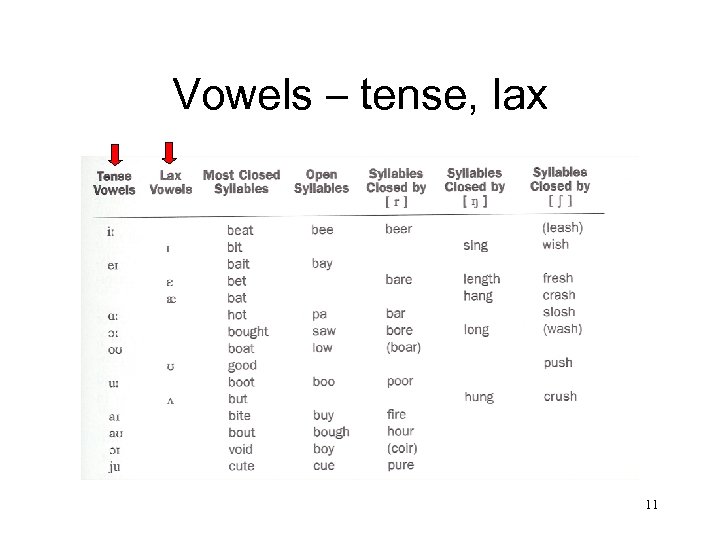 Vowels – tense, lax 11
![Allophone – [ ] • A variant of a phoneme. The allophones of a](https://present5.com/presentation/711b421fd8e1d342d3e6e36b66c5dd59/image-12.jpg "Allophone – [ ] • A variant of a phoneme. The allophones of a") Allophone – [ ] • A variant of a phoneme. The allophones of a phoneme form a set of sounds that: – Do not change the meaning of a word, – Are all very similar to one another, and – Occur in phonetic contexts different from one another (for example, syllable-initial as opposed to syllable-final. • The differences among allophones can be stated in terms of phonological rules. 12
Allophone – [ ] • A variant of a phoneme. The allophones of a phoneme form a set of sounds that: – Do not change the meaning of a word, – Are all very similar to one another, and – Occur in phonetic contexts different from one another (for example, syllable-initial as opposed to syllable-final. • The differences among allophones can be stated in terms of phonological rules. 12
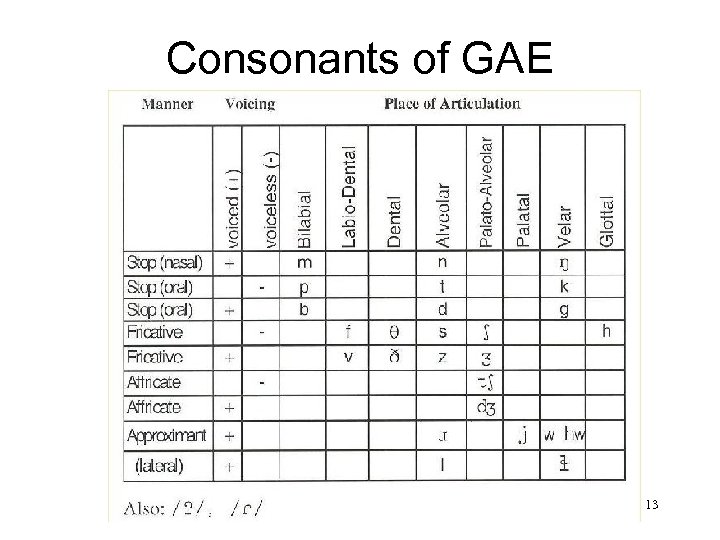 Consonants of GAE 13
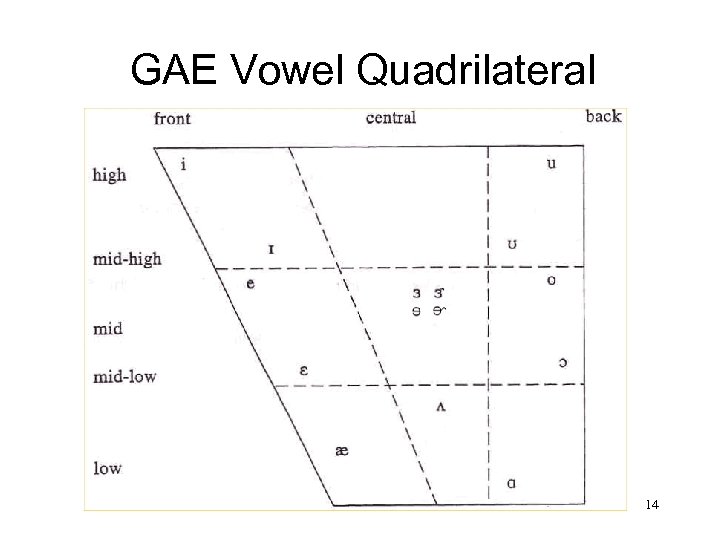 GAE Vowel Quadrilateral 14
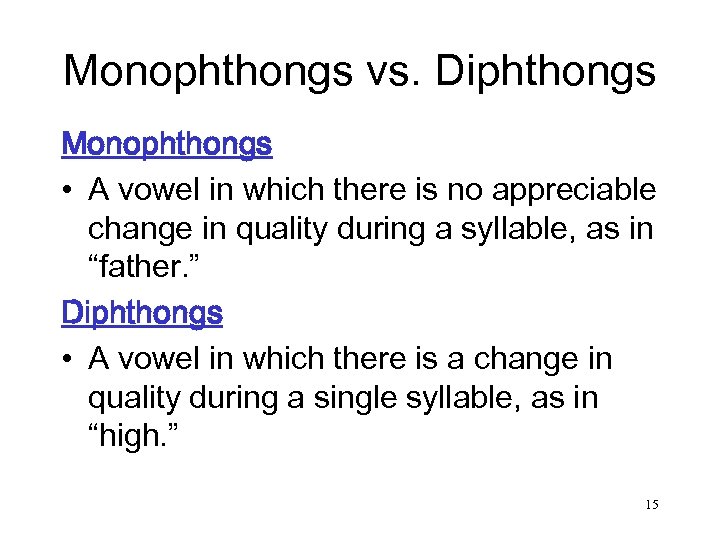 Monophthongs vs. Diphthongs Monophthongs • A vowel in which there is no appreciable change in quality during a syllable, as in “father. ” Diphthongs • A vowel in which there is a change in quality during a single syllable, as in “high. ” 15
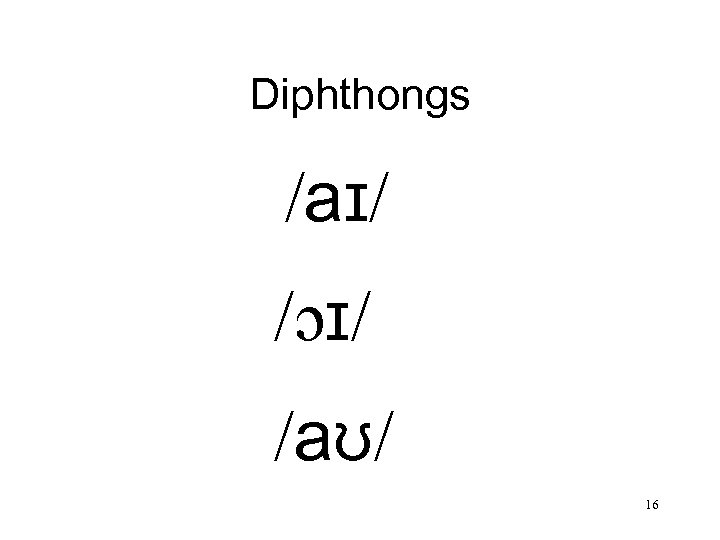 Diphthongs /aɪ/ /ɔɪ/ /aʊ/ 16
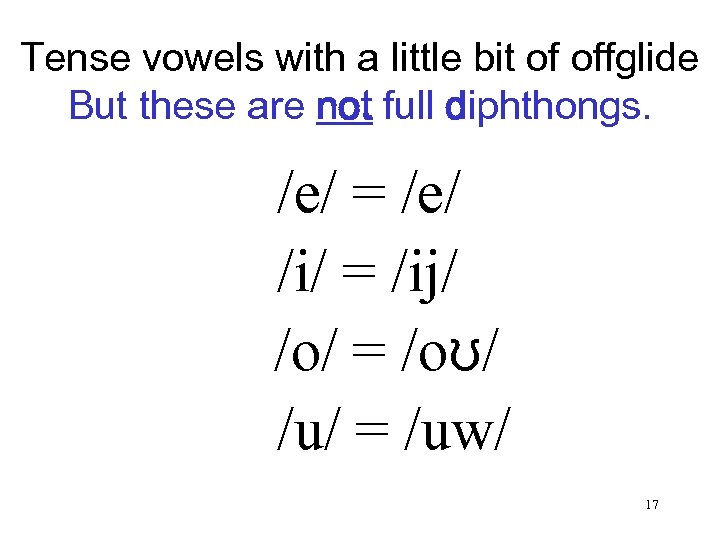 Tense vowels with a little bit of offglide But these are not full diphthongs. /e/ = /e/ /i/ = /ij/ /o/ = /oʊ/ /u/ = /uw/ 17
 Diphthong /aɪ/ • As in “high, buy, ” moves toward a high front vowel, but in most forms of English it does not go much beyond a mid front vowel. 18
 Diphthong /aʊ/ • As in “how” • Usually starts with a very similar quality to that at the beginning of “high” 19
 Diphthong /ɔɪ/ • As in “boy” 20
 Connected speech • The way we talk daily. • Our talk is “connected” because we do not separate each word as we talk. • Connected speech is not like citation form. 21
 Citation form • Citation form is a teacher type of talk. Each word is articulated separately. • We rarely talk in citation form. 22
 Feature theory Markedness – mark only unusual cases • Voicing, place and manner Consonants are assumed to be: – Central instead of lateral Therefore, “lateral” is a marked feature. You don’t have to mark “central. ” – Oral instead of nasal Therefore, “nasal” is marked. You don’t have to mark “oral. ” 23
 Binary vs. Graded Features • Binary features: – In a binary system, a state is either “on” or “off. ” For example, “voiced” or “voiceless”. – Binary codes are used for computers. Binary features are: • Graspable • Intuitive • Graded features: – Like prosody (the melody of language), it cannot be explained by clear-cut binary features. 24
 Coarticulation • Coarticulation Sounds before/after influence the next/previous sounds. – Anticipatory coarticulation “look-ahead” future sounds influence the present sound. When you say “I said ‘su’ again”, your mouth prepares for articulation of /u/ before it finishes producing /s/. – Perseverative coarticulation “carryover” previous sound still influences your present sound. • Coarticulation is language dependent. • French speakers can anticipate 6 segments. • English speakers anticipate 1 -2 segments. 25
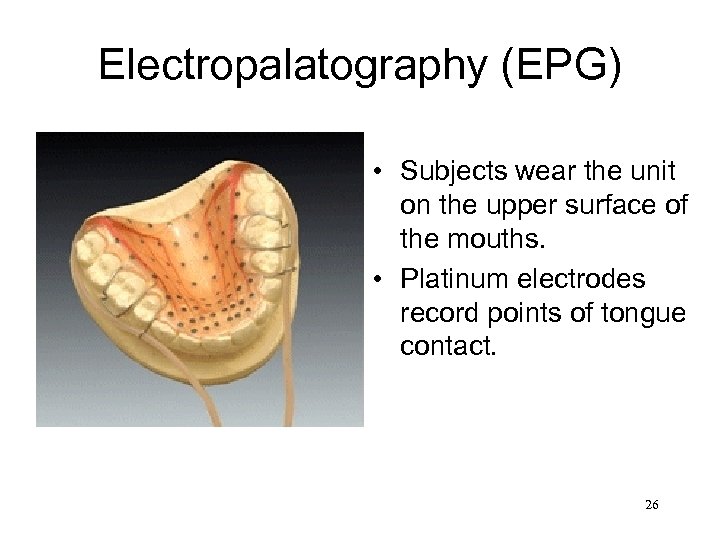 Electropalatography (EPG) • Subjects wear the unit on the upper surface of the mouths. • Platinum electrodes record points of tongue contact. 26
 Syllable • A unit of speech consisting of either a single vowel (or a syllabic consonant) or a vowel and one or more consonants associated with it. • The syllable is often used to describe patterns of stress and timing in speech. – Open syllable starts with one or more consonants and ends with V • CV – Closed syllable consonants at the end. • CVC, CVCC (etc. ) 27
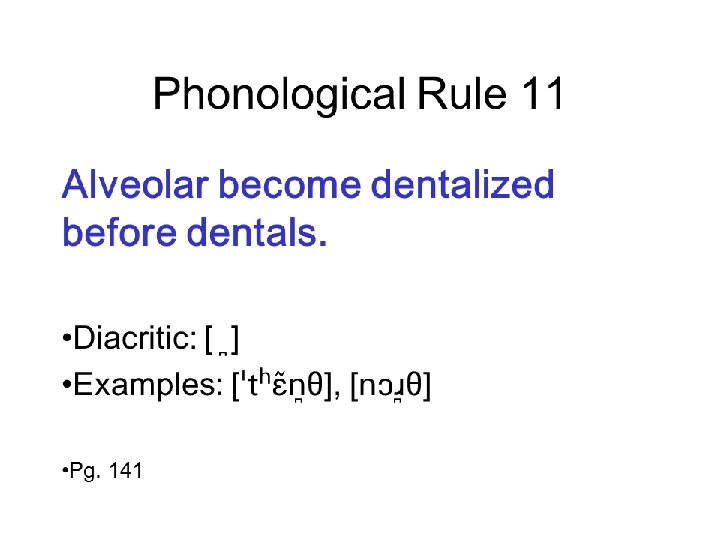
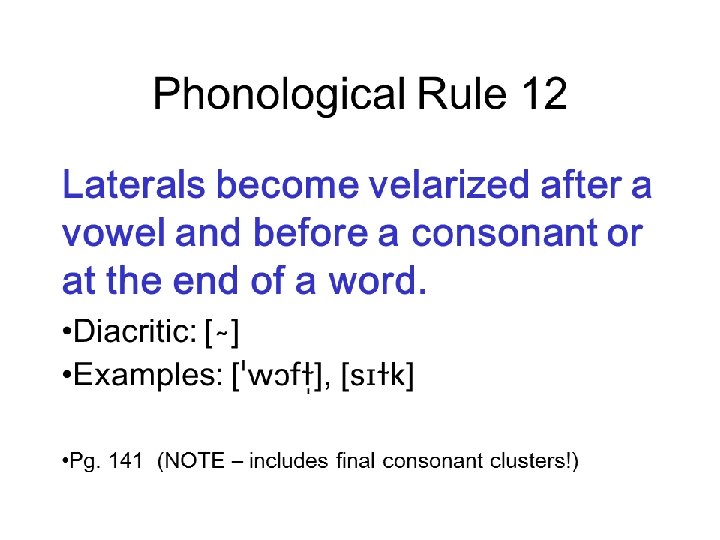
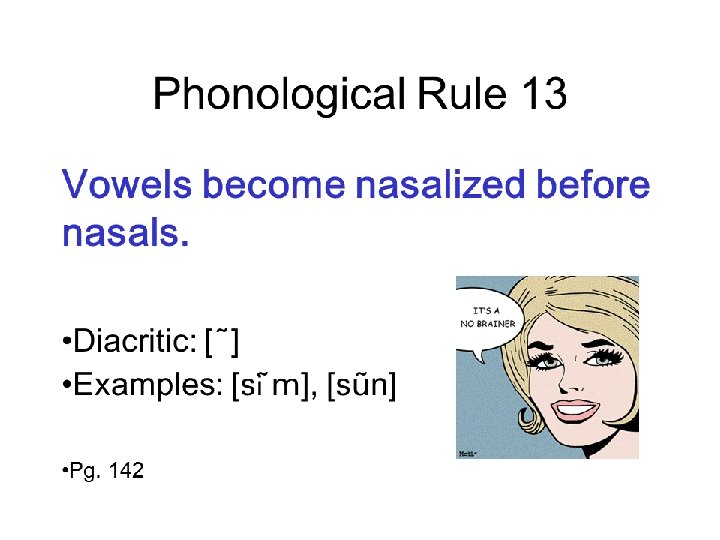
 Diacritics • A small mark that can be used to distinguish different values of an IPA symbol. • For example, the addition of /~/ distinguishes a velarized from a nonvelarized sound • Try saying “lemon” and “pull” to feel the different locations for producing the lateral sounds. • For specific diacritics, refer to the pages about 12 phonological rules. 28
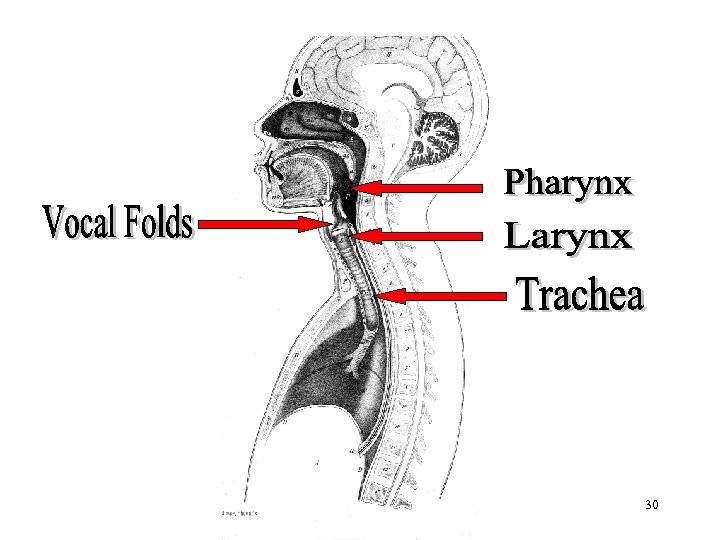
 Source Filter Theory • A theory in which energy from a source is modified by a set of filters. • Source The basic source of power for speech is the respiratory system pushing air out of the lungs. • Filter The larynx, pharynx, nasal cavity, and oral cavity (= supralaryngeal vocal tract) 29
 30
30
 Geminate consonant • Long consonants that can be analyzed as double are called geminates. • E. g. middle of Italian “folla” • Careful: many English words are spelled with two consonants, but these are usually NOT geminates (e. g. , “running”) 31
 homorganic • Two sounds that have the same place of articulation. • For example, /d/ and /n/, as in English “hand, ” are homorganic. They are both articulated on the alveolar ridge. 32
 Transcription methods • Broad a transcription that uses a simple set of symbols. • Narrow Transcription that shows more phonetic detail, either just by using more specific symbols or by also representing some allophonic differences. • Phonemic A transcription made by using letters of the simplest possible shapes, and in the simplest possible number (generally goes with “broad”) • Systematic phonetic A transcription that shows the allophones in very detailed manners (generally goes with “narrow”) • Impressionistic A transcription that only indicates general phonetic value, e. g. when transcribing foreign, child, or disordered speech – the more impressionistic, the more broad. 33
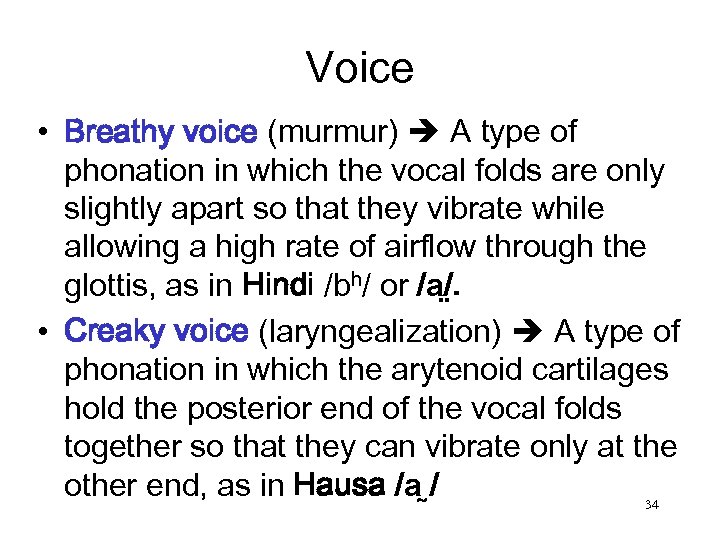 Voice • Breathy voice (murmur) A type of phonation in which the vocal folds are only slightly apart so that they vibrate while allowing a high rate of airflow through the glottis, as in Hindi /bh/ or /a /. • Creaky voice (laryngealization) A type of phonation in which the arytenoid cartilages hold the posterior end of the vocal folds together so that they can vibrate only at the other end, as in Hausa /a / 34
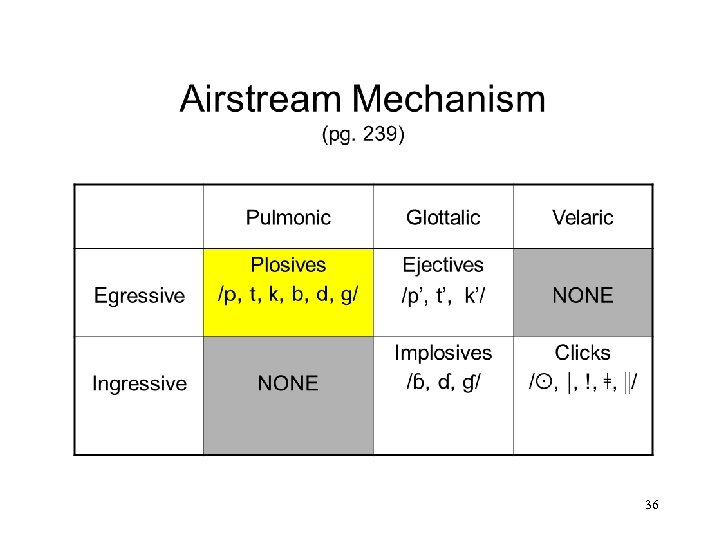
 Airstream mechanism • Airstream mechanism: The manner in which an airstream is set in motion for the purposes of speech. • Airstream mechanisms may produce ingressive (inward) or egressive (outward) airflow. • An airstream mechanism consists of the movement of an initiator. Speech sounds are produced with one of three airstream mechanisms, or occasionally by a combination of two of these. 35
 36
36
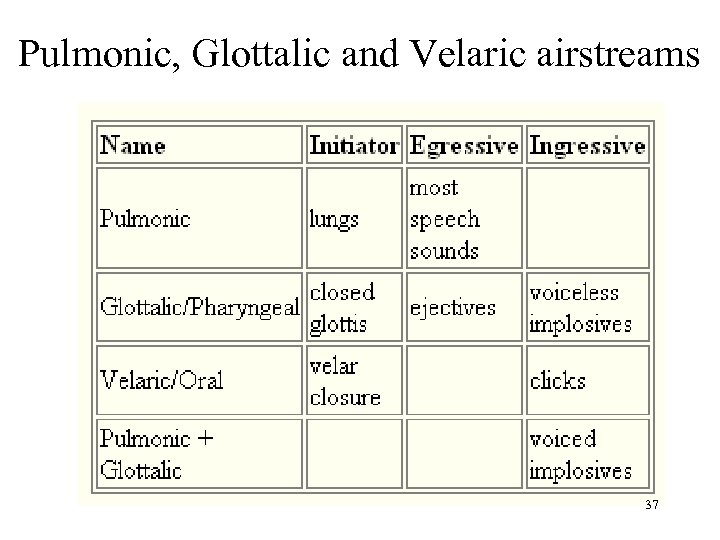 Pulmonic, Glottalic and Velaric airstreams 37
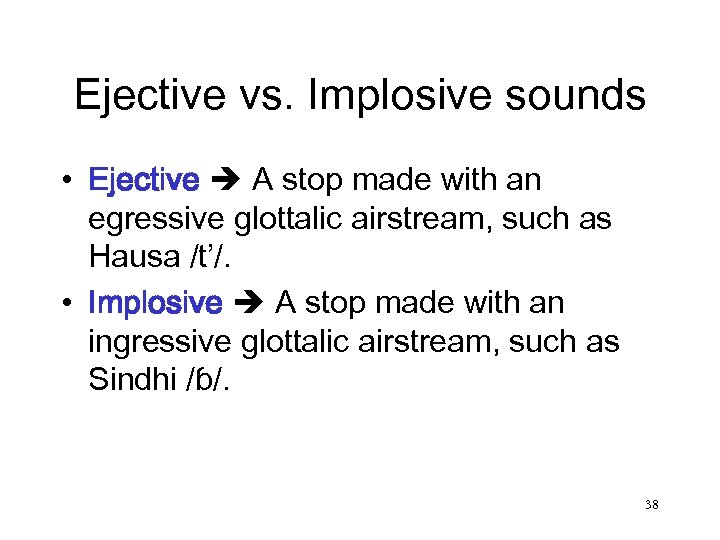 Ejective vs. Implosive sounds • Ejective A stop made with an egressive glottalic airstream, such as Hausa /t’/. • Implosive A stop made with an ingressive glottalic airstream, such as Sindhi /ɓ/. 38
 Different Languages • Review the examples of languages discussed in class exemplary of interesting phonetic and linguistic features. – Language with click sounds !Xhosa – Bilabial implosive Sindhi – Ejective (glottal egressive airstream mechanism) stops Lakhota, Hausa 39
 How to describe vowels Main classification • Tongue height high, mid, or low. • Tongue advancement front, central, or back. Also, we talk about… • Tenseness tense or lax • Lip rounding 40
 Describing the vowels… /i/ is a (high, mid, low) (back, central, front) vowel. 41
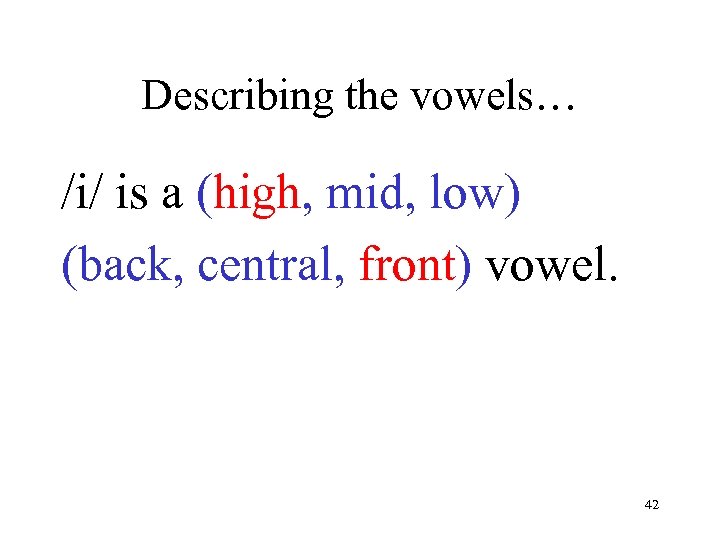 Describing the vowels… /i/ is a (high, mid, low) (back, central, front) vowel. 42
 Describing the vowels… /u/ is a (high, mid, low) (back, central, front) vowel. 43
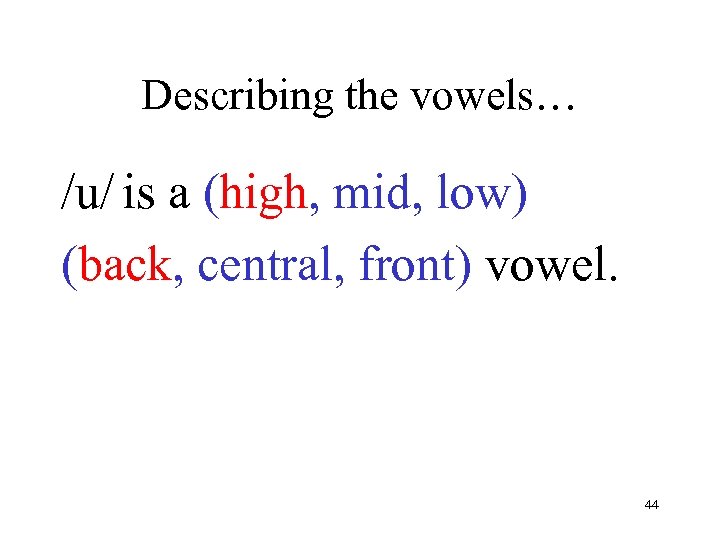 Describing the vowels… /u/ is a (high, mid, low) (back, central, front) vowel. 44
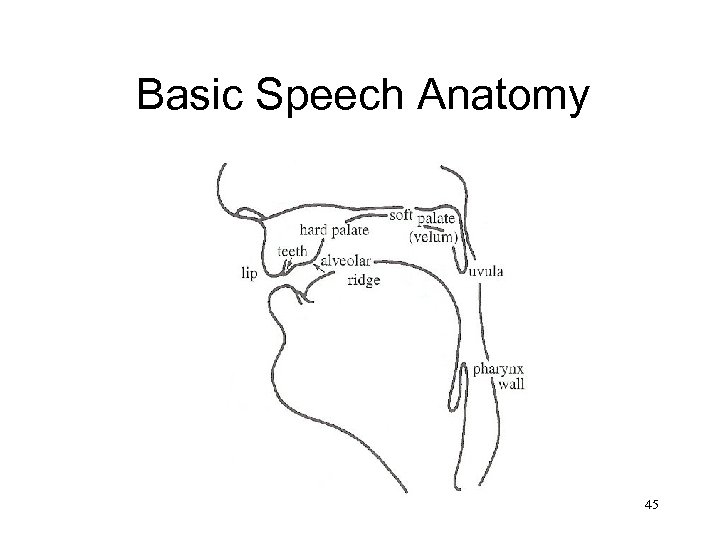 Basic Speech Anatomy 45
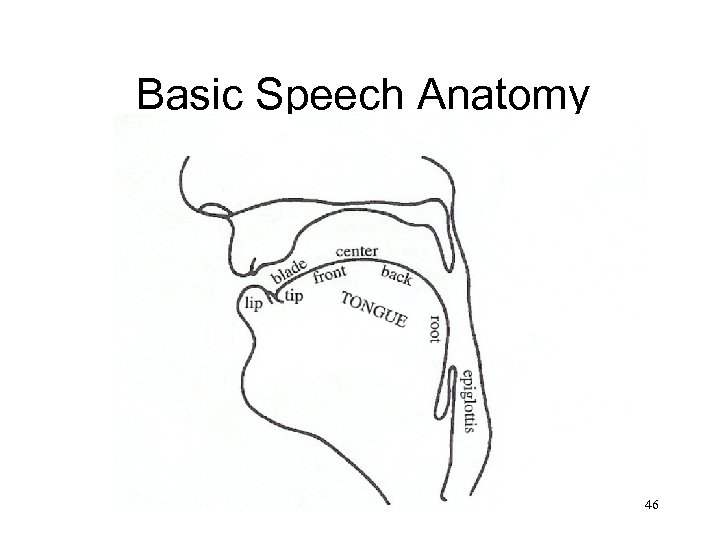 Basic Speech Anatomy 46
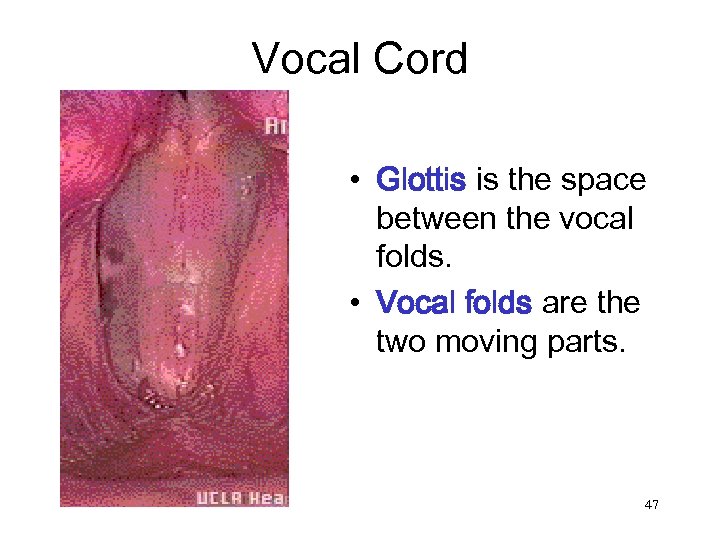 Vocal Cord • Glottis is the space between the vocal folds. • Vocal folds are the two moving parts. 47
 Stress placement • The symbol /ˈ / is a stress mark that has been placed before the syllable carrying the main stress. • Stress should always be marked in words of more than one syllable. 48
 Tone • A pitch that conveys part of the meaning a word. In Chinese, for example, /ma/ pronounced with a high-level tone means “mother” and with a high falling tone means “scold. ” • Tones occur in relative balance of the sounds. 49
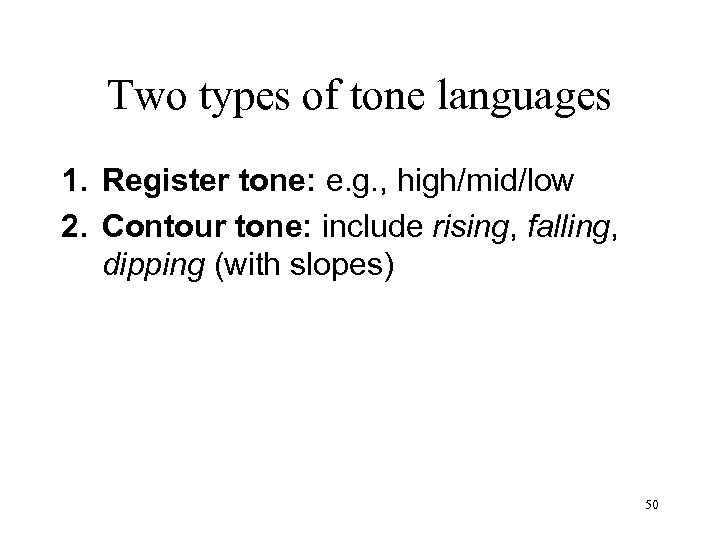 Two types of tone languages 1. Register tone: e. g. , high/mid/low 2. Contour tone: include rising, falling, dipping (with slopes) 50
 13 Phonological Rules • Of English 51
 52
52
 53
53
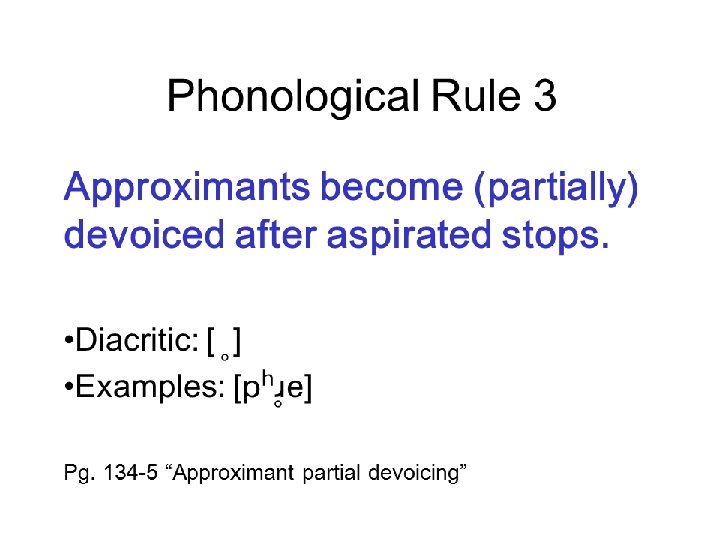 54
54
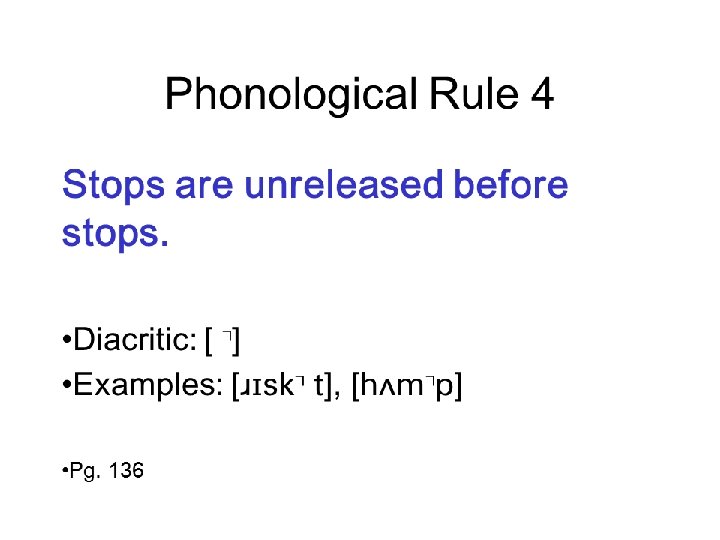 55
55
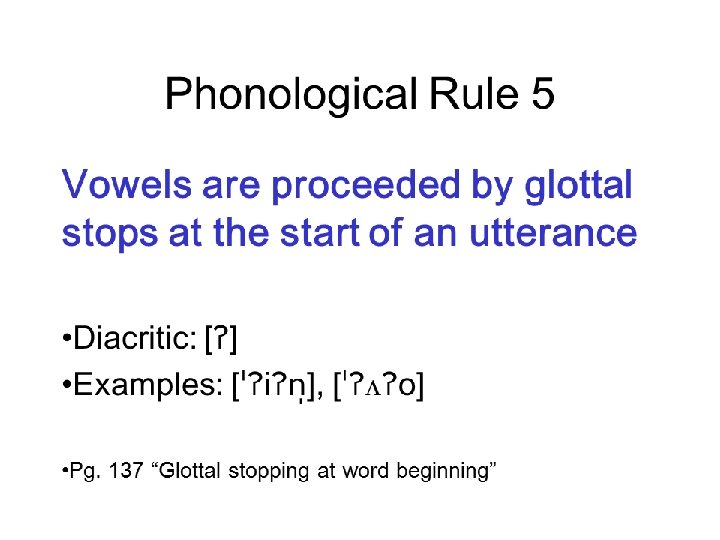 56
56
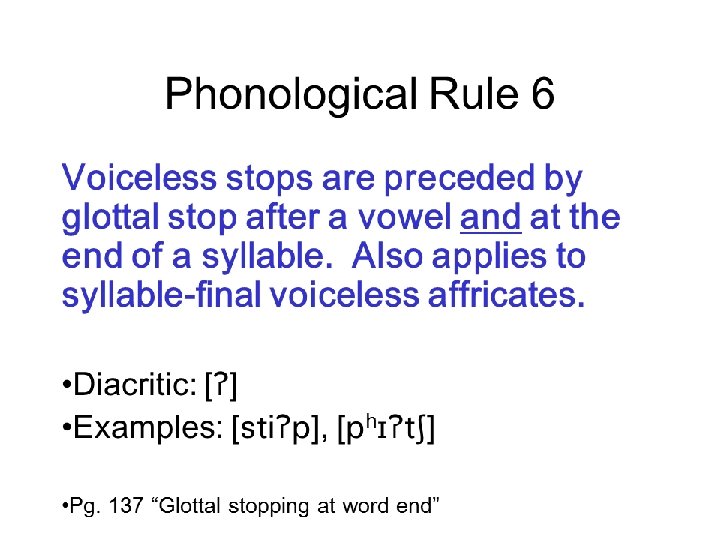 57
57
 58
58
 59
59
 60
60
 61
61
 62
62
 63
63
 64
64
 GOOD LUCK!! 65