


 Скачать презентацию Revenue recognition industry wide impact 29 April
8439e1b4da19edcaa46c191164b4f3ae.ppt
- Количество слайдов: 37
 Revenue recognition – industry wide impact 29 April 2017
 Agenda Introduction Step-by-step approach Recognition of revenue Special issues Sector wise impact © 2017 KPMG, an Indian Registered Partnership and a member firm of the KPMG network of independent member firms affiliated with KPMG International Cooperative (“KPMG International”), a Swiss entity. All rights reserved. 2
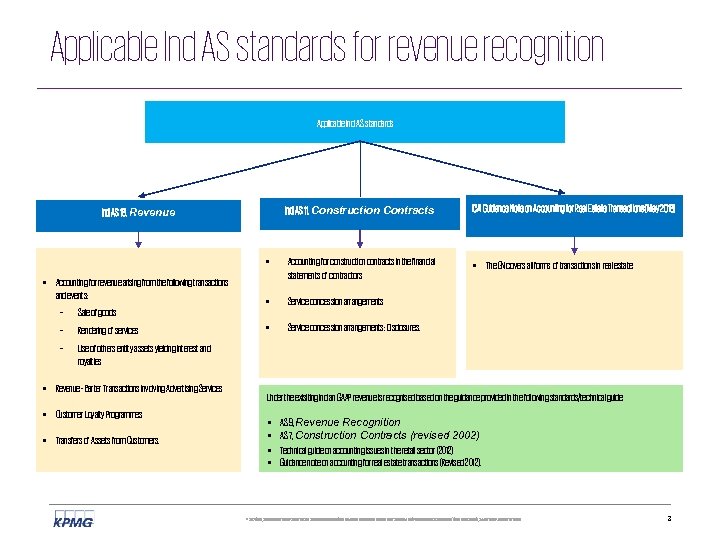 Applicable Ind AS standards for revenue recognition Applicable Ind AS standards Ind AS 11, Construction Contracts ICAI Guidance Note on Accounting for Real Estate Transactions (May 2016) • Accounting for construction contracts in the financial statements of contractors • The GN covers all forms of transactions in real estate. • Service concession arrangements: Disclosures. Ind AS 18, Revenue • Accounting for revenue arising from the following transactions and events: – Sale of goods – Rendering of services – Use of others entity assets yielding interest and royalties • Revenue - Barter Transactions Involving Advertising Services • Customer Loyalty Programmes • Transfers of Assets from Customers. Under the exisiting Indian GAAP revenue is recognised based on the guidance provided in the following standards/technical guide: • • AS 9, Revenue Recognition AS 7, Construction Contracts (revised 2002) Technical guide on accounting issues in the retail sector (2012) Guidance note on accounting for real estate transactions (Revised 2012). © 2017 KPMG, an Indian Registered Partnership and a member firm of the KPMG network of independent member firms affiliated with KPMG International Cooperative (“KPMG International”), a Swiss entity. All rights reserved. 3
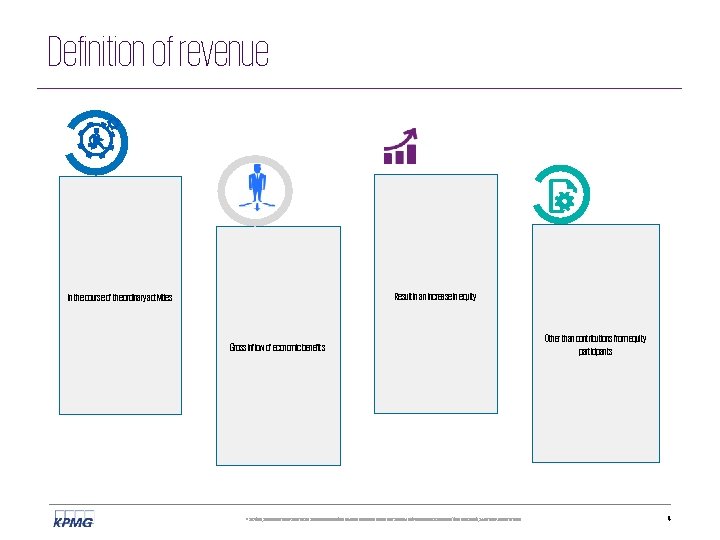 Definition of revenue Result in an increase in equity In the course of the ordinary activities Gross inflow of economic benefits © 2017 KPMG, an Indian Registered Partnership and a member firm of the KPMG network of independent member firms affiliated with KPMG International Cooperative (“KPMG International”), a Swiss entity. All rights reserved. Other than contributions from equity participants 4
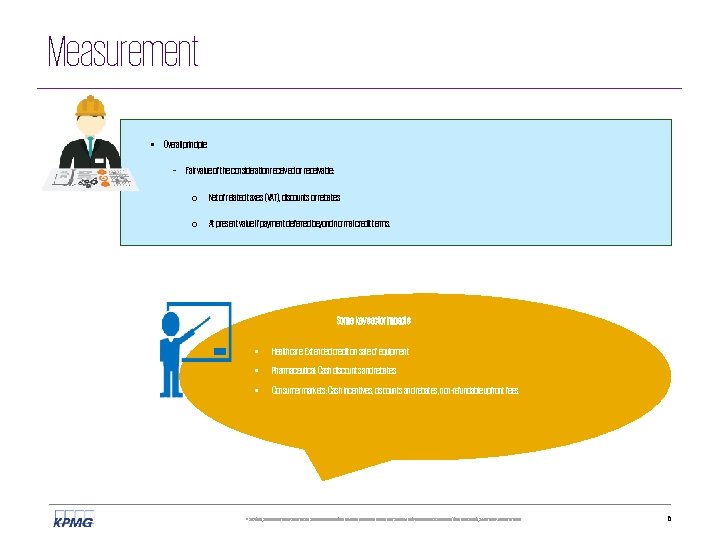 Measurement • Overall principle – Fair value of the consideration received or receivable: o Net of related taxes (VAT), discounts or rebates o At present value if payment deferred beyond normal credit terms. Some key sector impacts • Healthcare: Extended credit on sale of equipment • Pharmaceutical: Cash discounts and rebates • Consumer markets: Cash incentives, discounts and rebates, non-refundable upfront fees. © 2017 KPMG, an Indian Registered Partnership and a member firm of the KPMG network of independent member firms affiliated with KPMG International Cooperative (“KPMG International”), a Swiss entity. All rights reserved. 5
 Agenda Introduction Step-by-step approach Recognition of revenue Special issues Sector wise impact © 2017 KPMG, an Indian Registered Partnership and a member firm of the KPMG network of independent member firms affiliated with KPMG International Cooperative (“KPMG International”), a Swiss entity. All rights reserved. 6
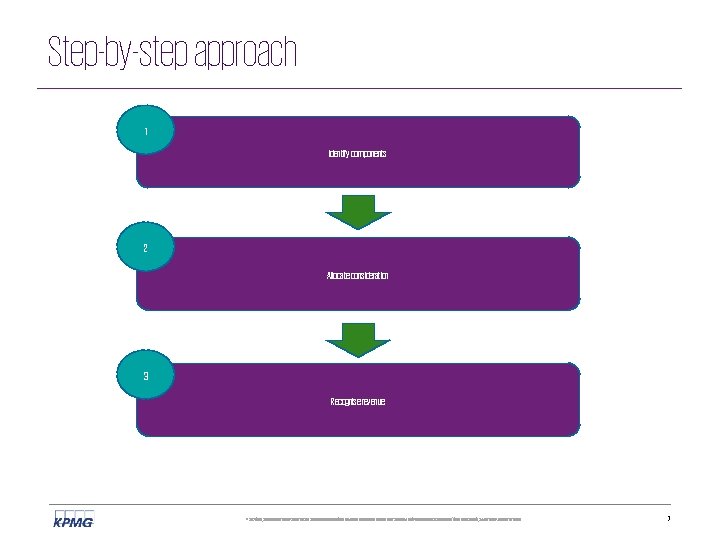 Step-by-step approach 1 Identify components 2 Allocate consideration 3 Recognise revenue © 2017 KPMG, an Indian Registered Partnership and a member firm of the KPMG network of independent member firms affiliated with KPMG International Cooperative (“KPMG International”), a Swiss entity. All rights reserved. 7
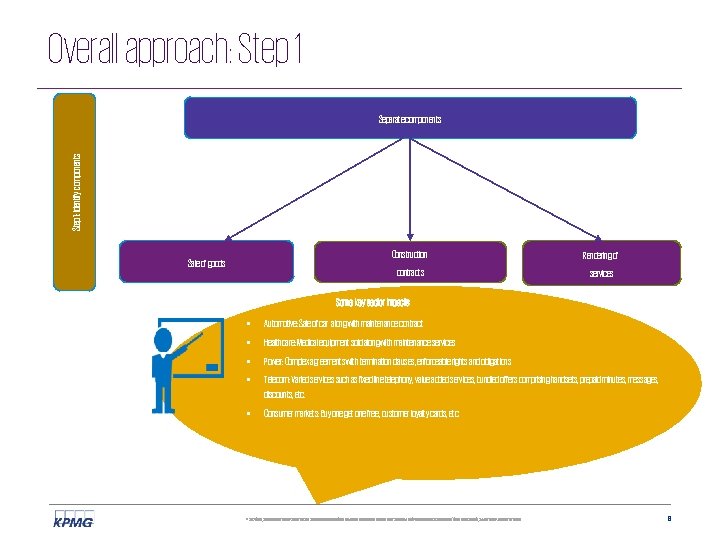 Overall approach: Step 1: Identify components Separate components Construction Rendering of contracts Sale of goods services Some key sector impacts • Automotive: Sale of car along with maintenance contract • Healthcare: Medical equipment sold along with maintenance services • Power: Complex agreements with termination clauses, enforceable rights and obligations • Telecom: Varied services such as fixed line telephony, value added services, bundled offers comprising handsets, prepaid minutes, messages, discounts, etc. • Consumer markets: Buy one get one free, customer loyalty cards, etc © 2017 KPMG, an Indian Registered Partnership and a member firm of the KPMG network of independent member firms affiliated with KPMG International Cooperative (“KPMG International”), a Swiss entity. All rights reserved. 8
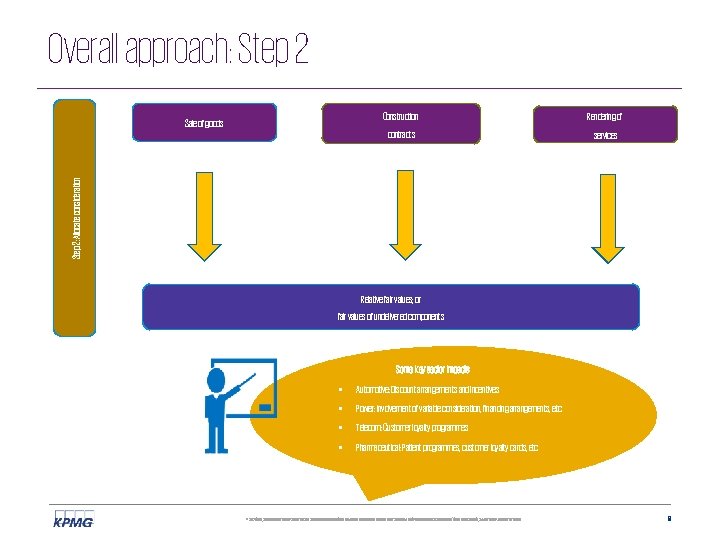 Overall approach: Step 2 Construction services Step 2: Allocate consideration Rendering of contracts Sale of goods Relative fair values; or fair values of undelivered components Some key sector impacts • Automotive: Discount arrangements and incentives • Power: Involvement of variable consideration, financing arrangements, etc. • Telecom: Customer loyalty programmes • Pharmaceutical: Patient programmes, customer loyalty cards, etc © 2017 KPMG, an Indian Registered Partnership and a member firm of the KPMG network of independent member firms affiliated with KPMG International Cooperative (“KPMG International”), a Swiss entity. All rights reserved. 9
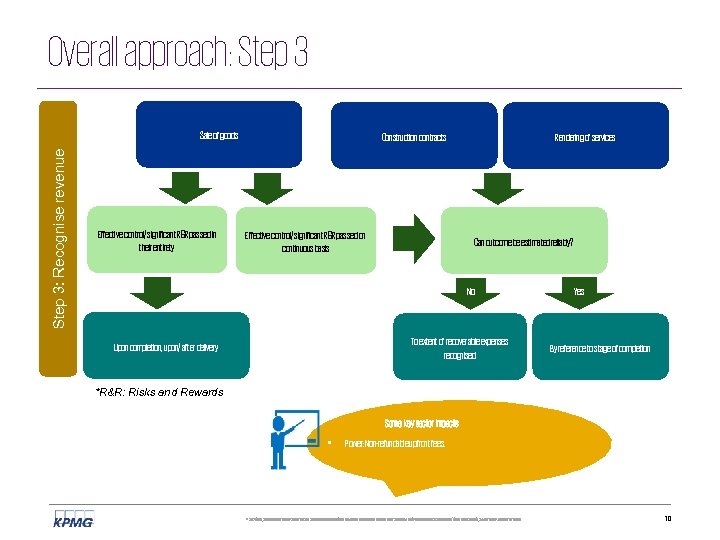 Overall approach: Step 3: Recognise revenue Sale of goods Effective control/ significant R&R passed in their entirety Construction contracts Effective control/ significant R&R passed on continuous basis Rendering of services Can outcome be estimated reliably? No To extent of recoverable expenses recognised Upon completion, upon/ after delivery Yes By reference to stage of completion *R&R: Risks and Rewards Some key sector impacts • Power: Non-refundable upfront fees. © 2017 KPMG, an Indian Registered Partnership and a member firm of the KPMG network of independent member firms affiliated with KPMG International Cooperative (“KPMG International”), a Swiss entity. All rights reserved. 10
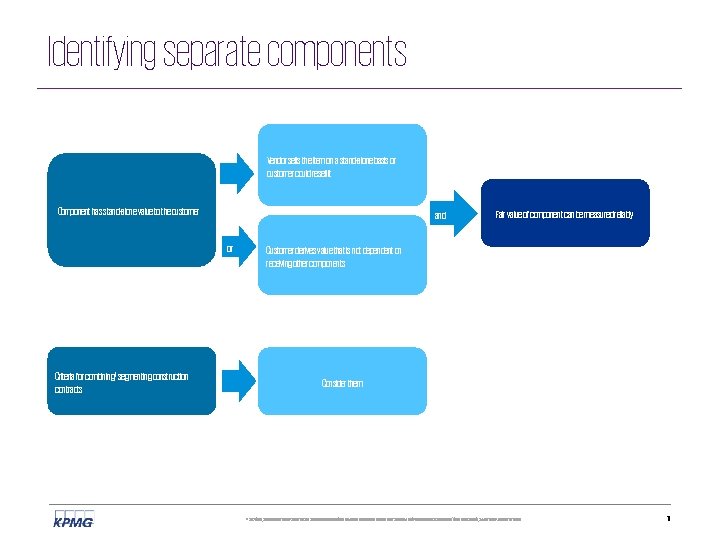 Identifying separate components Vendor sells the item on a stand-alone basis or customer could resell it Component has stand-alone value to the customer and or Criteria for combining/ segmenting construction contracts Fair value of component can be measured reliably Customer derives value that is not dependent on receiving other components Consider them © 2017 KPMG, an Indian Registered Partnership and a member firm of the KPMG network of independent member firms affiliated with KPMG International Cooperative (“KPMG International”), a Swiss entity. All rights reserved. 11
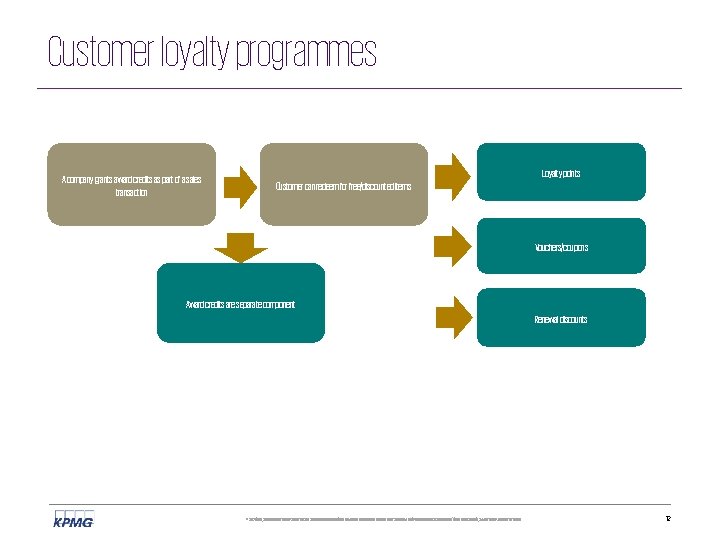 Customer loyalty programmes A company grants award credits as part of a sales transaction Loyalty points Customer can redeem for free/discounted items Vouchers/coupons Award credits are separate component Renewal discounts © 2017 KPMG, an Indian Registered Partnership and a member firm of the KPMG network of independent member firms affiliated with KPMG International Cooperative (“KPMG International”), a Swiss entity. All rights reserved. 12
 Maximum use of observable data Cost-plus-margin method is a last resort © 2017 KPMG, an Indian Registered Partnership and a member firm of the KPMG network of independent member firms affiliated with KPMG International Cooperative (“KPMG International”), a Swiss entity. All rights reserved. 13
 Agenda Introduction Step-by-step approach Recognition of revenue Special issues Sector wise impact © 2017 KPMG, an Indian Registered Partnership and a member firm of the KPMG network of independent member firms affiliated with KPMG International Cooperative (“KPMG International”), a Swiss entity. All rights reserved. 14
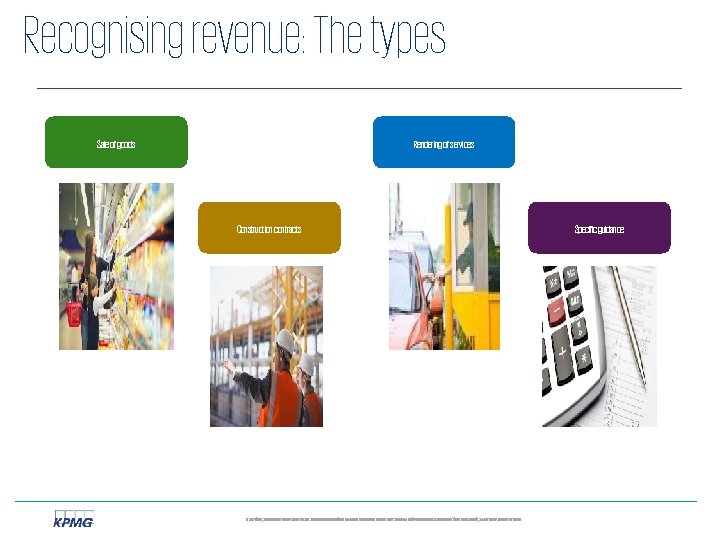 Recognising revenue: The types Sale of goods Rendering of services Construction contracts © 2017 KPMG, an Indian Registered Partnership and a member firm of the KPMG network of independent member firms affiliated with KPMG International Cooperative (“KPMG International”), a Swiss entity. All rights reserved. Specific guidance
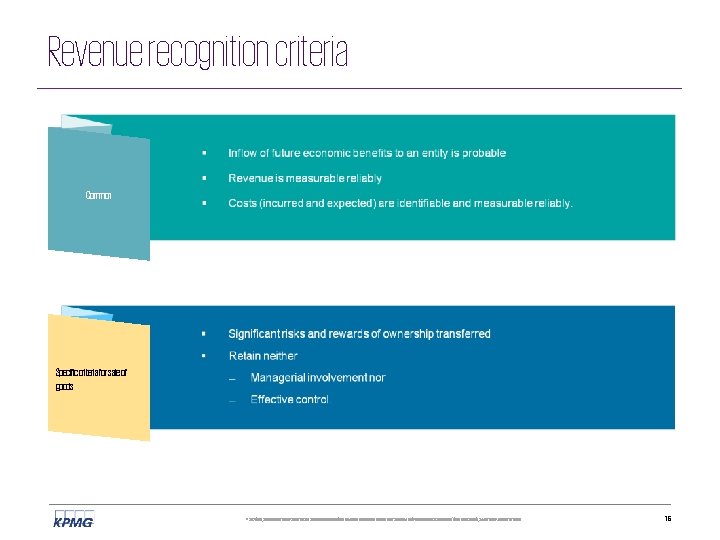 Revenue recognition criteria Common Specific criteria for sale of goods © 2017 KPMG, an Indian Registered Partnership and a member firm of the KPMG network of independent member firms affiliated with KPMG International Cooperative (“KPMG International”), a Swiss entity. All rights reserved. 16
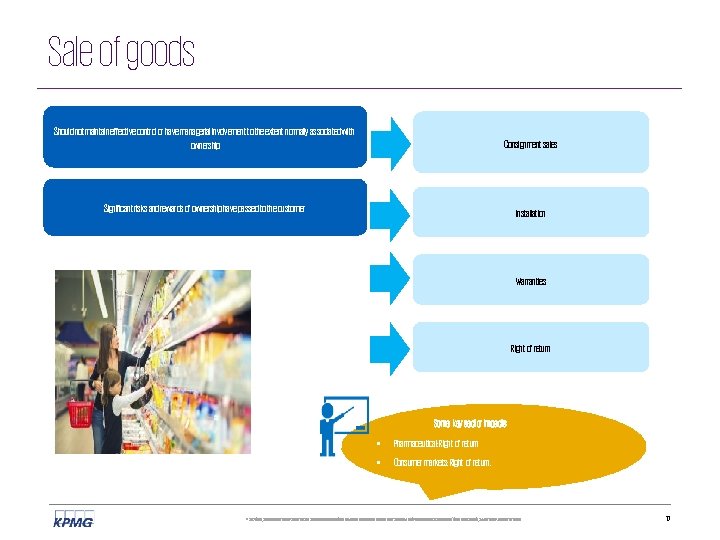 Sale of goods Should not maintain effective control or have managerial involvement to the extent normally associated with ownership Consignment sales Significant risks and rewards of ownership have passed to the customer Installation Warranties Right of return Some key sector impacts • Pharmaceutical: Right of return • Consumer markets: Right of return. © 2017 KPMG, an Indian Registered Partnership and a member firm of the KPMG network of independent member firms affiliated with KPMG International Cooperative (“KPMG International”), a Swiss entity. All rights reserved. 17
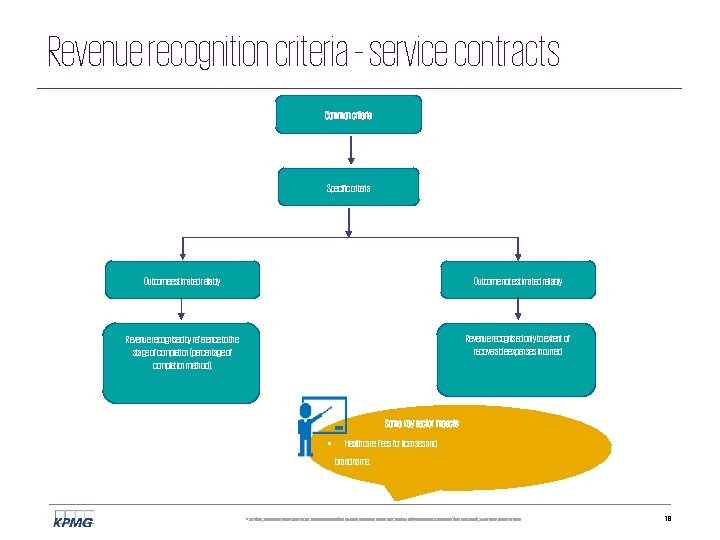 Revenue recognition criteria – service contracts Common criteria Specific criteria Outcome estimated reliably Outcome not estimated reliably Revenue recognised by reference to the stage of completion (percentage of completion method). Revenue recognised only to extent of recoverable expenses incurred. Some key sector impacts • Healthcare: Fees for licenses and brand name. © 2017 KPMG, an Indian Registered Partnership and a member firm of the KPMG network of independent member firms affiliated with KPMG International Cooperative (“KPMG International”), a Swiss entity. All rights reserved. 18
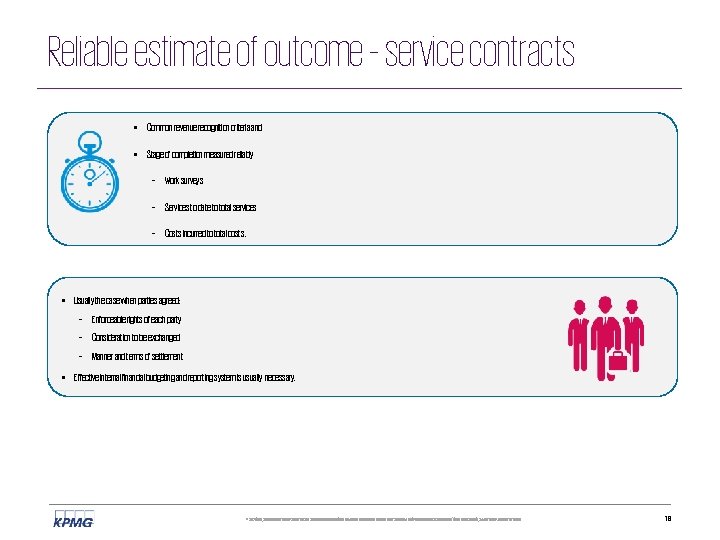 Reliable estimate of outcome – service contracts • Common revenue recognition criteria and • Stage of completion measured reliably – Work surveys – Services to date to total services – Costs incurred to total costs. • Usually the case when parties agreed: – Enforceable rights of each party – Consideration to be exchanged – Manner and terms of settlement • Effective internal financial budgeting and reporting system is usually necessary. © 2017 KPMG, an Indian Registered Partnership and a member firm of the KPMG network of independent member firms affiliated with KPMG International Cooperative (“KPMG International”), a Swiss entity. All rights reserved. 19
 Agenda Introduction Step-by-step approach Recognition of revenue Special issues Sector wise impact © 2017 KPMG, an Indian Registered Partnership and a member firm of the KPMG network of independent member firms affiliated with KPMG International Cooperative (“KPMG International”), a Swiss entity. All rights reserved. 20
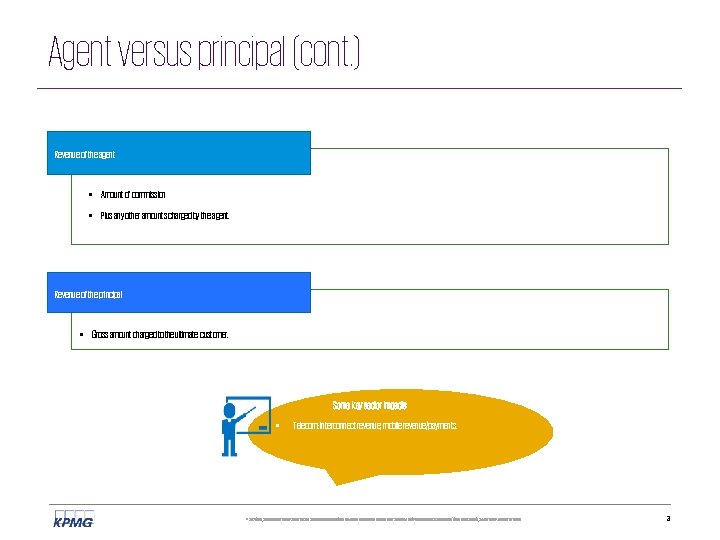 Agent versus principal (cont. ) Revenue of the agent • Amount of commission • Plus any other amounts charged by the agent. Revenue of the principal • Gross amount charged to the ultimate customer. Some key sector impacts • Telecom: Interconnect revenue, mobile revenue/payments. © 2017 KPMG, an Indian Registered Partnership and a member firm of the KPMG network of independent member firms affiliated with KPMG International Cooperative (“KPMG International”), a Swiss entity. All rights reserved. 21
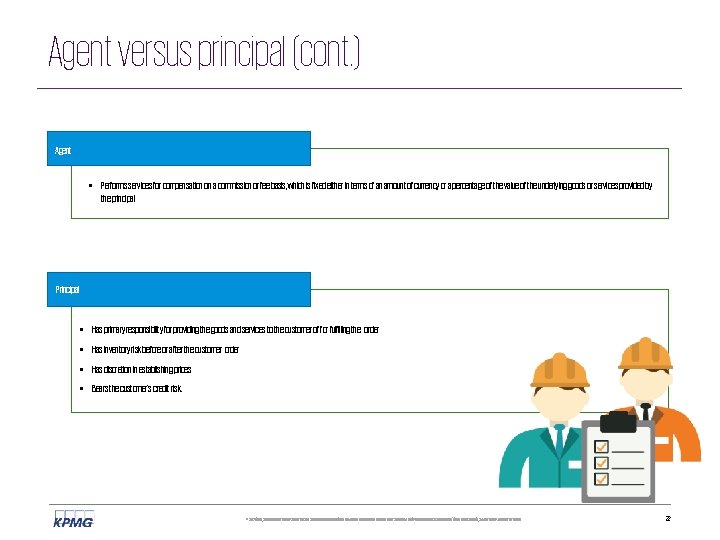 Agent versus principal (cont. ) Agent • Performs services for compensation on a commission or fee basis, which is fixed either in terms of an amount of currency or a percentage of the value of the underlying goods or services provided by the principal Principal • Has primary responsibility for providing the goods and services to the customer of for fulfilling the order • Has inventory risk before or after the customer order • Has discretion in establishing prices • Bears the customer’s credit risk. © 2017 KPMG, an Indian Registered Partnership and a member firm of the KPMG network of independent member firms affiliated with KPMG International Cooperative (“KPMG International”), a Swiss entity. All rights reserved. 22
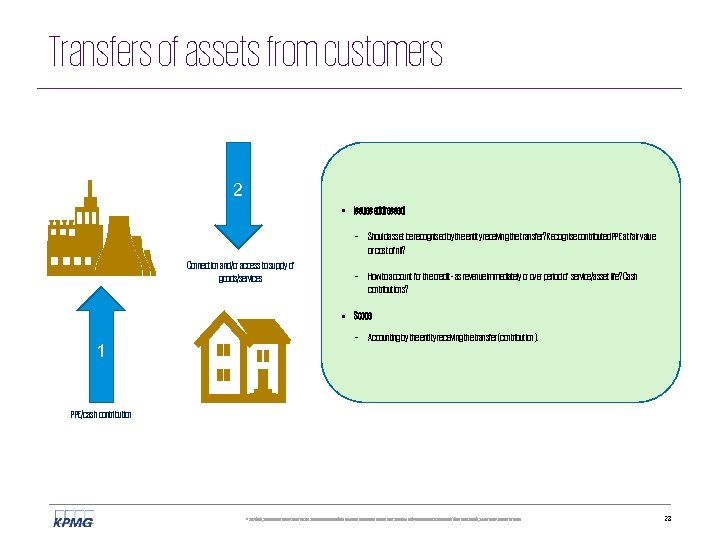 Transfers of assets from customers 2 • Issues addressed – Should asset be recognised by the entity receiving the transfer? Recognise contributed PPE at fair value or cost of nil? Connection and/or access to supply of goods/services – How to account for the credit - as revenue immediately or over period of service/asset life? Cash contributions? • Scope 1 – Accounting by the entity receiving the transfer (contribution ). PPE/cash contribution © 2017 KPMG, an Indian Registered Partnership and a member firm of the KPMG network of independent member firms affiliated with KPMG International Cooperative (“KPMG International”), a Swiss entity. All rights reserved. 23
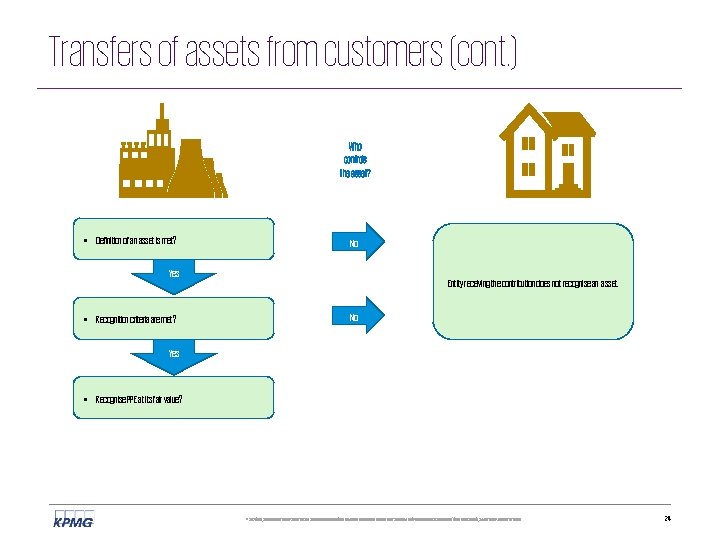 Transfers of assets from customers (cont. ) Who controls the asset? • Definition of an asset is met? No Yes • Recognition criteria are met? Entity receiving the contribution does not recognise an asset. No Yes • Recognise PPE at its fair value? © 2017 KPMG, an Indian Registered Partnership and a member firm of the KPMG network of independent member firms affiliated with KPMG International Cooperative (“KPMG International”), a Swiss entity. All rights reserved. 24
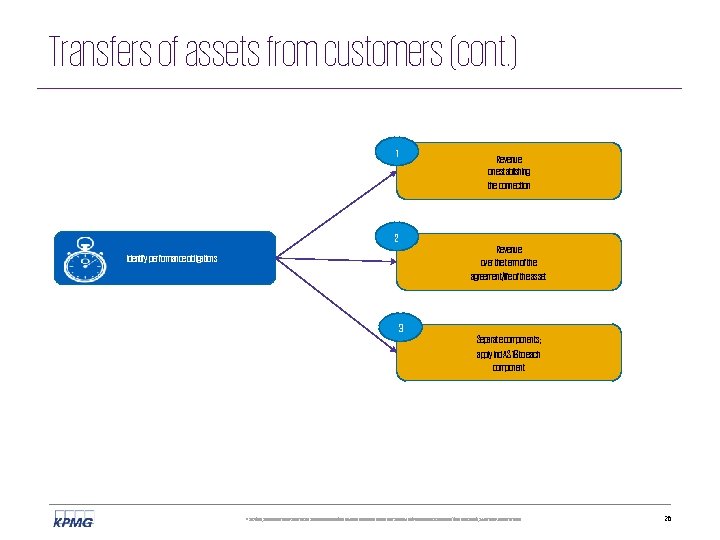 Transfers of assets from customers (cont. ) 1 Revenue on establishing the connection 2 Revenue over the term of the agreement/life of the asset Identify performance obligations 3 Separate components; apply Ind AS 18 to each component © 2017 KPMG, an Indian Registered Partnership and a member firm of the KPMG network of independent member firms affiliated with KPMG International Cooperative (“KPMG International”), a Swiss entity. All rights reserved. 25
 Disclosure • Accounting policies • Methods to determine the stage of completion • Revenue by category: – Sale of goods – Rendering of services – Construction contracts – Interest – Royalties – Dividends • Revenue from exchanges. © 2017 KPMG, an Indian Registered Partnership and a member firm of the KPMG network of independent member firms affiliated with KPMG International Cooperative (“KPMG International”), a Swiss entity. All rights reserved. 26
 Service concession: Scope - general • Applies to public-to-private service concession arrangements – Does not define but describes common features o Infrastructure is used to deliver public services o A contractual arrangement specifies nature and pricing of services o Private sector operator supplies at least some of infrastructure maintenance and related services o Infrastructure is returned to the grantor at the end of the concession period • Does not provide guidance on accounting by grantors. © 2017 KPMG, an Indian Registered Partnership and a member firm of the KPMG network of independent member firms affiliated with KPMG International Cooperative (“KPMG International”), a Swiss entity. All rights reserved. 27
 Service concession: Scope - criteria • An arrangement is within the scope of service concession if: – The grantor controls what services are provided using the infrastructure, to whom and at what price and – The grantor controls any significant residual interest in the infrastructure at the end of the term, or the infrastructure is used for all of its useful life. © 2017 KPMG, an Indian Registered Partnership and a member firm of the KPMG network of independent member firms affiliated with KPMG International Cooperative (“KPMG International”), a Swiss entity. All rights reserved. 28
 Operator’s rights over the infrastructure • Operator does not recognise concession infrastructure as its Property, Plant and Equipment (PPE) – Operator does not control the infrastructure – Applies irrespective of the extent to which operator bears the risks and rewards of ownership of the infrastructure – That is, there is no ‘PPE model’ under service concession • Service concession does not apply to operator’s existing PPE. © 2017 KPMG, an Indian Registered Partnership and a member firm of the KPMG network of independent member firms affiliated with KPMG International Cooperative (“KPMG International”), a Swiss entity. All rights reserved. 29
 Key general principles • Account for construction services under Ind AS 11, Construction Contracts • The operator recognises compensation for construction / upgrade services as – A financial asset, to the extent that it has an unconditional right to receive cash irrespective of usage of the infrastructure and/or – An intangible asset, to the extent it receives a right to charge users That is, nature of asset(s) recognised depends on allocation of demand risk • Operation revenue is accounted for in accordance with Ind AS 18, Revenue. © 2017 KPMG, an Indian Registered Partnership and a member firm of the KPMG network of independent member firms affiliated with KPMG International Cooperative (“KPMG International”), a Swiss entity. All rights reserved. 30
 Agenda Introduction Step-by-step approach Recognition of revenue Special issues Sector wise impact © 2017 KPMG, an Indian Registered Partnership and a member firm of the KPMG network of independent member firms affiliated with KPMG International Cooperative (“KPMG International”), a Swiss entity. All rights reserved. 31
 Power sector Background • Revenue recognition in the power sector is primarily dependent on the terms and conditions enlisted in the power purchase agreement. • Currently, revenue recognition in this sector is accounted for as per AS 9. • AS 9 prescribes pre conditions with respect to revenue recognition such as transfer of significant risk and rewards of ownership to the buyer, transfer of control to the buyer, reasonability of receipt of consideration, reliable measurement of revenue, etc. Implications • Significant judgement involved in the following areas: – Identification of performance obligations – Transfer of assets from customers – Non-refundable upfront fees – Allocation of transaction price. © 2017 KPMG, an Indian Registered Partnership and a member firm of the KPMG network of independent member firms affiliated with KPMG International Cooperative (“KPMG International”), a Swiss entity. All rights reserved. 32
 Healthcare sector Implications • Multiple element arrangements • Extended credit • Fee for licenses and brand name © 2017 KPMG, an Indian Registered Partnership and a member firm of the KPMG network of independent member firms affiliated with KPMG International Cooperative (“KPMG International”), a Swiss entity. All rights reserved. 33
 Telecommunication sector Implications • Complexities involved in provision of varied services such as fixed line telephony, value added services, bundled offers comprising handsets, prepaid minutes, messages, discounts, special offers and other incentives • Identification of the various performance obligations agreed upon each tariff plan • Identification and accounting for variable considerations • Analysis of sheer volume of contracts considering the variety of plans and the frequency with which plans can be modified by the customers • Customer loyalty programmes • Allocation of transaction price to the performance obligations in the contract • Challenges surrounding • Mobile content • Mobile payments. © 2017 KPMG, an Indian Registered Partnership and a member firm of the KPMG network of independent member firms affiliated with KPMG International Cooperative (“KPMG International”), a Swiss entity. All rights reserved. 34
 Automobiles Implications • Timing of revenue recognition - dispatch v/s transfer of significant risks and rewards • Accounting for incentives, discounts and service coupons • Multiple deliverable contracts. © 2017 KPMG, an Indian Registered Partnership and a member firm of the KPMG network of independent member firms affiliated with KPMG International Cooperative (“KPMG International”), a Swiss entity. All rights reserved. 35
 Q&A © 2017 KPMG, an Indian Registered Partnership and a member firm of the KPMG network of independent member firms affiliated with KPMG International Cooperative (“KPMG International”), a Swiss entity. All rights reserved. 36
 Thank you KPMG in India contact: Ruchi Rastogi Executive Director Assurance E-mail: ruchirastogi@kpmg. com The information contained herein is of a general nature and is not intended to address the circumstances of any particular individual or entity. Although we endeavour to provide accurate and timely information, there can be no guarantee that such information is accurate as of the date it is received or that it will continue to be accurate in the future. No one should act on such information without appropriate professional advice after a thorough examination of the particular situation. © 2017 KPMG, an Indian Registered Partnership and a member firm of the KPMG network of independent member firms affiliated with KPMG International Cooperative (“KPMG International”), a Swiss entity. All righ The KPMG name and logo are registered trademarks or trademarks of KPMG International. © 2017 KPMG, an Indian Registered Partnership and a member firm of the KPMG network of independent member firms affiliated with KPMG International Cooperative (“KPMG International”), a Swiss entity. All rights reserved. 37