


 Скачать презентацию REV-080037 Future 3 GPP Radio Technologies for IMT
983e2d253a4a43dca2610b078f6b8cb9.ppt
- Количество слайдов: 20
 REV-080037 Future 3 GPP Radio Technologies for IMT -Advanced Source: Samsung Agenda Item: 3 3 GPP IMT-Advanced Workshop 7 -8 April 2008 Shenzhen, China
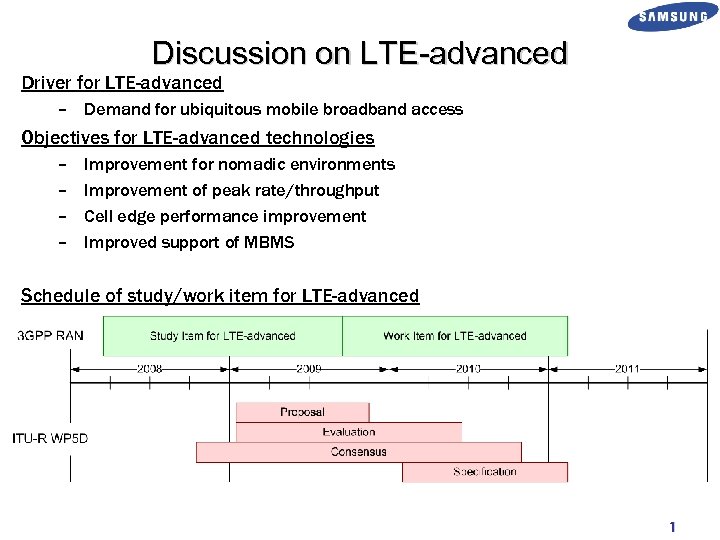 Discussion on LTE-advanced Driver for LTE-advanced – Demand for ubiquitous mobile broadband access Objectives for LTE-advanced technologies – – Improvement for nomadic environments Improvement of peak rate/throughput Cell edge performance improvement Improved support of MBMS Schedule of study/work item for LTE-advanced 1
 Enabling Technologies for LTE-Advanced • Peak Data Rate improvement – DL 4 x 4 : LTE baseline 2 x 2 – UL 2 x 4 : LTE baseline 1 x 2 – 8 Tx antennas at e. Node-B including 8 x 8 MIMO spatial multiplexing is also considered • Sector/cell throughput improvement – – – • Advanced Downlink MU-MIMO: 8 Tx beam-forming Uplink SU-MIMO Hybrid OFDMA and SC-FDMA in uplink Multi-stream MIMO SFN broadcast Superposition of unicast and broadcast traffic Cell edge performance improvement – Multi-hop relay – coverage extension – Multi-cell MIMO (Network MIMO) – toward a cell without cell edge? 2
 Uplink Improvements: Hybrid OFDMA and SC-FDMA Uplink SU-MIMO
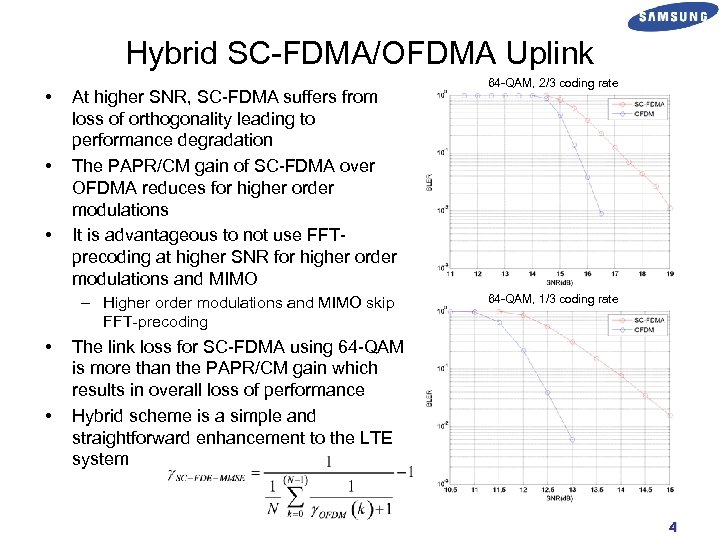 Hybrid SC-FDMA/OFDMA Uplink • • • At higher SNR, SC-FDMA suffers from loss of orthogonality leading to performance degradation The PAPR/CM gain of SC-FDMA over OFDMA reduces for higher order modulations It is advantageous to not use FFTprecoding at higher SNR for higher order modulations and MIMO – Higher order modulations and MIMO skip FFT-precoding • • 64 -QAM, 2/3 coding rate 64 -QAM, 1/3 coding rate The link loss for SC-FDMA using 64 -QAM is more than the PAPR/CM gain which results in overall loss of performance Hybrid scheme is a simple and straightforward enhancement to the LTE system 4
 Uplink SU-MIMO • Various configurations – UL antenna selection – UL beamforming / transmit diversity – UL Spatial multiplexing • UL SU-MIMO was discussed in LTE study item – But, not included in LTE spec – UE cost was one major concern – Feasible for LTE-advanced • Reducing pilot overhead is one key issue – Pilots on separate locations –more overhead – Pilots on same location, but with CDM • More complicated for OFDMA with distributed transmission 5
 Advanced MIMO Technology: 8 Tx beam-forming Multi-cell MIMO
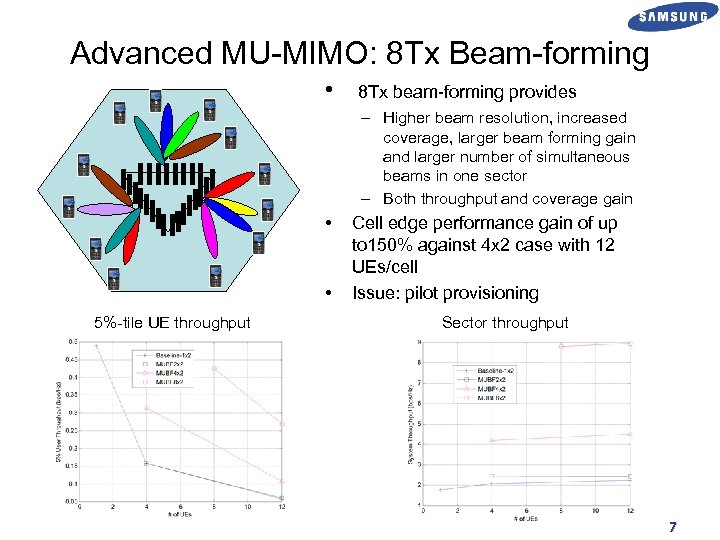 Advanced MU-MIMO: 8 Tx Beam-forming • 8 Tx beam-forming provides – Higher beam resolution, increased coverage, larger beam forming gain and larger number of simultaneous beams in one sector – Both throughput and coverage gain • • 5%-tile UE throughput Cell edge performance gain of up to 150% against 4 x 2 case with 12 UEs/cell Issue: pilot provisioning Sector throughput 7
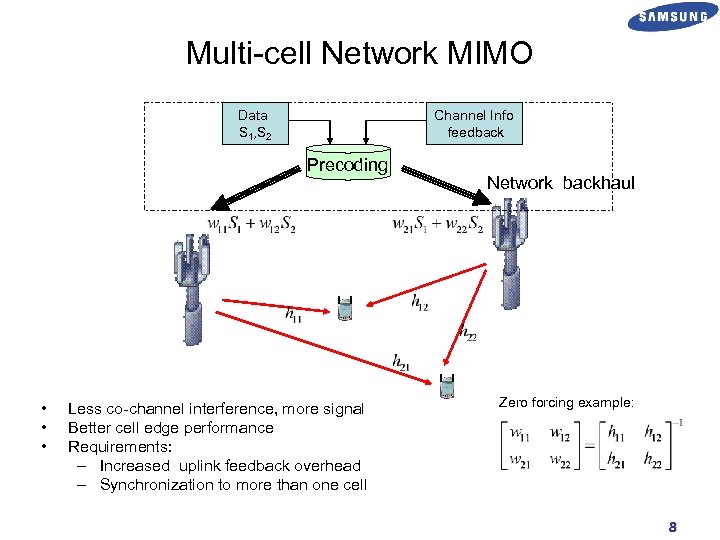 Multi-cell Network MIMO Data S 1, S 2 Channel Info feedback Precoding • • • Less co-channel interference, more signal Better cell edge performance Requirements: – Increased uplink feedback overhead – Synchronization to more than one cell Network backhaul Zero forcing example: 8
 Relay Technologies: Full duplex Relay Subcarrier Duplexed Relay Superposition Relay Collaborative mobile relay
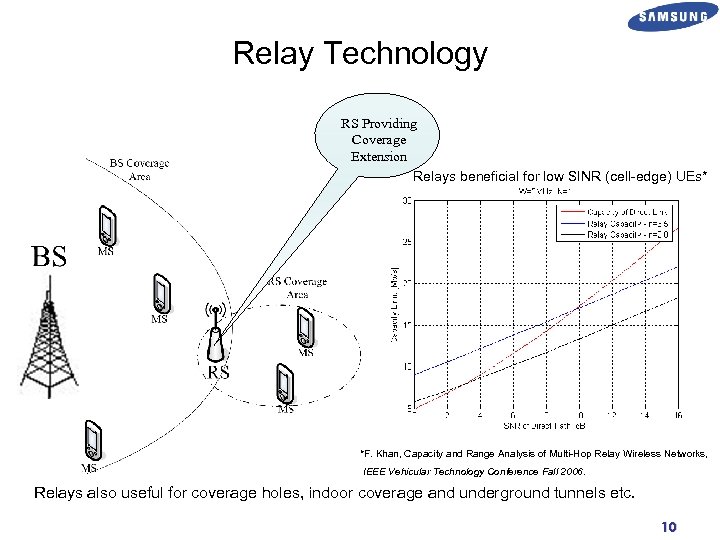 Relay Technology RS Providing Coverage Extension Relays beneficial for low SINR (cell-edge) UEs* *F. Khan, Capacity and Range Analysis of Multi-Hop Relay Wireless Networks, IEEE Vehicular Technology Conference Fall 2006. Relays also useful for coverage holes, indoor coverage and underground tunnels etc. 10
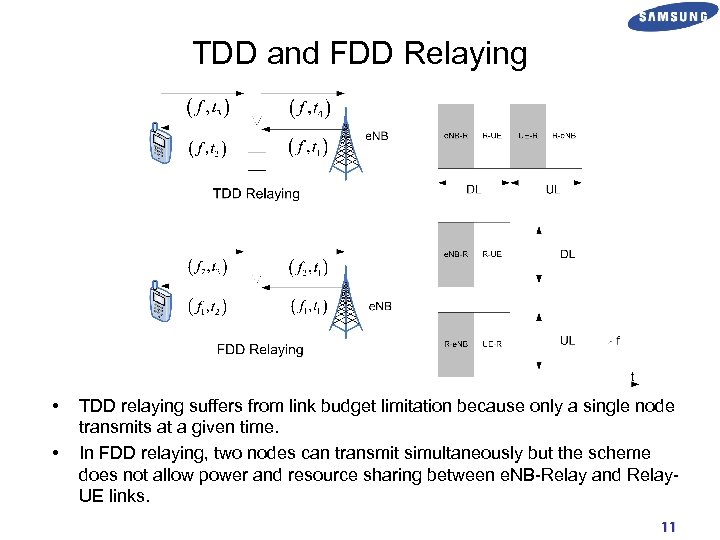 TDD and FDD Relaying • • TDD relaying suffers from link budget limitation because only a single node transmits at a given time. In FDD relaying, two nodes can transmit simultaneously but the scheme does not allow power and resource sharing between e. NB-Relay and Relay. UE links. 11
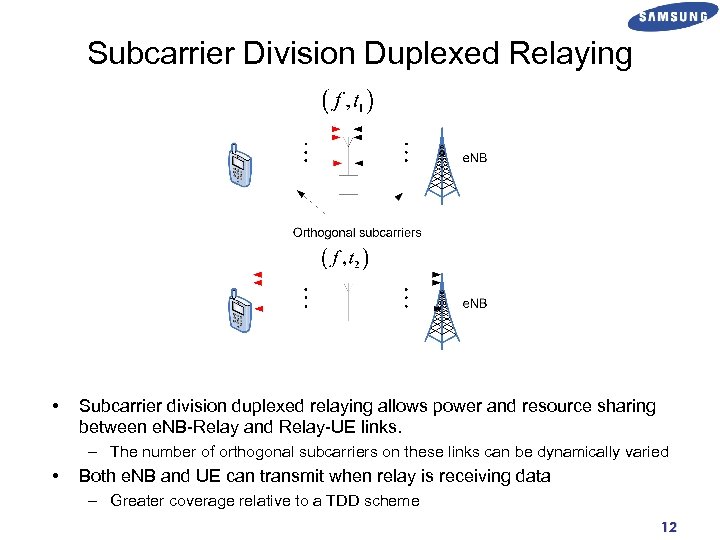 Subcarrier Division Duplexed Relaying • Subcarrier division duplexed relaying allows power and resource sharing between e. NB-Relay and Relay-UE links. – The number of orthogonal subcarriers on these links can be dynamically varied • Both e. NB and UE can transmit when relay is receiving data – Greater coverage relative to a TDD scheme 12
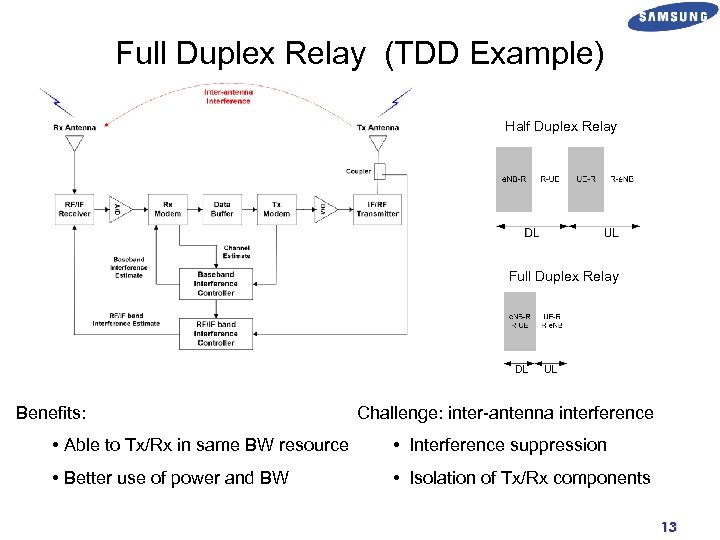 Full Duplex Relay (TDD Example) Half Duplex Relay Full Duplex Relay Benefits: Challenge: inter-antenna interference • Able to Tx/Rx in same BW resource • Interference suppression • Better use of power and BW • Isolation of Tx/Rx components 13
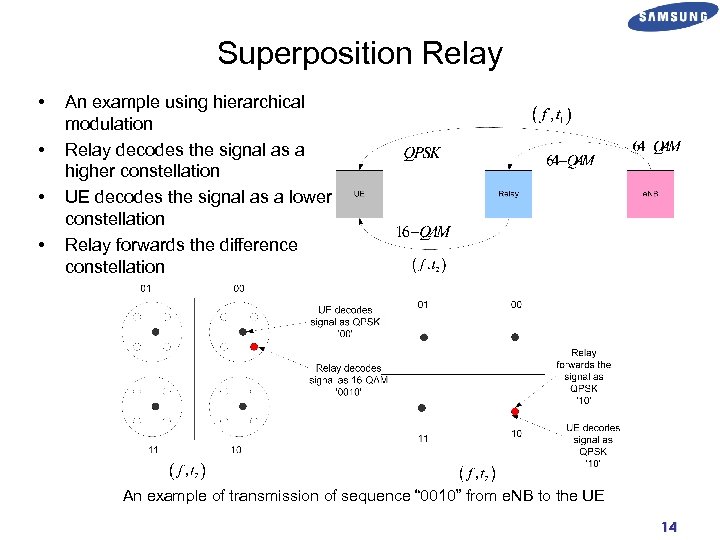 Superposition Relay • • An example using hierarchical modulation Relay decodes the signal as a higher constellation UE decodes the signal as a lower constellation Relay forwards the difference constellation An example of transmission of sequence “ 0010” from e. NB to the UE 14
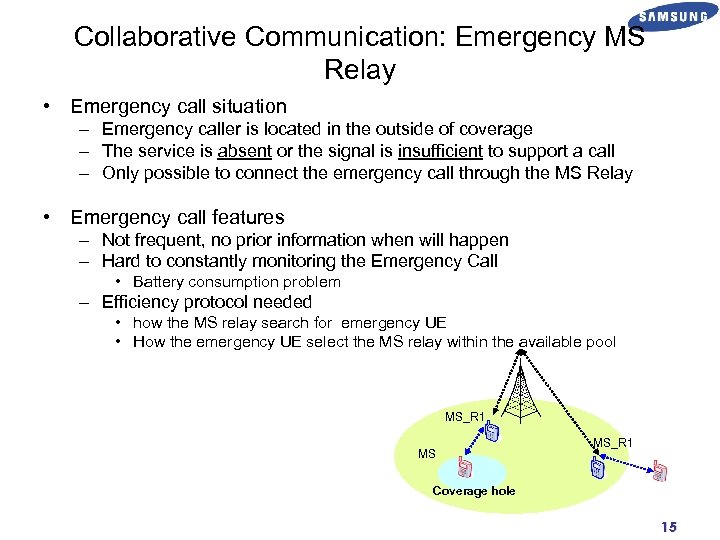 Collaborative Communication: Emergency MS Relay • Emergency call situation – Emergency caller is located in the outside of coverage – The service is absent or the signal is insufficient to support a call – Only possible to connect the emergency call through the MS Relay • Emergency call features – Not frequent, no prior information when will happen – Hard to constantly monitoring the Emergency Call • Battery consumption problem – Efficiency protocol needed • how the MS relay search for emergency UE • How the emergency UE select the MS relay within the available pool MS_R 1 MS MS_R 1 Coverage hole 15
 MBSFN Enhancements: Multi-stream MIMO for MBSFN Superposition of MBSFN and unicast
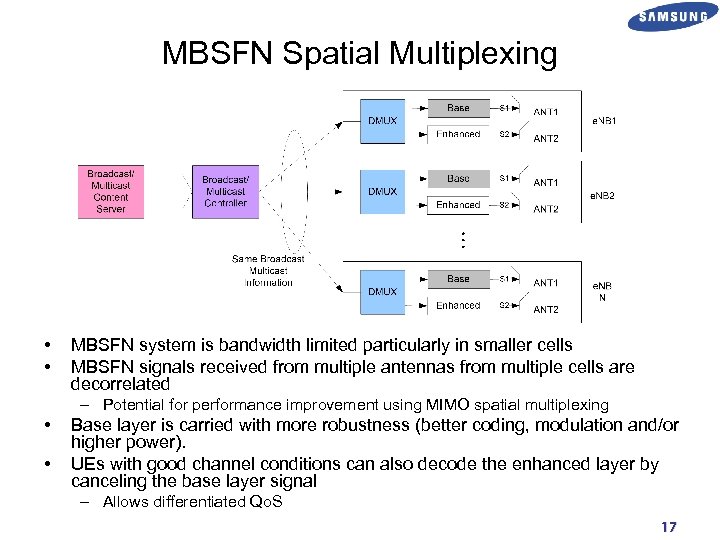 MBSFN Spatial Multiplexing • • MBSFN system is bandwidth limited particularly in smaller cells MBSFN signals received from multiple antennas from multiple cells are decorrelated – Potential for performance improvement using MIMO spatial multiplexing • • Base layer is carried with more robustness (better coding, modulation and/or higher power). UEs with good channel conditions can also decode the enhanced layer by canceling the base layer signal – Allows differentiated Qo. S 17
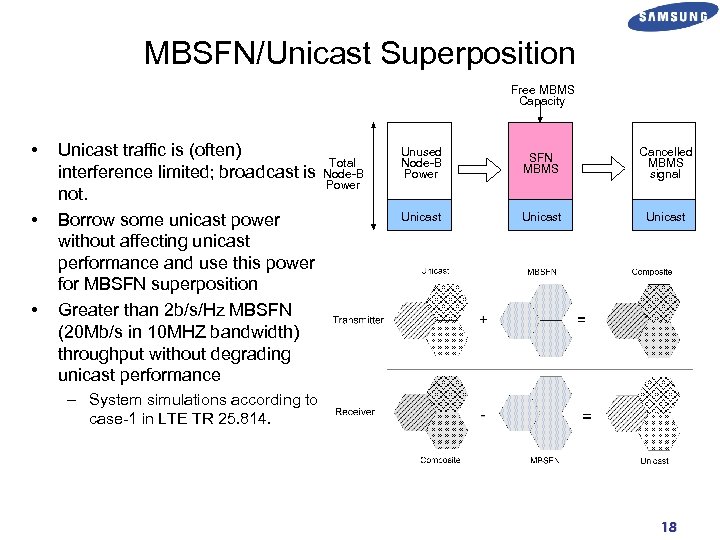 MBSFN/Unicast Superposition Free MBMS Capacity • • • Unicast traffic is (often) interference limited; broadcast is not. Borrow some unicast power without affecting unicast performance and use this power for MBSFN superposition Greater than 2 b/s/Hz MBSFN (20 Mb/s in 10 MHZ bandwidth) throughput without degrading unicast performance Total Node-B Power Unused Node-B Power SFN MBMS Cancelled MBMS signal Unicast – System simulations according to case-1 in LTE TR 25. 814. 18
 Summary • Driver for LTE-advanced is expected demand on ubiquitous broadband access • Key enabling technologies identified and discussed 19