


 Скачать презентацию Reuse of Legacy Data for Vehicle Support within
6a2e61dcf775744534091c667ca3988f.ppt
- Количество слайдов: 18
 Reuse of Legacy Data for Vehicle Support within the US Army Dr. Raj Iyer US Army Tank Automotive Research Development & Engineering Center (TARDEC) Warren, MI Presented at the NDIA 6 th Annual Systems Engineering Conference, San Diego, CA October 21, 2003
 Outline • • Need to move to 3 D Issues with legacy data Decision factors Methodology Conversion issues Where we are going Demos Conclusions 2
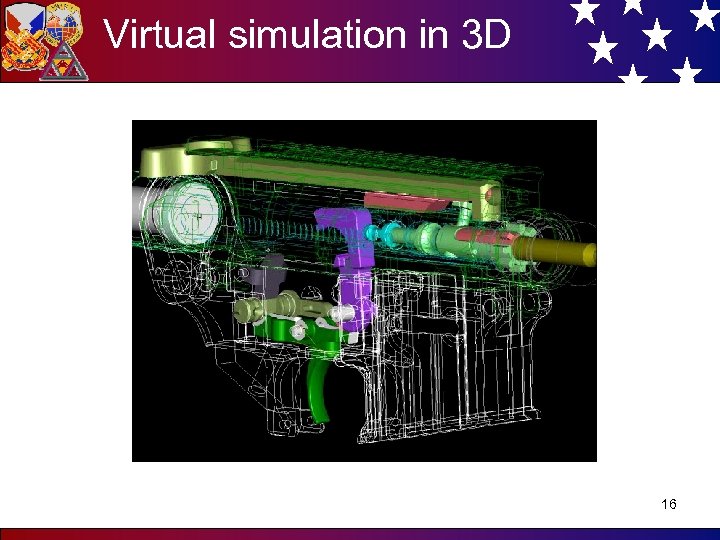
 Need to move to 3 D • Large holdings of legacy 2 D drawings • Need to redesign (or design new) parts based on older designs • Need to manufacture spare parts using new machine tools that cannot use legacy data – improved logistic support • Need to archive designs for future use • Need to visualize 3 D models for non-engineering use • Virtual prototyping – engineering analysis 3
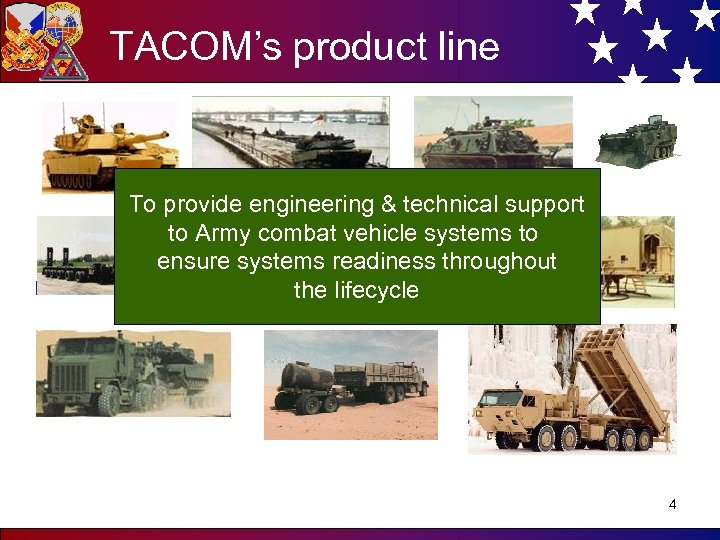 TACOM’s product line To provide engineering & technical support to Army combat vehicle systems to ensure systems readiness throughout the lifecycle 4
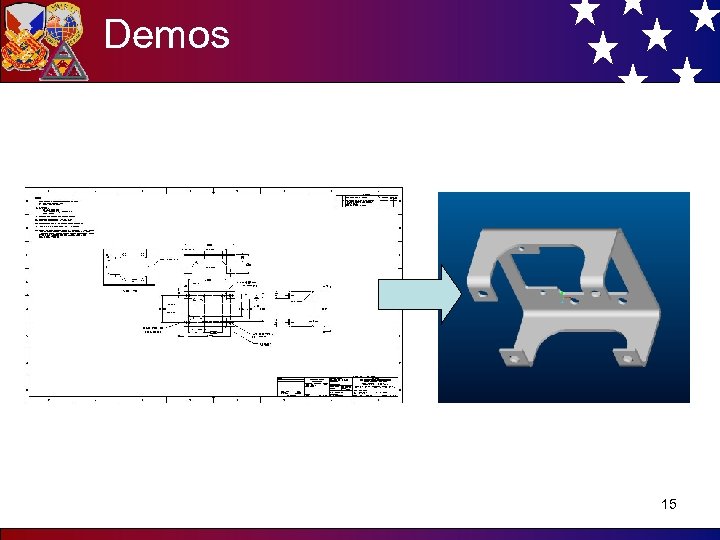
 Where we are today • Have close to a million scanned images in archives – Army vehicles are on an average 30 years old • Manually converted 20, 000 scanned images to 2 D CAD drawings • Manually converted about 4000 2 D drawings to Pro/ENGINEER 3 D models on FMTV • Evaluating automated software for 2 D to 3 D conversions 5
 Issues with legacy data • Scanned images – – Poor scanning resolution Poor quality of hardcopy drawings Multiple sheets because of scanner restrictions Need to be vectorized first • Vectorized drawings – – – Duplicate and overlapping edges Disconnected and crisscrossing edges Near zero length entities Breakup of entities Incorrect scale factor Ambiguous dimensions 6
 Conversion decision factors • • Future production quantities Remaining product lifecycle Potential for design changes Availability and quality of technical data package (TDP) • Mechanical content • System density 7
 Conversion requirements • Governed by “TACOM 3 D Modeling Best Practices” document – Models must be fully parametric and feature-based – Pro/ENGINEER recommended format – but does not preclude other CAD systems – Models must have associative 2 D drawing with dimensioning scheme consistent with original 2 D – Material and surface finish to be identified in 3 D – Layers, colors, notes, file names, … 8
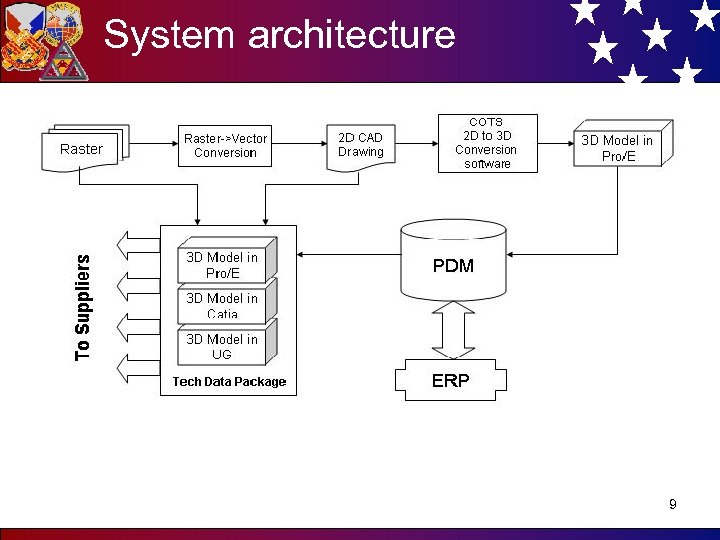 System architecture 9
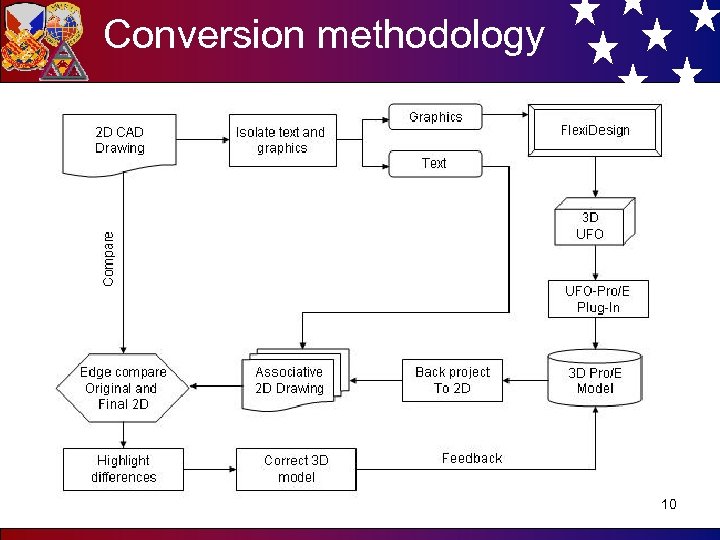 Conversion methodology 10
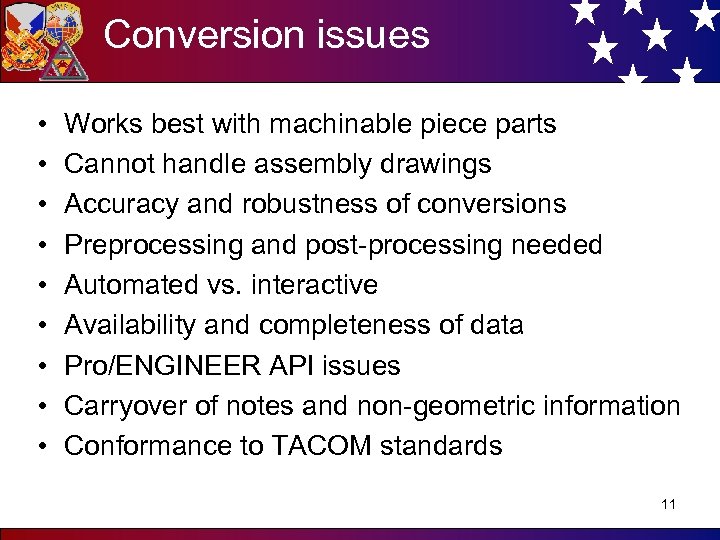 Conversion issues • • • Works best with machinable piece parts Cannot handle assembly drawings Accuracy and robustness of conversions Preprocessing and post-processing needed Automated vs. interactive Availability and completeness of data Pro/ENGINEER API issues Carryover of notes and non-geometric information Conformance to TACOM standards 11
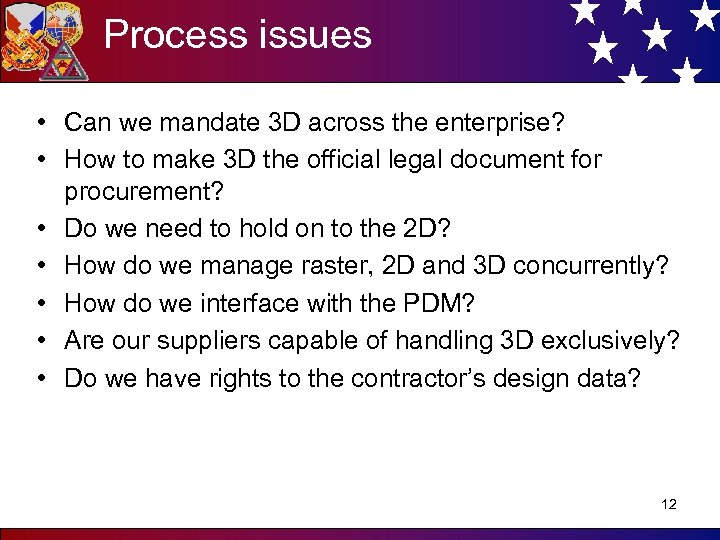 Process issues • Can we mandate 3 D across the enterprise? • How to make 3 D the official legal document for procurement? • Do we need to hold on to the 2 D? • How do we manage raster, 2 D and 3 D concurrently? • How do we interface with the PDM? • Are our suppliers capable of handling 3 D exclusively? • Do we have rights to the contractor’s design data? 12
 Where we are going • Working closely with Imagecom in customizing and fine-tuning Flexi. Design for automated conversions • Standards-based (STEP) approach to archiving and exchanging data • Feature-based 3 D-3 D translations where needed • Strategy for data management throughout the product lifecycle (PLM) • Evaluating effect on automated manufacturing • Reverse engineering 13
 Potential savings • Automated conversions 4 -5 times faster than manual conversions based on pilot conversions • May not require engineers or 3 D modeling experts • In-house conversions on an as-needed basis possible • Flexibility in outputs – Pro/E, Catia, UG, Solid. Works • Lower costs in procuring and manufacturing parts by providing supplier with CAD data that they can directly use 14
 Demos 15
 Virtual simulation in 3 D 16
 In summary • The Army now recognizes the need to move to 3 D like private industry • Take advantage of cost/time savings that auto makers have made by moving to 3 D • Cost-saving automated software becoming available and affordable today • Not a 100% solution – but definite productivity improvements over manual conversion approaches 17
 Contact • Any Questions? • For more information: Dr. Raj Iyer Engineering Business Group, TARDEC 6501 E. 11 Mile Road Warren, MI 48313 Tel: 586. 574. 7186 E-mail: raj. iyer@us. army. mil http: //www. tacom. army. mil/tardec 18