


 Скачать презентацию Return to Home Page July 15 2013 Russia
d8f164cc2a19c7654d12d0b658f73dce.ppt
- Количество слайдов: 33
 Return to Home Page July 15, 2013 Russia & Kyoto Role of U. S.
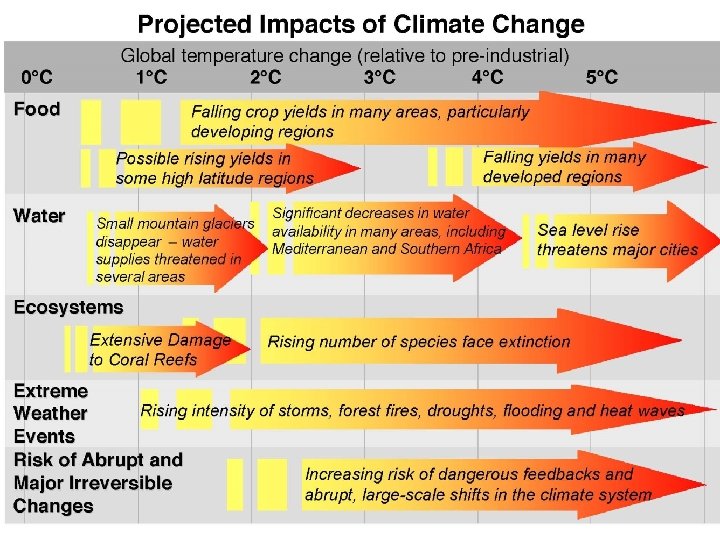 Projected Impacts of Climate Change
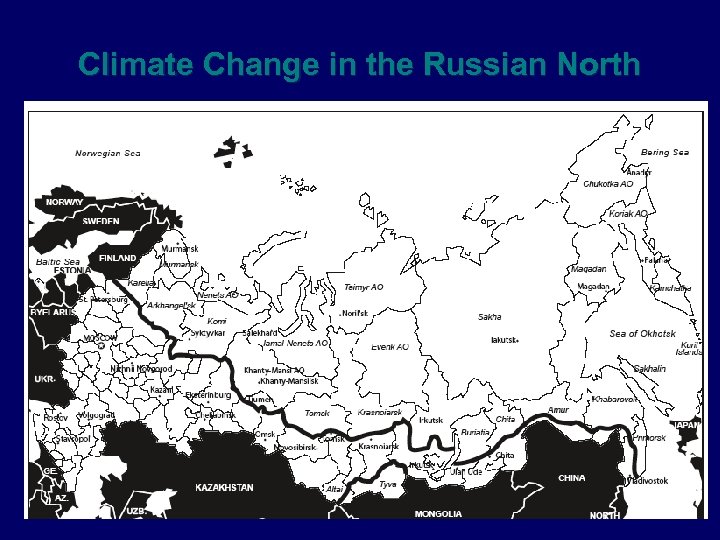 Climate Change in the Russian North
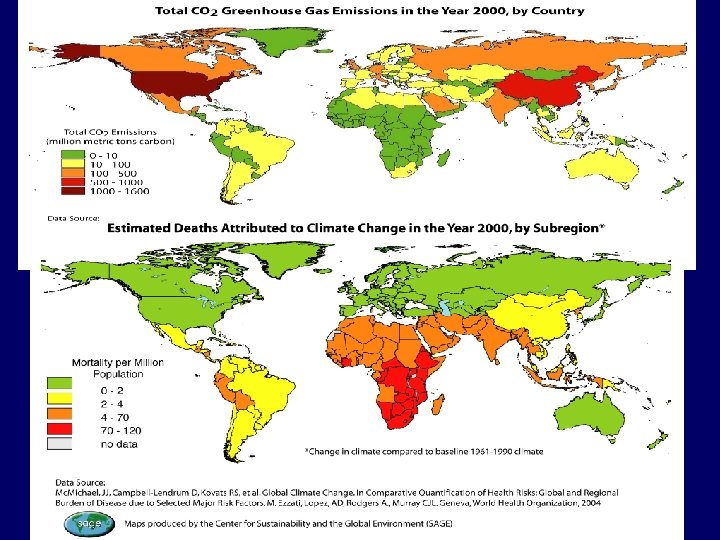 Carbon Dioxide Greenhouse Gas Emissions
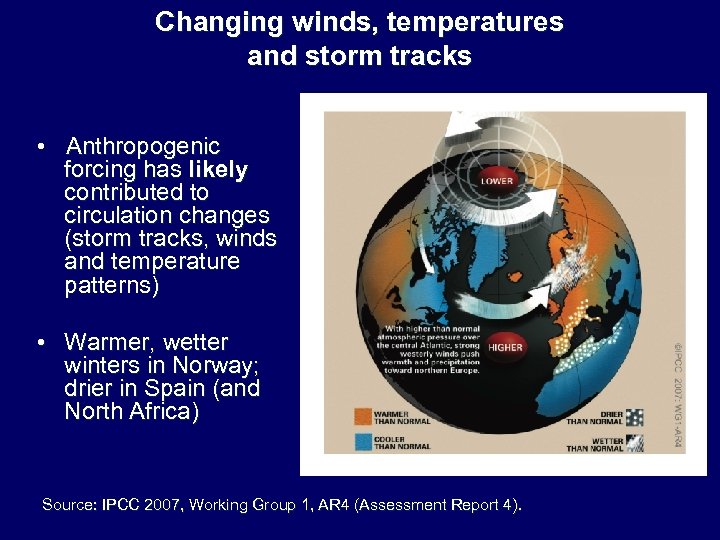 Changing winds, temperatures and storm tracks • Anthropogenic forcing has likely contributed to circulation changes (storm tracks, winds and temperature patterns) • Warmer, wetter winters in Norway; drier in Spain (and North Africa) Source: IPCC 2007, Working Group 1, AR 4 (Assessment Report 4).
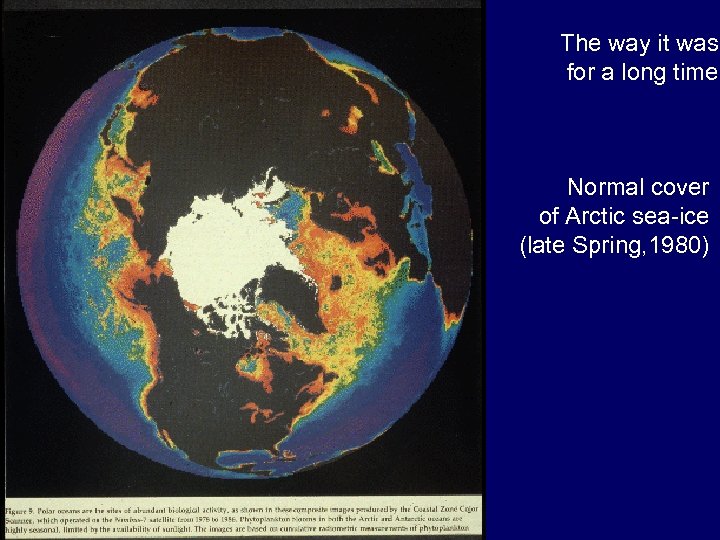 The way it was for a long time Normal cover of Arctic Sea Ice Normal cover of Arctic sea-ice (late Spring, 1980)
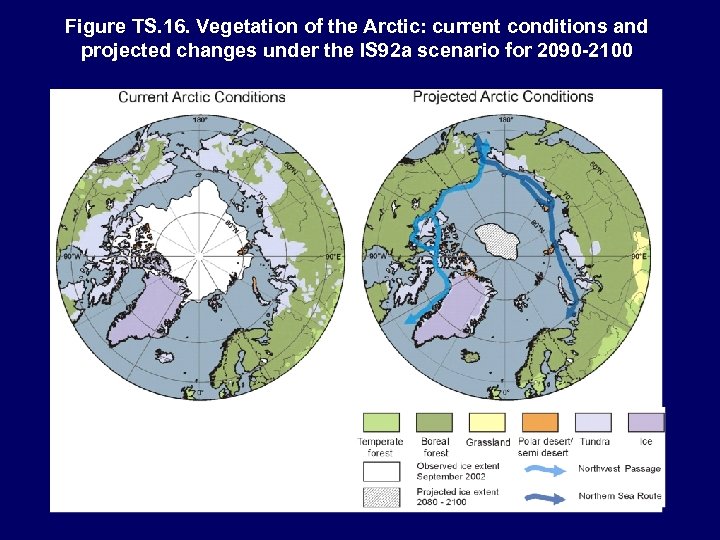 Figure TS. 16. Vegetation of the Arctic: current conditions and projected changes under the IS 92 a scenario for 2090 -2100
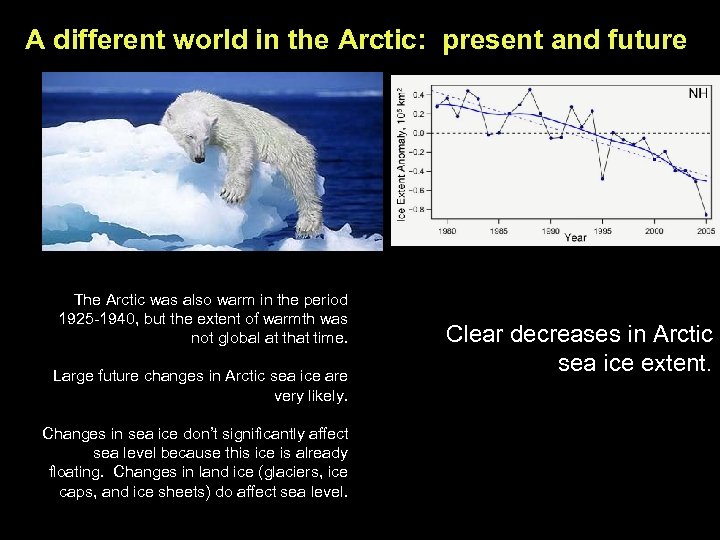 A different world in the Arctic: present and future The Arctic was also warm in the period 1925 -1940, but the extent of warmth was not global at that time. Large future changes in Arctic sea ice are very likely. Changes in sea ice don’t significantly affect sea level because this ice is already floating. Changes in land ice (glaciers, ice caps, and ice sheets) do affect sea level. Clear decreases in Arctic sea ice extent.
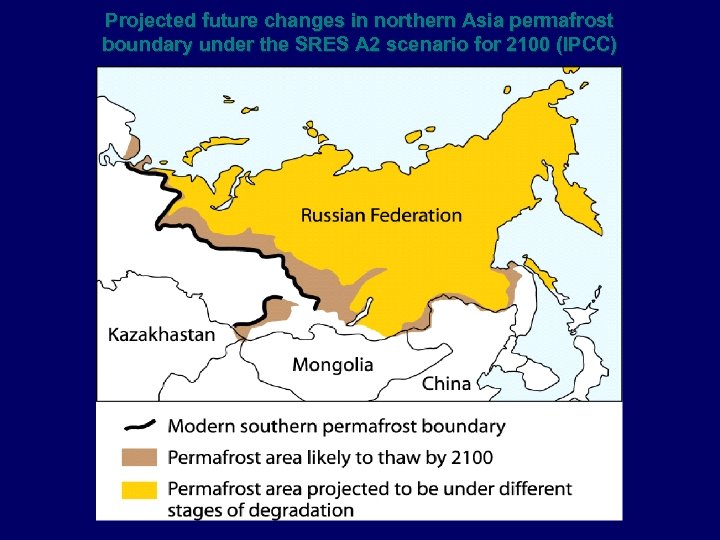 Projected future changes in northern Asia permafrost boundary under the SRES A 2 scenario for 2100 (IPCC)
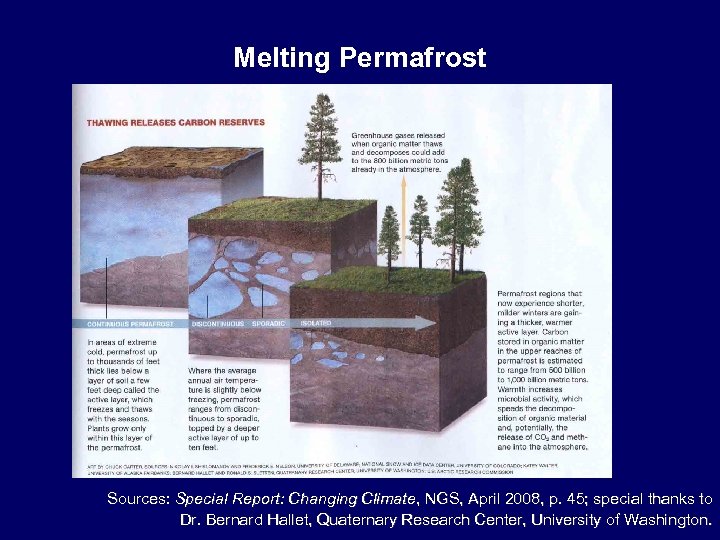 Melting Permafrost Sources: Special Report: Changing Climate, NGS, April 2008, p. 45; special thanks to Dr. Bernard Hallet, Quaternary Research Center, University of Washington.
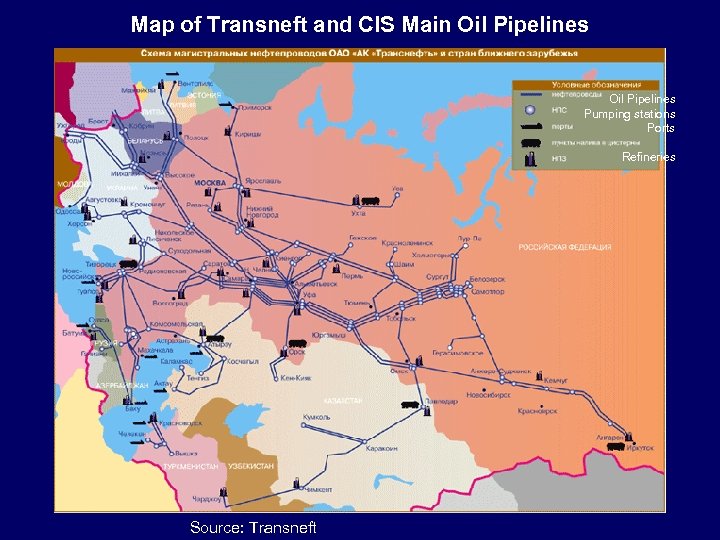 Map of Transneft and CIS Main Oil Pipelines Pumping stations Ports Refineries Source: Transneft
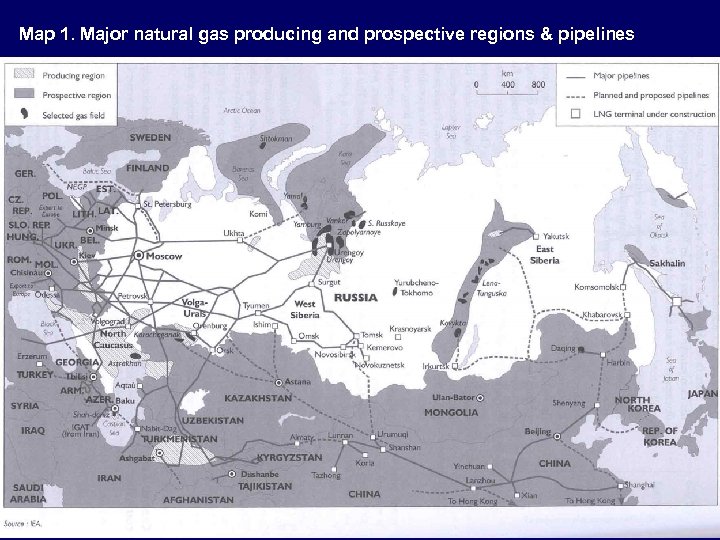 Map 1. Major natural gas producing and prospective regions & pipelines
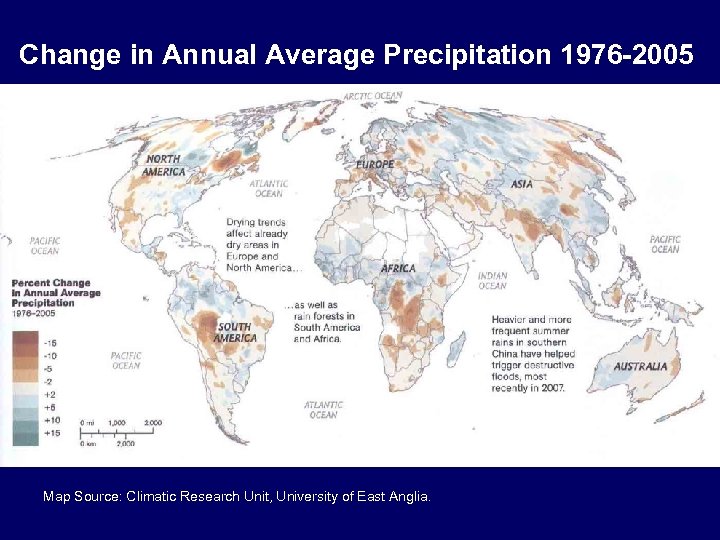 Change in Annual Average Precipitation 1976 -2005 Map Source: Climatic Research Unit, University of East Anglia.
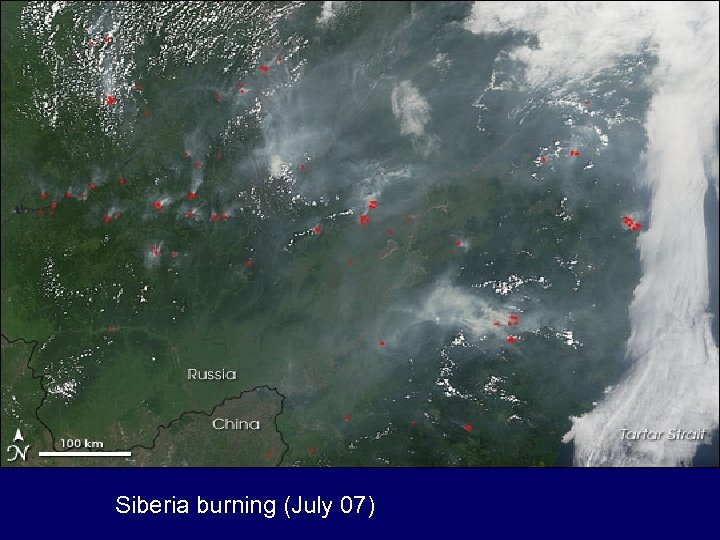 Siberian forest fires Siberia burning (July 07)
 Carbon Dioxide Emissions
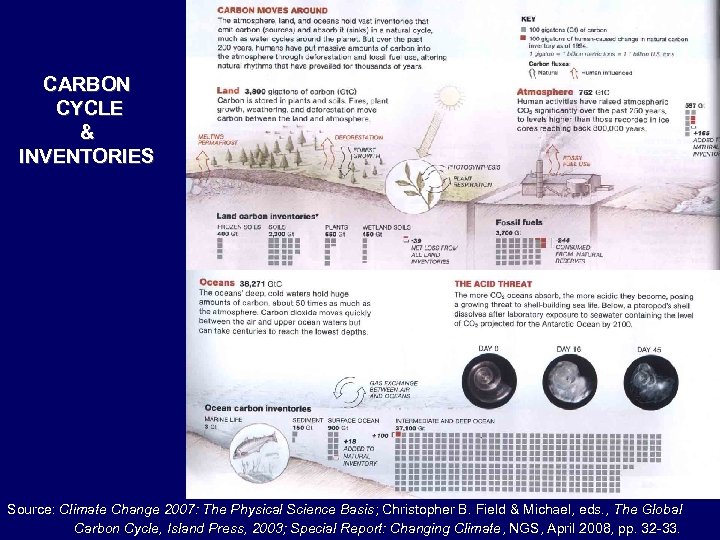 CARBON CYCLE & INVENTORIES Source: Climate Change 2007: The Physical Science Basis; Christopher B. Field & Michael, eds. , The Global Carbon Cycle, Island Press, 2003; Special Report: Changing Climate, NGS, April 2008, pp. 32 -33.
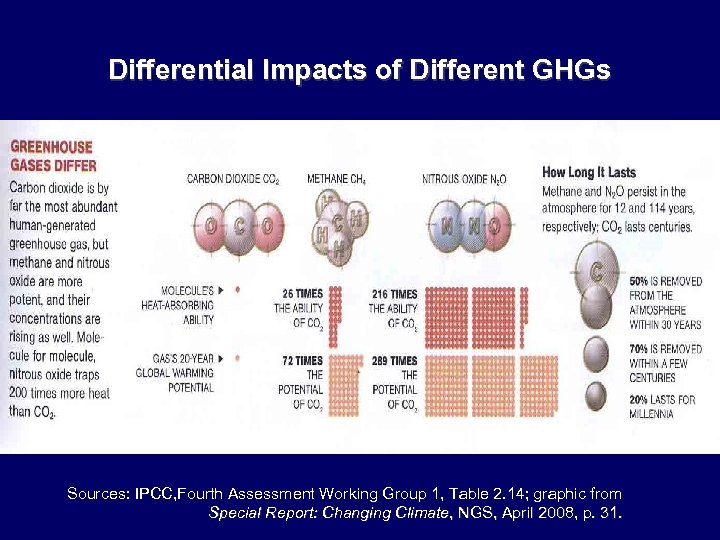 Differential Impacts of Different GHGs Sources: IPCC, Fourth Assessment Working Group 1, Table 2. 14; graphic from Special Report: Changing Climate, NGS, April 2008, p. 31.
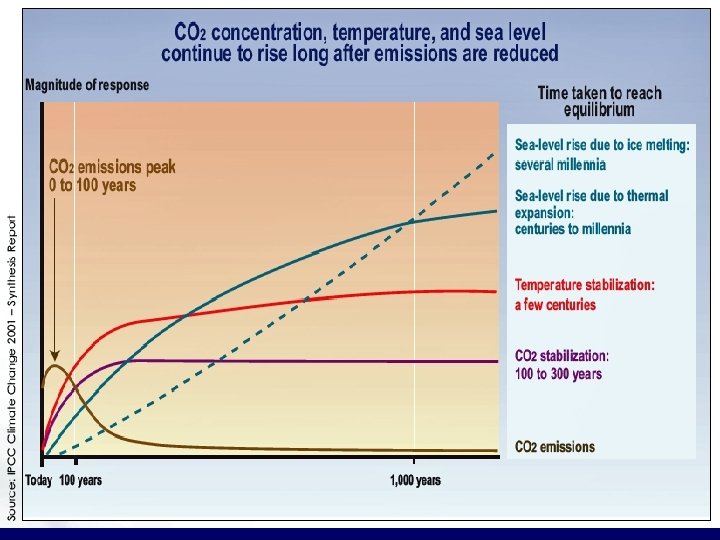 Carbon Dioxide terms long-term
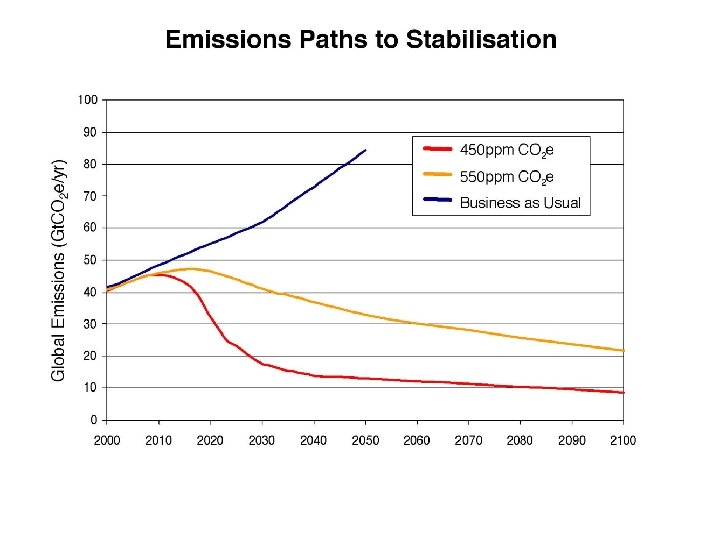 Emission Paths to Stabilization
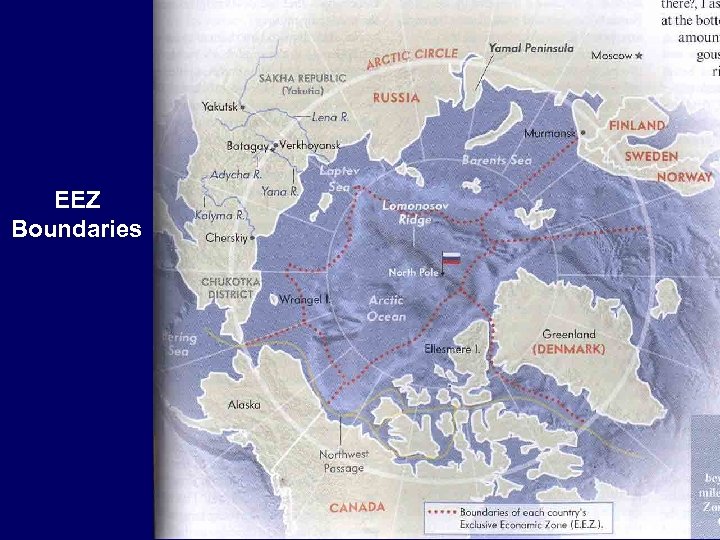 EEZ Boundaries
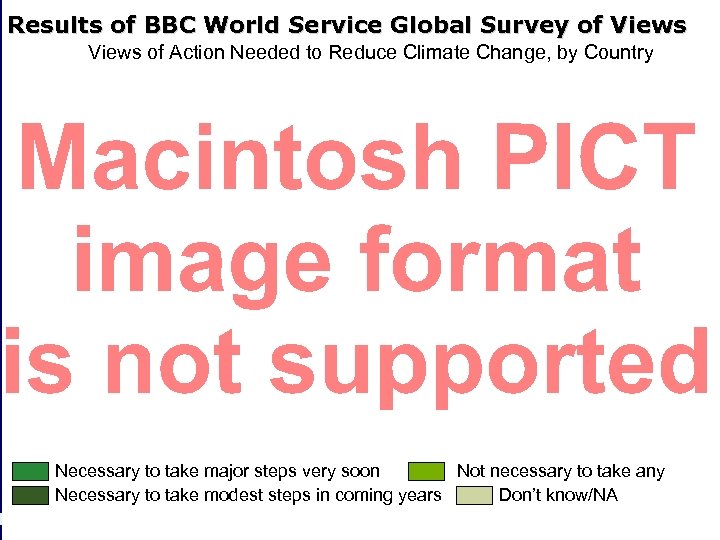 Results of BBC World Service Global Survey of Views of Action Needed to Reduce Climate Change, by Country Necessary to take major steps very soon Not necessary to take any steps Necessary to take modest steps in coming years Don’t know/NA Source: BBC/Globe. Scan/PIPA IPCC - WGI
 Russian testimonials "It's been a mild winter, lots of rivers are drying up. For us, it makes no difference -it'd be better if it were even warmer. But it bothers the reindeer. " Ivan Kanev, a nomad reindeer herder NARYAN-MAR, Nenets Autonomous District. "Of course you can see the effects of global warming. Sheet ice that normally covers the waters of the Barents Sea is quickly starting to shift and disappear. In recent years, you can't really see this permanent sea ice. It comes and goes. If the wind blows this way, it brings the ice to the coast. If it blows the other way, it floats away. ” Vera Letkova, meteorologist. IPCC - WGI
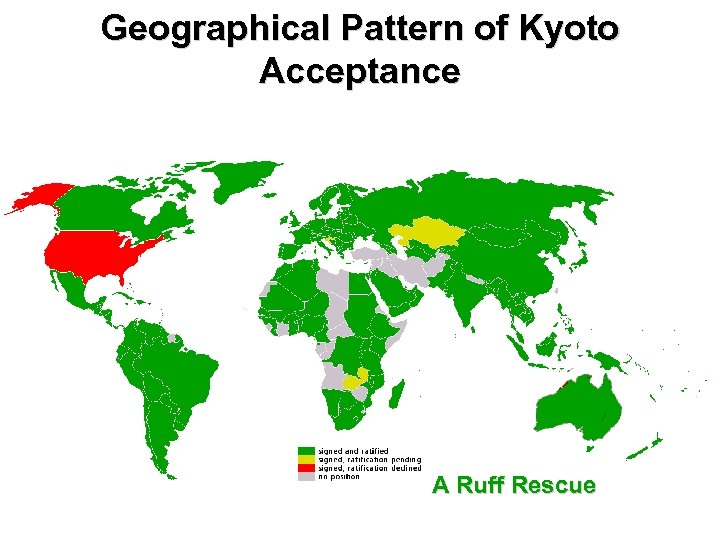 Geographical Pattern of Kyoto Acceptance A Ruff Rescue
 Basic UNFCCC & Kyoto Protocol information UNFCCC - United Nations Framework Convention on Climate Change Kyoto Protocol is amendment of UNFCCC Signed December 11, 1997 at Kyoto, Japan Opened for signature on March 16, 1998 Need 55 countries representing 55% of 1990 CO 2 emissions to ratify for entry-into-force GHG reduction targets for 2008 -2012 6 GHGs include CO 2, CH 4, N 20, CFC-12, CFC-10, 2001 Bush says U. S. will not ratify 44. 2% of 1990 global GHC emissions without US, Russia, Australia Russia 17. 4% of 1990 CO 2 emissions US and Australia ~40% of GHG emissions Talks stall in Hague post-2000 election 2001 Bonn COP revisions - allows CO 2 sink
 Kyoto Glossary continued: • Baseline and credit
A type of emissions trading scheme where firms are encouraged to reduce their greenhouse gas emissions below a projected “business as usual” path of increasing emissions. Any reductions below that future path earns credits for the difference which can be sold to other emitters struggling to contain increases to baseline levels. • Cap and trade
The most popular type of emissions trading scheme where emissions are subject to a cap, permits are issued up to that cap, and a market allows those emitting less than their quota of the cap to sell their excess permits to emitters needing to buy extra to meet their quota. • Carbon dioxide equivalent, CO 2 e,
See Mt. CO 2 e • Carbon neutral
An individual, family or organization that is responsible for no net emissions of greenhouse gases from all its activities is considered "carbon neutral". Emissions must be cut to a minimum and any necessary emissions then offset by emission reducing activities elsewhere. Buying accredited clean electricity helps cut household or office greenhouse emissions, while investing in sustainable energy projects or afforestation schemes are examples of offsets. • Carbon positive
An individual, family or organization that is responsible for taking more greenhouse gases out of the atmosphere than it emits is said to be "carbon positive". This requires paying for activities such as forest planting or investing in renewable energy.
Kyoto Glossary continued: • Baseline and credit
A type of emissions trading scheme where firms are encouraged to reduce their greenhouse gas emissions below a projected “business as usual” path of increasing emissions. Any reductions below that future path earns credits for the difference which can be sold to other emitters struggling to contain increases to baseline levels. • Cap and trade
The most popular type of emissions trading scheme where emissions are subject to a cap, permits are issued up to that cap, and a market allows those emitting less than their quota of the cap to sell their excess permits to emitters needing to buy extra to meet their quota. • Carbon dioxide equivalent, CO 2 e,
See Mt. CO 2 e • Carbon neutral
An individual, family or organization that is responsible for no net emissions of greenhouse gases from all its activities is considered "carbon neutral". Emissions must be cut to a minimum and any necessary emissions then offset by emission reducing activities elsewhere. Buying accredited clean electricity helps cut household or office greenhouse emissions, while investing in sustainable energy projects or afforestation schemes are examples of offsets. • Carbon positive
An individual, family or organization that is responsible for taking more greenhouse gases out of the atmosphere than it emits is said to be "carbon positive". This requires paying for activities such as forest planting or investing in renewable energy.
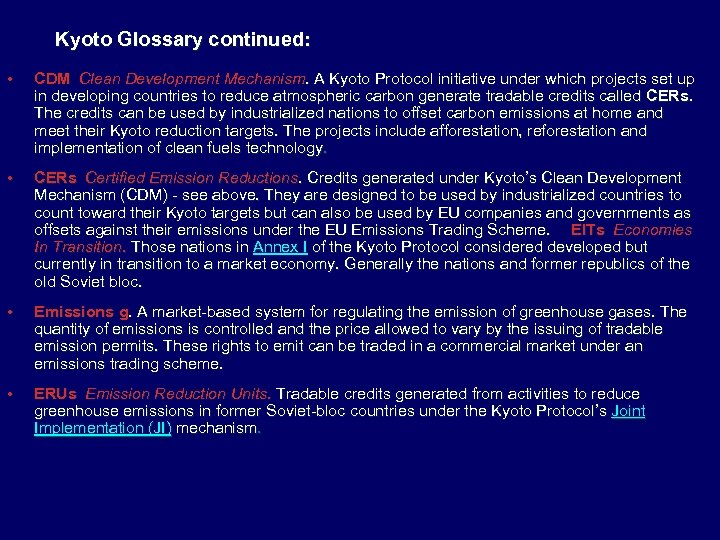 Kyoto Glossary continued: • CDM
Clean Development Mechanism. A Kyoto Protocol initiative under which projects set up in developing countries to reduce atmospheric carbon generate tradable credits called CERs. The credits can be used by industrialized nations to offset carbon emissions at home and meet their Kyoto reduction targets. The projects include afforestation, reforestation and implementation of clean fuels technology. • CERs
Certified Emission Reductions. Credits generated under Kyoto’s Clean Development Mechanism (CDM) - see above. They are designed to be used by industrialized countries to count toward their Kyoto targets but can also be used by EU companies and governments as offsets against their emissions under the EU Emissions Trading Scheme.
EITs
Economies In Transition. Those nations in Annex I of the Kyoto Protocol considered developed but currently in transition to a market economy. Generally the nations and former republics of the old Soviet bloc. • Emissions g. A market-based system for regulating the emission of greenhouse gases. The quantity of emissions is controlled and the price allowed to vary by the issuing of tradable emission permits. These rights to emit can be traded in a commercial market under an emissions trading scheme. • ERUs
Emission Reduction Units. Tradable credits generated from activities to reduce greenhouse emissions in former Soviet-bloc countries under the Kyoto Protocol’s Joint Implementation (JI) mechanism.
Kyoto Glossary continued: • CDM
Clean Development Mechanism. A Kyoto Protocol initiative under which projects set up in developing countries to reduce atmospheric carbon generate tradable credits called CERs. The credits can be used by industrialized nations to offset carbon emissions at home and meet their Kyoto reduction targets. The projects include afforestation, reforestation and implementation of clean fuels technology. • CERs
Certified Emission Reductions. Credits generated under Kyoto’s Clean Development Mechanism (CDM) - see above. They are designed to be used by industrialized countries to count toward their Kyoto targets but can also be used by EU companies and governments as offsets against their emissions under the EU Emissions Trading Scheme.
EITs
Economies In Transition. Those nations in Annex I of the Kyoto Protocol considered developed but currently in transition to a market economy. Generally the nations and former republics of the old Soviet bloc. • Emissions g. A market-based system for regulating the emission of greenhouse gases. The quantity of emissions is controlled and the price allowed to vary by the issuing of tradable emission permits. These rights to emit can be traded in a commercial market under an emissions trading scheme. • ERUs
Emission Reduction Units. Tradable credits generated from activities to reduce greenhouse emissions in former Soviet-bloc countries under the Kyoto Protocol’s Joint Implementation (JI) mechanism.
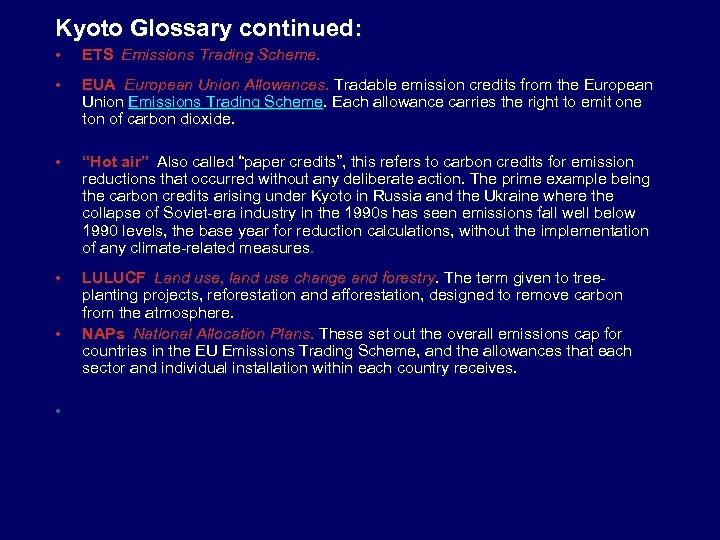 Kyoto Glossary continued: • ETS
Emissions Trading Scheme. • EUA
European Union Allowances. Tradable emission credits from the European Union Emissions Trading Scheme. Each allowance carries the right to emit one ton of carbon dioxide. • “Hot air”
Also called “paper credits”, this refers to carbon credits for emission reductions that occurred without any deliberate action. The prime example being the carbon credits arising under Kyoto in Russia and the Ukraine where the collapse of Soviet-era industry in the 1990 s has seen emissions fall well below 1990 levels, the base year for reduction calculations, without the implementation of any climate-related measures. • LULUCF
Land use, land use change and forestry. The term given to treeplanting projects, reforestation and afforestation, designed to remove carbon from the atmosphere.
NAPs
National Allocation Plans. These set out the overall emissions cap for countries in the EU Emissions Trading Scheme, and the allowances that each sector and individual installation within each country receives.
•
•
Kyoto Glossary continued: • ETS
Emissions Trading Scheme. • EUA
European Union Allowances. Tradable emission credits from the European Union Emissions Trading Scheme. Each allowance carries the right to emit one ton of carbon dioxide. • “Hot air”
Also called “paper credits”, this refers to carbon credits for emission reductions that occurred without any deliberate action. The prime example being the carbon credits arising under Kyoto in Russia and the Ukraine where the collapse of Soviet-era industry in the 1990 s has seen emissions fall well below 1990 levels, the base year for reduction calculations, without the implementation of any climate-related measures. • LULUCF
Land use, land use change and forestry. The term given to treeplanting projects, reforestation and afforestation, designed to remove carbon from the atmosphere.
NAPs
National Allocation Plans. These set out the overall emissions cap for countries in the EU Emissions Trading Scheme, and the allowances that each sector and individual installation within each country receives.
•
•
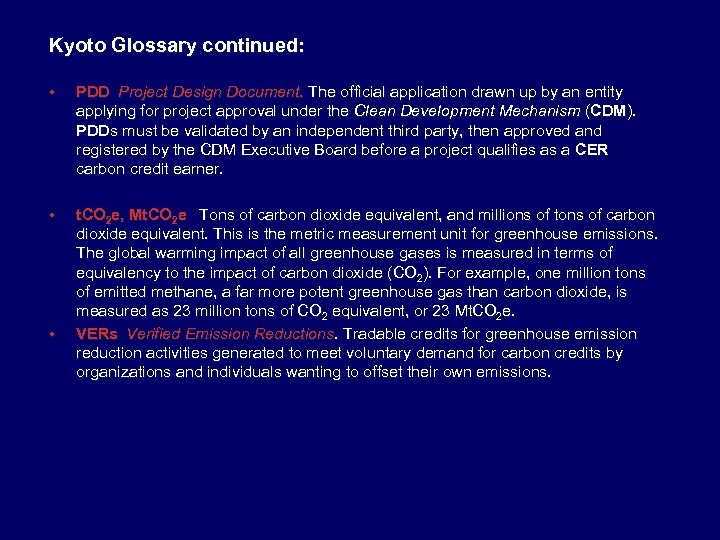 Kyoto Glossary continued: • PDD
Project Design Document. The official application drawn up by an entity applying for project approval under the Clean Development Mechanism (CDM). PDDs must be validated by an independent third party, then approved and registered by the CDM Executive Board before a project qualifies as a CER carbon credit earner. • t. CO 2 e, Mt. CO 2 e
Tons of carbon dioxide equivalent, and millions of tons of carbon dioxide equivalent. This is the metric measurement unit for greenhouse emissions. The global warming impact of all greenhouse gases is measured in terms of equivalency to the impact of carbon dioxide (CO 2). For example, one million tons of emitted methane, a far more potent greenhouse gas than carbon dioxide, is measured as 23 million tons of CO 2 equivalent, or 23 Mt. CO 2 e.
VERs
Verified Emission Reductions. Tradable credits for greenhouse emission reduction activities generated to meet voluntary demand for carbon credits by organizations and individuals wanting to offset their own emissions. •
Kyoto Glossary continued: • PDD
Project Design Document. The official application drawn up by an entity applying for project approval under the Clean Development Mechanism (CDM). PDDs must be validated by an independent third party, then approved and registered by the CDM Executive Board before a project qualifies as a CER carbon credit earner. • t. CO 2 e, Mt. CO 2 e
Tons of carbon dioxide equivalent, and millions of tons of carbon dioxide equivalent. This is the metric measurement unit for greenhouse emissions. The global warming impact of all greenhouse gases is measured in terms of equivalency to the impact of carbon dioxide (CO 2). For example, one million tons of emitted methane, a far more potent greenhouse gas than carbon dioxide, is measured as 23 million tons of CO 2 equivalent, or 23 Mt. CO 2 e.
VERs
Verified Emission Reductions. Tradable credits for greenhouse emission reduction activities generated to meet voluntary demand for carbon credits by organizations and individuals wanting to offset their own emissions. •
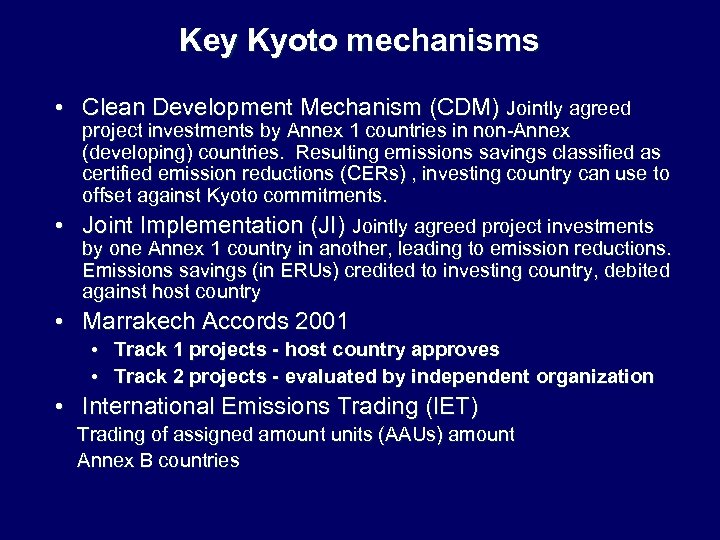 Key Kyoto mechanisms • Clean Development Mechanism (CDM) Jointly agreed project investments by Annex 1 countries in non-Annex (developing) countries. Resulting emissions savings classified as certified emission reductions (CERs) , investing country can use to offset against Kyoto commitments. • Joint Implementation (JI) Jointly agreed project investments by one Annex 1 country in another, leading to emission reductions. Emissions savings (in ERUs) credited to investing country, debited against host country • Marrakech Accords 2001 • Track 1 projects - host country approves • Track 2 projects - evaluated by independent organization • International Emissions Trading (IET) Trading of assigned amount units (AAUs) amount Annex B countries
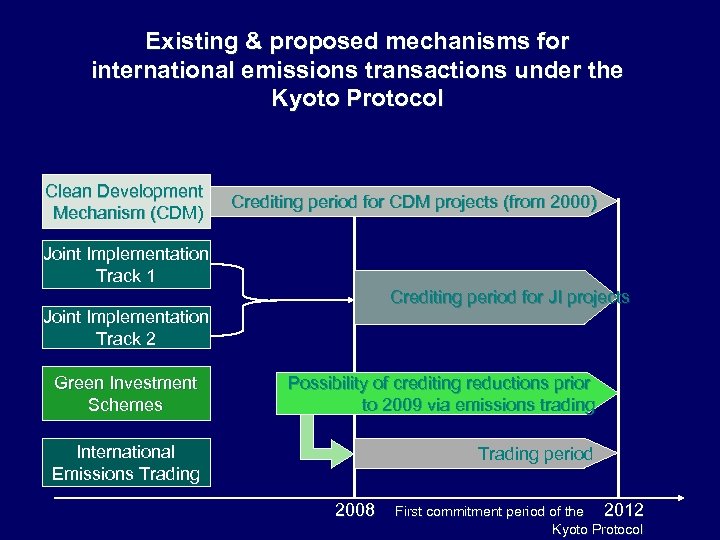 Existing & proposed mechanisms for international emissions transactions under the Kyoto Protocol Clean Development Mechanism (CDM) Crediting period for CDM projects (from 2000) Joint Implementation Track 1 Crediting period for JI projects Joint Implementation Track 2 Green Investment Schemes Possibility of crediting reductions prior to 2009 via emissions trading International Emissions Trading period 2008 First commitment period of the 2012 Kyoto Protocol
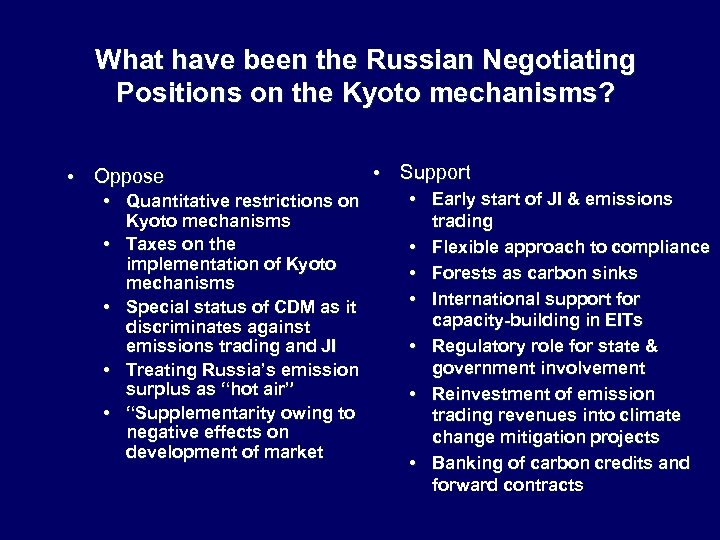 What have been the Russian Negotiating Positions on the Kyoto mechanisms? • Oppose • Quantitative restrictions on Kyoto mechanisms • Taxes on the implementation of Kyoto mechanisms • Special status of CDM as it discriminates against emissions trading and JI • Treating Russia’s emission surplus as “hot air” • “Supplementarity owing to negative effects on development of market • Support • Early start of JI & emissions trading • Flexible approach to compliance • Forests as carbon sinks • International support for capacity-building in EITs • Regulatory role for state & government involvement • Reinvestment of emission trading revenues into climate change mitigation projects • Banking of carbon credits and forward contracts
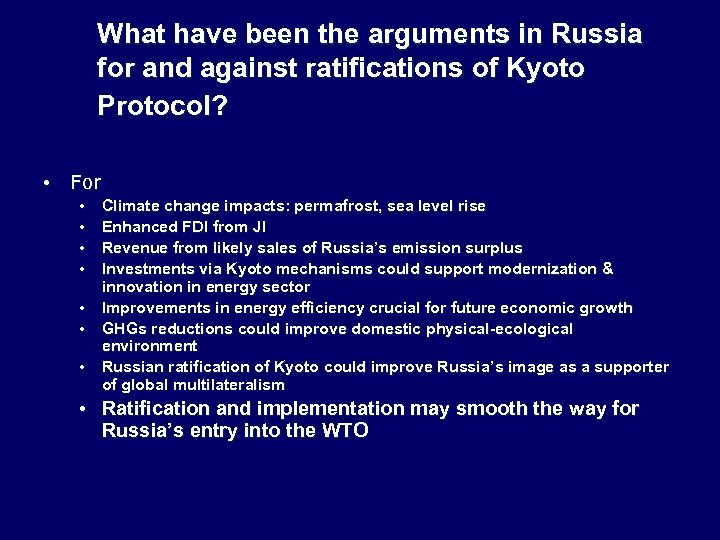 What have been the arguments in Russia for and against ratifications of Kyoto Protocol? • For • • Climate change impacts: permafrost, sea level rise Enhanced FDI from JI Revenue from likely sales of Russia’s emission surplus Investments via Kyoto mechanisms could support modernization & innovation in energy sector Improvements in energy efficiency crucial for future economic growth GHGs reductions could improve domestic physical-ecological environment Russian ratification of Kyoto could improve Russia’s image as a supporter of global multilateralism • Ratification and implementation may smooth the way for Russia’s entry into the WTO
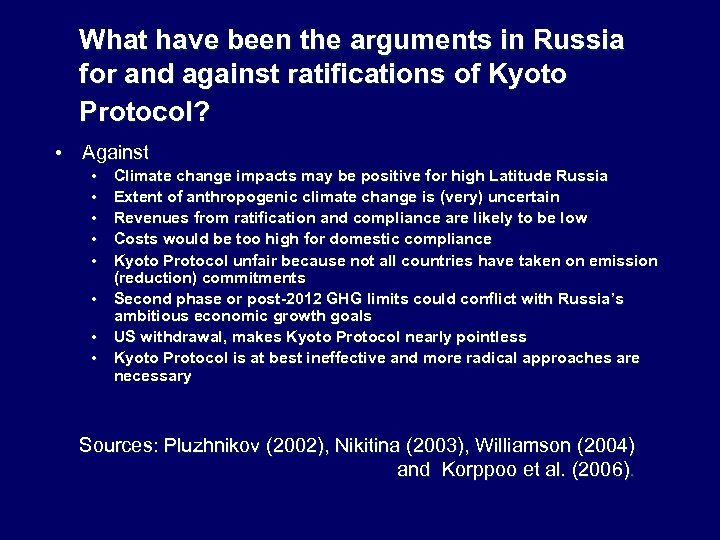 What have been the arguments in Russia for and against ratifications of Kyoto Protocol? • Against • • Climate change impacts may be positive for high Latitude Russia Extent of anthropogenic climate change is (very) uncertain Revenues from ratification and compliance are likely to be low Costs would be too high for domestic compliance Kyoto Protocol unfair because not all countries have taken on emission (reduction) commitments Second phase or post-2012 GHG limits could conflict with Russia ’s ambitious economic growth goals US withdrawal, makes Kyoto Protocol nearly pointless Kyoto Protocol is at best ineffective and more radical approaches are necessary Sources: Pluzhnikov (2002), Nikitina (2003), Williamson (2004) and Korppoo et al. (2006).