


 Скачать презентацию Rethinking Network Control Management The Case for
00f29e6eb6df995387577ec6b481ce0a.ppt
- Количество слайдов: 59
 Rethinking Network Control & Management The Case for a New 4 D Architecture David A. Maltz Carnegie Mellon University/Microsoft Research Joint work with Albert Greenberg, Gisli Hjalmtysson Andy Myers, Jennifer Rexford, Geoffrey Xie, Hong Yan, Jibin Zhan, Hui Zhang 1
 The Role of Network Control and Management v Many different network environments § § Data-center networks, enterprise/campus § v Access, backbone networks Sizes: 10 -10, 000 routers/switches Many different technologies § v Longest-prefix routing (IP), fixed-width routing (Ethernet), label switching (MPLS, ATM), circuit switching (optical, TDM) Many different policies § Routing, reachability, transit, traffic engineering, robustness The control plane software binds these elements together and defines the network 2
 We Can Change the Control Plane! v Pre-existing industry trend towards separating router hardware from software § § v IETF: FORCES, GSMP, GMPLS Soft. Router [Lakshman, Hot. Nets’ 04] Incremental deployment path exists § § Small enterprise networks have most to gain § 3 Individual networks can upgrade their control planes and gain benefits No changes to end-systems required
 A Clean-slate Design v What are the fundamental causes of network problems? v How to secure the network and protect the infrastructure? v How to provide flexibility in defining management logic? v What functionality needs to be distributed – what can be centralized? § § v How to reduce/simplify the software in networks? What would a “RISC” router look like? How to leverage technology trends? § 4 CPU and link-speed growing faster than # of switches
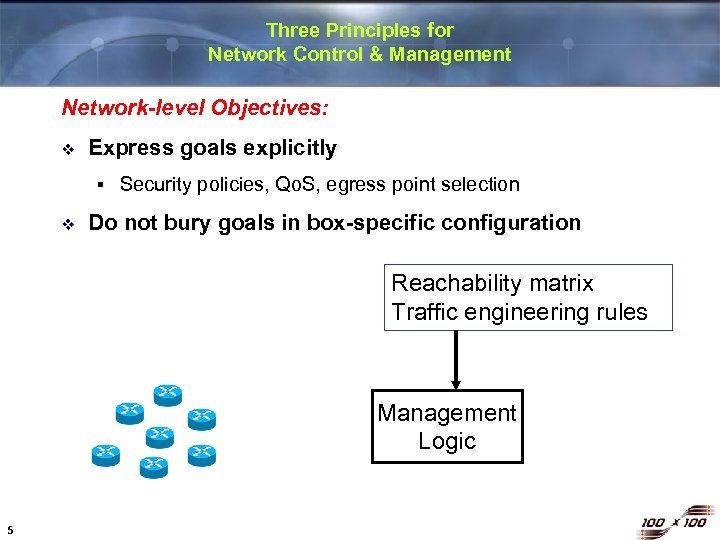 Three Principles for Network Control & Management Network-level Objectives: v Express goals explicitly § v Security policies, Qo. S, egress point selection Do not bury goals in box-specific configuration Reachability matrix Traffic engineering rules Management Logic 5
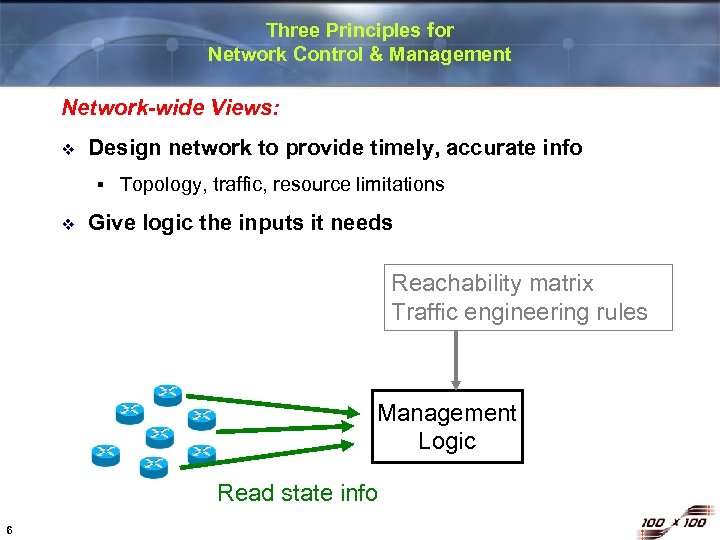 Three Principles for Network Control & Management Network-wide Views: v Design network to provide timely, accurate info § v Topology, traffic, resource limitations Give logic the inputs it needs Reachability matrix Traffic engineering rules Management Logic Read state info 6
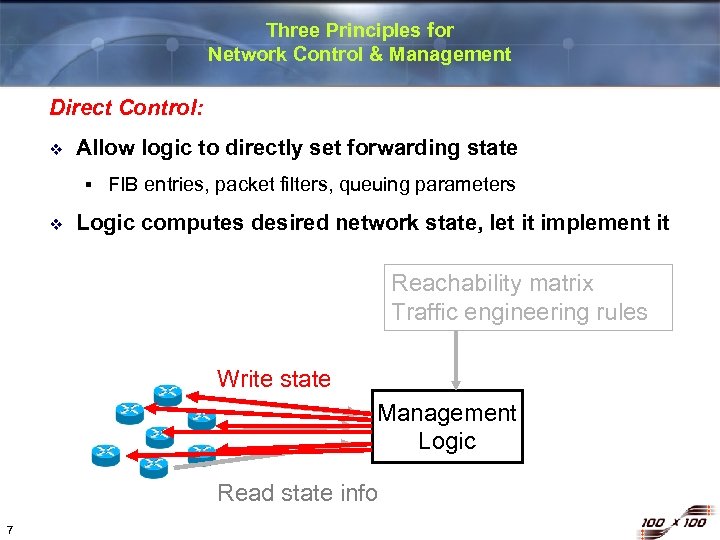 Three Principles for Network Control & Management Direct Control: v Allow logic to directly set forwarding state § v FIB entries, packet filters, queuing parameters Logic computes desired network state, let it implement it Reachability matrix Traffic engineering rules Write state Management Logic Read state info 7
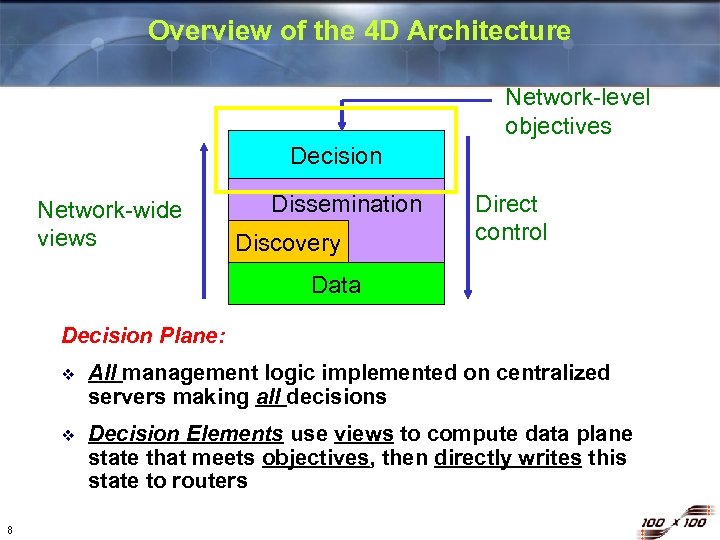 Overview of the 4 D Architecture Network-level objectives Decision Network-wide views Dissemination Discovery Direct control Data Decision Plane: v v 8 All management logic implemented on centralized servers making all decisions Decision Elements use views to compute data plane state that meets objectives, then directly writes this state to routers
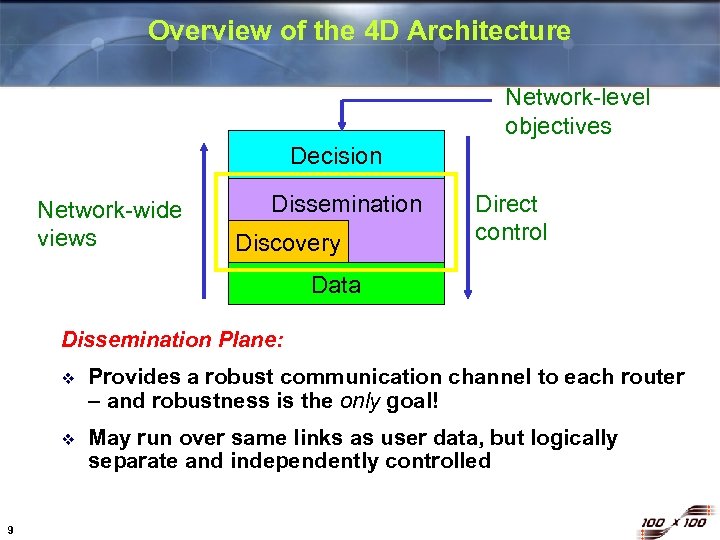 Overview of the 4 D Architecture Network-level objectives Decision Network-wide views Dissemination Discovery Direct control Data Dissemination Plane: v v 9 Provides a robust communication channel to each router – and robustness is the only goal! May run over same links as user data, but logically separate and independently controlled
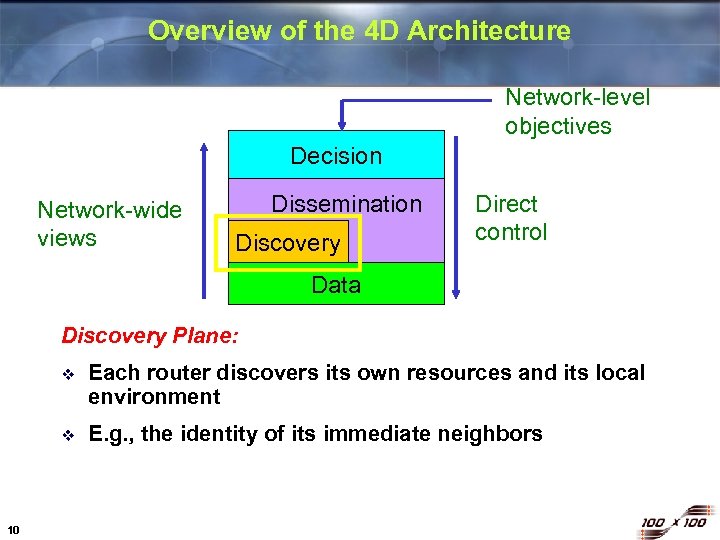 Overview of the 4 D Architecture Network-level objectives Decision Network-wide views Dissemination Discovery Direct control Data Discovery Plane: v v 10 Each router discovers its own resources and its local environment E. g. , the identity of its immediate neighbors
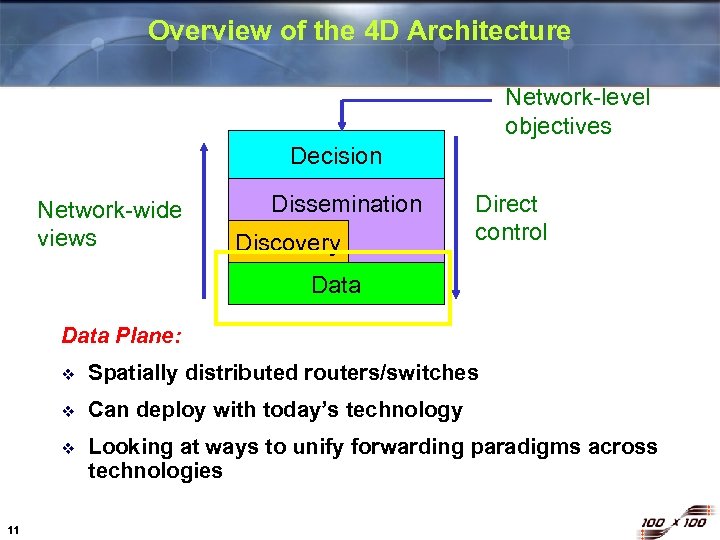 Overview of the 4 D Architecture Network-level objectives Decision Network-wide views Dissemination Discovery Direct control Data Plane: v v Can deploy with today’s technology v 11 Spatially distributed routers/switches Looking at ways to unify forwarding paradigms across technologies
 Concerns and Challenges v Distributed Systems issues § § Latency means DE’s view of network is behind reality. Will the control loop be stable? § What is the overhead to/from the DEs? § v How will communication between routers and DEs survive failures in the network? What happens in a network partition? Networking issues § § 12 Does the 4 D simplify control and management? Can we create logic to meet multiple objectives?
 The Feasibility of the 4 D Architecture We designed and built a prototype of the 4 D Architecture v 4 D Architecture permits many designs – prototype is a single, simple design point v Decision plane § § v Contains logic to simultaneously compute routes and enforce reachability matrix Multiple Decision Elements per network, using simple election protocol to pick master Dissemination plane § § 13 Uses source routes to direct control messages Extremely simple, but can route around failed data links
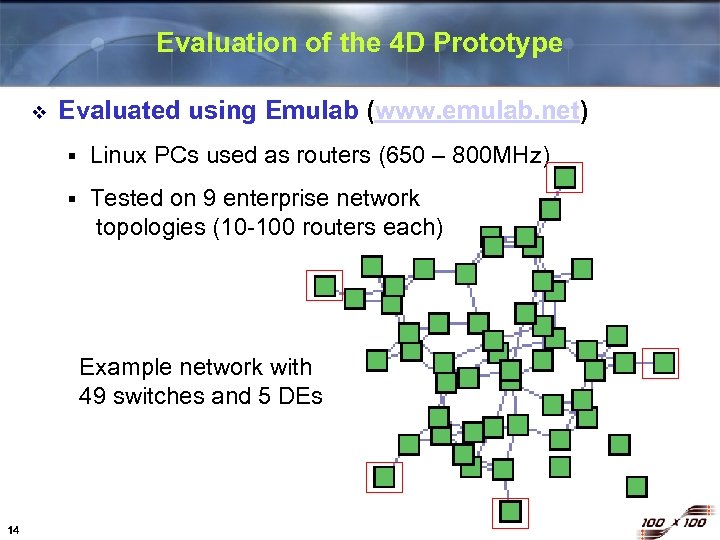 Evaluation of the 4 D Prototype v Evaluated using Emulab (www. emulab. net) § Linux PCs used as routers (650 – 800 MHz) § Tested on 9 enterprise network topologies (10 -100 routers each) Example network with 49 switches and 5 DEs 14
 Performance of the 4 D Prototype Trivial prototype has performance comparable to welltuned production networks v Recovers from single link failure in < 300 ms § § v < 1 s response considered “excellent” Faster forwarding reconvergence possible Survives failure of master Decision Element § § v New DE takes control within 1 s No disruption unless second fault occurs Gracefully handles complete network partitions § 15 Less than 1. 5 s of outage
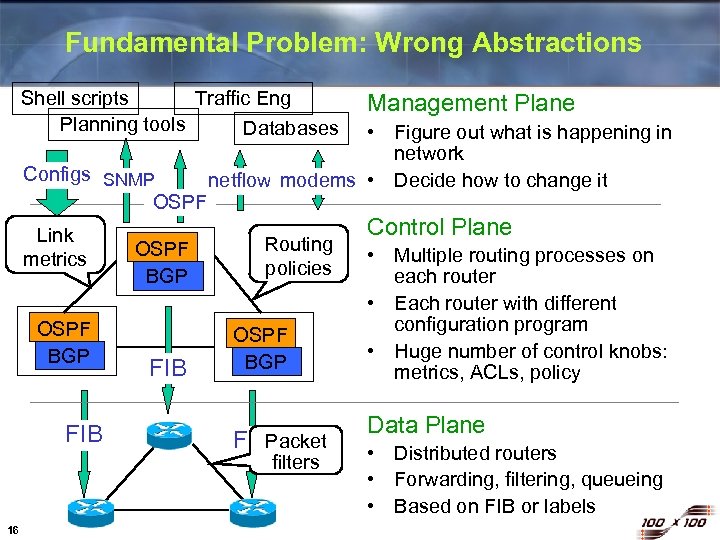 Fundamental Problem: Wrong Abstractions Shell scripts Traffic Eng Planning tools Databases Configs SNMP OSPF Link metrics OSPF BGP FIB • Figure out what is happening in network netflow modems • Decide how to change it Routing policies OSPF BGP FIB Packet filters 16 Management Plane Control Plane • Multiple routing processes on each router • Each router with different configuration program • Huge number of control knobs: metrics, ACLs, policy Data Plane • Distributed routers • Forwarding, filtering, queueing • Based on FIB or labels
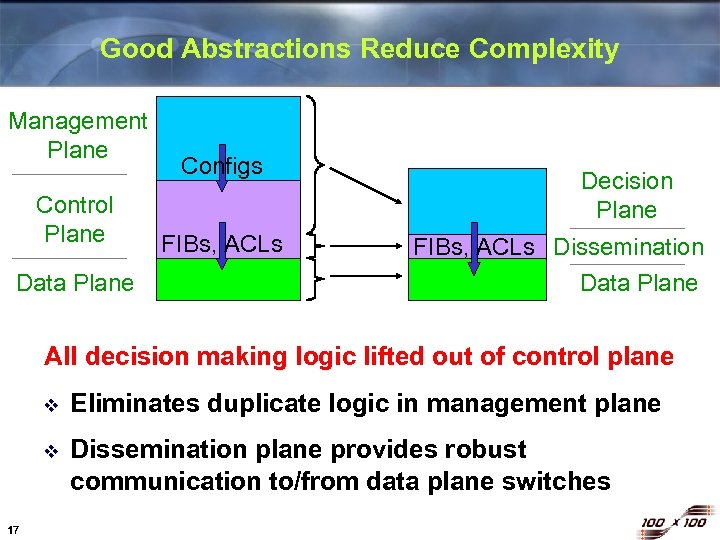 Good Abstractions Reduce Complexity Management Plane Control Plane Data Plane Configs FIBs, ACLs Decision Plane FIBs, ACLs Dissemination Data Plane All decision making logic lifted out of control plane v v 17 Eliminates duplicate logic in management plane Dissemination plane provides robust communication to/from data plane switches
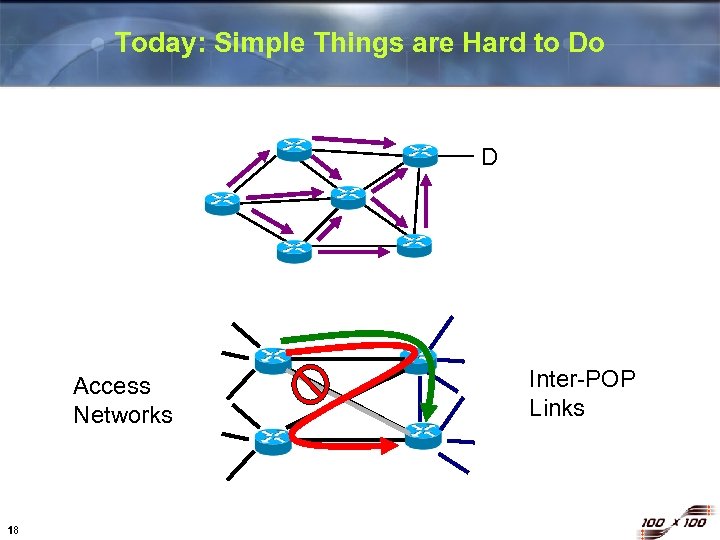 Today: Simple Things are Hard to Do D Access Networks 18 Inter-POP Links
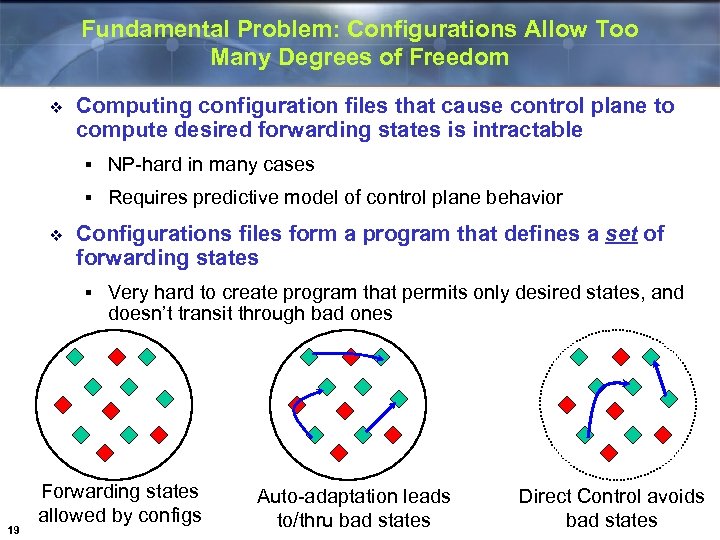 Fundamental Problem: Configurations Allow Too Many Degrees of Freedom v Computing configuration files that cause control plane to compute desired forwarding states is intractable § § v NP-hard in many cases Requires predictive model of control plane behavior Configurations files form a program that defines a set of forwarding states § 19 Very hard to create program that permits only desired states, and doesn’t transit through bad ones Forwarding states allowed by configs Auto-adaptation leads to/thru bad states Direct Control avoids bad states
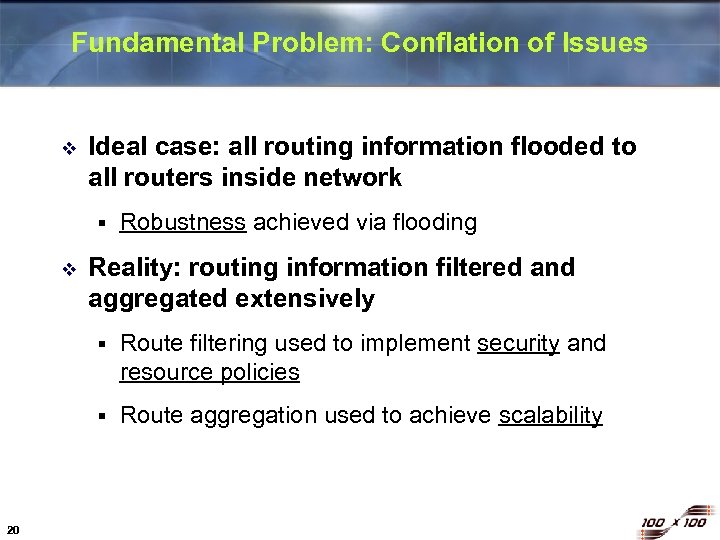 Fundamental Problem: Conflation of Issues v Ideal case: all routing information flooded to all routers inside network § v Robustness achieved via flooding Reality: routing information filtered and aggregated extensively § § 20 Route filtering used to implement security and resource policies Route aggregation used to achieve scalability
 4 D Separates Distributed Computing Issues from Networking Issues v Distributed computing issues ! protocols and network architecture § § Resiliency § v Overhead Scalability Networking issues ! management logic § § Egress point selection § Reachability control (VPNs) § 21 Traffic engineering and service provisioning Precomputation of backup paths
 Future Work v Scalability § § v Evaluate over 1 -10 K switches, 10 -100 K routes Networks with backbone-like propagation delays Structuring decision logic § § v Arbitrate among multiple, potentially competing objectives Unify control when some logic takes longer than others Protocol improvements § v Deployment in today’s networks § 22 Better dissemination and discovery planes Data center, enterprise, campus, backbone (RCP)
 Future Work v Experiment with network appliances § v Expand relationships with security § v 23 Using 4 D as mechanism for monitoring/quarantine Formulate models that establish bounds of 4 D § v Traffic shapers, traffic scrubbers Scale, latency, stability, failure models, objectives Generate evidence to support/refute principles
 Questions? 24
 Direct Control Provides Complete Control v Zero device-specific configuration v Supports many models for “pushing” routes § § Synchronized update – updates propagated, but not applied till agreed time in the future – clock skew defines convergence time § 25 Trivial push – convergence requires time for all updates to be receive and applied – same as today Controlled state trajectory – DE serializes updates to avoid all incorrect transient states
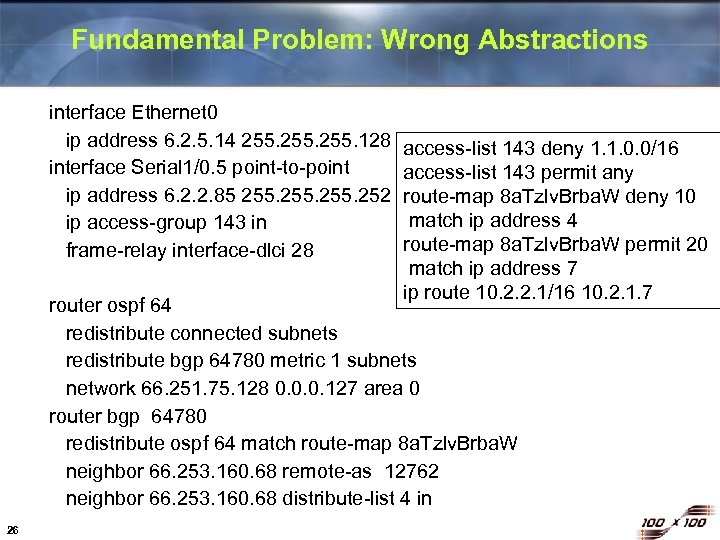 Fundamental Problem: Wrong Abstractions interface Ethernet 0 ip address 6. 2. 5. 14 255. 128 interface Serial 1/0. 5 point-to-point ip address 6. 2. 2. 85 255. 252 ip access-group 143 in frame-relay interface-dlci 28 access-list 143 deny 1. 1. 0. 0/16 access-list 143 permit any route-map 8 a. Tzlv. Brba. W deny 10 match ip address 4 route-map 8 a. Tzlv. Brba. W permit 20 match ip address 7 ip route 10. 2. 2. 1/16 10. 2. 1. 7 router ospf 64 redistribute connected subnets redistribute bgp 64780 metric 1 subnets network 66. 251. 75. 128 0. 0. 0. 127 area 0 router bgp 64780 redistribute ospf 64 match route-map 8 a. Tzlv. Brba. W neighbor 66. 253. 160. 68 remote-as 12762 neighbor 66. 253. 160. 68 distribute-list 4 in 26
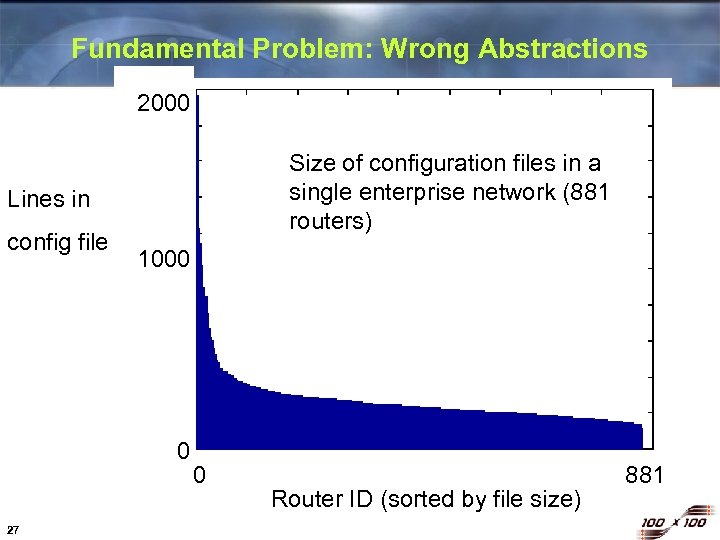 Fundamental Problem: Wrong Abstractions 2000 Size of configuration files in a single enterprise network (881 routers) Lines in config file 1000 0 27 0 Router ID (sorted by file size) 881
 28
28
 29
29
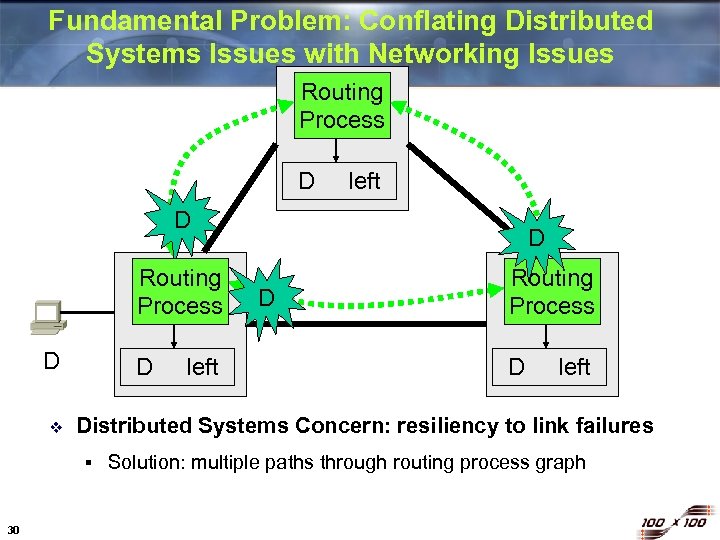 Fundamental Problem: Conflating Distributed Systems Issues with Networking Issues Routing Process D left D Routing Process D v D D Routing Process D left Distributed Systems Concern: resiliency to link failures § 30 left D Solution: multiple paths through routing process graph
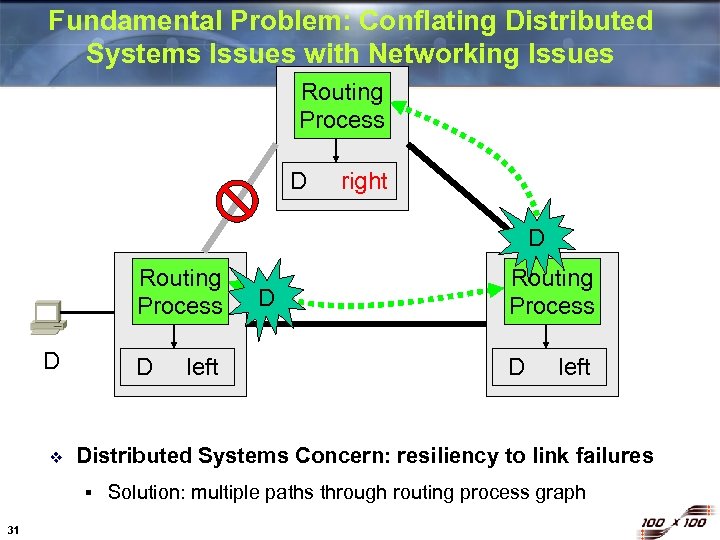 Fundamental Problem: Conflating Distributed Systems Issues with Networking Issues Routing Process D right D Routing Process D v D D left Distributed Systems Concern: resiliency to link failures § 31 left D Routing Process Solution: multiple paths through routing process graph
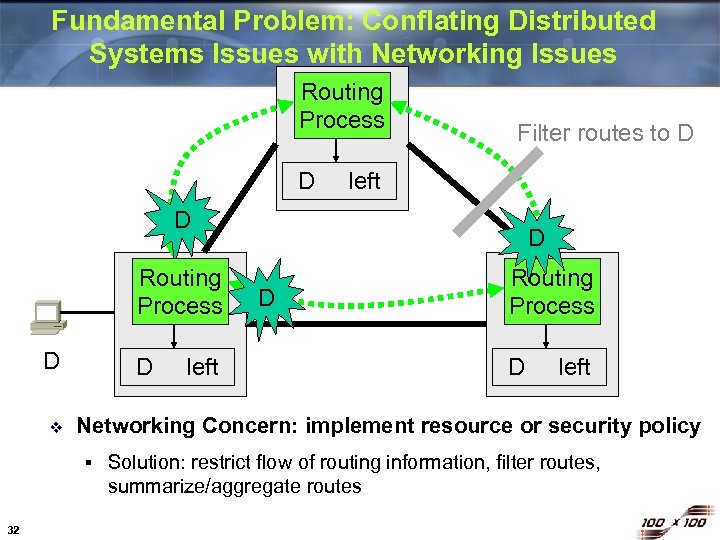 Fundamental Problem: Conflating Distributed Systems Issues with Networking Issues Routing Process D Filter routes to D left D Routing Process D v D D Routing Process D left Networking Concern: implement resource or security policy § 32 left D Solution: restrict flow of routing information, filter routes, summarize/aggregate routes
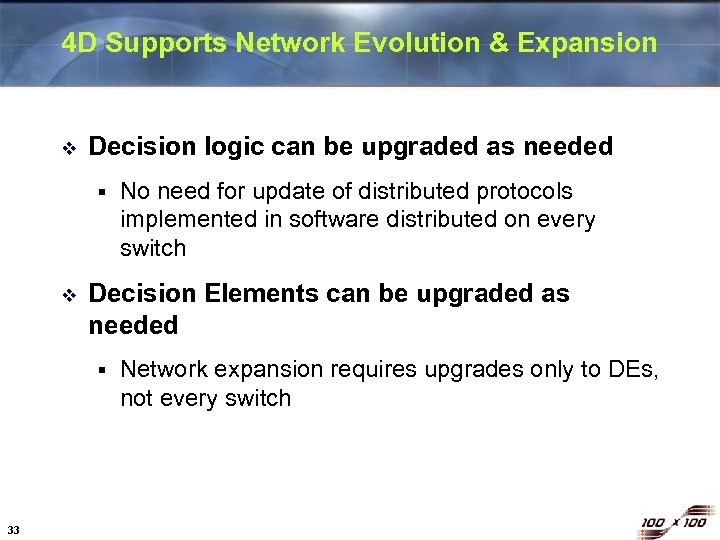 4 D Supports Network Evolution & Expansion v Decision logic can be upgraded as needed § v Decision Elements can be upgraded as needed § 33 No need for update of distributed protocols implemented in software distributed on every switch Network expansion requires upgrades only to DEs, not every switch
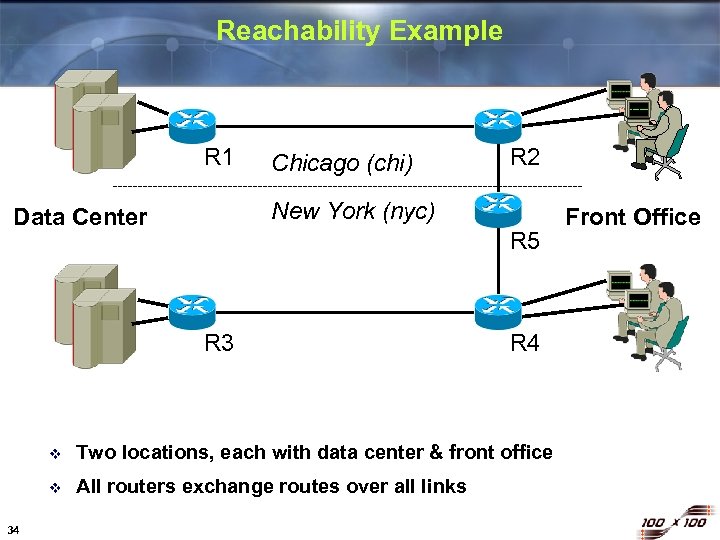 Reachability Example R 1 Chicago (chi) R 2 New York (nyc) Data Center R 5 R 3 R 4 v v 34 Two locations, each with data center & front office All routers exchange routes over all links Front Office
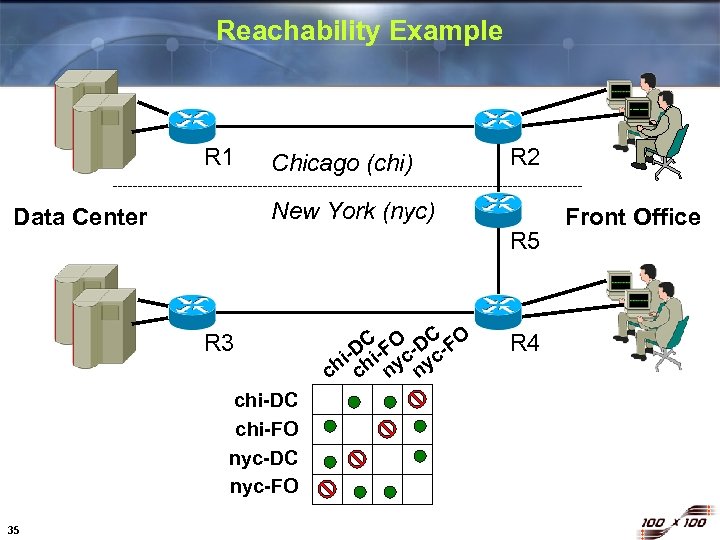 Reachability Example R 1 Chicago (chi) New York (nyc) Data Center R 5 R 3 chi-DC chi-FO nyc-DC nyc-FO 35 R 2 C FO -DC -FO -D hi chi nyc c R 4 Front Office
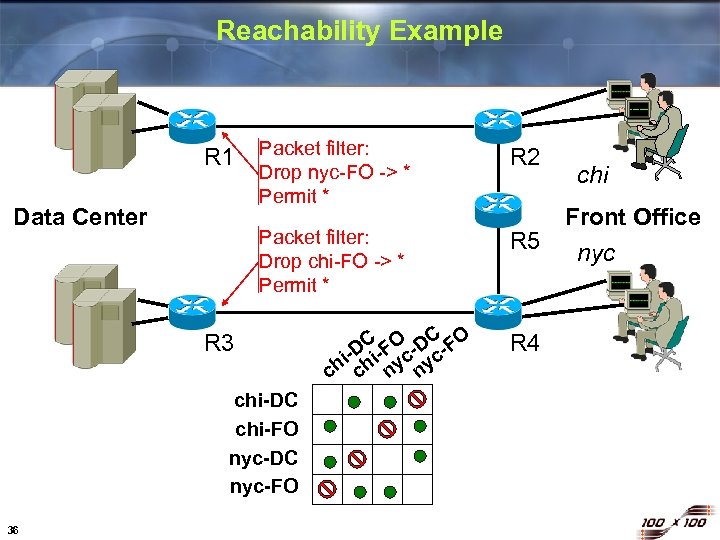 Reachability Example Data Center Packet filter: Drop nyc-FO -> * Permit * R 2 Packet filter: Drop chi-FO -> * Permit * R 1 R 5 R 3 chi-DC chi-FO nyc-DC nyc-FO 36 C FO -DC -FO -D hi chi nyc c R 4 chi Front Office nyc
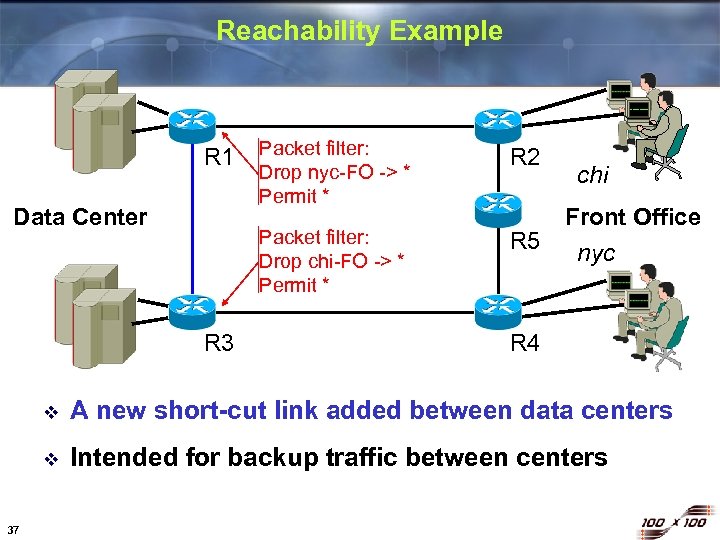 Reachability Example Data Center R 3 Packet filter: Drop nyc-FO -> * Permit * R 2 Packet filter: Drop chi-FO -> * Permit * R 1 R 5 chi Front Office nyc R 4 v v 37 A new short-cut link added between data centers Intended for backup traffic between centers
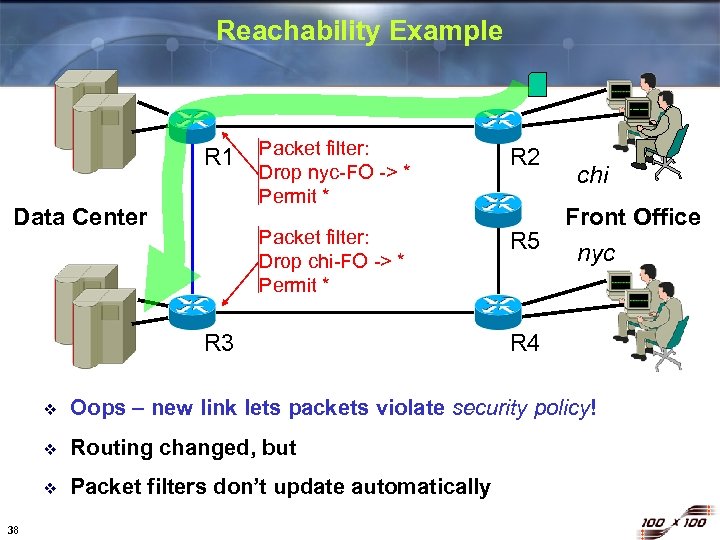 Reachability Example Data Center Packet filter: Drop nyc-FO -> * Permit * R 2 Packet filter: Drop chi-FO -> * Permit * R 1 R 5 R 3 chi Front Office nyc R 4 v v Routing changed, but v 38 Oops – new link lets packets violate security policy! Packet filters don’t update automatically
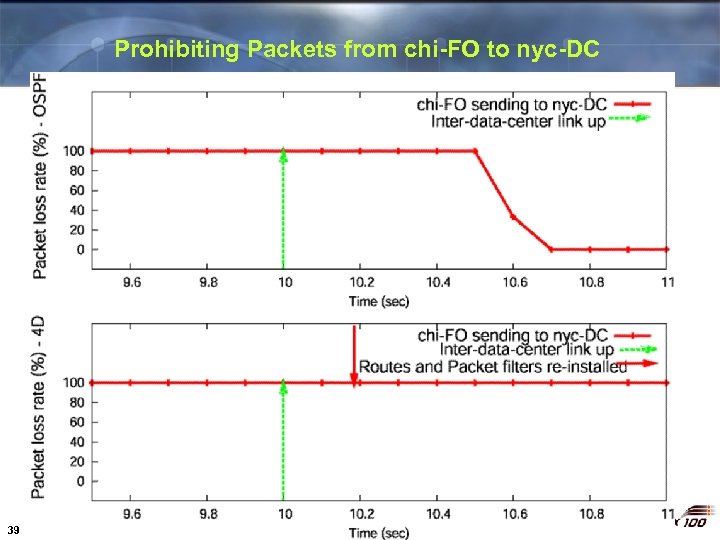 Prohibiting Packets from chi-FO to nyc-DC 39
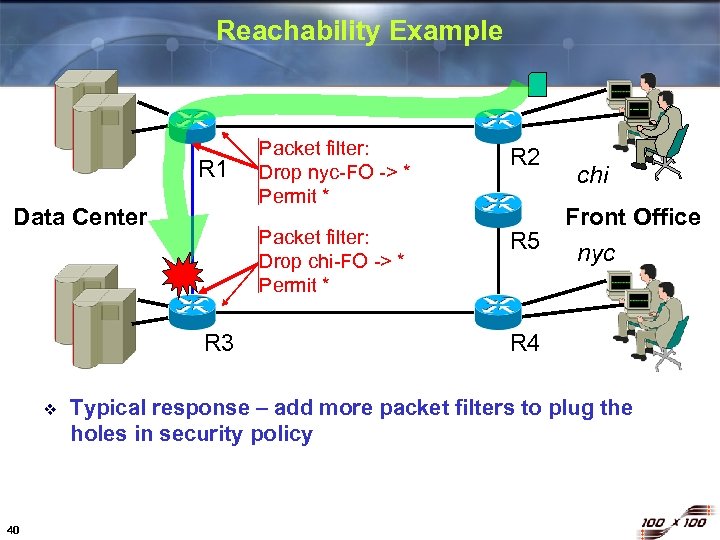 Reachability Example Data Center R 3 v 40 R 2 Packet filter: Drop chi-FO -> * Permit * R 1 Packet filter: Drop nyc-FO -> * Permit * R 5 chi Front Office nyc R 4 Typical response – add more packet filters to plug the holes in security policy
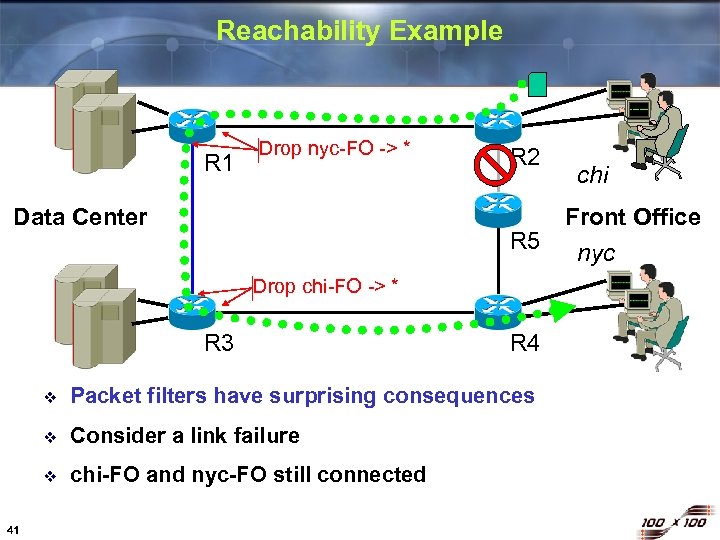 Reachability Example R 1 Drop nyc-FO -> * Data Center R 2 R 5 Drop chi-FO -> * R 3 R 4 v v Consider a link failure v 41 Packet filters have surprising consequences chi-FO and nyc-FO still connected chi Front Office nyc
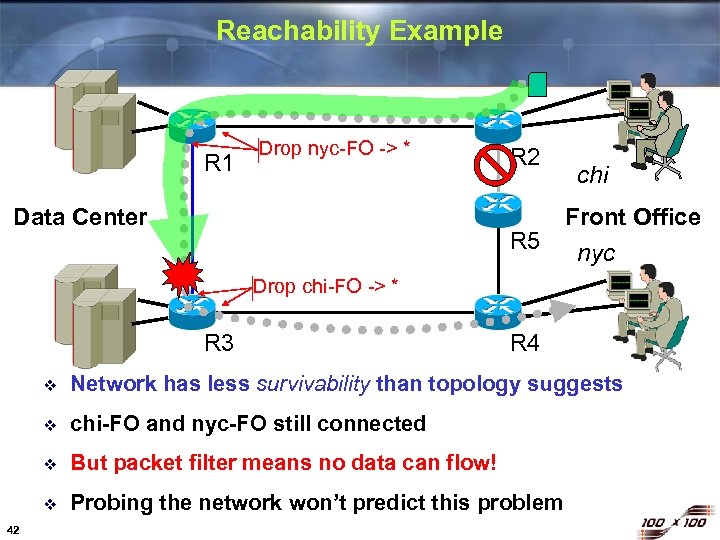 Reachability Example R 1 Drop nyc-FO -> * Data Center R 2 R 5 chi Front Office nyc Drop chi-FO -> * R 3 R 4 v v chi-FO and nyc-FO still connected v But packet filter means no data can flow! v 42 Network has less survivability than topology suggests Probing the network won’t predict this problem
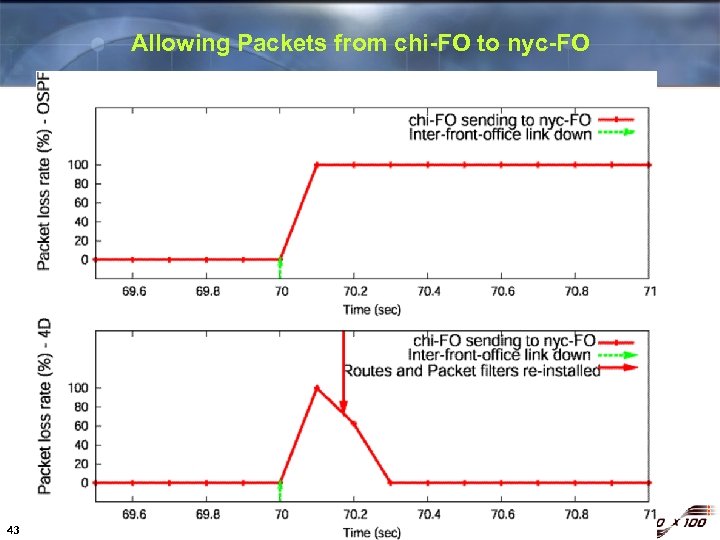 Allowing Packets from chi-FO to nyc-FO 43
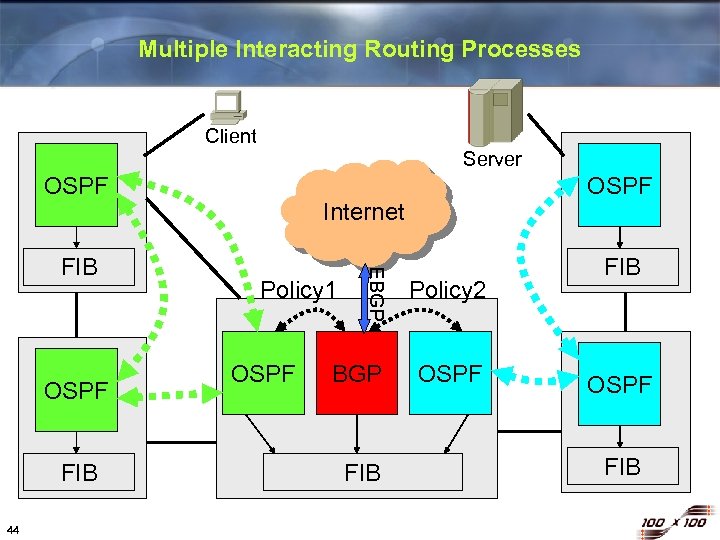 Multiple Interacting Routing Processes Client Server OSPF FIB 44 Internet Policy 1 OSPF EBGP FIB OSPF BGP FIB Policy 2 OSPF FIB
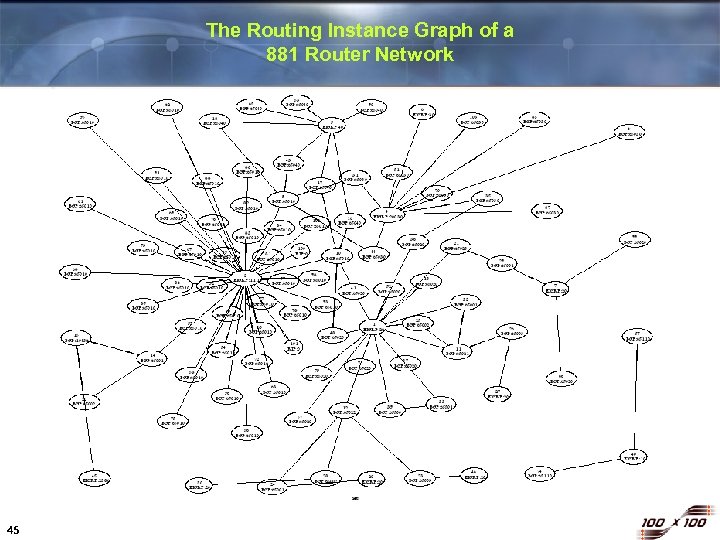 The Routing Instance Graph of a 881 Router Network 45
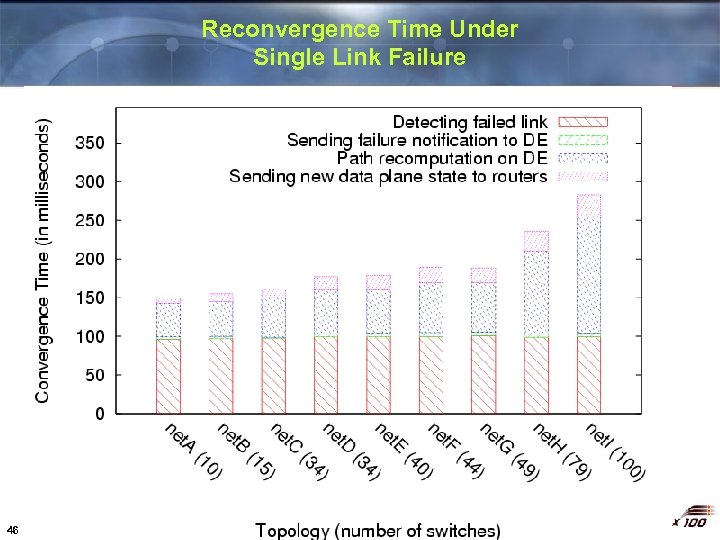 Reconvergence Time Under Single Link Failure 46
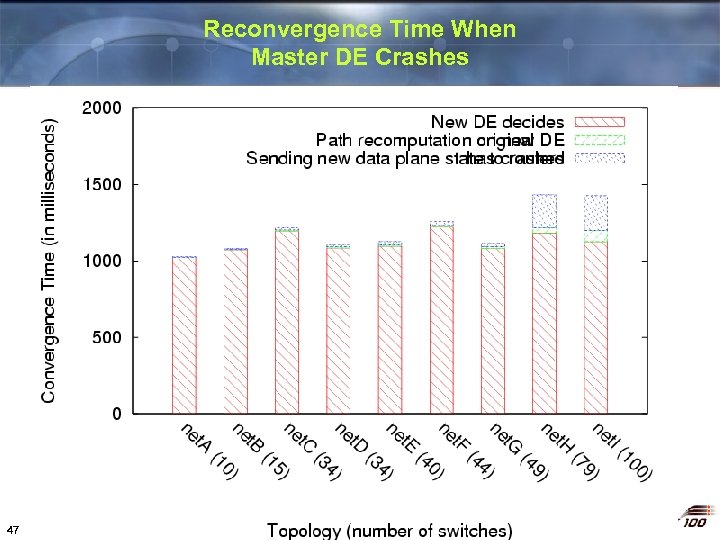 Reconvergence Time When Master DE Crashes 47
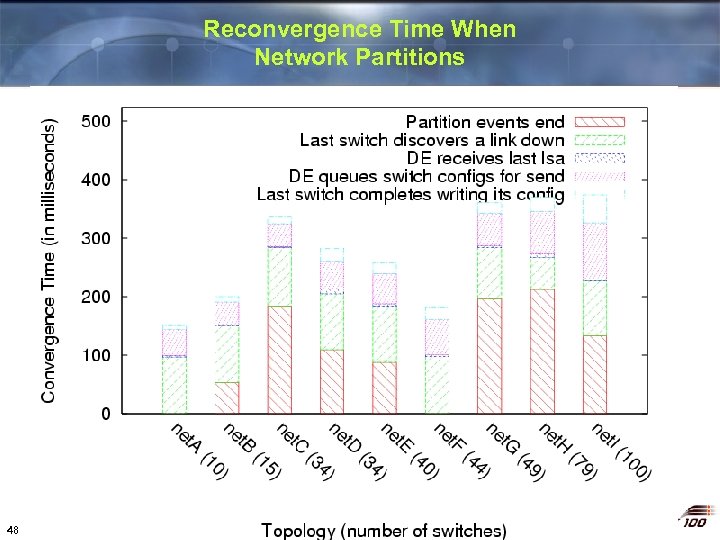 Reconvergence Time When Network Partitions 48
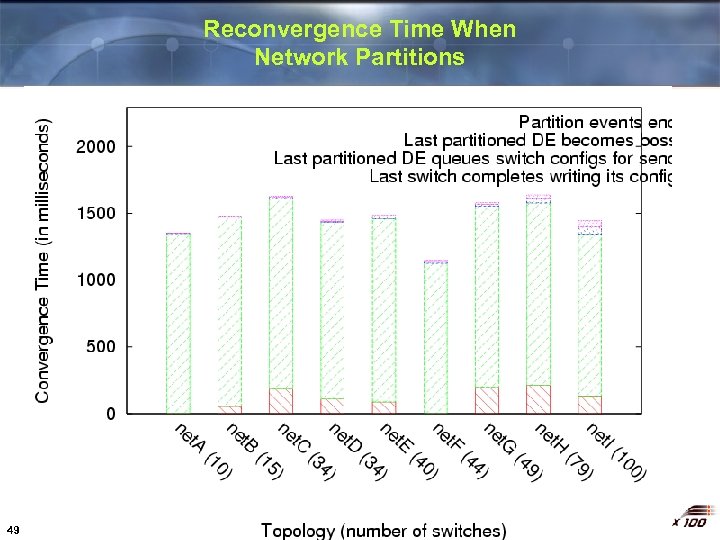 Reconvergence Time When Network Partitions 49
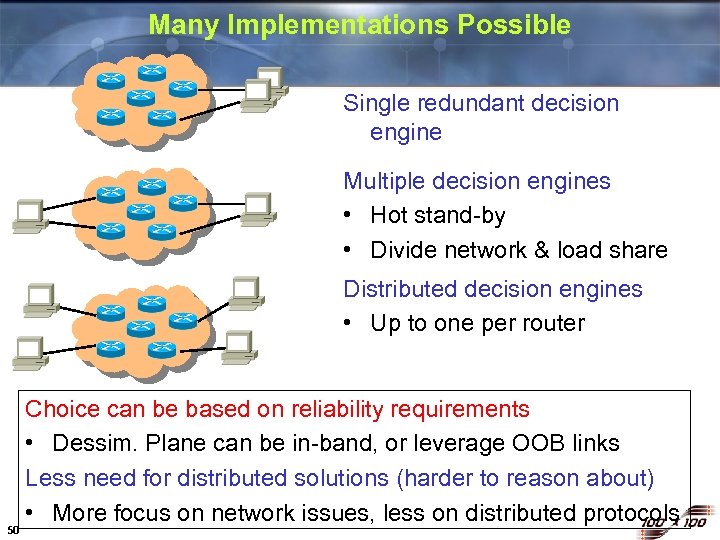 Many Implementations Possible Single redundant decision engine Multiple decision engines • Hot stand-by • Divide network & load share Distributed decision engines • Up to one per router 50 Choice can be based on reliability requirements • Dessim. Plane can be in-band, or leverage OOB links Less need for distributed solutions (harder to reason about) • More focus on network issues, less on distributed protocols
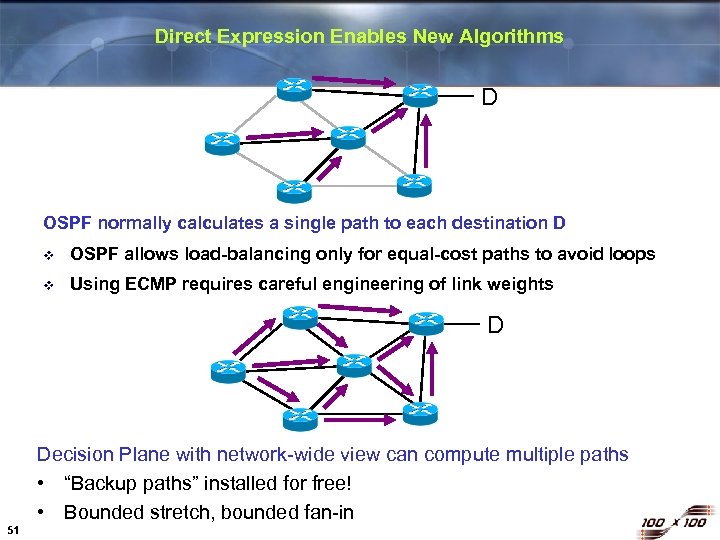 Direct Expression Enables New Algorithms D OSPF normally calculates a single path to each destination D v OSPF allows load-balancing only for equal-cost paths to avoid loops v Using ECMP requires careful engineering of link weights D Decision Plane with network-wide view can compute multiple paths • “Backup paths” installed for free! • Bounded stretch, bounded fan-in 51
 Systems of Systems v Systems are designed as components to be used in larger systems in different contexts, for different purposes, interacting with different components § v Example: OSPF and BGP are complex systems in its own right, they are components in a routing system of a network, interacting with each other and packet filters, interacting with management tools … Complex configuration to enable flexibility § § v 52 The glue has tremendous impact on network performance State of art: multiple interactive distributed programs written in assembly language Lack of intellectual framework to understand global behavior
 Supporting Network Evolution v Logic for controlling the network needs to change over time § § Interactions with other networks § v Traffic engineering rules Service characteristics Upgrades to field-deployed network equipment must be avoided § § 53 Very high cost Software upgrades often require hardware upgrades (more CPU or memory)
 Supporting Network Evolution Today v Today’s “Solution” § Vendors stuff their routers with software implementing all possible “features” – Multiple routing protocols – Multiple signaling protocols (RSVP, CR-LDP) – Each feature controlled by parameters set at configuration time to achieve late binding § Feature-creep creates configuration nightmare – Tremendous complexity for syntax & semantics – Mis-interactions between features is common Our Goal: Separate decision making logic from the fielddeployed devices 54
 Supporting Network Expansion v Networks are constantly growing § § v New routers/switches/links added Old equipment rarely removed Adding a new switch can cause old equipment to become overloaded § 55 CPU/Memory demands on each device should not scale up with network size
 Supporting Network Expansion Today v Routers run a link-state routing protocol § § v Size of link-state database scales with # of routers Expanding network can exceed memory limits of old routers Today’s “Solution” § Monitor resources on all routers § Predict approach of exhaustion and then: – Global upgrade – Rearchitecture of routing design to add summarization, route aggregation, information hiding Our Goal: make demands scale with hardware (e. g. , # of interfaces) 56
 Supporting Remote Devices v Maintaining communication with all network devices is critical for network management § § Monitoring status and network health § v Diagnosis of problems Updating configuration or software “the chicken or the egg…. ” § § 57 Cannot send device configuration/management information until it can communicate Device cannot communicate until it is correctly configured
 Supporting Remote Devices Today v Today’s “Solution” § Use PSTN as management network of last resort § Connect console of remote routers to phone modem § Can’t be used for customer premise equipment (CPE): DSL/cable modems, integrated access devices (IADs) § In a converged network, PSTN is decommissioned Our Goal: Preserve management communication to any device that is not physically partitioned, regardless of configuration state 58
 Recent Publications v v J. Rexford, A. Greenberg, G. Hjalmtysson, D. A. Maltz, A. Myers, G. Xie, J. Zhan, H. Zhang, “Network-Wide Decision Making: Toward a Wafer-Thin Control Plane, ” Proceedings of ACM Hot. Nets-III, San Diego, CA, November 2004. v D. A. Maltz, J. Zhan, G. Xie, G. Hjalmtysson, A. Greenberg, H. Zhang, “Routing Design in Operational Networks: A Look from the Inside, ” Proceedings of the 2004 Conference on Applications, Technologies, Architectures, and Protocols for Computer Communications (ACM SIGCOMM 2004), Portland, Oregon, 2004. v 59 G. Xie, J. Zhan, D. A. Maltz, H. Zhang, A. Greenberg, G. Hjalmtysson, J. Rexford, “On Static Reachability Analysis of IP Networks, ” IEEE INFOCOM 2005, Orlando, FL, March 2005. D. A. Maltz, J. Zhan, G. Xie, H. Zhang, G. Hjalmtysson, A. Greenberg, J. Rexford, “Structure Preserving Anonymization of Router Configuration Data, ” Proceedings of ACM/Usenix Internet Measurement Conference (IMC 2004), Sicily, Italy, 2004.