


 Скачать презентацию RETHINKING GUARDIANSHIP Supported Decision-Making DOHN HOYLE 1325 S Washington
a5f8734265280693d51afe7c24c0b71c.ppt
- Количество слайдов: 80
 RETHINKING GUARDIANSHIP/Supported Decision-Making DOHN HOYLE 1325 S. Washington Ave Lansing, MI. 48910 (517) 487 -5426 www. arcmi. org 1
 Summary Statement Every person can make choices and has a right to make decisions. People who have a cognitive or intellectual disability may express those choices/decisions in non-traditional ways. Any legal system or proceeding which deprives an individual of her/his right to be accommodated and supported in choosing and making decisions and which appoints a substitute decision-maker based on tests of competence, makes that person vulnerable and deprives him/her not only of his/her right to self-determination but also of other rights 2 which should be inalienable.
 The following is an adaptation of the “Statement of Principles” by the Coalition on Alternatives to Guardianship”. STATEMENT OF PRINCIPLES SUMMARY STATEMENT Every person can make choices and has a right to make decisions. People who have a cognitive or intellectual disability may express those choices/decisions in non-traditional ways. Any legal system or proceeding which deprives an individual of her/his right to be accommodated and supported in choosing and making decisions and which appoints a substitute decision-maker based on tests of competence, makes that person vulnerable and deprives him/her not only of his/her right to self-determination but also of other rights which should be inalienable. 1. PRINCIPLES Each individual can choose and make decisions about his/her life 2. Each individual has the right to make decisions (self-determination) 3. Individuals may want help from other persons of their choosing with whom they have trusting relationships, including family members or friends, to make decisions or have them interpreted, and to communicate them to others. This is called supported decision making. 3
 4. Individuals who have an intellectual disability may communicate choices, wishes, likes and dislikes in non-traditional ways which can include actions rather than language. Friends, family members, or others who are trusted by the individual, can help to interpret these decisions. 5. This natural interdependence of people must be recognized and supported decisions that are made within such trusted, supportive relationships must be given status and validation. 6. All adults have the right to make decisions with support or to name a substitute (e. g. by power of attorney) to make decisions for them. 7. Laws and/or policies that do not recognize supported decision making or that protect other interests at the expense of the individual’s right to self-determination discriminate against persons who have an intellectual disability and make them more vulnerable 8. Individuals should never be assessed to determine competency; decisions should be reviewable if there is concern that the will of the individual is not being respected or that the individual is being exploited. 9. Any legal system or proceeding which sets up a test of competency to be used to appoint a substitute decision-maker puts the individual at risk of also losing other rights. 10. A decision that could not have been made by the individual without support, e. g. consent for non-therapeutic sterilization, experimentation or other non-therapeutic procedures which could offend human dignity, should not be made within supported decision making relationships. *Coalition on Alternatives to Guardianship People First of Ontario Canadian Association for Community Living 180 Duncan Mill Road Suite 600 North York, Ontario M 3 D 1 Z 6 People First of Canada Ontario Association for Community Living Youth Involvement Ontario 4
 TASH RESOLUTION “Be it resolved that TASH, an international advocacy association of people with disabilities, their family members and other advocates, and people who work in the disability field affirms the rights of persons with disabilities and commits to the promotion and use of alternatives to guardianship rather than the removal of said rights. TASH urges the development and promotion of the use of accommodations and supports people need to make choices and decisions, to have their preferences recognized and honored, and to 5 have their rights to self-determination
 Today n Guardianship ¨What it is and what it isn’t ¨What it does do and what it doesn’t do n Ways to address barriers n Tools that help 6
 Guardianship is a situation, recognized by law, under which one person or entity exercises power over and on behalf of another person. (“a ward”) 7
 PAST REASONS FOR SEEKING GUARDIANSHIP? Financial decisions n Placement decisions n Sex and related issues n What will happen when parents or family are no longer around? n Medical reasons n Contracts n Decisions about programs, records, etc. n Administrative convenience n 8
 WHY AVOID GUARDIANSHIP? n Avoid public declaration of incompetency n Promote independence, dignity, freedom of choice n People deal with guardian – not person n Expense – attorneys, hearings, evaluations n Courts don’t always follow law (partial vs. plenary, promote independence, etc. ) 9
 WHY AVOID GUARDIANSHIP? (cont’d) n Very difficult to modify or terminate n Attorneys and G. A. L. s – very little training n Corporate guardian problems – take money & independence n It simply doesn’t do what you want it to do! 10
 Connecticut Supreme Court “Guardians appointed by the court whether limited or plenary, can be vested with substantial powers over a respondent. Therefore…the appointment of a guardian implicates a respondent’s constitutional rights…” 11
 Iowa Supreme Court Guardianship “…involves significant loss of liberty similarly to that present in an involuntary civil commitment for treatment of mental illness. ” (In Re: Hedin, quoting Arizona Court of Appeals) 12
![California Supreme Court “[A person who has] a conservator [appointed] may be subject to](https://present5.com/presentation/a5f8734265280693d51afe7c24c0b71c/image-13.jpg "California Supreme Court “[A person who has] a conservator [appointed] may be subject to") California Supreme Court “[A person who has] a conservator [appointed] may be subject to greater control of his or her life than one convicted of a crime” 13
California Supreme Court “[A person who has] a conservator [appointed] may be subject to greater control of his or her life than one convicted of a crime” 13
 National Elder Abuse and Guardianship Victims Taskforce “Too often the very Adult Guardianship and Conservatorship System meant to protect the elderly are being used as instruments to violate their rights, rob them of their lifelong savings and tear them away from their families and loved ones. ” 14
 “The typical ward has fewer rights than the typical convicted felon – they no longer receive money or pay their bills. They cannot marry – or divorce… it is, in one short sentence, the most punitive civil penalty that can be levied against an American citizen, with the exception of…the death penalty” -Claude Pepper, U. S. Representative 15
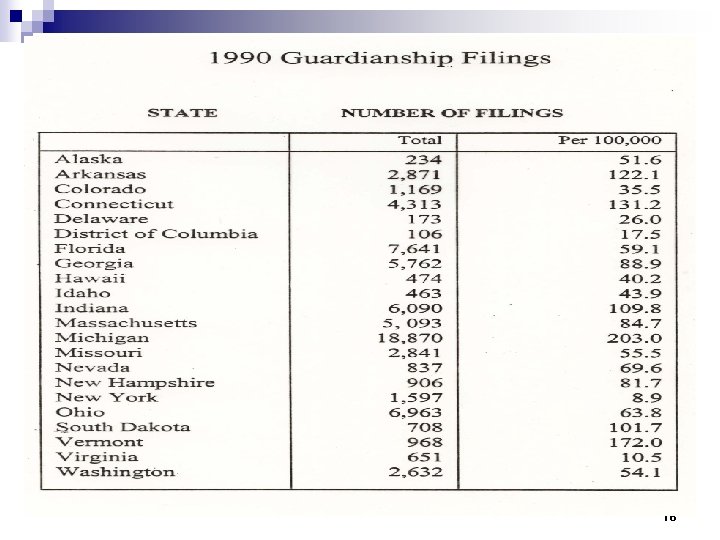 16
16
 The United Nations Convention on the Rights of Persons with Disabilities 17
 In the Preamble: Recognizing the importance for persons with disabilities of their individual autonomy and independence, including the freedom to make their own choices 18
 Article 4 General Obligation 5) The Provisions of the present Convention shall extend to all parts of Federal States without any limitation or exceptions 19
 Defines discrimination, in part as: “Discrimination on the basis of disability” means any distinction, exclusion or restriction on the basis of disability which has the purpose or effect of impairing or nullifying the recognition, enjoyment or exercise, of all human rights and fundamental freedoms” 20
 Article 3 General Principles The principles of the present Convention shall be: A) Respect for inherent dignity, individual autonomy including the freedom to make one’s own choices, and independence of persons. C) Full and effective participation and inclusion in society 21
 Article 5 Equality and Non-discrimination 1. States Parties recognize that all persons are equal before and under the law and are entitled without any discrimination to the equal protection and equal benefit of the law. 22
 Article 12 Equal recognition before the law 1) States Parties affirm that persons with disabilities have the right to recognition everywhere as persons before the law. 2) States Parties shall recognize that persons with disabilities enjoy legal capacity on an equal basis with others in all aspects of life. 23
 Article 12 (cont’d) 3) States Parties shall take appropriate measures to provide access by persons with disabilities to the support they may require in exercising their legal capacity. 24
 The vast majority of those who end up petitioning the court to appoint a guardian for some person are either related to the person or a friend 25
 However, most petitioners do not come to the decision to seek guardianship on their own, but are encouraged to do so by someone else 26
 Iowa Supreme Court “In making a determination as to whether a guardianship should be established…the court must consider the availability of third party assistance to meet a …proposed ward’s need for such necessities…” (in the Matter of Hedin, 1995) 27
 Utah Supreme Court (re: “Responsible Decisions”) “…responsible focuses the appointing authority’s attention on the content of the decision rather than on the ability of the individual to engage in a rational decision making process. ” 28
 “We have to reject the very idea of incompetence. We need to replace it with the idea of ‘assisted competence’. This will include a range of supports that will enable individuals with cognitive disabilities to receive assistance in decision–making that will preserve their rights…” -Thomas Nerney, Director of Center for Self 29 Determination for Persons with Developmental
 Pennsylvania Supreme Court “Persons cannot be deemed incapacitated if their impairments are counterbalanced by friends, family or other support. ” In re: Perry, 727 A 2 d 539 (Ps. Sup. Ct. 1999) 30
 CMS: Centers for Medicare and Medicaid Services Quality Framework Includes: n PERSON-CENTERED SERVICE PLANNING AND DELIVERY: . . . responses to changing needs/choices and participant directions n RIGHTS AND RESPONSIBILITIES Protection of rights and decision-making authority. . . www. cms. hhs. gov/HCBS/downloads/qualityframework. pdf 31
 Michigan Mental Health Code “Guardianship … shall be utilized only as is necessary to promote and protect the well-being of the individual…” (MCL 330. 1602(1)) 32
 We can no longer ignore the great incongruity of removing a persons rights to protect them. 33
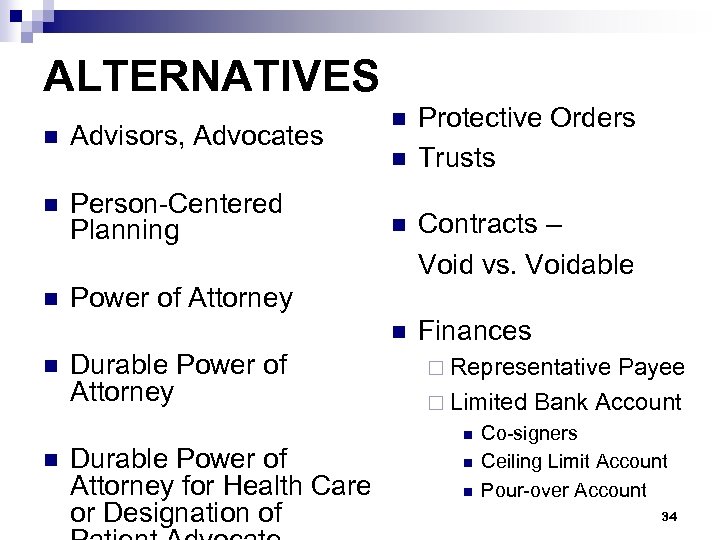 ALTERNATIVES n Advisors, Advocates n Person-Centered Planning n n Protective Orders Trusts Power of Attorney n Durable Power of Attorney Contracts – Void vs. Voidable n n n Finances ¨ Representative Payee ¨ Limited Bank Account n n Durable Power of Attorney for Health Care or Designation of n n Co-signers Ceiling Limit Account Pour-over Account 34
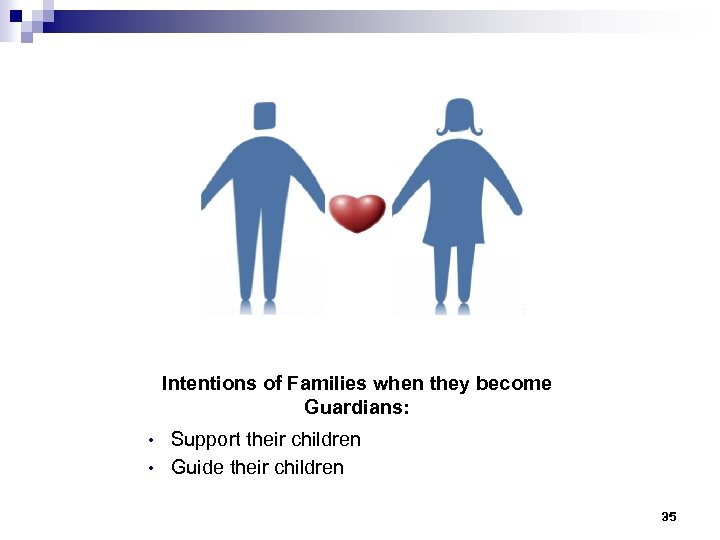 Intentions of Families when they become Guardians: • • Support their children Guide their children 35
 REALITY OF INVITING GOVERNMENT INTO YOUR RELATIONSHIP WITH YOUR CHILD: • • • The government is much larger than your family and will be personally involved in your family business You and your family will be accountable to the government The government can decide to remove you from the relationship 36
 Person Centered Planning “’Person-centered planning’ means a process for planning and supporting the individual receiving services that builds upon the individual’s capacity to engage in activities that promote community life and that honors the individual’s preferences, choices and abilities. The person-centered planning process involves families, friends, and professionals as the individual desires or requires” MCL 330. 1700 (g) Michigan’s Long Term Care Group Report and Recommendation, 37
 PERSON CENTERED PLANNING A person centered plan assists individuals to create a personalized image of a desirable future. The development of a plan suggests a process that can organize and guide community change in alliance with people with disabilities thus building the bridge from both sides. Essential to all person centered plans are the following characteristics: Person Directed – The plan for the person is that the person’s vision of what he or she would like to be and do. The plan is not static, but rather it changes as new opportunities and obstacles arise. Capacity Building – Planning focuses on the person’s gifts, talents and skills rather than deficits. It builds upon the individual’s desire to engage in activities that promote a sense of belonging in the community. Person Centered – The focus is continually on the person for whom the pan is being developed, and not on plugging the person into available slots in a program. The individual’s choices and preference must be honored. Network Building – The process brings together people who care about the person, and are committed to helping the person articulate their vision of a desirable future. They learn together and invent new courses of action to make the vision an reality. Outcome based – The plan focuses on increasing any or all of the following experiences which are valued by the individual: ¨ ¨ ¨ Growing in relationships or having friends. Contributing or performing functional/meaningful activities. Sharing ordinary places or being part of their own community. Gaining respect or having a valued role which expresses their gifts and talents. Making choices that are meaningful and express individual identity. Community Accountability – The plan will assure adequate supports when there are issues of health and safety, while respecting and according them full dignity as a fully participating member of the community. Adopted by the Howell Group of Michigan, October 1994
 Person Centered Planning n Preferences determined by person centered planning process are honored unless harmful to the individual n This process of determining preferences and choices enhances the dignity and self-determination of individuals n This process is more reliable than having a courtappointed person to make decisions with or without input from anyone. 39
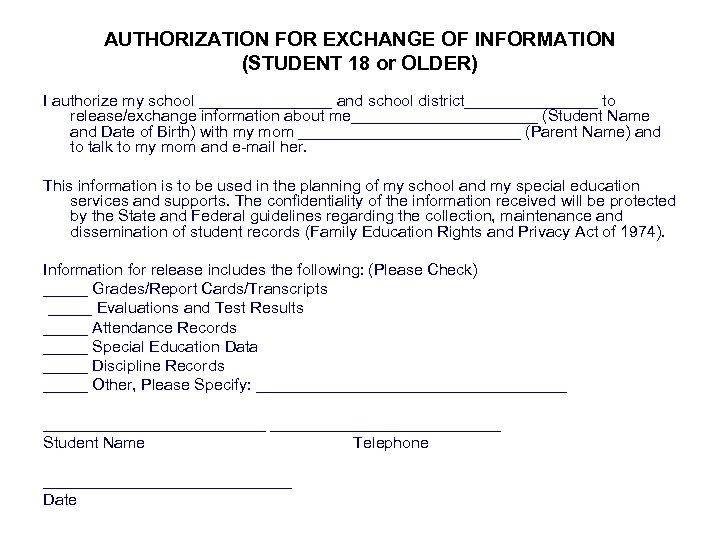 AUTHORIZATION FOR EXCHANGE OF INFORMATION (STUDENT 18 or OLDER) I authorize my school ________ and school district________ to release/exchange information about me___________ (Student Name and Date of Birth) with my mom _____________ (Parent Name) and to talk to my mom and e-mail her. This information is to be used in the planning of my school and my special education services and supports. The confidentiality of the information received will be protected by the State and Federal guidelines regarding the collection, maintenance and dissemination of student records (Family Education Rights and Privacy Act of 1974). Information for release includes the following: (Please Check) _____ Grades/Report Cards/Transcripts _____ Evaluations and Test Results _____ Attendance Records _____ Special Education Data _____ Discipline Records _____ Other, Please Specify: __________________________ Student Name Telephone ______________ Date
 Michigan Social Welfare Act MCL 400. 66 h v Affirms a person’s right to provide consent to treatment and have wishes followed when receiving government assistance (i. e. , Medicaid). v If the individual is unable to make medical decisions, then providers are required to obtain written consent of individual’s nearest relative, guardian or 41
 Medical Power of Attorney n Appoint an Agent to handle medical decisions or support you in medical decisions n Can be effective immediately n Can be as broad or narrow as desired 42
 Patient Advocate Designations (PADs) for Medical Decisions n Exercisable only in event the person is unable to make their own medical decisions (certified by two physicians) n Can be an individual 18 or over to exercise powers related to care, custody and medical treatment decisions of the person. n Includes the individual’s preferences regarding care and treatment. n Necessary for withdrawal of life-sustaining treatment. n New Michigan law also permits PADs for mental health decisions. This is also a preferred alternative to “Kevin’s 43 Law” (court-ordered, outpatient treatment).
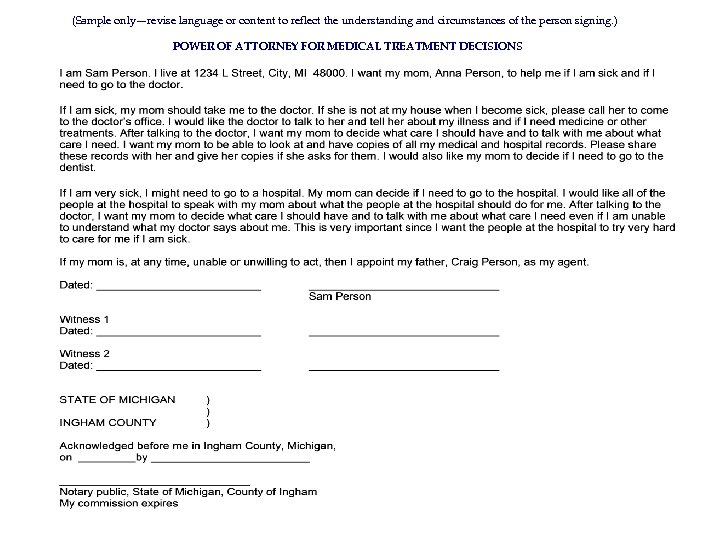 (Sample only—revise language or content to reflect the understanding and circumstances of the person signing. ) POWER OF ATTORNEY FOR MEDICAL TREATMENT DECISIONS
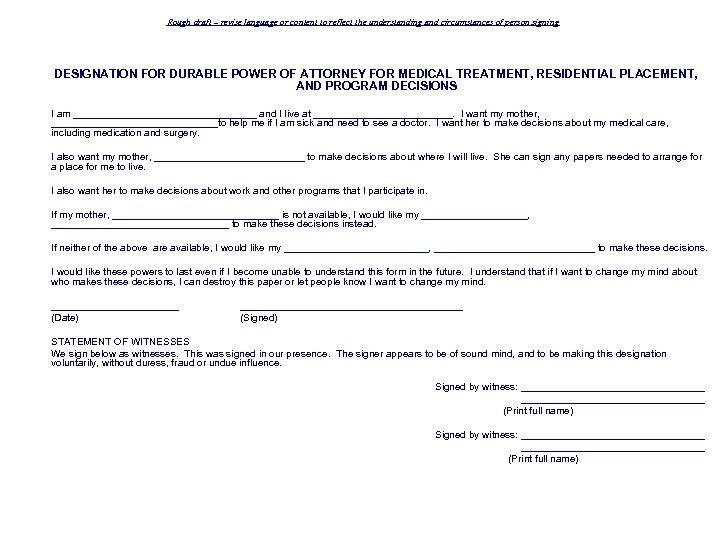 Rough draft – revise language or content to reflect the understanding and circumstances of person signing DESIGNATION FOR DURABLE POWER OF ATTORNEY FOR MEDICAL TREATMENT, RESIDENTIAL PLACEMENT, AND PROGRAM DECISIONS I am _________________ and I live at _____________. I want my mother, _______________to help me if I am sick and need to see a doctor. I want her to make decisions about my medical care, including medication and surgery. I also want my mother, ______________ to make decisions about where I will live. She can sign any papers needed to arrange for a place for me to live. I also want her to make decisions about work and other programs that I participate in. If my mother, _______________ is not available, I would like my __________, ________________ to make these decisions instead. If neither of the above are available, I would like my _____________, _______________ to make these decisions. I would like these powers to last even if I become unable to understand this form in the future. I understand that if I want to change my mind about who makes these decisions, I can destroy this paper or let people know I want to change my mind. ____________ (Date) ____________________ (Signed) STATEMENT OF WITNESSES We sign below as witnesses. This was signed in our presence. The signer appears to be of sound mind, and to be making this designation voluntarily, without duress, fraud or undue influence. Signed by witness: _________________________________ (Print full name)
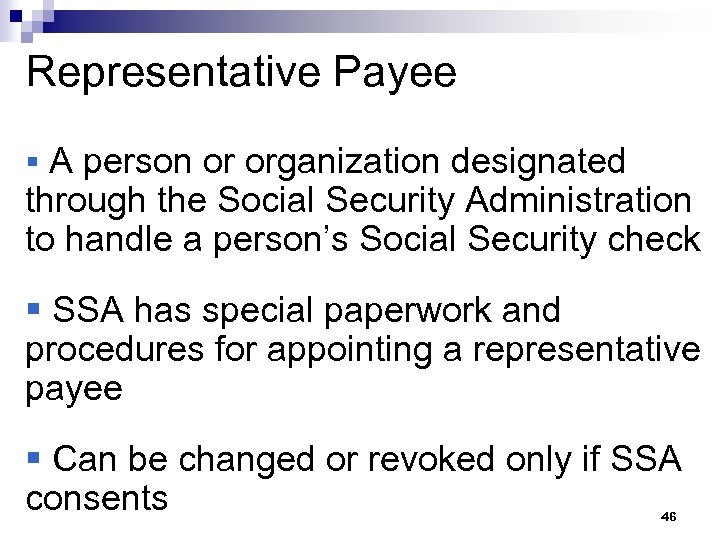 Representative Payee § A person or organization designated through the Social Security Administration to handle a person’s Social Security check § SSA has special paperwork and procedures for appointing a representative payee § Can be changed or revoked only if SSA consents 46
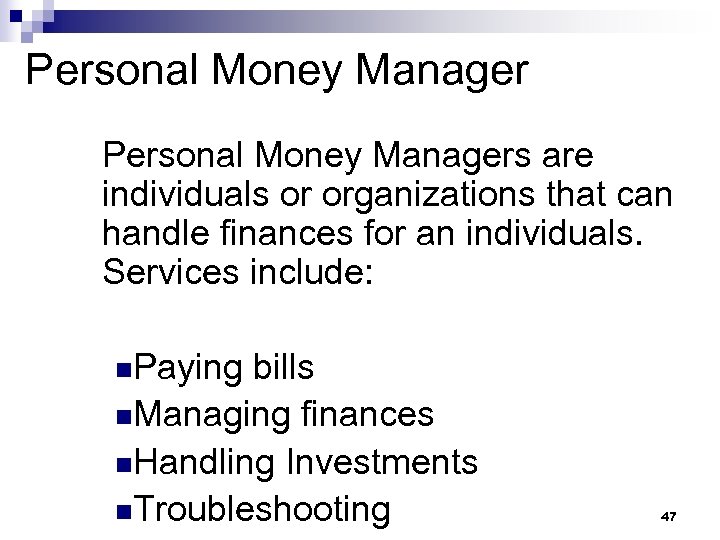 Personal Money Managers are individuals or organizations that can handle finances for an individuals. Services include: n. Paying bills n. Managing finances n. Handling Investments n. Troubleshooting 47
 Automatic Bill Paying n Automatic bill payment can be set up for an individual n Eliminates the ongoing need for bill payment assistance n Periodic monitoring is helpful 48
 Two Methods: Opting Out of Credit Card Offers n n Five Year Opt – Out Complete form online (secure website) at: www. optoutprescreen. com Permanent Opt – Out Form must be printed, signed and mailed. (Five year opt-out may be completed in the interim) Call: (888) 567 -8688 49
 Estate Planning for People with Disabilities Estate Planning for people with disabilities is generally done to preserve eligibility for governmental benefits that provide essential services. 50
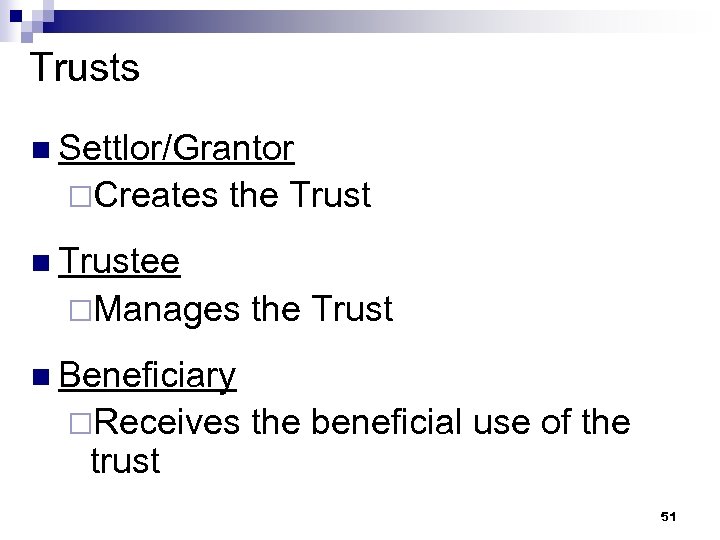 Trusts n Settlor/Grantor ¨Creates the Trust n Trustee ¨Manages the Trust n Beneficiary ¨Receives trust the beneficial use of the 51
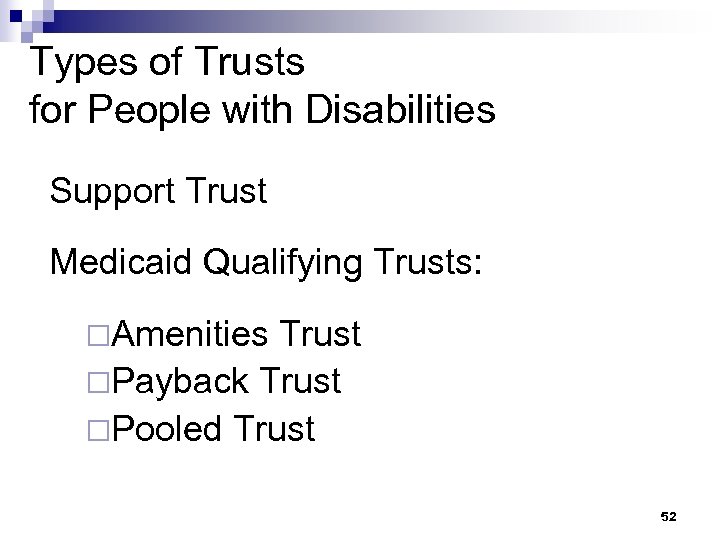 Types of Trusts for People with Disabilities Support Trust Medicaid Qualifying Trusts: ¨Amenities Trust ¨Payback Trust ¨Pooled Trust 52
 Fiduciary Duty n A Fiduciary is someone who has undertaken a relationship of trust and confidence to act on behalf of another person. n The Fiduciary duty is the highest standard of care in law or equity. n A Fiduciary must put the person’s interest before his or her personal interest. 53
 Support Trust n Provides for support, care and maintenance of the beneficiary n Can be created and funded by anyone including beneficiary n Does not preserve eligibility for government benefits (e. g. , Medicaid, SSI) n Typically established by family members for individuals with special needs who do not need government benefits 54
 Third-Party (Amenities) Trust n Established and funded with assets of a third party (e. g. family member) n Provides for amenities or extra items or services only (e. g. , advocacy, recreational activities, home furnishings, haircuts, music therapy) n If properly written, preserves beneficiary’s eligibility for government benefits 55
 Benefits of Amenities Trusts n Preserves Eligibility for Government Benefits n Provides for an enhanced quality of life for the beneficiary n Provides for Trustee to Act as an Advocate 56
 Pooled Accounts Trust n Used to preserve government benefits n Established and administered by a nonprofit organization. n Sub-accounts are established for the benefit of the individual. n Remaining assets at death are left with the non-profit organization. 57
 Pay Back (Self-Settled) Trusts n n n Established by a family member or designated individual with trust powers Funded with the Beneficiary’s own funds (e. g. , funds awarded from lawsuit) To provide for amenities or extra items to promote quality of life and independence Primarily used to preserve government benefits Requires language in the trust that upon the death of the individual, the State is paid back first for any government benefits paid during his/her lifetime before distributing rest of trust assets to anyone else 58
 Trust can be used for: n Medical treatment beyond Medicaid n Non-standard or noncovered personal services n Dental Care n n Educational or Vocational services n Recreation expenses or outings Can purchase home & rent to beneficiary with or without roommates (payments must cover total cost of home) n Can make the difference between success & failure of a placement n Favors consumer choice & inclusion n Travel for beneficiary or siblings, etc. n Books, magazines, cable television, phone calls Monitoring expenses n 59
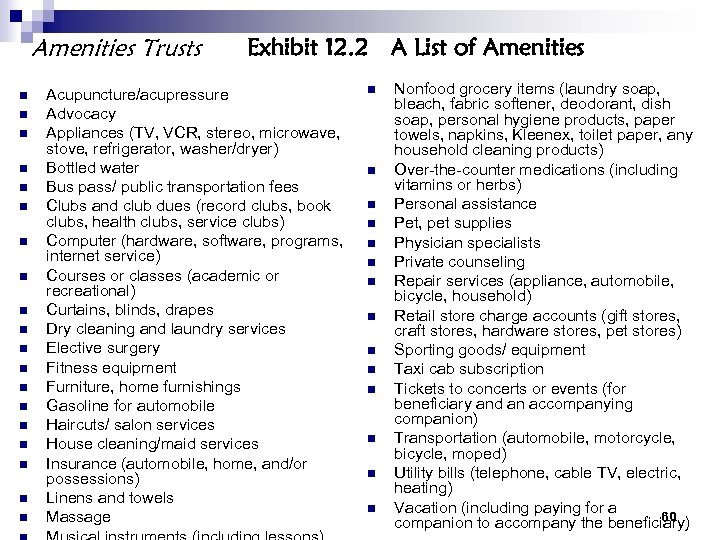 Amenities Trusts n n n n n Exhibit 12. 2 A List of Amenities Acupuncture/acupressure Advocacy Appliances (TV, VCR, stereo, microwave, stove, refrigerator, washer/dryer) Bottled water Bus pass/ public transportation fees Clubs and club dues (record clubs, book clubs, health clubs, service clubs) Computer (hardware, software, programs, internet service) Courses or classes (academic or recreational) Curtains, blinds, drapes Dry cleaning and laundry services Elective surgery Fitness equipment Furniture, home furnishings Gasoline for automobile Haircuts/ salon services House cleaning/maid services Insurance (automobile, home, and/or possessions) Linens and towels Massage n n n n Nonfood grocery items (laundry soap, bleach, fabric softener, deodorant, dish soap, personal hygiene products, paper towels, napkins, Kleenex, toilet paper, any household cleaning products) Over-the-counter medications (including vitamins or herbs) Personal assistance Pet, pet supplies Physician specialists Private counseling Repair services (appliance, automobile, bicycle, household) Retail store charge accounts (gift stores, craft stores, hardware stores, pet stores) Sporting goods/ equipment Taxi cab subscription Tickets to concerts or events (for beneficiary and an accompanying companion) Transportation (automobile, motorcycle, bicycle, moped) Utility bills (telephone, cable TV, electric, heating) Vacation (including paying for a 60 companion to accompany the beneficiary)
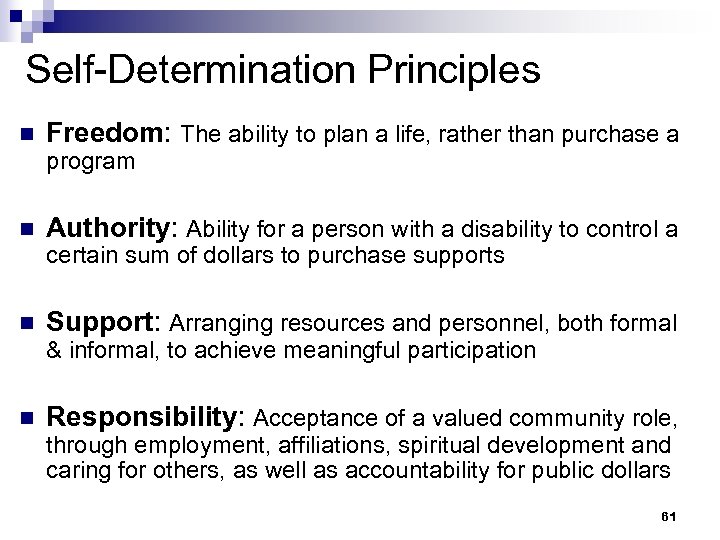 Self-Determination Principles n Freedom: The ability to plan a life, rather than purchase a program n Authority: Ability for a person with a disability to control a certain sum of dollars to purchase supports n Support: Arranging resources and personnel, both formal & informal, to achieve meaningful participation n Responsibility: Acceptance of a valued community role, through employment, affiliations, spiritual development and caring for others, as well as accountability for public dollars 61
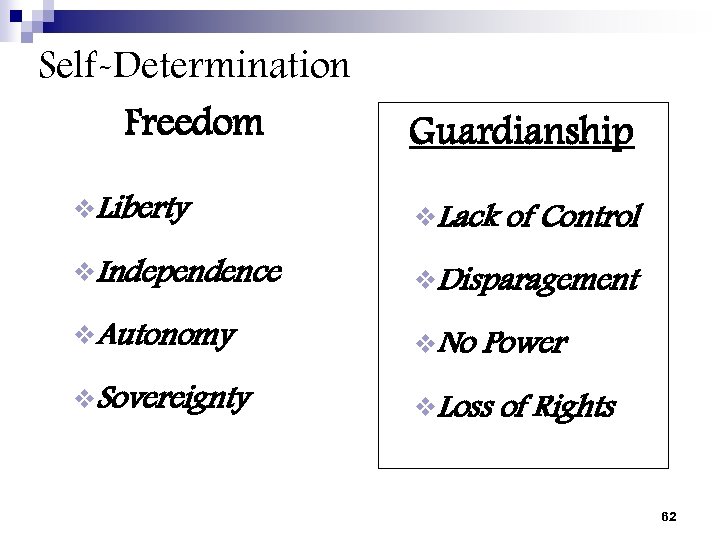 Self-Determination Freedom Guardianship v. Liberty v. Lack v. Independence v. Disparagement v. Autonomy v. No v. Sovereignty v. Loss of Control Power of Rights 62
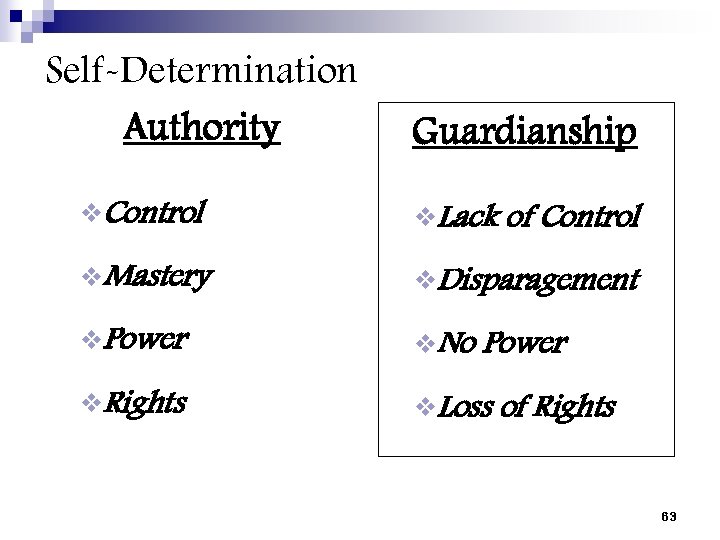 Self-Determination Authority Guardianship v. Control v. Lack v. Mastery v. Disparagement v. Power v. No v. Rights v. Loss of Control Power of Rights 63
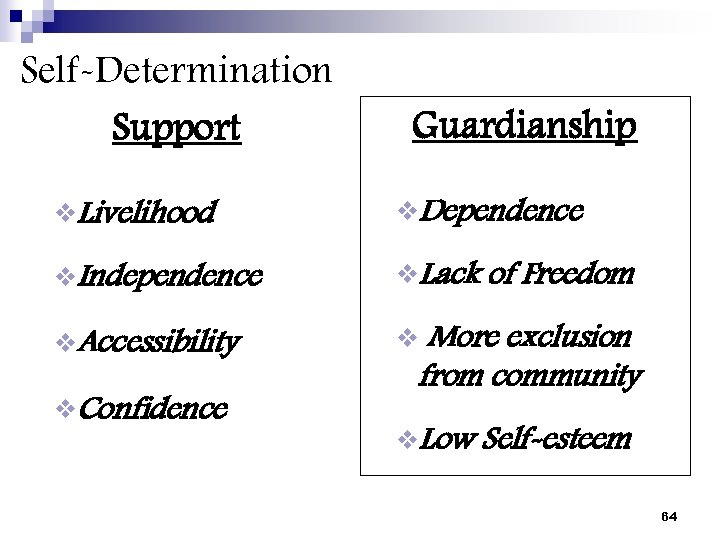 Self-Determination Support Guardianship v. Livelihood v. Dependence v. Independence v. Lack v. Accessibility v v. Confidence of Freedom More exclusion from community v. Low Self-esteem 64
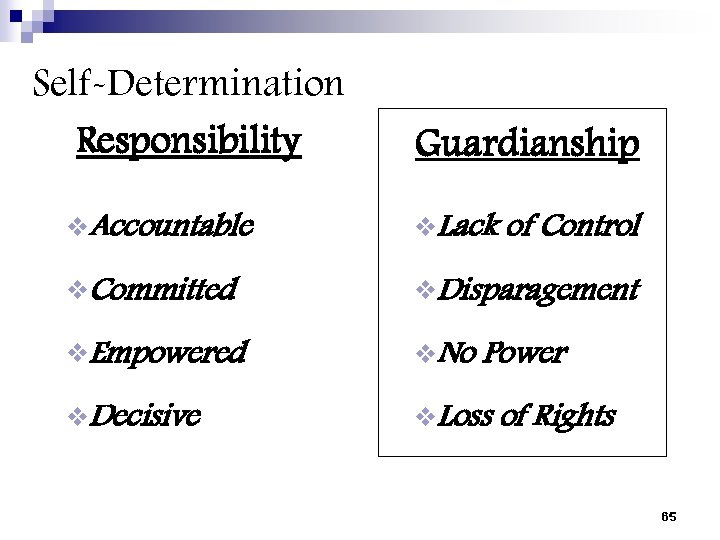 Self-Determination Responsibility Guardianship v. Accountable v. Lack v. Committed v. Disparagement v. Empowered v. No v. Decisive v. Loss of Control Power of Rights 65
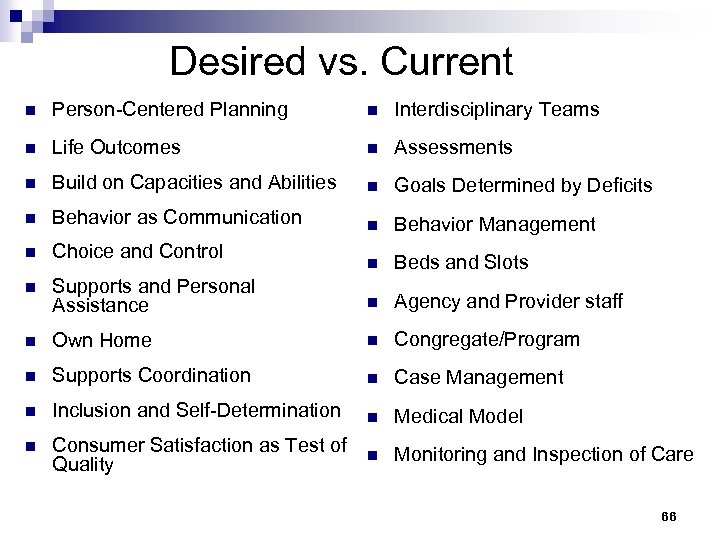 Desired vs. Current n Person-Centered Planning n Interdisciplinary Teams n Life Outcomes n Assessments n Build on Capacities and Abilities n Goals Determined by Deficits n Behavior as Communication n Behavior Management n Choice and Control n Beds and Slots n Supports and Personal Assistance n Agency and Provider staff n Own Home n Congregate/Program n Supports Coordination n Case Management n Inclusion and Self-Determination n Medical Model n Consumer Satisfaction as Test of Quality n Monitoring and Inspection of Care 66
 “ A person’s impairment does not diminish the right of that person to exert choice and control about his or her life or to fully participate in the economic, political, social cultural, and educational mainstream of society. ” Arlene Kanter 67
 QUALITY OF LIFE People in your life n Unpaid and paid n Of your choosing n Variety and array of relationships 68
 QUALITY OF LIFE Control n Where and how you live n What you do an where you do it n What supports, and how they are provided n Who provides supports 69
 QUALITY OF LIFE Money n Direct your budget n Opportunity to earn money n Decide how to spend your money 70
 “One of the biggest challenges facing us as we enter the twenty-first century…lies in the overemphasis, even dependency, on power control, paternalism, and, ultimately, coercion. ” Rod Copeland Commissioner of the Vermont Department of Developmental and Mental Health 71
 In the real world, people die for their freedoms. In the field of [developmental disabilities], they hold conventions or invite each other to conferences. In the real world, people learn from each other, and protect each other. In the field of [developmental disabilities], one must be licensed to teach, certified to treat, and commissioned to protect. That which is considered to be good in the field of [developmental disabilities] is professionally controlled. Burton Blatt, 1981 72
 What is least restrictive about the real world drives from thousands of years of human discourse under such diverse leaders as Attila and Lincoln, Pharaoh and Moses, George III and George Washington, Martin Luther and Martin Luther King. What’s most restrictive about the world of {developmental disabilities} derives from 200 years of professional interest in pathology rather than the universality of people. Professionals have created much of the need to do something about the problem of too restrictive environments forced upon {people with disabilities}. We have created or been much of the problem, and now we seem anxious to do something, but less to rescue {people with disabilities} than to redeem ourselves, less to obtain their freedoms than to establish ours, less because they need us than 73 because we need them”
 Dear Mr. Hoyle: “The American Bar Association (ABA) Commission on Disability Rights – with the ABA Commission on Law and Aging and in partnership with the Administration on Intellectual and Developmental Disabilities (AIDD) within the Administration for Community Living in the U. S. Department of Health and Human Services – Invites you to participate in a pioneering consensus Roundtable discussion, Beyond Guardianship: Supported Decision-Making by Individuals with Intellectual Disabilities. ” 74
 “The aim of the Roundtable is to empower and support the decision-making of the growing population of individuals with intellectual disabilities, moving beyond the current guardianship model. Specifically, participants will examine problems with the current system of decision-making, propose possible solutions, and recommend initial steps for getting there. The Roundtable is intended to advance a national symposium that will be framed by the recommendation from the Roundtable. ” 75
 Dear Dohn, “I am pleased to invite you to participate in a ground-breaking effort to envision and ensure the future of Supported Decision -Making: a critical and cutting-edge issue for people with disabilities, seniors and others who need or want assistance making life choices and an alternative to overbroad or undue guardianship. On October 24, 2013, Quality Trust for Individuals with Disabilities, the Council on Quality Leadership and the Burton Blatt Institute are sponsoring a one-day invitational symposium on Best Practices in Supported Decision-Making. Hosted by American University College of Law in Washington, DC, the symposium will develop specific recommendations for advancing the legal, policy, research and practical aspects of Supported Decision-Making. ” 76
 Dear Dohn, “I am pleased to invite you to participate in the Supported Decision. Making (SDM) Symposium 2015 sponsored by the National Resource Center on Supported Decision Making (NRC-SDM). NRC -SDM is a national effort to advance the use of supported decisionmaking in practice for people needing assistance making life decisions. ” “…On November 18 and 19 th, 2015 we have planned a one and a half day symposium agenda to highlight efforts underway to advance the use of SDM throughout the country. This is an invitational symposium to include leaders with expertise in supports for people who are aging and living with a disability. Hosted by American University Washington College of Law in Washington, DC, the symposium will result in discussions on the legal, policy, research and practical aspects of implementing Supported Decision. Making. We will also be identifying next steps and new partnerships needing for future progress. ” 77
 Symposium “Vision: Expand advance the use of SDM by creating a new paradigm focused on ensuring that older adults and people with disabilities have a TRUE opportunity to (1) be and remain equal members of their communities throughout the lifespan (2) actively use practices and supports that preserve and advance their personal vision for life; and (3) achieve positive life outcomes (e. g. , integrated employment, full inclusion, access to health care, individual flourishing, etc. ) that reflect personal desires, choices and preferences. ” Tina M. Campanella, CEO, Quality Trust for Individuals with Disabilities 78
 Every person can make choices and has a right to make decisions. People who have a cognitive or intellectual disability may express their preferences/choices/decisions in non-traditional ways. Any legal system or proceeding which deprives an individual of his/her right to be accommodated and supported in choosing and making decisions and which appoints a substitute decision-maker based on test of competence or capacity, makes that person vulnerable and deprives him/her not only of his/her right to self determination but also of other rights which should be inalienable. Our obligation is to find the best ways to provide the accommodations, and supports a person needs to maintain their autonomy and make decisions. 79
 Dohn Hoyle dhoyle@arcmi. org 1 -800 -292 -7851 Look for us on www. arcmi. org 80