


 Скачать презентацию Retail Tariffs Qo S sensitive pricing for
a5c8cc34a82a304e2499a387a90ace8b.ppt
- Количество слайдов: 8
 Retail Tariffs : Qo. S sensitive pricing for IP based services Nepal Telecommunications Authority
 Operators view on NGN • Charging is to be based on capacity and Qo. S rather than well established practice of charging by time and distance (miles and minutes) • Telecom operators are becoming media companies and vice versa. • Killer application is Vo. IP in NGN. • Feedback from industry suggest that many operators would like clarity on IP telephony as a first step on offering clarity on NGN policy. • Technical specifications of NGN should be specified by NGN for cost effective implementation of NGN by all the operators. • Common transition time schedule should be specified. • Technology neutrality is to be extended to NGN as well.
 IP telephony in Nepal • IP telephony – the transmission of voice signals over packet switched IP based Network – Divided into two categories • Internet Telephony • Voice over IP (Vo. IP)
 Internet Telephony • the transmission of quasi real-time voice signal using unmanaged normal internet i. e. public internet. • The scope of this service includes: – PC-to PC voice (Both within the country and abroad) – Pc-to Phone (PC in Nepal and to phone abroad) – IP based H. 323/SIP terminals in Nepal to similar terminals both Nepal and abroad, employing IP addressing scheme of Internet Assigned Numbers Authority (IANA) • Internet Service Providers (ISPs) are permitted to offer Internet Telephony service. But they are not allowed to terminate or originate any voice call interconnecting with PSTN/PLMN and ISDN.
 Voice over IP (Vo. IP) • the transmission of real-time voice signal using managed IPbased network achieving Qo. S equivalent to PSTN toll quality. • Taking a technology neutral approach, in line with the New Telecommunications Policy 2004, the existing PSTN/PLMN/ISDN operators who have the license to operate NLD (National long Distance) and ILD (International long Distance) service are permitted Vo. IP as technology option in their network for various types of bearer services subject to meeting the quality of service norms specified by the NTA from time to time. • NTA has defined the Qo. S benchmark for Vo. IP based ILD services for the time being. The parameters are MOS or Rvalue, One way End to –End delay, Go. S, Packet Loss, Packet Jitter, CCS 7 signaling delay.
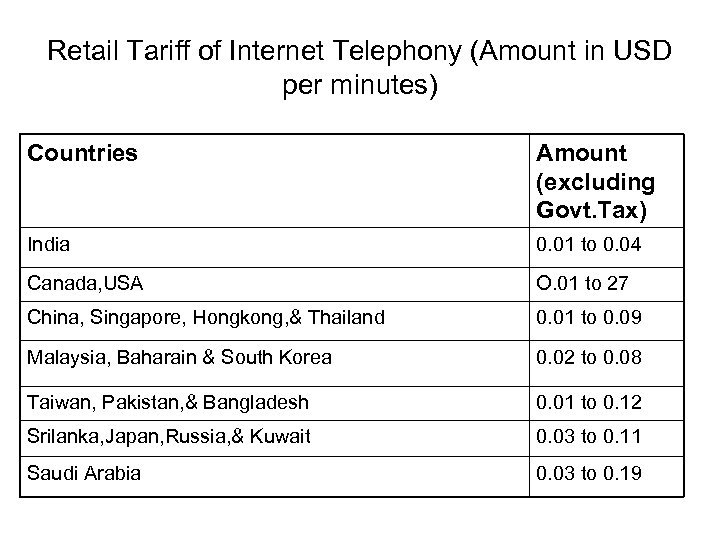 Retail Tariff of Internet Telephony (Amount in USD per minutes) Countries Amount (excluding Govt. Tax) India 0. 01 to 0. 04 Canada, USA O. 01 to 27 China, Singapore, Hongkong, & Thailand 0. 01 to 0. 09 Malaysia, Baharain & South Korea 0. 02 to 0. 08 Taiwan, Pakistan, & Bangladesh 0. 01 to 0. 12 Srilanka, Japan, Russia, & Kuwait 0. 03 to 0. 11 Saudi Arabia 0. 03 to 0. 19
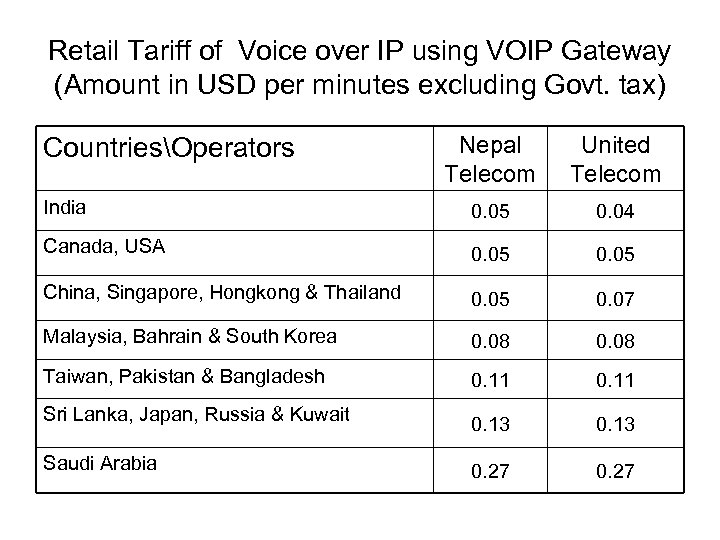 Retail Tariff of Voice over IP using VOIP Gateway (Amount in USD per minutes excluding Govt. tax) Nepal Telecom United Telecom India 0. 05 0. 04 Canada, USA 0. 05 China, Singapore, Hongkong & Thailand 0. 05 0. 07 Malaysia, Bahrain & South Korea 0. 08 Taiwan, Pakistan & Bangladesh 0. 11 Sri Lanka, Japan, Russia & Kuwait 0. 13 Saudi Arabia 0. 27 CountriesOperators
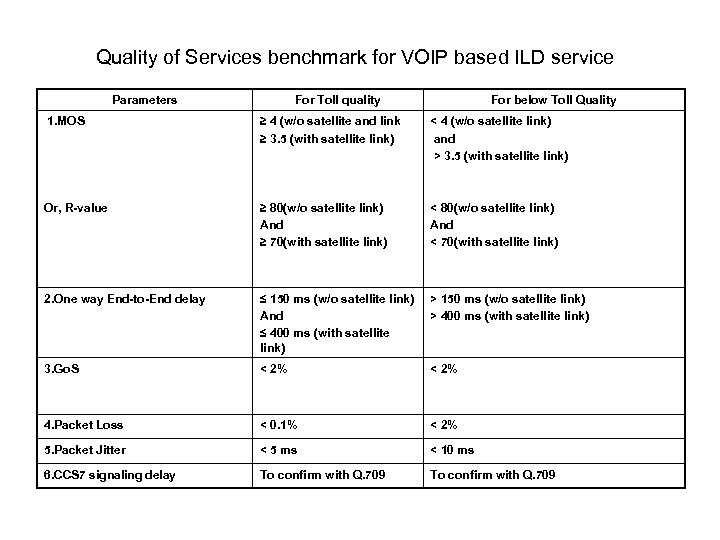 Quality of Services benchmark for VOIP based ILD service Parameters For Toll quality For below Toll Quality 1. MOS ≥ 4 (w/o satellite and link ≥ 3. 5 (with satellite link) < 4 (w/o satellite link) and > 3. 5 (with satellite link) Or, R-value ≥ 80(w/o satellite link) And ≥ 70(with satellite link) < 80(w/o satellite link) And < 70(with satellite link) 2. One way End-to-End delay ≤ 150 ms (w/o satellite link) And ≤ 400 ms (with satellite link) > 150 ms (w/o satellite link) > 400 ms (with satellite link) 3. Go. S < 2% 4. Packet Loss < 0. 1% < 2% 5. Packet Jitter < 5 ms < 10 ms 6. CCS 7 signaling delay To confirm with Q. 709