


 Скачать презентацию Results of the Ester Project in Latvia Valdis
2e95cb8ffd2c6021d3effb8b20dae1be.ppt
- Количество слайдов: 30
 Results of the Ester Project in Latvia Valdis Avotins, LIDA Salamanca Joint Workshop, June 23, 2005
 Agenda • • NIP Need: Market failure Risk capital program Technology incubator & seed program • Questions
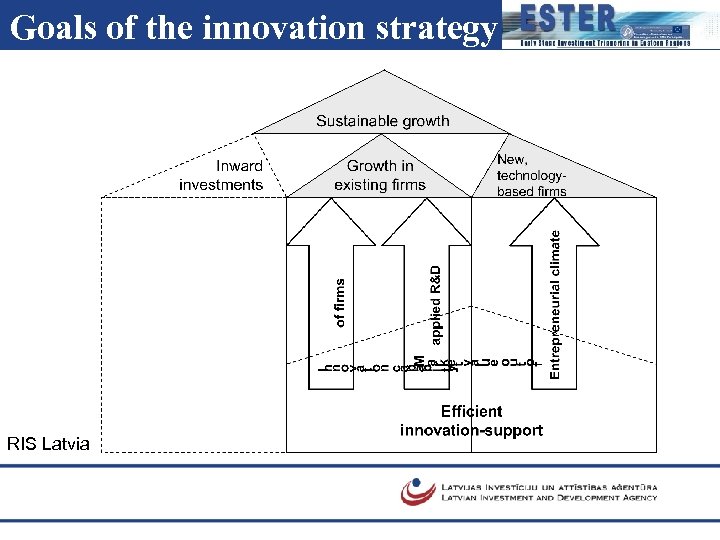 Goals of the innovation strategy RIS Latvia
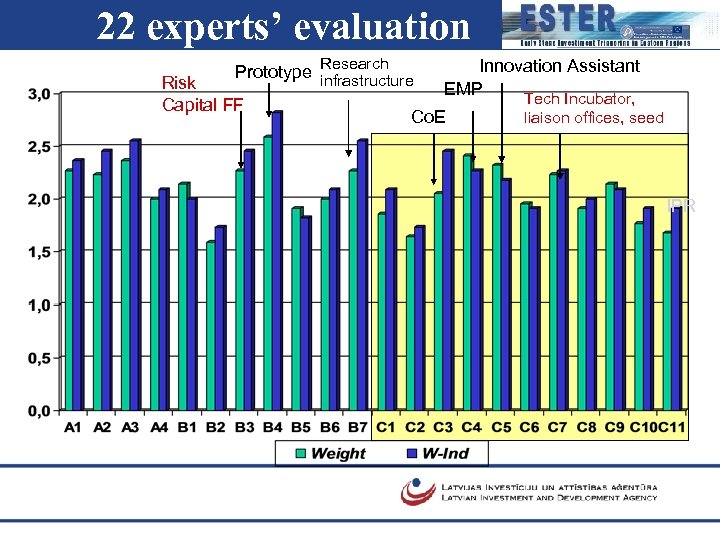 22 experts’ evaluation Research Innovation Assistant Prototype infrastructure Risk EMP Tech Incubator, Capital FF Co. E liaison offices, seed IPR
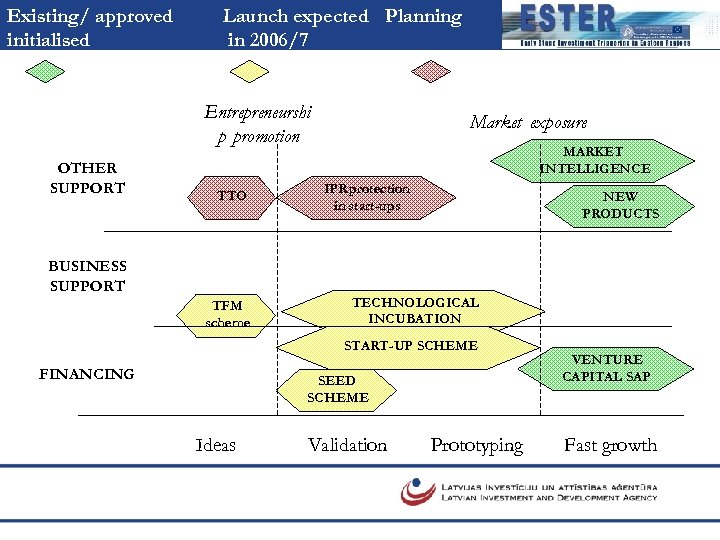 Existing/ approved initialised Launch expected Planning in 2006/7 Entrepreneurshi p promotion OTHER SUPPORT TTO BUSINESS SUPPORT TFM scheme Market exposure MARKET INTELLIGENCE IPR protection in start-ups NEW PRODUCTS TECHNOLOGICAL INCUBATION START-UP SCHEME FINANCING SEED SCHEME Ideas Validation Prototyping VENTURE CAPITAL SAP Fast growth
 Good investment environment • Rapid GDP growth 2000 2001 2002 2003 2004 6. 9 8 6. 4 7. 5 8. 5 • “Latvia is ranked among the top ten counties worldwide in terms of business start up time and length of bankruptcy procedures. ” Doing Business in 2004, World Bank • Wall Street Journal Index of Economic Freedom • Rank 28, Score 2. 31, (Israel Rank 33, score 2. 36) • The overall tax burden of GDP is only 29. 1%
 Background conditions • Low general entrepreneurship activity – Lowest amount of SME’s in EU (18 on 1000 inhabitants; EU average 51/1000) • Low share of innovative enterprises – 20% (incl. adoption) compared to EU average of 45% – Share of high-tech products in export ~6% – Employment in mid-to-high-tech is 23% of EU average • Lack of appropriate financial instruments for the needs of high-tech/ innovative companies at early stage of their development
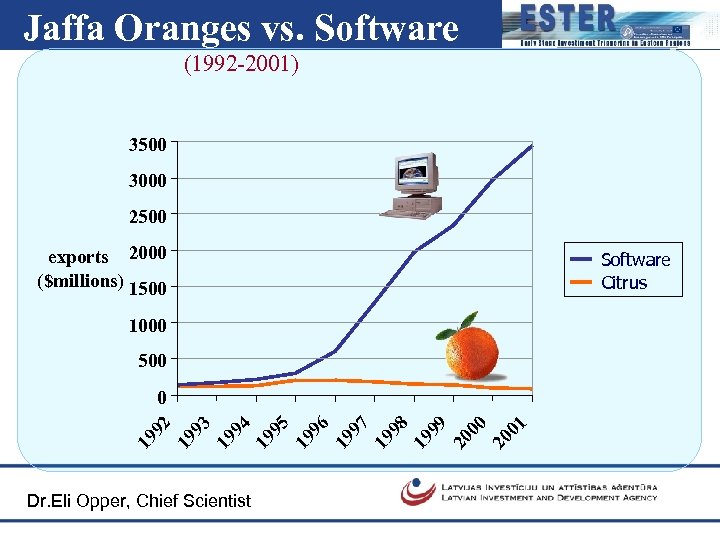 Jaffa Oranges vs. Software (1992 -2001) 3500 3000 2500 exports 2000 ($millions) 1500 1000 500 19 92 19 93 19 94 19 95 19 96 19 97 19 98 19 99 20 00 20 01 0 Dr. Eli Opper, Chief Scientist Software Citrus
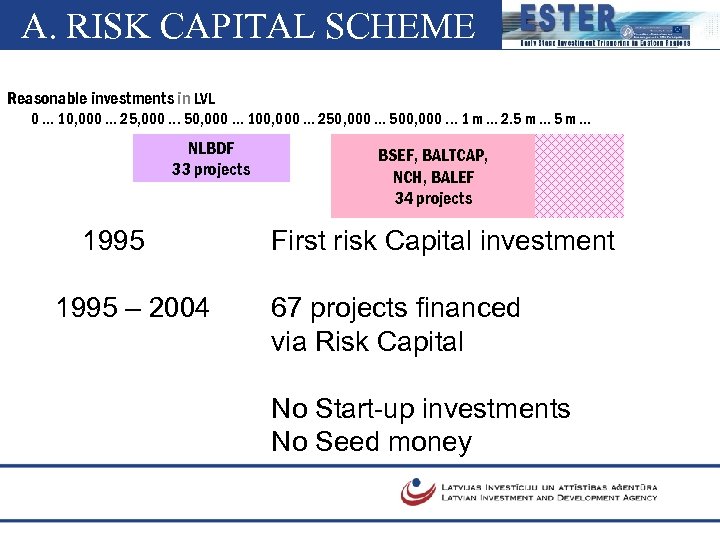 A. RISK CAPITAL SCHEME Reasonable investments in LVL 0. . . 10, 000. . . 25, 000. . . 50, 000. . . 100, 000. . . 250, 000. . . 500, 000. . . 1 m. . . 2. 5 m. . . NLBDF 33 projects 1995 – 2004 BSEF, BALTCAP, NCH, BALEF 34 projects First risk Capital investment 67 projects financed via Risk Capital No Start-up investments No Seed money
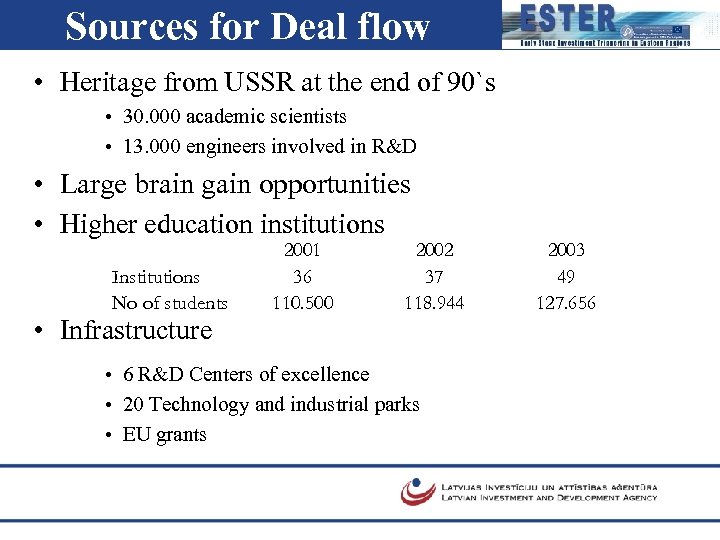 Sources for Deal flow • Heritage from USSR at the end of 90`s • 30. 000 academic scientists • 13. 000 engineers involved in R&D • Large brain gain opportunities • Higher education institutions Institutions No of students • Infrastructure 2001 36 110. 500 2002 37 118. 944 • 6 R&D Centers of excellence • 20 Technology and industrial parks • EU grants 2003 49 127. 656
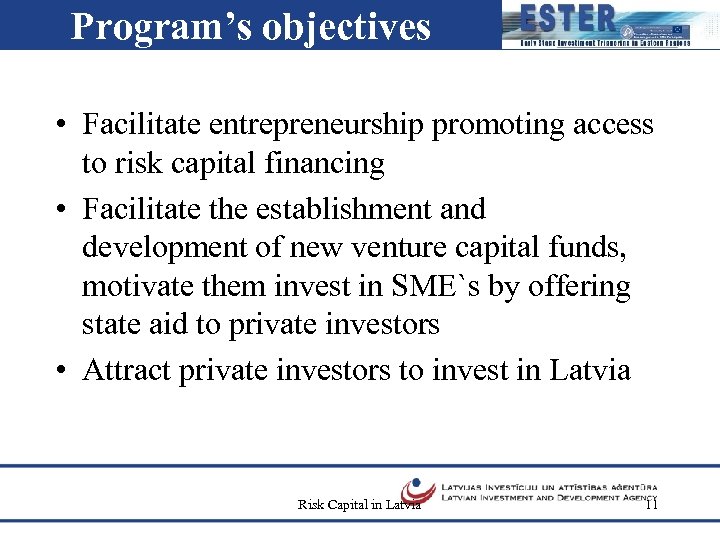 Program’s objectives • Facilitate entrepreneurship promoting access to risk capital financing • Facilitate the establishment and development of new venture capital funds, motivate them invest in SME`s by offering state aid to private investors • Attract private investors to invest in Latvia Risk Capital in Latvia 11
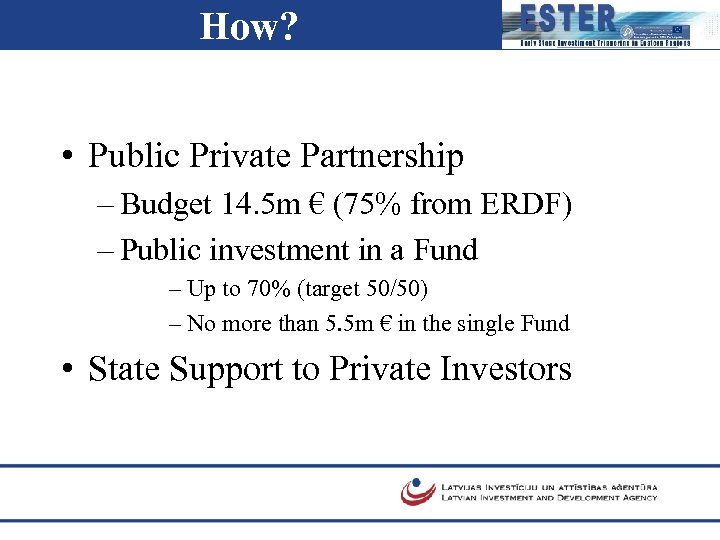 How? • Public Private Partnership – Budget 14. 5 m € (75% from ERDF) – Public investment in a Fund – Up to 70% (target 50/50) – No more than 5. 5 m € in the single Fund • State Support to Private Investors
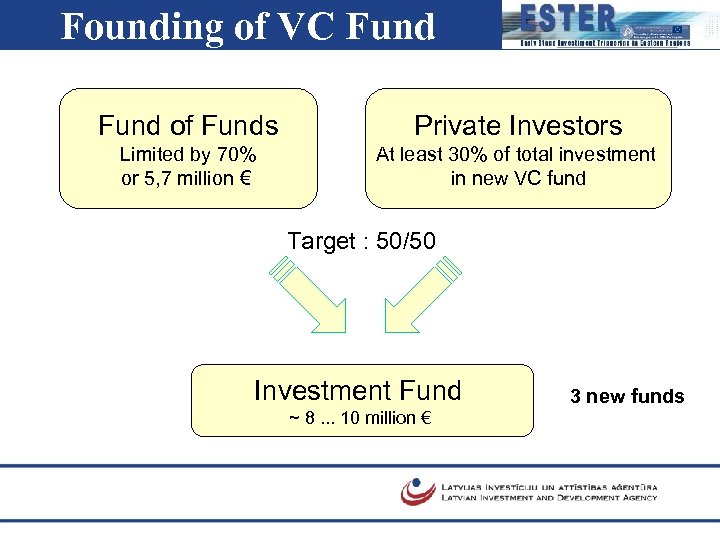 Founding of VC Fund of Funds Private Investors Limited by 70% or 5, 7 million € At least 30% of total investment in new VC fund Target : 50/50 Investment Fund ~ 8. . . 10 million € 3 new funds
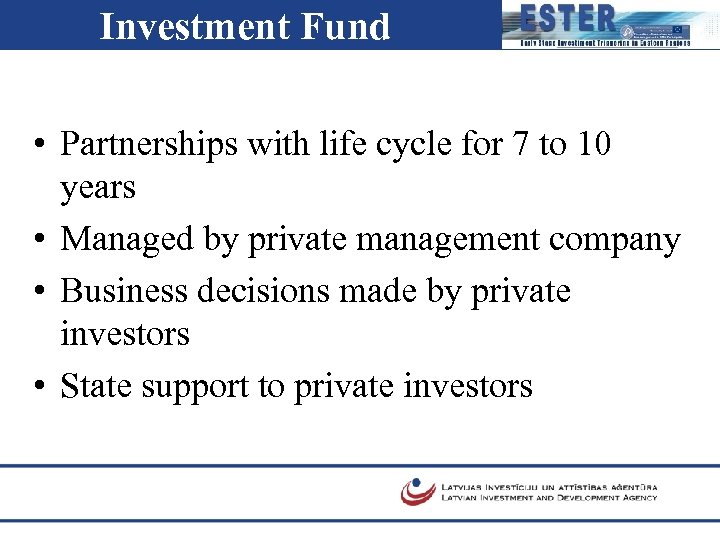 Investment Fund • Partnerships with life cycle for 7 to 10 years • Managed by private management company • Business decisions made by private investors • State support to private investors
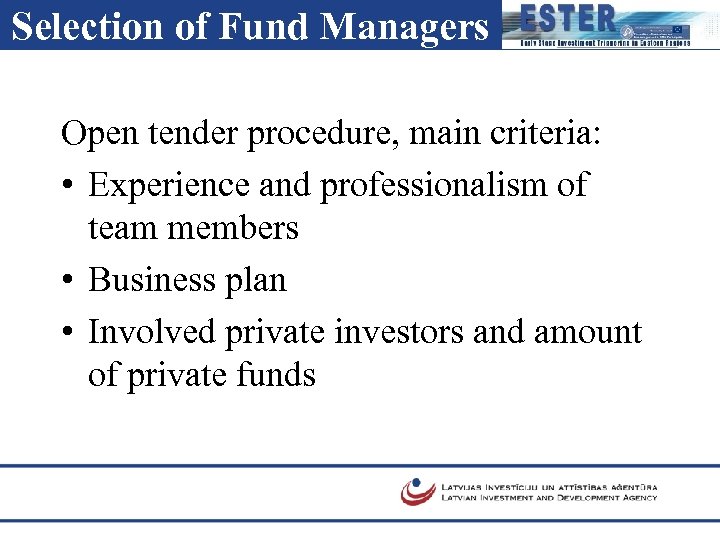 Selection of Fund Managers Open tender procedure, main criteria: • Experience and professionalism of team members • Business plan • Involved private investors and amount of private funds
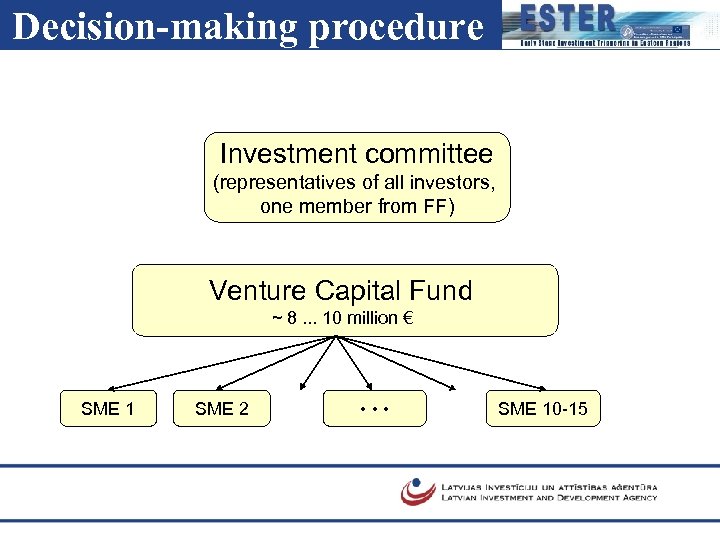 Decision-making procedure Investment committee (representatives of all investors, one member from FF) Venture Capital Fund ~ 8. . . 10 million € SME 1 SME 2 • • • SME 10 -15
 Restrictions for investment • SMEs registered in Latvia • Maximum investment 1 m € in one project • Maximum 300 k € in the first investment tranche • Time between trenches at least 12 months • Some sector restrictions (EU regulations)
 Return Distribution Mechanism 1. 2. 3. 4. Fund’s management expenses; Repay the original capital invested by private investors; Repay 25% of the original capital invested by the state; Priority return (hurdle rate) on private investors’ capital (6%); 5. Repay the remaining 75% of the state’s invested capital; 6. Hurdle rate return (6%) on the state’s invested capital; 7. Remaining profit, if any to private investors and FMC
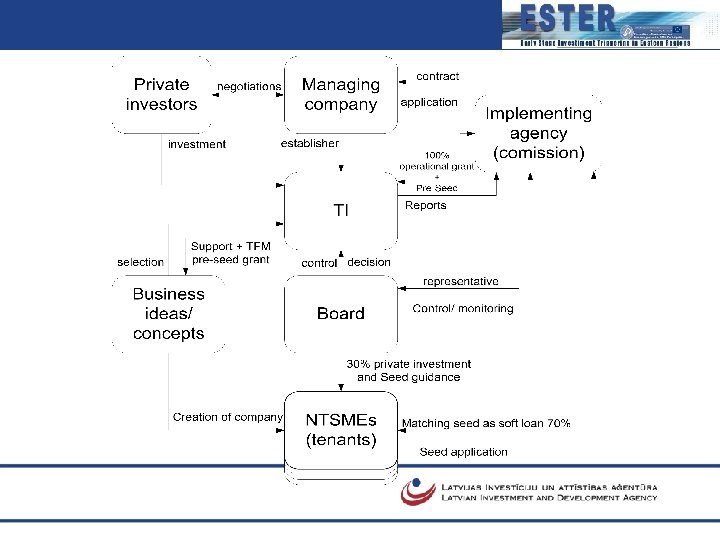
 B. The designeddraft Growth Future Scheme 4 1. Technology incubator grant 2. Pre-seed grant – Think for month 3. Seed soft loan Management companies or Operators of TI’s – private companies providing space & infrastructure, management and S&M advice, basic business services and private investment structuring in exchange for equity position in the tenant company Target groups: – Potential entrepreneurs from industry – Potential entrepreneurs from academia – Repatriating scientists and R&D personnel – Regional inventors Tested in Israel, with WB experts, EU experts, local expert panels
 New forms of Business Incubation in late 1990 s has been driven to multiply the number of succesful, fast-growth, high technology businesses in US a) Its led by serial entrepreneur; b) it has its own seed fund drawn from founder’s own, VCF or corporate partner’s capital; c) it may have specific sector focus Conventional incubators offer “heat, light and dial tone”, but “Smart” Venture Investment claim to offer more, developing ideas and incubating them in-house as well as providing late seed capital and A, B and C round investment. Incubation today is seen as a way in which capital can be efficiently applied to support new technology businesses Gill D. , Martin C. , Minshall T. , Rigby M. Funding Technology. Lessons from America. 2000
 Political Goals 1. 2. 3. 4. Improve the competitiveness of Latvia by facilitating development of high & medium tech industries; Create a potential for participation in future technologies (prestige, future competitiveness); Development of new sustainable export industries (Israeli & Finnish experience); Create economic champions / change the attitude of society towards technology commercialization. High growth high-tech company establishment is more expensive and it shows remarkable return after 8 -10 years : § longer establishment cycle; § specific infrastructure required; § specific knowledge needed.
 Background Existing market gap for early stage investment and low local entrepreneurial spirit results in few investments particularly in high growth Start-ups The Need: sharing investor risk to encourage investments and increase the number of high growth start-up companies Solution: outsourced integrated service to motivated professional venture teams
 Side measures for Deal flow • Entrepreneurship motivation scheme - outflow of 300 busines ideas, 100 marketing plans, 50 business plans; • Reposition of entrepreneurial culture : • by informative seminars, work shops, presentations, publications in media, etc; • Awareness creation program; • “Think for month” (pre-seed grant); • Innovation assistant grant scheme; • motivation scheme for inventors in universities and R&D institutes; • Innovation courses and innovation MBA program in RTU; • Technology transfer centre; • Business labs and Liaison offices in universities; • Ventspils school of entrepreneurship (Chalmers model)
 1. Technology Incubator grant • • 9 year program (3 x 3 support periods) Public – private partnership model Decisions made by TI private operators (PO) Grant is paid to TI operator as 30% fixed rate and 35 k. EUR per one tenant, minimum 2 tenants are required, quarterly payments • Public grant up to 75% (max. 500 k EUR) of TI’s annual budget • Based on Venture business not traditional incubation!
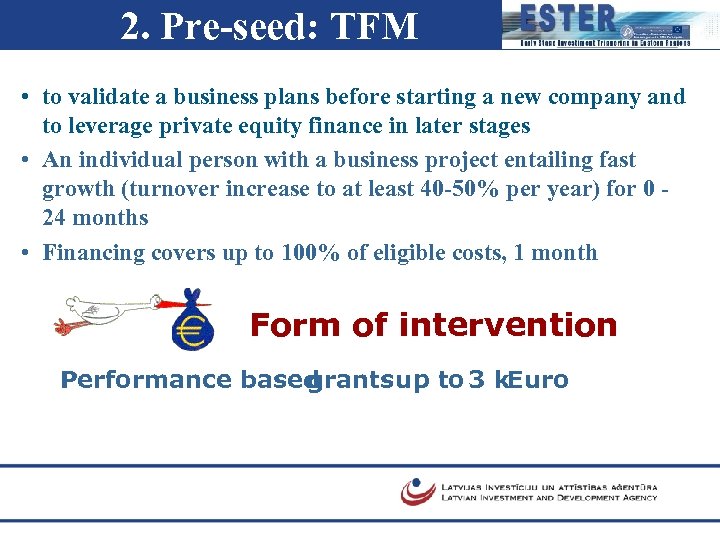 2. Pre-seed: TFM • to validate a business plans before starting a new company and to leverage private equity finance in later stages • An individual person with a business project entailing fast growth (turnover increase to at least 40 -50% per year) for 0 24 months • Financing covers up to 100% of eligible costs, 1 month Form of intervention Performance based grants up to 3 k. Euro
 3. The seed program • • • Investment management: TI PO Recipients – young (<6 month) SMEs after business concept validation max 300 K EUR soft loan, matching with private equity investment 70%: 30% converts to non-refundable grant in the case of failure Project duration 6 -24 months when sales appear 5% from annual turnover should be paid back until all loan is repaid
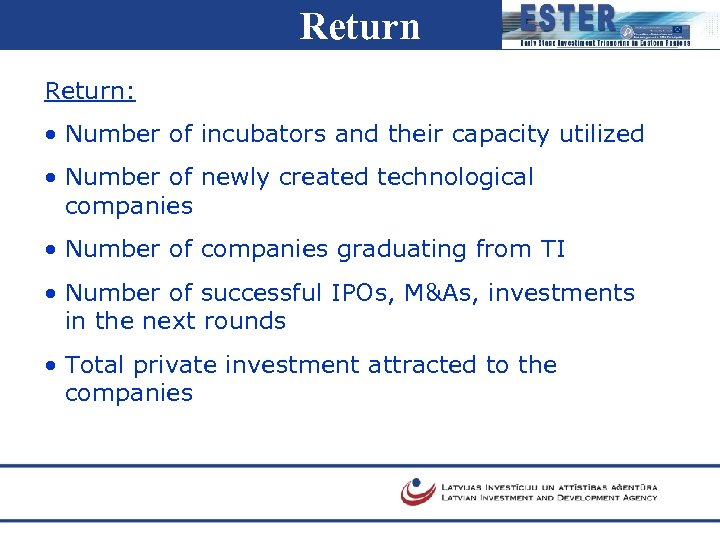 Return: • Number of incubators and their capacity utilized • Number of newly created technological companies • Number of companies graduating from TI • Number of successful IPOs, M&As, investments in the next rounds • Total private investment attracted to the companies
 Selection criteria 1. For TIs operators 2. For SMEs • • • TI management experience and professionalism of team members in new high growth SMEs creation Business plan Amount of offered financing Planned running costs per SME, share of private coinvestment • • • Registrated commercial entity in LR, younger than 6 months, planned growth over 50% Not yet in market, IPR owner or exclusive user High- or medium-tech Explicit orientation towards global market (export) Worked out draft business or / and technology plan Manageable company Significant milestones for 24 months
 Thank you for attention!