


 Скачать презентацию Results of semi realistic and realistic simulations performed
d667e391f507238b65886beceb6607bf.ppt
- Количество слайдов: 34
 Results of semi realistic and realistic simulations performed with new compressible dynamical core of COSMO-EULAG Bogdan Rosa, Damian K. Wójcik, Michał Z. Ziemiański Institute of Meteorology and Water Management National Research Institute Warsaw, Poland Podleśna, 61 Email: bogdan. rosa@imgw. pl COSMO General Meeting, 11 – 14 September 2017, Jerusalem, Israel
 Overview of project tasks Task 1: Integration of EULAG DC with COSMO framework The EULAG model has been successfully coupled to the COSMO framework from technical point of view. Coupling of the EULAG DC code with fully implemented ICON physics parameterizations will be performed in the framework of Task 5 of the project (postponed - due to unavailability of the official implementation of COSMO with ICON parameterizations). The task aimed at investigation and implementation of the strategy regarding lowest level of EULAG dynamical core on the surface will be carried out within COSMO Priority Project EX-CELO (In current implementation there is no additional surface layer). Task 2: Consolidation and optimization of the EULAG DC formulation This task has been completed. Task 3: Eulag DC code restructuring and engineering The remaining task, namely, implementation of a basic restart subroutine in the CE has been postponed for the next COSMO year (11. 2017 - 03. 2018). 19 th COSMO General Meeting, 11 -14 September 2017, Jerusalem, Israel
 Overview of project tasks Task 4: Optimization and testing of COSMO with EULAG DC Efforts aimed at tuning of the current COSMO-EULAG model have been already initiated. Once the COSMO-EULAG with fully implemented ICON physics is available (Task 5) optimization and testing of the model will be performed. Task 5: Integration and consolidation of the EULAG compressible DC with COSMO framework Implementation of ICON physics parameterizations to COSMO-EULAG (currently postponed). Our recent efforts have been focused on removing an observed pressure bias (successful). 19 th COSMO General Meeting, 11 -14 September 2017, Jerusalem, Israel
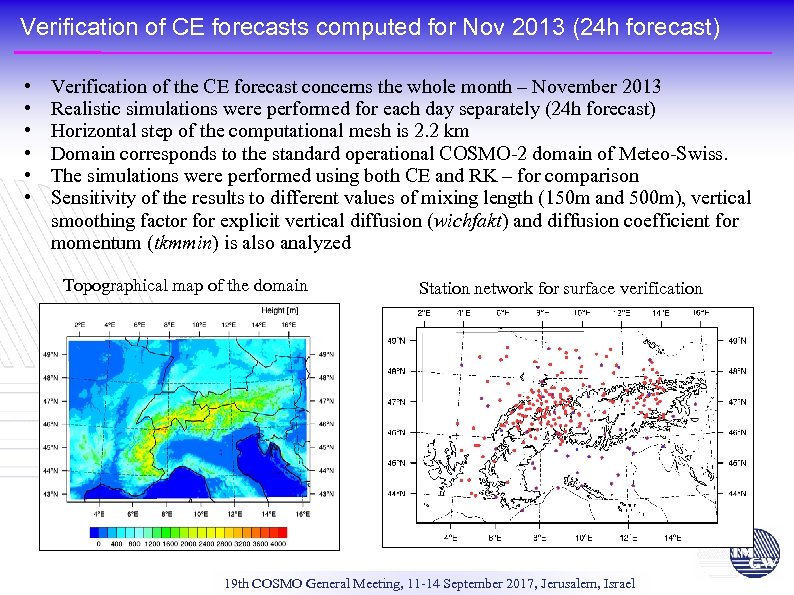 Verification of CE forecasts computed for Nov 2013 (24 h forecast) • • • Verification of the CE forecast concerns the whole month – November 2013 Realistic simulations were performed for each day separately (24 h forecast) Horizontal step of the computational mesh is 2. 2 km Domain corresponds to the standard operational COSMO-2 domain of Meteo-Swiss. The simulations were performed using both CE and RK – for comparison Sensitivity of the results to different values of mixing length (150 m and 500 m), vertical smoothing factor for explicit vertical diffusion (wichfakt) and diffusion coefficient for momentum (tkmmin) is also analyzed Topographical map of the domain Station network for surface verification 19 th COSMO General Meeting, 11 -14 September 2017, Jerusalem, Israel
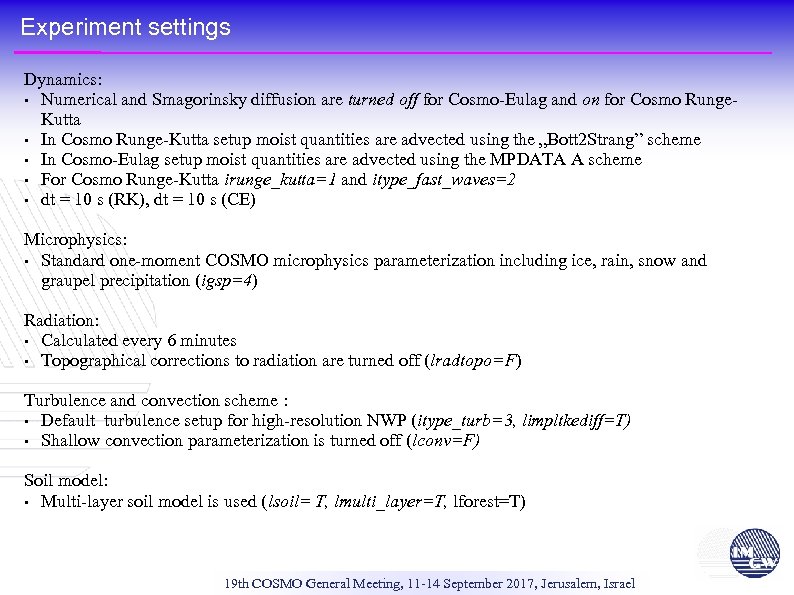 Experiment settings Dynamics: • Numerical and Smagorinsky diffusion are turned off for Cosmo-Eulag and on for Cosmo Runge. Kutta • In Cosmo Runge-Kutta setup moist quantities are advected using the „Bott 2 Strang” scheme • In Cosmo-Eulag setup moist quantities are advected using the MPDATA A scheme • For Cosmo Runge-Kutta irunge_kutta=1 and itype_fast_waves=2 • dt = 10 s (RK), dt = 10 s (CE) Microphysics: • Standard one-moment COSMO microphysics parameterization including ice, rain, snow and graupel precipitation (igsp=4) Radiation: • Calculated every 6 minutes • Topographical corrections to radiation are turned off (lradtopo=F) Turbulence and convection scheme : • Default turbulence setup for high-resolution NWP (itype_turb=3, limpltkediff=T) • Shallow convection parameterization is turned off (lconv=F) Soil model: • Multi-layer soil model is used (lsoil= T, lmulti_layer=T, lforest=T) 19 th COSMO General Meeting, 11 -14 September 2017, Jerusalem, Israel
![Wind [m/s] at 10 m – Forecast verification (before pressure correction) CE mixing length](https://present5.com/presentation/d667e391f507238b65886beceb6607bf/image-6.jpg "Wind [m/s] at 10 m – Forecast verification (before pressure correction) CE mixing length") Wind [m/s] at 10 m – Forecast verification (before pressure correction) CE mixing length = 150 m RK <|RMSE|> = 2. 211 <|ME|> = 0. 132 <|RMSE|> = 2. 250 <|ME|> = 0. 204 CE mixing length (default) = 500 m <|RMSE|> = 2. 242 <|ME|> = 0. 215 mixing length = 150 m RK mixing length (default) = 500 m <|RMSE|> = 2. 216 <|ME|> = 0. 164 There is notable overestimation of surface wind in CE. It may be related to different implicit diffusion of CE dynamical core and may need a dedicated tuning. All suggestions are very welcomed. 19 th COSMO General Meeting, 11 -14 September 2017, Jerusalem, Israel
Wind [m/s] at 10 m – Forecast verification (before pressure correction) CE mixing length = 150 m RK <|RMSE|> = 2. 211 <|ME|> = 0. 132 <|RMSE|> = 2. 250 <|ME|> = 0. 204 CE mixing length (default) = 500 m <|RMSE|> = 2. 242 <|ME|> = 0. 215 mixing length = 150 m RK mixing length (default) = 500 m <|RMSE|> = 2. 216 <|ME|> = 0. 164 There is notable overestimation of surface wind in CE. It may be related to different implicit diffusion of CE dynamical core and may need a dedicated tuning. All suggestions are very welcomed. 19 th COSMO General Meeting, 11 -14 September 2017, Jerusalem, Israel
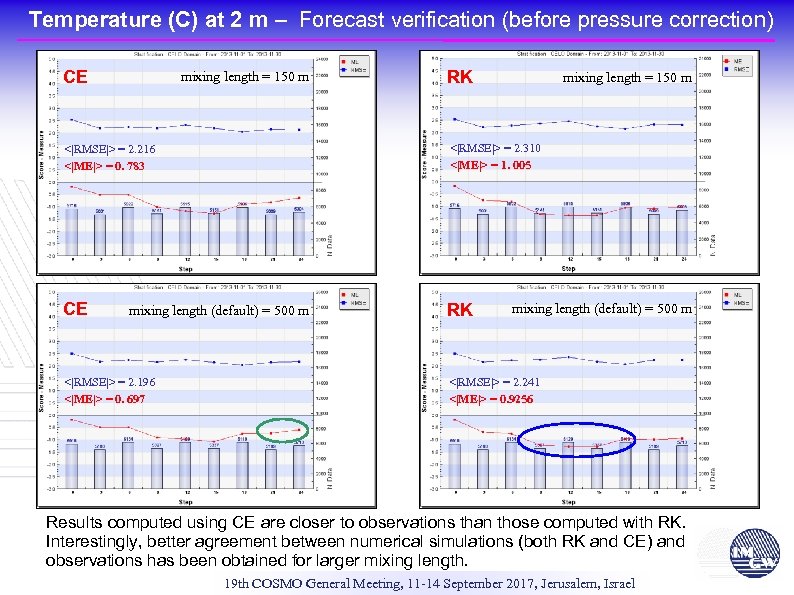 Temperature (C) at 2 m – Forecast verification (before pressure correction) CE mixing length = 150 m RK mixing length = 150 m <|RMSE|> = 2. 216 <|ME|> = 0. 783 <|RMSE|> = 2. 310 <|ME|> = 1. 005 CE RK mixing length (default) = 500 m <|RMSE|> = 2. 196 <|ME|> = 0. 697 mixing length (default) = 500 m <|RMSE|> = 2. 241 <|ME|> = 0. 9256 Results computed using CE are closer to observations than those computed with RK. Interestingly, better agreement between numerical simulations (both RK and CE) and observations has been obtained for larger mixing length. 19 th COSMO General Meeting, 11 -14 September 2017, Jerusalem, Israel
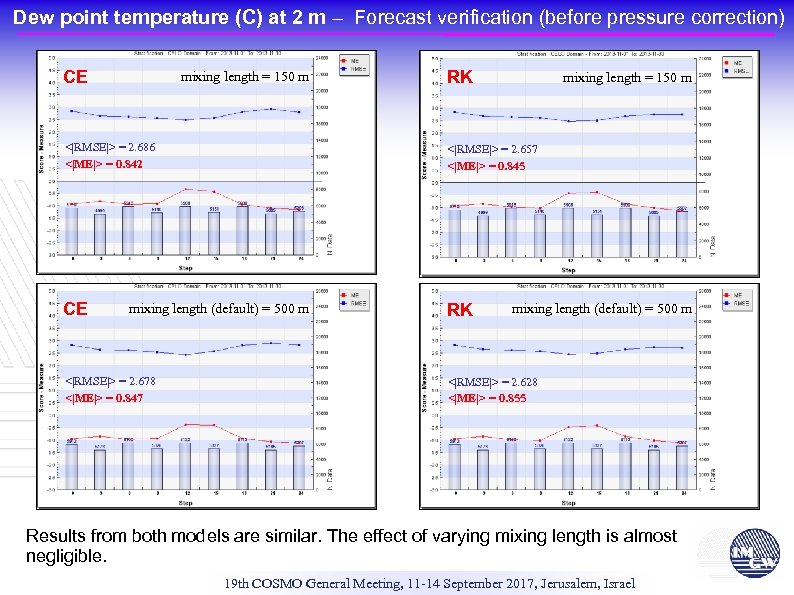 Dew point temperature (C) at 2 m – Forecast verification (before pressure correction) CE mixing length = 150 m RK mixing length = 150 m <|RMSE|> = 2. 686 <|ME|> = 0. 842 <|RMSE|> = 2. 657 <|ME|> = 0. 845 CE RK mixing length (default) = 500 m <|RMSE|> = 2. 678 <|ME|> = 0. 847 mixing length (default) = 500 m <|RMSE|> = 2. 628 <|ME|> = 0. 855 Results from both models are similar. The effect of varying mixing length is almost negligible. 19 th COSMO General Meeting, 11 -14 September 2017, Jerusalem, Israel
 Diagnosis of pressure bias Task 5: Integration and consolidation of the EULAG compressible DC with COSMO framework • Optimal formulation for the flows with the open boundary conditions: pressure bias diagnostics 19 th COSMO General Meeting, 11 -14 September 2017, Jerusalem, Israel
 Semi-realistic simulations: setup Semi-realistic simulations using COSMO Runge-Kutta (RK) and compressible COSMOEULAG (CE) were performed to diagnose for the problem of pressure bias development. Configuration: • Turbulence parameterization is turned on • Moist microphysics and saturation adjustment are turned off • Soil (sea) processes are turned off • Water vapour enters buoyancy and there are no sources / sinks of water vapour • dt = 15 s Computational domain: • Bay of Biscay (flat) • dx = 2. 2 km Test case: • 15 November 2013 (Azoren High) Figures in following slides show time evolution of horizontally averaged pressure perturbations. The perturbations are calculated with respect to the time-evolving pressure from the driving COSMO-7 simulation.
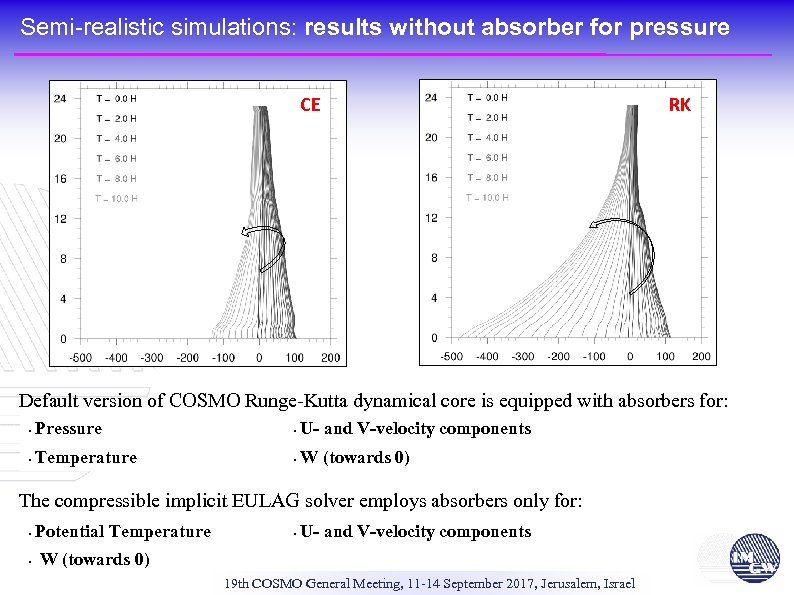 Semi-realistic simulations: results without absorber for pressure CE RK Default version of COSMO Runge-Kutta dynamical core is equipped with absorbers for: • Pressure • U- and V-velocity components • Temperature • W (towards 0) The compressible implicit EULAG solver employs absorbers only for: • • Potential Temperature • U- and V-velocity components W (towards 0) 19 th COSMO General Meeting, 11 -14 September 2017, Jerusalem, Israel
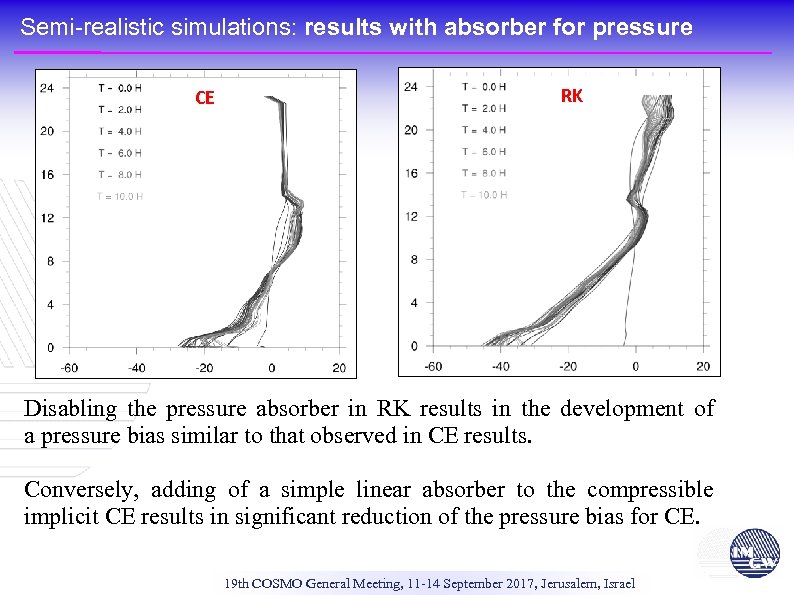 Semi-realistic simulations: results with absorber for pressure CE RK Disabling the pressure absorber in RK results in the development of a pressure bias similar to that observed in CE results. Conversely, adding of a simple linear absorber to the compressible implicit CE results in significant reduction of the pressure bias for CE. 19 th COSMO General Meeting, 11 -14 September 2017, Jerusalem, Israel
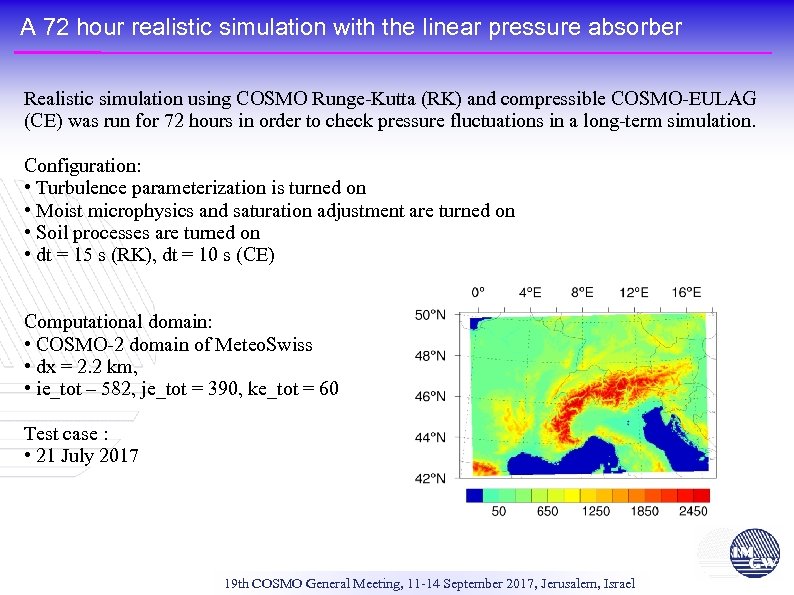 A 72 hour realistic simulation with the linear pressure absorber Realistic simulation using COSMO Runge-Kutta (RK) and compressible COSMO-EULAG (CE) was run for 72 hours in order to check pressure fluctuations in a long-term simulation. Configuration: • Turbulence parameterization is turned on • Moist microphysics and saturation adjustment are turned on • Soil processes are turned on • dt = 15 s (RK), dt = 10 s (CE) Computational domain: • COSMO-2 domain of Meteo. Swiss • dx = 2. 2 km, • ie_tot – 582, je_tot = 390, ke_tot = 60 Test case : • 21 July 2017 19 th COSMO General Meeting, 11 -14 September 2017, Jerusalem, Israel
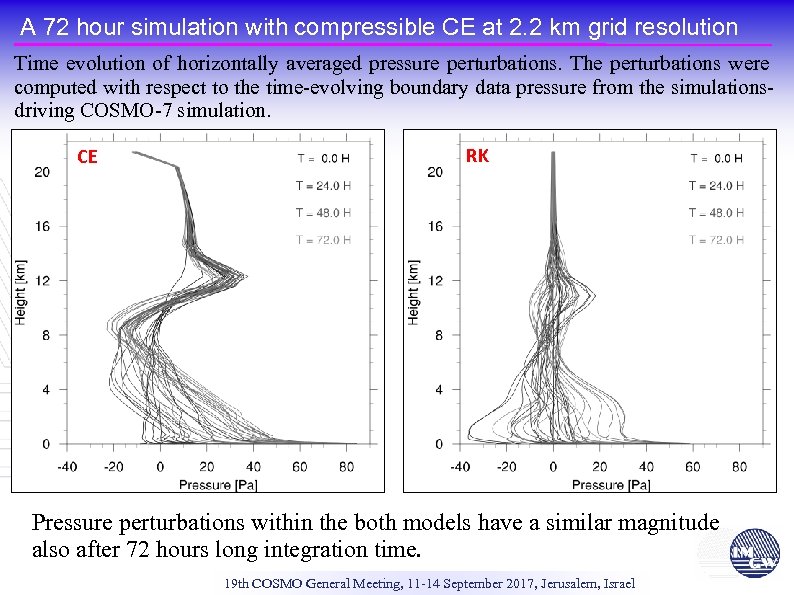 A 72 hour simulation with compressible CE at 2. 2 km grid resolution Time evolution of horizontally averaged pressure perturbations. The perturbations were computed with respect to the time-evolving boundary data pressure from the simulationsdriving COSMO-7 simulation. CE RK Pressure perturbations within the both models have a similar magnitude also after 72 hours long integration time. 19 th COSMO General Meeting, 11 -14 September 2017, Jerusalem, Israel
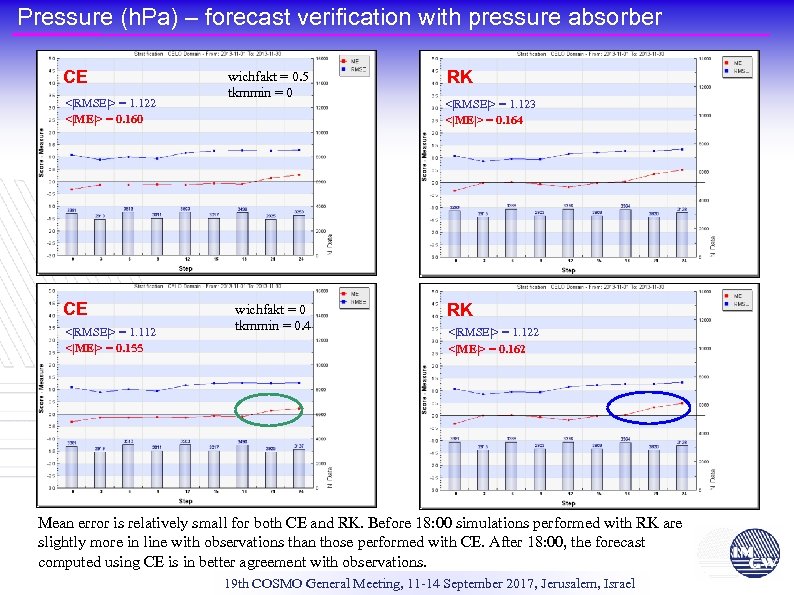 Pressure (h. Pa) – forecast verification with pressure absorber CE <|RMSE|> = 1. 122 <|ME|> = 0. 160 CE <|RMSE|> = 1. 112 <|ME|> = 0. 155 wichfakt = 0. 5 tkmmin = 0 wichfakt = 0 tkmmin = 0. 4 RK <|RMSE|> = 1. 123 <|ME|> = 0. 164 RK <|RMSE|> = 1. 122 <|ME|> = 0. 162 Mean error is relatively small for both CE and RK. Before 18: 00 simulations performed with RK are slightly more in line with observations than those performed with CE. After 18: 00, the forecast computed using CE is in better agreement with observations. 19 th COSMO General Meeting, 11 -14 September 2017, Jerusalem, Israel
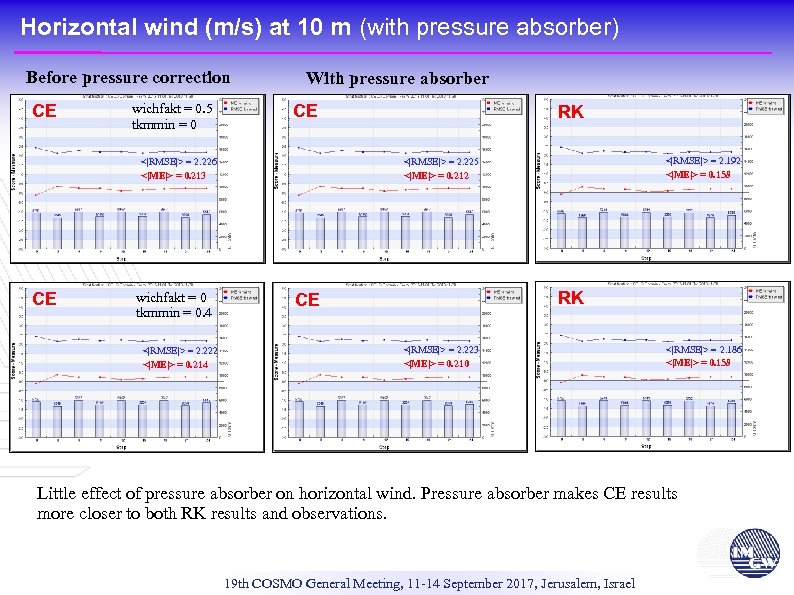 Horizontal wind (m/s) at 10 m (with pressure absorber) Before pressure correction CE wichfakt = 0. 5 tkmmin = 0 With pressure absorber CE wichfakt = 0 tkmmin = 0. 4 <|RMSE|> = 2. 222 <|ME|> = 0. 214 <|RMSE|> = 2. 192 <|ME|> = 0. 158 <|RMSE|> = 2. 225 <|ME|> = 0. 212 <|RMSE|> = 2. 226 <|ME|> = 0. 213 CE RK RK CE <|RMSE|> = 2. 223 <|ME|> = 0. 210 <|RMSE|> = 2. 186 <|ME|> = 0. 158 Little effect of pressure absorber on horizontal wind. Pressure absorber makes CE results more closer to both RK results and observations. 19 th COSMO General Meeting, 11 -14 September 2017, Jerusalem, Israel
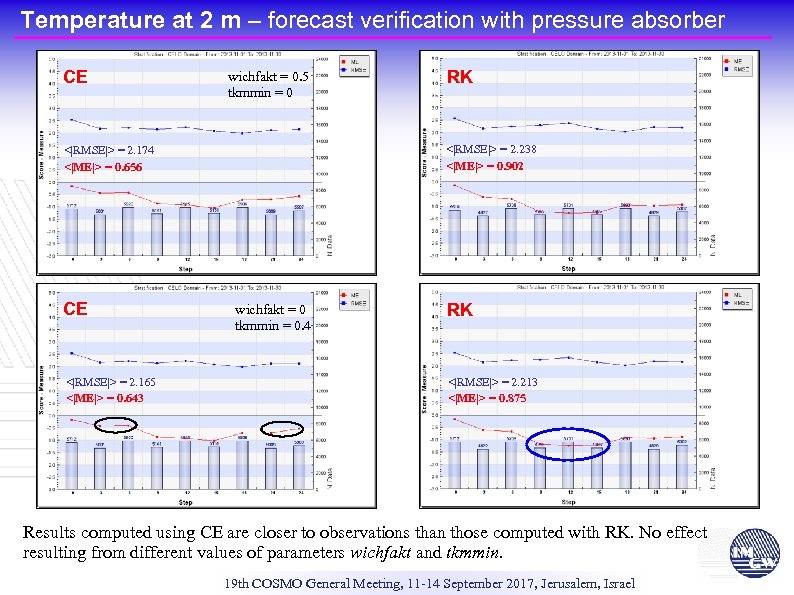 Temperature at 2 m – forecast verification with pressure absorber CE wichfakt = 0. 5 tkmmin = 0 <|RMSE|> = 2. 238 <|ME|> = 0. 902 <|RMSE|> = 2. 174 <|ME|> = 0. 656 CE <|RMSE|> = 2. 165 <|ME|> = 0. 643 RK wichfakt = 0 tkmmin = 0. 4 RK <|RMSE|> = 2. 213 <|ME|> = 0. 875 Results computed using CE are closer to observations than those computed with RK. No effect resulting from different values of parameters wichfakt and tkmmin. 19 th COSMO General Meeting, 11 -14 September 2017, Jerusalem, Israel
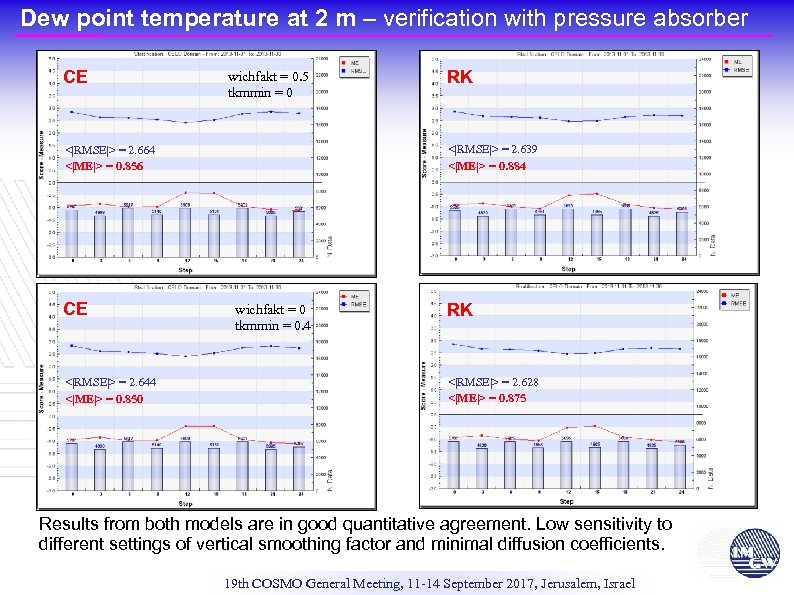 Dew point temperature at 2 m – verification with pressure absorber CE wichfakt = 0. 5 tkmmin = 0 <|RMSE|> = 2. 639 <|ME|> = 0. 884 <|RMSE|> = 2. 664 <|ME|> = 0. 856 CE <|RMSE|> = 2. 644 <|ME|> = 0. 850 RK wichfakt = 0 tkmmin = 0. 4 RK <|RMSE|> = 2. 628 <|ME|> = 0. 875 Results from both models are in good quantitative agreement. Low sensitivity to different settings of vertical smoothing factor and minimal diffusion coefficients. 19 th COSMO General Meeting, 11 -14 September 2017, Jerusalem, Israel
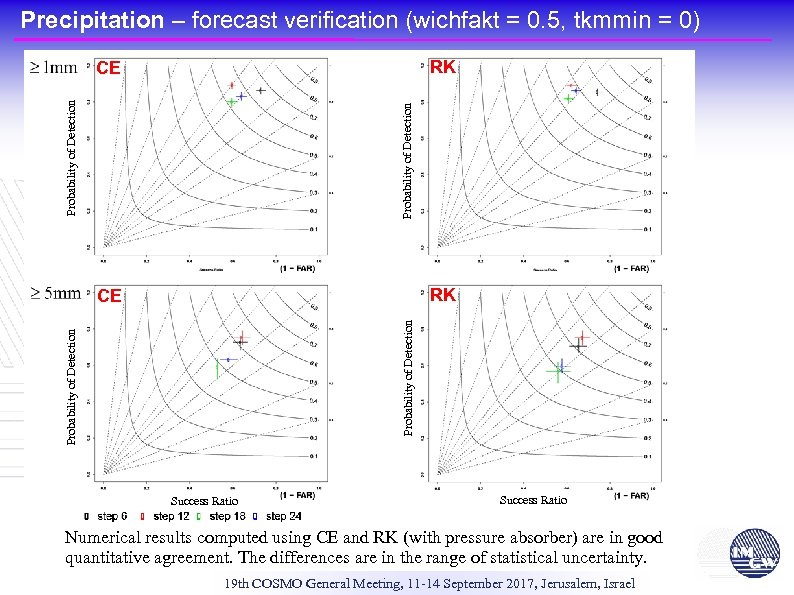 Precipitation – forecast verification (wichfakt = 0. 5, tkmmin = 0) RK Probability of Detection CE Success Ratio Numerical results computed using CE and RK (with pressure absorber) are in good quantitative agreement. The differences are in the range of statistical uncertainty. 19 th COSMO General Meeting, 11 -14 September 2017, Jerusalem, Israel
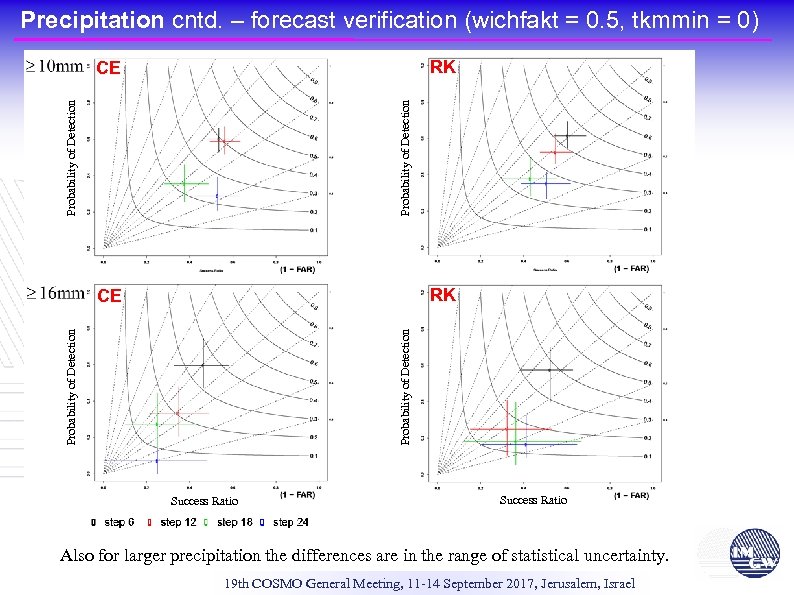 Precipitation cntd. – forecast verification (wichfakt = 0. 5, tkmmin = 0) RK Probability of Detection CE Success Ratio Also for larger precipitation the differences are in the range of statistical uncertainty. 19 th COSMO General Meeting, 11 -14 September 2017, Jerusalem, Israel
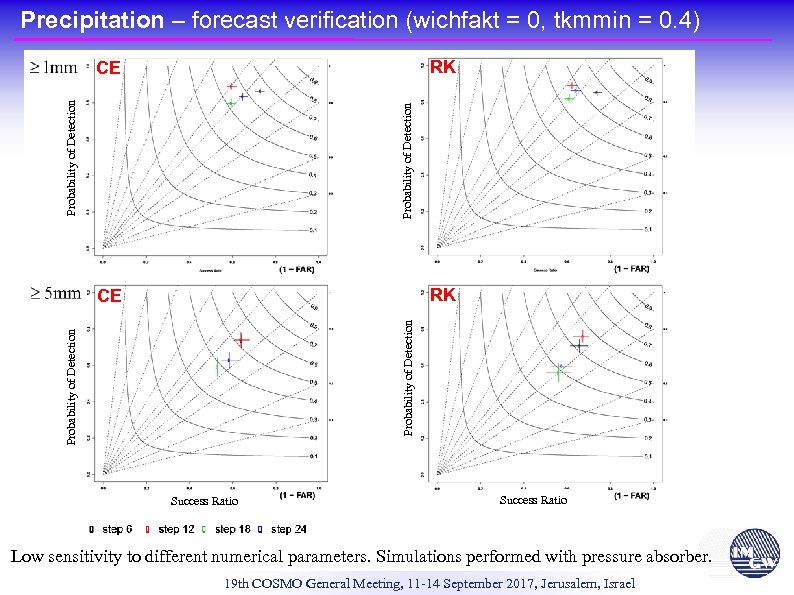 Precipitation – forecast verification (wichfakt = 0, tkmmin = 0. 4) RK Probability of Detection CE Success Ratio Low sensitivity to different numerical parameters. Simulations performed with pressure absorber. 19 th COSMO General Meeting, 11 -14 September 2017, Jerusalem, Israel
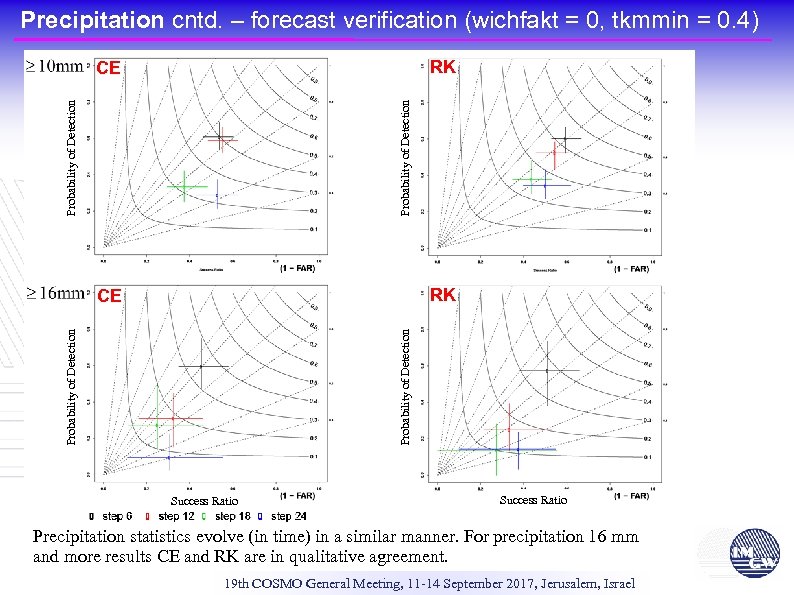 Precipitation cntd. – forecast verification (wichfakt = 0, tkmmin = 0. 4) RK Probability of Detection CE Success Ratio Precipitation statistics evolve (in time) in a similar manner. For precipitation 16 mm and more results CE and RK are in qualitative agreement. 19 th COSMO General Meeting, 11 -14 September 2017, Jerusalem, Israel
 Modeling of Alpine convection from the 19 July 2013 • Here we present results of simulations of Alpine convection performed with the new CE model (the most recent version with pressure absorber) • The simulations have been performed using four one-way nested domains having the horizontal grid size of 2. 2, 1. 1, 0. 55 and 0. 28 km • The simulations are compared with benchmark simulations of COSMO -Runge-Kutta with grid sizes of 2. 2 and 1. 1 km and satellite data 19 th COSMO General Meeting, 11 -14 September 2017, Jerusalem, Israel
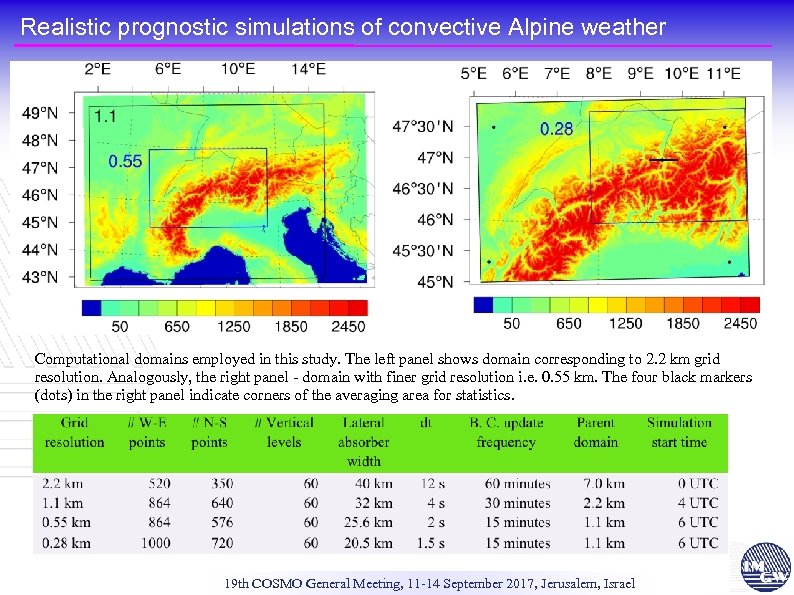 Realistic prognostic simulations of convective Alpine weather Computational domains employed in this study. The left panel shows domain corresponding to 2. 2 km grid resolution. Analogously, the right panel - domain with finer grid resolution i. e. 0. 55 km. The four black markers (dots) in the right panel indicate corners of the averaging area for statistics. 19 th COSMO General Meeting, 11 -14 September 2017, Jerusalem, Israel
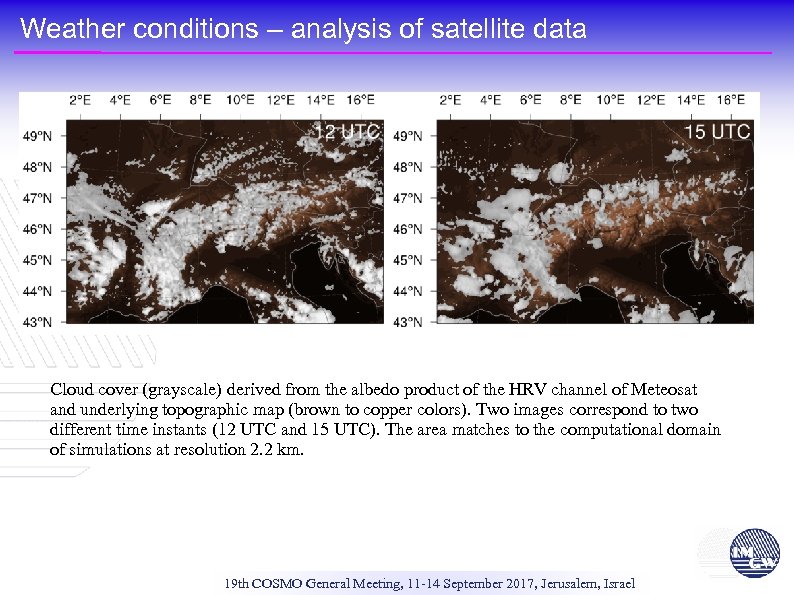 Weather conditions – analysis of satellite data Cloud cover (grayscale) derived from the albedo product of the HRV channel of Meteosat and underlying topographic map (brown to copper colors). Two images correspond to two different time instants (12 UTC and 15 UTC). The area matches to the computational domain of simulations at resolution 2. 2 km. 19 th COSMO General Meeting, 11 -14 September 2017, Jerusalem, Israel
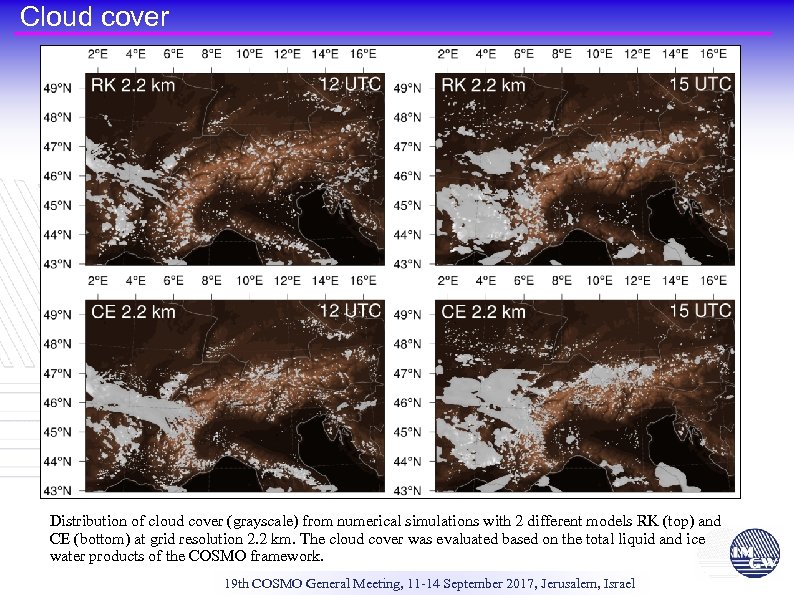 Cloud cover Distribution of cloud cover (grayscale) from numerical simulations with 2 different models RK (top) and CE (bottom) at grid resolution 2. 2 km. The cloud cover was evaluated based on the total liquid and ice water products of the COSMO framework. 19 th COSMO General Meeting, 11 -14 September 2017, Jerusalem, Israel
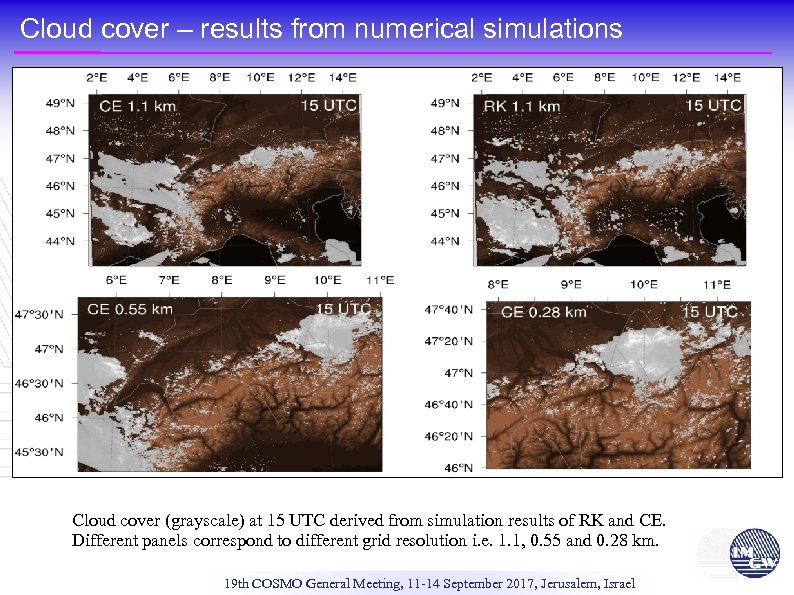 Cloud cover – results from numerical simulations Cloud cover (grayscale) at 15 UTC derived from simulation results of RK and CE. Different panels correspond to different grid resolution i. e. 1. 1, 0. 55 and 0. 28 km. 19 th COSMO General Meeting, 11 -14 September 2017, Jerusalem, Israel
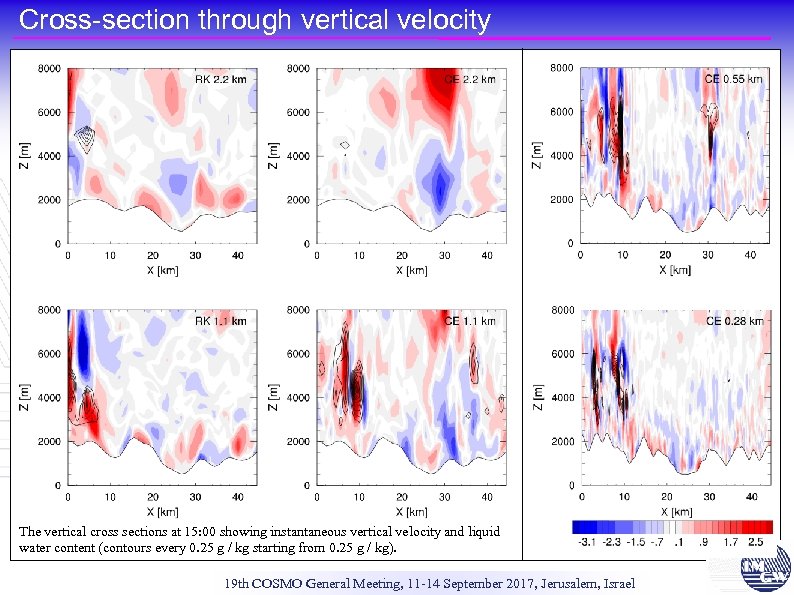 Cross-section through vertical velocity The vertical cross sections at 15: 00 showing instantaneous vertical velocity and liquid water content (contours every 0. 25 g / kg starting from 0. 25 g / kg). 19 th COSMO General Meeting, 11 -14 September 2017, Jerusalem, Israel
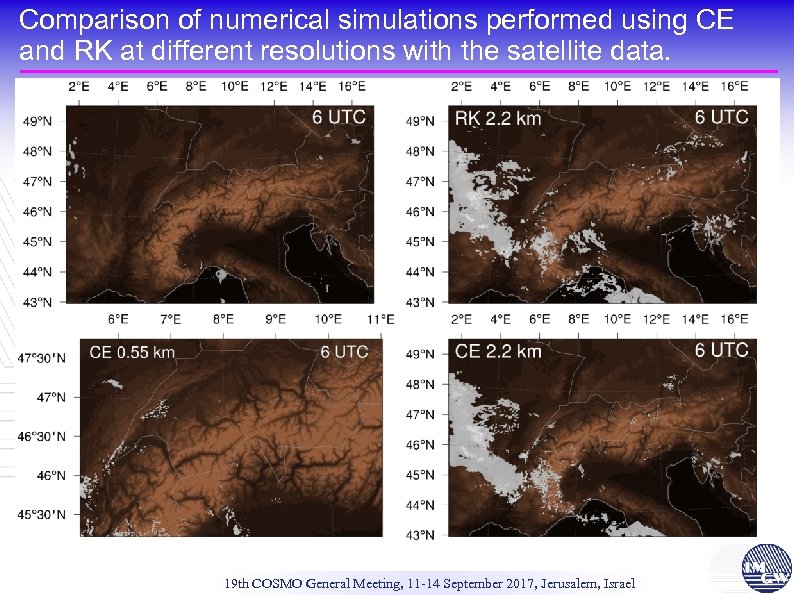 Comparison of numerical simulations performed using CE and RK at different resolutions with the satellite data. 19 th COSMO General Meeting, 11 -14 September 2017, Jerusalem, Israel
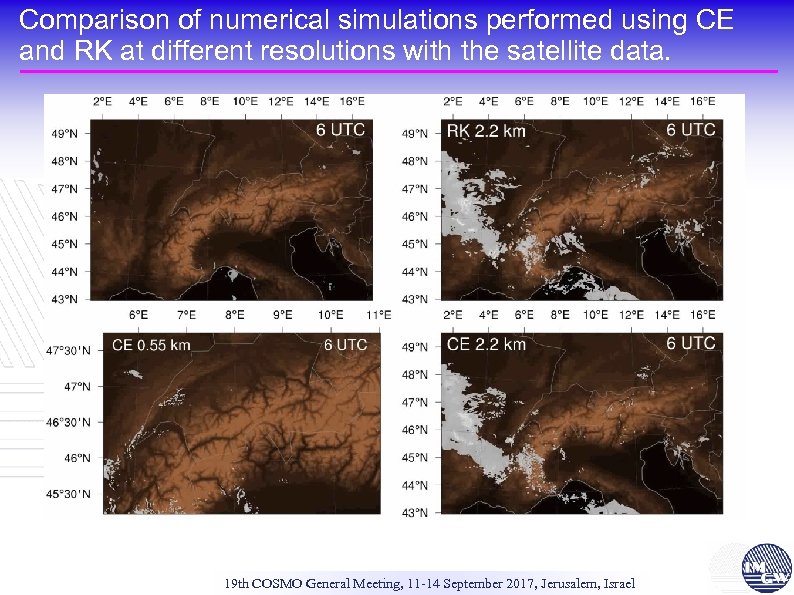 Comparison of numerical simulations performed using CE and RK at different resolutions with the satellite data. 19 th COSMO General Meeting, 11 -14 September 2017, Jerusalem, Israel
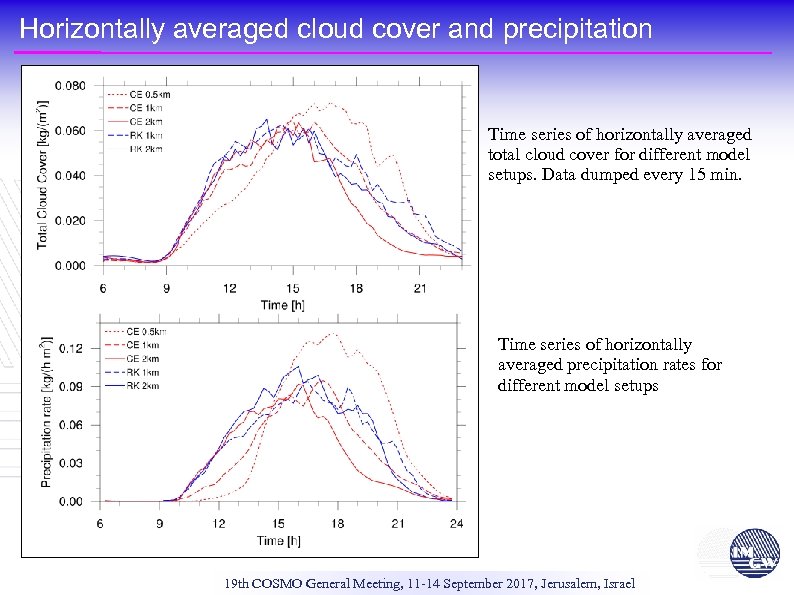 Horizontally averaged cloud cover and precipitation Time series of horizontally averaged total cloud cover for different model setups. Data dumped every 15 min. Time series of horizontally averaged precipitation rates for different model setups 19 th COSMO General Meeting, 11 -14 September 2017, Jerusalem, Israel
 Conclusions • CE results computed at grid resolutions 2. 2 and 1. 1 km and the results from reference RK simulation (2. 2 km) are generally similar for large scale cloud fields, precipitation and their evolution. • A robustness of CE numerics allowed for additional simulations of Alpine convective weather with horizontal grid sizes of 0. 55 and 0. 28 km. • The CE results show generally similar development of large-scale cloud fields for all model resolutions. • On the other hand, the CE simulations indicate significant influence of orographic forcing, strongly varying with underlying topography, on the model solutions (especially vertical wind component) so that no general grid convergence is obtained. • CE results indicate a dependence of the evolution of model representation of precipitation on the grid size. The difference concern e. g. the initial rate of precipitation growth (slower for higher resolutions) and timing and intensity of peak precipitation (later for higher resolutions and more intense especially for the grid size of 0. 55 km). • The differences between the CRK simulations employing 2. 2 and 1. 1 km grid sizes are smaller comparing with CE ones. 19 th COSMO General Meeting, 11 -14 September 2017, Jerusalem, Israel
 Documentation Extended abstract - 34 th International Conference on Alpine Meteorology, Reykjavík, Iceland, 18 -23 June 2017: Compressible EULAG solver for limited-area numerical Alpine weather prediction in the COSMO consortium Damian K. Wójcik, Bogdan Rosa, Michał Z. Ziemiański 19 th COSMO General Meeting, 11 -14 September 2017, Jerusalem, Israel
 THANK YOU FOR YOUR ATENTION