

Restoration and the Eighteenth Century 1660-1800 The Augustan


 Скачать презентацию Restoration and the Eighteenth Century 1660-1800 The Augustan
25656-lecture_2_milton.ppt
- Количество слайдов: 41
Restoration and the Eighteenth Century 1660-1800 The Augustan Age The Neoclassical Period The Age of Reason The Age of Enlightenment
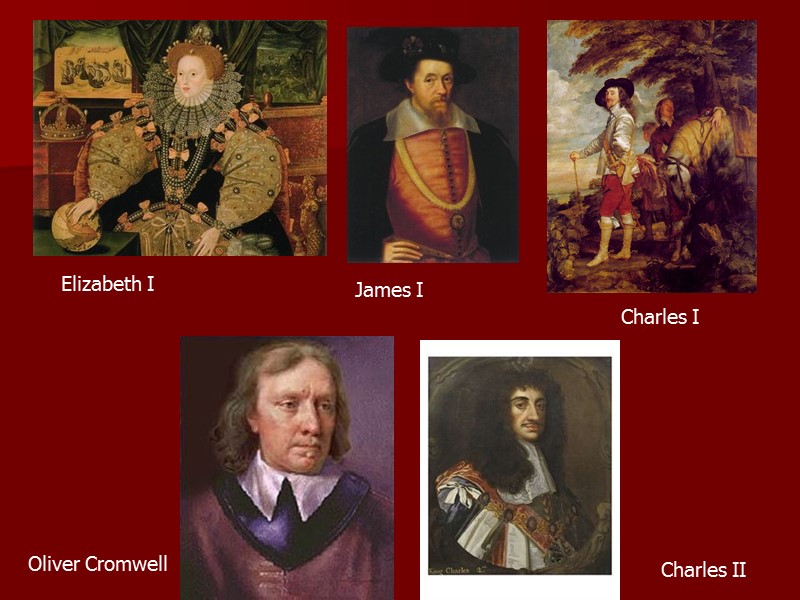
Elizabeth I James I Charles I Oliver Cromwell Charles II
Problems between the King and Parliament A puritan is one who lives in accordance with Protestant precepts, especially one who regards pleasure or luxury as sinful Many early puritans looked with misgivings on the secular imagination. They mistrusted literature on the same principle that they mistrusted statures( given idols), church music, and elaborate religious rituals, and thought these were allurements and enticing of the sensual world. Puritans were members of the Anglican Church who wanted all Catholic rituals removed; Puritans were active members of Parliament & were angered when James I arranged marriage of son (Charles) to a Catholic princess
Petition of Rights in 1628: King could not jail people without a good reason King could not make taxes without Parliament's approval King could not keep his soldiers in peoples’ homes & could not use army to maintain order during peacetime
1642 - Civil war. Charles I beheaded After the Civil War, a Commonwealth was created—type of government with no king & ruled by Parliament Oliver Cromwell led the Commonwealth, but did not use democracy— he became a military dictator
New Commonwealth Life in the Commonwealth was harsh because it was led by Cromwell & the Puritans; Forced strict religious rules on people of England: It was illegal to go to theaters & sporting events; “merrymaking” & “amusement” were illegal
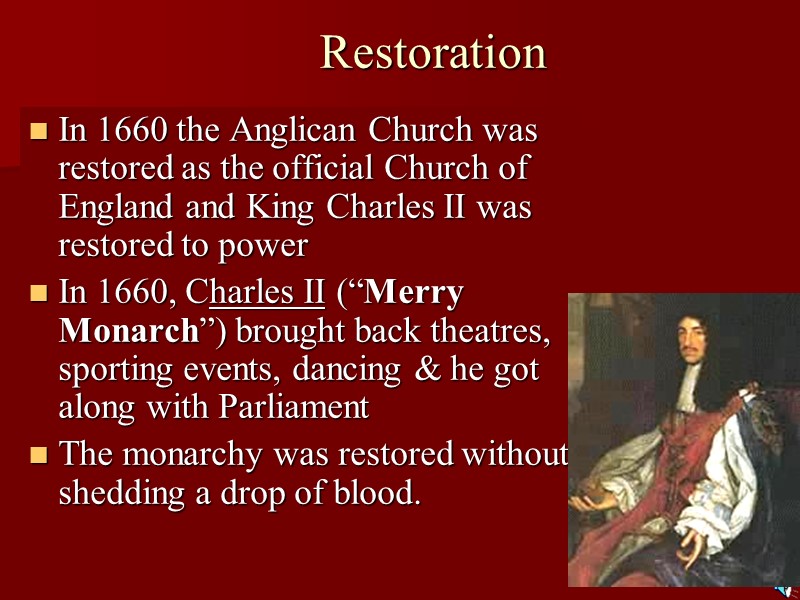
Restoration In 1660 the Anglican Church was restored as the official Church of England and King Charles II was restored to power In 1660, Charles II (“Merry Monarch”) brought back theatres, sporting events, dancing & he got along with Parliament The monarchy was restored without shedding a drop of blood.
Brought out of Civil War After ten years and multiple Civil Wars (1641-1651),Charles II united England, Scotland, and Ireland. During the Restoration, Parliament strengthened the Church of England—only Anglicans could attend universities, serve in Parliament, be priests in Anglican Church Parliament created Constitutional Monarchy based on Magna Carta & Petition of Right (Guaranteed rights of people & limited king)
“The Augustan Age” – like Emperor Augustus of Rome, the Stuart kings brought peace to their country tired from warfare. Tired of revolutionaries and fighting and elevating a monarch to a savior – Oliver Cromwell “The Neoclassical Period” – emphasis on Latin classics and emulating Latin works to bring around a “new classical” period.
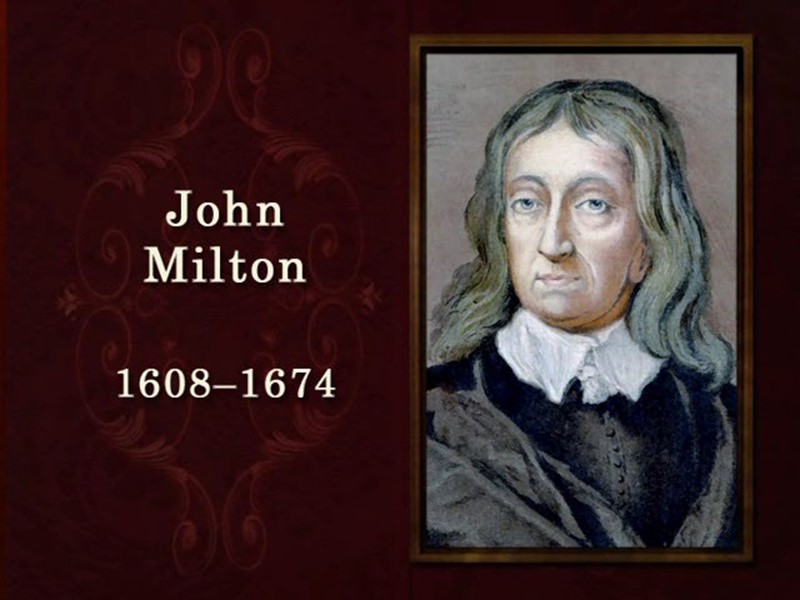
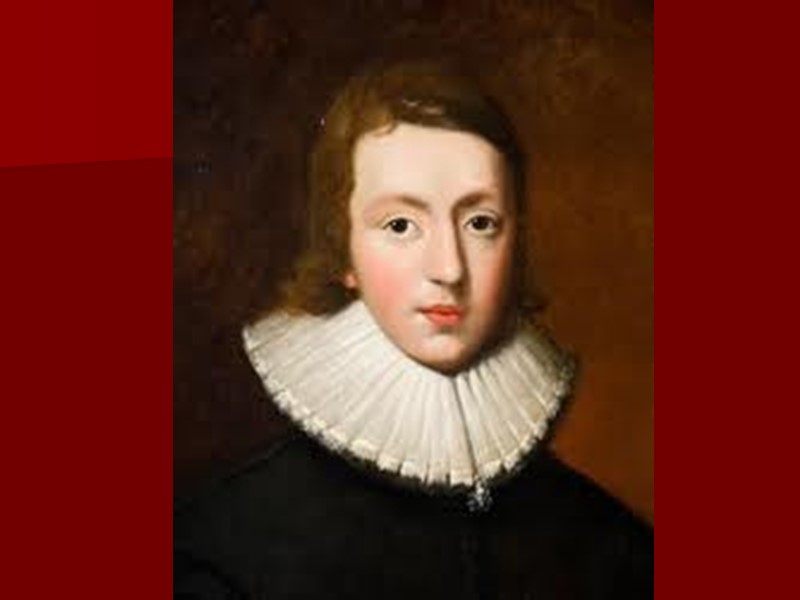
was born in 1608 into bourgeois class at a very early age decided to be a great poet educated at Cambridge, the Protestant University (poems: Pensaroso, L’Allegro, Lycidas, Comus) received his B. A. in 1629 and his M. A. in 1632 1638 traveled in Europe returned home in 1640, concerned about the political turmoil
Strongly supported the Puritan Reformation felt it was his duty as a poet to support the Parliamentary party Wrote with strong independence and on a variety of topics Church government Divorce Republicanism Was given a position of Latin Secretary to the Council of State 1652 – blind 1660 – lost his property
Pamphlets During the 1640s, Milton wrote and published several pamphlets arguing for radical causes: Of Reformation (1641), defending religious liberty Doctrine and Discipline of Divorce (1643) Of Education (1644), against strictly vocational education Areopagitica (1644), against censorship before publication The Tenure of Kings and Magistrates (1649), arguing that Kings could be overthrown
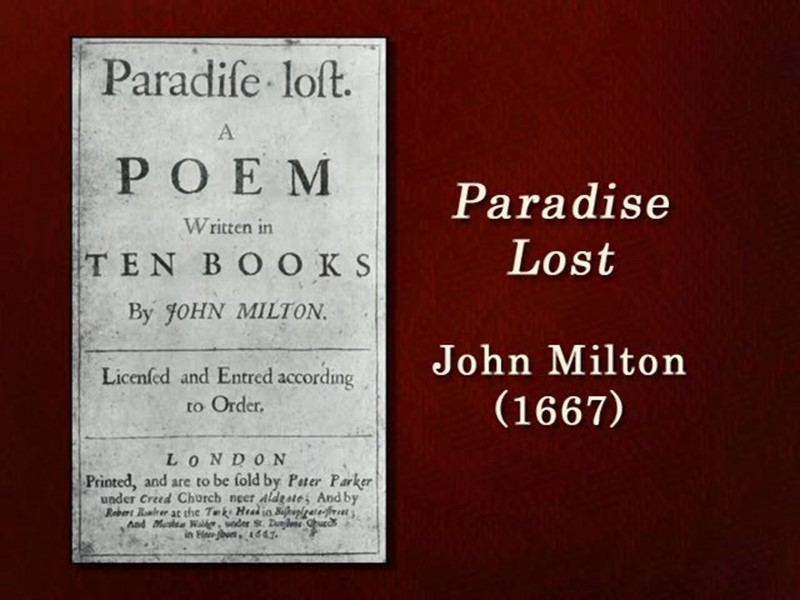
mmm In 1660 he published The Free and Easy Way to Establish a Free Commonwealth In 1660, when monarchy was restored with Charles II (son of Charles I) on the throne, Milton was in danger of being executed for treason; he went into hiding After a short time, he was assured that he would be safe, and he came out of hiding, but remained in retirement, and began to write his great epic, Paradise Lost Paradise Lost was first published in 1667; revised version in 1674
Milton had long imagined himself as someone who would be come the great national poet of his country; he had planned to write an epic to celebrate a great “British” hero like King Arthur Instead, he wrote an epic poem that celebrates “Christ” as a hero This causes problems, because Christ doesn’t act like a typical “human” hero Many readers—most famously the poet William Blake—have seen Satan as the actual hero Many readers have seen the poem as a political allegory about Milton’s experience in the Civil Wars, with Cromwell as “Christ” and King Charles I as “Satan,” or, sometimes, with Cromwell as “Satan” and King Charles I as “Christ”
Milton’s reputation During 17th century, he was seen as a dangerous rebel After 1800, he was associated by most people with Bible-reading Historians associate Milton with humanism, republican revolution, individualism, the rejection of censorship and religious intolerance Feminists see him as a misogynist, but one who produces a complex view of gender relations between Adam and Eve
In The Poetics, Aristotle (350AD) defined the two great literary genres as tragedy and epic high as opposed to comedy. Tragedy According to Aristotle, the events of a play must be contained in a single day (unity of time); the events must take place in one location (unity of place); and the play must not contain subplots or digressions (unity of action). (Milton: Samson Agonistes - 1671)
Epic poem An epic poem is a long narrative poem in an elevated style that presents characters of high position in adventure that prove important to the history of a nation or race.
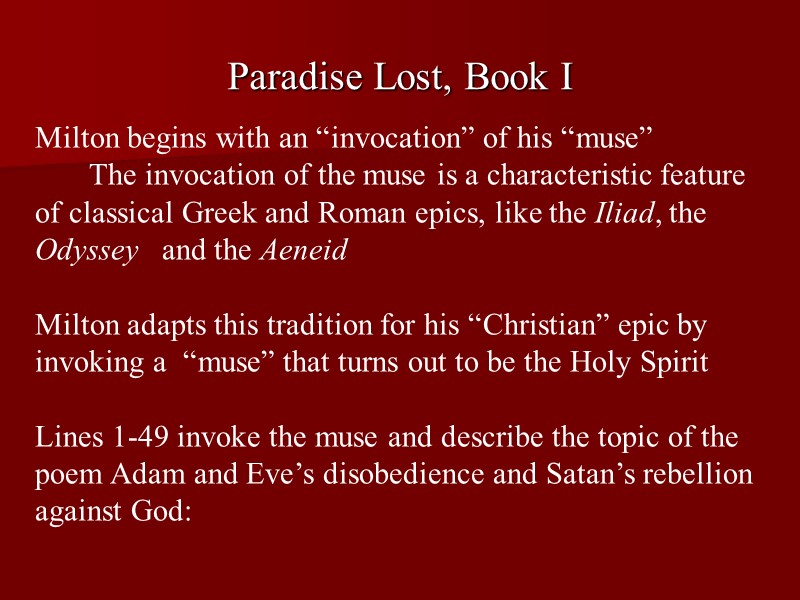
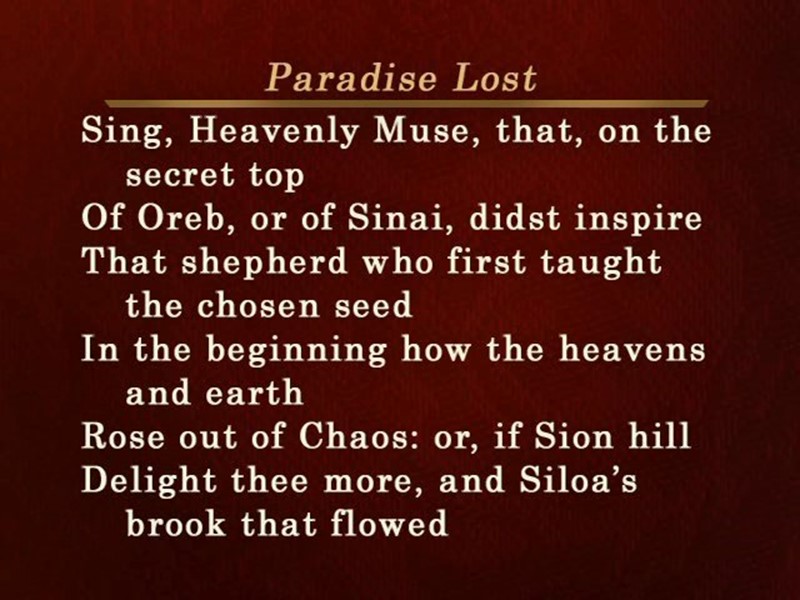
Paradise Lost, Book I Milton begins with an “invocation” of his “muse” The invocation of the muse is a characteristic feature of classical Greek and Roman epics, like the Iliad, the Odyssey and the Aeneid Milton adapts this tradition for his “Christian” epic by invoking a “muse” that turns out to be the Holy Spirit Lines 1-49 invoke the muse and describe the topic of the poem Adam and Eve’s disobedience and Satan’s rebellion against God:
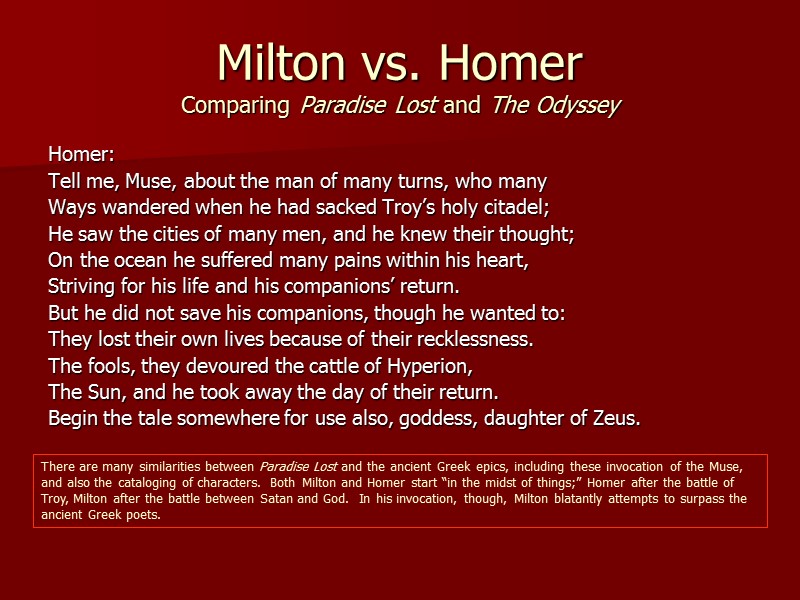
Milton vs. Homer Comparing Paradise Lost and The Odyssey Homer: Tell me, Muse, about the man of many turns, who many Ways wandered when he had sacked Troy’s holy citadel; He saw the cities of many men, and he knew their thought; On the ocean he suffered many pains within his heart, Striving for his life and his companions’ return. But he did not save his companions, though he wanted to: They lost their own lives because of their recklessness. The fools, they devoured the cattle of Hyperion, The Sun, and he took away the day of their return. Begin the tale somewhere for use also, goddess, daughter of Zeus. There are many similarities between Paradise Lost and the ancient Greek epics, including these invocation of the Muse, and also the cataloging of characters. Both Milton and Homer start “in the midst of things;” Homer after the battle of Troy, Milton after the battle between Satan and God. In his invocation, though, Milton blatantly attempts to surpass the ancient Greek poets.
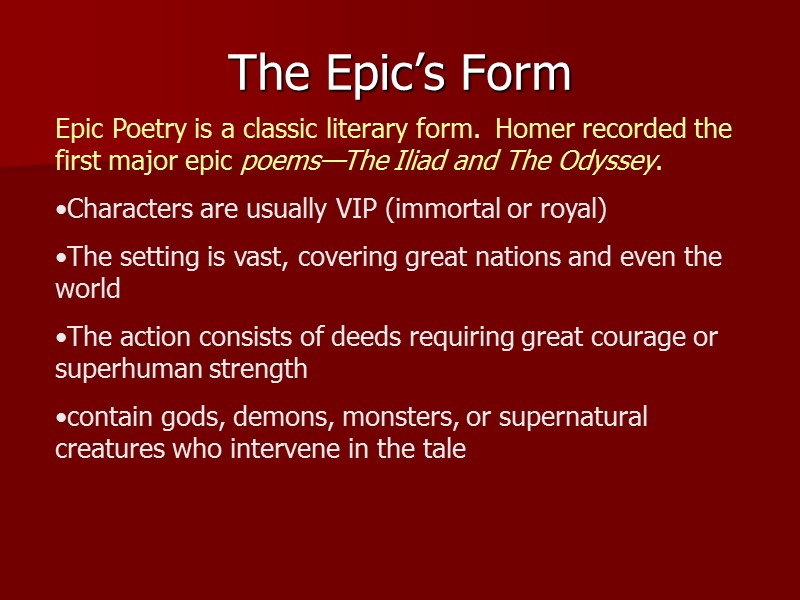
The Epic’s Form Epic Poetry is a classic literary form. Homer recorded the first major epic poems—The Iliad and The Odyssey. Characters are usually VIP (immortal or royal) The setting is vast, covering great nations and even the world The action consists of deeds requiring great courage or superhuman strength contain gods, demons, monsters, or supernatural creatures who intervene in the tale
begin in medias res with an invocation to the muse; are long, narrative poems (The key is in the length!); are written in verse, the most common being iambic pentameter, which does not necessarily have to rhyme (blank verse).
Paradise Lost is an epic poem in 12 books of blank verse describing the Christian story of the Fall of Man: the temptation of Adam and Eve by Satan and their expulsion from the Garden of Eden. Milton begins his story in media res (into the middle of things), after Satan and the other rebel angels have been defeated and cast down by God into Hell. The protagonist of this Protestant epic, is the fallen angel, Satan.
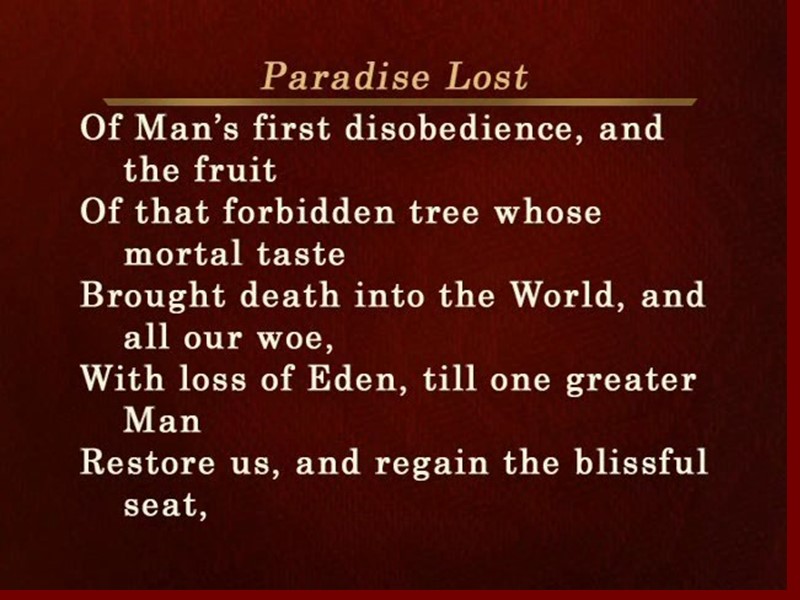
The theme The origin of evil itself. Milton believed, evil is embedded in man’s nature. The subject of the poem – ‘of man’s first disobedience’ & the resulting loss of paradise.
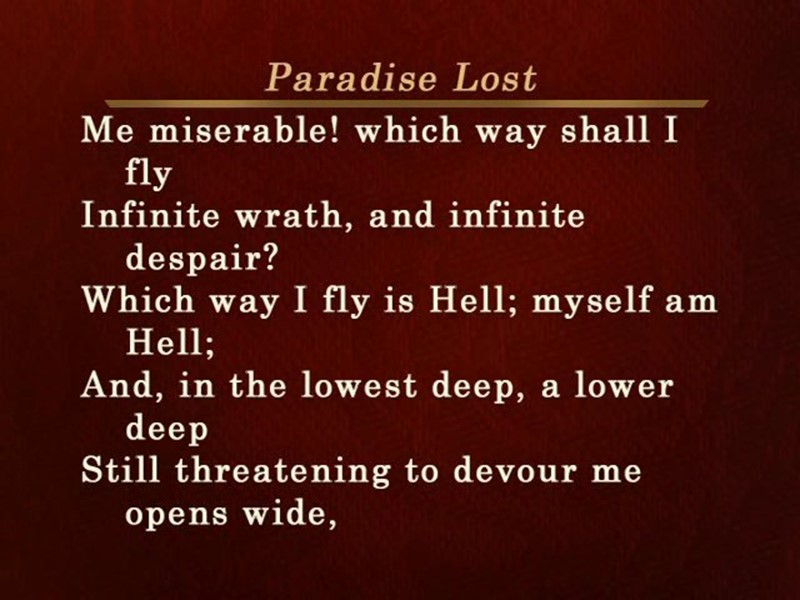
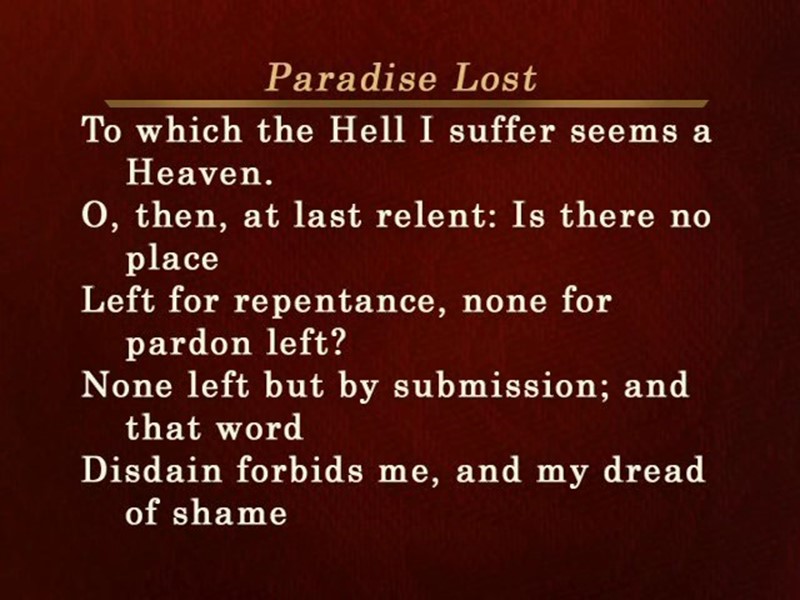
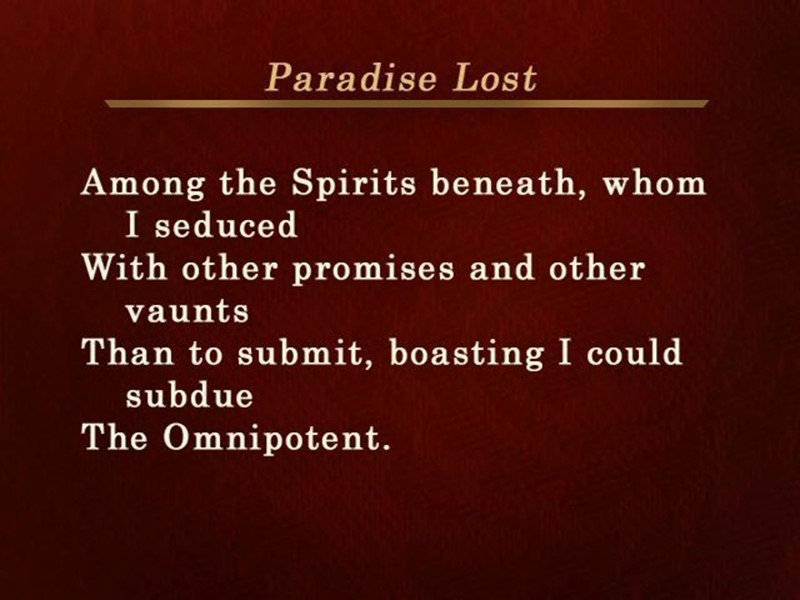
Milton presents Satan almost sympathetically, as an ambitious and prideful being who defies his creator, omnipotent God, and wages war on heaven, only to be defeated and cast down. Some critics regard the character of Satan as a Byronic hero. Later, Lucifer enters the Garden of Eden, where he successfully tempts Eve, wife of Adam, to eat fruit from the Tree of Knowledge of good and evil. He dooms himself. By commiting himself to the destruction of Adam & Eve, he also destroys himself.
Milton was a firm believer in the doctrine of felix culpa “happy sin” (happy fall) - the belief that man was greater, potentially, because of the fall and redemption than he had been before. Milton’s misogyny. The poem is very focused on the fall of man; woman is there, not as a partner, but as a subsidiary cause, created out of one of Adam’s less important bones .
Summary John Milton’s masterpiece Paradise Lost: considered the greatest English epic, Miltonic style: a grand style with long and powerful blank verse (lines without any final rhymes), difficult sentence structure and the theme of universe
II. Paradise Lost 1.The themes The story of the man’s fall; Pride (leads to Satan’s downfall) Revenge (it makes Satan tempt Adam & Eve) Disobedience Redemption (man is granted eternal salvation thanks to sacrifice of the Son of God) 2.Image of Satan 3.His sympathy with Satan
On April 27, 1667 the blind, impoverished Milton sold the copyright of Paradise Lost for £10.
Later in life, Milton wrote Paradise Regained, charting God's returning to man the possibility of paradise. This sequel has never had a reputation equal to the earlier poem. In The Marriage of Heaven and Hell, William Blake commented: The reason Milton wrote in fetters when he wrote of Angels & God, and at liberty when of Devils & Hell, is because he was a true Poet and of the Devil's party without knowing it.