


 Скачать презентацию Response to Intervention in General Remedial and Special
f2c3fbffed0a1be591b56717d5770196.ppt
- Количество слайдов: 117
 Response to Intervention in General, Remedial, and Special Education Bill Rynn Regional Consultant Exceptional Children’s Division N C Department of Public Instruction November 19, 2008 Reschly RTI 1
 Credits: The following leaders in the RTI movement are credited with much of the information in this presentation: George Batsche Liz Crawford Dan Reschly RTI 2
 NC DPI Definition: o The practice of providing high quality instruction matched to student need, monitoring progress frequently to make decisions about changes in instruction or goals and applying child response data to important educational decisions. Response to Intervention Policy Considerations and Implementation, NASDSE Reschly RTI 3
 What Is Response to Intervention (RTI)? o o Scientifically-based instruction/interventions matched to student needs Formative evaluation including frequent progress monitoring in relation to benchmarks, with decision rules applied Decisions driven by student RTI, including gen’l ed instruction/intervention, remedial services/individual interventions, sp ed eligibility, placement, annual review and exit Implementation requires: Allocating (aligning) resources to deliver effective interventions that produce improved child outcomes Reschly RTI 4
 RTI Model Differences o o Restricted vs Comprehensive System Wide LD Identification n n o o Do Tiers I and II, then traditional evaluation Or Use RTI in eligibility determination and in the design, implementation, and evaluation of IEPs Academic only or Academic and Behavior False dichotomies: Standard Protocol vs Problem Solving vs Recognition of Both n n Choices determined by nature of problem Use of both in many situations Reschly RTI 5
 Purpose of the RTI Process o o o Improve results in academic, behavioral, and emotional regulation domains, through n High quality interventions n Formative evaluation Student results drive decisions about needs and intensity of interventions Improve, eliminate disproportionate representation Identification of disabilities through procedures that are valid and connected to effective special ed interventions Improve special education results and increase exit from sp ed Prevention and early identification-intervention Reschly RTI 6
 Building Consensus I a shift to a new paradigm like RTI does not simply involve accepting a new set of skills. It also involves giving up certain beliefs in favor of others. …………. What beliefs might you have to give up in order to embrace RTI? What about your staff? Your colleagues? Reschly RTI 7
 Why RTI? o o o Dissatisfaction with ach. results Expensive programs with undocumented benefits, General Ed. Title I and Sp Ed Poor overall outcomes re: benchmark tests, graduate rates, early adult outcomes Overrepresentation in sp ed Disjointed programs across general, remedial and special ed. -compromised outcomes and wasted resources Reschly RTI 8
 Rt. I is……. Process that uses all resources within a school o Well-integrated system of instruction and interventions o Guided by student outcome data o Early intervention o Prevention of academic and behavioral problems o Rt. I Reschly RTI 9
 Rt. I is……. o o Whole school working together Using resources and expertise to help all students Regular monitoring of success/needs Data driven instruction ! Rt. I Reschly RTI 10
 Rt. I is……. Multi-step process o High-quality, research-based instruction and interventions o Varying levels of intensity o Match interventions to student’s needs o Rt. I Reschly RTI 11
 Implementation of Rt. I Three Components: o Prevention o Intervention o Component of SLD determination Reschly RTI 12
 Rt. I is Not…. o o A packaged program A curriculum Special Ed Just for eligibility identification Rt. I Reschly RTI 13
 Old Assumptions, cont. Unique Treatment Methods and Teacher Training by Disability But, Same methods work for virtually all High Incidence I SWD, LD, EMR IQ Essential to Accurate Classification-BUT Same kids found with problem solving processes and measures Identifying Disability and Sp Ed Placement Solves Problem Dubious Effects of Special Education Reschly RTI 14
 Some things do not make sense Reschly RTI 15
 Progression of Research, Policy, and Legal Requirements o o o RESEARCH: Scientific research with practice demonstrations leading to POLICY: Multiple policy analyses in presented in prestigious reports leading to FEDERAL LAW: Multiple layers of Federal legal requirements leading to STATE LAW: Changes in state rules leading to SCALING UP: Scaling up efforts in states Reschly RTI 16
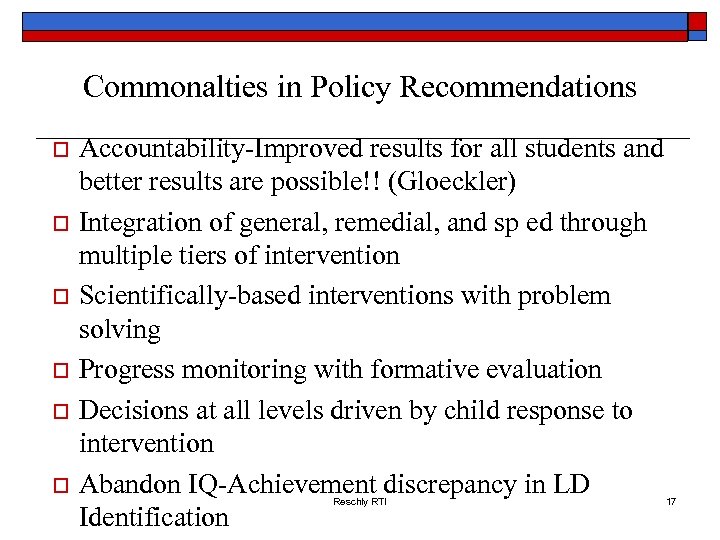 Commonalties in Policy Recommendations o o o Accountability-Improved results for all students and better results are possible!! (Gloeckler) Integration of general, remedial, and sp ed through multiple tiers of intervention Scientifically-based interventions with problem solving Progress monitoring with formative evaluation Decisions at all levels driven by child response to intervention Abandon IQ-Achievement discrepancy in LD Identification Reschly RTI 17
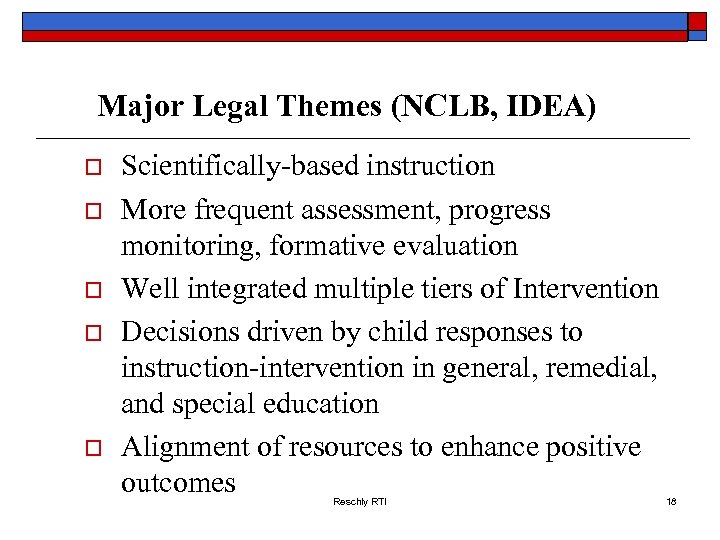 Major Legal Themes (NCLB, IDEA) o o o Scientifically-based instruction More frequent assessment, progress monitoring, formative evaluation Well integrated multiple tiers of Intervention Decisions driven by child responses to instruction-intervention in general, remedial, and special education Alignment of resources to enhance positive outcomes Reschly RTI 18
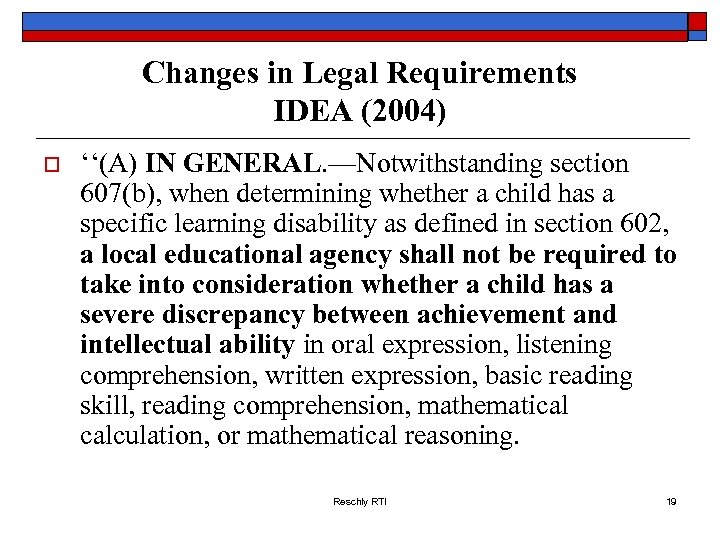 Changes in Legal Requirements IDEA (2004) o ‘‘(A) IN GENERAL. —Notwithstanding section 607(b), when determining whether a child has a specific learning disability as defined in section 602, a local educational agency shall not be required to take into consideration whether a child has a severe discrepancy between achievement and intellectual ability in oral expression, listening comprehension, written expression, basic reading skill, reading comprehension, mathematical calculation, or mathematical reasoning. Reschly RTI 19
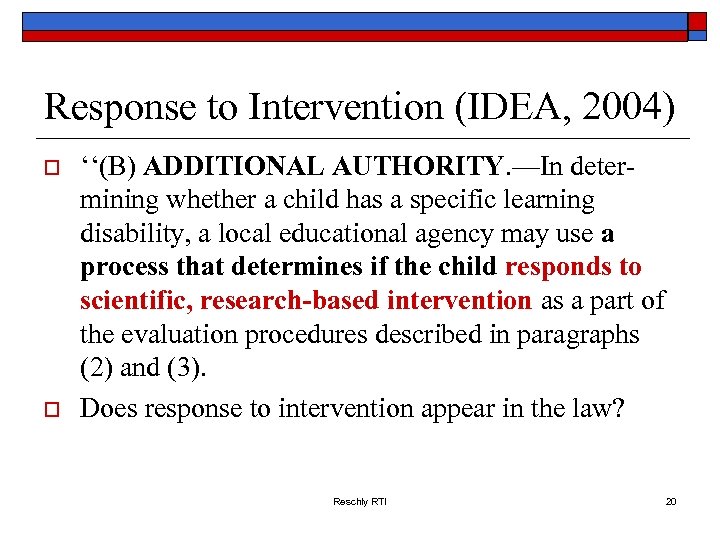 Response to Intervention (IDEA, 2004) o o ‘‘(B) ADDITIONAL AUTHORITY. —In deter- mining whether a child has a specific learning disability, a local educational agency may use a process that determines if the child responds to scientific, research-based intervention as a part of the evaluation procedures described in paragraphs (2) and (3). Does response to intervention appear in the law? Reschly RTI 20
 Final Regulation o NEW AND SIGNIFICANT: o (b must consider, as part of the evaluation described data that demonstrates that— o (1) Prior to, or as a part of the referral process, the child was provided appropriate high-quality, research-based instruction in regular education settings, consistent with section 1111(b)(8)(D) and (E) of the ESEA, including that the instruction was delivered by qualified personnel; and o (2) Data-based documentation of repeated assessments of achievement at reasonable intervals, reflecting formal assessment of student progress during instruction, was provided to the child's parents. Reschly RTI 21
 Prevention-Early Intervention o o LEA can use 15% of federal IDEA funds to support prevention and early identificationtreatment Purpose: minimize over-identification and unnecessary sp ed referrals Provide academic and behavioral supports; and professional development re: early literacy and behavior MUST use the 15% if LEA has “significant disproportionality Reschly RTI 22
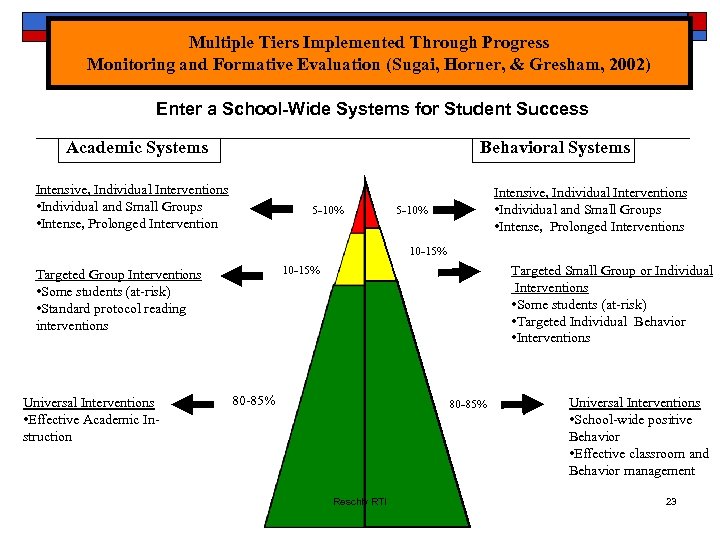 Multiple Tiers Implemented Through Progress Monitoring and Formative Evaluation (Sugai, Horner, & Gresham, 2002) Enter a School-Wide Systems for Student Success Academic Systems Behavioral Systems Intensive, Individual Interventions • Individual and Small Groups • Intense, Prolonged Intervention 5 -10% Intensive, Individual Interventions • Individual and Small Groups • Intense, Prolonged Interventions 5 -10% 10 -15% Universal Interventions • Effective Academic Instruction Targeted Small Group or Individual Interventions • Some students (at-risk) • Targeted Individual Behavior • Interventions 10 -15% Targeted Group Interventions • Some students (at-risk) • Standard protocol reading interventions 80 -85% Reschly RTI Universal Interventions • School-wide positive Behavior • Effective classroom and Behavior management 23
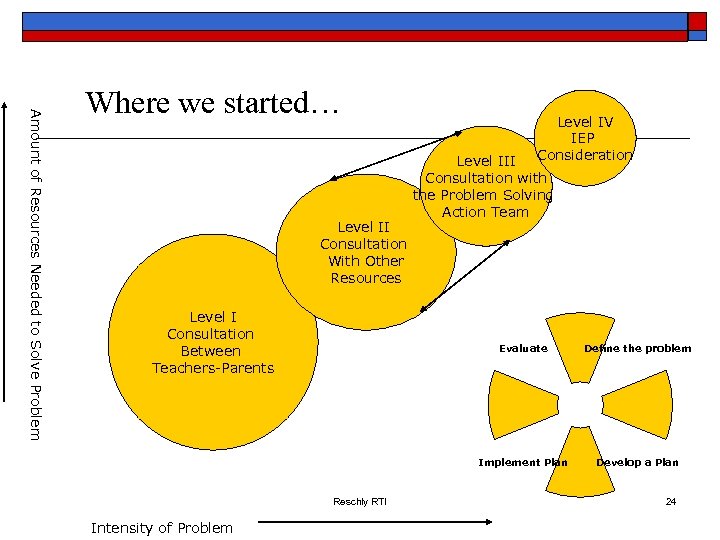 Amount of Resources Needed to Solve Problem Where we started… Level II Consultation With Other Resources Level I Consultation Between Teachers-Parents Level IV IEP Consideration Level III Consultation with the Problem Solving Action Team Evaluate Implement Plan Reschly RTI Intensity of Problem Define the problem Develop a Plan 24
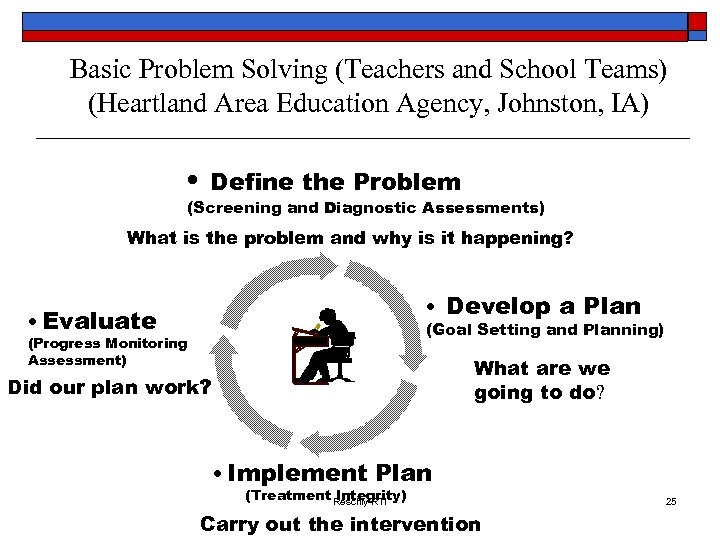 Basic Problem Solving (Teachers and School Teams) (Heartland Area Education Agency, Johnston, IA) • Define the Problem (Screening and Diagnostic Assessments) What is the problem and why is it happening? • Develop a Plan • Evaluate (Goal Setting and Planning) (Progress Monitoring Assessment) What are we going to do? Did our plan work? • Implement Plan (Treatment Reschly RTI Integrity) Carry out the intervention 25
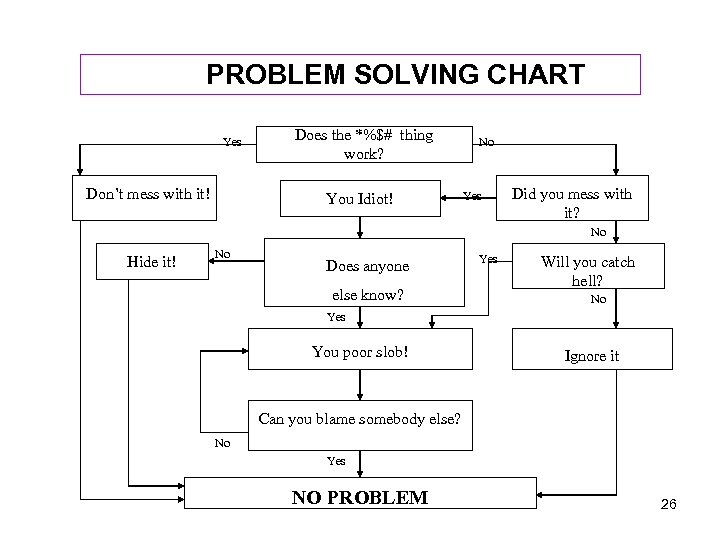 PROBLEM SOLVING CHART Yes Don’t mess with it! Does the *%$# thing work? You Idiot! No Yes Did you mess with it? No Hide it! No Does anyone else know? Yes Will you catch hell? No Yes You poor slob! Ignore it Can you blame somebody else? No Yes NO PROBLEM 26
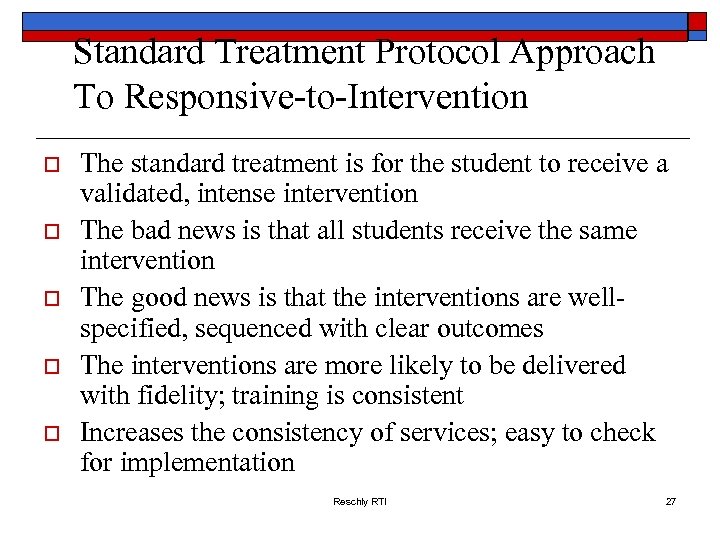 Standard Treatment Protocol Approach To Responsive-to-Intervention o o o The standard treatment is for the student to receive a validated, intense intervention The bad news is that all students receive the same intervention The good news is that the interventions are wellspecified, sequenced with clear outcomes The interventions are more likely to be delivered with fidelity; training is consistent Increases the consistency of services; easy to check for implementation Reschly RTI 27
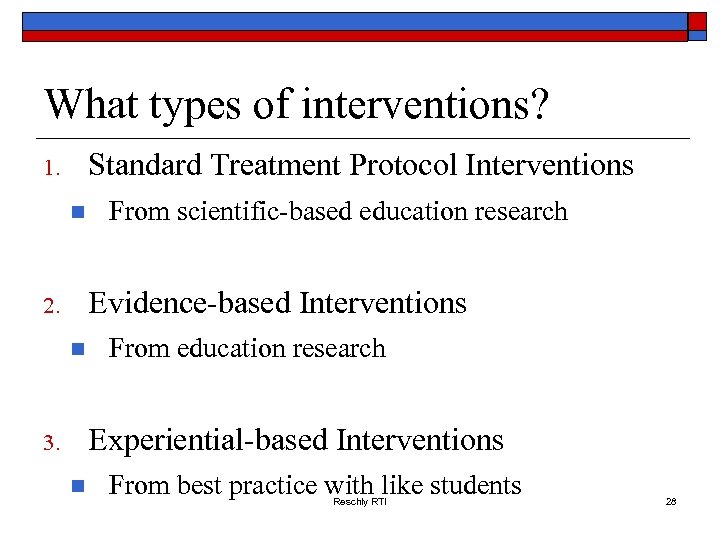 What types of interventions? Standard Treatment Protocol Interventions 1. n From scientific-based education research Evidence-based Interventions 2. n From education research Experiential-based Interventions 3. n From best practice with like students Reschly RTI 28
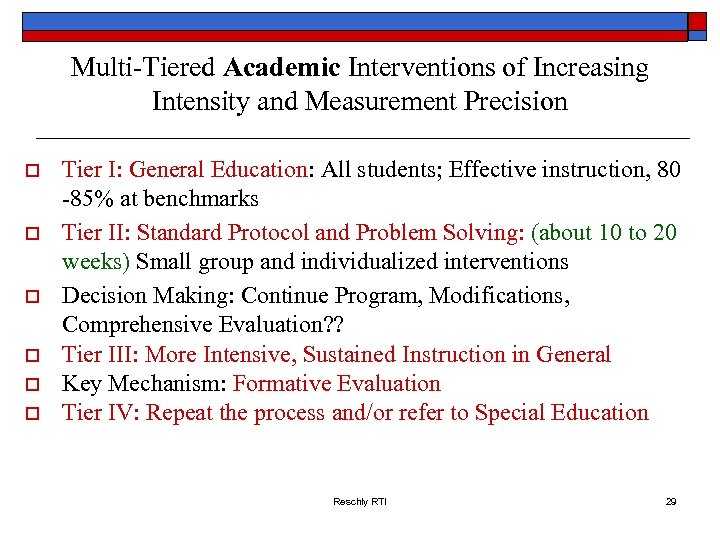 Multi-Tiered Academic Interventions of Increasing Intensity and Measurement Precision o o o Tier I: General Education: All students; Effective instruction, 80 -85% at benchmarks Tier II: Standard Protocol and Problem Solving: (about 10 to 20 weeks) Small group and individualized interventions Decision Making: Continue Program, Modifications, Comprehensive Evaluation? ? Tier III: More Intensive, Sustained Instruction in General Key Mechanism: Formative Evaluation Tier IV: Repeat the process and/or refer to Special Education Reschly RTI 29
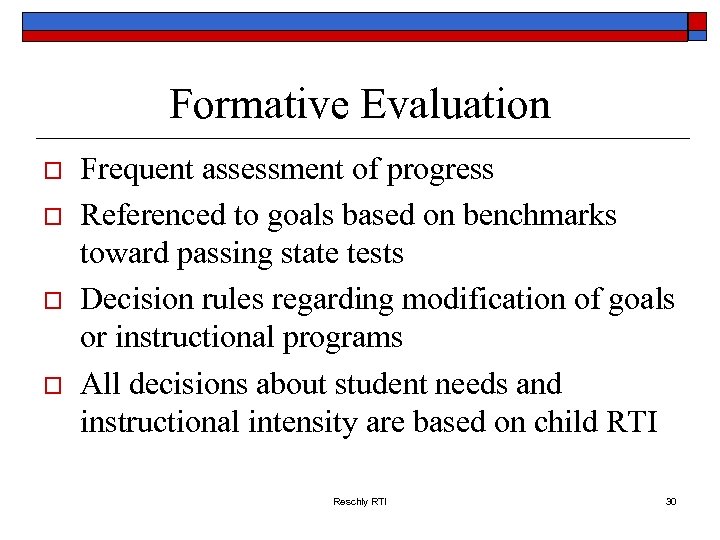 Formative Evaluation o o Frequent assessment of progress Referenced to goals based on benchmarks toward passing state tests Decision rules regarding modification of goals or instructional programs All decisions about student needs and instructional intensity are based on child RTI Reschly RTI 30
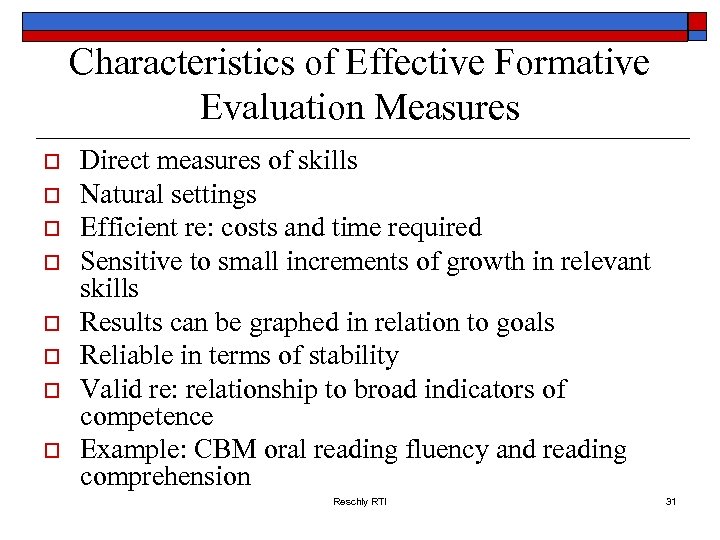 Characteristics of Effective Formative Evaluation Measures o o o o Direct measures of skills Natural settings Efficient re: costs and time required Sensitive to small increments of growth in relevant skills Results can be graphed in relation to goals Reliable in terms of stability Valid re: relationship to broad indicators of competence Example: CBM oral reading fluency and reading comprehension Reschly RTI 31
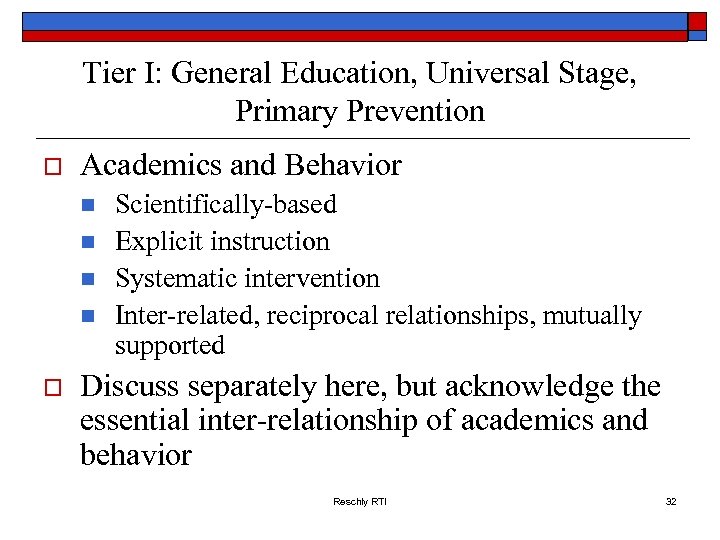 Tier I: General Education, Universal Stage, Primary Prevention o Academics and Behavior n n o Scientifically-based Explicit instruction Systematic intervention Inter-related, reciprocal relationships, mutually supported Discuss separately here, but acknowledge the essential inter-relationship of academics and behavior Reschly RTI 32
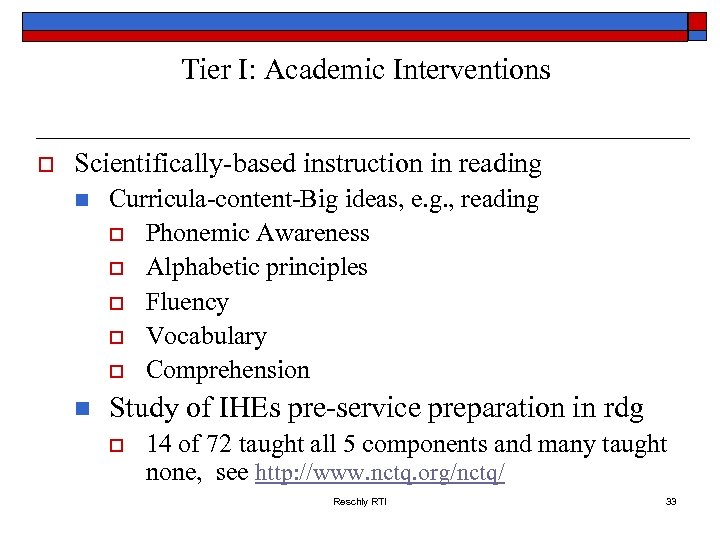 Tier I: Academic Interventions o Scientifically-based instruction in reading n Curricula-content-Big ideas, e. g. , reading o Phonemic Awareness o Alphabetic principles o Fluency o Vocabulary o Comprehension n Study of IHEs pre-service preparation in rdg o 14 of 72 taught all 5 components and many taught none, see http: //www. nctq. org/nctq/ Reschly RTI 33
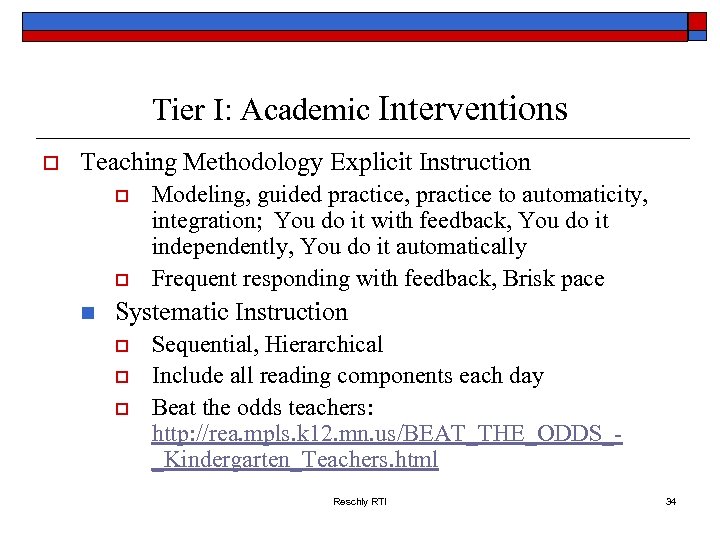 Tier I: Academic Interventions o Teaching Methodology Explicit Instruction o o n Modeling, guided practice, practice to automaticity, integration; You do it with feedback, You do it independently, You do it automatically Frequent responding with feedback, Brisk pace Systematic Instruction o o o Sequential, Hierarchical Include all reading components each day Beat the odds teachers: http: //rea. mpls. k 12. mn. us/BEAT_THE_ODDS__Kindergarten_Teachers. html Reschly RTI 34
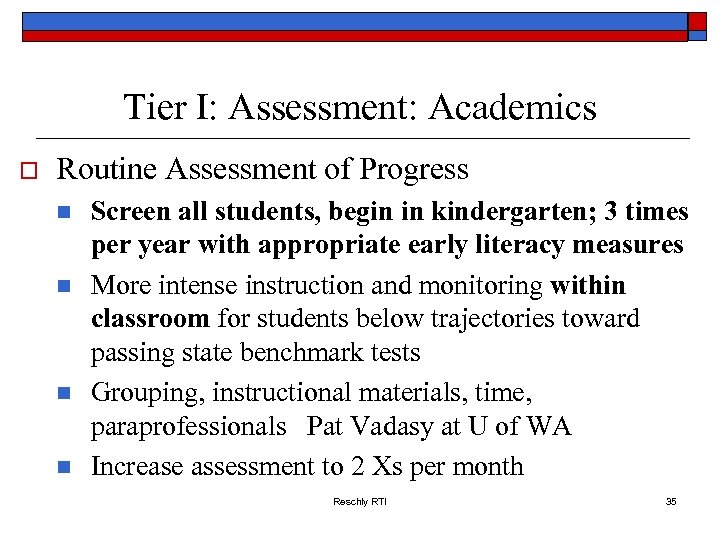 Tier I: Assessment: Academics o Routine Assessment of Progress n n Screen all students, begin in kindergarten; 3 times per year with appropriate early literacy measures More intense instruction and monitoring within classroom for students below trajectories toward passing state benchmark tests Grouping, instructional materials, time, paraprofessionals Pat Vadasy at U of WA Increase assessment to 2 Xs per month Reschly RTI 35
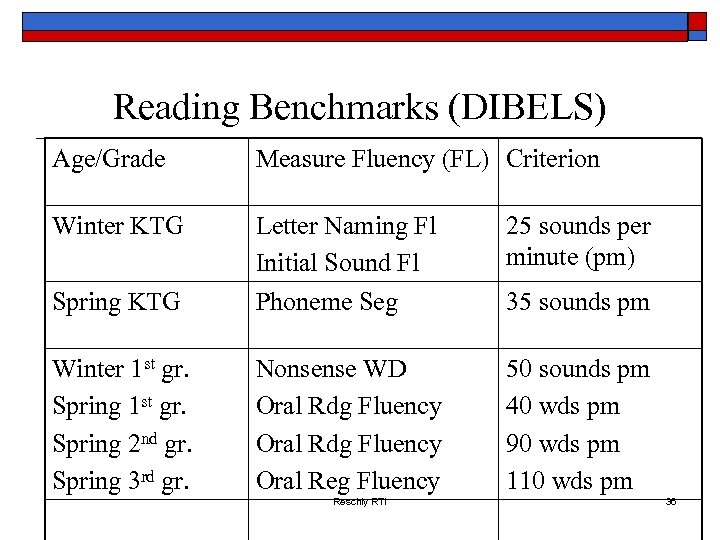 Reading Benchmarks (DIBELS) Age/Grade Measure Fluency (FL) Criterion Winter KTG 25 sounds per minute (pm) Spring KTG Letter Naming Fl Initial Sound Fl Phoneme Seg Winter 1 st gr. Spring 2 nd gr. Spring 3 rd gr. Nonsense WD Oral Rdg Fluency Oral Reg Fluency 50 sounds pm 40 wds pm 90 wds pm 110 wds pm Reschly RTI 35 sounds pm 36
 Foundations of CBM o o Deno & Mirkin (1977) Breakthrough Brief samples of behavior n Use of oral reading fluency samples o o o n n Production per unit of time Fluency and accuracy combined Words read correct per minute Math-digits correct Spelling-letters correct Reschly RTI 37
 Importance of Standardized CBM Procedures o o Standardized meaning uniformity in administration, scoring, interpretation Prerequisite to use of data in n Determining risk status within classroom or school Measuring change for individuals or groups Predicting later performance Reschly RTI 38
 Oral Reading Fluency o What is it? n Reading aloud fluently and accurately from text. o Why do it? Indicator of proficiency in reading that is sensitive to growth n Highly correlated with performance on standardized tests and tests of comprehension n Provides information that may be used to evaluate effects of instruction n o Word Calling Myth Reschly RTI 39
 Middle and High School RTI Applications o Same principles and goals: Improve Results n n n Evidence-based interventions matched to student needs implemented with good fidelity Data-based, progress monitoring with formative evaluation, that is, data on initial status, goals related to benchmarks, progress monitoring against goals, and changes in interventions based on progress Decisions based on student responses to interventions Reschly RTI 40
 Middle and High School RTI Applications Frequent Goals at Middle and High School o Academic skills deficits n n Teach skills in basic areas including reading and math See Florida web site for teaching reading to adolescents at www. fcrr. org/ CBM used, progress at > 1 word correct growth per week, goals, graphs, formative evaluation, etc. Significant needs for basic instruction Reschly RTI 41
 Middle and High School RTI Applications Effort and Work Completion o o o Can Do But Won’t Do Unintended reinforcement for poor effort and low productivity Interventions do improve both effort and productivity Data are critical!!! Data followed by interventions, etc. Reschly RTI 42
 Middle and High School RTI Applications School Involvement and Drop Out o o o Drop out not an event, but a process Encouragement to leave or to stay? ? Drop out prevention measures n n n Find at risk kids Ensure teacher encouragement, someone who cares, monitors, encourages Formal programs like Check and Connect Reschly RTI 43
 Middle and High School RTI Applications Problem Solving Example o Drop Out n n n Scientifically-based interventions Identify proxies for drop out to permit early intervention, e. g. , school attendance, disciplinary referrals, failing courses, etc. Gather data on current conditions Establish goals Implement interventions Monitor progress and change intervention if results do not meet reasonable goals Reschly RTI 44
 Summary of Tier I o o Universal level, all students Scientifically-based, right content and direct instruction Greater intensity and increased measurement precision for students below benchmark trajectories Criterion for success? 80% to 85% are at or above benchmarks n n Assess classrooms, schools, districts Identify students needing additional assistance Reschly RTI 45
 Tier II: Academic and Behavioral Interventions o o Individual behavior interventions in general education that meet all criteria for problem solving Individual or small group academic interventions, following n n n Standard protocol interventions (reading) Individualized academic Evidence based practices. Reschly RTI 46
 Tier II Behavior: Problem Solving Criteria cont. o o o Development of an intervention plan that is written, systematic, and based on scientifically-based instructional or behavioral intervention principles Implementation of the plan with treatment fidelity checks Reschly RTI 47
 Tier II Academic Interventions (Vaughn et al. , 2003 Exceptional Children) o o Goals: Move performance to benchmark trajectories and, If needed, consider more intensive interventions Example of Tier II academic intervention n n Small group, N=4 -5, pull out, similar needs 30 to 35 minutes per day in addition to classroom instruction Progress monitoring weekly 10 to 20 weeks of instruction 5 -component reading interventions, with emphasis on weak components Reschly RTI 48
 Tier II: Academics and Behavior o Targeted individual interventions in classrooms and in standard protocol academic settings n Behavior (attention and on task) predict outcomes of academic interventions) n Standard protocol interventions use a point system to prompt and reinforce task engagement n Improved behavior often is crucial to persistence of academic interventions effects over time and generalization to classroom settings Reschly RTI 49
 Standard Protocol Reading Models for Tier II o o o o http: //www. texasreading. org/utcrla/ U Texas, Vaughn http: //www. fcrr. org/ Florida State Torgesen Reading five domains taught each day Direct instruction Weekly progress monitoring Individual graphs, progress against goals referenced to benchmarks Decisions determined by student response n Fade Tier II and return to general education n Consider Tier III based on insufficient response Reschly RTI 50
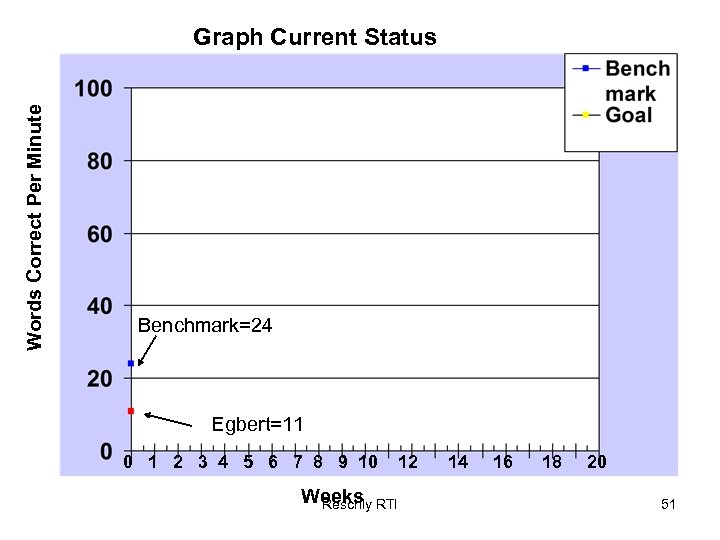 Words Correct Per Minute Graph Current Status Benchmark=24 Egbert=11 0 1 2 3 4 5 6 7 8 9 10 12 Weeks RTI Reschly 14 16 18 20 51
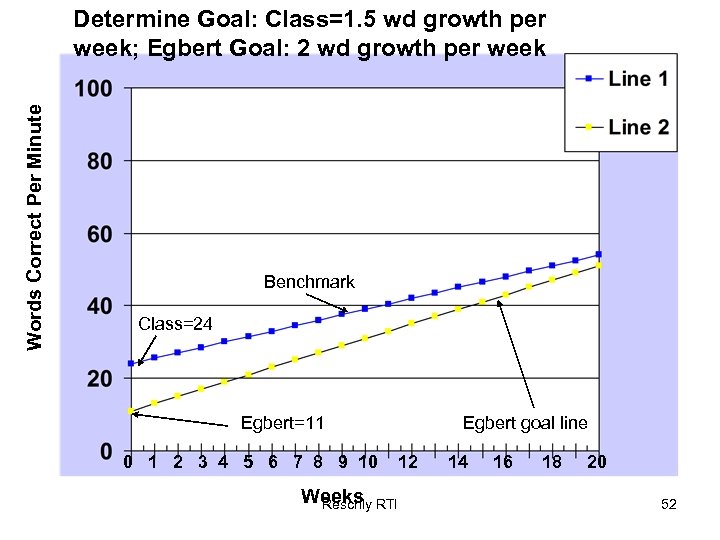 Words Correct Per Minute Determine Goal: Class=1. 5 wd growth per week; Egbert Goal: 2 wd growth per week Benchmark Class=24 Egbert=11 0 1 2 3 4 5 6 7 8 9 10 Egbert goal line 12 Weeks RTI Reschly 14 16 18 20 52
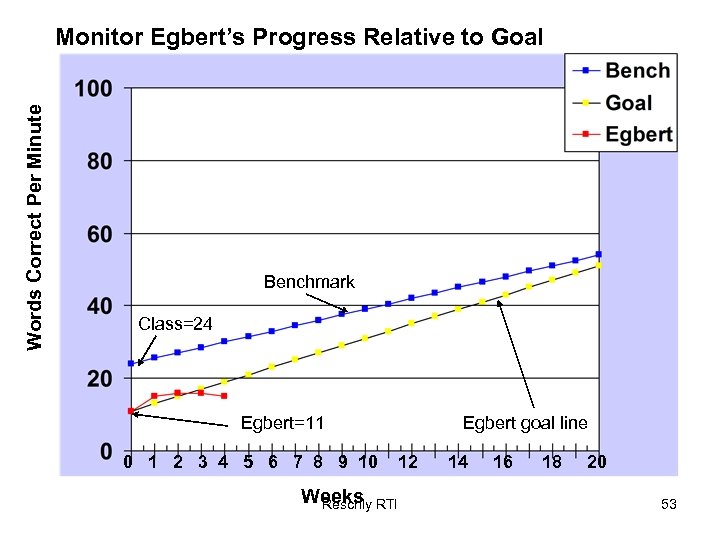 Words Correct Per Minute Monitor Egbert’s Progress Relative to Goal Benchmark Class=24 Egbert=11 0 1 2 3 4 5 6 7 8 9 10 Egbert goal line 12 Weeks RTI Reschly 14 16 18 20 53
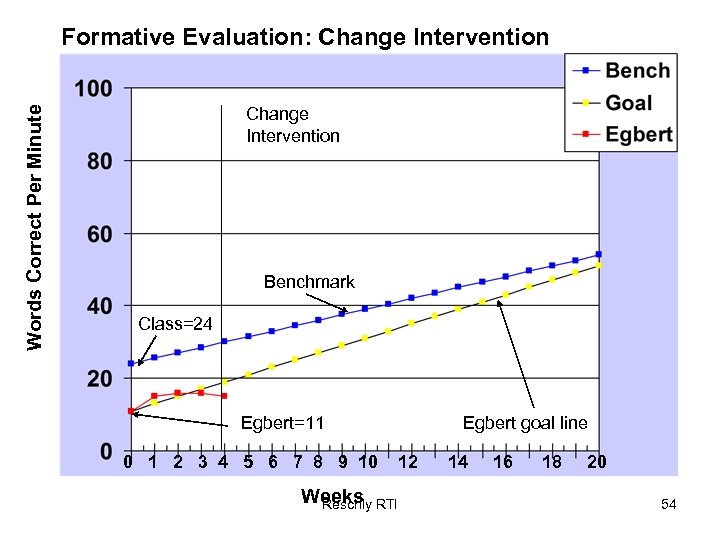 Words Correct Per Minute Formative Evaluation: Change Intervention Benchmark Class=24 Egbert=11 0 1 2 3 4 5 6 7 8 9 10 Egbert goal line 12 Weeks RTI Reschly 14 16 18 20 54
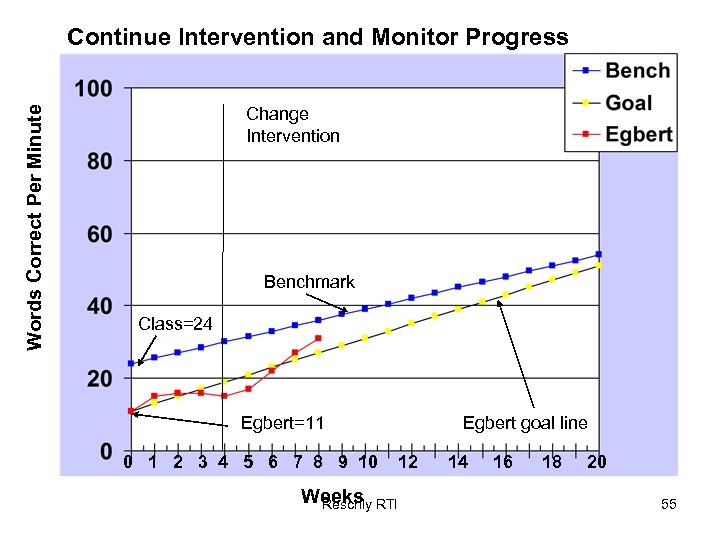 Words Correct Per Minute Continue Intervention and Monitor Progress Change Intervention Benchmark Class=24 Egbert=11 0 1 2 3 4 5 6 7 8 9 10 Egbert goal line 12 Weeks RTI Reschly 14 16 18 20 55
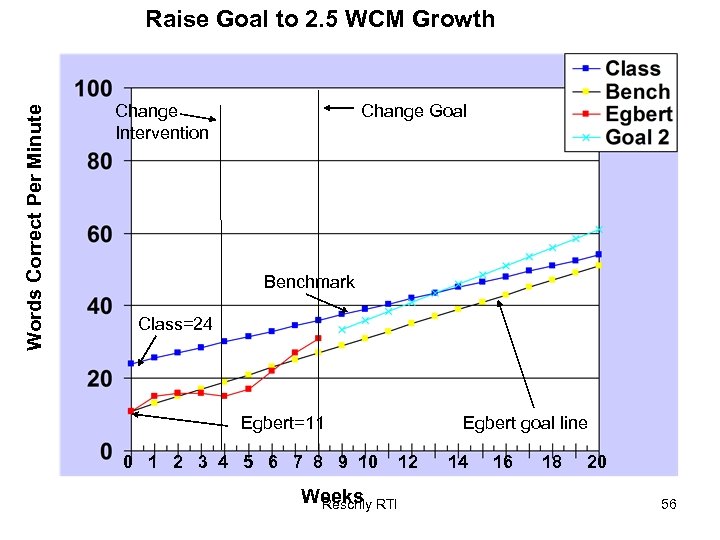 Words Correct Per Minute Raise Goal to 2. 5 WCM Growth Change Intervention Change Goal Benchmark Class=24 Egbert=11 0 1 2 3 4 5 6 7 8 9 10 Egbert goal line 12 Weeks RTI Reschly 14 16 18 20 56
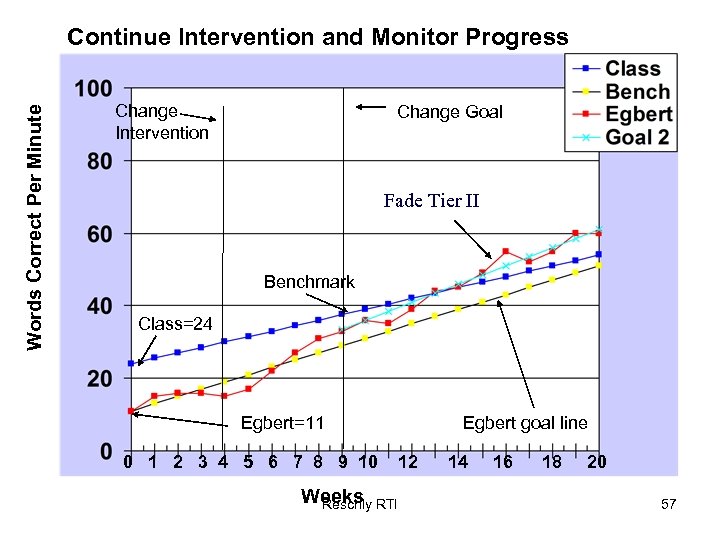 Words Correct Per Minute Continue Intervention and Monitor Progress Change Intervention Change Goal Fade Tier II Benchmark Class=24 Egbert=11 0 1 2 3 4 5 6 7 8 9 10 Egbert goal line 12 Weeks RTI Reschly 14 16 18 20 57
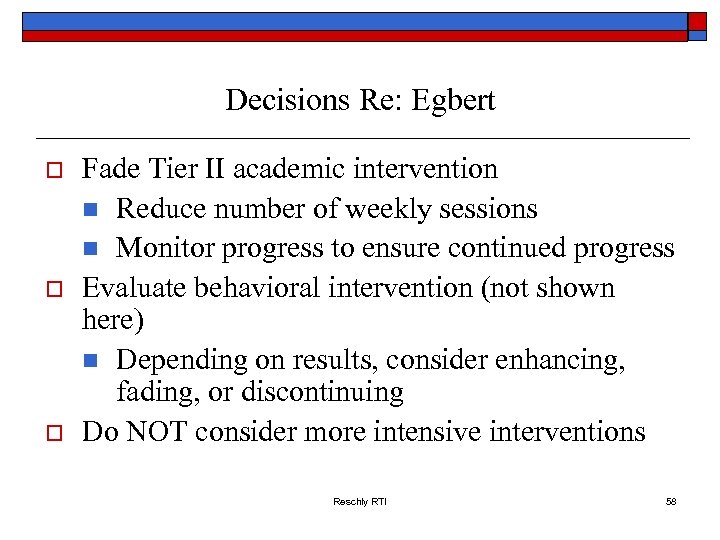 Decisions Re: Egbert o o o Fade Tier II academic intervention n Reduce number of weekly sessions n Monitor progress to ensure continued progress Evaluate behavioral intervention (not shown here) n Depending on results, consider enhancing, fading, or discontinuing Do NOT consider more intensive interventions Reschly RTI 58
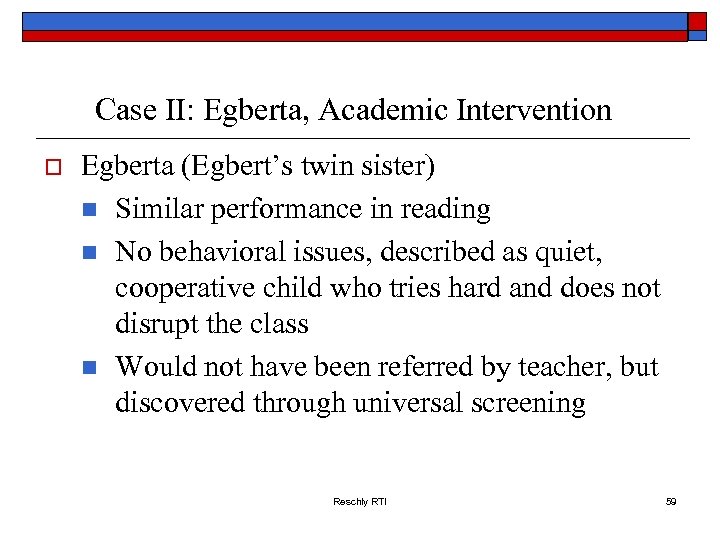 Case II: Egberta, Academic Intervention o Egberta (Egbert’s twin sister) n Similar performance in reading n No behavioral issues, described as quiet, cooperative child who tries hard and does not disrupt the class n Would not have been referred by teacher, but discovered through universal screening Reschly RTI 59
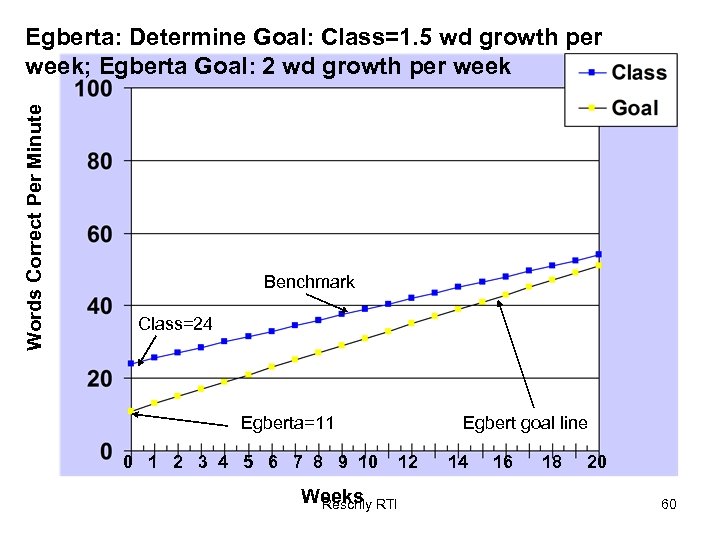 Words Correct Per Minute Egberta: Determine Goal: Class=1. 5 wd growth per week; Egberta Goal: 2 wd growth per week Benchmark Class=24 Egberta=11 0 1 2 3 4 5 6 7 8 9 10 Egbert goal line 12 Weeks RTI Reschly 14 16 18 20 60
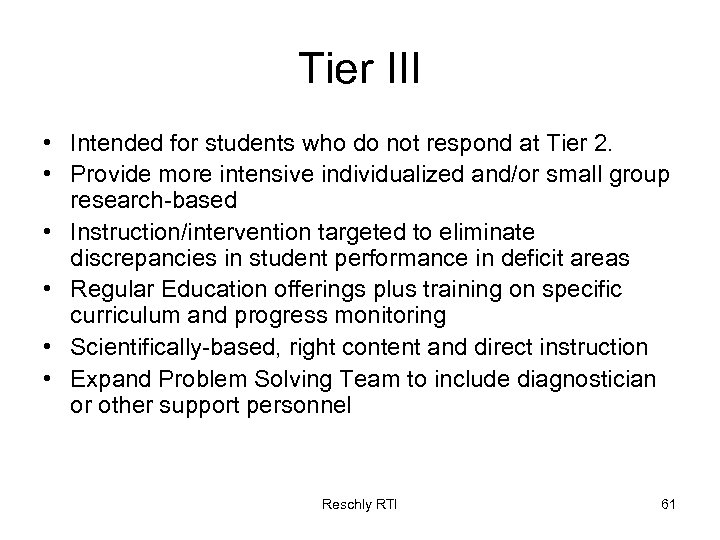 Tier III • Intended for students who do not respond at Tier 2. • Provide more intensive individualized and/or small group research-based • Instruction/intervention targeted to eliminate discrepancies in student performance in deficit areas • Regular Education offerings plus training on specific curriculum and progress monitoring • Scientifically-based, right content and direct instruction • Expand Problem Solving Team to include diagnostician or other support personnel Reschly RTI 61
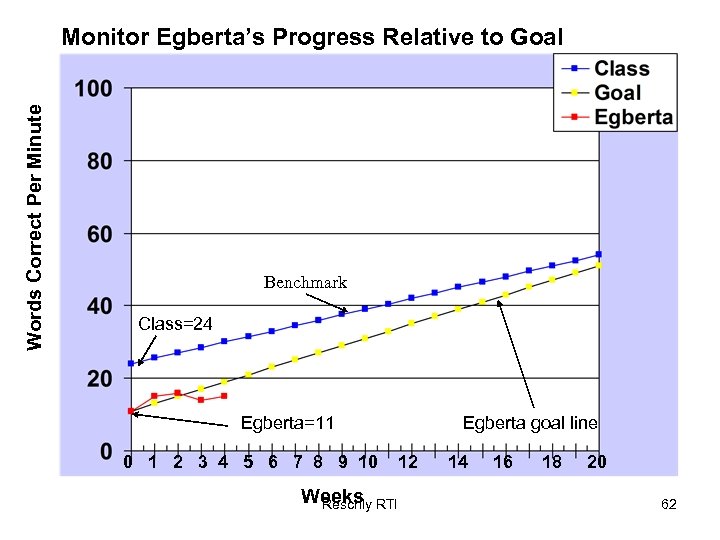 Words Correct Per Minute Monitor Egberta’s Progress Relative to Goal Benchmark Class=24 Egberta=11 0 1 2 3 4 5 6 7 8 9 10 Egberta goal line 12 Weeks RTI Reschly 14 16 18 20 62
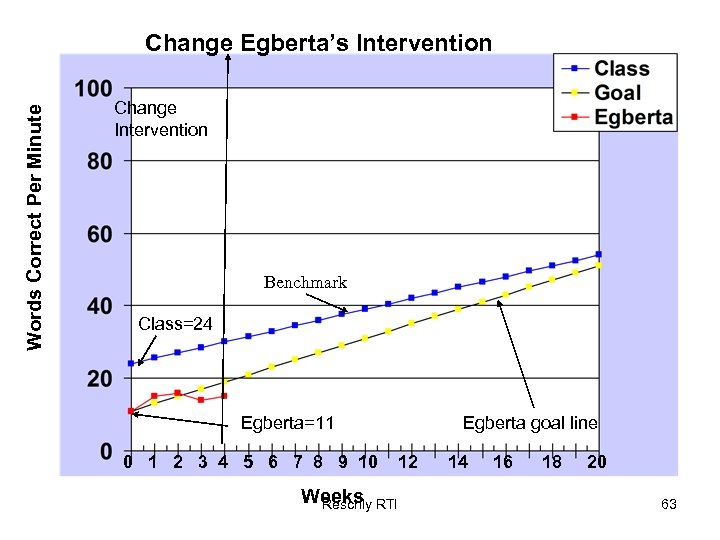 Words Correct Per Minute Change Egberta’s Intervention Change Intervention Benchmark Class=24 Egberta=11 0 1 2 3 4 5 6 7 8 9 10 Egberta goal line 12 Weeks RTI Reschly 14 16 18 20 63
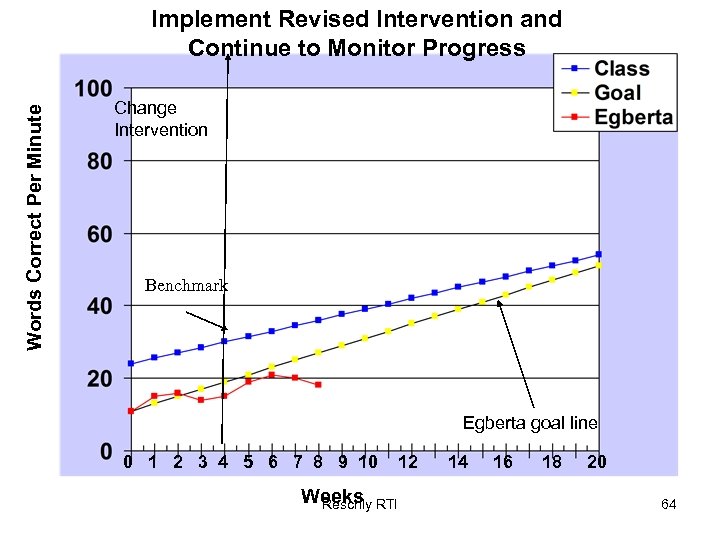 Words Correct Per Minute Implement Revised Intervention and Continue to Monitor Progress Change Intervention Benchmark Egberta goal line 0 1 2 3 4 5 6 7 8 9 10 12 Weeks RTI Reschly 14 16 18 20 64
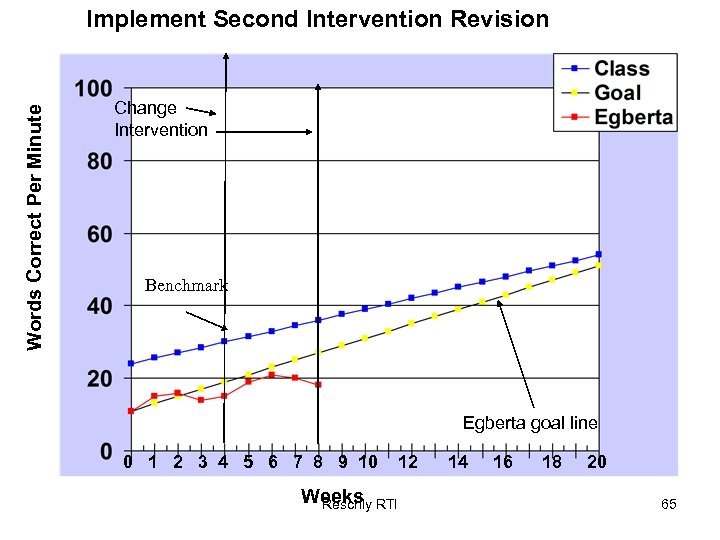 Words Correct Per Minute Implement Second Intervention Revision Change Intervention Benchmark Egberta goal line 0 1 2 3 4 5 6 7 8 9 10 12 Weeks RTI Reschly 14 16 18 20 65
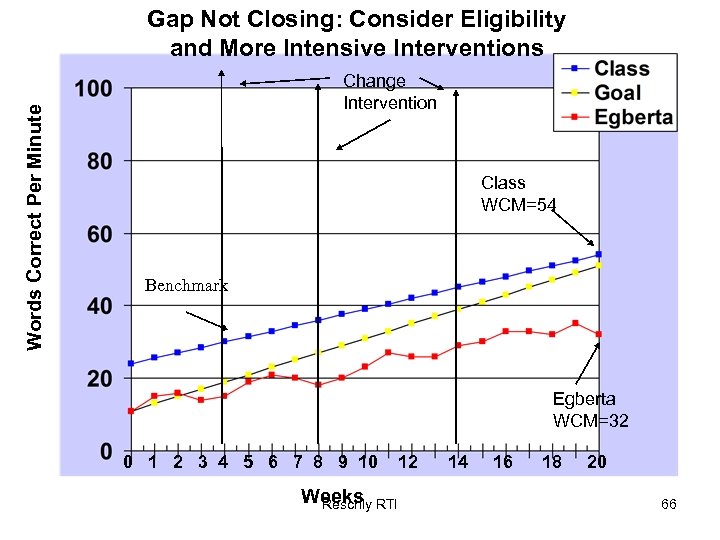 Words Correct Per Minute Gap Not Closing: Consider Eligibility and More Intensive Interventions Change Intervention Class WCM=54 Benchmark Egberta WCM=32 0 1 2 3 4 5 6 7 8 9 10 12 Weeks RTI Reschly 14 16 18 20 66
 Egberta Consideration of Eligibility o o o Levels Difference: Large performance differences compared to peers and benchmark expectations in relevant domains of behavior Rate Difference: Large differences in rate of learning compared to peers and trajectories toward benchmark standards when provided with high quality interventions implemented over a significant period Documented Adverse Impact on Education Documented Need for Special Education Exit Criteria Exclusion Factors: Rule out MR etc. Reschly RTI 67
 What is a Comprehensive Evaluation o Note Federal Regulation, n o (g) The child is assessed in all areas related to the suspected disability, including, if appropriate, health, vision, hearing, social and emotional status, general intelligence, academic performance, communicative status, and motor abilities. (34 C. F. R. 300. 532 Meaning? Note “if appropriate” Reschly RTI 68
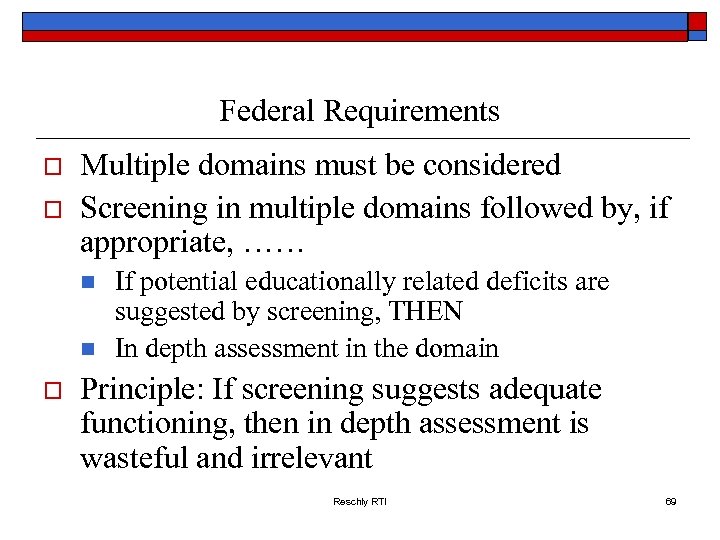 Federal Requirements o o Multiple domains must be considered Screening in multiple domains followed by, if appropriate, …… n n o If potential educationally related deficits are suggested by screening, THEN In depth assessment in the domain Principle: If screening suggests adequate functioning, then in depth assessment is wasteful and irrelevant Reschly RTI 69
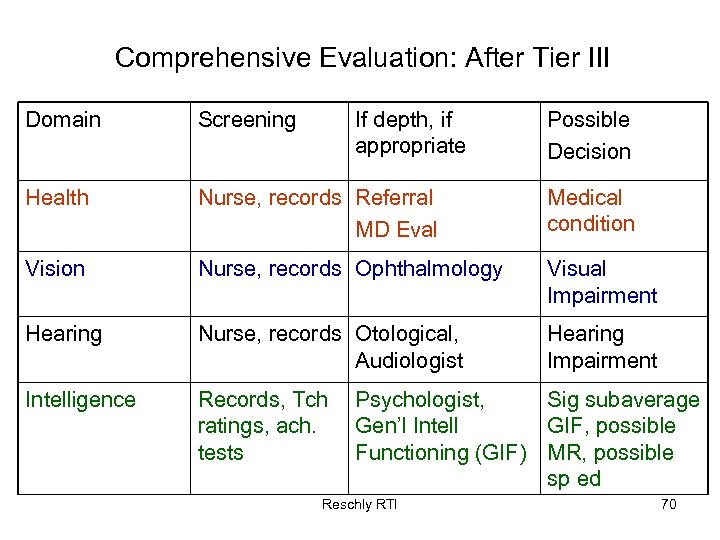 Comprehensive Evaluation: After Tier III Domain Screening If depth, if appropriate Possible Decision Health Nurse, records Referral MD Eval Medical condition Vision Nurse, records Ophthalmology Visual Impairment Hearing Nurse, records Otological, Audiologist Hearing Impairment Intelligence Records, Tch ratings, ach. tests Psychologist, Sig subaverage Gen’l Intell GIF, possible Functioning (GIF) MR, possible sp ed Reschly RTI 70
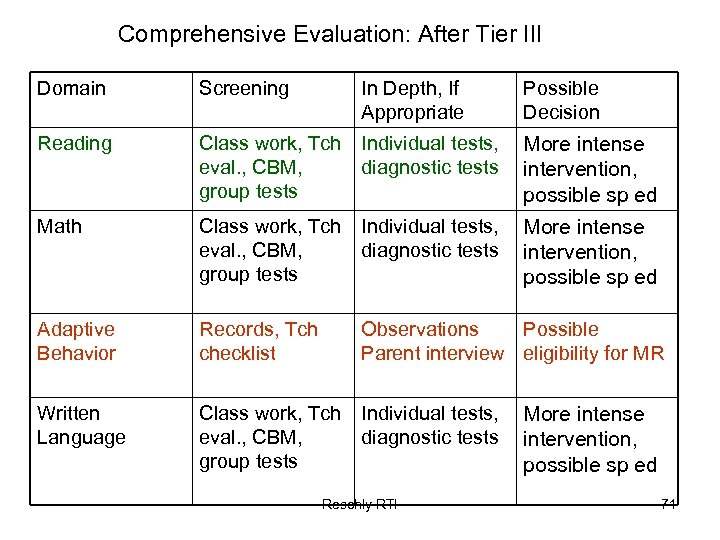 Comprehensive Evaluation: After Tier III Domain Screening In Depth, If Appropriate Possible Decision Reading Class work, Tch Individual tests, eval. , CBM, diagnostic tests group tests More intense intervention, possible sp ed Math Class work, Tch Individual tests, eval. , CBM, diagnostic tests group tests More intense intervention, possible sp ed Adaptive Behavior Records, Tch checklist Written Language Class work, Tch Individual tests, eval. , CBM, diagnostic tests group tests Observations Possible Parent interview eligibility for MR Reschly RTI More intense intervention, possible sp ed 71
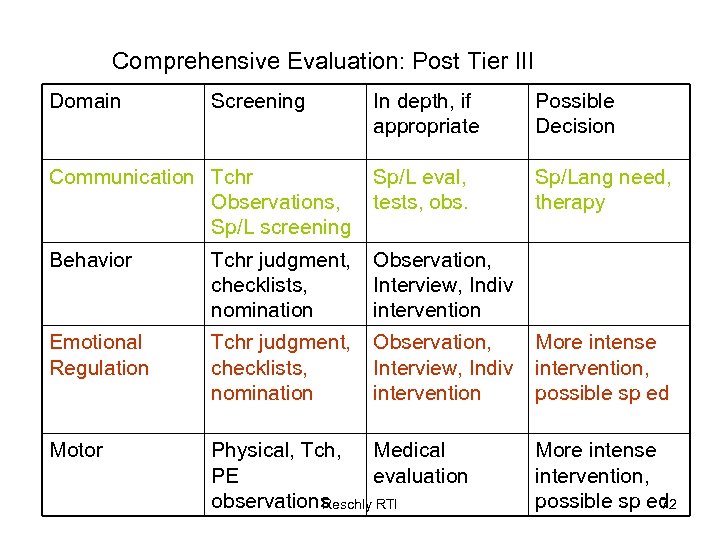 Comprehensive Evaluation: Post Tier III Domain Screening In depth, if appropriate Possible Decision Communication Tchr Observations, Sp/L screening Sp/L eval, tests, obs. Sp/Lang need, therapy Behavior Tchr judgment, checklists, nomination Observation, Interview, Indiv intervention Emotional Regulation Tchr judgment, checklists, nomination Observation, Interview, Indiv intervention Motor Physical, Tch, Medical PE evaluation observations Reschly RTI More intense intervention, possible sp ed 72
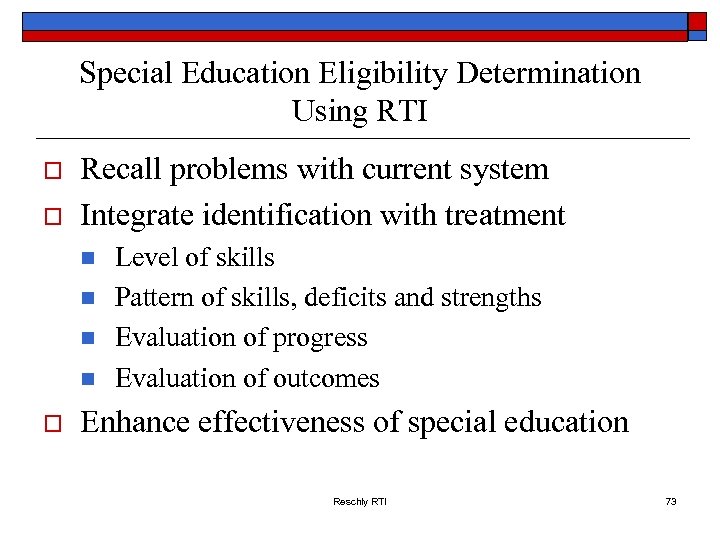 Special Education Eligibility Determination Using RTI o o Recall problems with current system Integrate identification with treatment n n o Level of skills Pattern of skills, deficits and strengths Evaluation of progress Evaluation of outcomes Enhance effectiveness of special education Reschly RTI 73
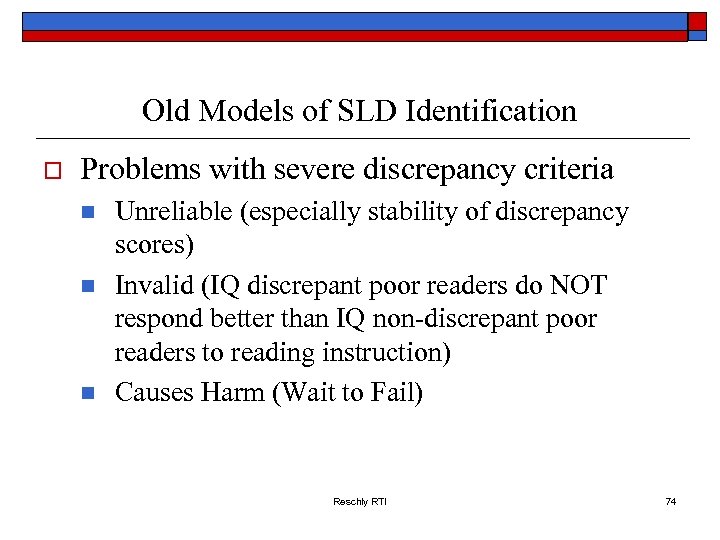 Old Models of SLD Identification o Problems with severe discrepancy criteria n n n Unreliable (especially stability of discrepancy scores) Invalid (IQ discrepant poor readers do NOT respond better than IQ non-discrepant poor readers to reading instruction) Causes Harm (Wait to Fail) Reschly RTI 74
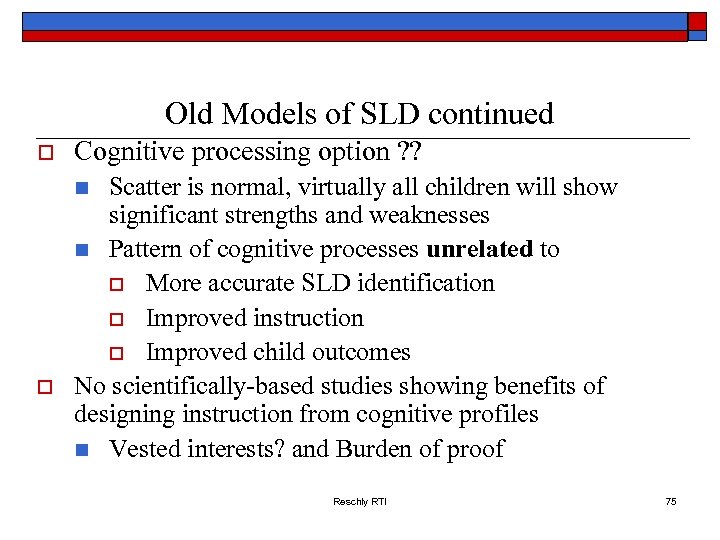 Old Models of SLD continued o Cognitive processing option ? ? Scatter is normal, virtually all children will show significant strengths and weaknesses n Pattern of cognitive processes unrelated to o More accurate SLD identification o Improved instruction o Improved child outcomes No scientifically-based studies showing benefits of designing instruction from cognitive profiles n Vested interests? and Burden of proof n o Reschly RTI 75
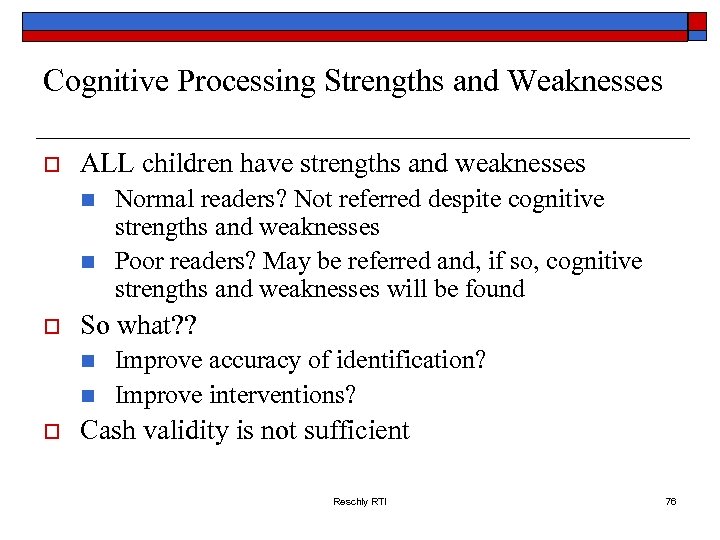 Cognitive Processing Strengths and Weaknesses o ALL children have strengths and weaknesses n n o So what? ? n n o Normal readers? Not referred despite cognitive strengths and weaknesses Poor readers? May be referred and, if so, cognitive strengths and weaknesses will be found Improve accuracy of identification? Improve interventions? Cash validity is not sufficient Reschly RTI 76
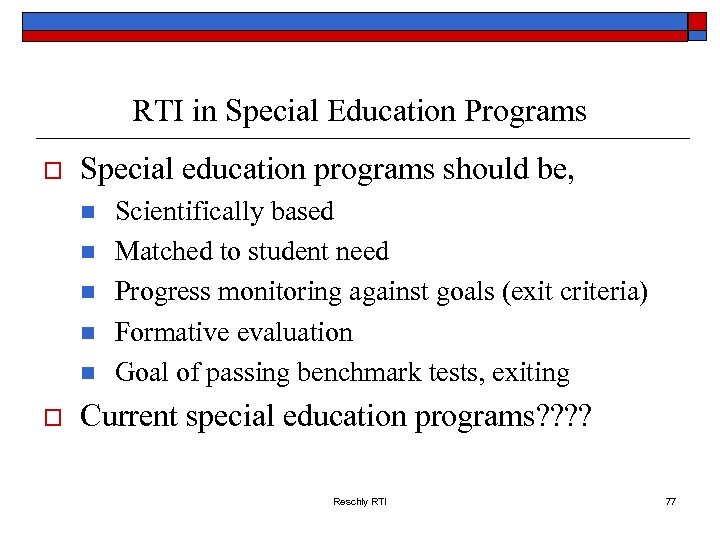 RTI in Special Education Programs o Special education programs should be, n n n o Scientifically based Matched to student need Progress monitoring against goals (exit criteria) Formative evaluation Goal of passing benchmark tests, exiting Current special education programs? ? Reschly RTI 77
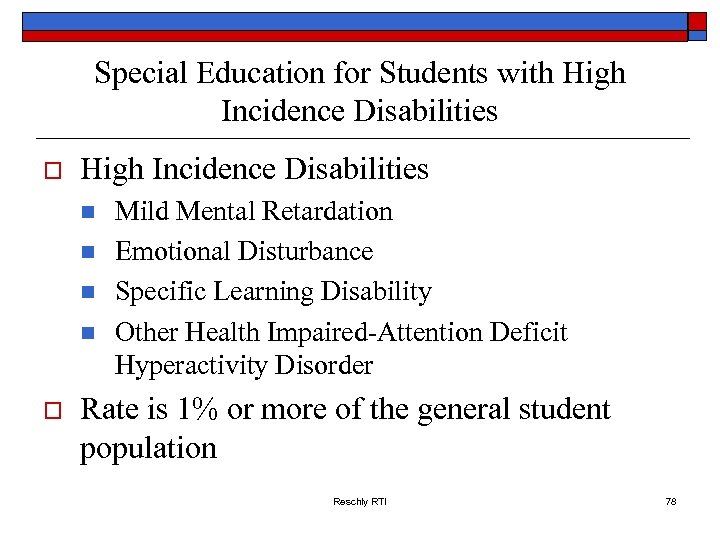 Special Education for Students with High Incidence Disabilities o High Incidence Disabilities n n o Mild Mental Retardation Emotional Disturbance Specific Learning Disability Other Health Impaired-Attention Deficit Hyperactivity Disorder Rate is 1% or more of the general student population Reschly RTI 78
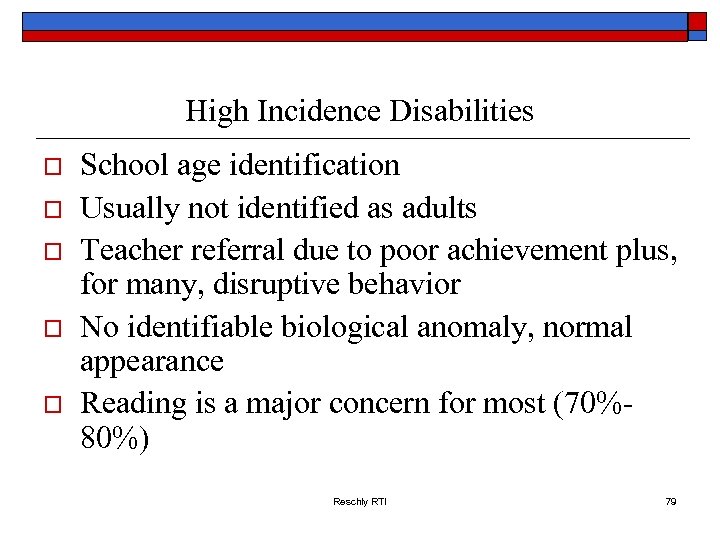 High Incidence Disabilities o o o School age identification Usually not identified as adults Teacher referral due to poor achievement plus, for many, disruptive behavior No identifiable biological anomaly, normal appearance Reading is a major concern for most (70%80%) Reschly RTI 79
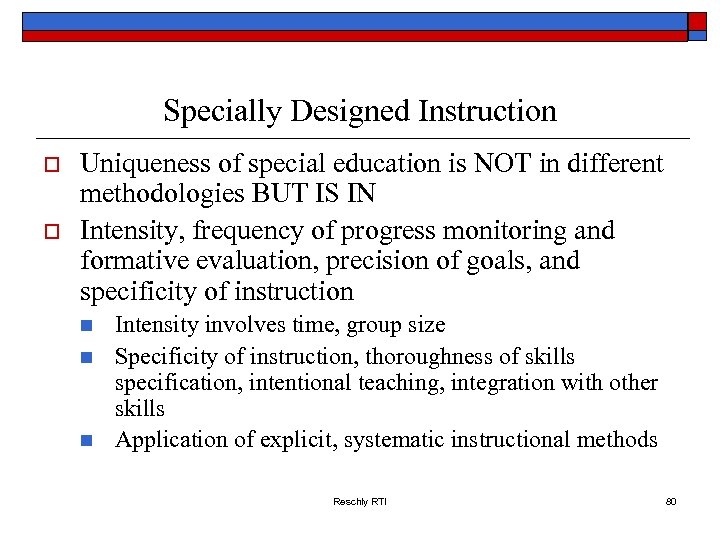 Specially Designed Instruction o o Uniqueness of special education is NOT in different methodologies BUT IS IN Intensity, frequency of progress monitoring and formative evaluation, precision of goals, and specificity of instruction n Intensity involves time, group size Specificity of instruction, thoroughness of skills specification, intentional teaching, integration with other skills Application of explicit, systematic instructional methods Reschly RTI 80
 Special Education Final Remarks o Special education can be effective n n n n Set of services brought to students, not a place Integrated with general education curriculum Strong accountability Implementation of scientifically based interventions with Specification of goals Frequent progress monitoring Formative evaluation Exit criteria Reschly RTI 81
 Critical Skills/Competencies o o o Problem solving-interviewing skills Behavior assessment including CBM Powerful instructional interventions Powerful behavior change interventions Relationship skills Tailoring assessment to referral concerns Reschly RTI 82
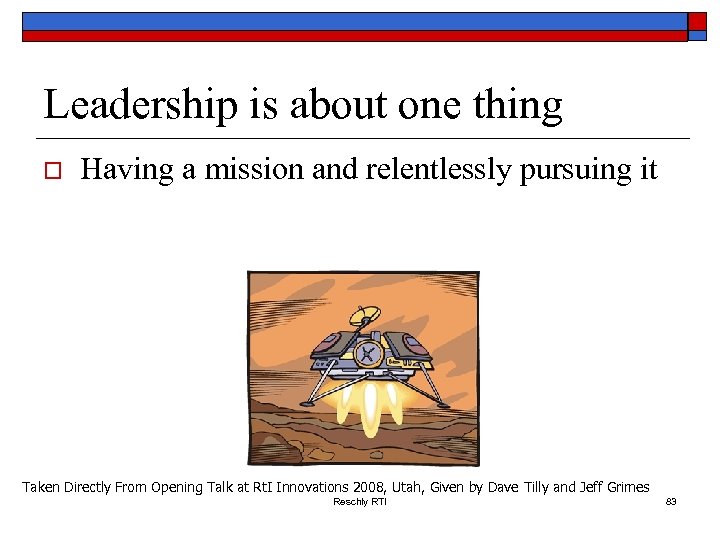 Leadership is about one thing o Having a mission and relentlessly pursuing it Taken Directly From Opening Talk at Rt. I Innovations 2008, Utah, Given by Dave Tilly and Jeff Grimes Reschly RTI 83
 PSM/Rt. I Content: All Personnel o Understanding of: n n n National, state, district policies regarding Rt. I Link between NCLB, IDEA 04, AYP and Rt. I Beliefs, knowledge and skills that support implementation of Rt. I Steps in the PSM, multilevel Rt. I model, and how eligibility is determined using Rt. I Fundamental utility of using progress monitoring Taken Directly From Talk at Rt. I Innovations 2008, Utah, Reschly RTI Given by George Batsche 84
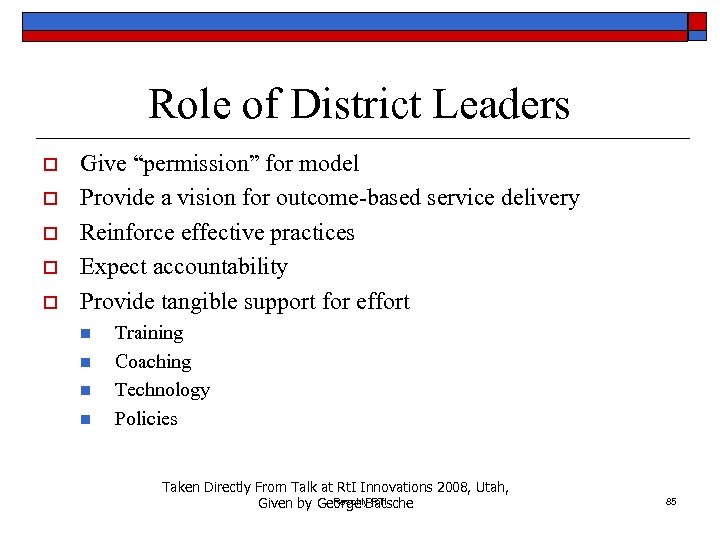 Role of District Leaders o o o Give “permission” for model Provide a vision for outcome-based service delivery Reinforce effective practices Expect accountability Provide tangible support for effort n n Training Coaching Technology Policies Taken Directly From Talk at Rt. I Innovations 2008, Utah, Reschly RTI Given by George Batsche 85
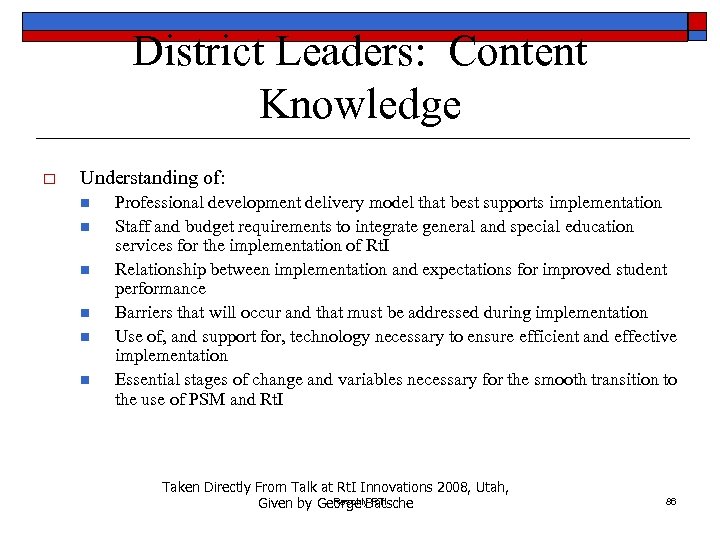 District Leaders: Content Knowledge o Understanding of: n n n Professional development delivery model that best supports implementation Staff and budget requirements to integrate general and special education services for the implementation of Rt. I Relationship between implementation and expectations for improved student performance Barriers that will occur and that must be addressed during implementation Use of, and support for, technology necessary to ensure efficient and effective implementation Essential stages of change and variables necessary for the smooth transition to the use of PSM and Rt. I Taken Directly From Talk at Rt. I Innovations 2008, Utah, Reschly RTI Given by George Batsche 86
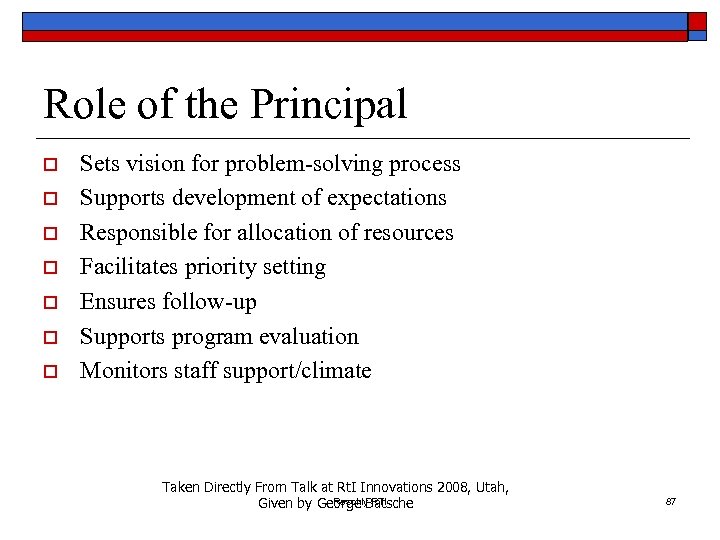 Role of the Principal o o o o Sets vision for problem-solving process Supports development of expectations Responsible for allocation of resources Facilitates priority setting Ensures follow-up Supports program evaluation Monitors staff support/climate Taken Directly From Talk at Rt. I Innovations 2008, Utah, Reschly RTI Given by George Batsche 87
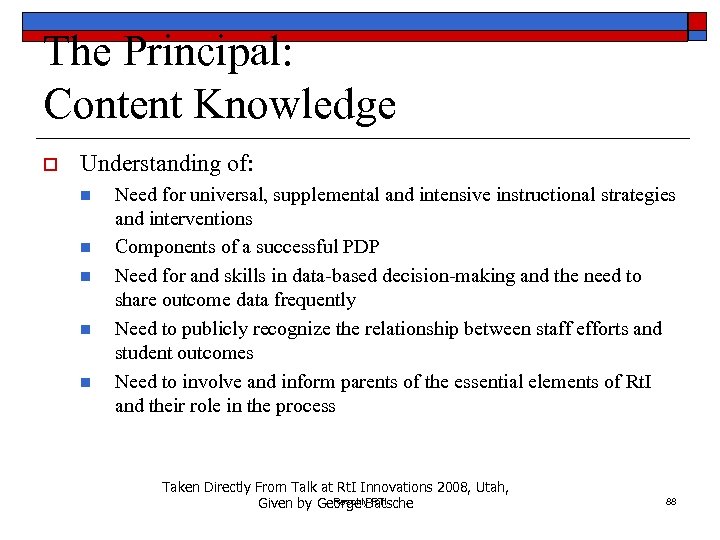 The Principal: Content Knowledge o Understanding of: n n n Need for universal, supplemental and intensive instructional strategies and interventions Components of a successful PDP Need for and skills in data-based decision-making and the need to share outcome data frequently Need to publicly recognize the relationship between staff efforts and student outcomes Need to involve and inform parents of the essential elements of Rt. I and their role in the process Taken Directly From Talk at Rt. I Innovations 2008, Utah, Reschly RTI Given by George Batsche 88
 Role of the Facilitator o o o o Ensures pre-meeting preparation Reviews steps in process and desired outcomes Facilitates movement through steps Facilitates consensus building Sets follow-up schedule/communication Creates evaluation criteria/protocol Ensures parent involvement Taken Directly From Talk at Rt. I Innovations 2008, Utah, Reschly RTI Given by George Batsche 89
 What is a “Team”? Facilitator’s Vision o o o o o Agreement through CONSENSUS We agree to “try and see” No one person is an expert-a show maker or a show stopper People stay focused on common goal-Development of Effective Interventions Interpersonal conflicts do not affect outcome This is about “the student” We are seeking an significant improvement-not a cure Resources must be managed well Primary resource is “time” Taken Directly From Talk at Rt. I Innovations 2008, Utah, Reschly RTI Given by George Batsche 90
 Role of Participants o o o Review Request for Assistance forms prior to meeting Complete individual problem-solving Attitude of consensus building Understand data Research interventions for problem area Taken Directly From Talk at Rt. I Innovations 2008, Utah, Reschly RTI Given by George Batsche 91
 The Participants: Content Knowledge o An understanding of: n The relationship between Rt. I and student achievement n Need to increase the range of empirically validated instructional practices in the general education classroom n Uses of the problem-solving method n Technology and other supports available and necessary to implement Rt. I n Administrative and leadership support necessary to maximize the implementation of Rt. I n Need to provide practical models and examples with sufficient student outcome data n Need for demonstration and guided practice opportunities Taken Directly From Talk at Rt. I Innovations 2008, Utah, Reschly RTI Given by George Batsche 92
 Student Services Staff: Content Knowledge o An understanding of: n The different models for evaluating student performance differences and their impact on the development of instructional and assessment practices n Evaluation strategies to assess instructional quality in general and special education classrooms and programs n CBM and related continuous progress monitoring technologies to relate individual student performance to instructional quality data n Need for and models of social support and the role of support staff in the provision of that support for school staff n Specific training in coaching, mentoring and data management strategies Taken Directly From Talk at Rt. I Innovations 2008, Utah, Reschly RTI Given by George Batsche 93
 Role of Parent o o Review Request for Assistance form prior to meeting Complete individual problem solving Prioritize concerns Attitude of consensus building Taken Directly From Talk at Rt. I Innovations 2008, Utah, Reschly RTI Given by George Batsche 94
 Student Involvement o o o Increases motivation of student Reduces teacher load Teaches self-responsibility Taken Directly From Talk at Rt. I Innovations 2008, Utah, Reschly RTI Given by George Batsche 95
 Impact on Leaders: A Change in Focus o o o o Student progress, not labels are most important All students compared to general education expectations All students affect AYP A student’s response to intervention is the most important data Academic Engaged Time is the currency of problem-solving Training and coaching must be focused on Problem Solving Model Increase the use of technology Interventions must be evidence-based Reschly RTI Taken Directly From Talk at Rt. I Innovations 2008, Utah, Given by George Batsche 96
 Staff Support o o o Risk-free or risky environment? Expectations may be most important factor “Alternative” not “Less” Taken Directly From Talk at Rt. I Innovations 2008, Utah, Reschly RTI Given by George Batsche 97
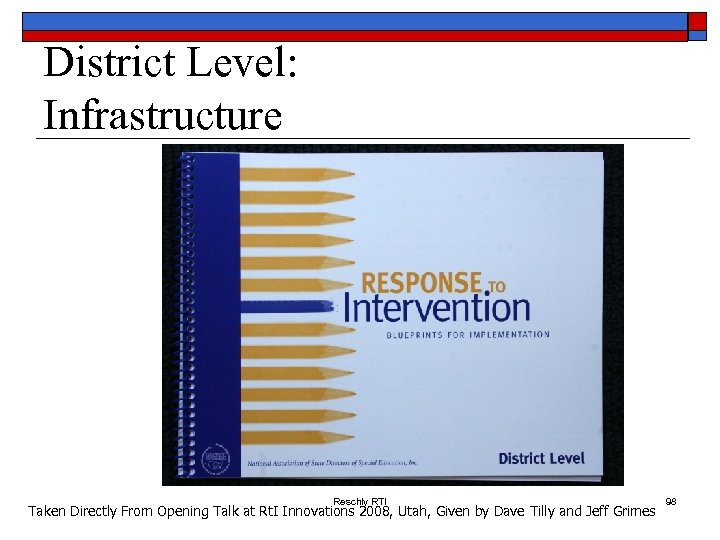 District Level: Infrastructure Reschly RTI Taken Directly From Opening Talk at Rt. I Innovations 2008, Utah, Given by Dave Tilly and Jeff Grimes 98
 School Building Level: Infrastructure Reschly RTI Taken Directly From Opening Talk at Rt. I Innovations 2008, Utah, Given by Dave Tilly and Jeff Grimes 99
 Purpose of Blueprints o o Think of blueprints for your house They tell you: n n o Where to put the walls Where to put the windows How the framing should come togther Where the plumbing and electrical run They Don’t tell you: n n n What color to paint the walls What furniture to buy Where to hang your pictures Taken Directly From Talk at Rt. I Innovations 2008, Utah, Given by Judy Elliott Reschly RTI 100
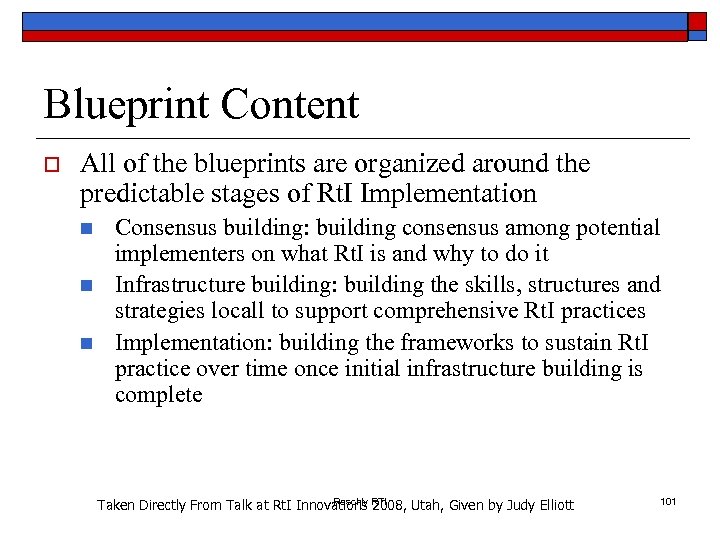 Blueprint Content o All of the blueprints are organized around the predictable stages of Rt. I Implementation n Consensus building: building consensus among potential implementers on what Rt. I is and why to do it Infrastructure building: building the skills, structures and strategies locall to support comprehensive Rt. I practices Implementation: building the frameworks to sustain Rt. I practice over time once initial infrastructure building is complete Reschly 2008, Utah, Given by Judy Elliott Taken Directly From Talk at Rt. I Innovations RTI 101
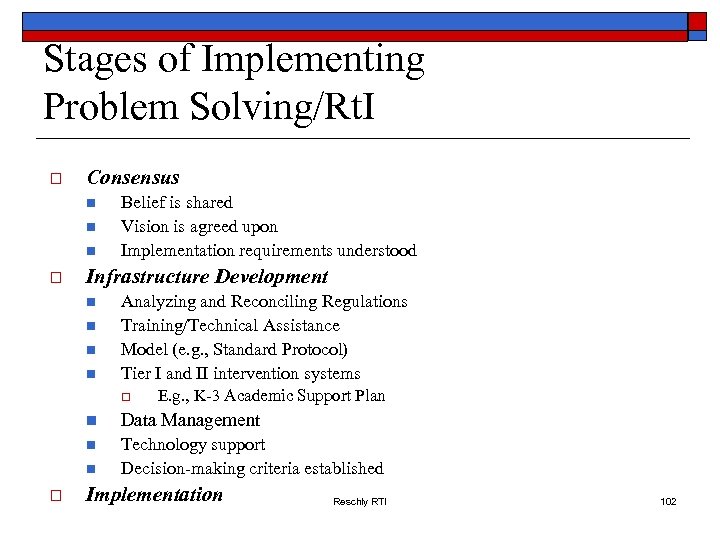 Stages of Implementing Problem Solving/Rt. I o Consensus n n n o Belief is shared Vision is agreed upon Implementation requirements understood Infrastructure Development n n Analyzing and Reconciling Regulations Training/Technical Assistance Model (e. g. , Standard Protocol) Tier I and II intervention systems o E. g. , K-3 Academic Support Plan n Data Management n Technology support Decision-making criteria established n o Implementation Reschly RTI 102
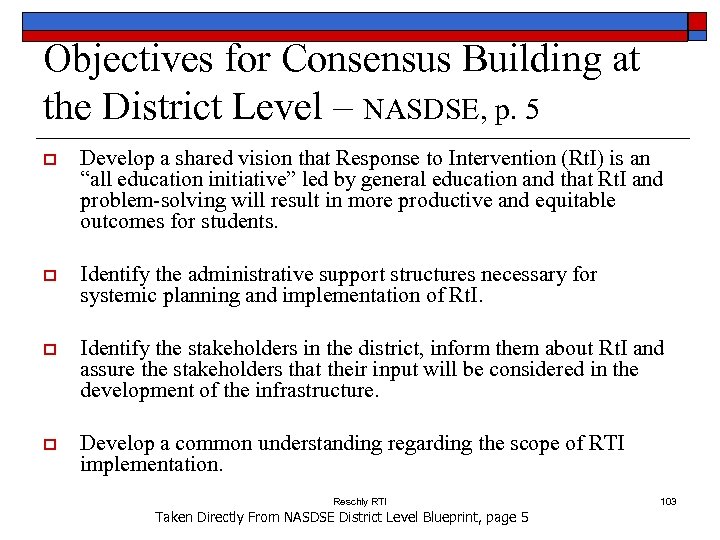 Objectives for Consensus Building at the District Level – NASDSE, p. 5 o Develop a shared vision that Response to Intervention (Rt. I) is an “all education initiative” led by general education and that Rt. I and problem-solving will result in more productive and equitable outcomes for students. o Identify the administrative support structures necessary for systemic planning and implementation of Rt. I. o Identify the stakeholders in the district, inform them about Rt. I and assure the stakeholders that their input will be considered in the development of the infrastructure. o Develop a common understanding regarding the scope of RTI implementation. Reschly RTI Taken Directly From NASDSE District Level Blueprint, page 5 103
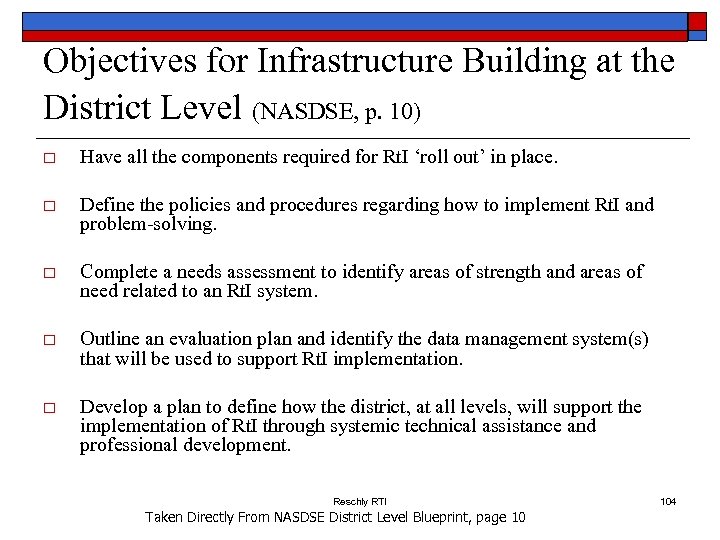 Objectives for Infrastructure Building at the District Level (NASDSE, p. 10) o Have all the components required for Rt. I ‘roll out’ in place. o Define the policies and procedures regarding how to implement Rt. I and problem-solving. o Complete a needs assessment to identify areas of strength and areas of need related to an Rt. I system. o Outline an evaluation plan and identify the data management system(s) that will be used to support Rt. I implementation. o Develop a plan to define how the district, at all levels, will support the implementation of Rt. I through systemic technical assistance and professional development. Reschly RTI Taken Directly From NASDSE District Level Blueprint, page 10 104
 Objectives for Implementation at the District Level (NASDSE, p. 20) o o o The district will have the necessary systemic supports in place to ensure successful implementation of Rt. I. The district will implement a multi-year implementation and professional development plan that provides ongoing and sustained support for Rt. I implementation. The district will use a systemic evaluation plan to assess the impact of Rt. I on student, site, district and personnel outcomes. Reschly RTI Taken Directly From NASDSE District Level Blueprint, page 20 105
 The many “gotta haves” – Common Language and Common Understanding o o o o Working knowledge and skill of the problem solving model Working knowledge of the Tiered system of intervention Skill in use of data to make instructional decisions Working knowledge of how to create decisions rules for tiered intervention Ability to link assessment data to robust instruction and behavior interventions Skill to seek and implement evidence based practices Ability to speak your truth Taken Directly From Talk at Rt. I Innovations 2008, Utah, Given by Judy Elliott Reschly RTI 106
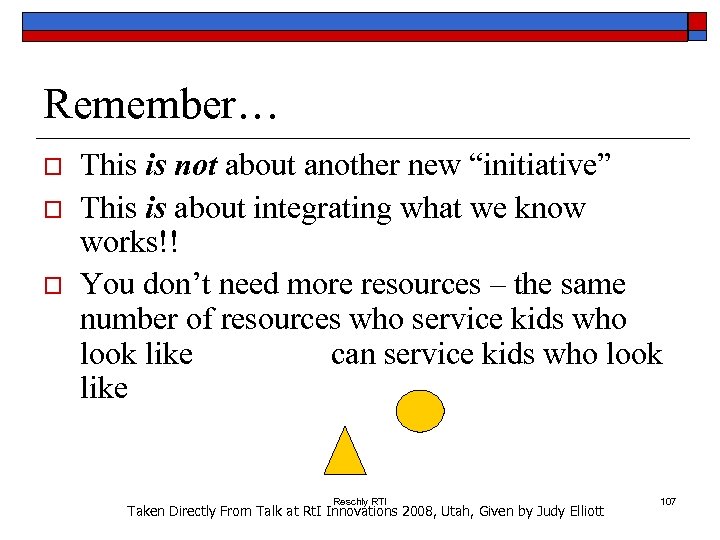 Remember… o o o This is not about another new “initiative” This is about integrating what we know works!! You don’t need more resources – the same number of resources who service kids who look like can service kids who look like Reschly RTI Taken Directly From Talk at Rt. I Innovations 2008, Utah, Given by Judy Elliott 107
 What do we know about systems change? o Communicate a clear and common vision o Planned and pursued in a systematic manner over time o One size does NOT fit all o Professional development is critical o Outcome evaluation is NONNEGOTIABLE! Reschly RTI 108
 Why have past initiatives failed? o o o o Failure to achieve CONSENSUS School culture is ignored Purpose unclear Lack of ongoing communication Unrealistic expectations of initial success Failure to measure and analyze progress Participants not involved in planning Reschly RTI 109
 Consensus Building o Educators will embrace new ideas when two conditions exist: n n They understand the NEED for the idea They perceive that they either have the SKILLS to implement the idea OR they have the SUPPORT to develop the skills Reschly RTI 110
 How can we work smarter? o Explain “the why” o Provide a clear vision o Explain the scope and sequence o Start listening o Provide incentives Reschly RTI 111
 Leadership Teams o Given all of these leadership things we’ve talked about o What’s your leadership role? o What’s the first thing you’re going to do when you get back to your districts/schools? Taken Directly From Opening Talk at Rt. I Innovations 2008, Utah, Given by Dave Tilly and Jeff Grimes Reschly RTI 112
 Coming together is a beginning. Keeping together is progress. Working together is success. Henry Ford Reschly RTI Taken Directly From Opening Talk at Rt. I Innovations 2008, Utah, Given by Dave Tilly and Jeff Grimes 113
 Continuing Education: Problem solving and system design o o o Reschly, D. J. , Tilly, W. D. III, & Grimes, J. P. (Eds. ). (1999). Special education in transition: Functional assessment and noncategorical programming. Longmont, CO: Sopris West. Bergan, J. R. , & Kratochwill, T. R. (1990). Behavioral consultation and therapy. New York: Plenum. Shinn, M. R. (Ed. ). (1989). Curriculum-based measurement: Assessing special children. New York: Guilford Press. Reschly RTI 114
 Continuing Education: CBM, CBE, Behavioral Assessment o o o Shinn, M. R. (Ed. ) (1998). Advanced applications of curriculum-based measurement: New York: Guilford Press. Shapiro, E. S. (Ed. ) (1996). Academic skills problems: Direct assessment and intervention (2 nd Ed. ). New York: Guilford Press. Shapiro, E. S. , & Kratochwill, T. R. (Eds. ). (2000). Behavioral assessment in schools: Theory, research, and clinical applications (2 nd Ed. ). New York: Guilford Press. Reschly RTI 115
 Continuing Education: Academic and Behavioral Interventions o o o Sulzer-Azaroff, B. , & Mayer, G. R. (1991). Behavior analysis for lasting change. Fort Worth, TX: Holt, Rinehart, Winston. Howell, K. & Nolet, V. (2000). Curriculum-based evaluation: Teaching and decision making (3 rd Ed. ). Atlanta, GA: Wadsworth. Shinn, M. R. , Walker, H. M. , & Stoner, G. (2002). Interventions for academic and behaviors problems II: Preventive and remedial approaches. Bethesda, MD: NASP Reschly RTI 116
 Who Can Help? Sherry Abernethy NCDPI RTI Coordinator Sabernethy@dpi. state. nc. us Your Regional EC Consultant (Northwest) Bill Rynn rynnb@charterinternet. com Your Regional Literacy Consultant www. ncpublicschools/ec. org Your Regional Behavioral Consultant www. ncpublicschools/ec. org Thank you for all you do for children in North Carolina! Reschly RTI 117