 Скачать презентацию Response to Intervention Curriculum-Based Measurement Special Educators
6569fb26b3d1b16e9cb91a59795d04d9.ppt
- Количество слайдов: 101



Response to Intervention Curriculum-Based Measurement & Special Educators: Assessing Student Foundation Academic Skills Jim Wright www. interventioncentral. org
Response to Intervention Curriculum-Based Measurement (CBM) for Special Educators: Workshop Agenda Curriculum-Based Measurement: An Introduction CBM Reading, Math Computation, & Writing Charting & Evaluating Data Using CBM Writing IEP Goals for CBM Web Resources www. interventioncentral. org
Response to Intervention Curriculum-Based Measurement: An Introduction www. interventioncentral. org
Response to Intervention Curriculum-Based Measurement: Advantages as a Set of Tools to Monitor RTI/Academic Cases • Aligns with curriculum-goals and materials • Is reliable and valid (has ‘technical adequacy’) • Is criterion-referenced: sets specific performance levels for specific tasks • Uses standard procedures to prepare materials, administer, and score • Samples student performance to give objective, observable ‘low-inference’ information about student performance • Has decision rules to help educators to interpret student data and make appropriate instructional decisions • Is efficient to implement in schools (e. g. , training can be done quickly; the measures are brief and feasible for classrooms, etc. ) Source: Hosp, M. K. , Hosp, J. L. , & Howell, K. W. (2007). The ABCs of CBM. New York: Guilford. • Provides data that can be converted into visual displays www. interventioncentral. org 4
Response to Intervention Among other areas, CBM Techniques have been developed to assess: • • Reading fluency Reading comprehension Math computation Writing Spelling Phonemic awareness skills Early math skills www. interventioncentral. org 5
Response to Intervention CBM Student Reading Samples: What Difference Does Fluency Make? • 3 rd Grade: 19 Words Per Minute • 3 rd Grade: 70 Words Per Minute • 3 rd Grade: 98 Words Per Minute www. interventioncentral. org 6
Response to Intervention Measuring General vs. Specific Academic Outcomes General Outcome Measures… • Track the student’s increasing proficiency on general curriculum goals such as reading fluency. Example: CBM -Oral Reading Fluency (Hintz et al. , 2006). • Are most useful for longer-term measurement (e. g. , to set and track IEP goals over the timespan of a school Sources: Burns, M. K. , & Gibbons, K. A. (2008). Implementing response-to-intervention in elementary and secondary schools: Procedures to assure scientific-based practices. New York: Routledge. year). Hintz, J. M. , Christ, T. J. , & Methe, S. A. (2006). Curriculum-based assessment. Psychology in the Schools, 43, 45 -56. www. interventioncentral. org 7
Response to Intervention Measuring General vs. Specific Academic Outcomes Specific Sub-Skill Mastery Measures… • Track short-term student academic progress with clear criteria for mastery (Burns & Gibbons, 2008). Example: Letter Identification. • Are helpful in assessing whether the student has acquired short-term skills whose acquisition may require weeks rather than months. Sources: Burns, M. K. , & Gibbons, K. A. (2008). Implementing response-to-intervention in elementary and secondary schools: Procedures to assure scientific-based practices. New York: Routledge. Hintz, J. M. , Christ, T. J. , & Methe, S. A. (2006). Curriculum-based assessment. Psychology in the Schools, 43, 45 -56. www. interventioncentral. org 8
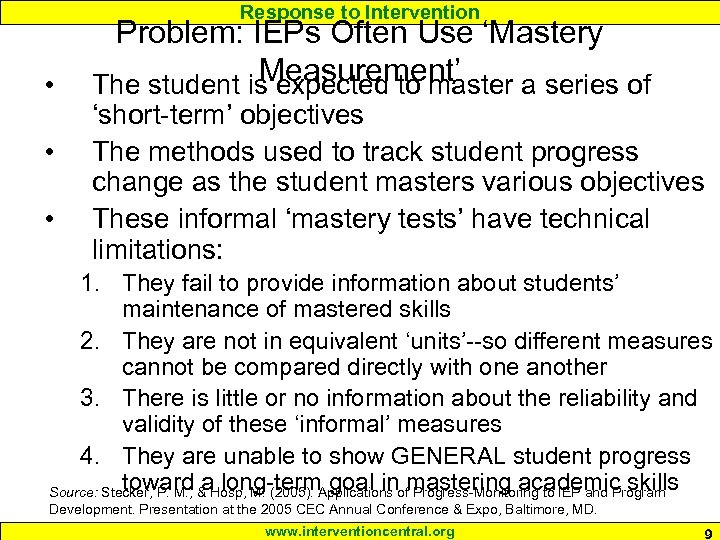
Response to Intervention • • • Problem: IEPs Often Use ‘Mastery Measurement’ The student is expected to master a series of ‘short-term’ objectives The methods used to track student progress change as the student masters various objectives These informal ‘mastery tests’ have technical limitations: 1. They fail to provide information about students’ maintenance of mastered skills 2. They are not in equivalent ‘units’--so different measures cannot be compared directly with one another 3. There is little or no information about the reliability and validity of these ‘informal’ measures 4. They are unable to show GENERAL student progress toward a long-term goal in mastering academic skills Source: Stecker, P. M. , & Hosp, M. (2005). Applications of Progress-Monitoring to IEP and Program Development. Presentation at the 2005 CEC Annual Conference & Expo, Baltimore, MD. www. interventioncentral. org 9
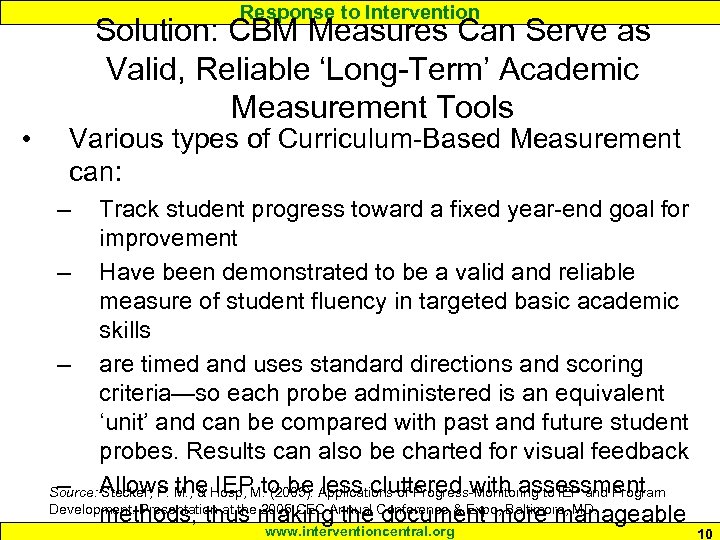
Response to Intervention • Solution: CBM Measures Can Serve as Valid, Reliable ‘Long-Term’ Academic Measurement Tools Various types of Curriculum-Based Measurement can: – Track student progress toward a fixed year-end goal for improvement – Have been demonstrated to be a valid and reliable measure of student fluency in targeted basic academic skills – are timed and uses standard directions and scoring criteria—so each probe administered is an equivalent ‘unit’ and can be compared with past and future student probes. Results can also be charted for visual feedback – Stecker, P. M. , & Hosp, M. (2005). Applications of Progress-Monitoring to IEP and Program Source: Allows the IEP to be less cluttered with assessment Development. Presentation at the 2005 CEC Annual Conference & Expo, Baltimore, MD. methods, thus making the document more manageable www. interventioncentral. org 10
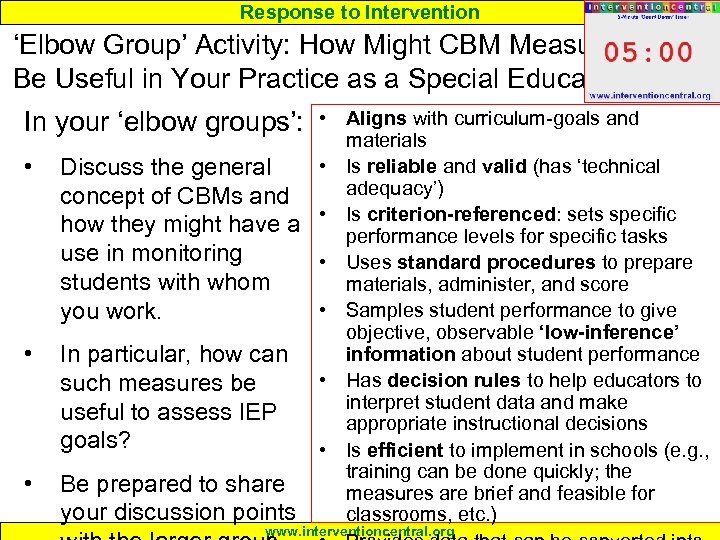
Response to Intervention ‘Elbow Group’ Activity: How Might CBM Measures Be Useful in Your Practice as a Special Educator? In your ‘elbow groups’: • • Aligns with curriculum-goals and materials • Is reliable and valid (has ‘technical Discuss the general adequacy’) concept of CBMs and how they might have a • Is criterion-referenced: sets specific performance levels for specific tasks use in monitoring • Uses standard procedures to prepare students with whom materials, administer, and score • Samples student performance to give you work. objective, observable ‘low-inference’ information about student performance In particular, how can • Has decision rules to help educators to such measures be interpret student data and make useful to assess IEP appropriate instructional decisions goals? • Is efficient to implement in schools (e. g. , training can be done quickly; the Be prepared to share measures are brief and feasible for your discussion points classrooms, etc. ) www. interventioncentral. org
Response to Intervention Curriculum-Based Measurement: Oral Reading Fluency Jim Wright www. interventioncentral. org
Response to Intervention In your packet, for CBM reading/literacy… Here are key resource and activity materials: • Oral Reading Fluency (ORF): Directions: pp. 2 -7 • Research-Based Norms: ORF: p. 17 • CBM Literacy Measures: Listing: pp. 1921 • ORF Record Form: pp. 41 -42 www. interventioncentral. org 13
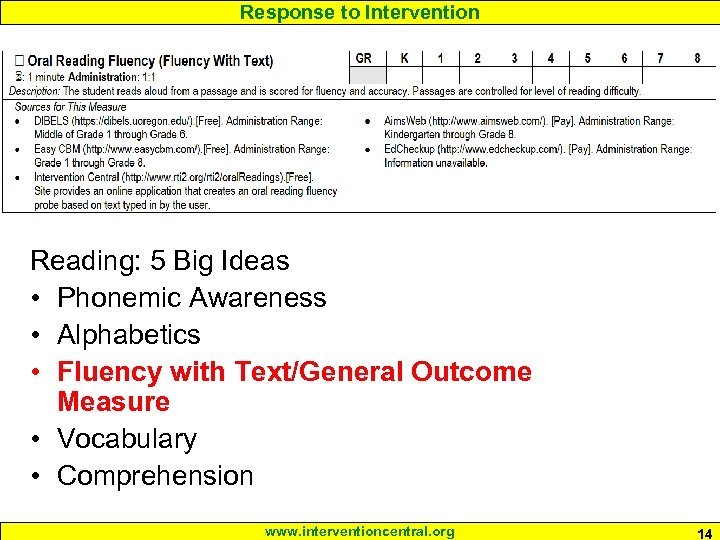
Response to Intervention Reading: 5 Big Ideas • Phonemic Awareness • Alphabetics • Fluency with Text/General Outcome Measure • Vocabulary • Comprehension www. interventioncentral. org 14
Response to Intervention Five Big Ideas in Reading • “Phonemic Awareness: The ability to hear and manipulate sounds in words. • Alphabetic Principle: The ability to associate sounds with letters and use these sounds to form words. • Fluency with Text: The effortless, automatic ability to read words in connected text. • Vocabulary: The ability to understand (receptive) and use (expressive) words to acquire and convey meaning. • Comprehension: The complex cognitive process involving the intentional interaction SOURCE: University of Oregon: http: //reading. uoregon. edu/big_ideas/trial_bi_index. php www. interventioncentral. org 15
Response to Intervention http: //www. nichd. nih. gov/publications/nrppubskey. cfm www. interventioncentral. org 16
Response to Intervention NRP Conclusions Regarding Importance of Oral Reading Fluency: “An extensive review of the literature indicates that classroom practices that encourage repeated oral reading with feedback and guidance leads to meaningful improvements in reading expertise for students—for good readers as well as those who are experiencing www. interventioncentral. org 17
Response to Intervention CBM Reading Probes: Preparation www. interventioncentral. org 18
Response to Intervention CBM Reading : Preparation www. interventioncentral. org
Response to Intervention CBM Reading Assessment: Preparation • Decide on ‘measurement pool’ (e. g. , basal reading series, literature selections sorted according to readability) • Prepare examiner and student copies of passages • Select passages randomly from larger library when administering to student www. interventioncentral. org 20
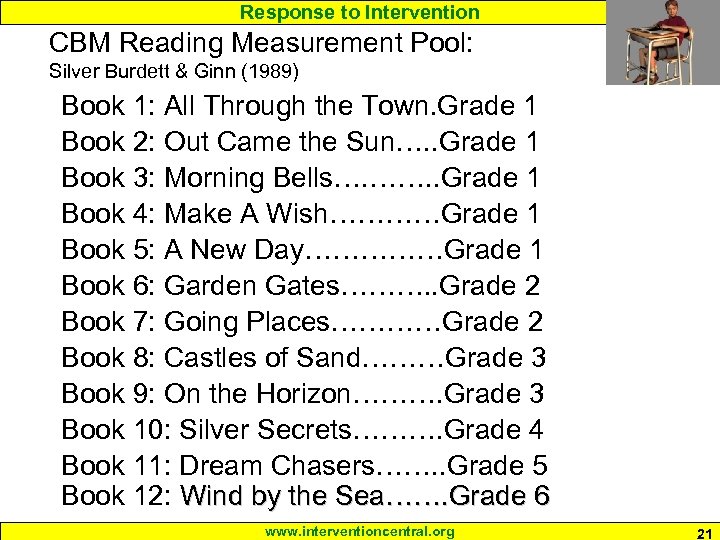
Response to Intervention CBM Reading Measurement Pool: Silver Burdett & Ginn (1989) Book 1: All Through the Town. Grade 1 Book 2: Out Came the Sun…. . Grade 1 Book 3: Morning Bells…. ……. . Grade 1 Book 4: Make A Wish…………Grade 1 Book 5: A New Day……………Grade 1 Book 6: Garden Gates………. . Grade 2 Book 7: Going Places…………Grade 2 Book 8: Castles of Sand………Grade 3 Book 9: On the Horizon………. Grade 3 Book 10: Silver Secrets………. Grade 4 Book 11: Dream Chasers……. . Grade 5 Book 12: Wind by the Sea……. Grade 6 www. interventioncentral. org 21
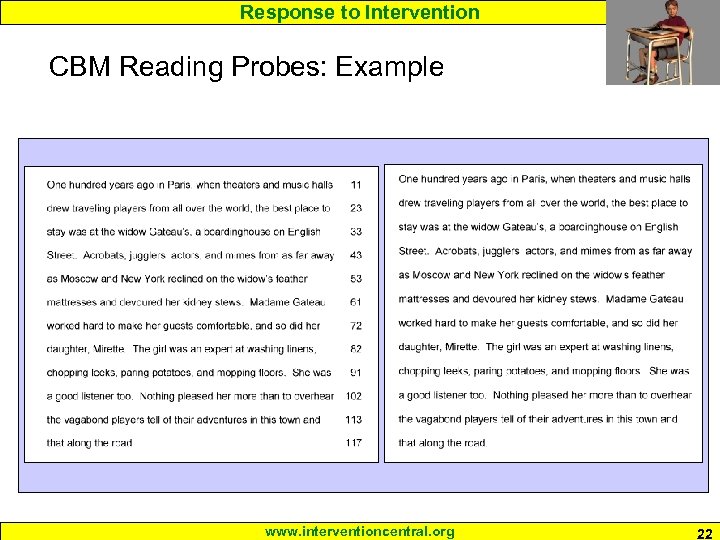
Response to Intervention CBM Reading Probes: Example www. interventioncentral. org 22
Response to Intervention CBM Reading Probes: Administration www. interventioncentral. org 23
Response to Intervention CBM Reading : Administration www. interventioncentral. org
Response to Intervention CBM Reading Probes: Administration Materials needed: • 3 passages selected at random from probe collection • Stopwatch • Pencil, pen, or marker • Quiet, non-distracting location www. interventioncentral. org 25
Response to Intervention CBM Reading Assessment: Administration • Sit at table next to or across from student • Read off standardized directions • Start stopwatch after (a) student reads first word, or (b) examiner provides first word www. interventioncentral. org 26
Response to Intervention CBM Reading Assessment: Administration • Supply correct word if student hesitates for longer than 3 seconds • Mark errors on examiner passage • Mark student stopping point in passage (“]”) at end of 60 seconds • Tell student to stop reading www. interventioncentral. org 27
Response to Intervention CBM Reading Probes: Scoring www. interventioncentral. org 28
Response to Intervention CBM Reading : Scoring www. interventioncentral. org
Response to Intervention CBM Reading Assessment: Scoring Words are counted as correct if. . . • the student repeats a correctly read word • the student self-corrects within 3 seconds • variant pronunciation of a word is due to dialectical differences or speech articulation issues www. interventioncentral. org 30
Response to Intervention CBM Reading Assessment: Scoring Words are counted as incorrect if they are. . . • • • mispronunciations substitutions (e. g. , home for house) omissions hesitations of greater than 3 seconds word transpositions www. interventioncentral. org 31
Response to Intervention CBM Reading Assessment: Scoring Words read aloud are ignored if. . . • the student inserts them into the text www. interventioncentral. org 32
Response to Intervention CBM Reading Assessment: Computing Correctly Read Words Number of correctly read words (CRW) is calculated by: • subtracting number of errors (E) from • total read words (TRW) during timed minute --words read up to end bracket in passage www. interventioncentral. org 33
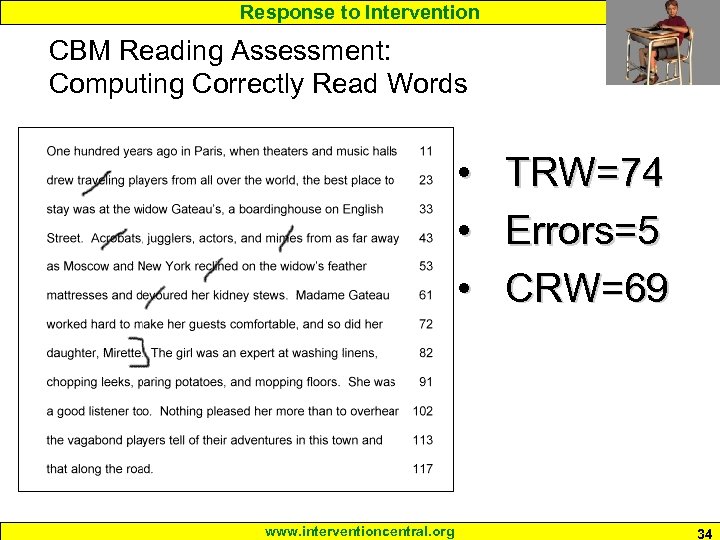
Response to Intervention CBM Reading Assessment: Computing Correctly Read Words • • • www. interventioncentral. org TRW=74 Errors=5 CRW=69 34
Response to Intervention CBM Reading Assessment: Omitted Text Adjustment: 1. Count up the number of words omitted in a segment of a passage 2. Subtract all but one of those omitted words from the total word count (TRW) 3. Repeat for additional omitted passages 4. Count each omission as single error when calculating correctly read words (CRW) www. interventioncentral. org 35
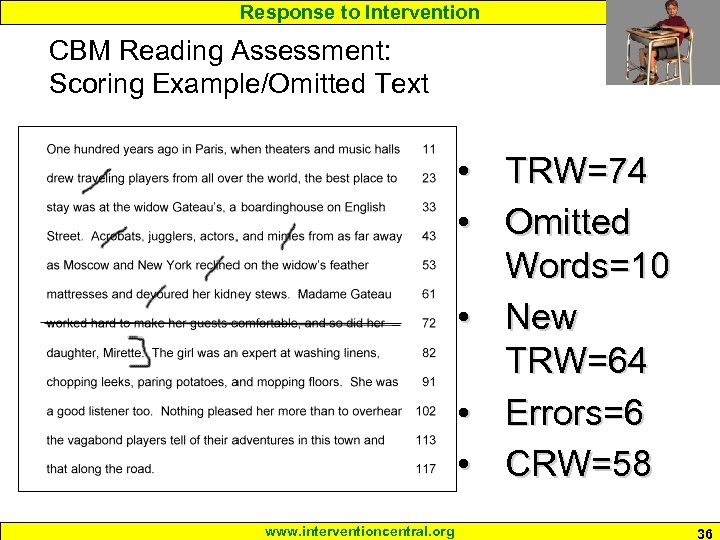
Response to Intervention CBM Reading Assessment: Scoring Example/Omitted Text • TRW=74 • Omitted Words=10 • New TRW=64 • Errors=6 • CRW=58 www. interventioncentral. org 36
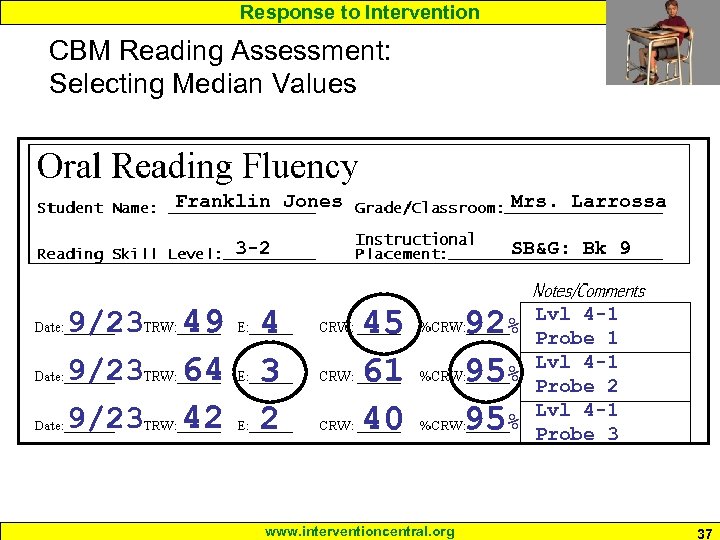
Response to Intervention CBM Reading Assessment: Selecting Median Values Franklin Jones Mrs. Larrossa 3 -2 9/23 49 4 64 3 42 2 SB&G: Bk 9 45 61 40 www. interventioncentral. org 92% 95% Lvl 4 -1 Probe 1 Lvl 4 -1 Probe 2 Lvl 4 -1 Probe 3 37
Response to Intervention CBM: Math Computation www. interventioncentral. org
Response to Intervention In your packet, for CBM Math… Here are key resource and activity materials: • CBM Math Computation: Directions: pp. 7 -11 • Research Norms: Math Computation: p. 17 • Early Math Fluency: Listing: p. 24 • Math Computation & Concepts/Applications: Listing: p. 30 -31 www. interventioncentral. org 39
Response to Intervention CBM Math Computation Probes: Preparation www. interventioncentral. org
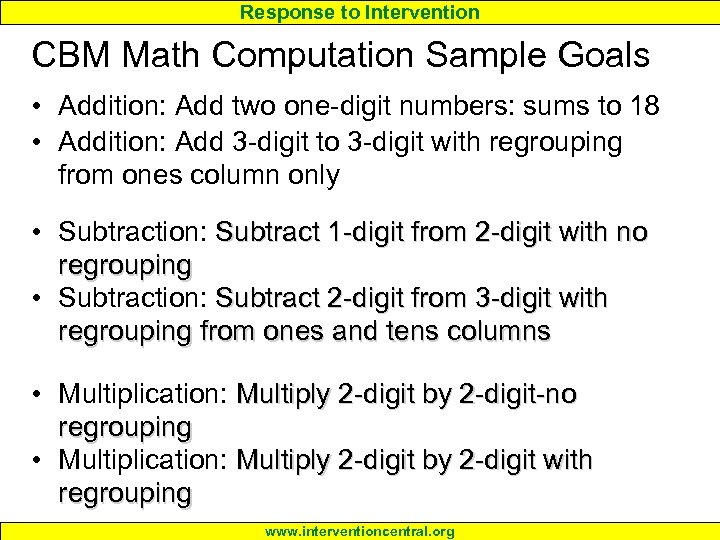
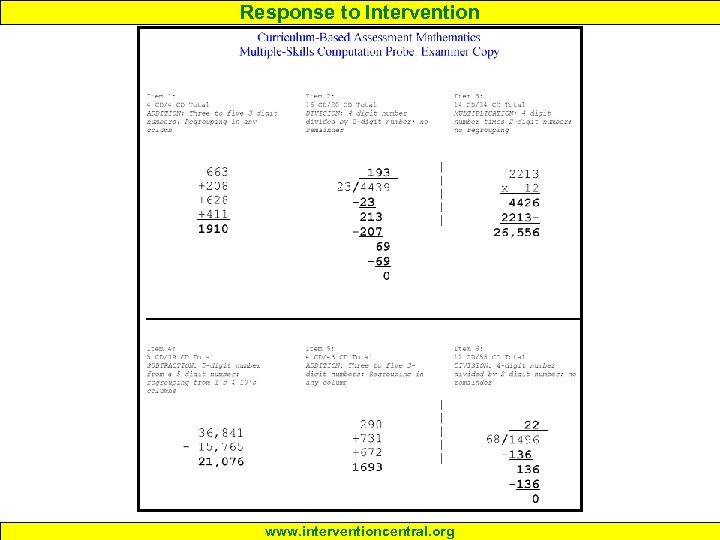
Response to Intervention CBM Math Computation Sample Goals • Addition: Add two one-digit numbers: sums to 18 • Addition: Add 3 -digit to 3 -digit with regrouping from ones column only • Subtraction: Subtract 1 -digit from 2 -digit with no regrouping • Subtraction: Subtract 2 -digit from 3 -digit with regrouping from ones and tens columns • Multiplication: Multiply 2 -digit by 2 -digit-no regrouping • Multiplication: Multiply 2 -digit by 2 -digit with regrouping www. interventioncentral. org
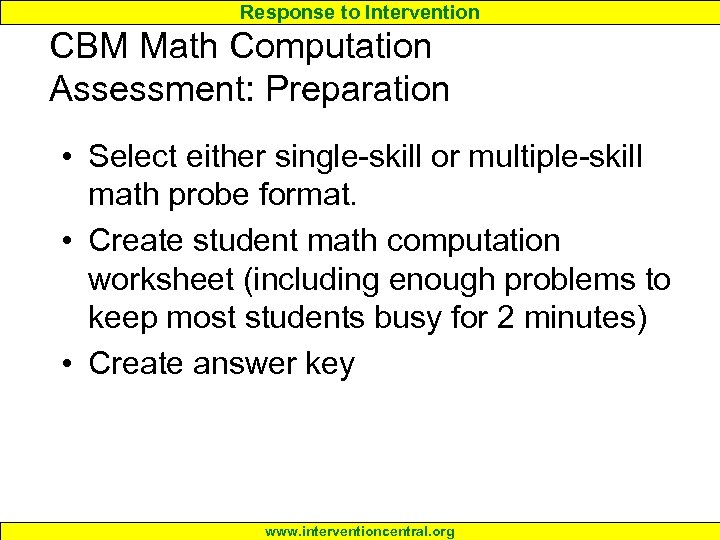
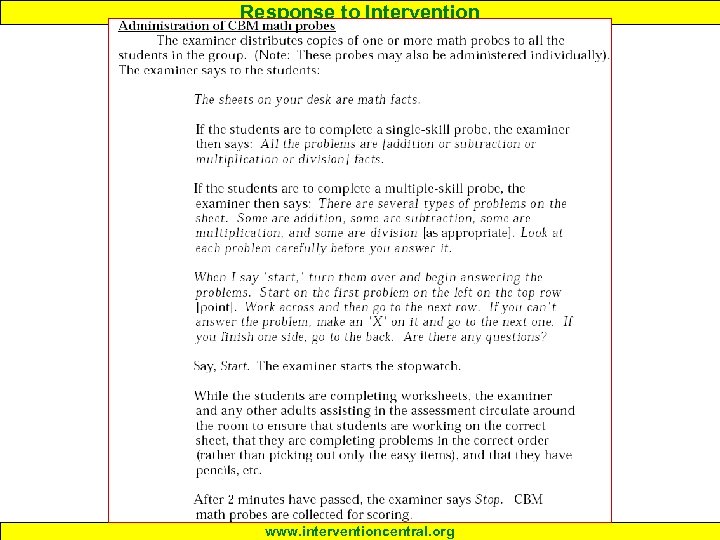
Response to Intervention CBM Math Computation Assessment: Preparation • Select either single-skill or multiple-skill math probe format. • Create student math computation worksheet (including enough problems to keep most students busy for 2 minutes) • Create answer key www. interventioncentral. org
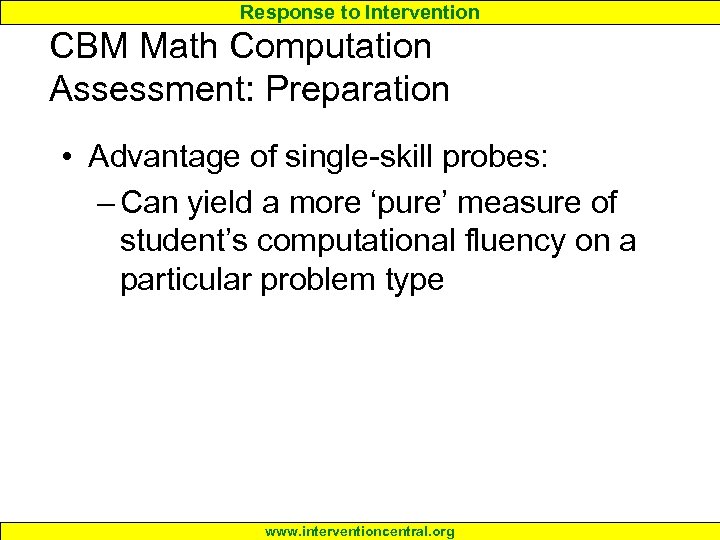
Response to Intervention CBM Math Computation Assessment: Preparation • Advantage of single-skill probes: – Can yield a more ‘pure’ measure of student’s computational fluency on a particular problem type www. interventioncentral. org
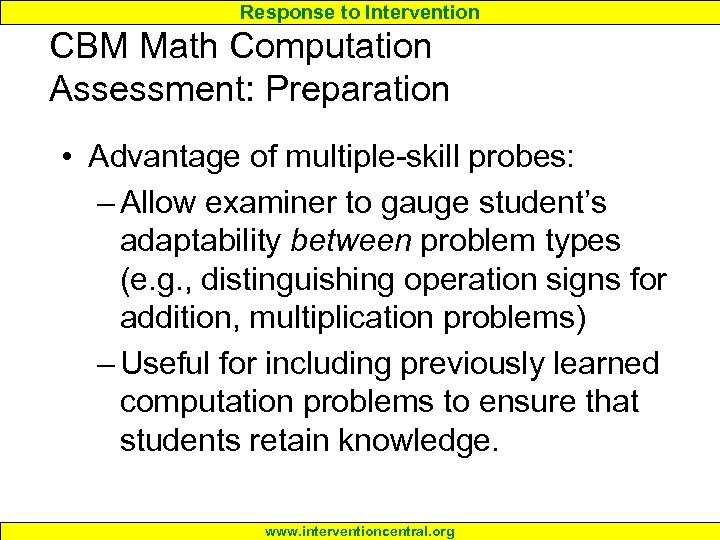
Response to Intervention CBM Math Computation Assessment: Preparation • Advantage of multiple-skill probes: – Allow examiner to gauge student’s adaptability between problem types (e. g. , distinguishing operation signs for addition, multiplication problems) – Useful for including previously learned computation problems to ensure that students retain knowledge. www. interventioncentral. org
Response to Intervention www. interventioncentral. org
Response to Intervention CBM Math Computation Probes: Administration www. interventioncentral. org
Response to Intervention www. interventioncentral. org
Response to Intervention CBM Math Computation Probes: Scoring www. interventioncentral. org
Response to Intervention CBM Math Computation Assessment: Scoring Unlike more traditional methods for scoring math computation problems, CBM gives the student credit for each correct digit in the answer. This approach to scoring is more sensitive to short-term student gains and acknowledges the child’s partial competencies in math. www. interventioncentral. org
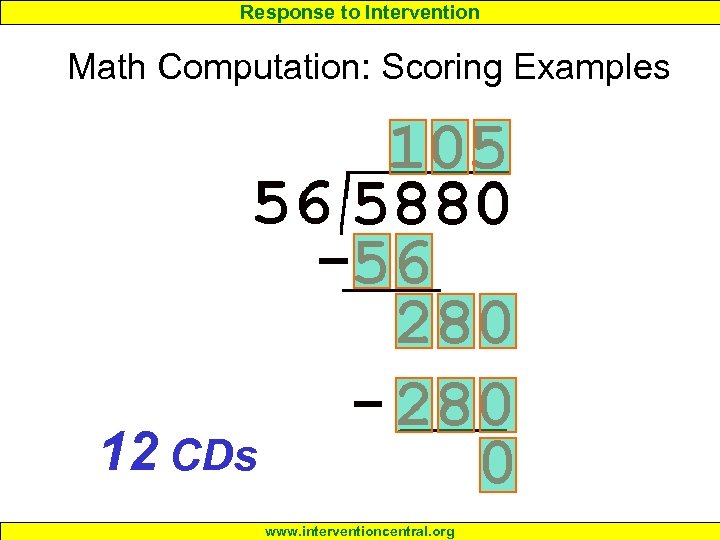
Response to Intervention Math Computation: Scoring Examples 3 2 CDs 12 CDs www. interventioncentral. org
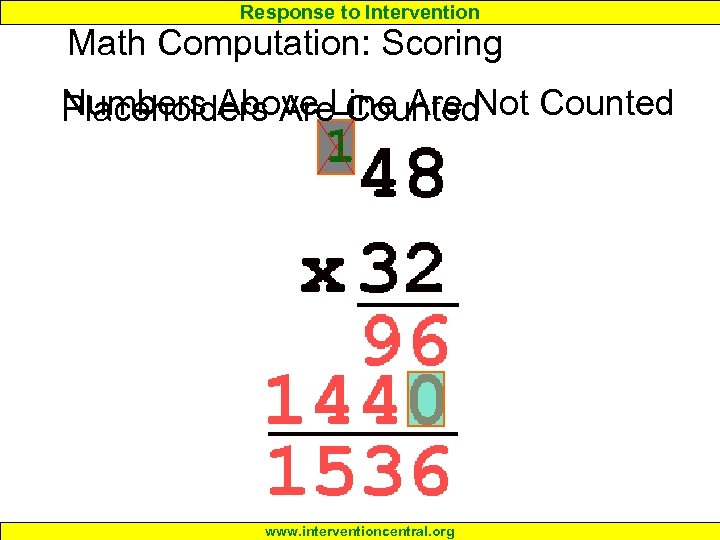
Response to Intervention Math Computation: Scoring Numbers Above Line Are Not Counted Placeholders Are Counted www. interventioncentral. org
Response to Intervention Question: How can a school use CBM Math Computation probes if students are encouraged to use one of several methods to solve a computation problem—and have no fixed algorithm? Answer: Students should know their ‘math facts’ automatically. Therefore, students can be given math computation probes to assess the speed and fluency of basic math facts— even if their curriculum encourages a variety of methods for solving math computation problems. www. interventioncentral. org
Response to Intervention The application to create CBM Early Math Fluency probes online http: //www. interventioncentral. org/php/number fly/ numberfly. php www. interventioncentral. org
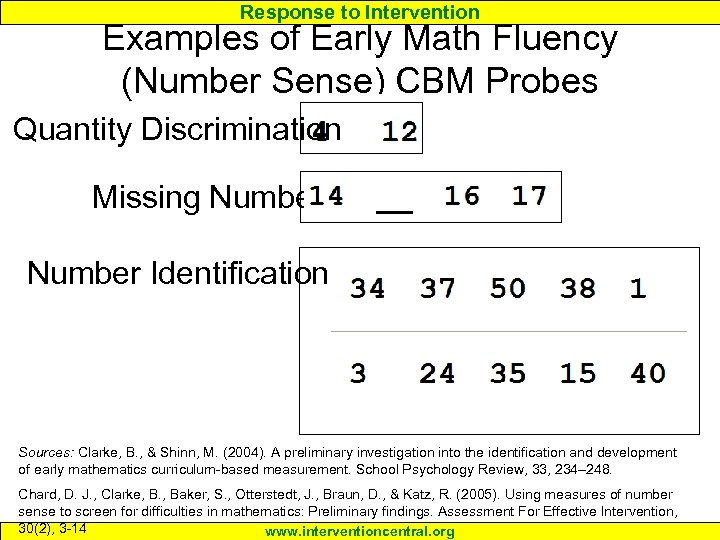
Response to Intervention Examples of Early Math Fluency (Number Sense) CBM Probes Quantity Discrimination Missing Number Identification Sources: Clarke, B. , & Shinn, M. (2004). A preliminary investigation into the identification and development of early mathematics curriculum-based measurement. School Psychology Review, 33, 234– 248. Chard, D. J. , Clarke, B. , Baker, S. , Otterstedt, J. , Braun, D. , & Katz, R. (2005). Using measures of number sense to screen for difficulties in mathematics: Preliminary findings. Assessment For Effective Intervention, 30(2), 3 -14 www. interventioncentral. org
Response to Intervention Curriculum-Based Measurement: Writing Jim Wright www. interventioncentral. org
Response to Intervention In your packet, for CBM Writing… Here are key resource and activity materials: • CBM Writing: Directions: pp. 12 -16 • Research Norms: Writing: Total Words Written: p. 17 www. interventioncentral. org 56
Response to Intervention CBM Writing: Preparation www. interventioncentral. org
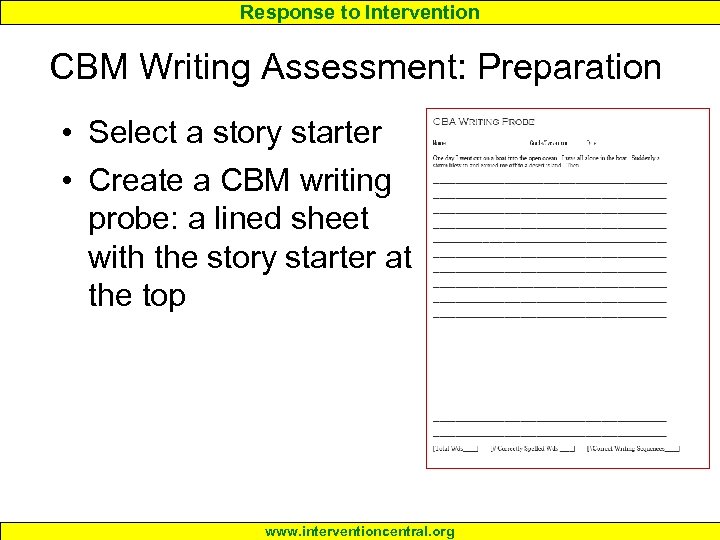
Response to Intervention CBM Writing Assessment: Preparation • Select a story starter • Create a CBM writing probe: a lined sheet with the story starter at the top www. interventioncentral. org
Response to Intervention CBM Writing Assessment: Preparation Story Starter Tips: • Create or collect story starters that students will find motivating to write about. (And toss out starters that don’t inspire much enthusiasm!) • Avoid story starters that allow students simply to generate long lists: e. g. , “What I want for my birthday is…” www. interventioncentral. org
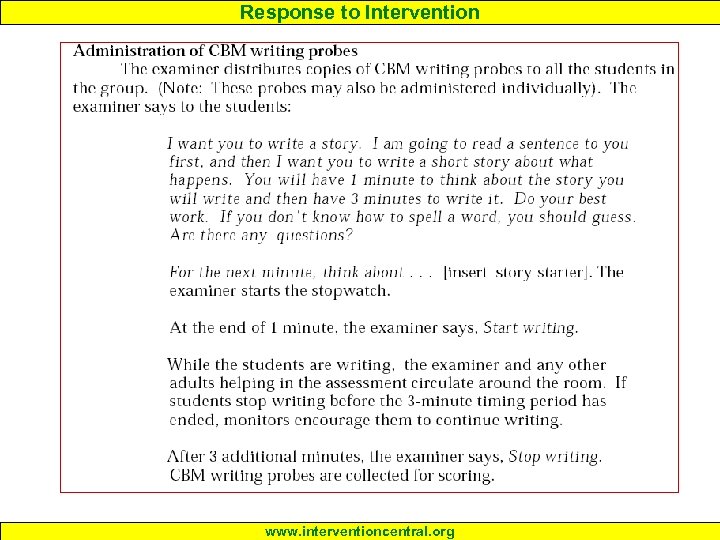
Response to Intervention CBM Writing Probes: Administration www. interventioncentral. org
Response to Intervention www. interventioncentral. org
Response to Intervention CBM Writing Probes: Scoring www. interventioncentral. org
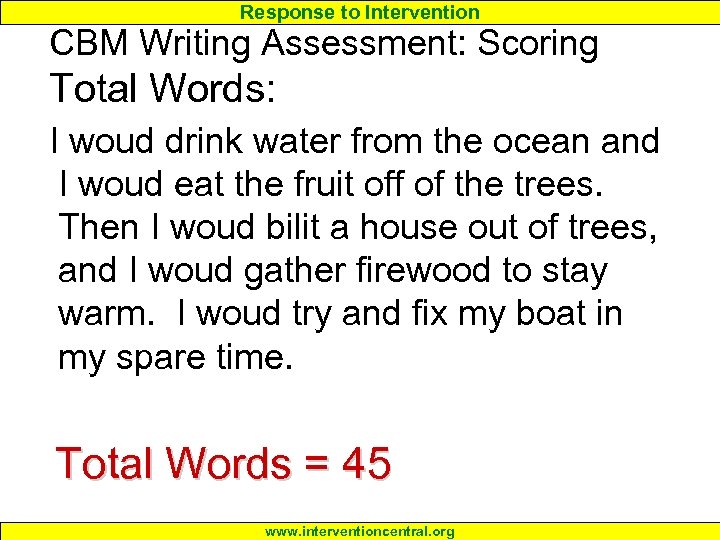
Response to Intervention CBM Writing Assessment: Scoring Total Words: I woud drink water from the ocean and I woud eat the fruit off of the trees. Then I woud bilit a house out of trees, and I woud gather firewood to stay warm. I woud try and fix my boat in my spare time. Total Words = 45 www. interventioncentral. org
Response to Intervention CBM Writing Assessment: Scoring Total Words: Useful for tracking a student’s fluency in writing (irrespective of spelling, punctuation, etc. ) www. interventioncentral. org
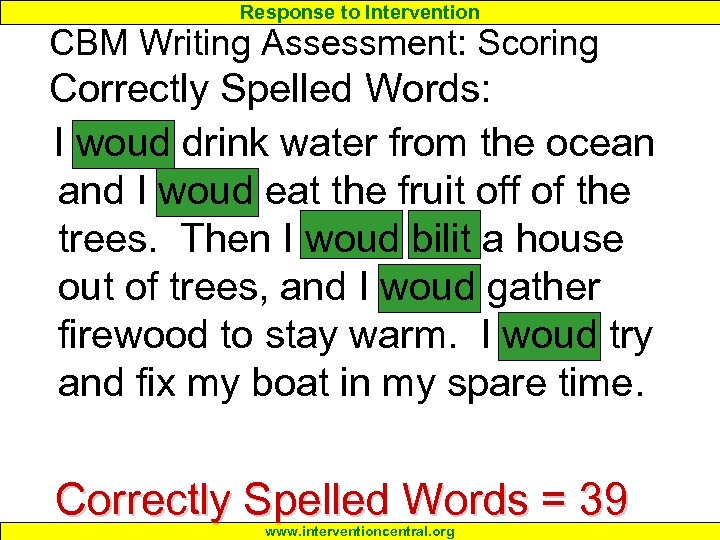
Response to Intervention CBM Writing Assessment: Scoring Correctly Spelled Words: I woud drink water from the ocean and I woud eat the fruit off of the trees. Then I woud bilit a house out of trees, and I woud gather firewood to stay warm. I woud try and fix my boat in my spare time. Correctly Spelled Words = 39 www. interventioncentral. org
Response to Intervention CBM Writing Assessment: Scoring Correctly Spelled Words: Permits teachers to (a) monitor student spelling skills in context of writing assignments, and (b) track student vocabulary usage. www. interventioncentral. org
Response to Intervention CBM Writing Assessment: Scoring Correct Writing Sequences: Most global CBM measure. Looks at quality of writing in context. www. interventioncentral. org
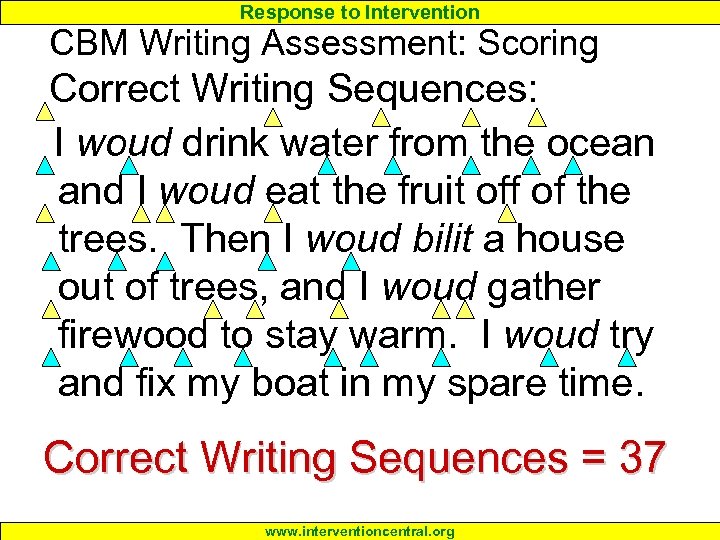
Response to Intervention CBM Writing Assessment: Scoring Correct Writing Sequences: I woud drink water from the ocean and I woud eat the fruit off of the trees. Then I woud bilit a house out of trees, and I woud gather firewood to stay warm. I woud try and fix my boat in my spare time. Correct Writing Sequences = 37 www. interventioncentral. org
Response to Intervention Team Activity: How Can Teachers Use CBMWriting in Their Classrooms? At your table: • Discuss the CBM-Writing assessment methods presented in this workshop. • What are the strengths of CBM -Writing as a classroom assessment tool? • What other methods might teachers use to supplement CBM-Writing to gather more complete information about www. interventioncentral. org
Response to Intervention Creating Progress. Monitoring Charts for CBM Data www. interventioncentral. org
Response to Intervention In your packet, for CBM Charting… Here are key resource and activity materials: • CBM Charting Example: pp. 43 -47 • CBM ORF Charting Form: p. 48 www. interventioncentral. org 74
Response to Intervention Charting Example: Jared M. Background. Your Teacher Support Team has completed a CBM survey-level screening in reading for Jared M. , a 4 th grader. According to his teacher, Jared reads at the beginning 2 nd-grade level. An initial RTI Team meeting is held on Monday, January 20 th. At that meeting, an intervention is designed … Your team schedules a follow -up RTI Team meeting for Monday, March 10 th, about six instructional weeks from the date of the initial meeting. www. interventioncentral. org 77
Response to Intervention Charting Example: Jared M. • 1. Survey-Level Assessment. On Jared’s attached CBM Student Record Form, review the Survey-Level assessment results. For each level of CBM probe administered, circle the median Correctly Read Words (CRWs), Errors (E), and Percentage of Correctly Read Words (%CRWs). Consult Table 1 on the Record Form to identify the student’s Mastery, Instructional, and Frustration levels of reading. www. interventioncentral. org 78
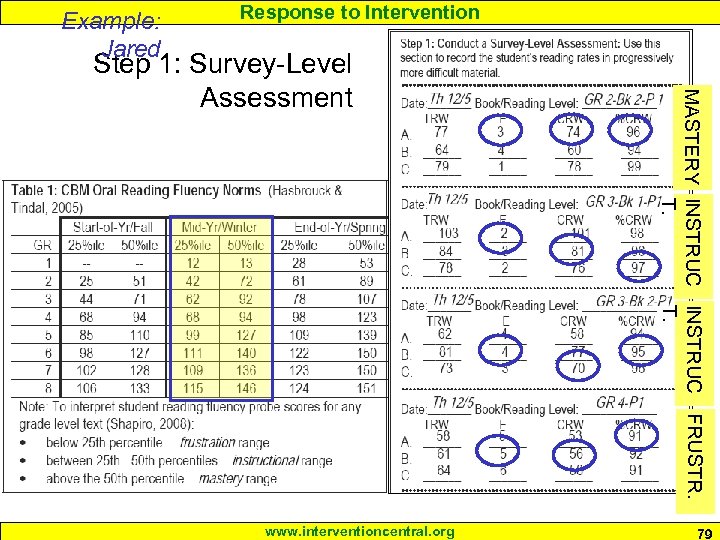
Example: Jared Response to Intervention www. interventioncentral. org MASTERY INSTRUC FRUSTR. T. T. Step 1: Survey-Level Assessment 79
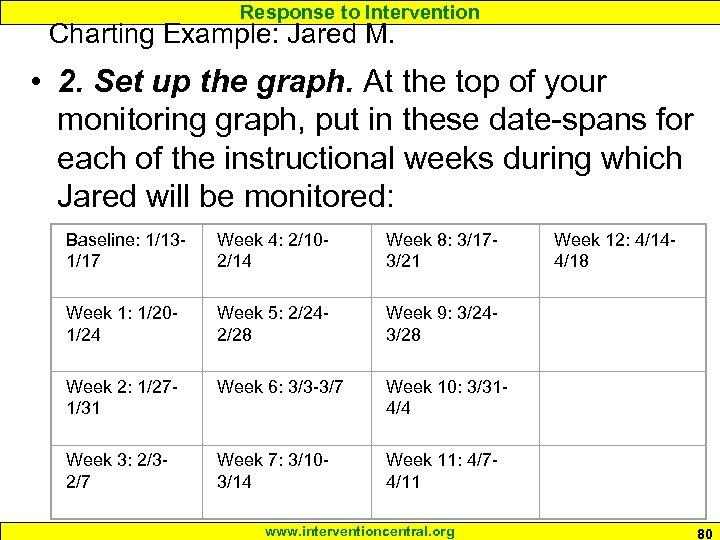
Response to Intervention Charting Example: Jared M. • 2. Set up the graph. At the top of your monitoring graph, put in these date-spans for each of the instructional weeks during which Jared will be monitored: Baseline: 1/131/17 Week 4: 2/102/14 Week 8: 3/173/21 Week 12: 4/144/18 Week 1: 1/201/24 Week 5: 2/242/28 Week 9: 3/243/28 Week 2: 1/271/31 Week 6: 3/3 -3/7 Week 10: 3/314/4 Week 3: 2/32/7 Week 7: 3/103/14 Week 11: 4/74/11 www. interventioncentral. org 80
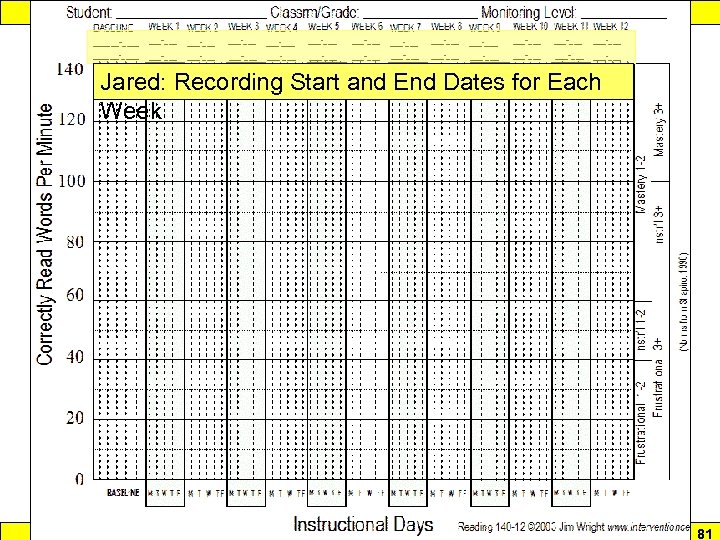
Response to Intervention Jared: Recording Start and End Dates for Each Week www. interventioncentral. org 81
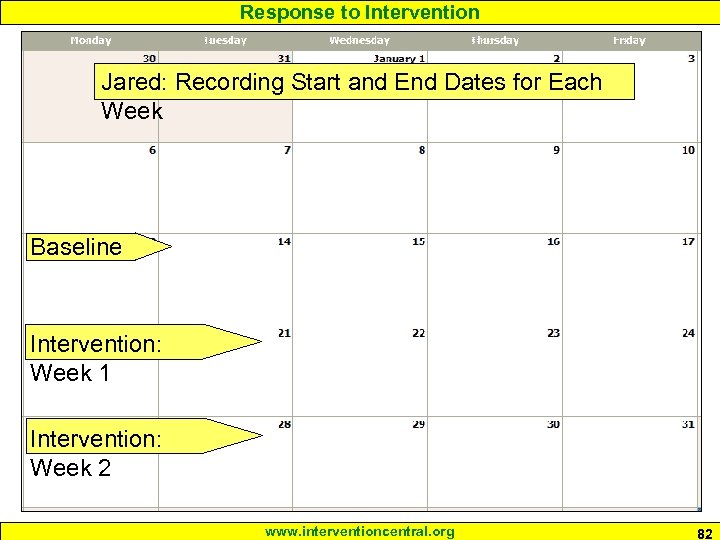
Response to Intervention Jared: Recording Start and End Dates for Each Week Baseline Intervention: Week 1 Intervention: Week 2 www. interventioncentral. org 82
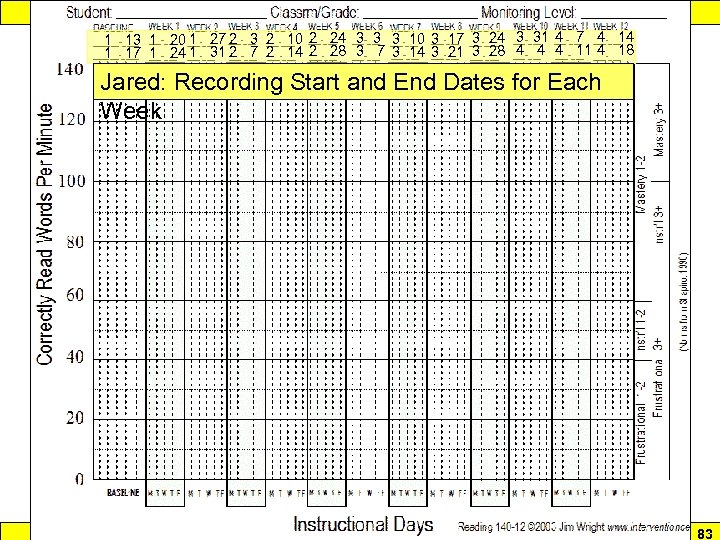
Response to Intervention 1 13 1 20 1 27 2 3 2 10 2 24 3 3 3 10 3 17 3 24 3 31 4 7 4 14 1 17 1 24 1 31 2 7 2 14 2 28 3 7 3 14 3 21 3 28 4 4 4 11 4 18 Jared: Recording Start and End Dates for Each Week www. interventioncentral. org 83
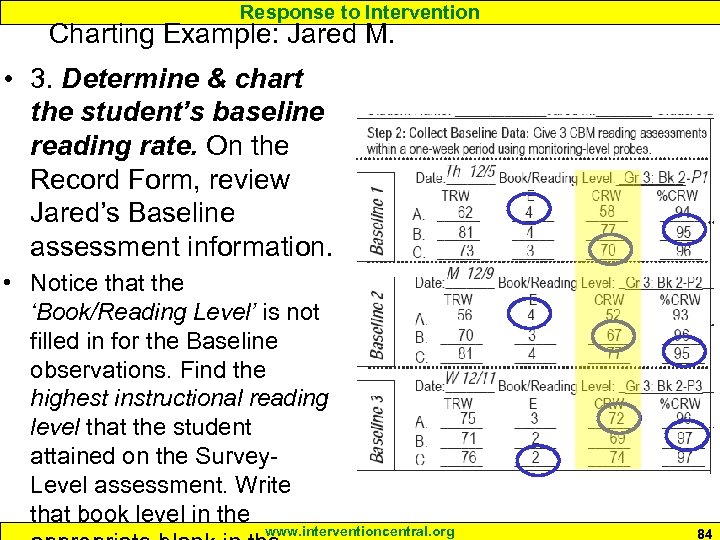
Response to Intervention Charting Example: Jared M. • 3. Determine & chart the student’s baseline reading rate. On the Record Form, review Jared’s Baseline assessment information. • Notice that the ‘Book/Reading Level’ is not filled in for the Baseline observations. Find the highest instructional reading level that the student attained on the Survey. Level assessment. Write that book level in the www. interventioncentral. org 84
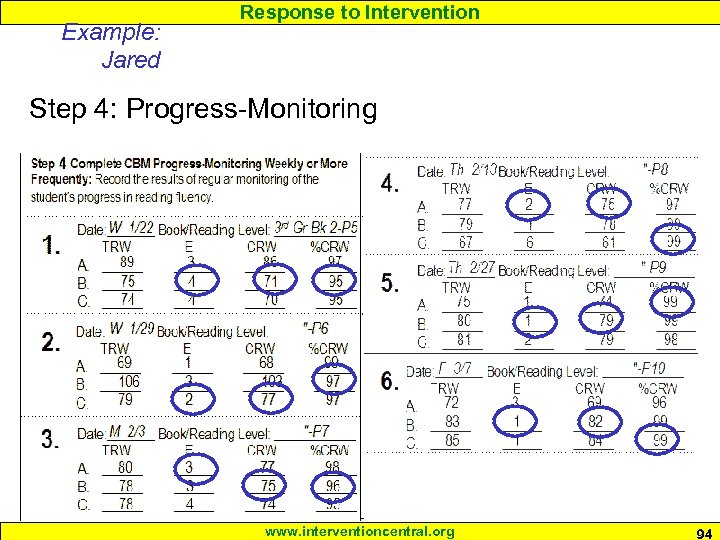
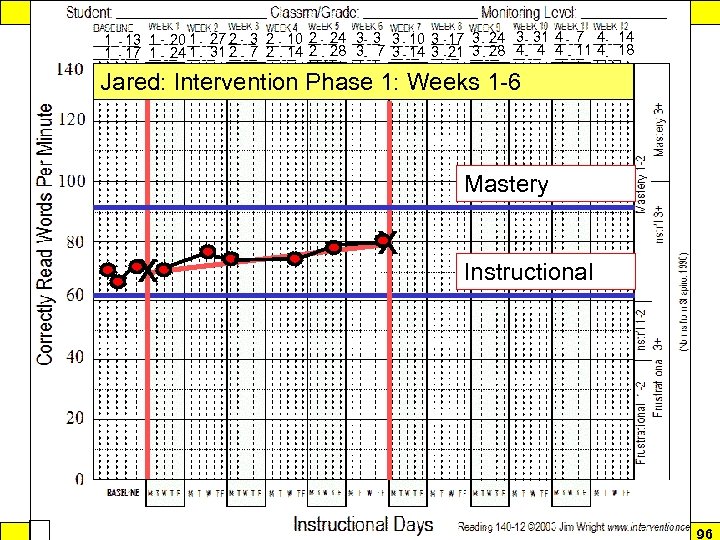
Response to Intervention Charting Example: Jared M. 3. 3. Determine & chart the student’s baseline reading rate (Cont. ) • Circle the median CRW and E for each of the Baseline observations. • On the progress-monitoring graph, chart the median CRWs and Es for all 3 observations. • Circle this middle Baseline datapoint on your chart. www. interventioncentral. org 85
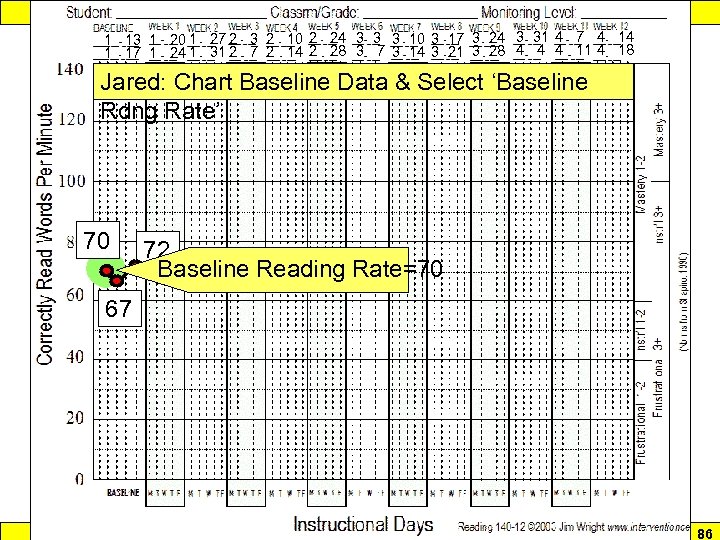
Response to Intervention 1 13 1 20 1 27 2 3 2 10 2 24 3 3 3 10 3 17 3 24 3 31 4 7 4 14 1 17 1 24 1 31 2 7 2 14 2 28 3 7 3 14 3 21 3 28 4 4 4 11 4 18 Jared: Chart Baseline Data & Select ‘Baseline Rdng Rate’ 70 72 Baseline Reading Rate=70 67 www. interventioncentral. org 86
Response to Intervention Charting Example: Jared M. • 4. Set a performance goal. To compute Jared’s performance goal in reading: – Use Table 2 on the Record Form to identify the rate of progress that Jared should make each week in goal-level (3 rd-Grade) reading material. – You will recall that your RTI Team has decided to monitor Jared’s reading for six weeks before holding a follow-up meeting. To compute how much Jared’s reading rate should increase in that time, multiply his expected weekly progress by the number of weeks that he will be monitored. – Add Jared’s expected reading progress to his baseline reading rate. This combined figure is www. interventioncentral. org Jared’s reading goal. 87
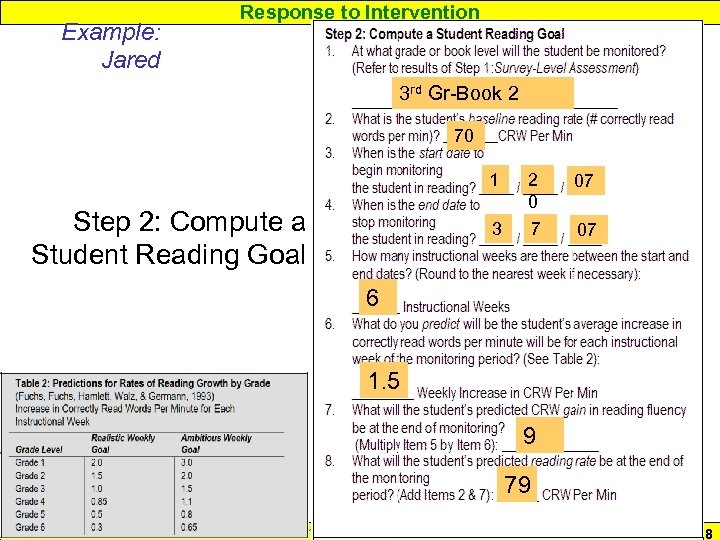
Example: Jared Response to Intervention 3 rd Gr-Book 2 70 1 07 3 Step 2: Compute a Student Reading Goal 2 0 7 07 6 1. 5 9 79 www. interventioncentral. org 88
Response to Intervention Charting Example: Jared M. 5. Plot the ‘Aim-Line’. To graph a 6 -week ‘aim-line’: • Draw a vertical dividing line (‘start-line’) at the point where the intervention will begin (start of Week 1). • Draw a second dividing line on the graph (‘endline’) that marks the conclusion of six weeks of monitoring (end of Week 6). • On the start-line, mark an ‘X’ at the point that is equal to the value of your circled baseline datapoint. • Mark Jared’s reading goal with an ‘X’ at the appropriate spot on the end-line. • Now draw a straight line between the start-line and end-line ‘X’s. This is your chart’s aim-line. www. interventioncentral. org 89
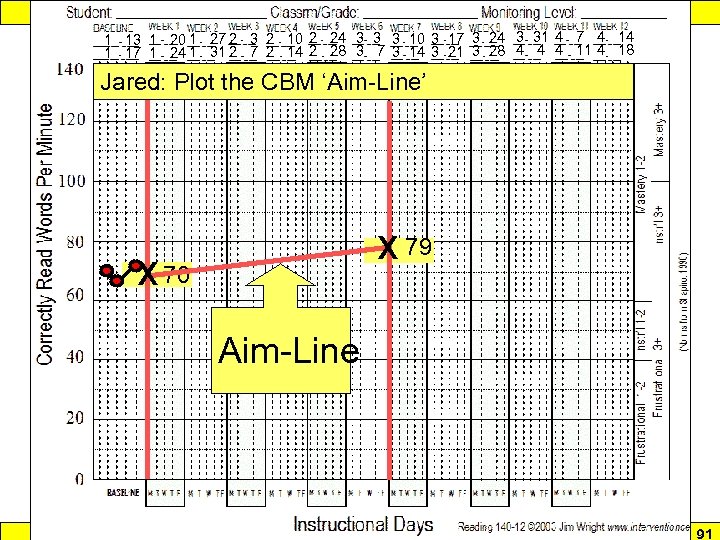
Response to Intervention 1 13 1 20 1 27 2 3 2 10 2 24 3 3 3 10 3 17 3 24 3 31 4 7 4 14 1 17 1 24 1 31 2 7 2 14 2 28 3 7 3 14 3 21 3 28 4 4 4 11 4 18 Jared: Plot the CBM ‘Aim-Line’ X 79 X 70 Aim-Line www. interventioncentral. org 91
Response to Intervention Charting Example: Jared M. 6. Plot Jared’s progress-monitoring data. Review Jared’s CBM data for the first six weeks of progress-monitoring. • Circle the median CRWs and Es. • Plot these values on the chart. What conclusions do you draw from the chart? • Based on these data, should the RTI Team recommend changing Jared’s intervention? Keep it in place with no changes? Why? www. interventioncentral. org 93
Example: Jared Response to Intervention Step 4: Progress-Monitoring www. interventioncentral. org 94
Response to Intervention 1 13 1 20 1 27 2 3 2 10 2 24 3 3 3 10 3 17 3 24 3 31 4 7 4 14 1 17 1 24 1 31 2 7 2 14 2 28 3 7 3 14 3 21 3 28 4 4 4 11 4 18 Jared: Intervention Phase 1: Weeks 1 -6 Mastery X X www. interventioncentral. org Instructional 96
Response to Intervention Writing IEP Goals for CBM www. interventioncentral. org
Response to Intervention In your packet, for CBM IEP goals… Here are key resource and activity materials: • Format for Writing CBM IEP Goals: p. 31 www. interventioncentral. org 98
Response to Intervention CBM: Elements of IEP Goals An IEP goal written for curriculum-based measurement has three components: 1. Conditions under which the data is collected 2. Student behavior to be directly observed & measured 3. Criterion for judging the student’s performance www. interventioncentral. org 99
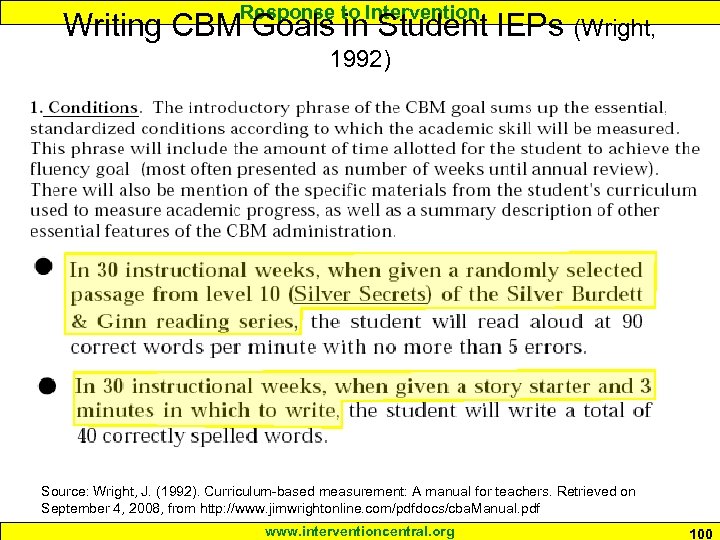
Response to Intervention Writing CBM Goals in Student IEPs (Wright, 1992) Source: Wright, J. (1992). Curriculum-based measurement: A manual for teachers. Retrieved on September 4, 2008, from http: //www. jimwrightonline. com/pdfdocs/cba. Manual. pdf www. interventioncentral. org 100
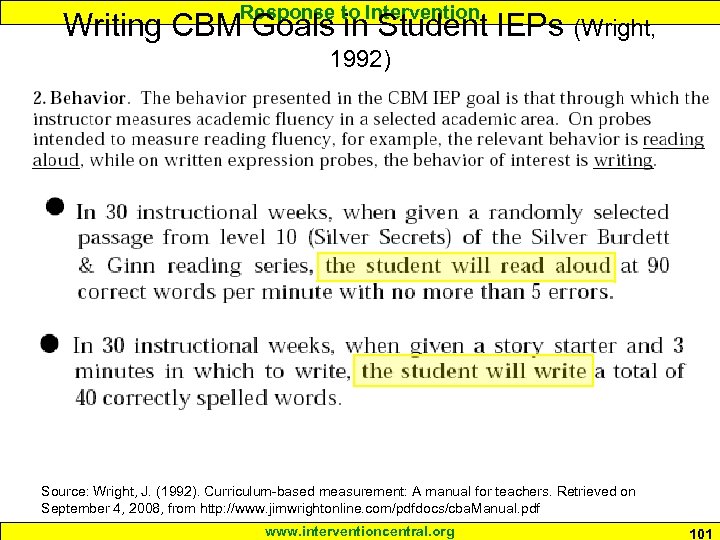
Response to Intervention Writing CBM Goals in Student IEPs (Wright, 1992) Source: Wright, J. (1992). Curriculum-based measurement: A manual for teachers. Retrieved on September 4, 2008, from http: //www. jimwrightonline. com/pdfdocs/cba. Manual. pdf www. interventioncentral. org 101
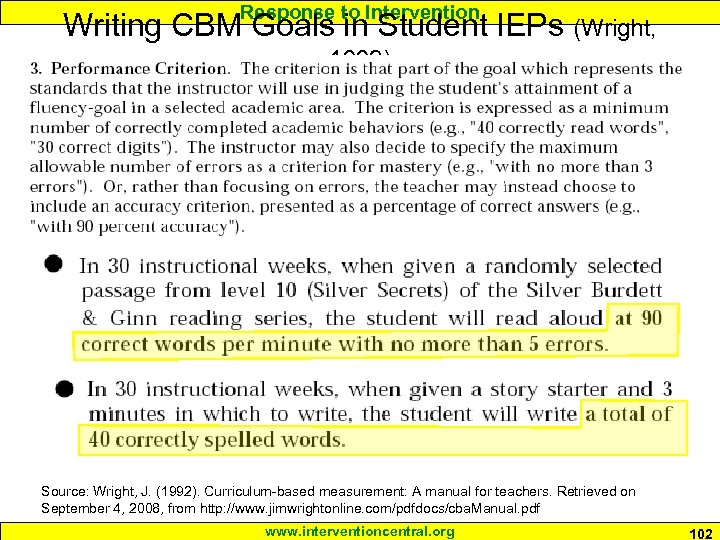
Response to Intervention Writing CBM Goals in Student IEPs (Wright, 1992) Source: Wright, J. (1992). Curriculum-based measurement: A manual for teachers. Retrieved on September 4, 2008, from http: //www. jimwrightonline. com/pdfdocs/cba. Manual. pdf www. interventioncentral. org 102
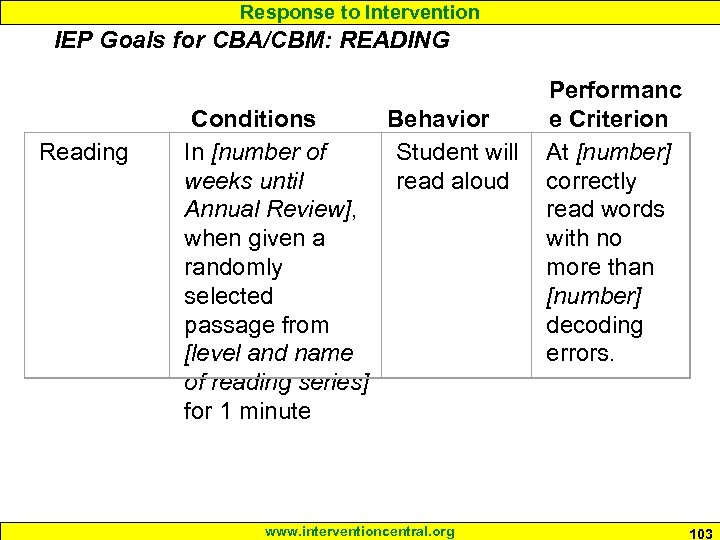
Response to Intervention IEP Goals for CBA/CBM: READING Reading Performanc Conditions Behavior e Criterion In [number of Student will At [number] weeks until read aloud correctly Annual Review], read words when given a with no randomly more than selected [number] passage from decoding [level and name errors. of reading series] for 1 minute www. interventioncentral. org 103
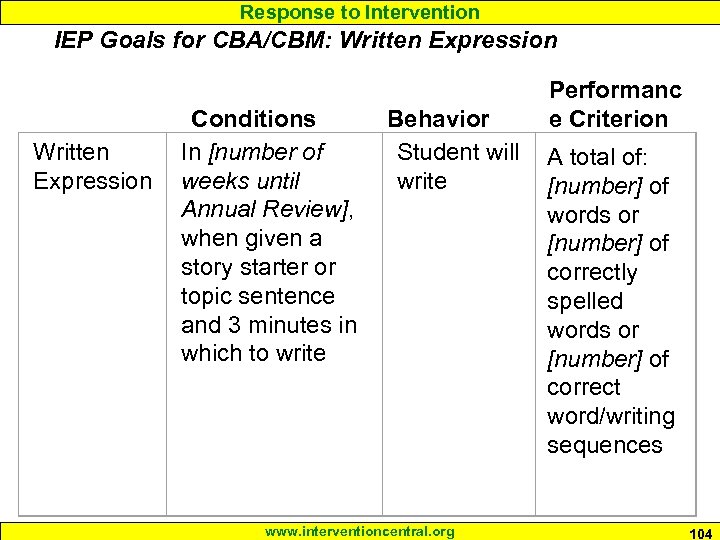
Response to Intervention IEP Goals for CBA/CBM: Written Expression Conditions Behavior In [number of Student will weeks until write Annual Review], when given a story starter or topic sentence and 3 minutes in which to write www. interventioncentral. org Performanc e Criterion A total of: [number] of words or [number] of correctly spelled words or [number] of correct word/writing sequences 104
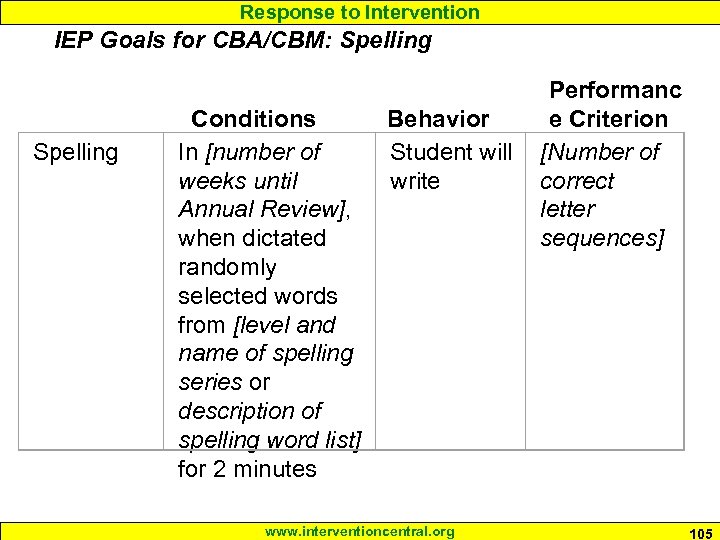
Response to Intervention IEP Goals for CBA/CBM: Spelling Conditions In [number of weeks until Annual Review], when dictated randomly selected words from [level and name of spelling series or description of spelling word list] for 2 minutes Performanc Behavior e Criterion Student will [Number of write correct letter sequences] www. interventioncentral. org 105
Response to Intervention The Special Educator & Data Collection: Expectations www. interventioncentral. org
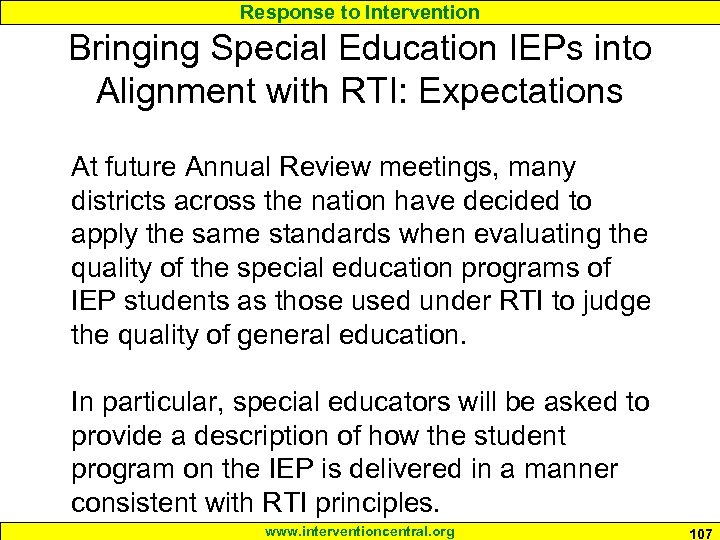
Response to Intervention Bringing Special Education IEPs into Alignment with RTI: Expectations At future Annual Review meetings, many districts across the nation have decided to apply the same standards when evaluating the quality of the special education programs of IEP students as those used under RTI to judge the quality of general education. In particular, special educators will be asked to provide a description of how the student program on the IEP is delivered in a manner consistent with RTI principles. www. interventioncentral. org 107
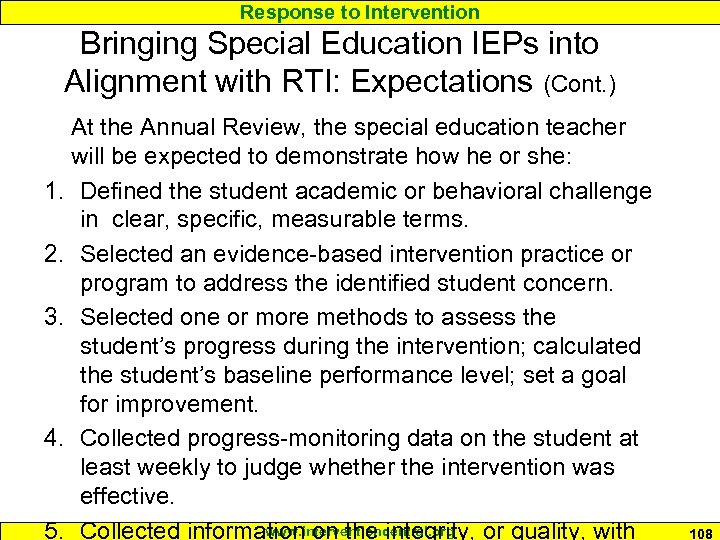
Response to Intervention Bringing Special Education IEPs into Alignment with RTI: Expectations (Cont. ) At the Annual Review, the special education teacher will be expected to demonstrate how he or she: 1. Defined the student academic or behavioral challenge in clear, specific, measurable terms. 2. Selected an evidence-based intervention practice or program to address the identified student concern. 3. Selected one or more methods to assess the student’s progress during the intervention; calculated the student’s baseline performance level; set a goal for improvement. 4. Collected progress-monitoring data on the student at least weekly to judge whether the intervention was effective. www. interventioncentral. org 5. Collected information on the integrity, or quality, with 108
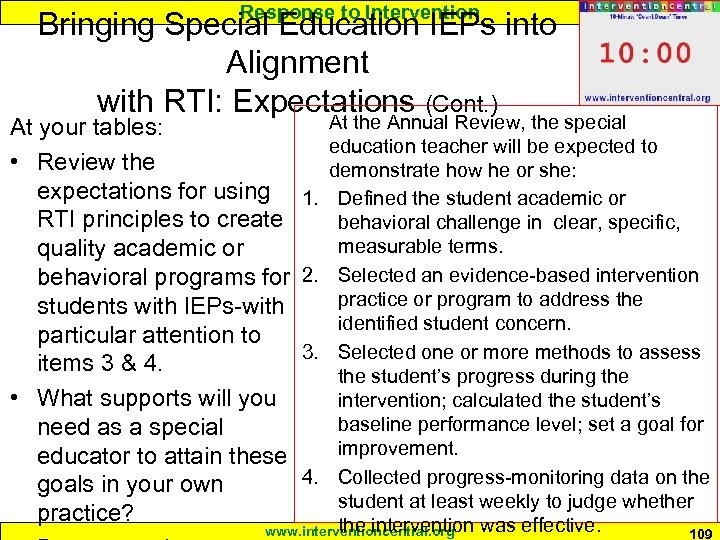
Response to Intervention Bringing Special Education IEPs into Alignment with RTI: Expectations (Cont. ) At the Annual Review, the special education teacher will be expected to demonstrate how he or she: Defined the student academic or behavioral challenge in clear, specific, measurable terms. Selected an evidence-based intervention practice or program to address the identified student concern. Selected one or more methods to assess the student’s progress during the intervention; calculated the student’s baseline performance level; set a goal for improvement. Collected progress-monitoring data on the student at least weekly to judge whether the intervention was effective. www. interventioncentral. org 109 At your tables: • Review the expectations for using 1. RTI principles to create quality academic or behavioral programs for 2. students with IEPs-with particular attention to 3. items 3 & 4. • What supports will you need as a special educator to attain these 4. goals in your own practice?
Скачать презентацию Response to Intervention Curriculum-Based Measurement Special Educators
6569fb26b3d1b16e9cb91a59795d04d9.ppt