 Скачать презентацию Response to Intervention at Brown International Academy Suzanne
8b8e2014f32b33fd94376b315c911bb9.ppt
- Количество слайдов: 85



Response to Intervention at Brown International Academy Suzanne Loughran Sally Whitelock
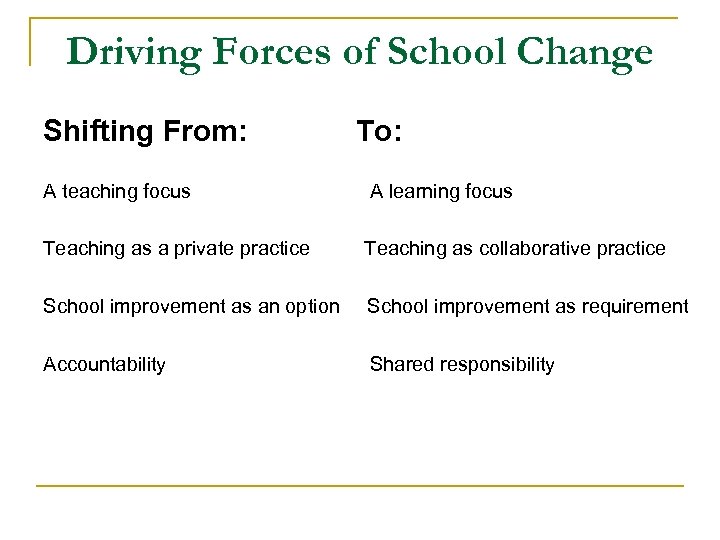
Driving Forces of School Change Shifting From: To: A teaching focus A learning focus Teaching as a private practice Teaching as collaborative practice School improvement as an option School improvement as requirement Accountability Shared responsibility
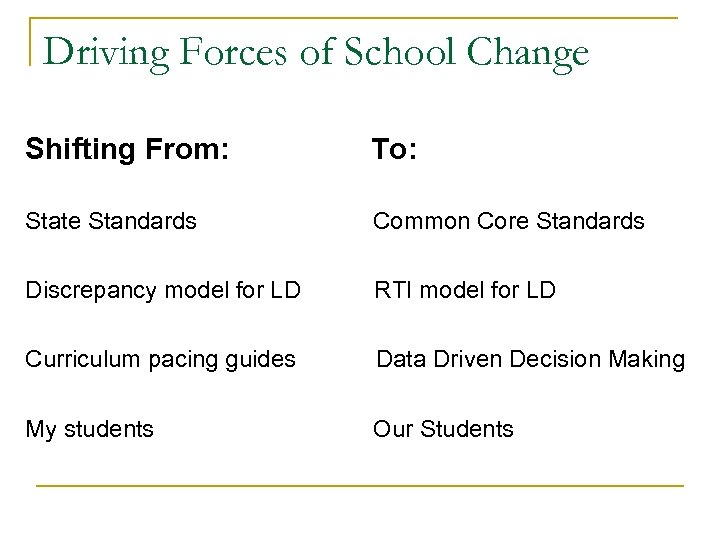
Driving Forces of School Change Shifting From: To: State Standards Common Core Standards Discrepancy model for LD RTI model for LD Curriculum pacing guides Data Driven Decision Making My students Our Students

Couldn't help it ma, that first step is a a big one!
RTI n “is the practice of providing high-quality research based instruction and interventions matched to student needs, monitoring progress frequently and utilizing student data to make instructional decisions. ”
RTI n “is characterized by a systematic approach to allocating resources, whereby students access appropriate levels of support and intervention, given their academic and/or behavioral needs. ” n “The goal of the process is accelerating learning for all students, and driven by a belief that all children can learn and achieve high standards as a result of effective teaching. ” Renaissance Learning
RTI In Colorado a three-tiered delivery system is recommended which groups students with common needs which can be met with more intensive, sometimes different instructional approaches than the core curriculum.
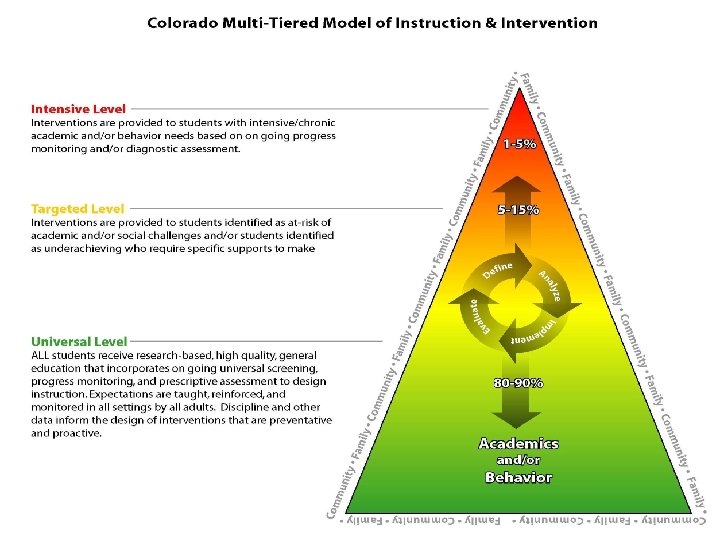
Tier 1 n Represents the majority of students (Ideally 80%) predominantly served by the core instructional programs. n Tier 1 instruction includes research-based curricula and instructional strategies that are aligned with Colorado State Standards and Benchmarks. It utilizes flexible grouping and focuses on specific data driven learning targets.
Tier II n Tier II represents a smaller group of students (10 -15%) who may require specific interventions to achieve the learning rate necessary to meet grade level academic benchmarks. n Interventions are strategies, “targeted” or “supplemental” and may or may not be different from the core programs, or adaptations of it depending on the outcome of the data team problem-solving process.
Tier III n Tier III represents an even smaller group of students (5 -10%) who need “intensive” intervention. n Students in Tier III generally need more time in intervention groups to make progress and require more systematic slower paced instruction with more practice cycles. In some cases it may be the same curriculum used in Tier II but intensified in frequency, duration and practice cycles.
Development of RTI at Brown Major Components of Brown’s RTI Model n School-wide vision and structures n Core Curriculum n Assessment process n Data Based Decision Making n Group Development
Components of RTI at Brown n n School-wide vision and structures q Vision q Use of Resources: Flooding and Technology q Professional Development Core Curriculum and Interventions q Guaranteed and Viable Core Curriculum q Research-base Tier 2 and 3 interventions Assessment q Screening Assessments q Formative Assessments q Progress Monitoring q Summative Assessments Data-based Decision Making q School Improvement Goals & Plan q Collaborative problem-solving in weekly data teams q Student Intervention Teams Group Development q Problem solving protocols q Data driven dialogue q Essential Agreements

School-wide vision and structures At Brown International Academy
School-wide Vision and Structures n Vision q q High expectations IB PYP program and philosophy Standards-based instruction Collaborative problem solving and collective responsibility
School-wide Vision and Structures n Use of Resources q Daily Schedule n n n q Technology n n q Driven by the flooding model (for Tier 2 and 3 interventions) Ensures daily core instruction and interventions for reading and math Maximizes resources in the building Purchased assessment resources (STAR reading, SEL, STAR math) Intervention resources (Larson math, i. Succeed Math, Math Facts in a Flash) All teachers in the school n n Budget for intervention teachers Use Spanish teacher and Librarian
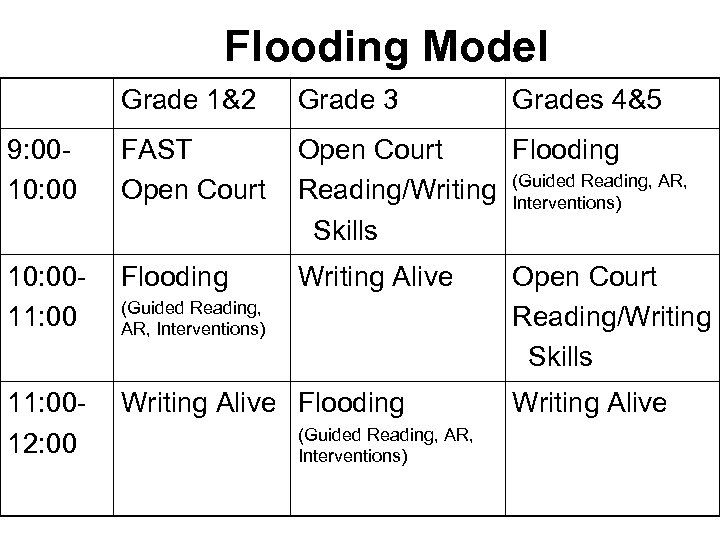
Flooding Model Grade 1&2 Grade 3 9: 0010: 00 FAST Open Court Flooding Reading/Writing (Guided Reading, AR, Interventions) Skills 10: 0011: 00 Flooding Writing Alive (Guided Reading, AR, Interventions) Open Court Reading/Writing Skills 11: 0012: 00 Writing Alive Flooding Writing Alive (Guided Reading, AR, Interventions) Grades 4&5
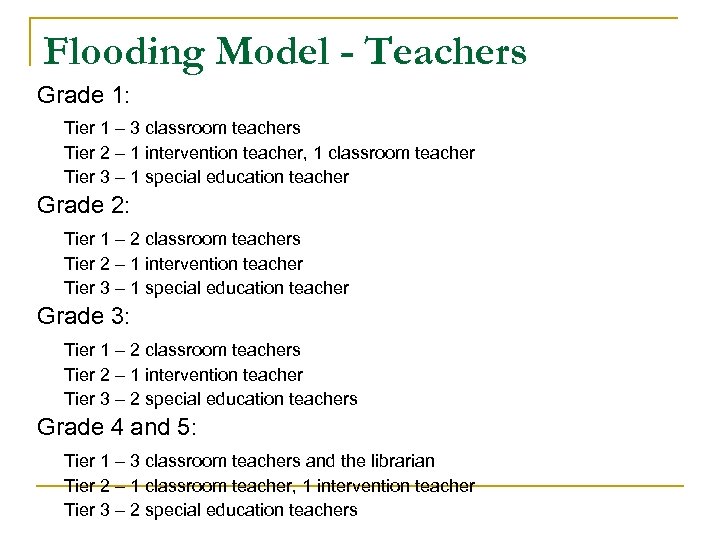
Flooding Model - Teachers Grade 1: Tier 1 – 3 classroom teachers Tier 2 – 1 intervention teacher, 1 classroom teacher Tier 3 – 1 special education teacher Grade 2: Tier 1 – 2 classroom teachers Tier 2 – 1 intervention teacher Tier 3 – 1 special education teacher Grade 3: Tier 1 – 2 classroom teachers Tier 2 – 1 intervention teacher Tier 3 – 2 special education teachers Grade 4 and 5: Tier 1 – 3 classroom teachers and the librarian Tier 2 – 1 classroom teacher, 1 intervention teacher Tier 3 – 2 special education teachers
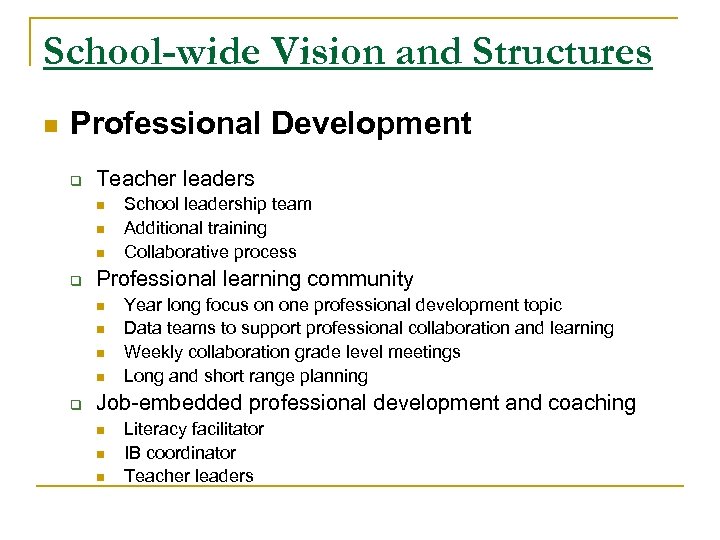
School-wide Vision and Structures n Professional Development q Teacher leaders n n n q Professional learning community n n q School leadership team Additional training Collaborative process Year long focus on one professional development topic Data teams to support professional collaboration and learning Weekly collaboration grade level meetings Long and short range planning Job-embedded professional development and coaching n n n Literacy facilitator IB coordinator Teacher leaders

Core Curriculum and Interventions At Brown International Academy
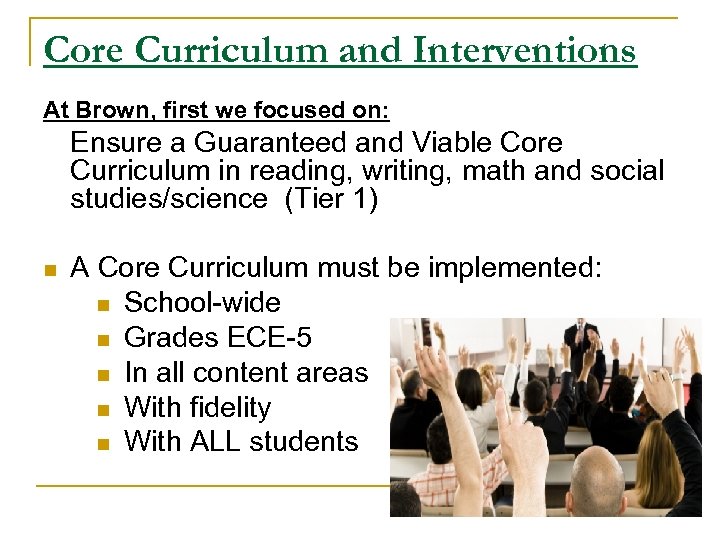
Core Curriculum and Interventions At Brown, first we focused on: Ensure a Guaranteed and Viable Core Curriculum in reading, writing, math and social studies/science (Tier 1) n A Core Curriculum must be implemented: n School-wide n Grades ECE-5 n In all content areas n With fidelity n With ALL students
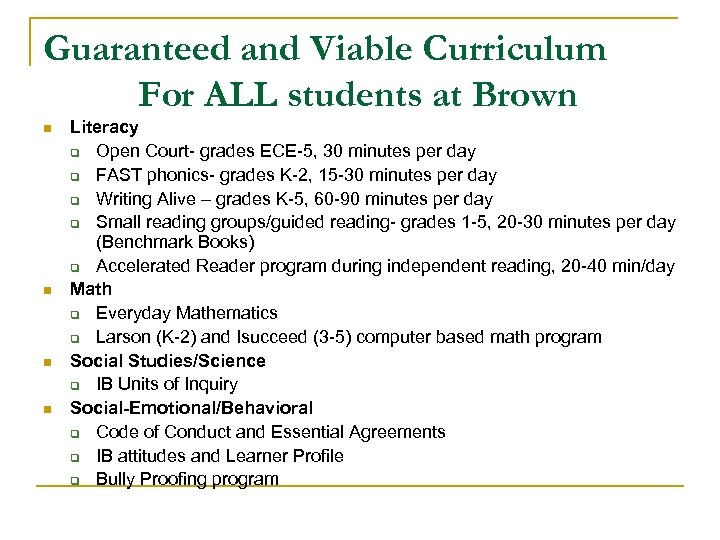
Guaranteed and Viable Curriculum For ALL students at Brown n n Literacy q Open Court- grades ECE-5, 30 minutes per day q FAST phonics- grades K-2, 15 -30 minutes per day q Writing Alive – grades K-5, 60 -90 minutes per day q Small reading groups/guided reading- grades 1 -5, 20 -30 minutes per day (Benchmark Books) q Accelerated Reader program during independent reading, 20 -40 min/day Math q Everyday Mathematics q Larson (K-2) and Isucceed (3 -5) computer based math program Social Studies/Science q IB Units of Inquiry Social-Emotional/Behavioral q Code of Conduct and Essential Agreements q IB attitudes and Learner Profile q Bully Proofing program
Core Curriculum and Interventions At Brown, next we focused on: Implemented research-based interventions (Tier 2 and Tier 3) for all students below grade level proficiency. n Research-based Interventions Implemented (Tier 2 and 3): n n n For all students who need it, based on universal screening and summative assessment data With fidelity First in reading, then in math
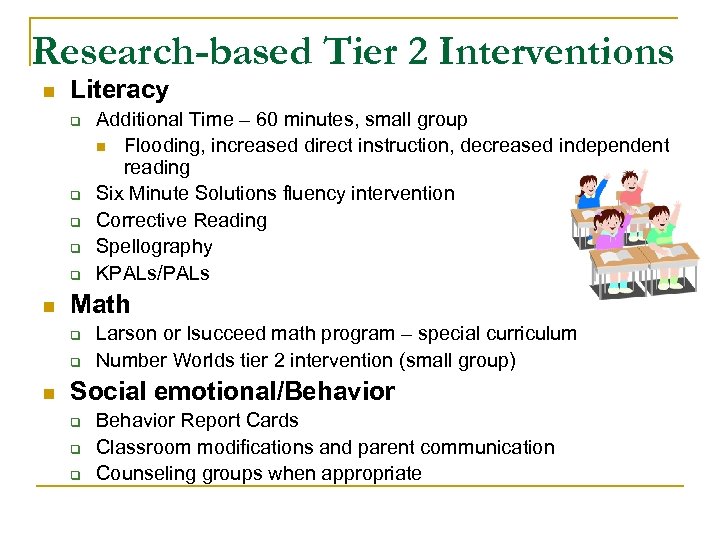
Research-based Tier 2 Interventions n Literacy q q q n Math q q n Additional Time – 60 minutes, small group n Flooding, increased direct instruction, decreased independent reading Six Minute Solutions fluency intervention Corrective Reading Spellography KPALs/PALs Larson or Isucceed math program – special curriculum Number Worlds tier 2 intervention (small group) Social emotional/Behavior q q q Behavior Report Cards Classroom modifications and parent communication Counseling groups when appropriate
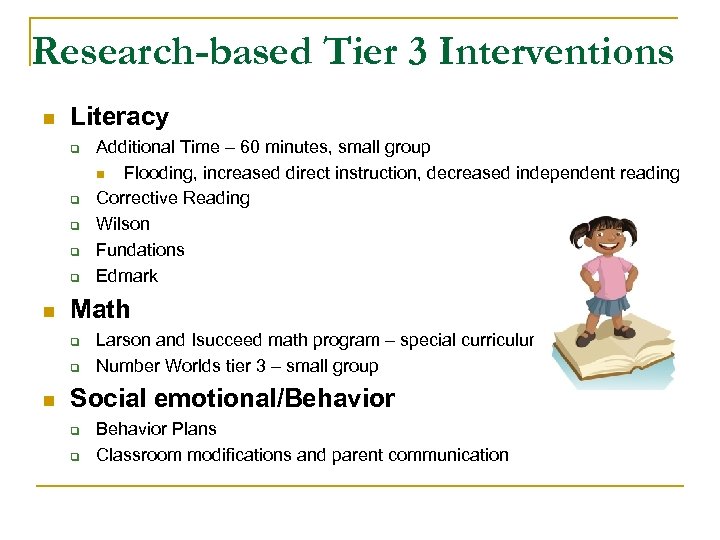
Research-based Tier 3 Interventions n Literacy q q q n Math q q n Additional Time – 60 minutes, small group n Flooding, increased direct instruction, decreased independent reading Corrective Reading Wilson Fundations Edmark Larson and Isucceed math program – special curriculum Number Worlds tier 3 – small group Social emotional/Behavior q q Behavior Plans Classroom modifications and parent communication
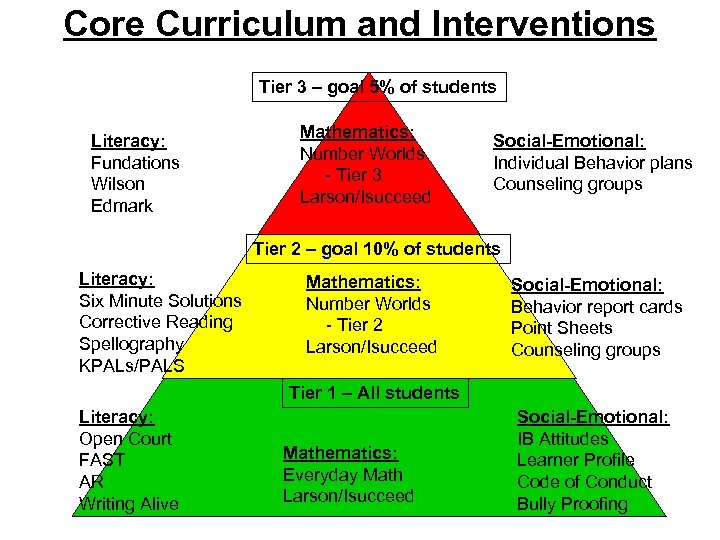
Core Curriculum and Interventions Tier 3 – goal 5% of students Literacy: Fundations Wilson Edmark Mathematics: Number Worlds - Tier 3 Larson/Isucceed Social-Emotional: Individual Behavior plans Counseling groups Tier 2 – goal 10% of students Literacy: Six Minute Solutions Corrective Reading Spellography KPALs/PALS Mathematics: Number Worlds - Tier 2 Larson/Isucceed Social-Emotional: Behavior report cards Point Sheets Counseling groups Tier 1 – All students Literacy: Open Court FAST AR Writing Alive Mathematics: Everyday Math Larson/Isucceed Social-Emotional: IB Attitudes Learner Profile Code of Conduct Bully Proofing
How is RTI currently structured in your school?

Assessment At Brown International Academy
Assessment To achieve an effective RTI model reliable and regular data must be available to: n n n Identify the academic and behavioral needs of students Inform collaborative problem solving Design instruction aligned with student needs Evaluate the effectiveness of curricular programs interventions and instructional practices Determine if students are achieving grade level proficiencies
RTI Assessment n Summative Assessments n Screening Assessments n Formative Assessments n Progress Monitoring n Diagnostic Assessments
Summative Assessments that occur after learning to document individual or group achievement or mastery of standards. They measure achievement at a point in time for purposes of reporting and accountability.
Summative Assessments At Brown, first we focused on: Ensure that teachers could administer and interpret district mandated assessments appropriately: n Summative Assessments (including High Stakes tests) n n Administered 1 to 3 times per year Used to support goal setting q q n Used to support instruction q n School Improvement Plan Power standards Data Teams and SMART goals Used to identify students needing interventions q Placement of students in Tier 2 and 3 interventions
Summative Assessments at Brown n CSAP – State assessment test q q q n DRA 2 – required state assessment for CBLA q q n Grades 3 -5 Reading, Writing, Math Used to develop power standards Grades K-5 Reading DPS Benchmark Assessment q q q Grades 3 -5 Reading, Writing, Math Graphs examined during data teams
Screening Assessments that occur three times per year (August, December, May) that are predictive of High Stakes testing and identify students who are at-risk of academic failure. They measure achievement at a point in time for the purpose of identifying students who are in need of academic interventions.
Screening Assessment At Brown, next we focued on: Determine if additional screening assessment information is needed. n Universal Screening n n 1 to 3 times per year Used to support instruction q q n Data Teams SMART goals Used to identify students needing interventions q Placement of students in Tier 2 and 3 interventions
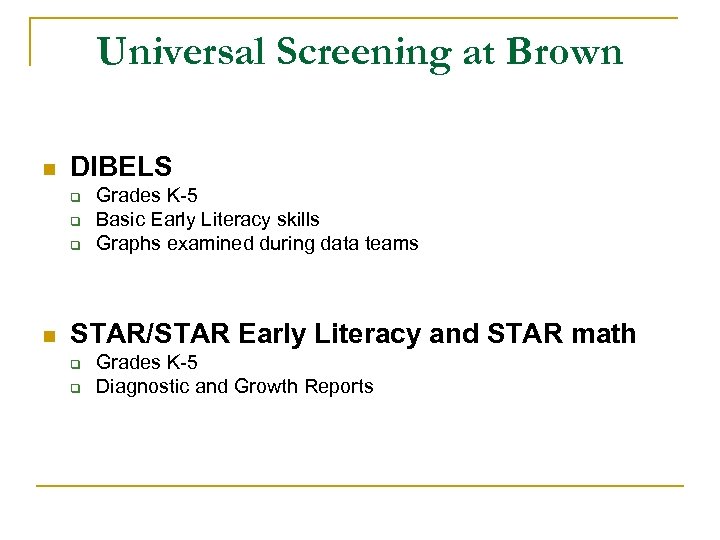
Universal Screening at Brown n DIBELS q q q n Grades K-5 Basic Early Literacy skills Graphs examined during data teams STAR/STAR Early Literacy and STAR math q q Grades K-5 Diagnostic and Growth Reports
Formative Assessment “for” learning conducted throughout teaching and learning to diagnose student needs, plan next steps in instruction and provide students with feedback to improve their work. Richard Stiggens
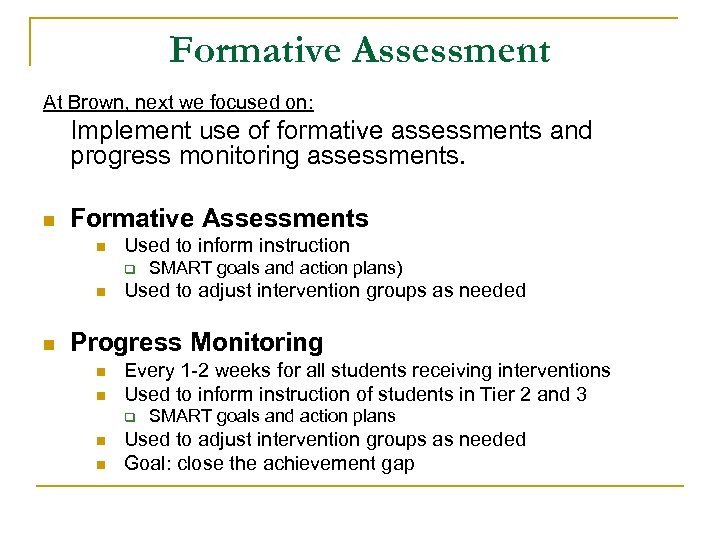
Formative Assessment At Brown, next we focused on: Implement use of formative assessments and progress monitoring assessments. n Formative Assessments n Used to inform instruction q n n SMART goals and action plans) Used to adjust intervention groups as needed Progress Monitoring n n Every 1 -2 weeks for all students receiving interventions Used to inform instruction of students in Tier 2 and 3 q n n SMART goals and action plans Used to adjust intervention groups as needed Goal: close the achievement gap
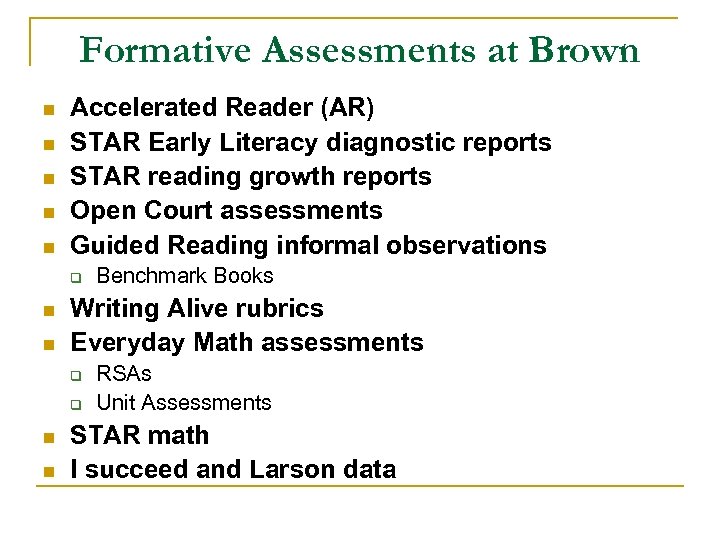
Formative Assessments at Brown n n Accelerated Reader (AR) STAR Early Literacy diagnostic reports STAR reading growth reports Open Court assessments Guided Reading informal observations q n n Writing Alive rubrics Everyday Math assessments q q n n Benchmark Books RSAs Unit Assessments STAR math I succeed and Larson data
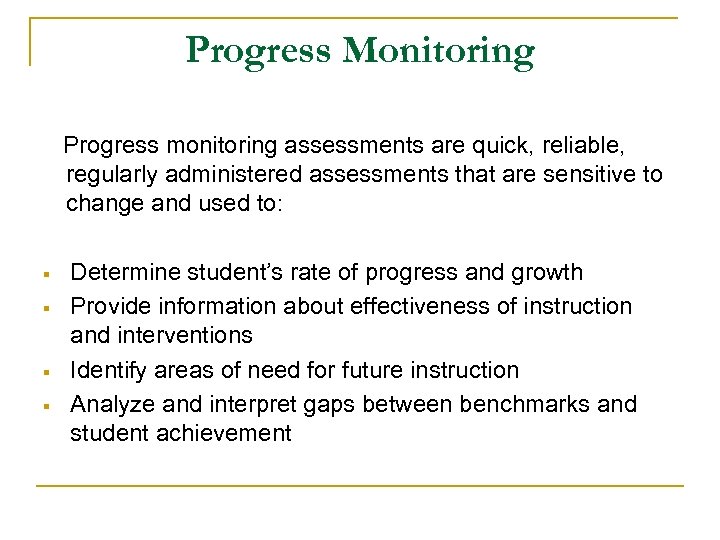
Progress Monitoring Progress monitoring assessments are quick, reliable, regularly administered assessments that are sensitive to change and used to: § § Determine student’s rate of progress and growth Provide information about effectiveness of instruction and interventions Identify areas of need for future instruction Analyze and interpret gaps between benchmarks and student achievement
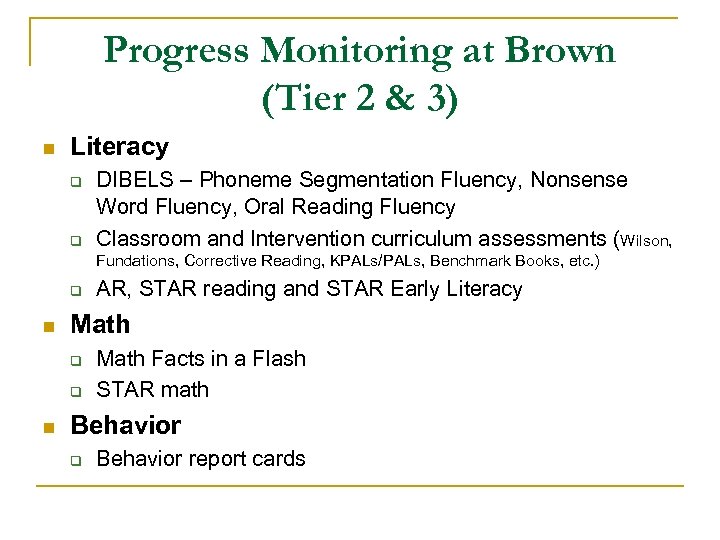
Progress Monitoring at Brown (Tier 2 & 3) n Literacy q q DIBELS – Phoneme Segmentation Fluency, Nonsense Word Fluency, Oral Reading Fluency Classroom and Intervention curriculum assessments (Wilson, Fundations, Corrective Reading, KPALs/PALs, Benchmark Books, etc. ) q n Math q q n AR, STAR reading and STAR Early Literacy Math Facts in a Flash STAR math Behavior q Behavior report cards
Diagnostic Assessments n Provide in-depth reliable assessment of targeted skills n Provide information for planning more effective instruction and interventions
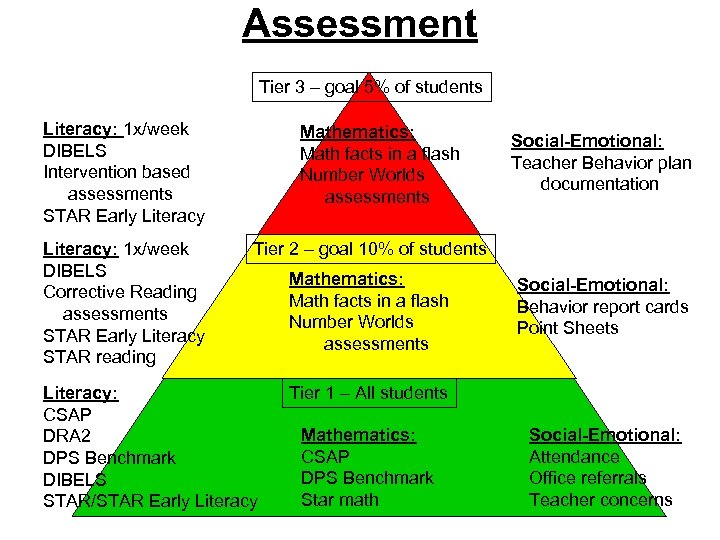
Assessment Tier 3 – goal 5% of students Literacy: 1 x/week DIBELS Intervention based assessments STAR Early Literacy: 1 x/week DIBELS Corrective Reading assessments STAR Early Literacy STAR reading Mathematics: Math facts in a flash Number Worlds assessments Social-Emotional: Teacher Behavior plan documentation Tier 2 – goal 10% of students Literacy: CSAP DRA 2 DPS Benchmark DIBELS STAR/STAR Early Literacy Mathematics: Math facts in a flash Number Worlds assessments Social-Emotional: Behavior report cards Point Sheets Tier 1 – All students Mathematics: CSAP DPS Benchmark Star math Social-Emotional: Attendance Office referrals Teacher concerns
What are some of the major challenges you have faces related to assessments?
Data Based Decision Making At Brown International Academy
Data Driven Decision Making A major feature of the RTI Model is its use of data to drive the decision-making process at the school, classroom and individual levels. Data are most helpful when they are used for self assessment and combined with reflection, problem-solving and discovery and planning.
Data Driven Decision Making “Data driven dialogue is a collective process designed to share common understanding of issues and events using information from a variety of sources. ” Colorado Dept. of Education “When teachers operate in professional communities and take collective responsibility for student learning, they produce schoolwide gains in academic achievement. ” Louis, Kruse, & Marks, 1996
Data Driven Dialogue “Reflective dialogue about important matters is at the heart of such communities (Professional Learning Communities). In these schools, teaching and learning are public acts to be shared, examined, analyzed and refined. ” Wellman & Lipton, 2004
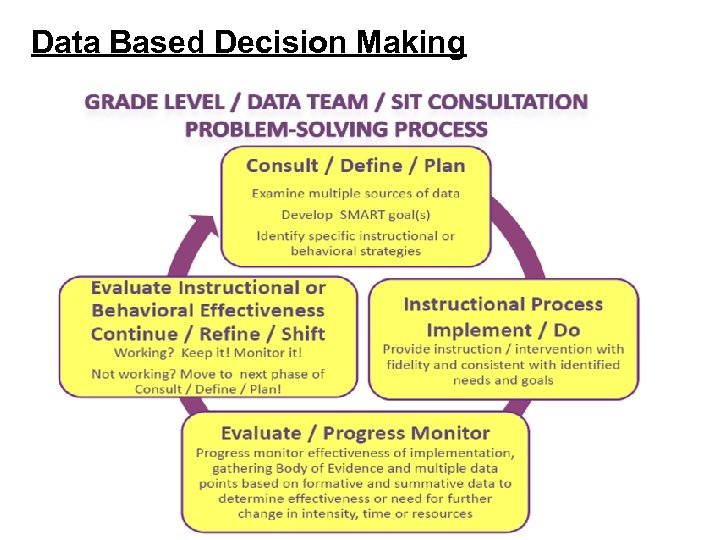
Data Based Decision Making
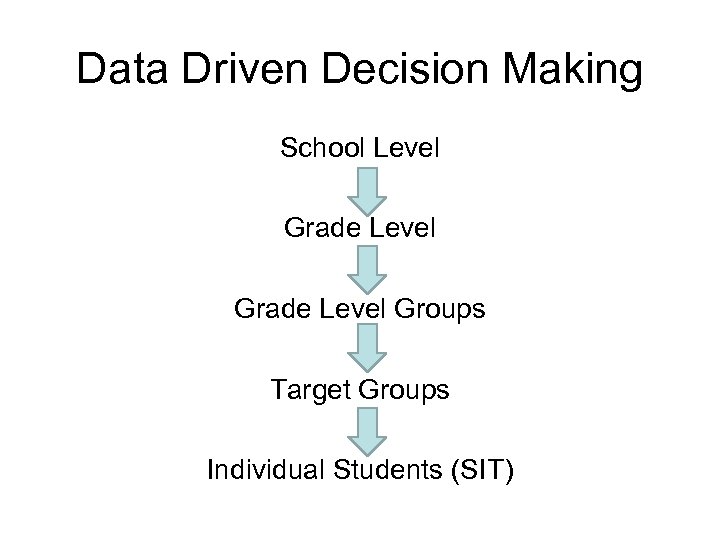
Data Driven Decision Making School Level Grade Level Groups Target Groups Individual Students (SIT)
Data teams Weekly grade level teams are held: Goal: In a collaborative manner, teachers will effectively analyze data and use data to inform instruction. q q Six week rotation: reading, writing, math n Two weeks on each Review all data for the content area Look at data for groups of students Adjust flooding groups every 6 weeks
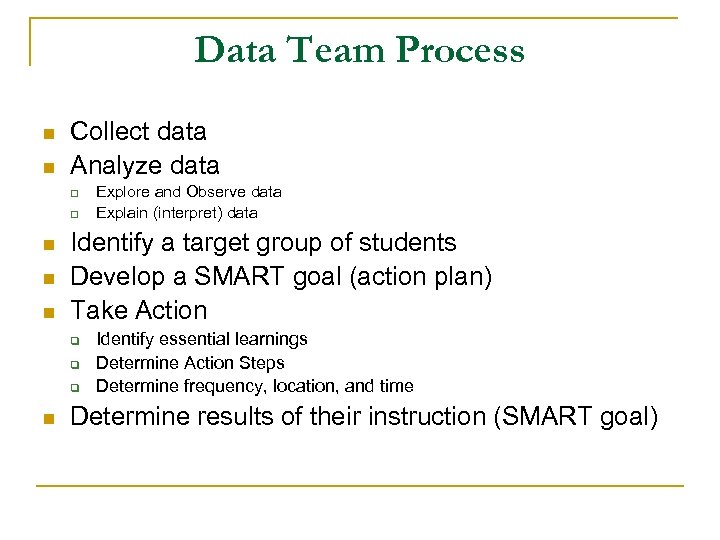
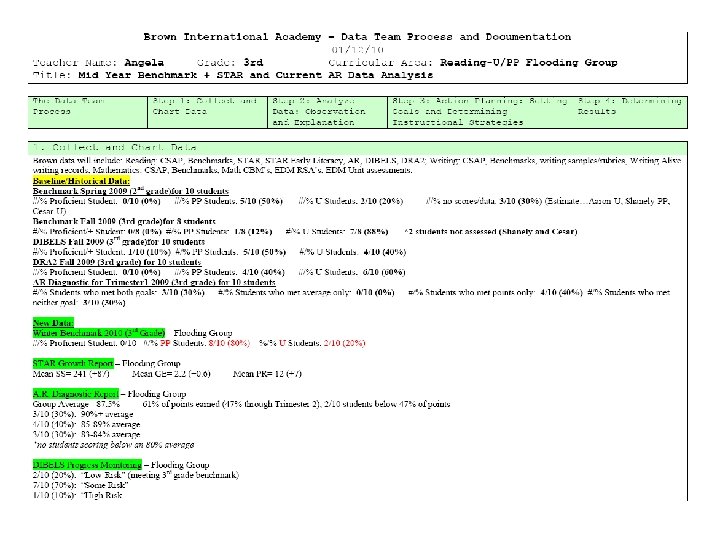
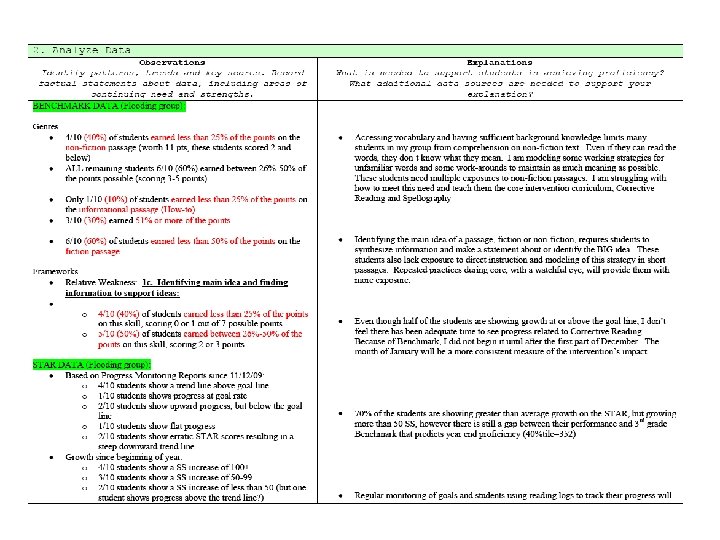
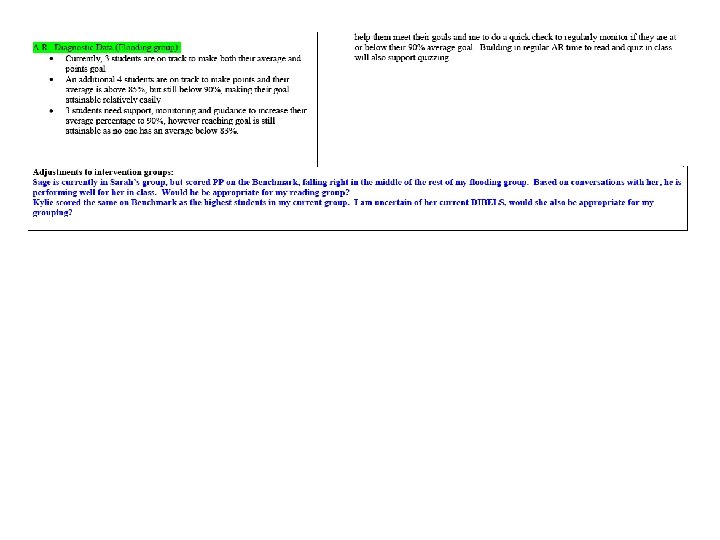
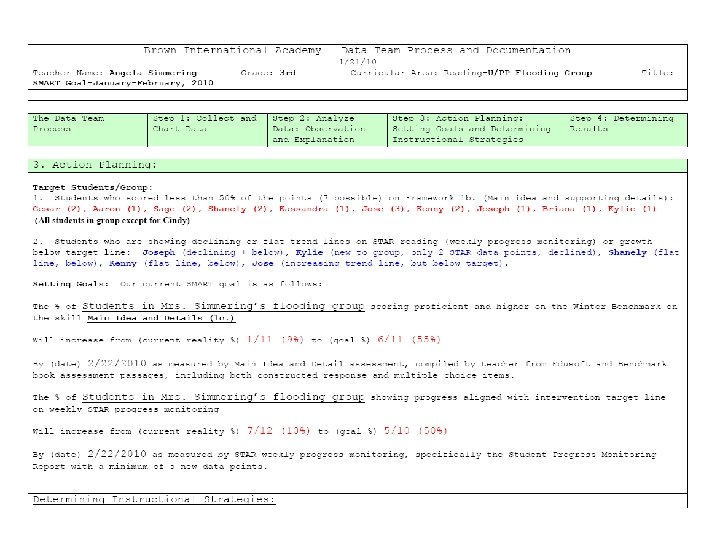
Data Team Process n n Collect data Analyze data q q n n n Identify a target group of students Develop a SMART goal (action plan) Take Action q q q n Explore and Observe data Explain (interpret) data Identify essential learnings Determine Action Steps Determine frequency, location, and time Determine results of their instruction (SMART goal)
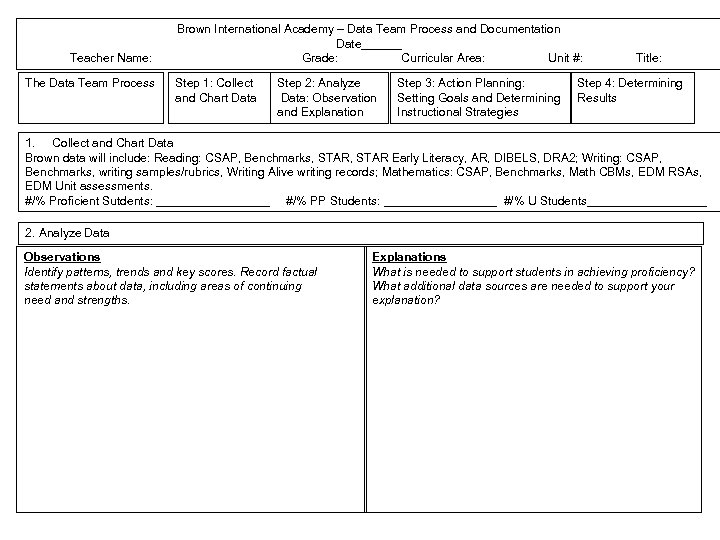
Teacher Name: The Data Team Process Brown International Academy – Data Team Process and Documentation Date______ Grade: Curricular Area: Unit #: Step 1: Collect and Chart Data Step 2: Analyze Data: Observation and Explanation Step 3: Action Planning: Setting Goals and Determining Instructional Strategies Title: Step 4: Determining Results 1. Collect and Chart Data Brown data will include: Reading: CSAP, Benchmarks, STAR Early Literacy, AR, DIBELS, DRA 2; Writing: CSAP, Benchmarks, writing samples/rubrics, Writing Alive writing records; Mathematics: CSAP, Benchmarks, Math CBMs, EDM RSAs, EDM Unit assessments. #/% Proficient Sutdents: _________ #/% PP Students: _________ #/% U Students_________ 2. Analyze Data Observations Identify patterns, trends and key scores. Record factual statements about data, including areas of continuing need and strengths. Explanations What is needed to support students in achieving proficiency? What additional data sources are needed to support your explanation?
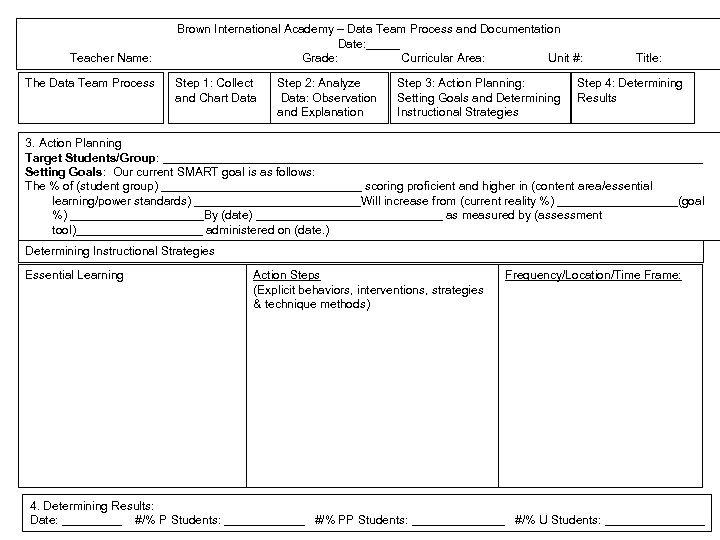
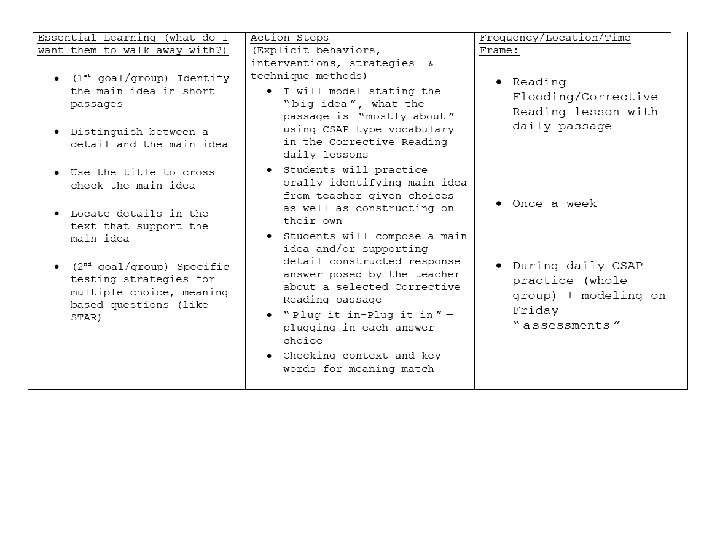
Teacher Name: The Data Team Process Brown International Academy – Data Team Process and Documentation Date: _____ Grade: Curricular Area: Unit #: Step 1: Collect and Chart Data Step 2: Analyze Data: Observation and Explanation Step 3: Action Planning: Setting Goals and Determining Instructional Strategies Title: Step 4: Determining Results 3. Action Planning Target Students/Group: _________________________________________ Setting Goals: Our current SMART goal is as follows: The % of (student group) _______________ scoring proficient and higher in (content area/essential learning/power standards) _____________Will increase from (current reality %) _________(goal %) __________By (date) ______________ as measured by (assessment tool)__________ administered on (date. ) Determining Instructional Strategies Essential Learning Action Steps (Explicit behaviors, interventions, strategies & technique methods) Frequency/Location/Time Frame: 4. Determining Results: Date: _____ #/% P Students: ______ #/% PP Students: _______ #/% U Students: ________
Take our your data team exemplar. What do you notice about how teachers use data to inform instruction?
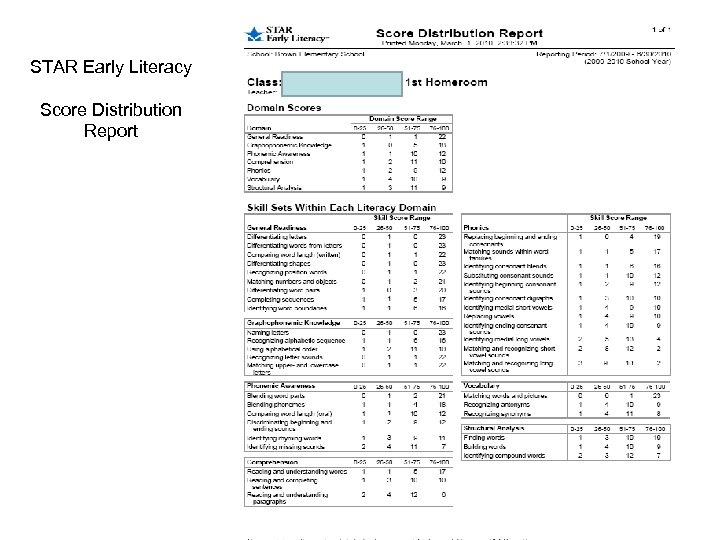
STAR Early Literacy Score Distribution Report
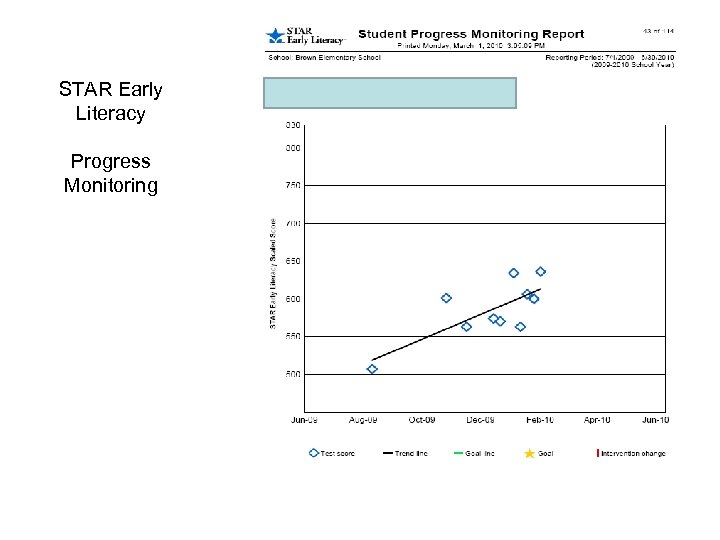
STAR Early Literacy Progress Monitoring
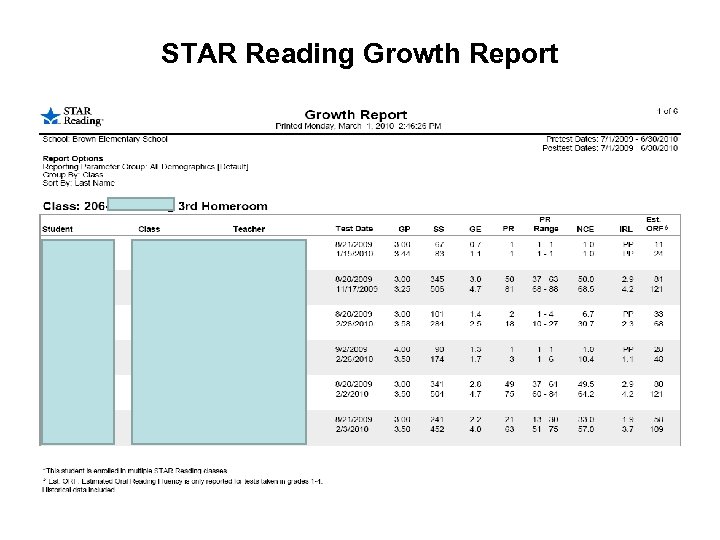
STAR Reading Growth Report
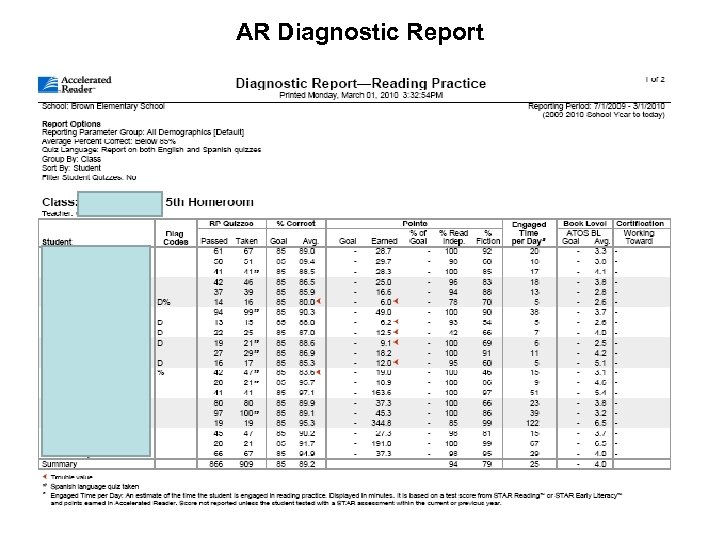
AR Diagnostic Report
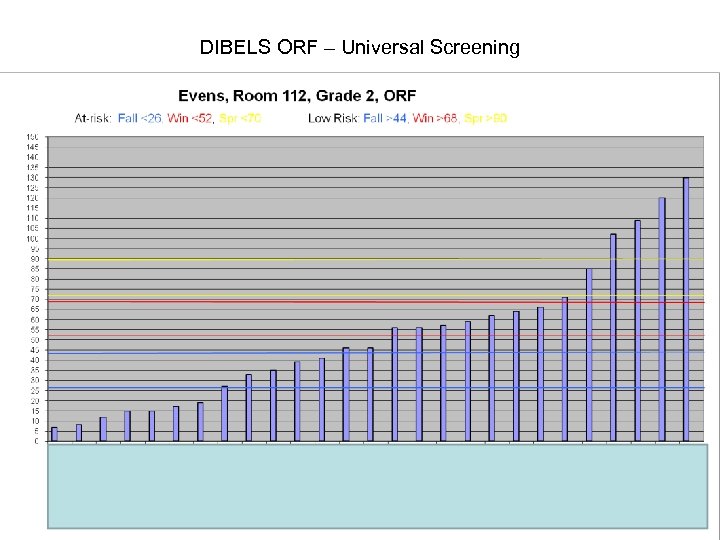
DIBELS ORF – Universal Screening
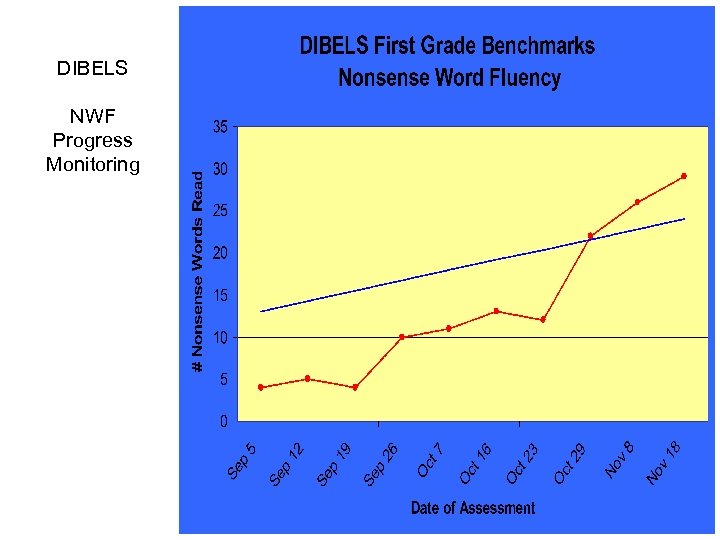
DIBELS NWF Progress Monitoring
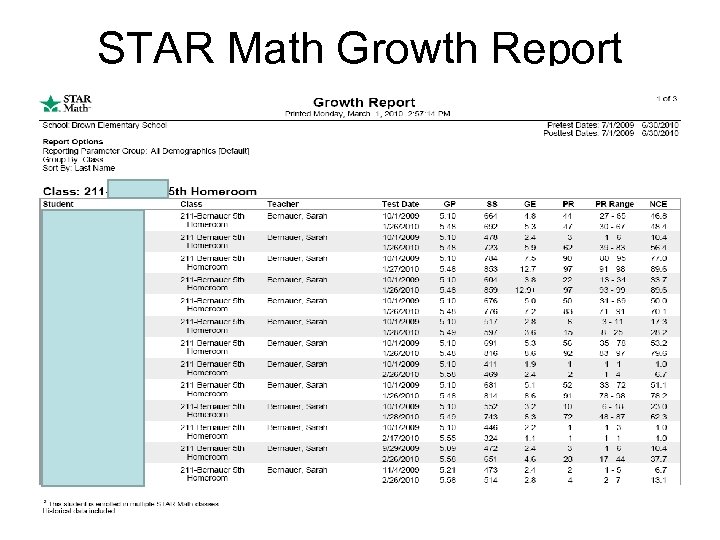
STAR Math Growth Report
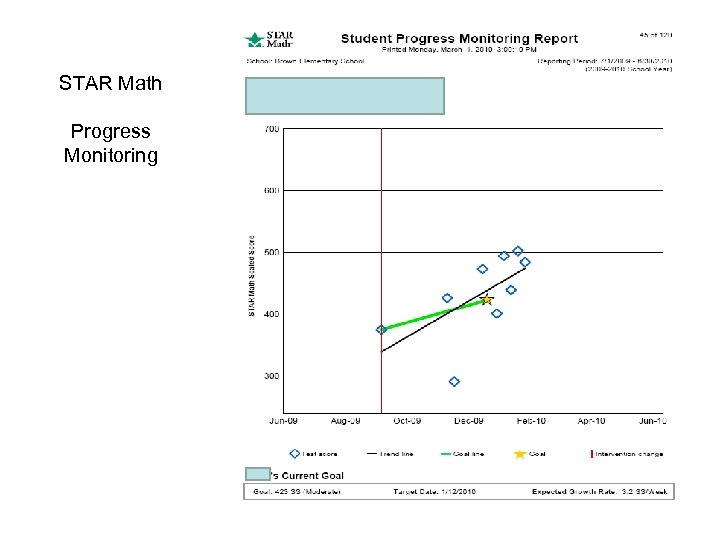
STAR Math Progress Monitoring
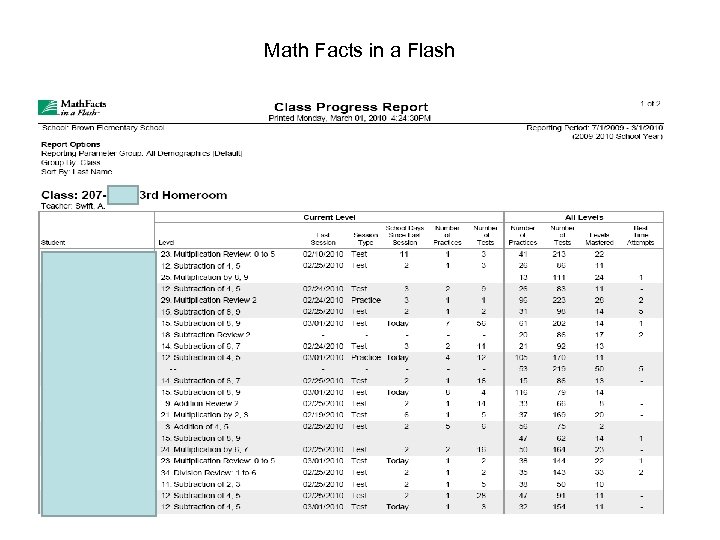
Math Facts in a Flash
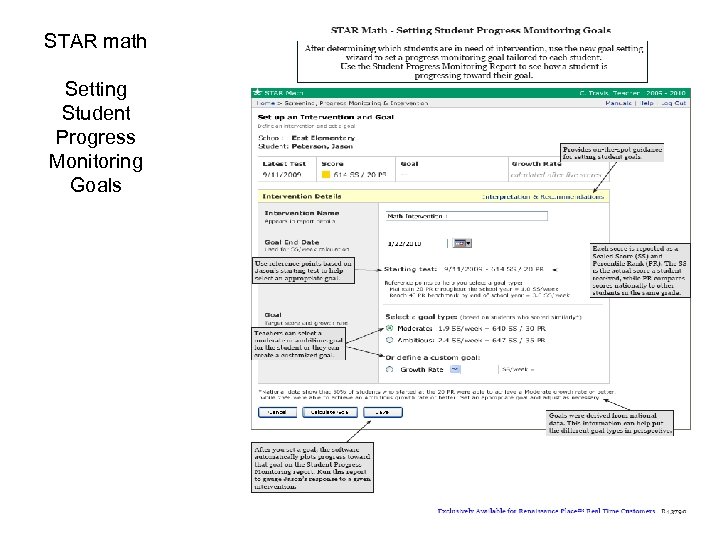
STAR math Setting Student Progress Monitoring Goals
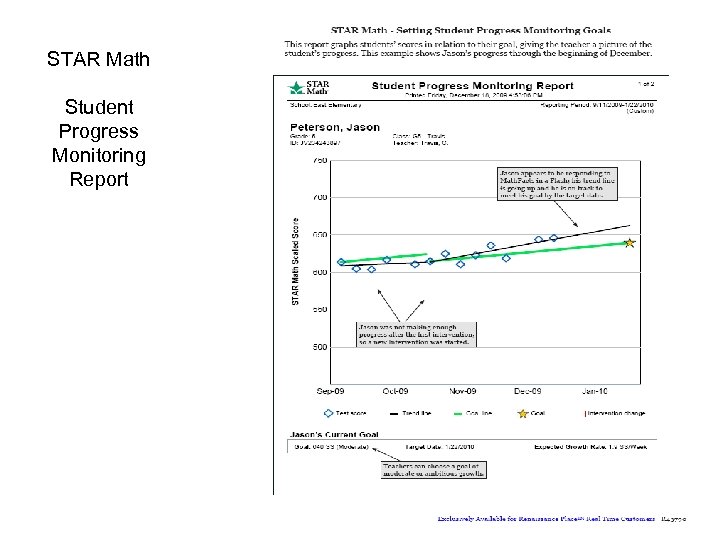
STAR Math Student Progress Monitoring Report
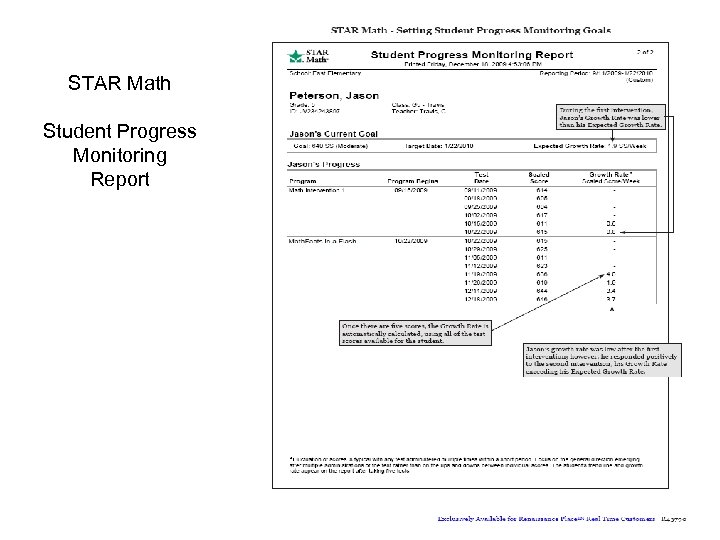
STAR Math Student Progress Monitoring Report
What standardized assessments do you use to progress monitor and diagnose student needs on an on-going basis? How frequently do you collect this data?
Student Intervention Teams n If students are not improving achievement as they are being monitored during the data team process, they are referred to the SIT team. q Students may be referred due to lack of progress in: n n q Reading Writing Math Behavior Students may be referred by: teacher, administrator, parent, etc.
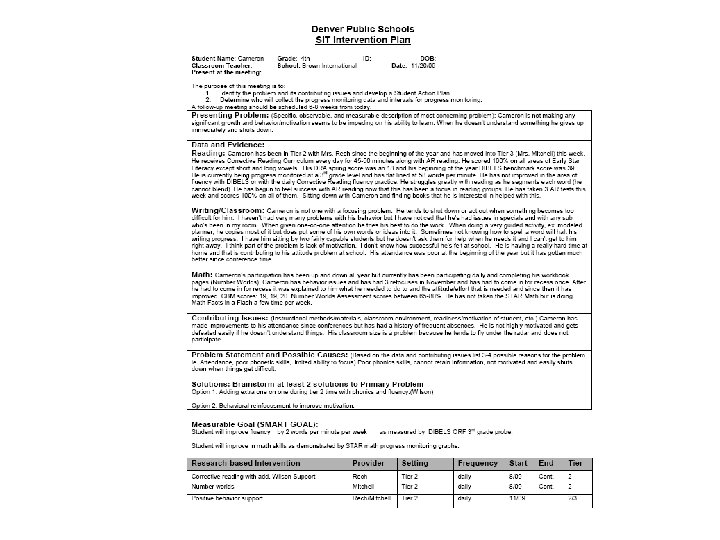
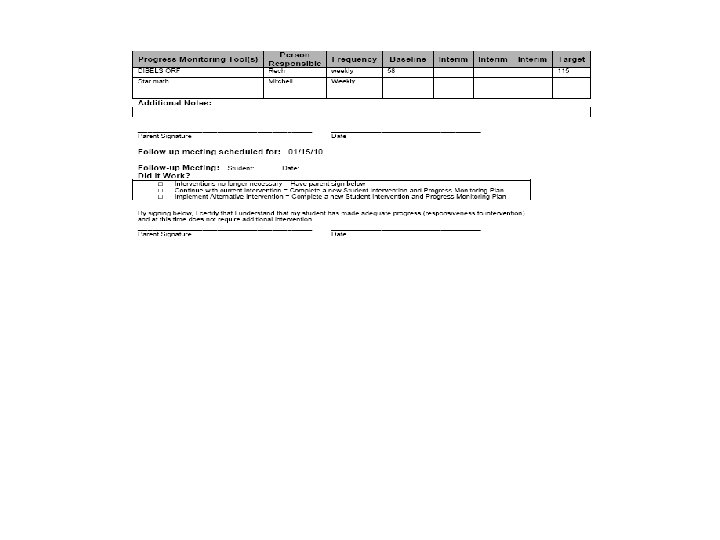
Student Intervention Teams n Problem solving teams q Purpose: to develop an individualized plan for a student not making adequate progress: q q n n n As demonstrated by Progress Monitoring data In relation to their peers Classroom teacher brings achievement, attendance, social-emotional data, etc. The literacy facilitator or School Psychologist leads the group through the process A plan is developed which includes: q q q A research based intervention A progress monitoring tool A follow up date
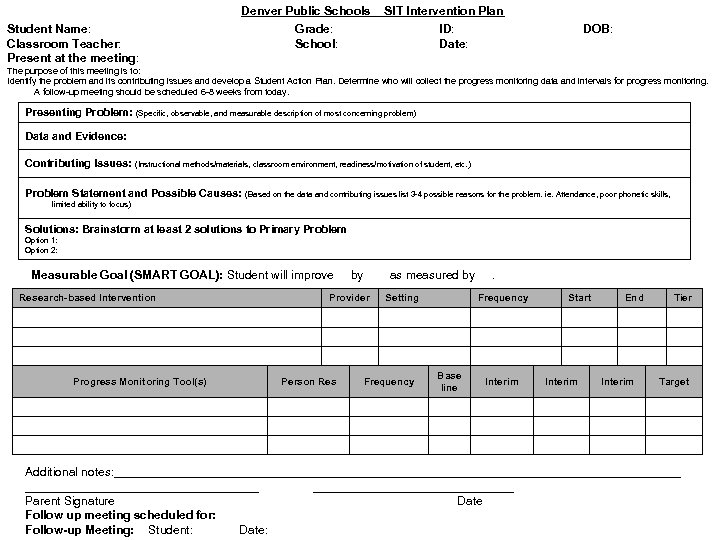
Student Name: Classroom Teacher: Present at the meeting: Denver Public Schools Grade: School: SIT Intervention Plan ID: Date: DOB: The purpose of this meeting is to: Identify the problem and its contributing issues and develop a Student Action Plan. Determine who will collect the progress monitoring data and intervals for progress monitoring. A follow-up meeting should be scheduled 6 -8 weeks from today. Presenting Problem: (Specific, observable, and measurable description of most concerning problem) Data and Evidence: Contributing Issues: (Instructional methods/materials, classroom environment, readiness/motivation of student, etc. ) Problem Statement and Possible Causes: (Based on the data and contributing issues list 3 -4 possible reasons for the problem. ie. Attendance, poor phonetic skills, limited ability to focus) Solutions: Brainstorm at least 2 solutions to Primary Problem Option 1: Option 2: Measurable Goal (SMART GOAL): Student will improve Research-based Intervention Progress Monitoring Tool(s) by as measured by Provider Person Res Setting Frequency Base line Interim Start Interim End Interim Tier Target Additional notes: ___________________________________________ _______________ Parent Signature Date Follow up meeting scheduled for: Follow-up Meeting: Student: Date:
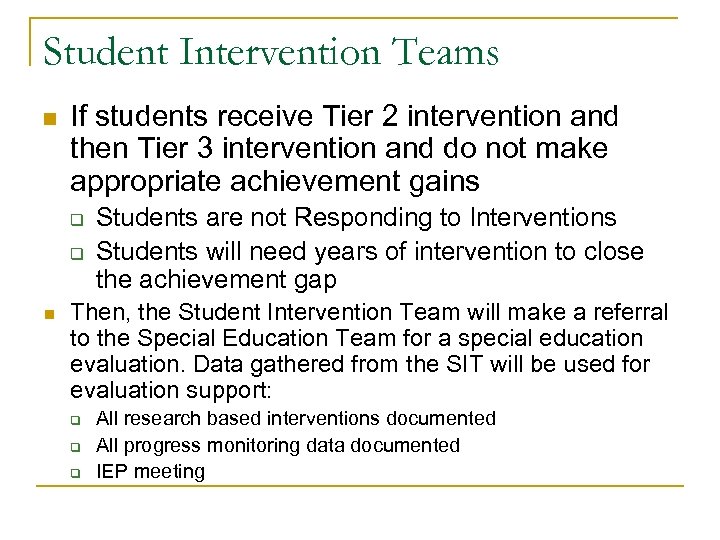
Student Intervention Teams n If students receive Tier 2 intervention and then Tier 3 intervention and do not make appropriate achievement gains q q n Students are not Responding to Interventions Students will need years of intervention to close the achievement gap Then, the Student Intervention Team will make a referral to the Special Education Team for a special education evaluation. Data gathered from the SIT will be used for evaluation support: q q q All research based interventions documented All progress monitoring data documented IEP meeting

Group Development At Brown International Academy
Group Development Attention to Task designs are learning focused and congruent with organizational values and goals. v Tasks are time and energy efficient i. e. clear agenda, define product success, use data to make decisions. Attention to Process v Shared tools, structures and protocols v Structured learning-focused conversations and norms of collaboration Attention to Relationships v Shared norms & values v Balanced participation v Members seek & honor diverse perspectives v Teaching practices actively questioned & calibrated against agreed upon standards v Comsistently using data to self assess and reflect v
Group Development PD at Brown n Adaptive Schools: Building Collaborative Teams n Critical Friends n Facilitative Leadership n Data Driven Dialogue n Tointon Leadership Institute n IB Training in Inquiry and Action research
Conclusion RTI is school reform. It takes a common vision. v It takes strong leadership. v It takes willingness to change. v It requires the belief that all children can learn. v It requires research based curriculum, interventions, assessments, and data driven dialogue. v

Our mission at Brown International is to empower learners to grow and evolve into compassionate, confident, contributing citizens of the world. Learners will be open-minded to multiple perspectives, advocate for peace, and promote change within our global community.
Скачать презентацию Response to Intervention at Brown International Academy Suzanne
8b8e2014f32b33fd94376b315c911bb9.ppt