


 Скачать презентацию Responding to Multicultural Training Needs and Resource Development
fb2f64605f17979946c802148e1c2d5c.ppt
- Количество слайдов: 21
 Responding to Multicultural Training Needs and Resource Development Some Intersections of TB and HIV Federal Training Centers Collaboration Meeting Kansas City July 14 -16, 2010 Stephanie Spencer, MA California Department of Public Health TB Control Branch
 How does culture shape TB & HIV and identify cross-cultural training needs? p System factors: Culture shapes U. S. economic and political systems; Culture shapes the healthcare system Disparities exist in access to health care p Provider factors: Culture shapes attitudes and beliefs about cultural groups; culture influences clinician / staff attitudes/ beliefs about groups and about health care p Patient factors: Culture shapes patients’ health beliefs and practices, patients’ experiences of health care system, patients’ abilities to deal with health concerns 2
 Specific Cultural Aspects of HIV/AIDS & TB (sexual activity; expression, regulation of desire) q death and dying q cleanliness and contamination q guilt or innocence; reward and punishment q tradition and culture change q gender roles & relationships q social class relationships q economic and power structures q meaning/symbolism of body fluids q ideas about personal and social responsibility q prevention and treatment/latent vs. active disease q personal and affinity-group identity 3 q substance use q
 Epidemiology Helps Identify Cultural Groups and Cross-cultural Factors q Epidemiologic information on HIV/AIDS and TB… § § When are people being diagnosed? Is incidence changing over time? Who is affected? Where affected people… § …living when they are diagnosed? § …being diagnosed? § How are people becoming infected? q …points to the groups of people that programs need to target for prevention and treatment q But, epi data doesn’t give enough information about these groups to design specific, effective interventions or disease investigations 4
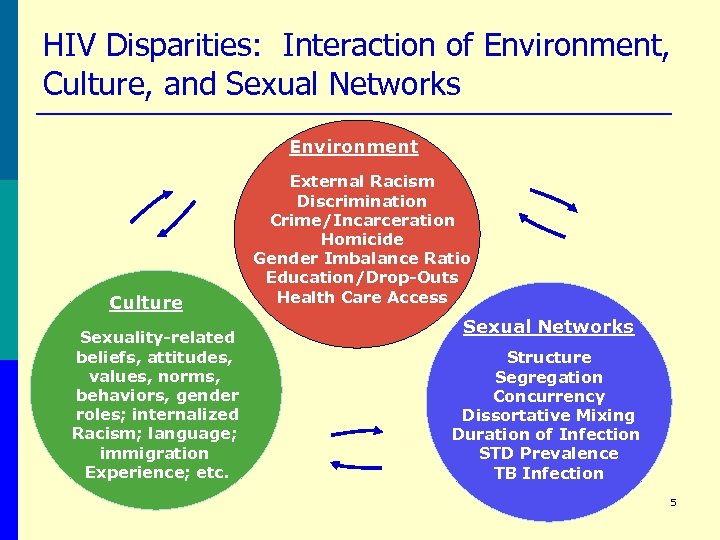 HIV Disparities: Interaction of Environment, Culture, and Sexual Networks Environment Culture Sexuality-related beliefs, attitudes, values, norms, behaviors, gender roles; internalized Racism; language; immigration Experience; etc. External Racism Discrimination Crime/Incarceration Homicide Gender Imbalance Ratio Education/Drop-Outs Health Care Access Sexual Networks Structure Segregation Concurrency Dissortative Mixing Duration of Infection STD Prevalence TB Infection 5
 TB Risk Factors in U. S. Present Cross-cultural Training Needs p Birth in a high TB incidence country p Drug/Alcohol abuse p Incarcerated p Homeless p U. S. -born racial/ethnic minority, especially if at least one parent is foreign-born 6
 TB Risk Factors in California 75% are born in TB high incidence countries n Top five countries of origin of TB cases: p China p India p Mexico p Philippines p Vietnam q 10% have these risk factors n Drug/Alcohol abuse n Incarcerated n Homeless n U. S. -born racial/ethnic minority, especially if at least one parent is foreign-born 7 q All factors present cross-cultural training needs q
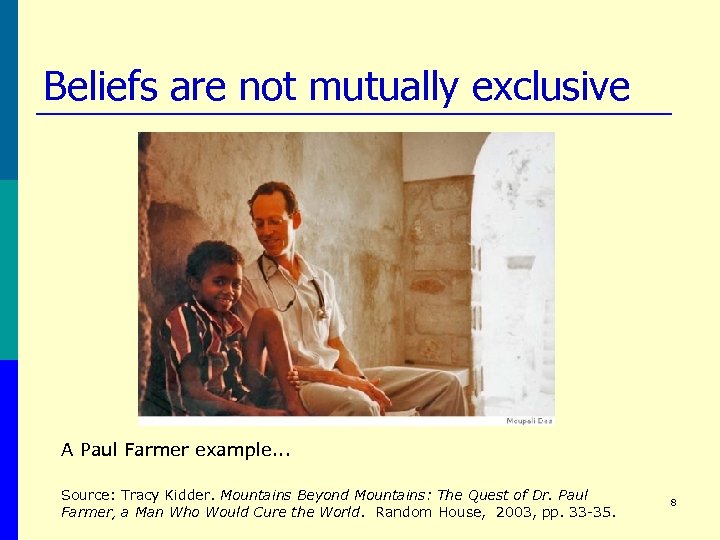 Beliefs are not mutually exclusive A Paul Farmer example. . . Source: Tracy Kidder. Mountains Beyond Mountains: The Quest of Dr. Paul Farmer, a Man Who Would Cure the World. Random House, 2003, pp. 33 -35. 8
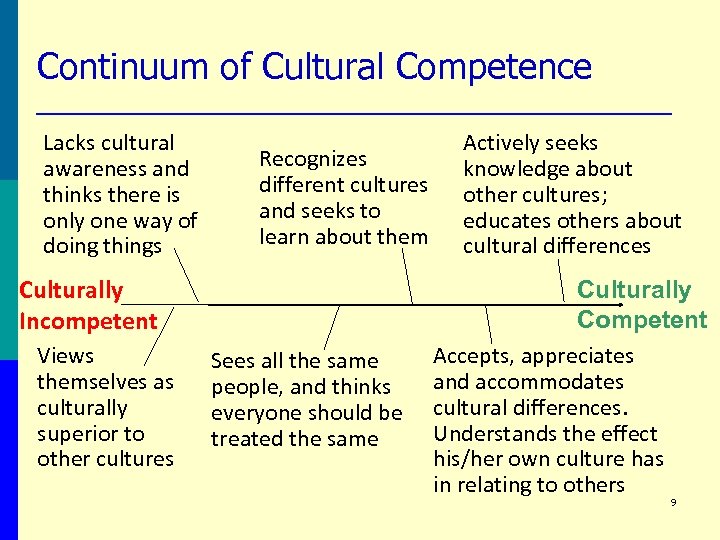 Continuum of Cultural Competence Lacks cultural awareness and thinks there is only one way of doing things Recognizes different cultures and seeks to learn about them Culturally Incompetent Views themselves as culturally superior to other cultures Sees all the same people, and thinks everyone should be treated the same Actively seeks knowledge about other cultures; educates others about cultural differences Culturally Competent Accepts, appreciates and accommodates cultural differences. Understands the effect his/her own culture has in relating to others 9
 Developing Cross-Cultural Competence q Understanding the background, cultural values, and beliefs of patients, and applying that understanding in a health context. q Cultural competency is the genuine sensitivity and respect given to people regardless of their ethnicity, race, language, culture or national origin. q Ability to anticipate and recognize misunderstandings that arise from the differing cultural assumptions and expectations of providers and patients and to respond to such issues appropriately. http: //www. cahealthadvocates. org/_docs/cmc/2008/Importance-Language. Services-2008. ppt#385, 8, Cultural Competence 10
 Developing Cultural Competence: Fundamental Attitudes q Non-judgmental approach to another’s culture q Cultural humility about one’s own beliefs q Awareness of one’s own biases and assumptions q Willing and able to explain and describe one’s perspectives to others q Desire to understand others’ perspectives q Flexibility to negotiate toward desired outcomes 11
 Skills for Cultural Competence (1) — Document for performance reviews q Questioning skills to learn about a patient’s or partner’s culture—including how a systematic set of cultural health beliefs and health practices makes sense q Observational skills to learn about a patient’s and group’s access to health care and other social needs q Communication skills to effectively negotiate with people of different cultural backgrounds about their health beliefs, behaviors, and access needs 12
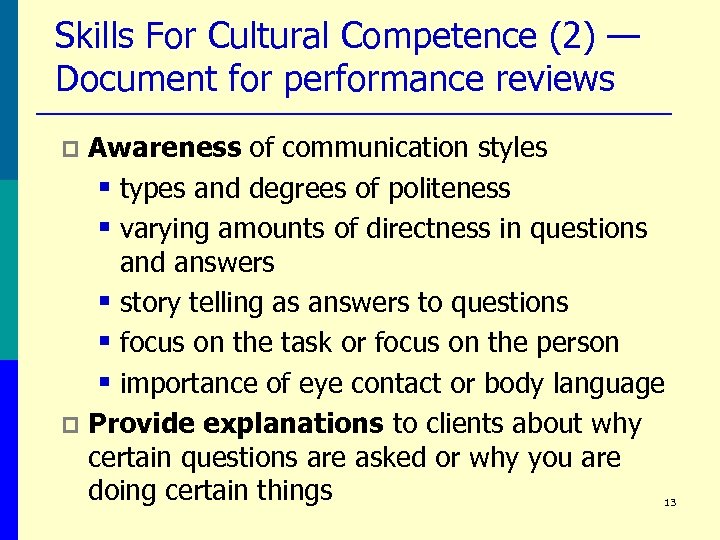 Skills For Cultural Competence (2) — Document for performance reviews Awareness of communication styles § types and degrees of politeness § varying amounts of directness in questions and answers § story telling as answers to questions § focus on the task or focus on the person § importance of eye contact or body language p Provide explanations to clients about why certain questions are asked or why you are doing certain things p 13
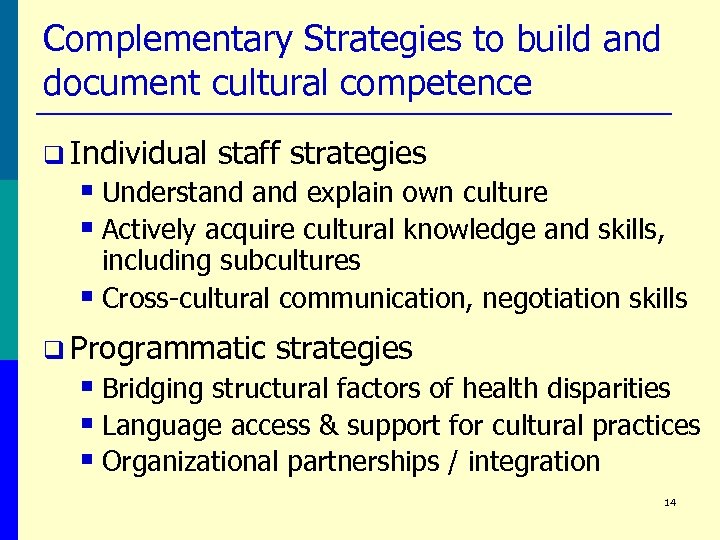 Complementary Strategies to build and document cultural competence q Individual staff strategies § Understand explain own culture § Actively acquire cultural knowledge and skills, including subcultures § Cross-cultural communication, negotiation skills q Programmatic strategies § Bridging structural factors of health disparities § Language access & support for cultural practices § Organizational partnerships / integration 14
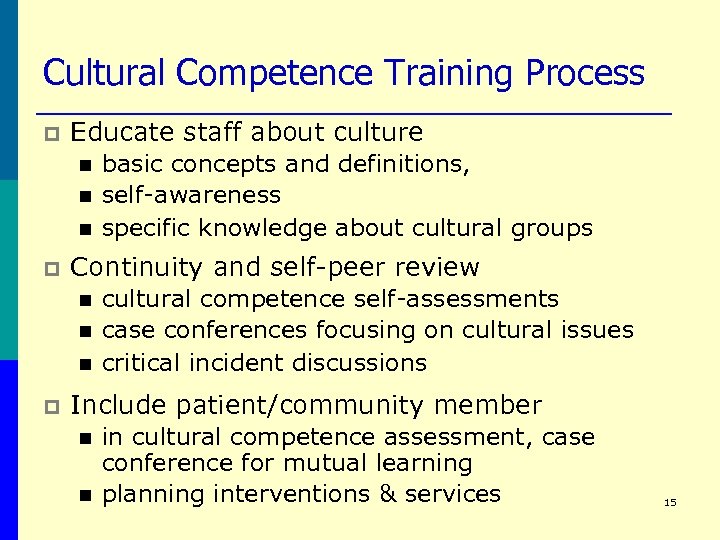 Cultural Competence Training Process p Educate staff about culture n n n p Continuity and self-peer review n n n p basic concepts and definitions, self-awareness specific knowledge about cultural groups cultural competence self-assessments case conferences focusing on cultural issues critical incident discussions Include patient/community member n n in cultural competence assessment, case conference for mutual learning planning interventions & services 15
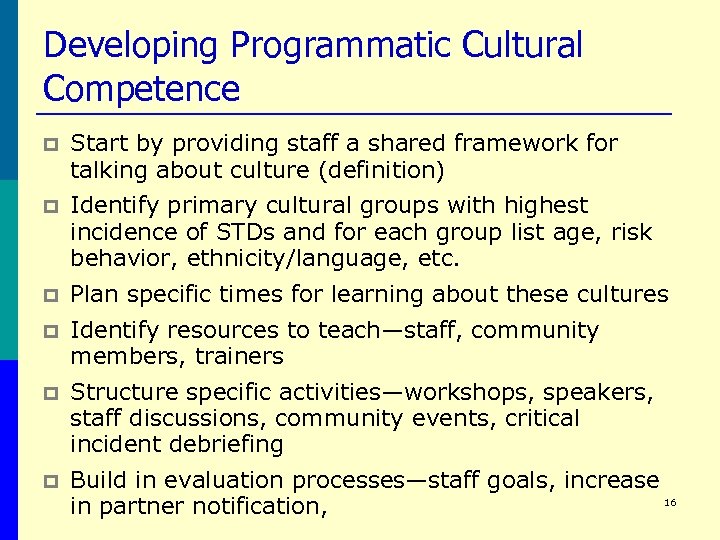 Developing Programmatic Cultural Competence p Start by providing staff a shared framework for talking about culture (definition) p Identify primary cultural groups with highest incidence of STDs and for each group list age, risk behavior, ethnicity/language, etc. p Plan specific times for learning about these cultures p Identify resources to teach—staff, community members, trainers p Structure specific activities—workshops, speakers, staff discussions, community events, critical incident debriefing p Build in evaluation processes—staff goals, increase 16 in partner notification,
 Programmatic Strategies to Build Cultural Competence (1) q Language Access Find out which are most common languages in your jurisdiction q Identify interpretation resources and funding before you need them, including bilingual staff q Train staff to identify and accommodate client interpretation needs q Develop effective ways of letting patients know that interpretation is available at no cost to them q Implement interpreter training standards for language skills and STD-specific training 17
 Programmatic Strategies to Build Cultural Competence (2) Support for Cultural Practices q Acknowledge and respect ethnomedical explanations and treatments while negotiating biomedical treatment q Support family decision making while ensuring legalities of patient consent q Are there cultural healers you can involve? q Are there effective outreach or treatment practices in clients’ communities or from home countries that you can adapt? 18
 Programmatic strategies to build cultural competence (3) Resources for Cultural Knowledge q Non-medical specialists q social scientists q members of cultural heritage or identity groups q “traditional” or “alternative” healers q patients themselves q patients’ families q community members 19
 Programmatic strategies to build cultural competence (4) q Community Partnerships Which local ethnic, cultural or advocacy groups have community organizations? q Can you partner with them for outreach or to help plan accessible services? q Do any of these organizations have opinion leaders, cultural brokers, trained interpreters? q Do these organizations know anything about STDs, HIV/AIDS? q Do these organizations have formal or informal support services for patients, partners, families? 20
 Reaching the goal: culturally appropriate and effective services Culturally competent staff and programs can develop individual patient-centered care that includes clients’ cultures and biomedical best practices: q Culture Care Preservation q Culture Care Accommodation q Culture Care Repatterning 21