


 Скачать презентацию Responding to Legislative Mandates in Creating an Innovative
0f72a6735dd6d67181c735cdadf7644d.ppt
- Количество слайдов: 45
 Responding to Legislative Mandates in Creating an Innovative Individualized Student Transition Plan Brett L. Bruner, M. S. Director of First Year Experience/Persistence & Retention Eric J. Wilson II Graduate Assistant for Persistence & Retention Fort Hays State University 0
 Overview • • Learning Outcomes & Key Terminology Introduction & Background of Institution Impetus for Action Developing the FHSU Response Implementing the FHSU Response Assessing the Plan So What? Applying the Plan to Your Campus 1
 Learning Outcomes As a result of attending this educational session, participants will • Articulate the importance of “transition” as it relates to our work with orientation & retention. • Articulate the value of public policy awareness at the local, state & national levels as it affects our work in OTR. 2
 Learning Outcomes As a result of attending this educational session, participants will • Identify 2 key first year milestones on your campus to begin the development of a transition plan. • Identify 1 key performance indicator to assess a student transition plan. 3
 Key Terminology • Orientation: • Transition: • Retention: 4
 Key Terminology • Orientation: deliberate programmatic & service efforts designed to facilitate the transition of new students to the institution; prepare students for the institution’s educational opportunities & student responsibilities; initiate the integration of new students into the intellectual, cultural, & social climate of the institution; & support the parents, partners, guardians & children of the new student. Source: NODA Task Force to Explore the Definition of Orientation, Transition & Retention (2012). 5
 Key Terminology • Retention: student progression through higher education, focusing primarily on student persistence (i. e. term to tem) through the beginning of the 2 nd year at the same institution and/or achievement of personal educational objectives. Source: NODA Task Force to Explore the Definition of Orientation, Transition & Retention (2012). 6
 Key Terminology • Orientation: • Transition: • Retention: 7
 Key Terminology • Transition: the process students go through (typically lasting up to 1 year) when entering a particular institution of higher education and/or entering the same institution for a new purpose. Source: NODA Task Force to Explore the Definition of Orientation, Transition & Retention (2012). 8
 Institutional Background Fort Hays State University • 13, 000 total students • 3 business modalities • Located in Hays, KS (halfway between Kansas City & Denver) • Fall 2014 New Student Cohort Data – 980 first year students – 400 transfer students – 125 international students 9
 Institutional Background Fort Hays State University • Continued on-campus enrollment growth – Eastern Colorado – Western Nebraska • First-year residential live-on requirement • Decentralized first year advising model 10
 Historical Retention Challenges Fort Hays State University 11
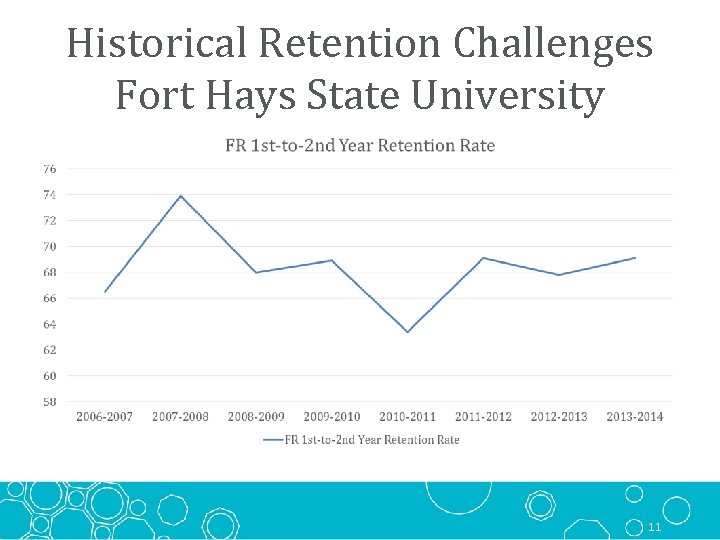
 Historical Retention Challenges Fort Hays State University • Silos of institutional retention efforts – No common elements – Jumping on the latest bandwagons • Institutional Retention Committee’s lack of identity • Few pockets of departmental FR seminar courses • Academic integration = sole focus 12
 Office of First Year Experience/ Persistence & Retention • “Duty to Dream” 2011 Strategic Plan • Opened in August 2012 • Division of Student Affairs – Enrollment Management Cluster – Student Support Services Cluster – Student Life Cluster 13
 Office of First Year Experience/ Persistence & Retention New Student Orientation programs Extended Orientation experiences Welcome weeks Freshman seminar First year/transfer year experience transitional program • Retention initiatives • First year living & learning communities • Parent & family engagement • • • 14
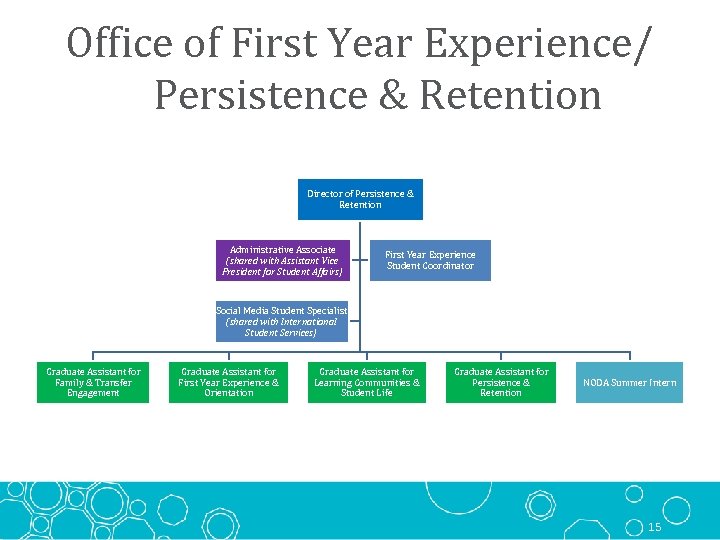 Office of First Year Experience/ Persistence & Retention Director of Persistence & Retention Administrative Associate (shared with Assistant Vice President for Student Affairs) First Year Experience Student Coordinator Social Media Student Specialist (shared with International Student Services) Graduate Assistant for Family & Transfer Engagement Graduate Assistant for First Year Experience & Orientation Graduate Assistant for Learning Communities & Student Life Graduate Assistant for Persistence & Retention NODA Summer Intern 15
 Impetus for Action • Goal 1: Increase Higher Education Attainment – Aspiration 1: Increase to 60 % the number of Kansas adults who have a certificate, associate’s degree, or bachelor’s degree by 2020 – Aspiration 2: Achieve a 10% increase in retention & graduation rates by 2020 16
 Impetus for Action • Goal 1: Increase Higher Education Attainment – Measure 1: First to second year retention rates at universities, community colleges & technical colleges – Measure 2: Six-year graduation rates for universities 17
 K. S. A. 76 -717 “For those students admitted under an exception to the minimum standards prescribed by the Kansas Board of Regents, each state educational institution shall require each such student to adopt an individual plan for success prior to enrollment. ” – Kansas State Legislature, Spring 2015 18
 Further Guidelines of K. S. A. 76 -717 1. Be jointly developed by the student & the student’s advisor 2. Address the student’s academic coursework. 3. Be adopted prior to the student’s initial enrollment at the university. 4. Be reviewed by the student & advisor at least once pr semester. 19
 Developing the FHSU Response • Openness to Interpretation – Definition of an “individual plan of success” – Definition of “prior to enrollment” • Intentionality of All Students vs. Mandated “Windows” Exceptions Students • Technologically integrated 20
 Developing the FHSU Response: 2012 -2013 • Interdisciplinary Team – – – FYE/Persistence & Retention, Chair Academic Advising & Career Exploration Center Admissions College of Health & Life Sciences – Dean Rep. Computing & Technology Center Department of Health & Human Performance – Dept. Chair. Rep. Institutional College Completion Team Kansas Academy of Mathematics & Science Kelly Center Registrar’s Office Residential Life Student Life 21
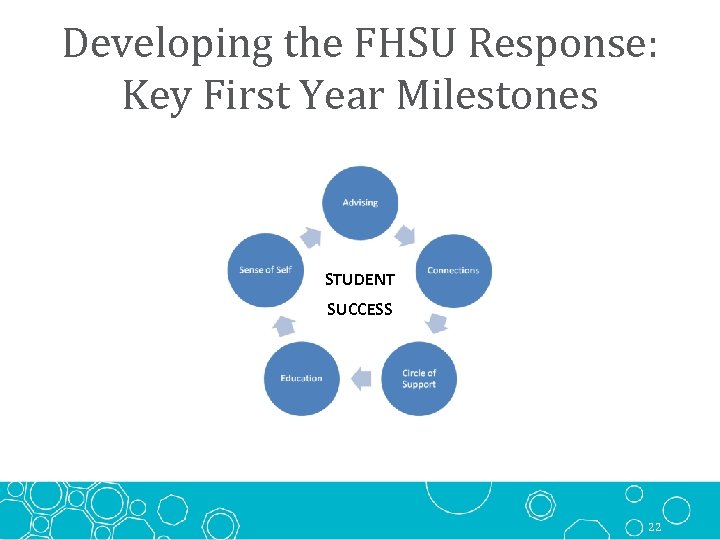 Developing the FHSU Response: Key First Year Milestones STUDENT SUCCESS 22
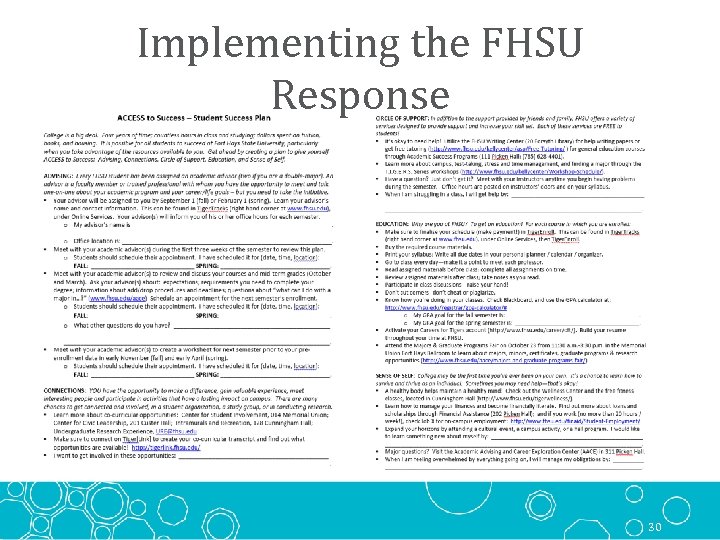
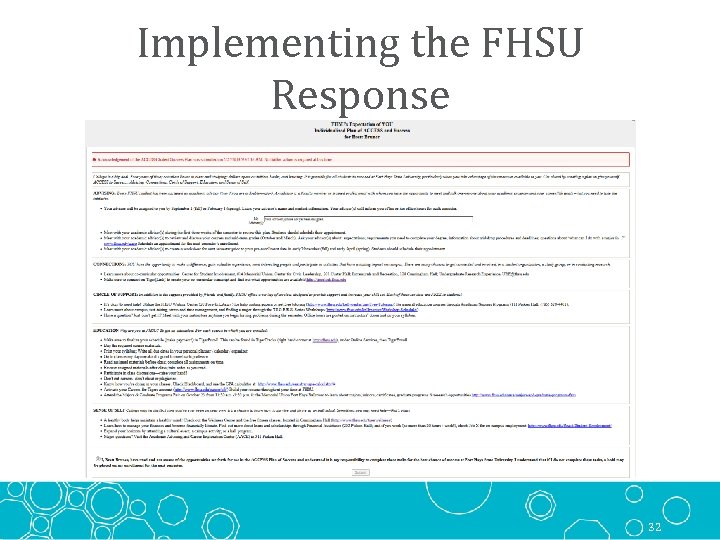
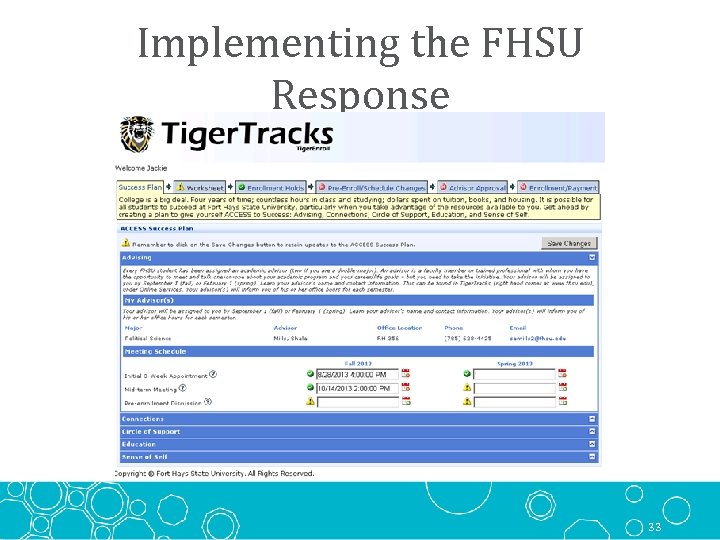
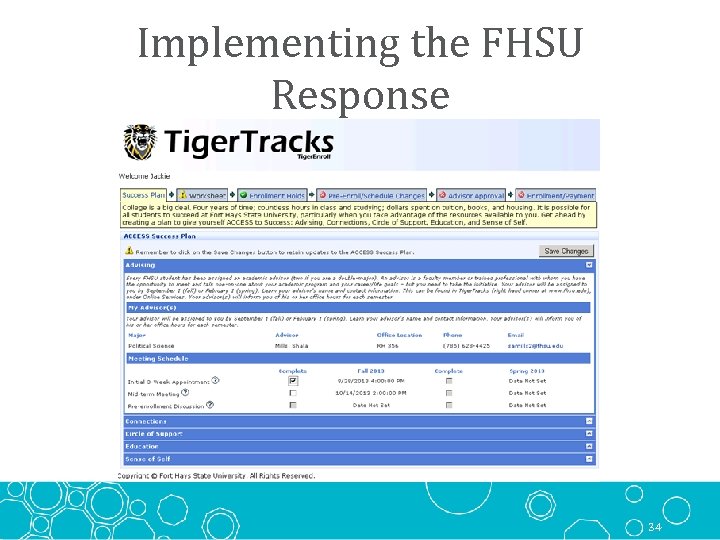
 The FHSU Response: ACCESS to Success – Student Success Plan • Advising – Academic Advising & Career Exploration Center • Connections – Center for Student Involvement • Circle of support – Kelly Center • Education – UNIV 101 Instructor & Academic Advisor • Sense of Self – Student Health Center 23
 Implementing the FHSU Response • Tiger STRIPES: Freshman Orientation & Pre. Enrollment Days – Introduction by opening speaker – Re-emphasis by undergraduate student staff & faculty members – Inclusion in family breakout session “Academics 101” – Electronic signature of active participation 24
 Implementing the FHSU Response 25
 Implementing the FHSU Response • UNIV 101 Freshman Seminar – Reflection Questions During Week 1 • Connections: I want to get involved in these opportunities______________________. • Circle of support: When I am struggling in a class, I will get help by: _____________________. • Education: My GPA goal for the semester is______. • Sense of Self: I would like to learn something new about myself by: _____________________. • Sense of Self: When I am feeling overwhelmed by everything going on, I will manage by_________. 26
 Implementing the FHSU Response • UNIV 101 Freshman Seminar – Reflection Questions Re-evaluated Throughout Semester – Week 6 Individual Transition Meetings with UNIV 101 Instructor – Individual Final Presentations – Use of technology to record answers • Special Notes about UNIV 101 – Curriculum is coordinated by Office of First Year Experience/Persistence & Retention – Required course for all FY students within 12 months of high school graduation 27
 Implementing the FHSU Response • Advising – 3 required meetings with advisor each semester • Within the first 2 weeks of each semester • Following release of mid-semester grades • Preceding pre-enrollment for the subsequent semester – Failure to comply = FYE hold on pre-enrollment account • Individual meetings with FYE staff member 28
 Implementing the FHSU Response • Campus partner events – Back-to-School Picnic – Center for Student Involvement – T. I. G. E. R. S. Series Workshops – Academic Success Programs/Kelly Center – Wellness Fair – Student Health Center – Majors & Graduate Programs Fair – Academic Advising & Career Exploration Center 29
 Implementing the FHSU Response 30
 Implementing the FHSU Response 31
 Implementing the FHSU Response 32
 Implementing the FHSU Response 33
 Implementing the FHSU Response 34
 Assessing the Plan 35
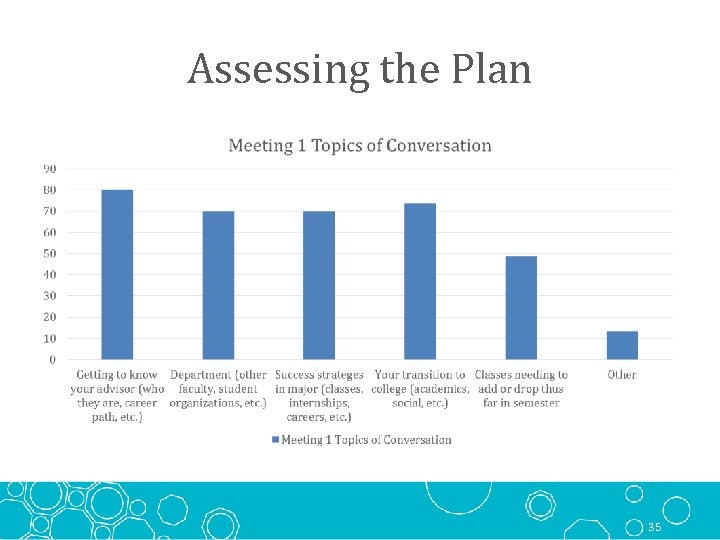
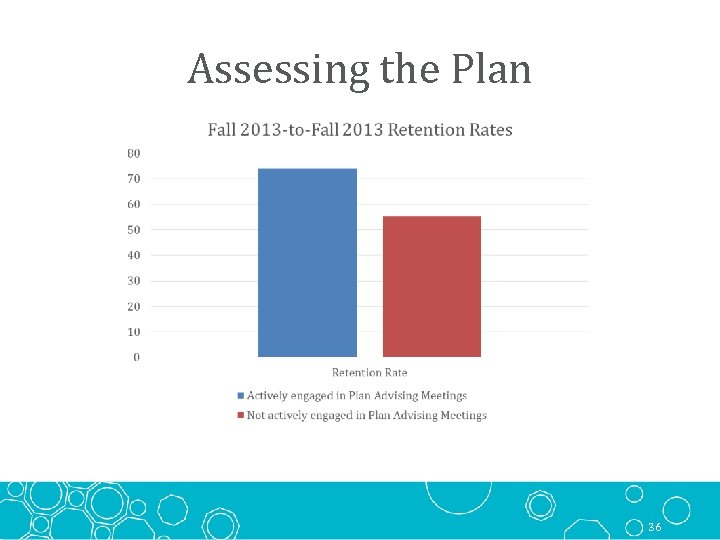 Assessing the Plan 36
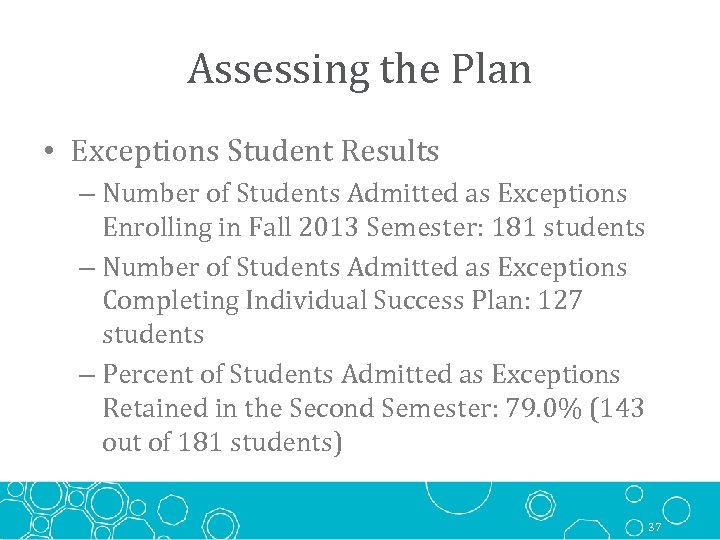 Assessing the Plan • Exceptions Student Results – Number of Students Admitted as Exceptions Enrolling in Fall 2013 Semester: 181 students – Number of Students Admitted as Exceptions Completing Individual Success Plan: 127 students – Percent of Students Admitted as Exceptions Retained in the Second Semester: 79. 0% (143 out of 181 students) 37
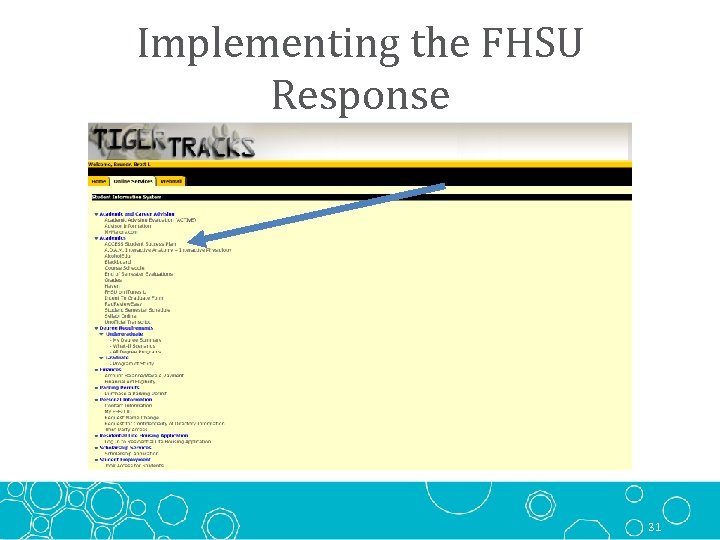
![Assessing the Plan • Connections – 457 first year students have an active Tiger[Link]](https://present5.com/presentation/0f72a6735dd6d67181c735cdadf7644d/image-39.jpg "Assessing the Plan • Connections – 457 first year students have an active Tiger[Link]") Assessing the Plan • Connections – 457 first year students have an active Tiger[Link] profile • Circle of support – 268 first year students attended a T. I. G. E. R. S. Series Workshop – 9 first year students participated in the Spring Collegiate Recovery Workshop • Education – 494 first year students attended 38
Assessing the Plan • Connections – 457 first year students have an active Tiger[Link] profile • Circle of support – 268 first year students attended a T. I. G. E. R. S. Series Workshop – 9 first year students participated in the Spring Collegiate Recovery Workshop • Education – 494 first year students attended 38
 Assessing the Plan • Continuous Improvement – Integration into Tiger Central: Online Advising Notes – Timing of the 2 nd meeting – Collaboration with Residential Life – integration with first-year residence halls 39
 So What? Applying Elements of the Plan to Your Campus Reflection Questions • What is the status of Transition elements on your campus? • Are there pubic policy mandates that might be affecting what OTR might look like on your campus in the future? 40
 So What? Applying Elements of the Plan to Your Campus Reflection Questions • Reflecting back on the original definition of Transition, what is your ideal vision of Transition on your campus? • What other campus partners do you need to bring to the table to make this a reality? 41
 So What? Applying Elements of the Plan to Your Campus Reflection Questions • What key first year milestones will drive what a Transition plan will look like for you? • What key performance indicators will you use to assess your Transition plan? 42
 Responding to Legislative Mandates in Creating an Innovative Individualized Student Transition Plan Brett L. Bruner, M. S. Director of First Year Experience/Persistence & Retention blbruner@fhsu. edu Eric J. Wilson II Graduate Assistant for Persistence & Retention ejwilson 5@fhsu. edu 43
 Please complete an evaluation of this session in Guidebook by clicking the link after the session description.