


 Скачать презентацию Responding to Constituents Demand Survival Strategies of MP s
a212d72cf39c5558b59e73284fa18793.ppt
- Количество слайдов: 32
 Responding to Constituents’ Demand: Survival Strategies of MP’s in Ghana’s 4 th Republic. Kojo Asante, Victor Brobbey & George Ofosu 22 nd September, 2011 www. institutions-africa. org
 What do we know about the Accountability Relationship between Legislators and Citizens’ in Africa? 2 MP-Citizens accountability relationship in Africa is clientelistic. But…. New information from the Africa Power and Politics Program finds that citizens are prioritizing collective ‘club goods’ and public goods in Ghana. AND suggests that in response to these demands some incumbent MPs in Ghana overtime have begun to turn their backs on providing solely private goods in favor of the provision of collective ‘club goods’. Lindberg suggests that MP’s behavior is explained by electoral competition Q. If MPs are Changing their Behavior, How are they Responding to Demands of Citizen? www. institutions-africa. org
 3 Research Strategy Ethnographic methods: Using a most different case study method with electoral competitiveness as a key factor, we trained and attached two research assistants to follow two MPs over one month. RAs were tasked to identify constituents that matters most to MPs by: 1. Estimating time allocation to various groups when MPs visit their constituency 2. The siting of developmental projects that are under the MP’s control (such as MP’s Fund ) 3. The distribution of MPs personal resources to service private goods demands www. institutions-africa. org
 4 Meet Our Legislators MP-A Comes from an electorally safe constituency for the opposition NPP Since 1996, the NPP candidate has won the seat with a 49% margin MP-A is in his second term as MP In parliament, he is on 3 committees including Finance and Defence He is a trained teacher and businessman MP-B Comes from a semi-competitive constituency 650 km from the capital MP in 2006 via a bye-election and reelected in 2008 for ruling NDC Since 2006, NDC candidate has won the seat with a 30% margin MP-B serves on 4 committees and is a Deputy Minister He is also a lawyer www. institutions-africa. org
 How do our MPs Allocate their Resources in Support of the Re-Election Bid? 5 Time Resources and Image: MP-A wants to been seen as a rep for all, so displays no party symbols in his car. He does not drive his 4 x 4 Mercedes Benz to the village and prefers to take the bus because is perceived by some as profligate. MP-A uses most of his time to meet constituents, party executives at Parliament House and the rest at ministries to lobby for projects. Very little time is spent on attending to formal parliamentary duties. MP-B spends most of his time in his ministry in Accra where all constituents go to. He sometimes has to stay till 9 pm. Over the period of the study when Parliament was in session MP-B was never seen in Parliament. www. institutions-africa. org
 How do our MPs Allocate their Resources in Support of the Re-Election Bid? Cont. 6 Developmental Projects: MP-B used his MP’s fund to provide classroom blocks and succeeded in leveraging his ministerial position to secure a commitment from a government agency to provide a school building for his constituency while on a tour with the President in his region. Similarly, he arranged with a bank in Accra to set up a loan scheme to help small-scale women entrepreneurs. MP-A used his MP’s fund to provide scholarships for students. He also was involved in commissioning a number of projects in 12 communities including classroom blocks, toilet facilities, post office rehabilitation roofing for schools, streetlights, computer training centers, etc. www. institutions-africa. org
 How do our MPs Allocate their Resources in Support of the Re-Election Bid? Cont. 7 Distribution of Private Good: Both MPs receive numerous calls and visits from constituents seeking personal assistance. In their constituency, MPs had as many as 20 visitors a day. MP-B was not spared this burden even on the day of the funeral of his wife. In terms of cash handout, MP-A gave out $622 and MP-B $1, 143 during observation. Both MPs admit that when they are in their constituency is much harder to defer payments for personal assistance. MPs and their Parties: Both MPs rely heavily on their local party executives to represent them in their absence from the constituency. In return, they sponsor party events and even pay for utility bills of the party office. www. institutions-africa. org
 8 Conclusion 1. Current research under the APPP is beginning to shed light on the accountability relationship between MPs and citizens in Ghana and for that matter Africa. 1. In response to demands by citizens for both club and private goods, some MP are turning their backs on providing solely private goods. 2. To prosecute their re-election agenda, MPs strategically allocate their resources (time, financial and development project) on a daily basis. 3. We find that the strategy of our two MPs, in spite of their differences, are not particularly different. 1. While, the data was insufficient to draw strong causal claims or inference, it is useful in generating hypotheses and inspiring future research. 2. Several questions linger on: Does electoral competitiveness matter? Do ruling party MPs and particularly MPs who double as Minister induce a higher demand for private goods? www. institutions-africa. org
 The Africa Power and Politics Programme is a consortium research programme funded by the UK Department for International Development (DFID) and Irish Aid for the benefit of developing countries. www. institutions-africa. org
 Institutionalising Developmental Leadership at National Level Towards a theory of developmental patrimonialism Tim Kelsall September 2011 www. institutions-africa. org
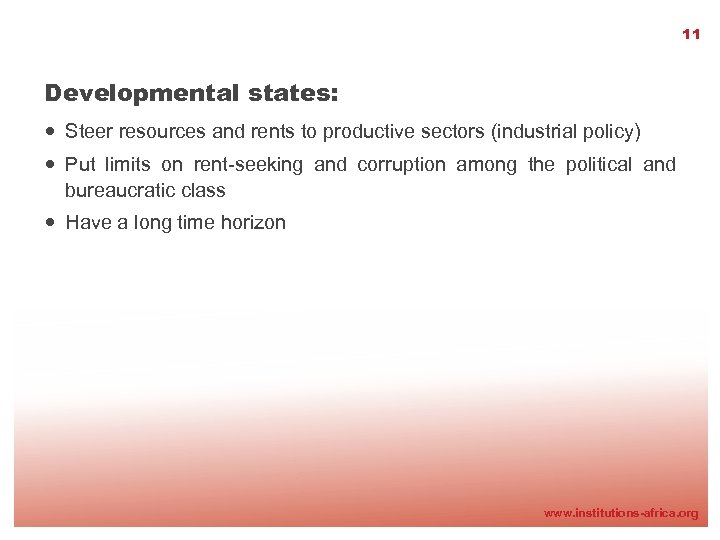 11 Developmental states: Steer resources and rents to productive sectors (industrial policy) Put limits on rent-seeking and corruption among the political and bureaucratic class Have a long time horizon www. institutions-africa. org
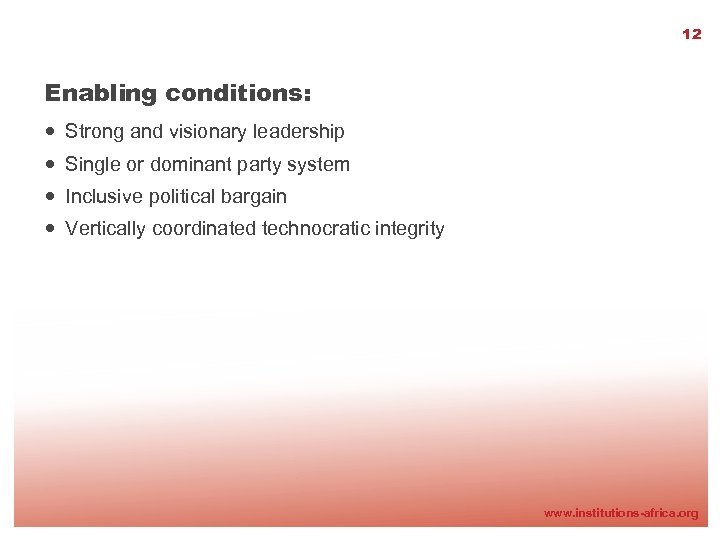 12 Enabling conditions: Strong and visionary leadership Single or dominant party system Inclusive political bargain Vertically coordinated technocratic integrity www. institutions-africa. org
 13 APPP key finding 1: Rent centralisation mechanisms are crucial to successful development www. institutions-africa. org
 14 Differences with conventional wisdom: 1. ‘Good governance’ not necessary 2. Good industrial policy is necessary www. institutions-africa. org
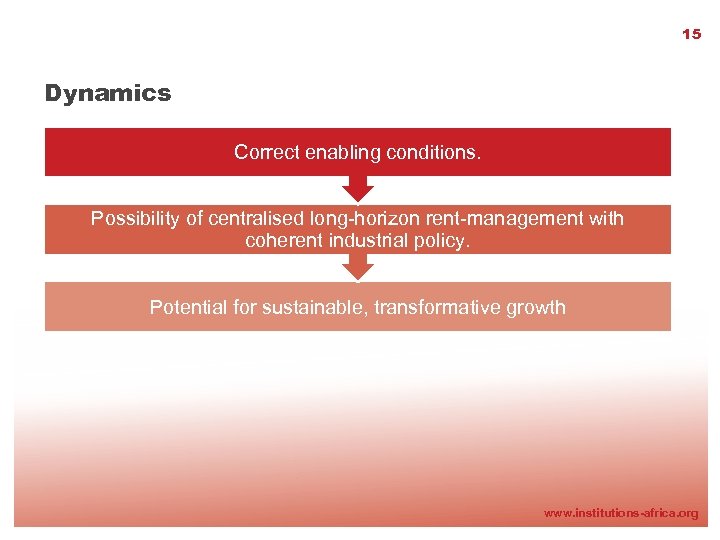 15 Dynamics Correct enabling conditions. Possibility of centralised long-horizon rent-management with coherent industrial policy. Potential for sustainable, transformative growth www. institutions-africa. org
 16 APPP key finding 2: A diversity of institutions, including unconventional institutions, can play a role in rent-centralisation www. institutions-africa. org
 17 Caveat: additional enabling conditions Institutionalised arrangements for political succession Pro-rural policy bias Conducive state-business relations www. institutions-africa. org
 18 Disabling conditions: Weak leadership lacking in vision Winner-takes-all political system Vigorous political competition Cowed or incompetent economic technocracy Political succession not institutionalised Poor state-business relations Urban policy bias Absence of a rent-centralisation mechanism www. institutions-africa. org
 19 Developmental-patrimonial states in Africa Have fulfilled most of the enabling conditions, incl having rentcentralisation mechanisms Have lacked institutionalised mechanisms for political succession www. institutions-africa. org
 20 Non-developmental democratic states in Africa Tend to lack several enabling conditions May have solved the problem of political succession (competitive election, presidential term limits), but not in a way that is helpful to rent-centralisation and development www. institutions-africa. org
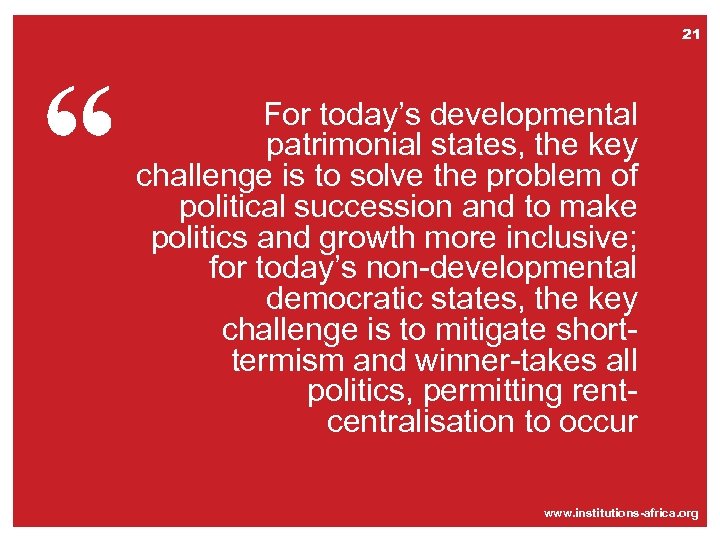 21 “ For today’s developmental patrimonial states, the key challenge is to solve the problem of political succession and to make politics and growth more inclusive; for today’s non-developmental democratic states, the key challenge is to mitigate shorttermism and winner-takes all politics, permitting rentcentralisation to occur www. institutions-africa. org
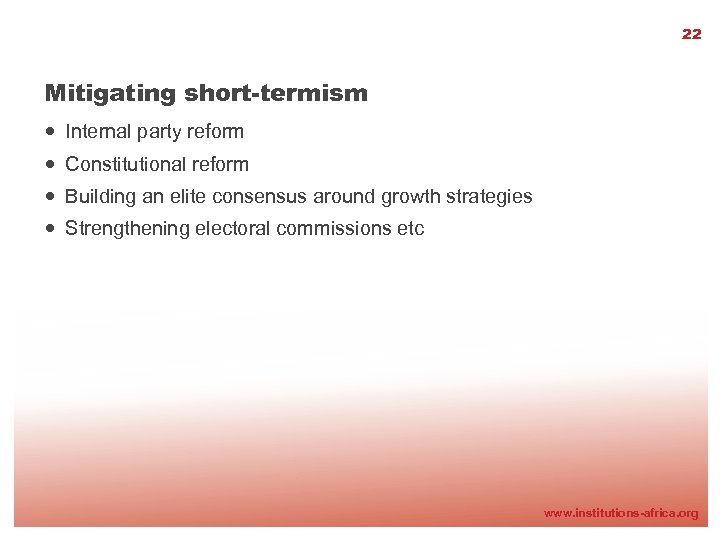 22 Mitigating short-termism Internal party reform Constitutional reform Building an elite consensus around growth strategies Strengthening electoral commissions etc www. institutions-africa. org
 The Africa Power and Politics Programme is a consortium research programme funded by the UK Department for International Development (DFID) and Irish Aid for the benefit of developing countries. www. institutions-africa. org
 Developmental leadership and ‘aid effectiveness’ What APPP research means for donors David Booth EADI/DSA Conference, York, 22 Sept 2011 www. institutions-africa. org
 25 Disclaimers Not a mainstream APPP report but a spin-off, linking to a personal hobby-horse APPP research is not just or mainly for donors, but this paper is The occasion is the “ 4 th High Level Forum on Aid Effectiveness” in Busan, in November, but the issues are more chronic I do, however, assume a rough knowledge of the 2005 “Paris Declaration on Aid Effectiveness” Multiple influences and convergences, which I can’t acknowledge www. institutions-africa. org
 26 “ Country ownership needs to be brought back to the centre of discussion … www. institutions-africa. org
 27 … posing afresh the question of how to get a constructive relationship between aid and political commitment to development goals at country level The current concepts of aid alignment, donor harmonisation and management for results don’t provide the needed answers They are answers to a different question, based on the false premise that development-oriented leadership already exists and just needs to be nurtured www. institutions-africa. org
 28 “ Aid can be harmful to country-owned development understood in this way … www. institutions-africa. org
 29 … because it shields incumbents from the consequences of irresponsible or short-termist actions But research, including theory about developmental patrimonialism and the framework of the Elites, Poverty and Production programme, shows that: non-developmental leadership decisions (short-termism, neglect of implementation, etc. ) are the product of … politicians’ collective-action logjams under conditions of elite fragmentation and highly competitive electoral competition External actors can in principle, and do to some extent in practice, help to solve otherwise fatal collective-action problems They could do more of that (or fund others to do it), and do less disbursement of funds www. institutions-africa. org
 30 “ Treating country ownership as an outcome to be constructed suggests a different concept of development cooperation … www. institutions-africa. org
 31 … with less focus on filling resource gaps and more on assisting the right kinds of institutional change That means transforming development agencies … … which the agencies can’t do on their own We need nothing less than a new politics and public discourse about development in donor countries Thank you www. institutions-africa. org
 The Africa Power and Politics Programme is a consortium research programme funded by the UK Department for International Development (DFID) and Irish Aid for the benefit of developing countries. www. institutions-africa. org