 Скачать презентацию Respiratory System Keri Muma Bio 6 Functions
bb71036b8c61162a24ee9ba165e8c9e8.ppt
- Количество слайдов: 66



Respiratory System Keri Muma Bio 6
Functions n n n Gas exchange – between the external environment and the blood Filters, humidifies, and warms inspired air Production of sound Smell Maintains p. H homeostasis
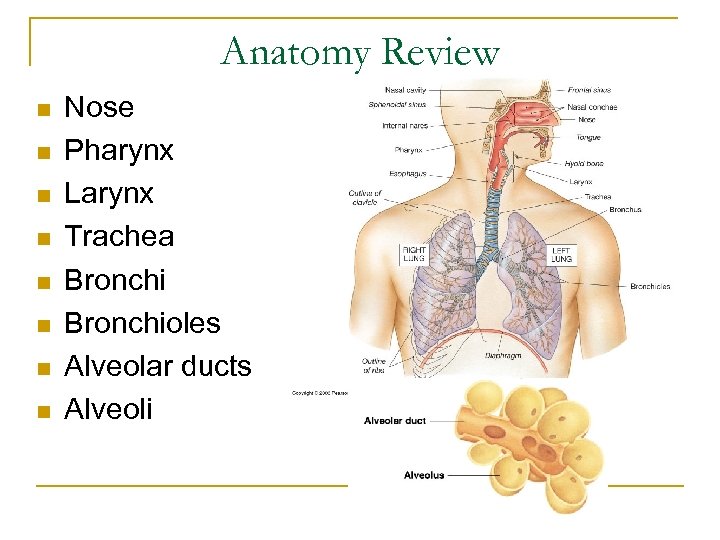
Anatomy Review n n n n Nose Pharynx Larynx Trachea Bronchioles Alveolar ducts Alveoli
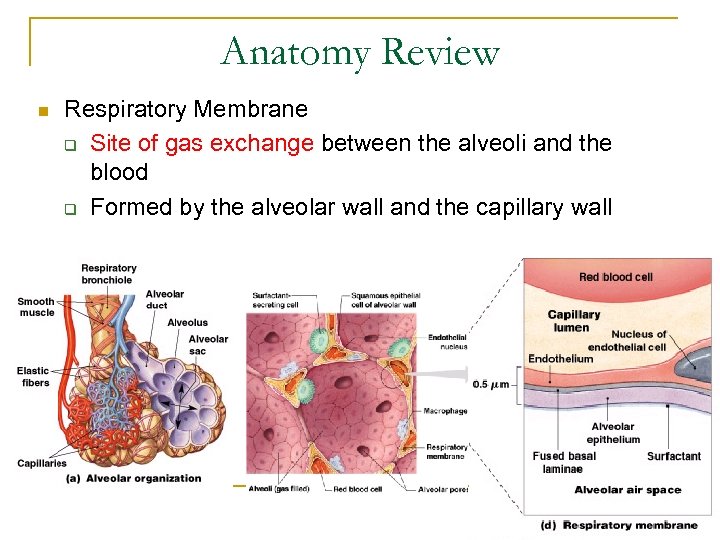
Anatomy Review n Respiratory Membrane q Site of gas exchange between the alveoli and the blood q Formed by the alveolar wall and the capillary wall
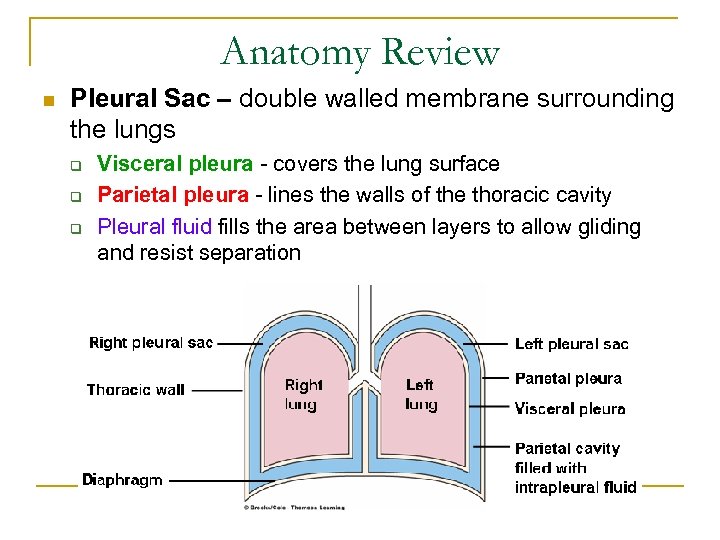
Anatomy Review n Pleural Sac – double walled membrane surrounding the lungs q q q Visceral pleura - covers the lung surface Parietal pleura - lines the walls of the thoracic cavity Pleural fluid fills the area between layers to allow gliding and resist separation
Respiratory Pressures n Respiratory pressures are described relative to atmospheric pressure @ sea level q q Patm = 760 mm Hg Negative pressure: -1 mm Hg = 759 mm Hg Positive pressure: + 1 mm Hg = 761 mm Hg 0 mm Hg = 760 mm Hg
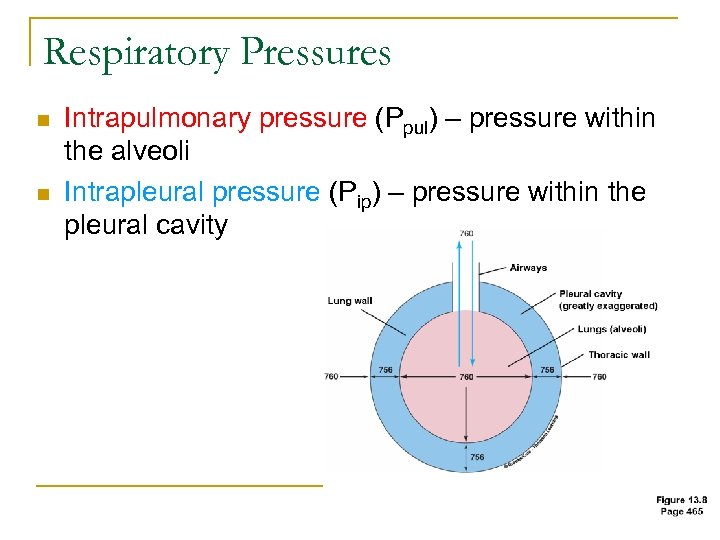
Respiratory Pressures n n Intrapulmonary pressure (Ppul) – pressure within the alveoli Intrapleural pressure (Pip) – pressure within the pleural cavity
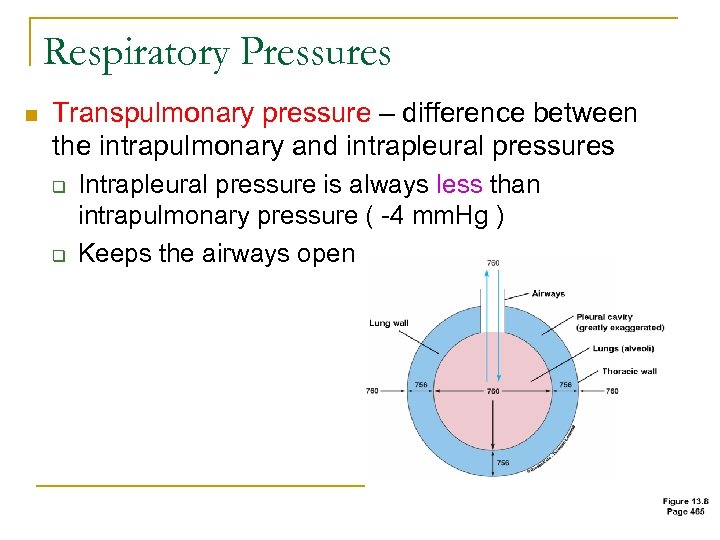
Respiratory Pressures n Transpulmonary pressure – difference between the intrapulmonary and intrapleural pressures q q Intrapleural pressure is always less than intrapulmonary pressure ( -4 mm. Hg ) Keeps the airways open
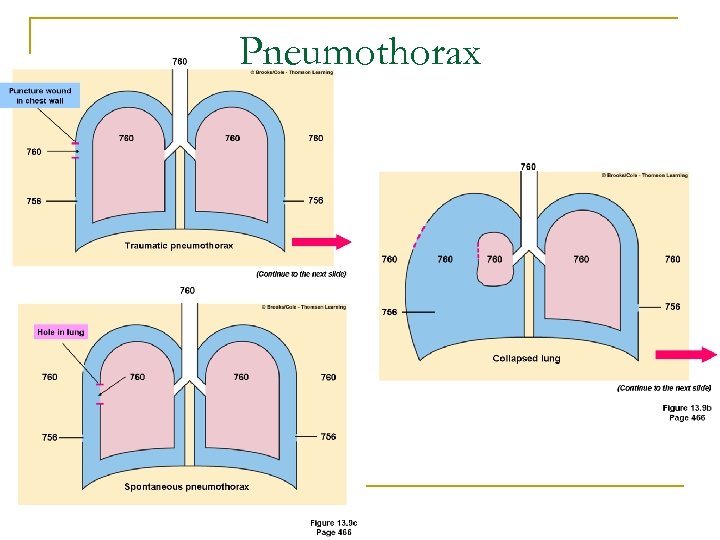
Pneumothorax
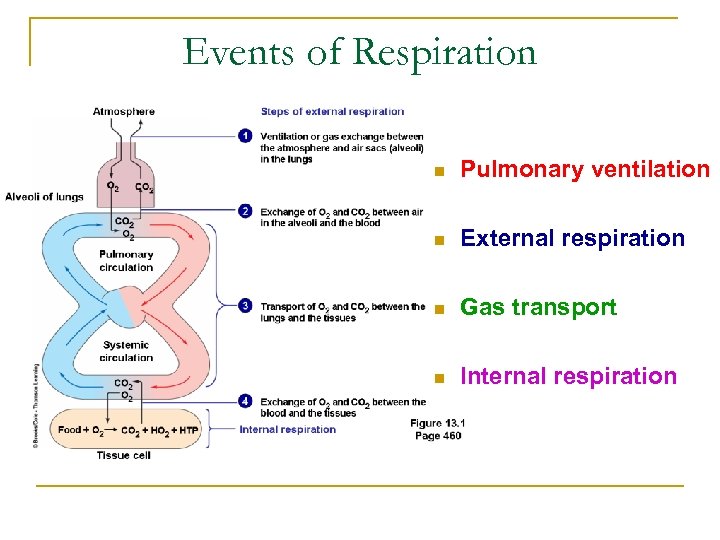
Events of Respiration n Pulmonary ventilation n External respiration n Gas transport n Internal respiration
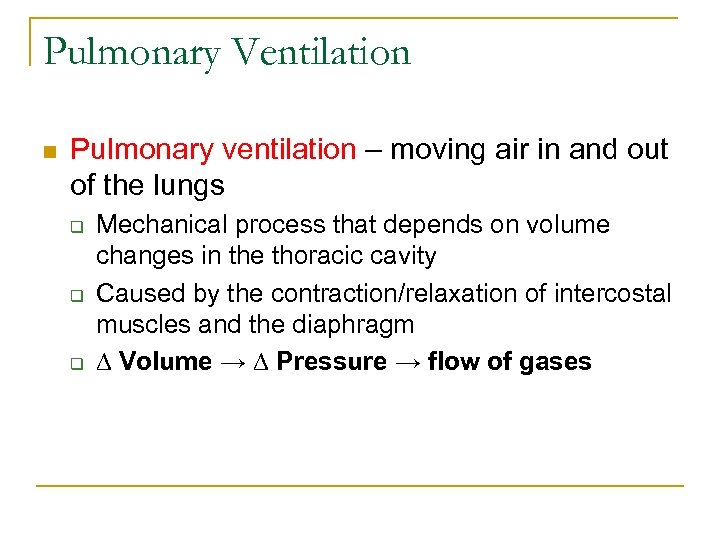
Pulmonary Ventilation n Pulmonary ventilation – moving air in and out of the lungs q q q Mechanical process that depends on volume changes in the thoracic cavity Caused by the contraction/relaxation of intercostal muscles and the diaphragm ∆ Volume → ∆ Pressure → flow of gases
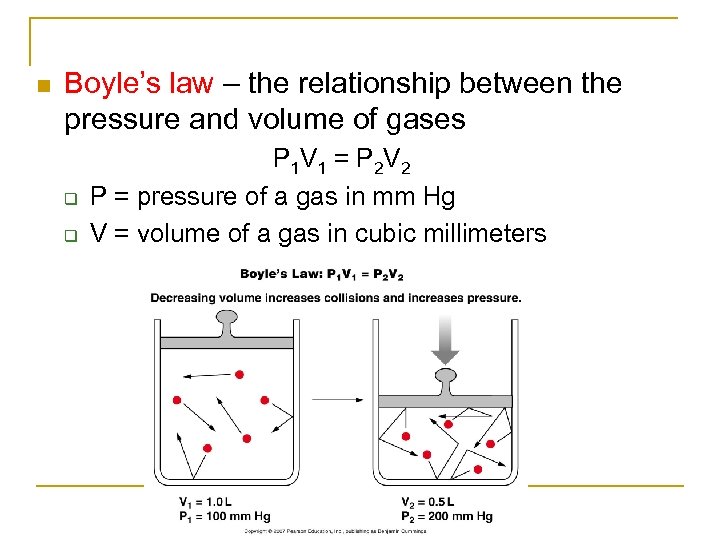
n Boyle’s law – the relationship between the pressure and volume of gases q q P 1 V 1 = P 2 V 2 P = pressure of a gas in mm Hg V = volume of a gas in cubic millimeters
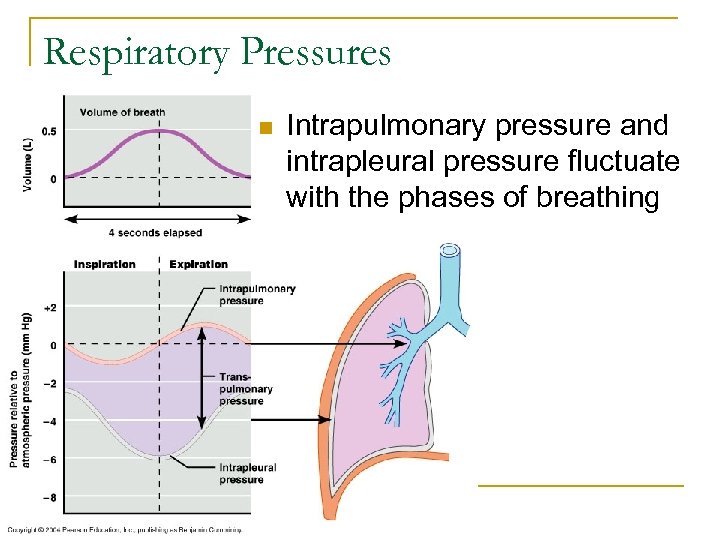
Respiratory Pressures n Intrapulmonary pressure and intrapleural pressure fluctuate with the phases of breathing
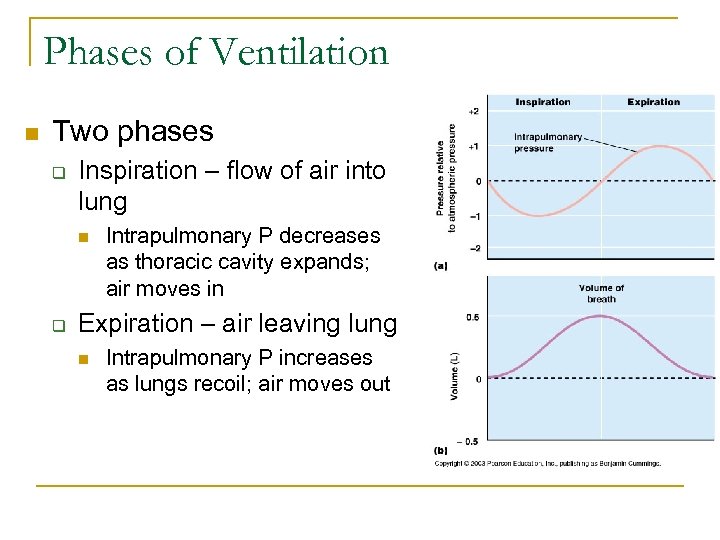
Phases of Ventilation n Two phases q Inspiration – flow of air into lung n q Intrapulmonary P decreases as thoracic cavity expands; air moves in Expiration – air leaving lung n Intrapulmonary P increases as lungs recoil; air moves out
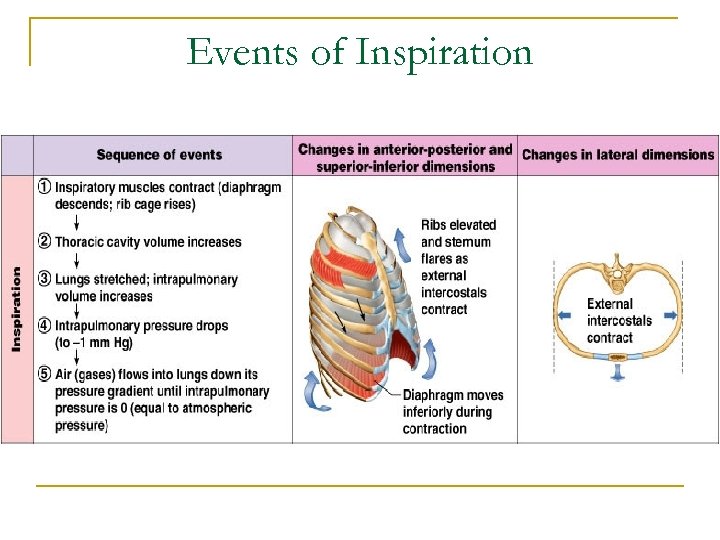
Events of Inspiration
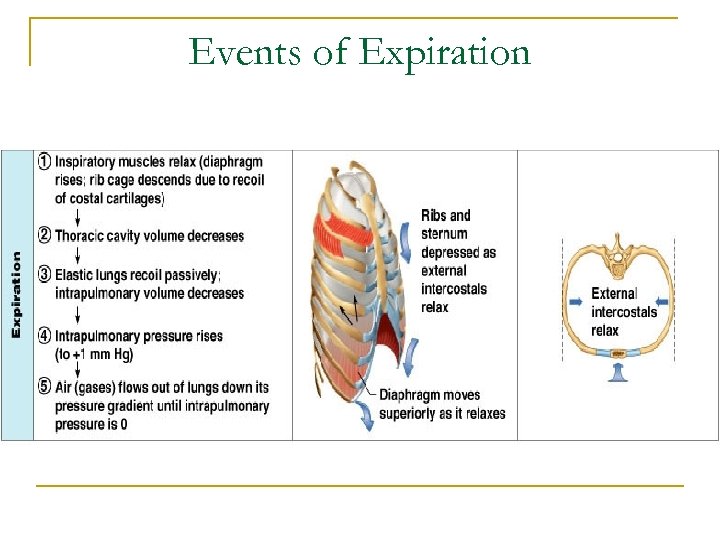
Events of Expiration
Factors Effecting Ventilation n Lung Compliance - the ease with which the lungs can be expanded q q n Reduced by factors that produce resistance to distension of the lung tissue and surrounding thoracic cage Reduced by pulmonary edema, fibrosis, surface tension of the alveoli Elasticity – how readily the lungs recoil after stretching q Elastic CT and surface tension of the alveoli
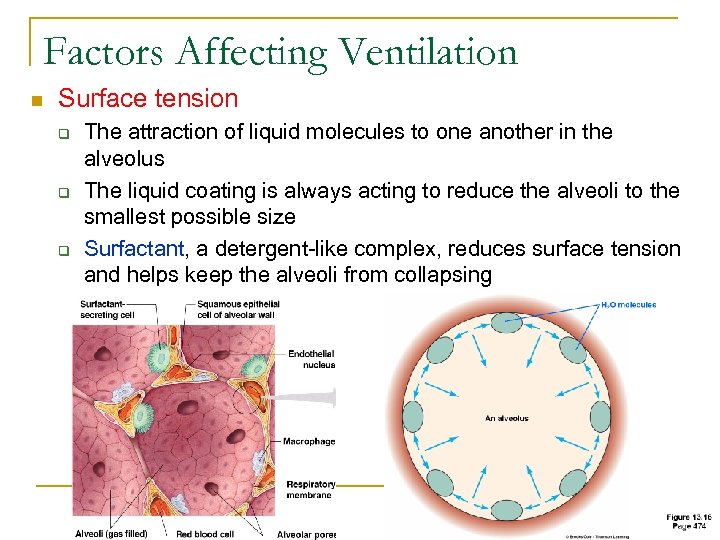
Factors Affecting Ventilation n Surface tension q q q The attraction of liquid molecules to one another in the alveolus The liquid coating is always acting to reduce the alveoli to the smallest possible size Surfactant, a detergent-like complex, reduces surface tension and helps keep the alveoli from collapsing
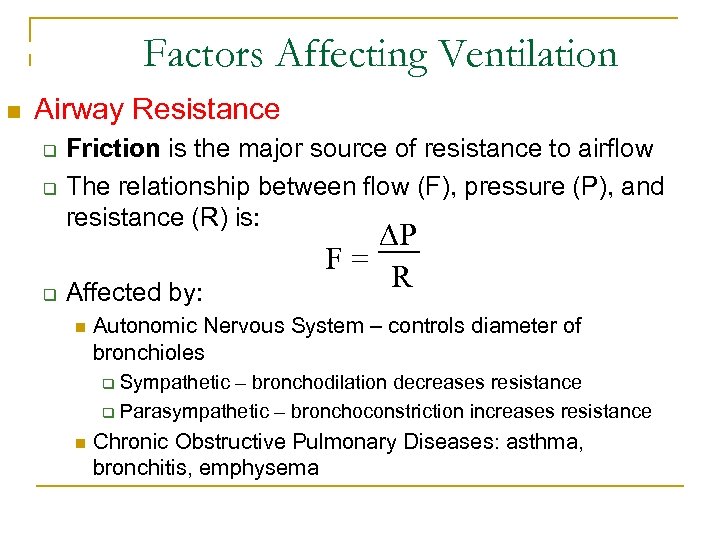
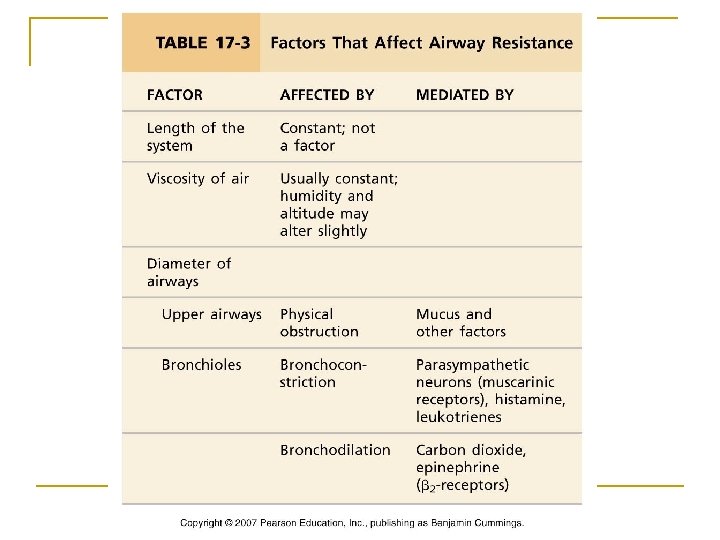
Factors Affecting Ventilation n Airway Resistance q q q Friction is the major source of resistance to airflow The relationship between flow (F), pressure (P), and resistance (R) is: Affected by: n P F= R Autonomic Nervous System – controls diameter of bronchioles Sympathetic – bronchodilation decreases resistance q Parasympathetic – bronchoconstriction increases resistance q n Chronic Obstructive Pulmonary Diseases: asthma, bronchitis, emphysema
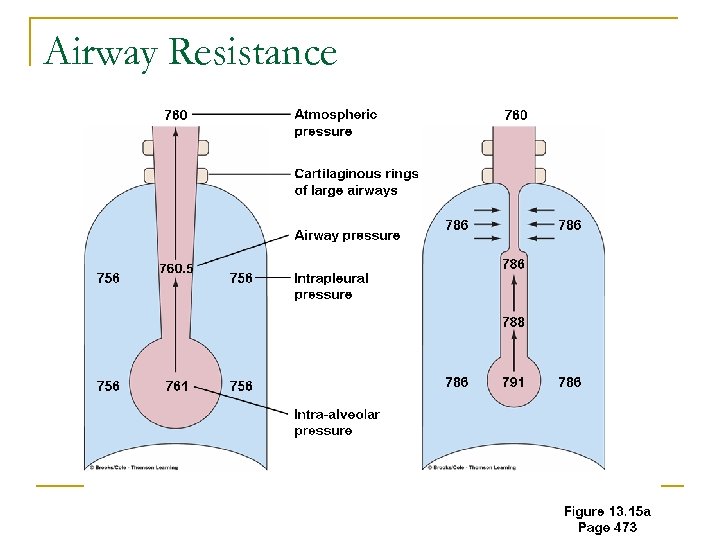
Airway Resistance
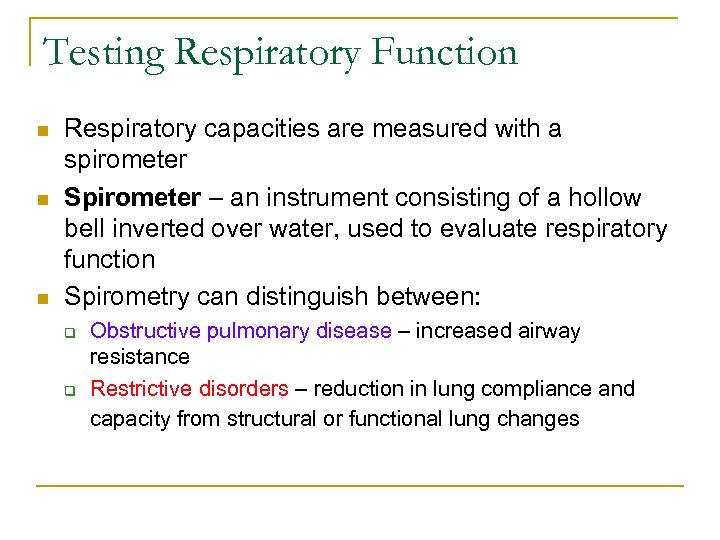
Testing Respiratory Function n Respiratory capacities are measured with a spirometer Spirometer – an instrument consisting of a hollow bell inverted over water, used to evaluate respiratory function Spirometry can distinguish between: q q Obstructive pulmonary disease – increased airway resistance Restrictive disorders – reduction in lung compliance and capacity from structural or functional lung changes
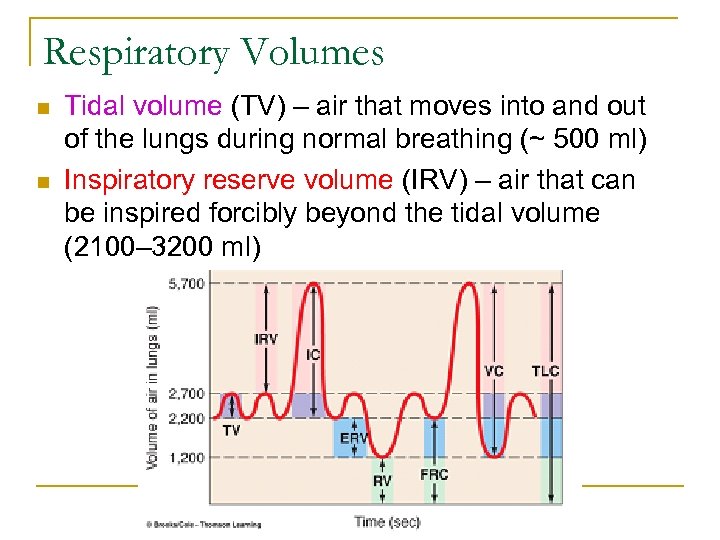
Respiratory Volumes n n Tidal volume (TV) – air that moves into and out of the lungs during normal breathing (~ 500 ml) Inspiratory reserve volume (IRV) – air that can be inspired forcibly beyond the tidal volume (2100– 3200 ml)
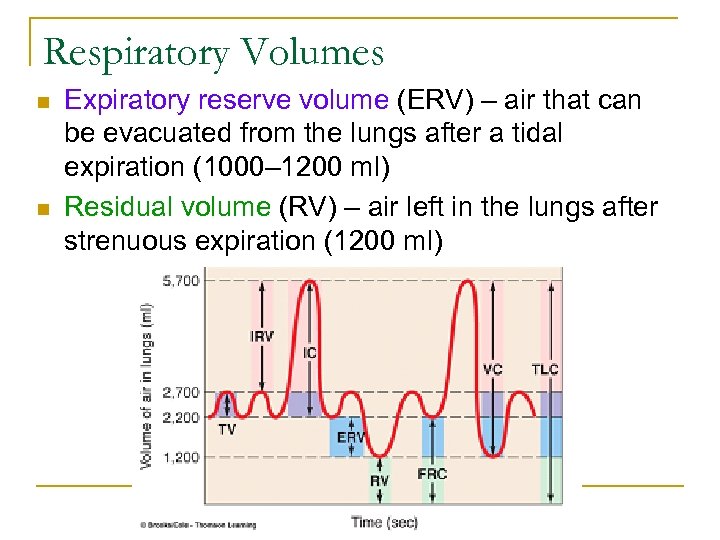
Respiratory Volumes n n Expiratory reserve volume (ERV) – air that can be evacuated from the lungs after a tidal expiration (1000– 1200 ml) Residual volume (RV) – air left in the lungs after strenuous expiration (1200 ml)
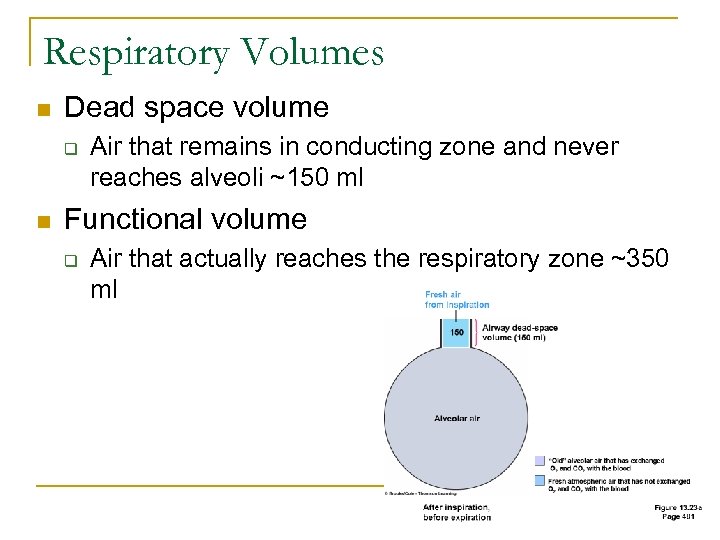
Respiratory Volumes n Dead space volume q n Air that remains in conducting zone and never reaches alveoli ~150 ml Functional volume q Air that actually reaches the respiratory zone ~350 ml
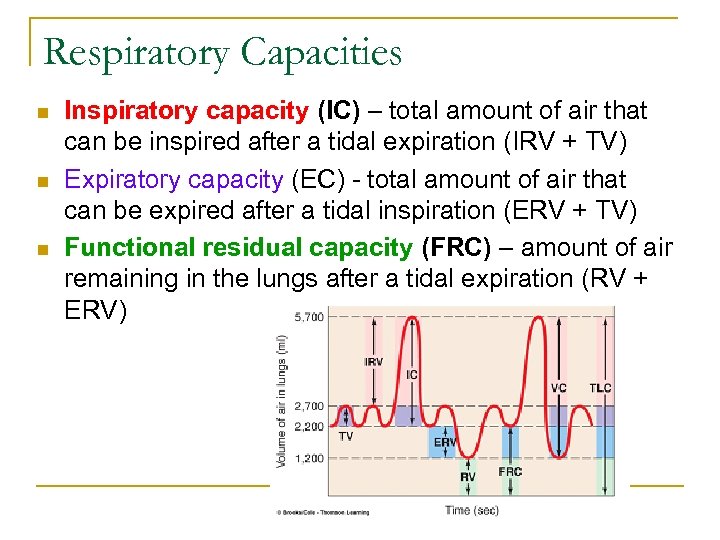
Respiratory Capacities n n n Inspiratory capacity (IC) – total amount of air that can be inspired after a tidal expiration (IRV + TV) Expiratory capacity (EC) - total amount of air that can be expired after a tidal inspiration (ERV + TV) Functional residual capacity (FRC) – amount of air remaining in the lungs after a tidal expiration (RV + ERV)
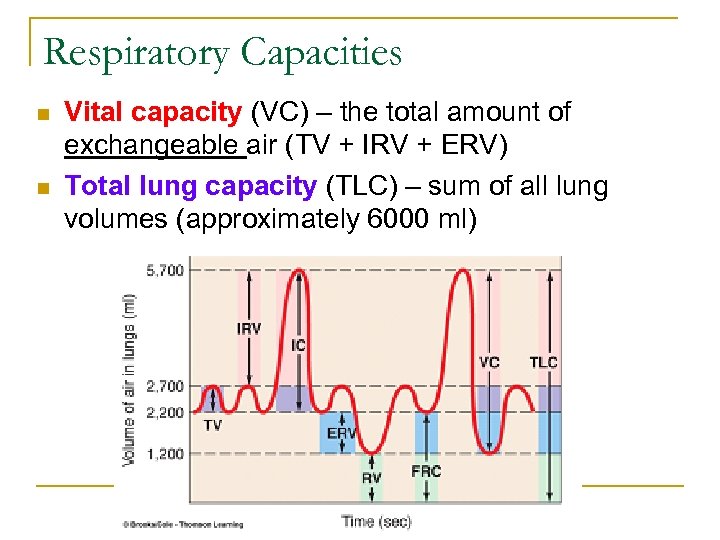
Respiratory Capacities n n Vital capacity (VC) – the total amount of exchangeable air (TV + IRV + ERV) Total lung capacity (TLC) – sum of all lung volumes (approximately 6000 ml)
Testing Respiratory Function n Total ventilation – total amount of gas flow into or out of the respiratory tract in one minute q q n n (respiratory rate X tidal volume) Example: 12 breaths/min X 500 m. L/breath = 6000 m. L/min Forced vital capacity (FVC) – gas forcibly expelled after taking a deep breath Forced expiratory volume (FEV) – the amount of gas expelled during specific time intervals of the FVC
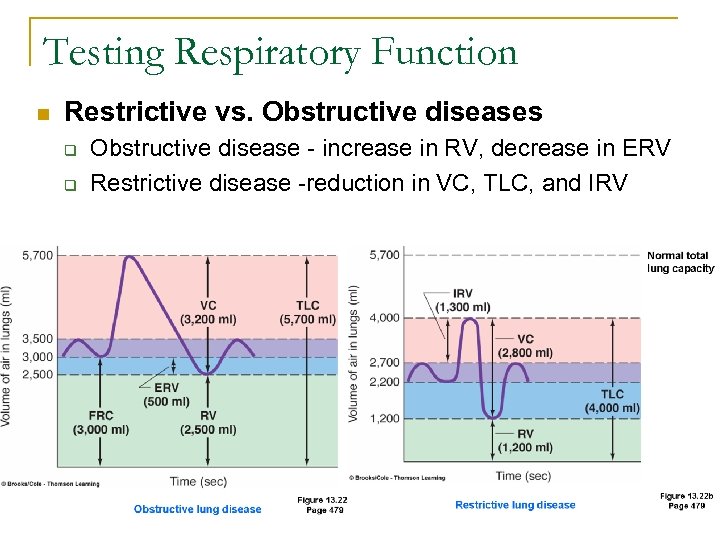
Testing Respiratory Function n Restrictive vs. Obstructive diseases q q Obstructive disease - increase in RV, decrease in ERV Restrictive disease -reduction in VC, TLC, and IRV
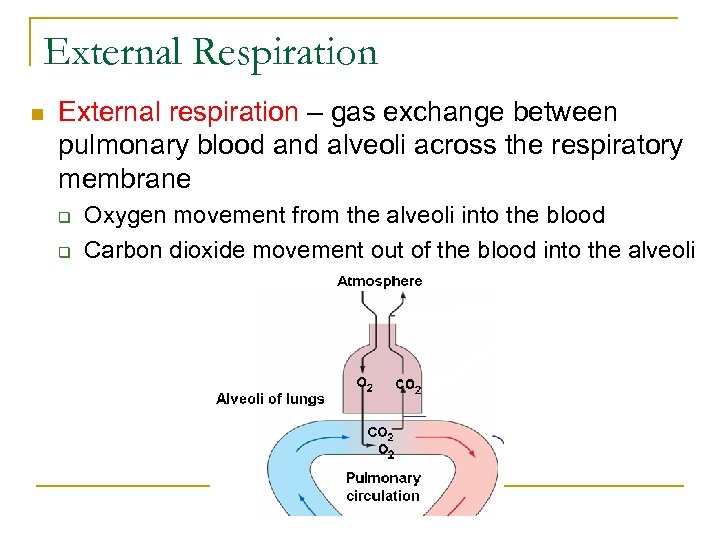
External Respiration n External respiration – gas exchange between pulmonary blood and alveoli across the respiratory membrane q q Oxygen movement from the alveoli into the blood Carbon dioxide movement out of the blood into the alveoli
External Respiration n Factors influencing the movement of oxygen and carbon dioxide across the respiratory membrane q q q Partial pressure gradients and gas solubility Matching of alveolar ventilation and pulmonary blood perfusion Structural characteristics of the respiratory membrane
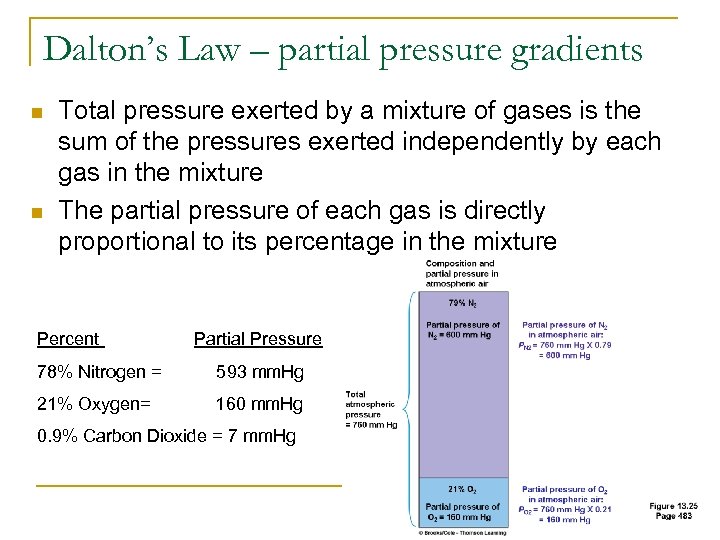
Dalton’s Law – partial pressure gradients n n Total pressure exerted by a mixture of gases is the sum of the pressures exerted independently by each gas in the mixture The partial pressure of each gas is directly proportional to its percentage in the mixture Percent Partial Pressure 78% Nitrogen = 593 mm. Hg 21% Oxygen= 160 mm. Hg 0. 9% Carbon Dioxide = 7 mm. Hg
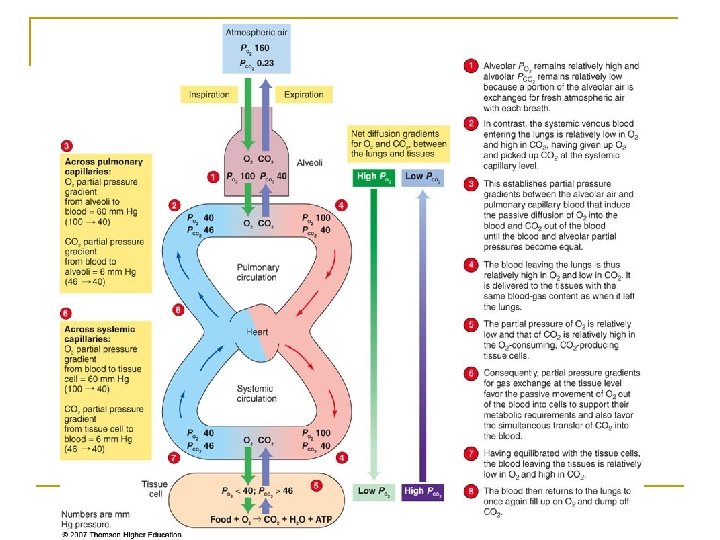
Factors Influencing External Respiration n Partial Pressure Gradients q Oxygen movement into the blood from the alveoli n n q The alveoli have a higher PO 2 than the blood Oxygen moves by diffusion towards the area of lower partial pressure Carbon dioxide movement out of the blood to the alveoli n Blood returning from tissues has a higher PCO 2 than the air in the alveoli
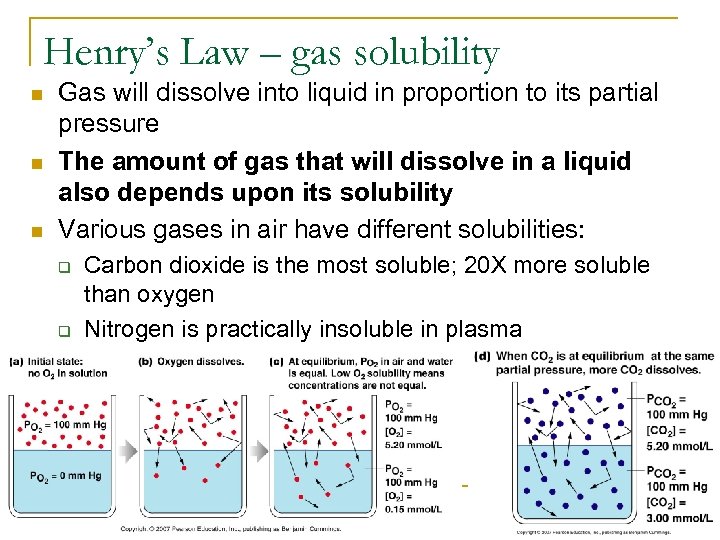
Henry’s Law – gas solubility n n n Gas will dissolve into liquid in proportion to its partial pressure The amount of gas that will dissolve in a liquid also depends upon its solubility Various gases in air have different solubilities: q q Carbon dioxide is the most soluble; 20 X more soluble than oxygen Nitrogen is practically insoluble in plasma
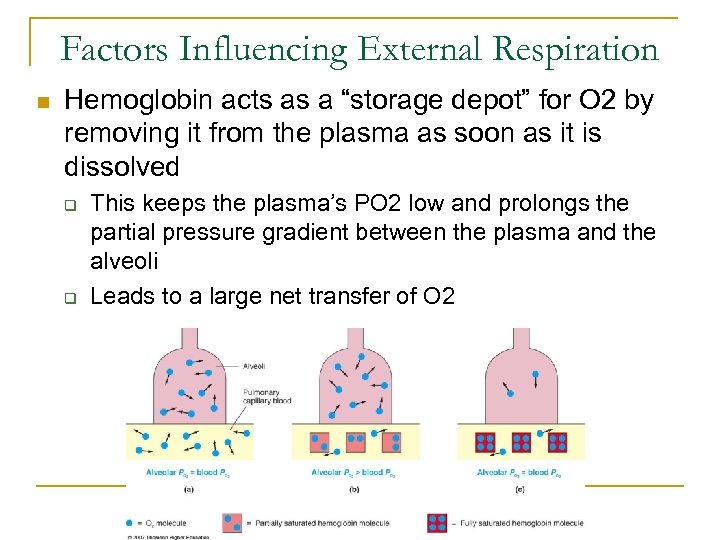
Factors Influencing External Respiration n Hemoglobin acts as a “storage depot” for O 2 by removing it from the plasma as soon as it is dissolved q q This keeps the plasma’s PO 2 low and prolongs the partial pressure gradient between the plasma and the alveoli Leads to a large net transfer of O 2
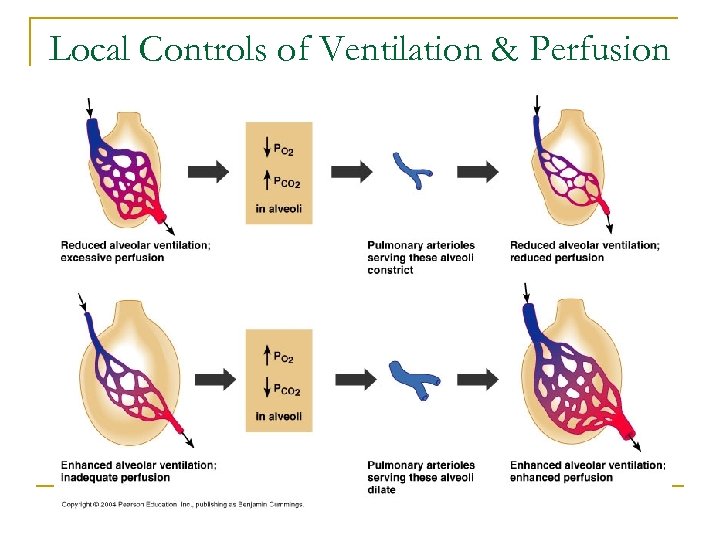
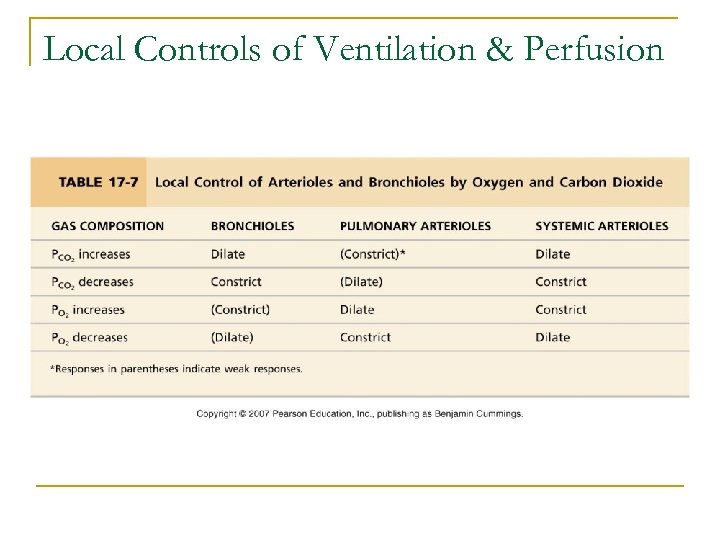
Factors Influencing External Respiration n Ventilation and perfusion are matched for efficient gas exchange q q n Ventilation – the amount of gas reaching the alveoli Perfusion – the blood flow reaching the alveoli Changes in PCO 2 and PO 2 in the alveoli cause local changes: q q When alveolar CO 2 is high and O 2 is low: Bronchioles will dilate and arterioles constrict When alveolar CO 2 is low and O 2 is high: Bronchioles will constrict and arterioles will dilate
Local Controls of Ventilation & Perfusion
Local Controls of Ventilation & Perfusion
Factors Influencing External Respiration n Structural characteristics of the respiratory membrane: q q Are only 0. 5 to 1 m thick, allowing for efficient gas exchange Have a total surface area (in males) of about 60 m 2 (40 times that of one’s skin) Thickening causes gas exchange to be inadequate: inflammation, edema, mucus, fibrosis Decrease in surface area with emphysema, when walls of adjacent alveoli breakdown
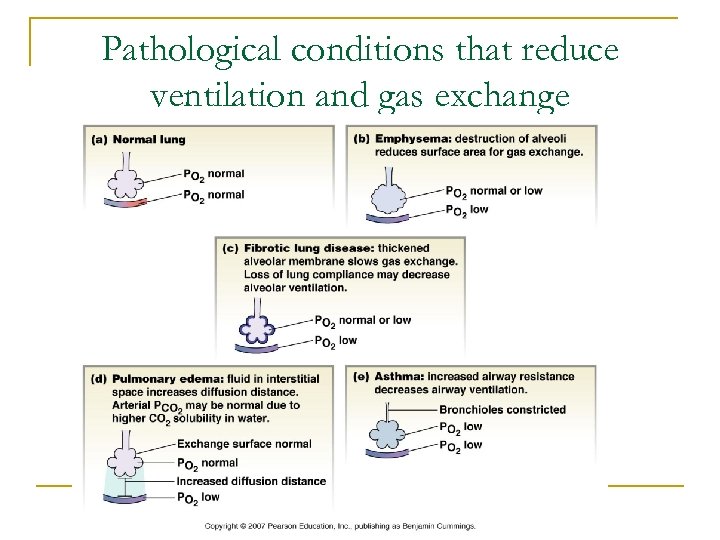
Pathological conditions that reduce ventilation and gas exchange
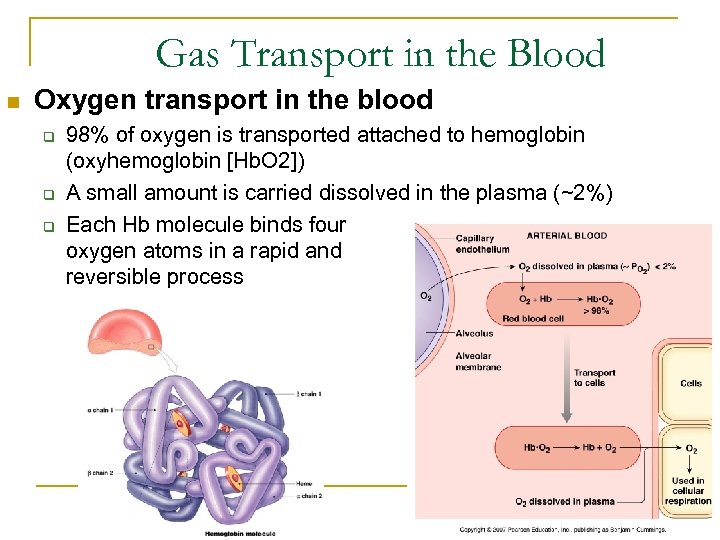
Gas Transport in the Blood n Oxygen transport in the blood q q q 98% of oxygen is transported attached to hemoglobin (oxyhemoglobin [Hb. O 2]) A small amount is carried dissolved in the plasma (~2%) Each Hb molecule binds four oxygen atoms in a rapid and reversible process
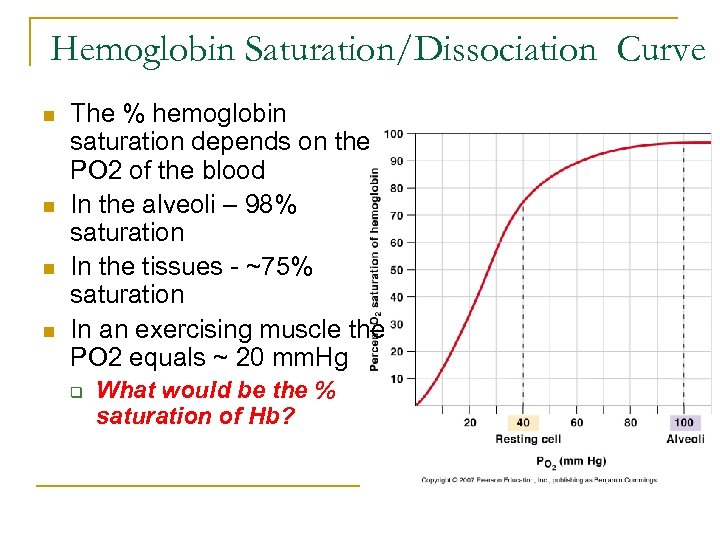
Hemoglobin Saturation/Dissociation Curve n n The % hemoglobin saturation depends on the PO 2 of the blood In the alveoli – 98% saturation In the tissues - ~75% saturation In an exercising muscle the PO 2 equals ~ 20 mm. Hg q What would be the % saturation of Hb?
Factors Affecting Saturation of Hemoglobin n Increases in the following factors decreases hemoglobin’s affinity for oxygen q q q n Temperature H+ (acidity) PCO 2, 2, 3 -biphosphoglycerate (BPG) (a. k. a diphosphoglycerate) These factors modify the structure of hemoglobin and alter its affinity for oxygen and enhances oxygen unloading from Hb These parameters are higher in systemic capillaries supplying tissues, where oxygen unloading is the goal
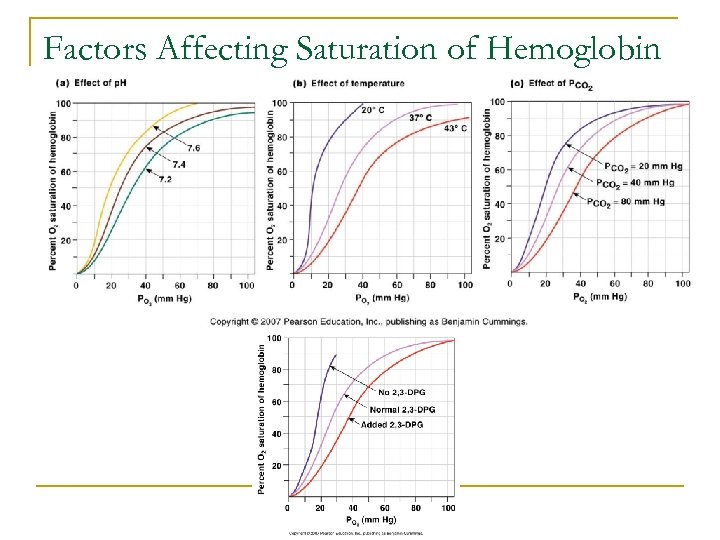
Factors Affecting Saturation of Hemoglobin
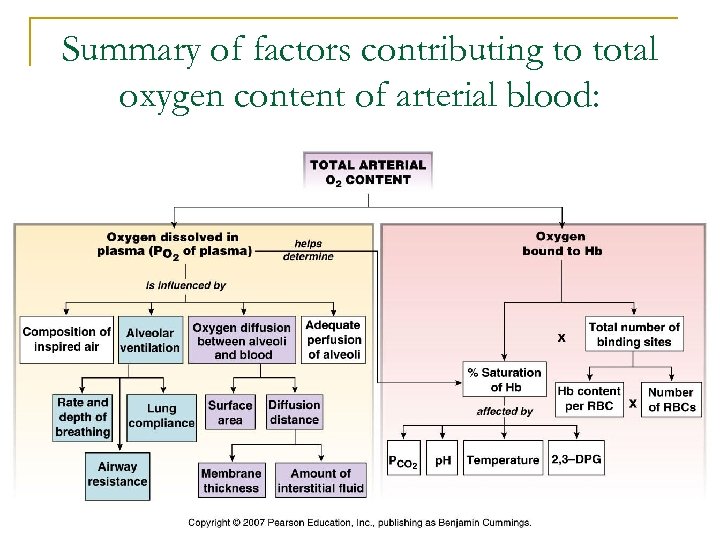
Summary of factors contributing to total oxygen content of arterial blood:
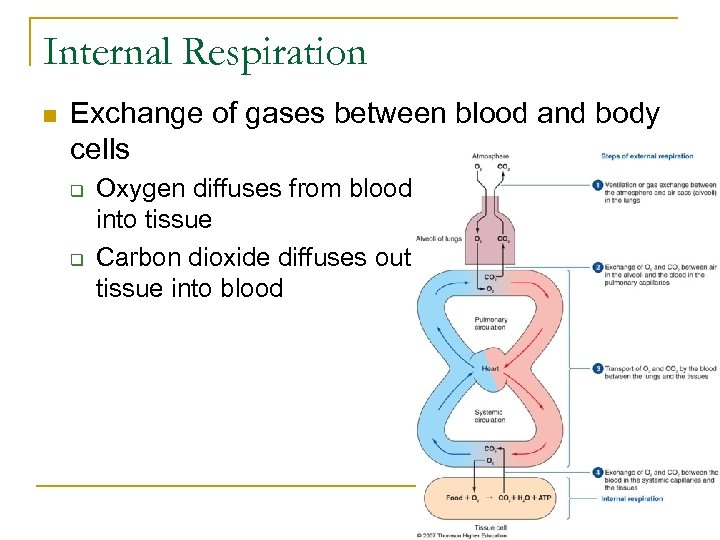
Internal Respiration n Exchange of gases between blood and body cells q q Oxygen diffuses from blood into tissue Carbon dioxide diffuses out tissue into blood of
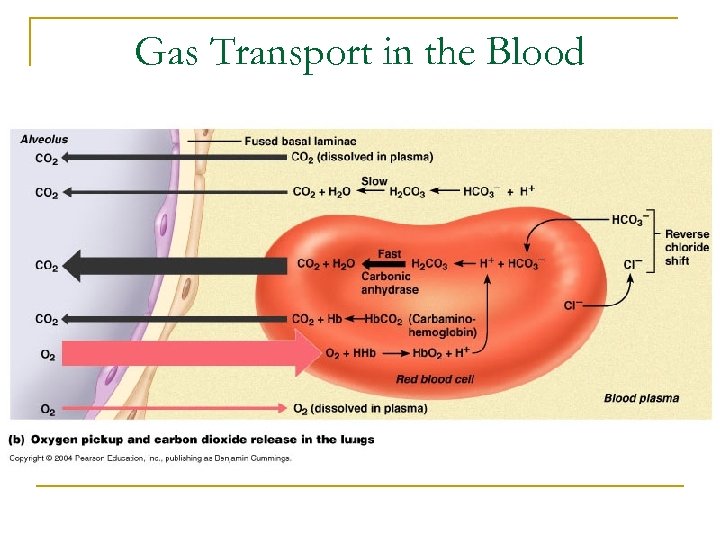
Gas Transport in the Blood n Carbon dioxide is transported in the blood in three forms: q q q Dissolved in plasma – 7% Bound to hemoglobin – 23% is carried in RBCs as carbaminohemoglobin, at a different binding site than oxygen Most is carried as bicarbonate ions in plasma – 70% is transported as bicarbonate (HCO 3–)
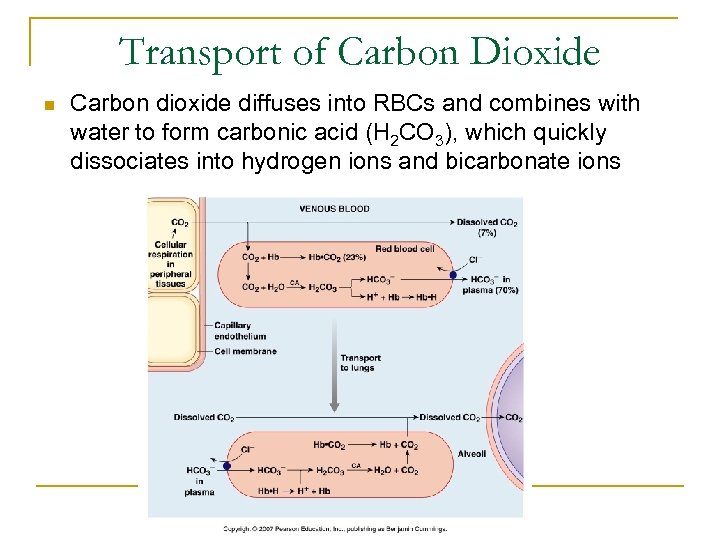
Transport of Carbon Dioxide n Carbon dioxide diffuses into RBCs and combines with water to form carbonic acid (H 2 CO 3), which quickly dissociates into hydrogen ions and bicarbonate ions
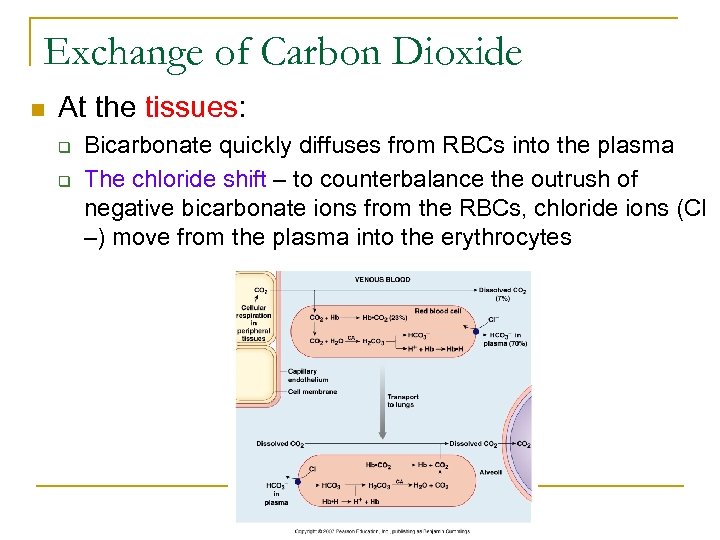
Exchange of Carbon Dioxide n At the tissues: q q Bicarbonate quickly diffuses from RBCs into the plasma The chloride shift – to counterbalance the outrush of negative bicarbonate ions from the RBCs, chloride ions (Cl –) move from the plasma into the erythrocytes
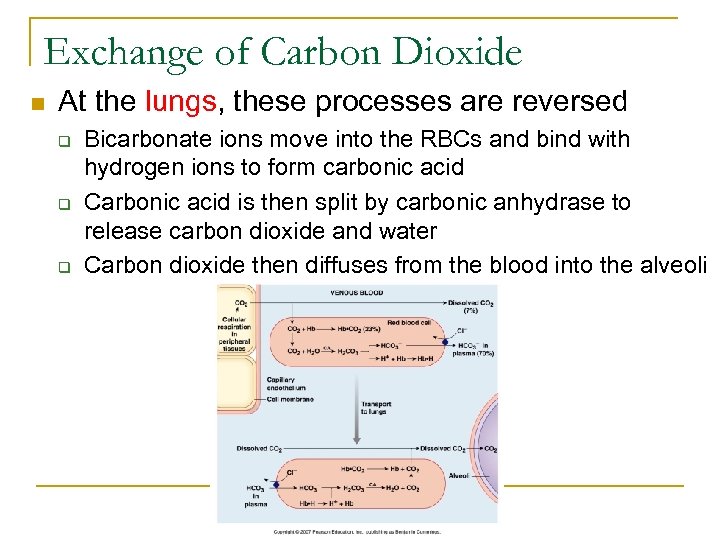
Exchange of Carbon Dioxide n At the lungs, these processes are reversed q q q Bicarbonate ions move into the RBCs and bind with hydrogen ions to form carbonic acid Carbonic acid is then split by carbonic anhydrase to release carbon dioxide and water Carbon dioxide then diffuses from the blood into the alveoli
Gas Transport in the Blood
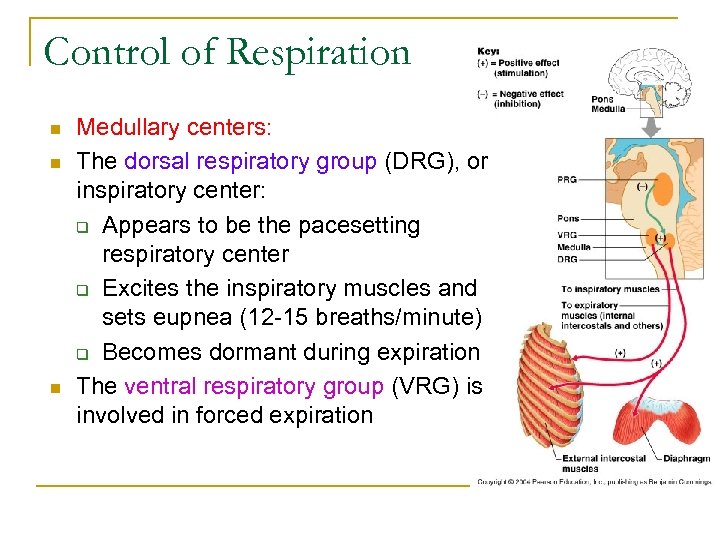
Control of Respiration n Medullary centers: The dorsal respiratory group (DRG), or inspiratory center: q Appears to be the pacesetting respiratory center q Excites the inspiratory muscles and sets eupnea (12 -15 breaths/minute) q Becomes dormant during expiration The ventral respiratory group (VRG) is involved in forced expiration
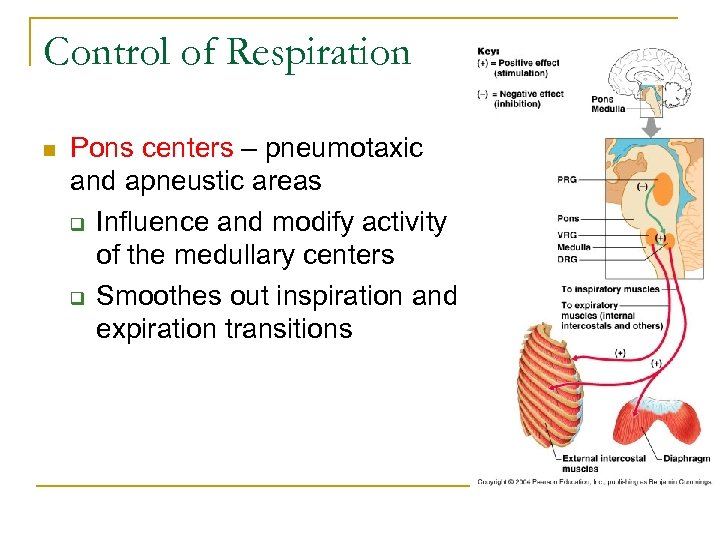
Control of Respiration n Pons centers – pneumotaxic and apneustic areas q Influence and modify activity of the medullary centers q Smoothes out inspiration and expiration transitions
Depth and Rate of Breathing n Cortical controls are direct signals from the cerebral motor cortex that bypass medullary controls (conscious control) q n Examples: voluntary breath holding, taking a deep breath Hypothalamic controls act through the limbic system to modify rate and depth of respiration q Example: breath holding that occurs in anger, hyperventilation from anxiety
Depth and Rate of Breathing n Three chemical factors affecting ventilation: q q q Carbon dioxide levels- main regulatory chemical for respiration n ↑ CO 2 = ↓ blood p. H n Increased CO 2 increases respiration n Changes in CO 2 act on central chemoreceptors in the medulla oblongata Oxygen levels n Peripheral chemoreceptors in the aorta and carotid artery detect oxygen concentration changes n Information is sent to the medulla oblongata via the vagus nerve Arterial p. H
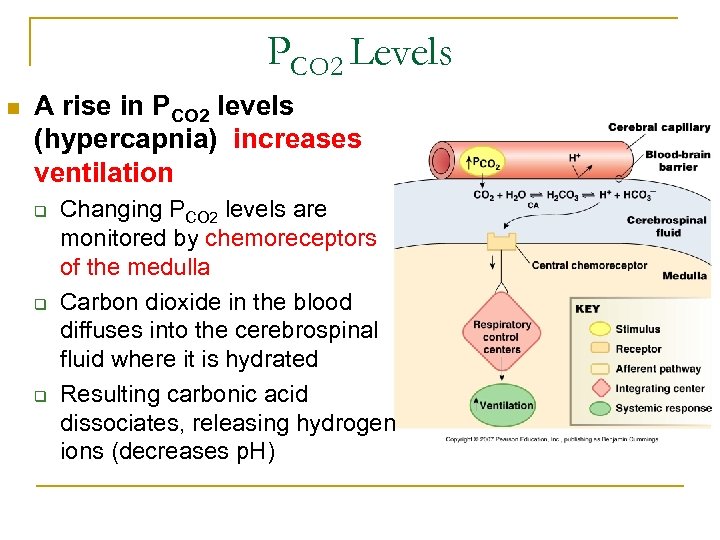
PCO 2 Levels n A rise in PCO 2 levels (hypercapnia) increases ventilation q q q Changing PCO 2 levels are monitored by chemoreceptors of the medulla Carbon dioxide in the blood diffuses into the cerebrospinal fluid where it is hydrated Resulting carbonic acid dissociates, releasing hydrogen ions (decreases p. H)
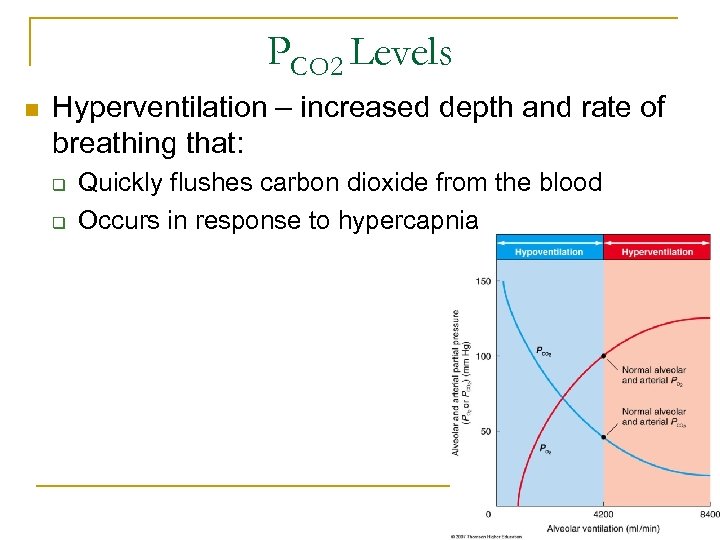
PCO 2 Levels n Hyperventilation – increased depth and rate of breathing that: q q Quickly flushes carbon dioxide from the blood Occurs in response to hypercapnia
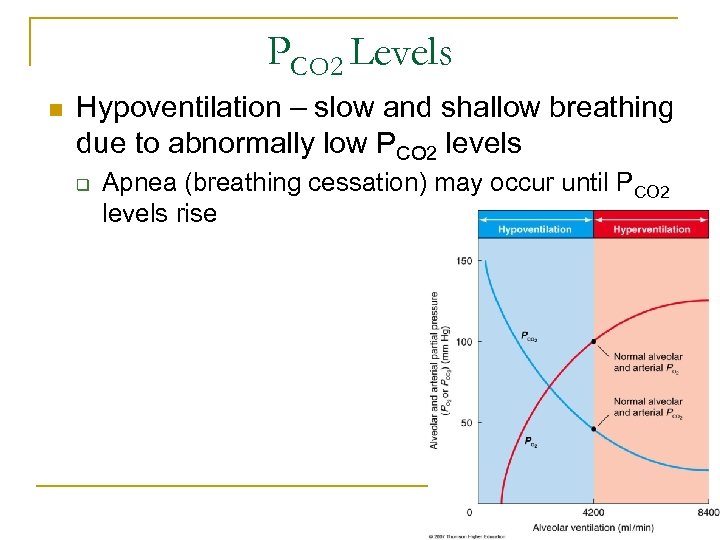
PCO 2 Levels n Hypoventilation – slow and shallow breathing due to abnormally low PCO 2 levels q Apnea (breathing cessation) may occur until PCO 2 levels rise
PO 2 Levels n n Arterial oxygen levels are monitored by the aortic and carotid bodies Substantial drops in arterial PO 2 (to 60 mm Hg) are needed before oxygen levels become a major stimulus for increased ventilation If carbon dioxide is not removed (e. g. , as in emphysema and chronic bronchitis), chemoreceptors become unresponsive to PCO 2 chemical stimuli In such cases, PO 2 levels become the principal respiratory stimulus (hypoxic drive)
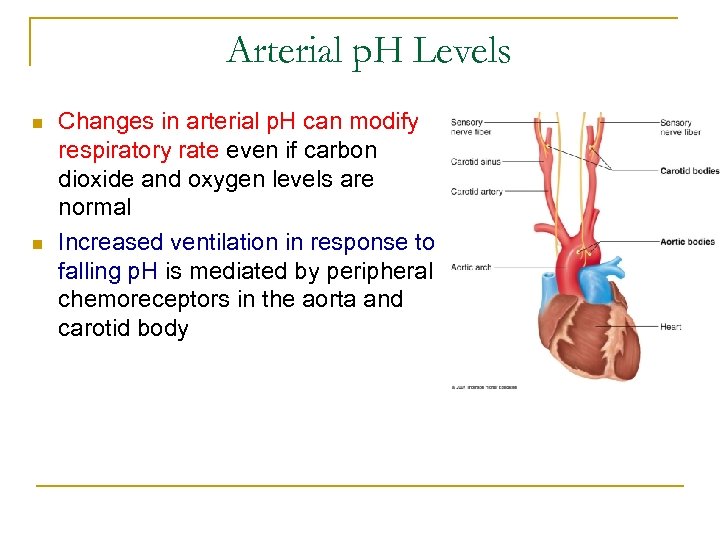
Arterial p. H Levels n n Changes in arterial p. H can modify respiratory rate even if carbon dioxide and oxygen levels are normal Increased ventilation in response to falling p. H is mediated by peripheral chemoreceptors in the aorta and carotid body
Arterial p. H Levels n Acidosis may reflect: q q q n Carbon dioxide retention Accumulation of lactic acid Excess fatty acid metabolism in patients with diabetes mellitus Respiratory system controls will attempt to raise the p. H by increasing respiratory rate and depth
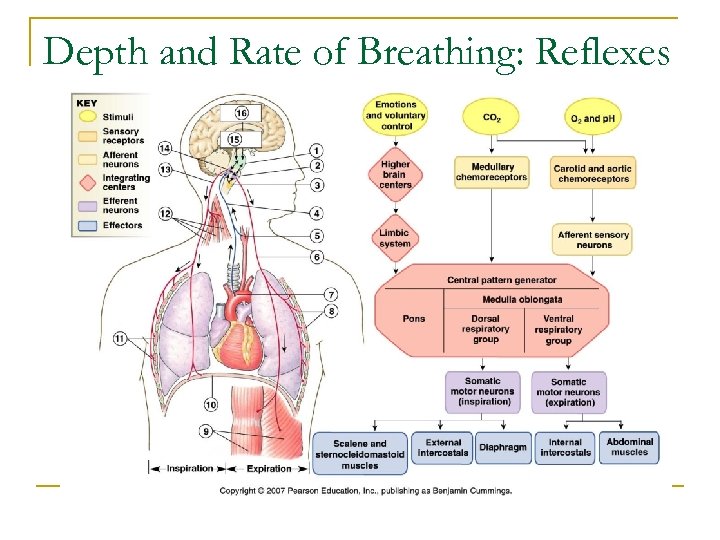
Depth and Rate of Breathing: Reflexes
Depth and Rate of Breathing n Other Reflexes q q Pulmonary irritant reflexes – irritants promote reflexive constriction of air passages Inflation reflex (Hering-Breuer) – stretch receptors in the lungs are stimulated by lung inflation n Upon inflation, inhibitory signals are sent to the medullary inspiration center to end inhalation and allow expiration
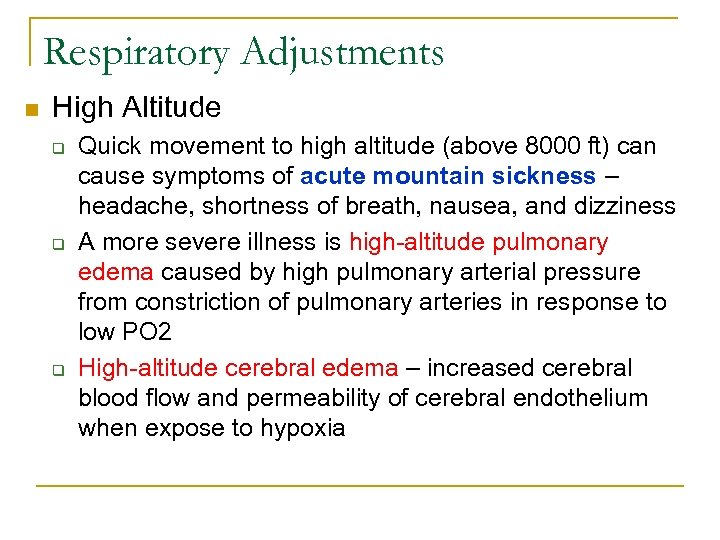
Respiratory Adjustments n High Altitude q q q Quick movement to high altitude (above 8000 ft) can cause symptoms of acute mountain sickness – headache, shortness of breath, nausea, and dizziness A more severe illness is high-altitude pulmonary edema caused by high pulmonary arterial pressure from constriction of pulmonary arteries in response to low PO 2 High-altitude cerebral edema – increased cerebral blood flow and permeability of cerebral endothelium when expose to hypoxia
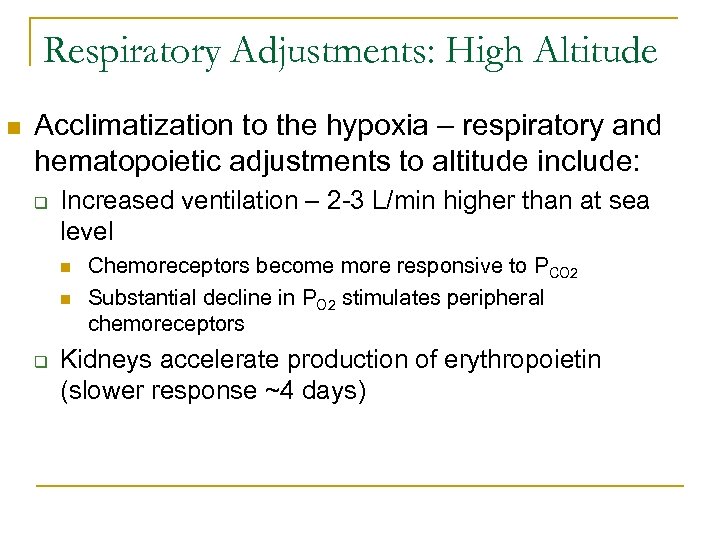
Respiratory Adjustments: High Altitude n Acclimatization to the hypoxia – respiratory and hematopoietic adjustments to altitude include: q Increased ventilation – 2 -3 L/min higher than at sea level n n q Chemoreceptors become more responsive to PCO 2 Substantial decline in PO 2 stimulates peripheral chemoreceptors Kidneys accelerate production of erythropoietin (slower response ~4 days)
Скачать презентацию Respiratory System Keri Muma Bio 6 Functions
bb71036b8c61162a24ee9ba165e8c9e8.ppt