


 Скачать презентацию Resource Sharing Initiatives in Atlantic Canada The Standards
fa2af6338ddee67d41befca6a4fce667.ppt
- Количество слайдов: 60
 Resource Sharing Initiatives in Atlantic Canada: The Standards Dilemma Slavko Manojlovich Assistant to the University Librarian for Systems and Planning Memorial University Of Newfoundland Email: slavko@mun. ca Access 2004
 Outline • Standards – a formal view • Standards – the view from the trenches • Standards – “gotchas” over the past 6 months Access 2004
 What is a standard? A NISO standard developed through consensus, identifies model methods, materials, or practices for libraries, bibliographic and information services, and publishers. Access 2004
 Library Related Standards • • • Standard Identifiers (ISBN, DOI) Z 39. 50 NCIP Open. URL Meta. Search (in progress) … … Access 2004
 ISBИ ∑ИSIP ZXXXIX. L ΘPИЦRҐ Access 2004
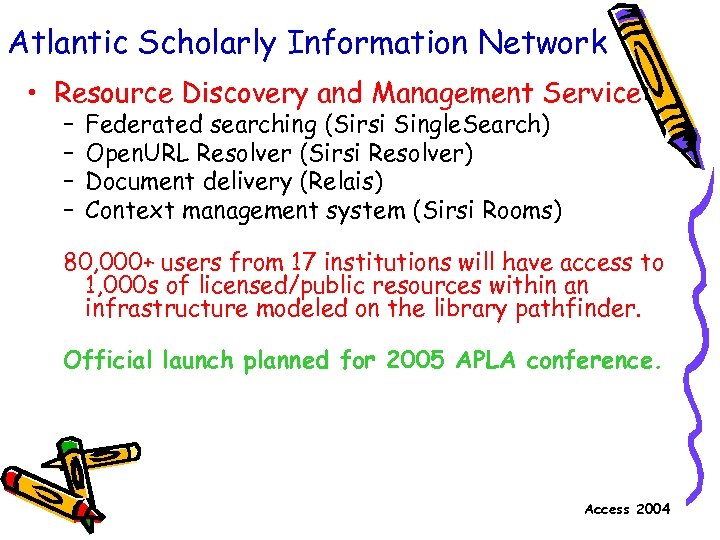 Atlantic Scholarly Information Network • Resource Discovery and Management Service: – – Federated searching (Sirsi Single. Search) Open. URL Resolver (Sirsi Resolver) Document delivery (Relais) Context management system (Sirsi Rooms) 80, 000+ users from 17 institutions will have access to 1, 000 s of licensed/public resources within an infrastructure modeled on the library pathfinder. Official launch planned for 2005 APLA conference. Access 2004
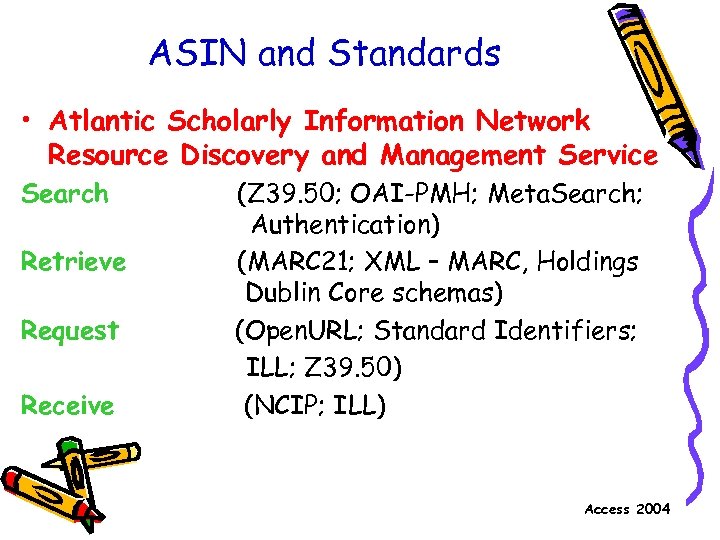 ASIN and Standards • Atlantic Scholarly Information Network Resource Discovery and Management Service Search Retrieve Request Receive (Z 39. 50; OAI-PMH; Meta. Search; Authentication) (MARC 21; XML – MARC, Holdings Dublin Core schemas) (Open. URL; Standard Identifiers; ILL; Z 39. 50) (NCIP; ILL) Access 2004
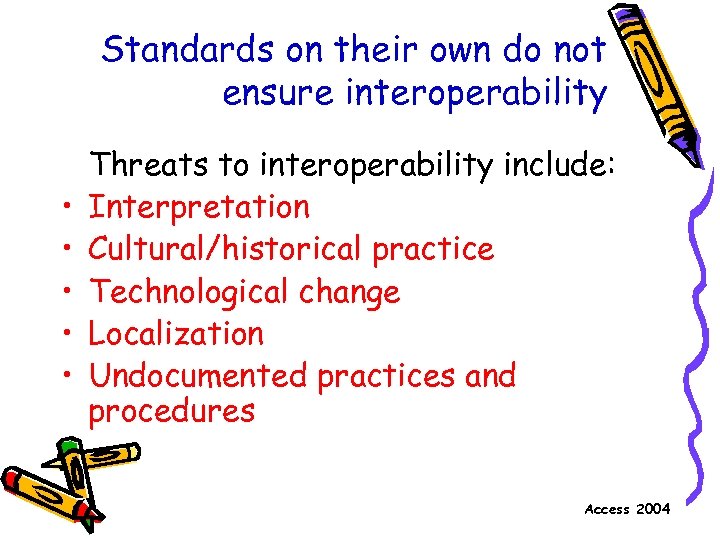 Standards on their own do not ensure interoperability • • • Threats to interoperability include: Interpretation Cultural/historical practice Technological change Localization Undocumented practices and procedures Access 2004
 Threats to Interoperability • Interpretation Standards are often defined using terminology with imprecise semantics (e. g. index, keyword, phrase, exact match, user address, etc. ). Standards and associated profiles require a reality check. • Cultural/Historical Practice Different cataloguing rules and associated formats underlie MARC 21, UNIMARC, dan. MARC 2, etc. See: http: //liber. library. uu. nl/publish/articles/000066/index. html Access 2004
 Threats to Interoperability • Technological Change Memorial’s ILS history includes: UTLAS/CLSI SPIRES/CLSI SIRSI Retrofitting ILS to conform to new standards. Some standards die (e. g. Z 39. 58) • Localization “Though cataloging rules are intended to be objective and formats are inflexible, catalogers are human, and much of what they enter is a personal decision, often subjective rather than objective. ” Henry L. Snyder UC - Riverside Access 2004
 Threats to Interoperability • Undocumented practices and procedures – Vendor and version of Z 39. 50 server – Supported Z 39. 50 attribute combinations and record syntaxes – Extent of available holdings and holdings data elements including the Resolver’s knowledgebase – Limitations of the server: truncation, stopwords, etc. – Indexing policies, character set encoding (This also applies to web-based search services) Access 2004
 ASIN and Known Item Searching • Focus on known item searching through the use of: – Standard Identifiers – Precision searches (exact, first in field) – Scan (browse) • Reduce reliance on keyword and phrase searches – Low precision – Extra work for staff – Adds unnecessary processing for patrons (similar to Google results) – Extra processing for client and server software Access 2004
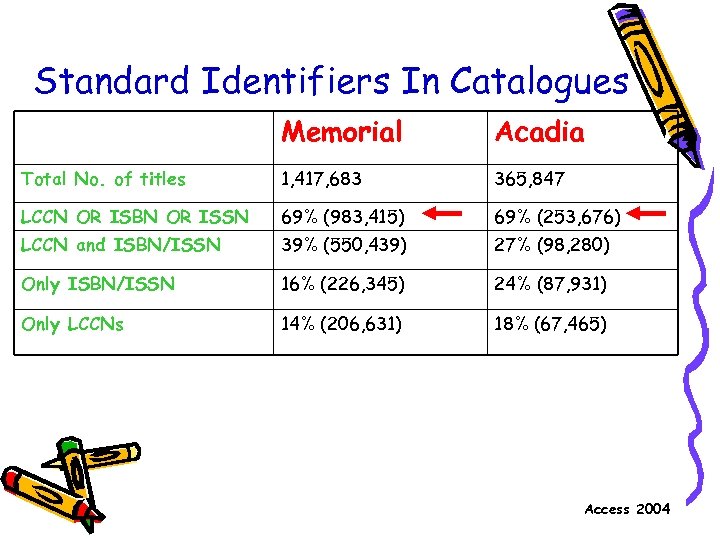 Standard Identifiers In Catalogues Memorial Acadia Total No. of titles 1, 417, 683 365, 847 LCCN OR ISBN OR ISSN 69% (983, 415) 69% (253, 676) LCCN and ISBN/ISSN 39% (550, 439) 27% (98, 280) Only ISBN/ISSN 16% (226, 345) 24% (87, 931) Only LCCNs 14% (206, 631) 18% (67, 465) Access 2004
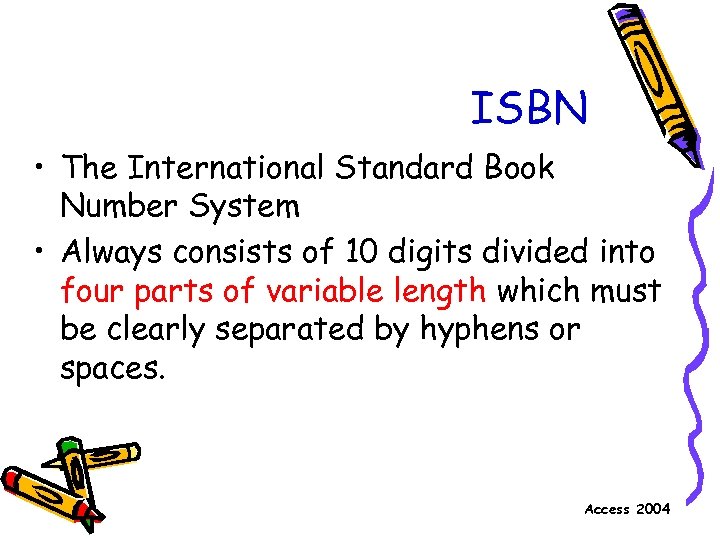 ISBN • The International Standard Book Number System • Always consists of 10 digits divided into four parts of variable length which must be clearly separated by hyphens or spaces. Access 2004
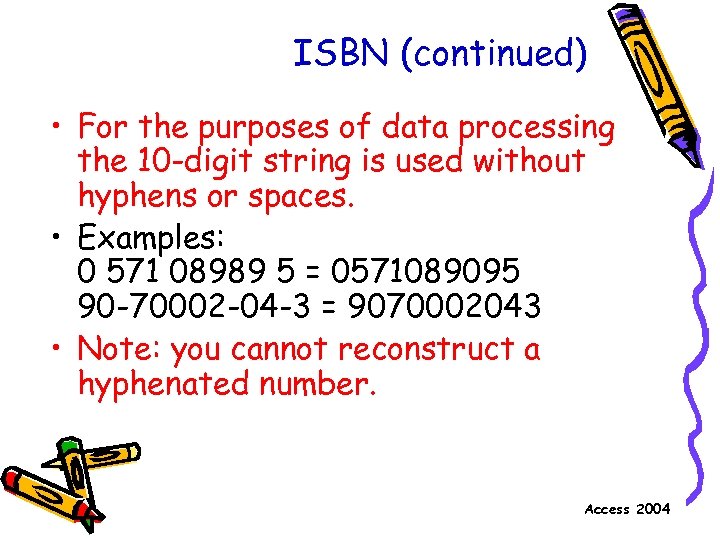 ISBN (continued) • For the purposes of data processing the 10 -digit string is used without hyphens or spaces. • Examples: 0 571 08989 5 = 0571089095 90 -70002 -04 -3 = 9070002043 • Note: you cannot reconstruct a hyphenated number. Access 2004
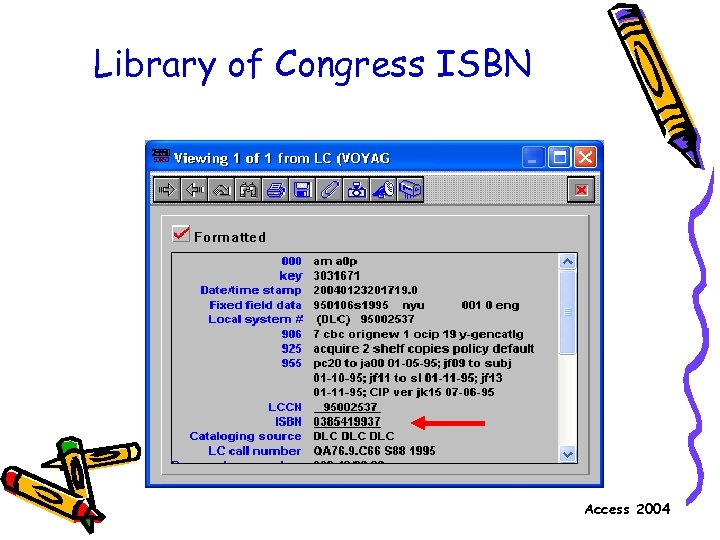 Library of Congress ISBN Access 2004
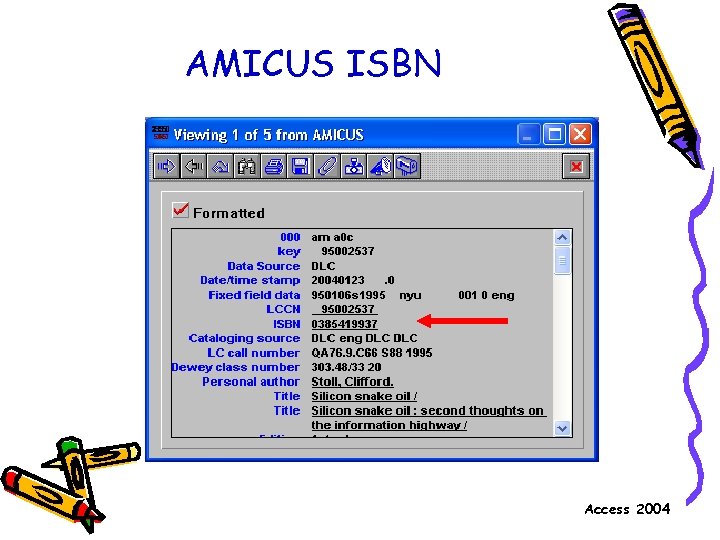 AMICUS ISBN Access 2004
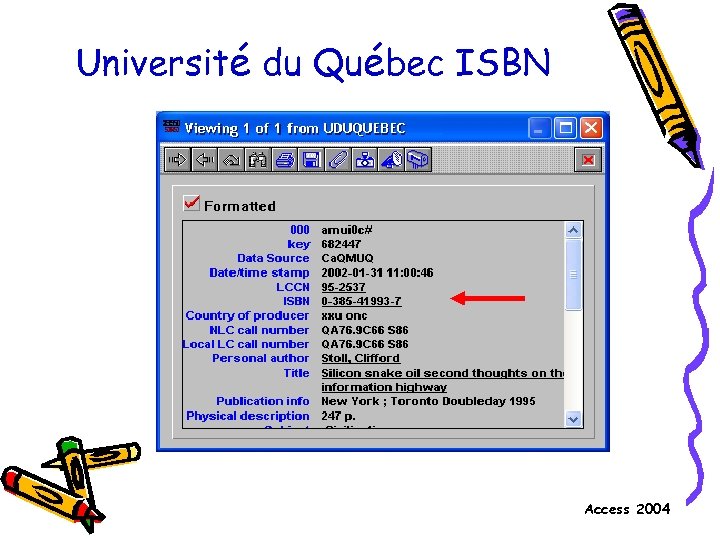 Université du Québec ISBN Access 2004
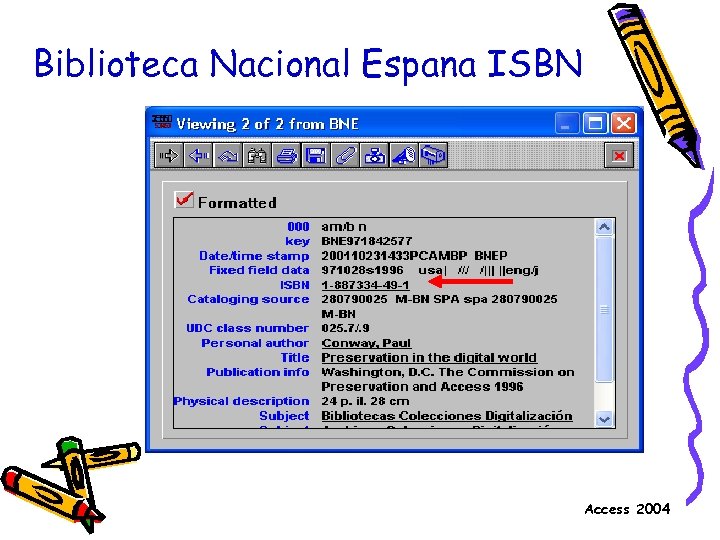 Biblioteca Nacional Espana ISBN Access 2004
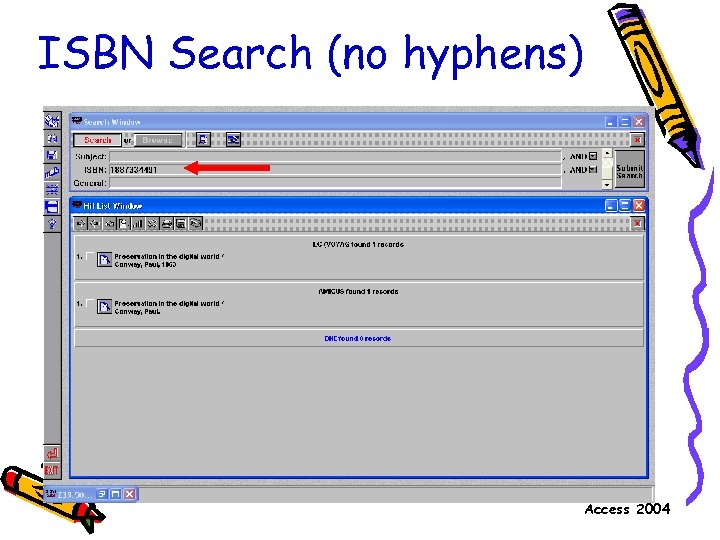 ISBN Search (no hyphens) Access 2004
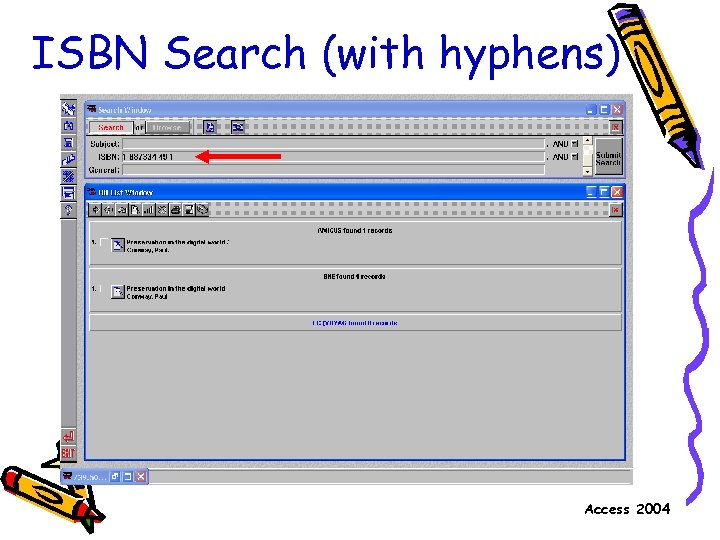 ISBN Search (with hyphens) Access 2004
 Gotcha!! ISBN search and hyphens Access 2004
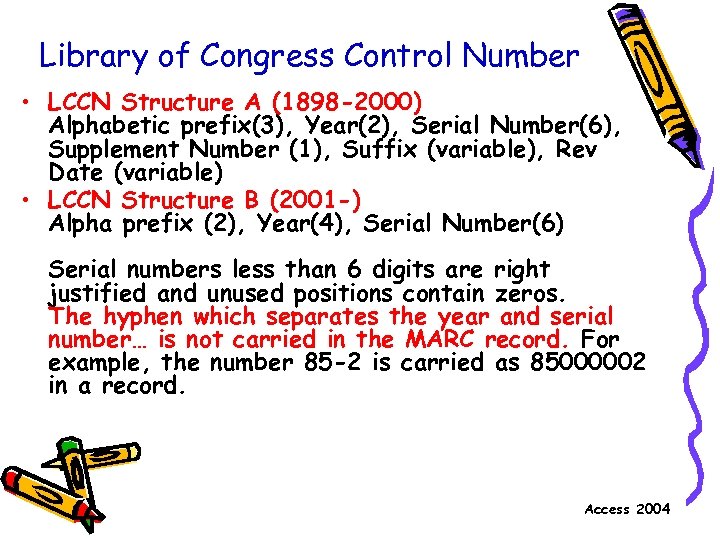 Library of Congress Control Number • LCCN Structure A (1898 -2000) Alphabetic prefix(3), Year(2), Serial Number(6), Supplement Number (1), Suffix (variable), Rev Date (variable) • LCCN Structure B (2001 -) Alpha prefix (2), Year(4), Serial Number(6) Serial numbers less than 6 digits are right justified and unused positions contain zeros. The hyphen which separates the year and serial number… is not carried in the MARC record. For example, the number 85 -2 is carried as 85000002 in a record. Access 2004
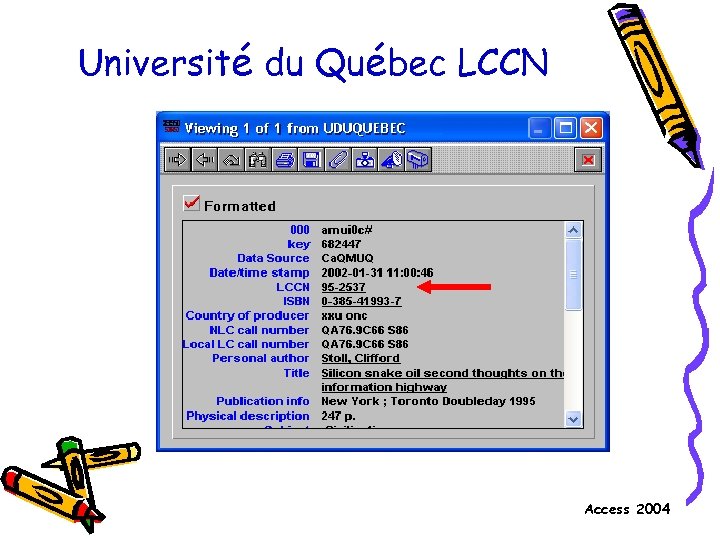 Université du Québec LCCN Access 2004
 World. Cat LCCN Z 39. 50 Search • Use attribute 9 (LCCN) Search for: 95002537 returns 11 records 95002537 (Silicon Snake oil) 95025377 (The Industrial Revolution…) 95025378 (Avoiding Nuclear Anarchy…). . sn 95002537 (My little bedtime stories) • Use attribute 1007 (Standard Identifier) Search for: 95002537 returns 2 records 95002537 (Silicon Snake oil) 950025372 (Apercu de genealogie et d'histoire des familles Beaulieu du Grand Madawaska) Access 2004
 Gotcha!! World. Cat LCCN Search Access 2004
 RPN Query • Reverse Polish Notation Used to express boolean queries in Z 39. 50 without using brackets. Process from right to left. RPN query: Orwell: NOT: Down: AND: Paris: London: AND Means: (Paris AND London AND Down) NOT Orwell Access 2004
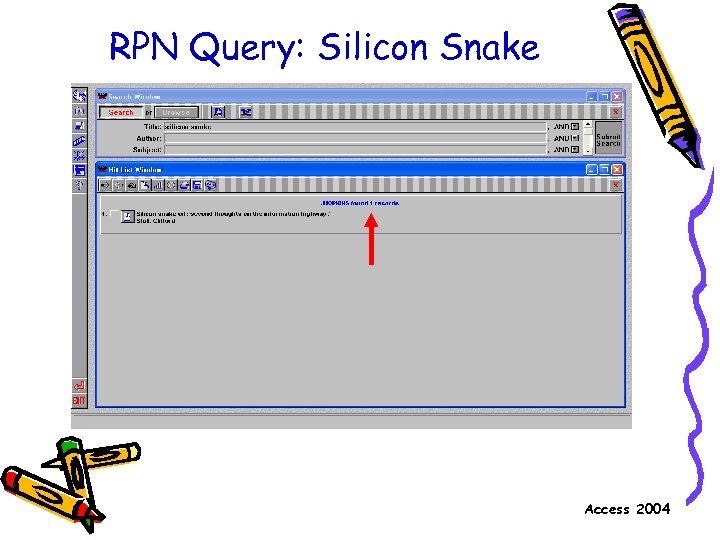 RPN Query: Silicon Snake Access 2004
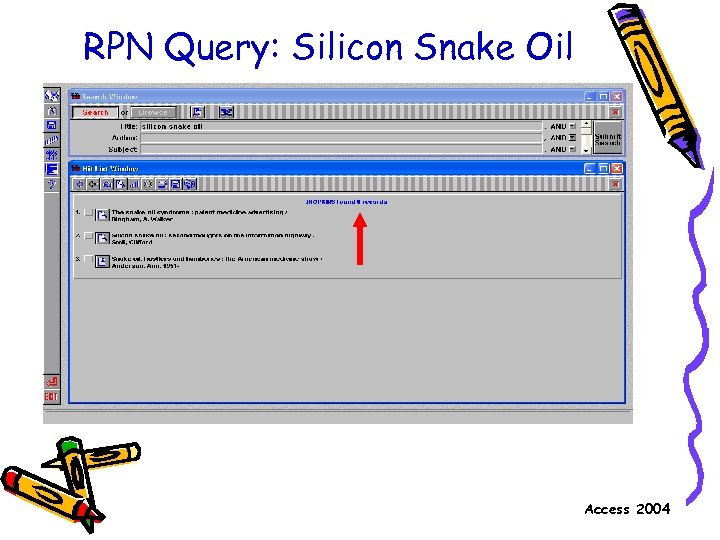 RPN Query: Silicon Snake Oil Access 2004
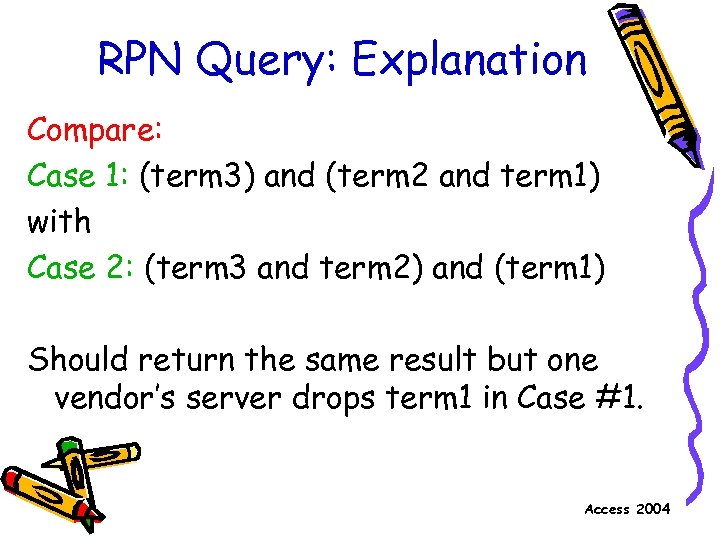 RPN Query: Explanation Compare: Case 1: (term 3) and (term 2 and term 1) with Case 2: (term 3 and term 2) and (term 1) Should return the same result but one vendor’s server drops term 1 in Case #1. Access 2004
 Gotcha!! RPN Queries Access 2004
 Character Sets • Question: How do I search the Taiwan National Library Z server in Chinese? • Character set negotiation UNICODE, MARC-8, CCCII, EACC and other character sets. • MARC-8 to Unicode conversion rules for double width diacritics Use rules set by the MARC 21 community or the Unicode Consortium? • JACKPHY (Japanese, Arabic, Chinese…) records from LC are improperly coded. • Without character set negotiation how do you encode foreign language characters in a Z 39. 50 search? Access 2004
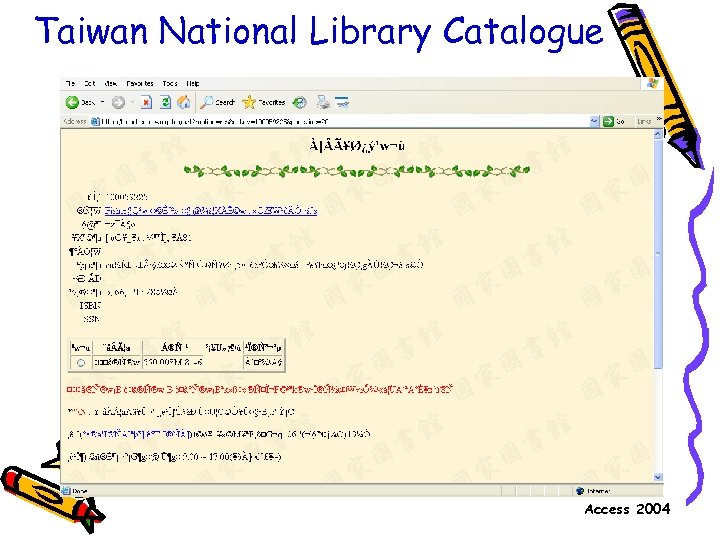 Taiwan National Library Catalogue Access 2004
 Gotcha!! Non-roman language search Access 2004
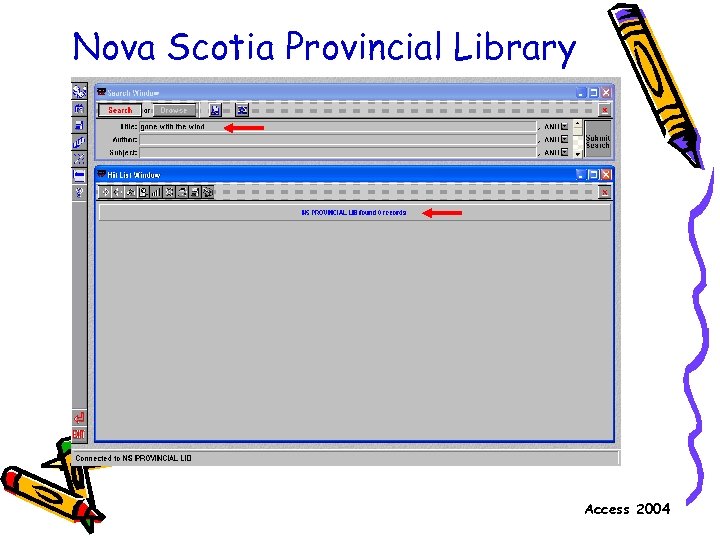
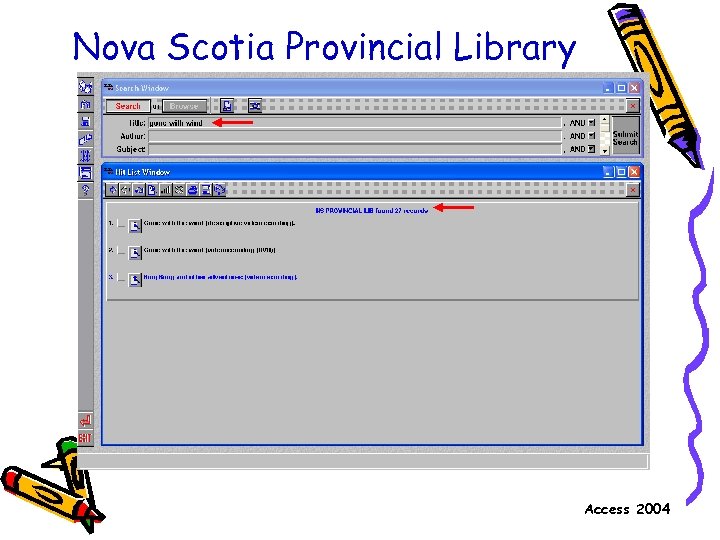
 Stopwords • Some servers do not index high posting and/or reserved terms including articles, boolean operators, etc. • Use of stopwords in a search may generate an “error message” and/or return “ 0” results. • Stopwords are not documented. Access 2004
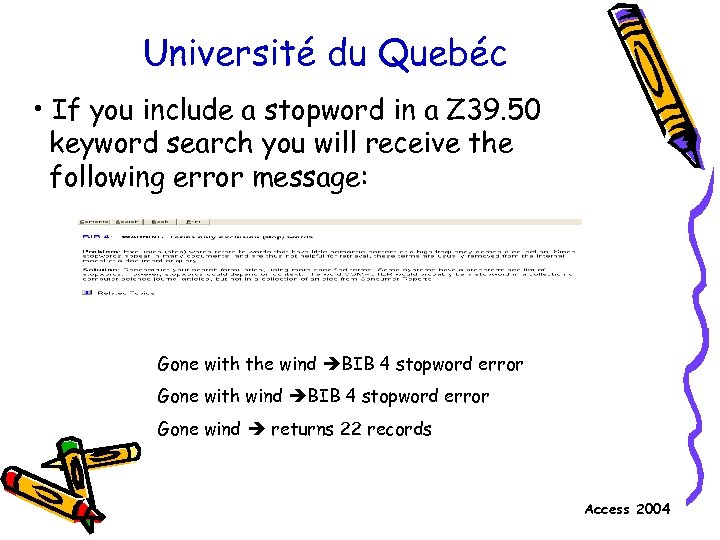 Université du Quebéc • If you include a stopword in a Z 39. 50 keyword search you will receive the following error message: Gone with the wind BIB 4 stopword error Gone with wind BIB 4 stopword error Gone wind returns 22 records Access 2004
 Nova Scotia Provincial Library Access 2004
 Nova Scotia Provincial Library Access 2004
 Gotcha!! Stopwords in searches Access 2004
 “Any” Search • According to the Bath Profile: Uses: Searches for complete word in data elements that are commonly used as access points (as defined by the server). Any searches comprising more than one keyword are interpreted in such a way that the terms may exist in the same or different attributes. Example: a search on "Dickens AND Twist" might conceivably find "Dickens" in the Author Use Attribute (1003) and "Twist" in the Title Use Attribute (4). Access 2004
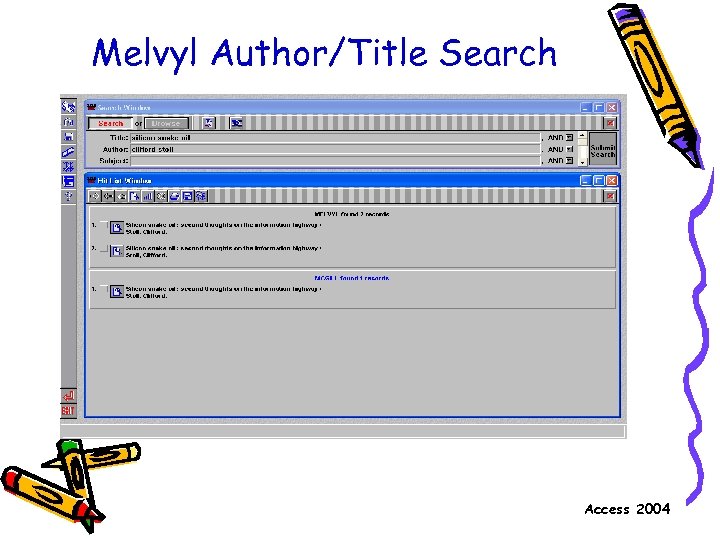 Melvyl Author/Title Search Access 2004
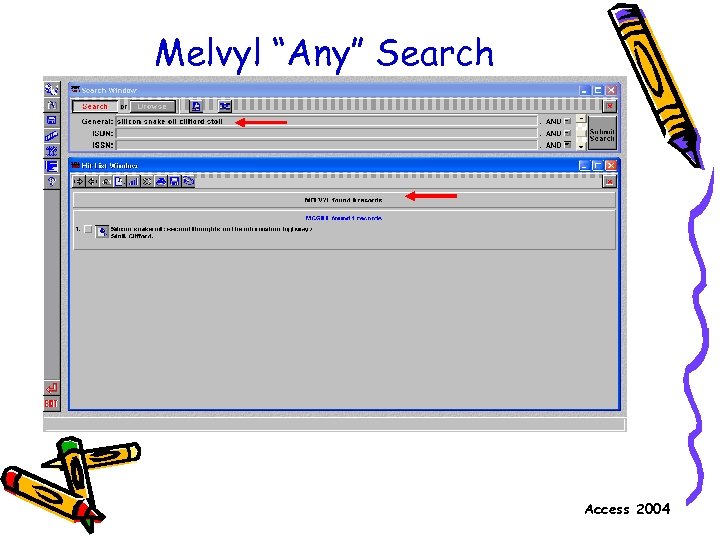 Melvyl “Any” Search Access 2004
 Melvyl “Any” Search Explanation • Melvyl supports searching for authors, titles, subjects, etc. using the “Any” search but the terms must all be from the same heading (e. g. author, title, etc. ) Access 2004
 Gotcha!! Melvyl “Any” Search Access 2004
 Scan (browse) • Browse is an essential component of a library catalogue interface, especially for known item searching. • View a list of author/title/subject headings and retrieve records associated with the desired heading. • There are wide-spread problems with the follow-up Z 39. 50 search associated with a browse list. Access 2004
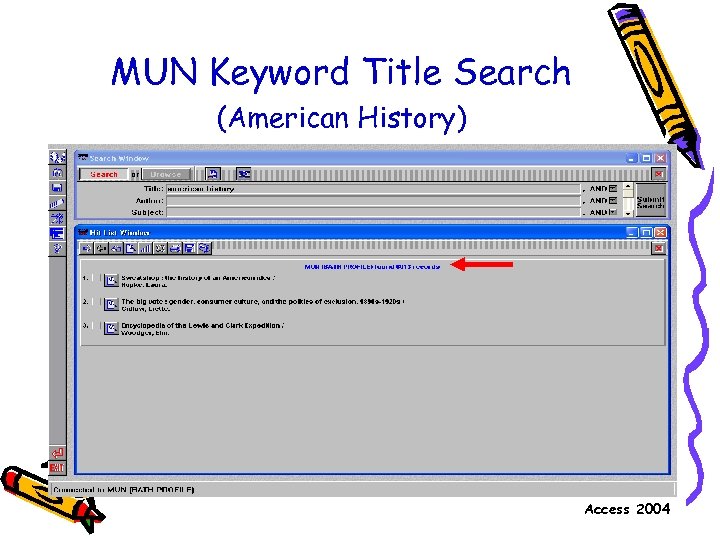 MUN Keyword Title Search (American History) Access 2004
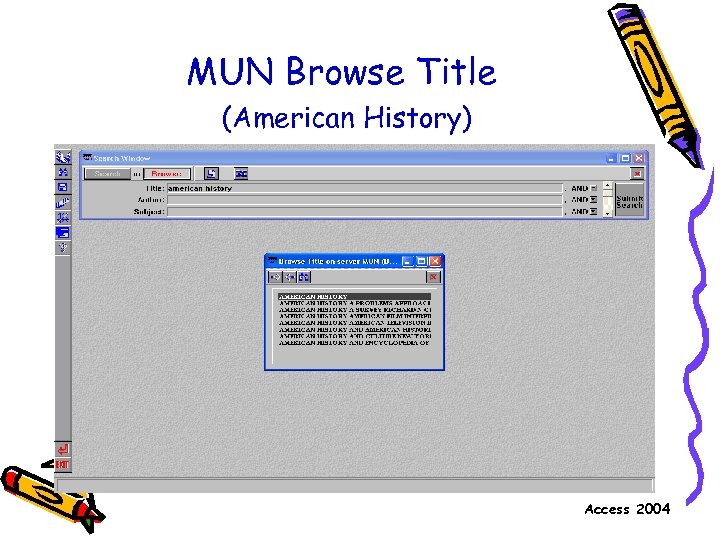 MUN Browse Title (American History) Access 2004
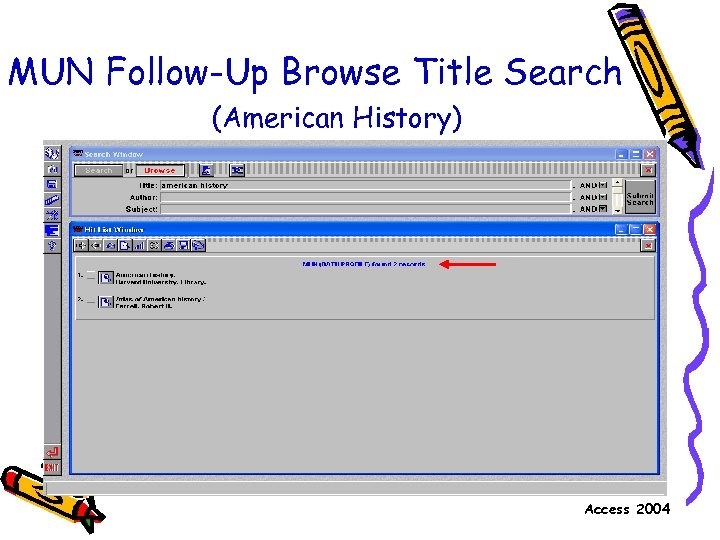 MUN Follow-Up Browse Title Search (American History) Access 2004
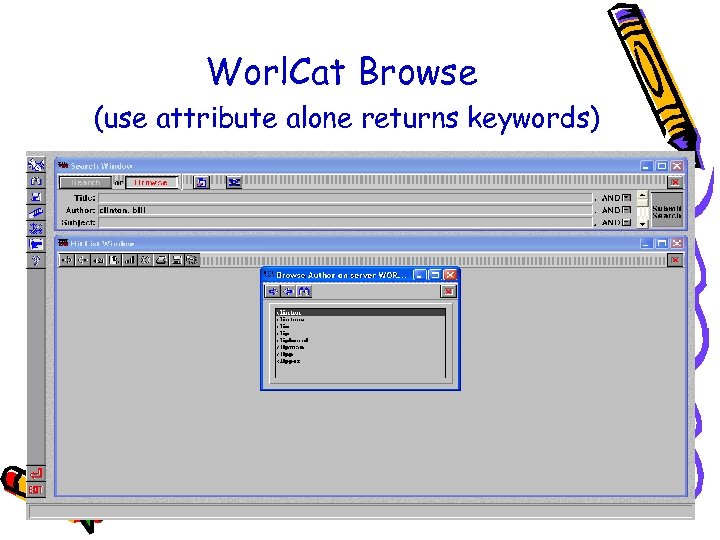 Worl. Cat Browse (use attribute alone returns keywords) Access 2004
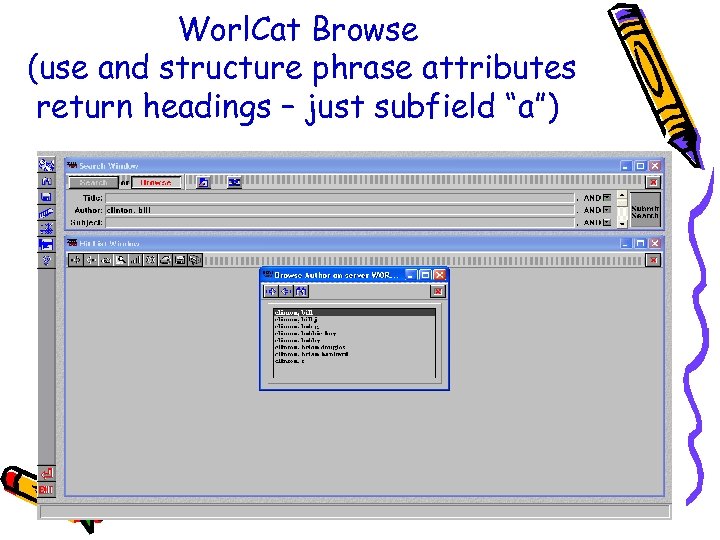 Worl. Cat Browse (use and structure phrase attributes return headings – just subfield “a”) Access 2004
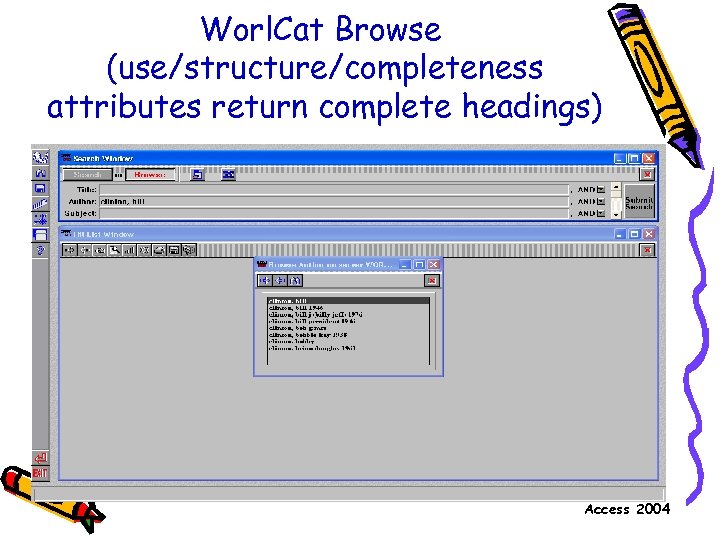 Worl. Cat Browse (use/structure/completeness attributes return complete headings) Access 2004
 Follow-up Search From a Browse List • Not well defined by the profiles. Implementor agreement is confusing. • Ideally, a follow-up search should be an “exact match” just like it is in the catalogue, however, “exact match” is not supported by all servers. • Heading punctuation must be included for some servers and removed for others. Access 2004
 Gotcha!! Follow-up Browse search Access 2004
 NCIP • Mapping of data elements to/from circulation/ILL to NCIP is not a trivial process. • Circulation systems have a long history and reflect “local” policies. • One example: Sirsi’s Unicorn system supports two logins for a user: bar code and altid both tied to the same pin. NCIP and the Relais ILL system support a single loginid Access 2004 per user.
 Gotcha!! NCIP/Circulation/ILL Cross-walk Access 2004
 Dealing With The Gotchas • ISBN Search – Identify servers which require hyphens in searches and lobby vendors and Bath/NISO Profile committees to support ISBN search without hyphens – Strip out hyphens from a search when required – Reconstruct hyphenated ISBN when required (? ) Access 2004
 Dealing With The Gotchas • World. Cat LCCN Search – Contact OCLC regarding the problem. • RPN Queries – Given that the problem is associated with the largest installed base of Z 39. 50 servers lobby the Z client developers to send RPN queries based on the OCLC way which appears to work with all Z servers. Access 2004
 Dealing With The Gotchas • Non-roman language search – Strive for an end-to-end Unicode solution which includes the metasearching client, XML record display and ILL document request service. • Stopwords – Identify servers with stopword limitations and configure client to strip out common stopwords from keyword searches and/or lobby Bath/NISO US profile committees for a solution. For Université du Quebéc, use “phrase” search. Access 2004
 Dealing With The Gotchas • Melvyl “Any” Search – Contact Melvyl • Follow-up Browse Search – Lobby Bath/NISO US profile committees for a solution. Ask OCLC to update documentation on Browse. • NCIP/CIRC/ILL cross-walk – Communicate problems to NCIP committee. Will need to register additional schemas to accommodate local needs. Access 2004
 Final Words Of Advice • • Test, test, and test some more. Don’t take standards for granted. Listen to your users concerns. Communicate/share problems with others. • Test, test, and test some more. Access 2004