


 Скачать презентацию Resource Family Finance and Travel Training Types
6fed716fe36c85317dddc52842ad4e19.ppt
- Количество слайдов: 35
 Resource Family Finance and Travel Training
 Types of Services Initial Clothing Allowance- the purchase of necessary clothing items to establish a basic wardrobe for a child placed for the first time in foster care or a substitute residential setting. Age 0 -2 3 -6 7 -12 13 & older Initial Clothing Limits $60. 00 $100. 00 $240. 00
 Child Clothing- special clothing allowances can be used for a child who has had frequent moves or other situations justifying a need (weight gain, etc…)
 Initial Clothing & Child Clothing Allowances Items that can be purchased include: shirts, pants, shorts, shoes, coats, jackets, socks, belts, pajamas, hats, scarves, gloves, robes, swimwear, dresses, sweaters, undergarments, school uniforms
 School Supplies-are allowable but may vary by county due to funding. If funding is available the following can be purchased: notebooks, pencils, paper , ruler , mats, crayons, markers, paint , calculator, binders, folders, scissors, glue, book fees, poster board, band instruments, Lysol, Kleenex, paper towels, hand soap, plastic tubs, workbook fees, tutoring, school pictures and athletic equipment (other items requested by the teacher, as appropriate)
 Food Needs- allowable items that can be purchased include: Food Need ONLY-this includes formula or special foods required for the care of the child.
 Personal Hygiene- allowable items that can be purchased include: hair care products oral hygiene products famine hygiene products deodorant diapers diaper wipes shaving razors and shaving cream body wash/soap lotion
 Prescription Drugs/Medication- allowable items that can be purchased include: -Prescription drugs/medications not covered by Medicaid -Food supplement substitutes PRESCRIBED by a Physician for infants or food for children on special diets.
 Proper Purchasing Procedures: 1. Allowable Purchases: are goods and services that have been approved in writing for payment by the Area Social Work Supervisor BEFORE the goods or services are purchased or rendered. Approval MUST be in the form of a purchase order or a check.
 2. Use of Purchase Orders: purchase orders MUST have all of the following information on them in order to be valid: -Issuing County’s name and address -Vendor name and address -Purchase order number and date -Case ID number -Client ID number -Detail description of items to be purchased
 Use of Purchase Order continued… -List of terms and conditions -Line #, description, units, unit price amount -Total amount approved -Signatures of both bookkeeper and supervisor
 3. Purchase Orders -Must be used at authorized vendor list on the purchase order -Must be used to purchase only the items listed on the purchase order -Must be used for the specific child for whom services were approved -Must NOT charge over the amount that was approved
 4. Expiration dates of purchase orders: -Purchase orders must be used in a timely manner; -MOST purchase orders are only good for ONE MONTHcheck with the worker to see when the service was end dated; -If a purchase order is not used before the end date, that purchase order will have to be voided and a new purchase order issued.
 5. Use of checks written to vendors: -Must be spent at the store that check is made payable to; -Must be used to purchase ONLY the items that were authorized to purchase; -Must be used to purchase for specific child for whom the check was authorized; -The ENTIRE amount of the check is to be spent for specific child and specific item or items authorized-NO changes is to be returned to the client, resource parent, foster child or worker.
 6. Use of checks written to resource parent: -Must be used to purchase only the item(s) that were authorized to be purchased; -Must be used to purchase item only for the specific child for whom the check was authorized; -The entire amount of the check must be spent for the specific child and the specific itme(s) that were authorized; -No charge is to be given back to the resource parent; -A hand receipt and itemized receipts are required.
 7. Use of checks written to foster child: - Checks can be written to a foster child when age appropriate for birthday, monthly and Christmas allowances but requires a hand receipt. *This varies from county to county depending on the funding available in that county. - If a foster child receives a check for a special allowance, a hand receipt AND itemized receipt are REQUIRED
 The Mississippi Department of Human Services, Division of Family and Children’s Services is exempt from sales tax.
 8. Receipts: A VALID receipt MUST have ALL of the following: -Vendor’s name & address -Date of purchase -Purchase order number -Itemized list of items purchase and amounts for EACH item and a total amount spent -Signature of the person making the purchase (resource parent, worker, client or child) -Signature of person receiving the purchase order (resource parent, client, or child)
 9. Receipts continued… -Name of child or client for whom the purchase was made -Receipts must be returned to the bookkeeper with TEN (10) days -Receipts must total the EXACT amount that a check was written for or if a purchase order was issued, the receipt can total up to the amount that was approved.
 10. Resource family purchasing agreement: -This is an agreement between the resource family & DFCS policy regarding purchases made on behalf of a child or children placed in their home. -Must be signed by resource parent(s) and resource worker -Original is maintained in resource family case record -Copy is given to resource family -A new agreement is signed each time resource families license is renewed
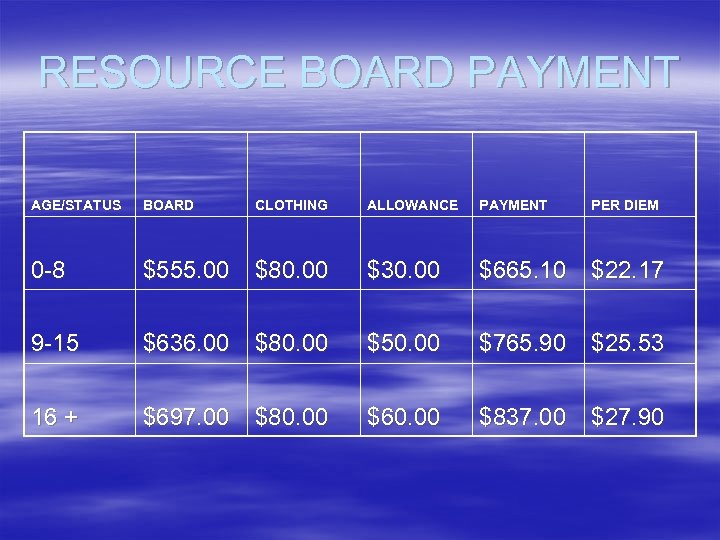 RESOURCE BOARD PAYMENT AGE/STATUS BOARD CLOTHING ALLOWANCE PAYMENT PER DIEM 0 -8 $555. 00 $80. 00 $30. 00 $665. 10 $22. 17 9 -15 $636. 00 $80. 00 $50. 00 $765. 90 $25. 53 16 + $697. 00 $80. 00 $60. 00 $837. 00 $27. 90
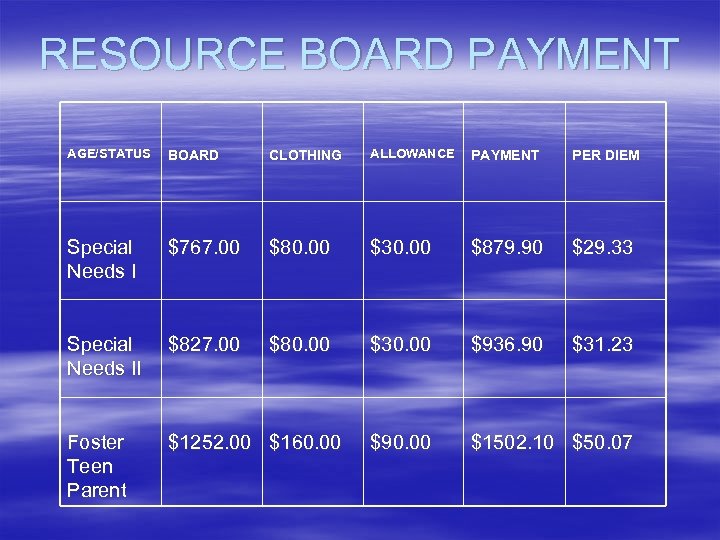 RESOURCE BOARD PAYMENT AGE/STATUS BOARD CLOTHING ALLOWANCE PAYMENT PER DIEM Special Needs I $767. 00 $80. 00 $30. 00 $879. 90 $29. 33 Special Needs II $827. 00 $80. 00 $30. 00 $936. 90 $31. 23 Foster Teen Parent $1252. 00 $160. 00 $90. 00 $1502. 10 $50. 07
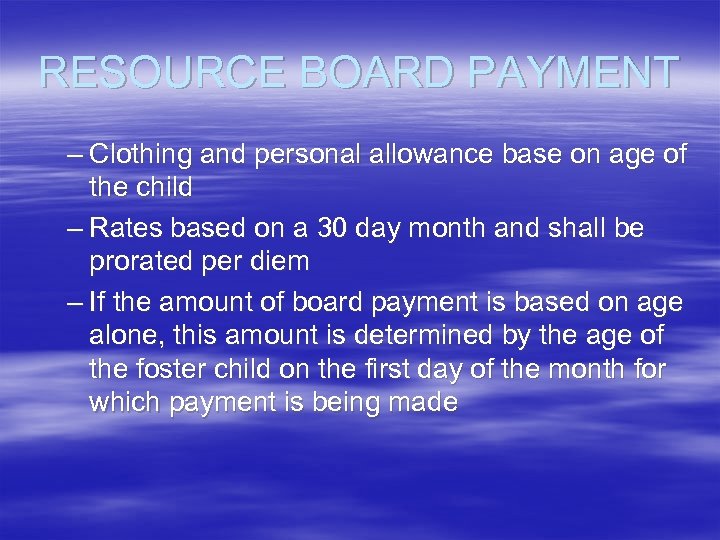 RESOURCE BOARD PAYMENT – Clothing and personal allowance base on age of the child – Rates based on a 30 day month and shall be prorated per diem – If the amount of board payment is based on age alone, this amount is determined by the age of the foster child on the first day of the month for which payment is being made
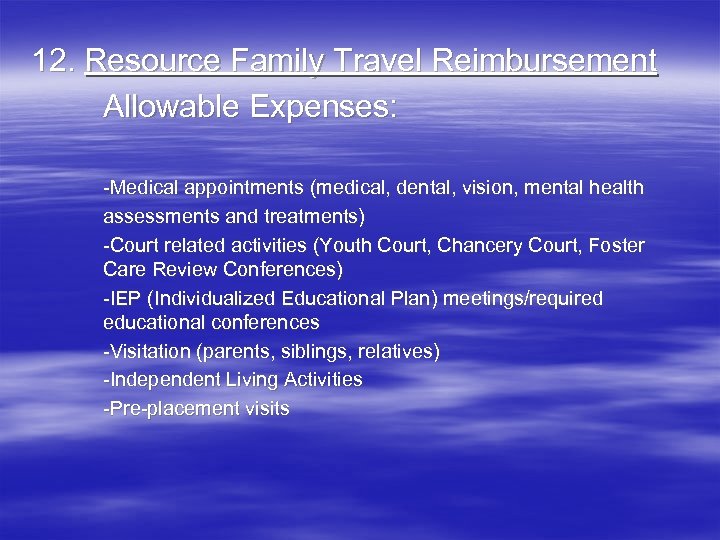 12. Resource Family Travel Reimbursement Allowable Expenses: -Medical appointments (medical, dental, vision, mental health assessments and treatments) -Court related activities (Youth Court, Chancery Court, Foster Care Review Conferences) -IEP (Individualized Educational Plan) meetings/required educational conferences -Visitation (parents, siblings, relatives) -Independent Living Activities -Pre-placement visits
 Resource Family Travel Reimbursement continued…. . In order for resource parents to be eligible for reimbursement, they shall complete a MDHS-AF-148 V, Non- Employee Voucher for reimbursement for expensed (pink form only) that includes verification of motor vehicle insurance and valid driver’s license. This form MUST be completed in BLUE INK ONLY.
 Resource Family Travel Reimbursement continued…. . A W-9 MUST accompany the MDHS-AF-148 V the first time a resource parent turns in for travel reimbursement.
 MDSH-AF-148 V (Form) The following codes must be used: FUND-3653 AGCY-651 ORGN-2440 ACTV – H 070 RPTG-WK 18
 Independent Living Skills Groups All children age 14 and older are required to attend Independent Living Skills Groups (IL).
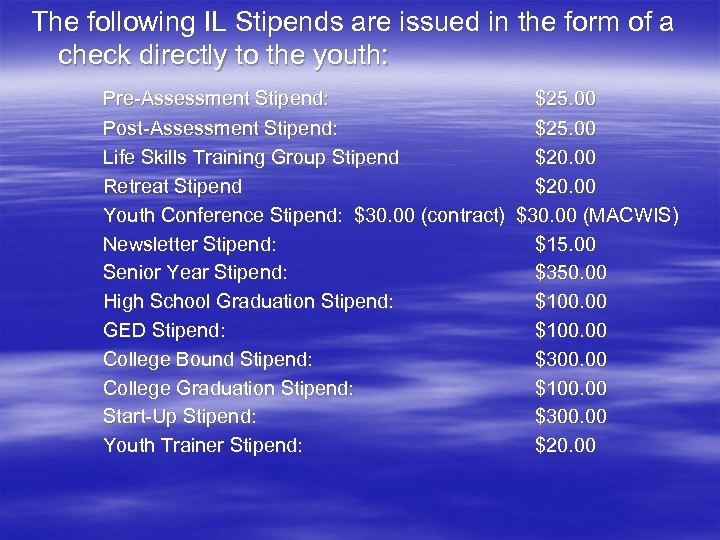 The following IL Stipends are issued in the form of a check directly to the youth: Pre-Assessment Stipend: $25. 00 Post-Assessment Stipend: $25. 00 Life Skills Training Group Stipend $20. 00 Retreat Stipend $20. 00 Youth Conference Stipend: $30. 00 (contract) $30. 00 (MACWIS) Newsletter Stipend: $15. 00 Senior Year Stipend: $350. 00 High School Graduation Stipend: $100. 00 GED Stipend: $100. 00 College Bound Stipend: $300. 00 College Graduation Stipend: $100. 00 Start-Up Stipend: $300. 00 Youth Trainer Stipend: $20. 00
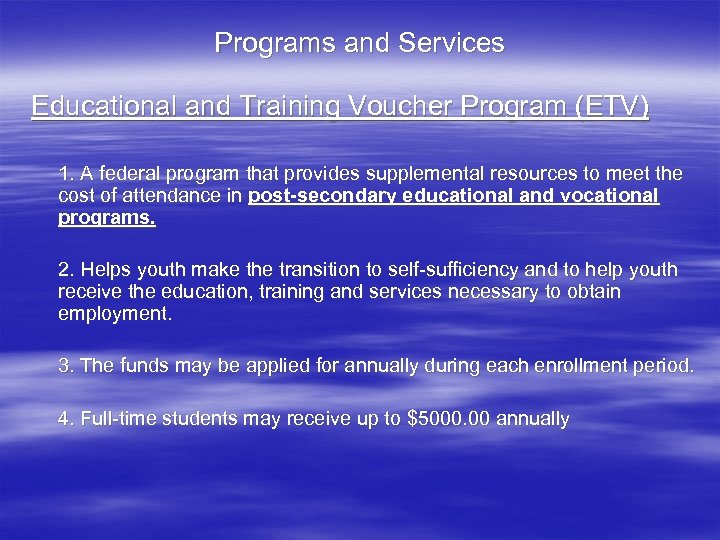 Programs and Services Educational and Training Voucher Program (ETV) 1. A federal program that provides supplemental resources to meet the cost of attendance in post-secondary educational and vocational programs. 2. Helps youth make the transition to self-sufficiency and to help youth receive the education, training and services necessary to obtain employment. 3. The funds may be applied for annually during each enrollment period. 4. Full-time students may receive up to $5000. 00 annually
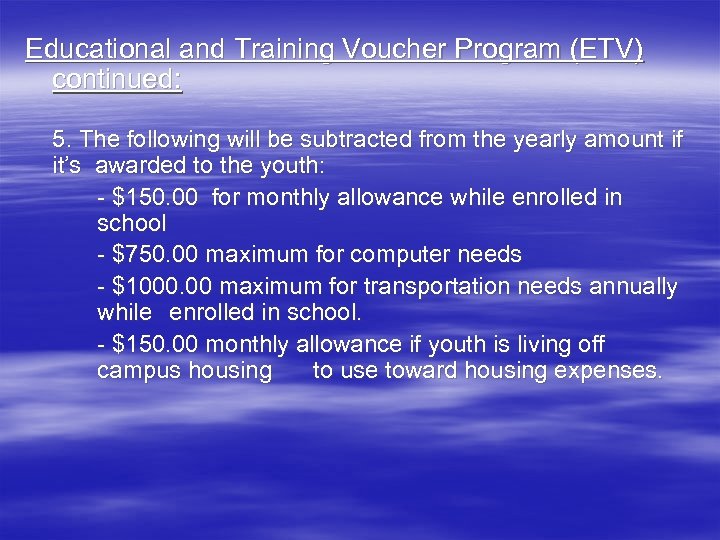 Educational and Training Voucher Program (ETV) continued: 5. The following will be subtracted from the yearly amount if it’s awarded to the youth: - $150. 00 for monthly allowance while enrolled in school - $750. 00 maximum for computer needs - $1000. 00 maximum for transportation needs annually while enrolled in school. - $150. 00 monthly allowance if youth is living off campus housing to use toward housing expenses.
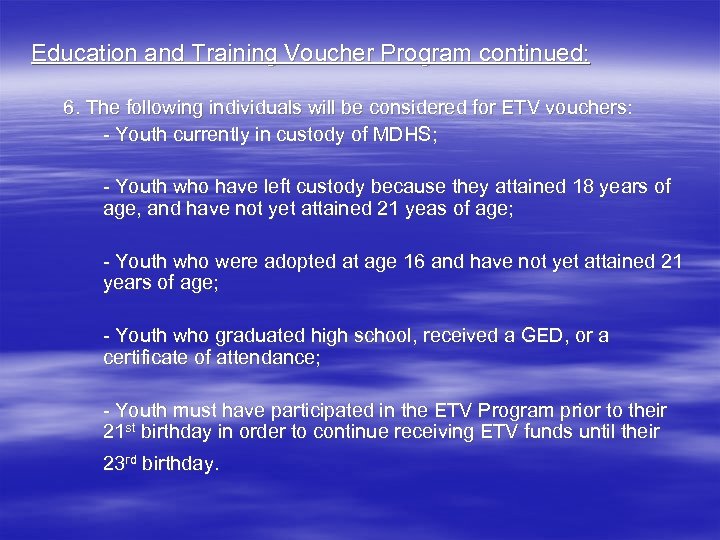 Education and Training Voucher Program continued: 6. The following individuals will be considered for ETV vouchers: - Youth currently in custody of MDHS; - Youth who have left custody because they attained 18 years of age, and have not yet attained 21 yeas of age; - Youth who were adopted at age 16 and have not yet attained 21 years of age; - Youth who graduated high school, received a GED, or a certificate of attendance; - Youth must have participated in the ETV Program prior to their 21 st birthday in order to continue receiving ETV funds until their 23 rd birthday.
 ETV Applications should be made using the following criteria: Youth must be enrolled in a post-secondary school (college, trade school, technical school or cosmetology school) All applications must include the following: - Financial Aid award/denial letter - School acceptance letter - Class schedule - Billing statement from the school - In good standing with the college, university or vocational training school - Maintaining a grade point average of 2. 0 on a 4. 0 scale. - Making progress towards completing the programs they are enrolled. - Priority will be given to full-time students in the event of ETV funding being depleted, per federal fiscal year.
 All applications must include the following continued: An initial ETV application must be submitted in writing to enroll the youth into the ETV Program prior to their 21 st birthday. Renewal applications may be submitted during the yearly enrollment period until their 23 rd birthday.
 ETV Approval Process 1. The Independent Living Specialist will assist in identifying eligible youth. 2. The youth must first apply for, and have received confirmation and/or disapproval notices from applications made from the Pell Grant, MTAG, Scholarships, or other grants the youth may have applied for. The IL Specialist must also factor in the sources and amounts of any other funds that may be available to the youth. 3. The MDHS worker sends the ETV application to the State IL Coordinator for review. The State IL Director will make the referral for approval or denial. 4. If approved, the County of Responsibility Bookkeeper prepares payment for the approved ETV Support Service Provider (vendor or youth) 5. The ETV funds for a youth can be entered from ANY county locations, regardless of the originating County of Responsibility.