 Скачать презентацию Resource-based Approach to Feature Interaction in Adaptive Software
1bf4e8f9fce888dde19f3fcf57e9b51c.ppt
- Количество слайдов: 19



Resource-based Approach to Feature Interaction in Adaptive Software Betty H. C. Cheng Software Engineering and Network Systems Laboratory Michigan State University http: //www. cse. msu. edu/SENS Authors: Jesús Bisbal and Betty H. C. Cheng jesus. bisbal@upf. edu, chengb@cse. msu. edu ACKNOWLEDGEMENTS: This work has been supported in part by grants: NSF EIA-0000433, CDA-9700732, EIA-0203060, EIA-0130724, ITR-0313142, Department WOSS 2004 RAFTING of the Navy, and Office of Naval Research under Grant No. N 00014 -01 -1 -0744.
Context… • Aspects of self-management problem being addressed? – Self-management involves dynamic adaptation – Focus on assurance issues of self-management – Feature interaction • What aspects are you NOT dealing with? – Adaptation mechanisms – ADLs for self-management/adaptation – Programming Languages • Domains, properties, or applications targeting? – Mobile computing applications – Component-based software development – Assurance issues WOSS 2004 RAFTING 2
RAPIDware Project • Ongoing project in SENS Laboratory • Funded by U. S Office of Naval Research – Critical Infrastructure Protection /Adaptable SW Program • Goal: Software (middleware) that can protect itself from: – Hardware and software component failures – Changing environmental conditions – Changing requirements (e. g. security policies) – Malicious entities • Applications: – Dynamic power management – Dynamic error correction for data transmission/receipt – Dynamically changing security algorithms and policies – Dynamic introduction of fault-tolerant capabilities WOSS 2004 RAFTING 3
Example RAPIDware Activities • Transparent shaping – Automated weaving adaptive behavior into existing programs [WOSS 02, ICAC 04, DOA 04, ICDCS 04] • Rigorous software engineering of adaptive code – Safe adaptation using dependency analysis [WADS’ 04] – Synthesis of fault-tolerant code from specifications [DSN 04] • Adaptive overlay networks [ICNP’ 03, ICDCS’ 04] • Middleware-kernel interaction [MPAC’ 04] • Decision-making software using machine learning techniques [ICDL’ 04] • Adaptive energy management [IWQo. S’ 04] WOSS 2004 RAFTING 4
Outline • • Adaptive software components Feature interactions Resource-based approach Implementation: wireless image retrieval scenario • Future work WOSS 2004 RAFTING 5
Adaptive Software Components • Dynamically adapt at run-time • Reactive to environmental or user requirement changes • Adaptive mechanisms actively investigated • Assurance of adaptation mechanisms somewhat neglected to date WOSS 2004 RAFTING 6
Feature Interactions • Widely investigated by the telecommunications industry • Receiving increasing attention from other domains: – Whenever several software entities control a shared resource – “A feature interaction occurs when the behavior of one feature is affected by the behavior of another feature, or another instance of the same feature” [L. Blair et al. , 2001] – Ex: electronic mail, web services, componentbased software WOSS 2004 RAFTING 7
Feature Interactions • Off-line (design-time) approaches: – Formally describe each feature (e. g. FOPL, CTL) – Reason about interactions (e. g. theorem provers, model checking) – Requires a priori knowledge of complete set of features • On-line approaches (run-time) approaches: – Features Manager mediates between features to avoid interactions – Requires training phase or domain-specific knowledge WOSS 2004 RAFTING 8
RAFTING: Resource-based Approach to Fea. Ture Interactio. N • Premise: – For practical purposes all feature interactions are or can be thought as being caused by resource contention • Shifts focus from features to resources used by those features • Simplifies feature interaction detection process • Well-suited to component-based software development using third-party vendor COTS – Vendors do not disclose internal workings of components, only externally observable behavior WOSS 2004 RAFTING 9
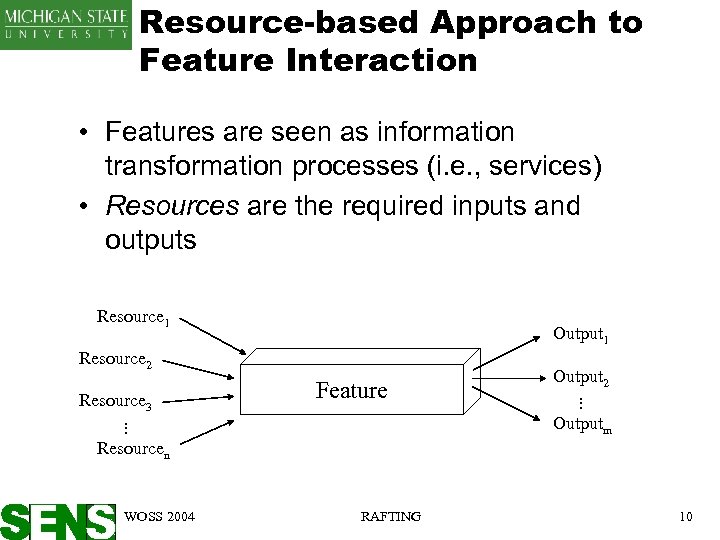
Resource-based Approach to Feature Interaction • Features are seen as information transformation processes (i. e. , services) • Resources are the required inputs and outputs Resource 1 Output 1 Resource 2 Feature . . . Resource 3 Output 2 . . . Outputm Resourcen WOSS 2004 RAFTING 10
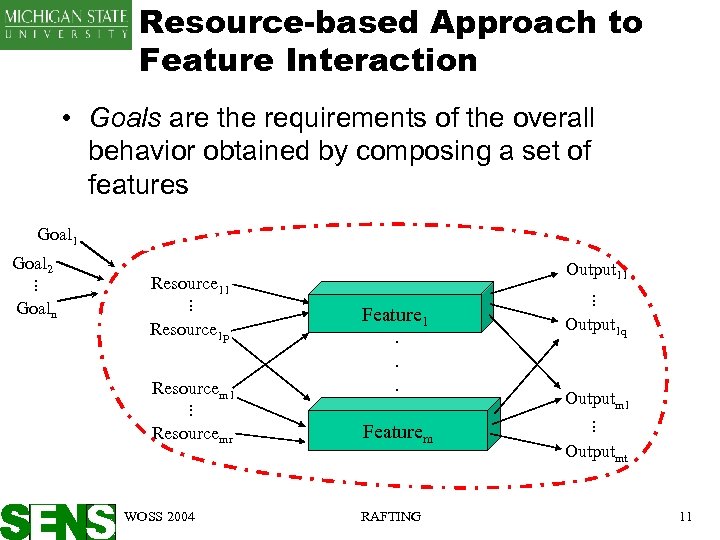
Resource-based Approach to Feature Interaction • Goals are the requirements of the overall behavior obtained by composing a set of features Goal 1 Goal 2. . . Resource 1 p Resourcem 1 Feature 1. . . WOSS 2004 Featurem RAFTING Output 1 q Outputm 1. . . Resourcemr . . . Resource 11. . . Goaln Output 11 Outputmt 11
Resource-based Approach to Feature Interaction • Feature-Resource Relationships defined in terms of usage and production of a resource • USES(%) – Describes how a feature uses a given resource or perform its task • PRODUCES(%) – Indicates that a feature produces a resource • Resources can be rather abstract: – E. g. : time could be considered a resource in order to describe time-dependent relationships WOSS 2004 RAFTING 12
Resource-based Approach to Feature Interaction • System specifications: – Features – Resources – Relationships – Goals • General objective: – a generic features manager will only require this information in order to mediate between features WOSS 2004 RAFTING 13
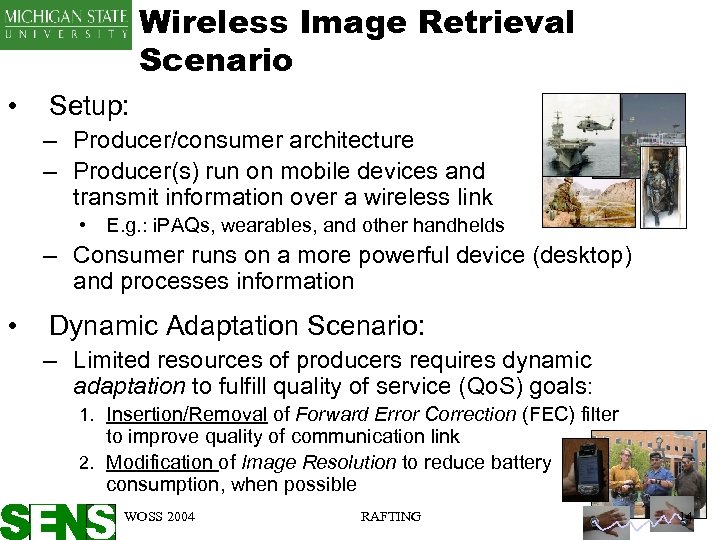
Wireless Image Retrieval Scenario • Setup: – Producer/consumer architecture – Producer(s) run on mobile devices and transmit information over a wireless link • E. g. : i. PAQs, wearables, and other handhelds – Consumer runs on a more powerful device (desktop) and processes information • Dynamic Adaptation Scenario: – Limited resources of producers requires dynamic adaptation to fulfill quality of service (Qo. S) goals: 1. Insertion/Removal of Forward Error Correction (FEC) filter to improve quality of communication link 2. Modification of Image Resolution to reduce battery consumption, when possible WOSS 2004 RAFTING 14
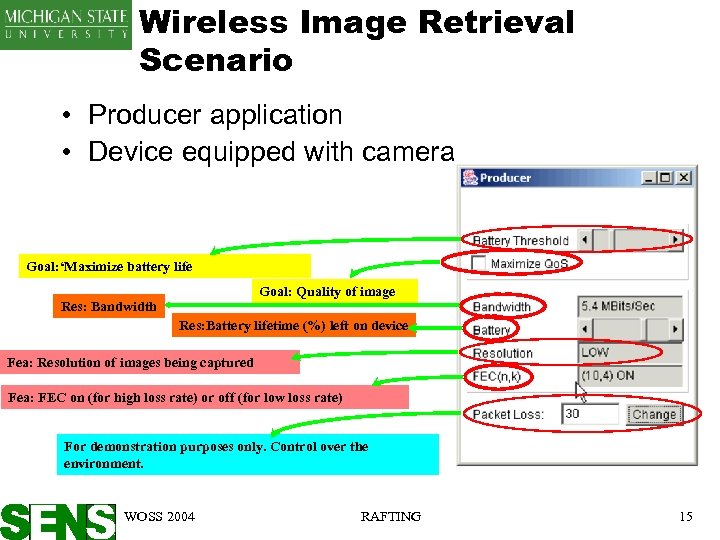
Wireless Image Retrieval Scenario • Producer application • Device equipped with camera Goal: ‘Maximize battery life Goal: Quality of image Res: Bandwidth Res: Battery lifetime (%) left on device Fea: Resolution of images being captured Fea: FEC on (for high loss rate) or off (for low loss rate) For demonstration purposes only. Control over the environment. WOSS 2004 RAFTING 15
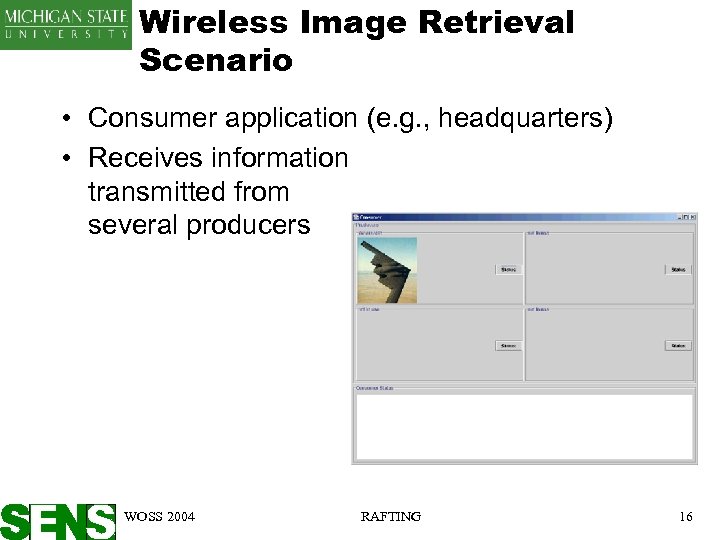
Wireless Image Retrieval Scenario • Consumer application (e. g. , headquarters) • Receives information transmitted from several producers WOSS 2004 RAFTING 16
Future Work • Can all interesting interactions be modeled using this resource-centric approach? – If not, which ones can? • Resolution policies expressed in terms of resources (for uniformity) or in terms of features (users’ perspective) WOSS 2004 RAFTING 17

WOSS 2004 RAFTING 18
Questions? WOSS 2004 RAFTING 19
Скачать презентацию Resource-based Approach to Feature Interaction in Adaptive Software
1bf4e8f9fce888dde19f3fcf57e9b51c.ppt