


 Скачать презентацию Resolution Of Charter Party Disputes Lesson Maritime Commercial
29619cc96e91853fd2ebb8121647f4a0.ppt
- Количество слайдов: 31
 Resolution Of Charter Party Disputes Lesson: Maritime Commercial Management Week: 6 ITU Maritime Faculty-2016
 When C/P in force 1 No written agreement need. Negotioation continue subject to … Legally agreement may be binding in earlier stage unless subject to other. .
 When C/P in force 2 Normally a «recap» will made out to be accepted by the parties. The accepted recap may then be the legally binding agreement, even if charter party is only signed later. It goes that a dispute arising after a voyage has been performed. Without a charter party having not been signed or recap having been transmitted, may be very hard to resolve. Parties may be in disagreement as to Cargo, demurrage, laytime, etc.
 The parties Seller, Buyer, consignee, carrier, Owner, Broker, Agent,
 1 - Maritime law and Legislation It is sometimes difficult to decide which country’s law should apply to a dispute. The choice of the applicable law may depend on several facors: the nationality of the parties; the place where the has been concluded; the place of the contractual performance; the language of the agreement, etc.
 1 - Court and Arbitration Proceedings If a dispute arises between the parties concerning the interpretation of a charterparty or the way it has been performed, the dispute must be decided either by arbitrators or by a court of law. If the parties wish to avoid the latter (i. e. court proceedings), the charterparty must expressly state (by means of an arbitration clause) that any disputes under the agreement are to be settled by arbitration. Unless the charterparty expressly states that a dispute under the agreement shall be settled by arbitration, it will be reerred to court proceedings.
 Arbitration 1 An arbitration clause will indicate the law that is applicable under that particular charter agreement (e. g. English law, U. S. law, , etc. ), as well as the procedure for nominating arbitrators and conducting the arbitration (e. g. how arbitrators should be nominated, whether an arbitration award can be appealed, whether arbitration awards are to be made public, etc. ). 1+1=1
 Arbitration 2 A common principle shared by most legal systems is for each party to nominate one arbitrator, and for those arbitrators to then jointly appoint an umpire, who was cast the deciding vote if the arbitrators cannot agree on a solution. A losing party may not normally appeal an award, and in many countries, an arbitration award may be appealed only on formal grounds, for example, if the arbitrators have wrongfully refused to hear a witness, if there is evidence that they have been bribed, etc.
 Arbitration 3 Although both New York and London are the most popular centres for arbitration in charterparty disputes, arbitration proceedings can also conducted in major centres such as Moscow, Paris, İstanbul, etc, provided this is agreed in the charterparty.
 Governing law Great confusion can arise where a contract does not state by which system of law, the contract as a whole is to be governed – “the proper law”- and the parties and their brokers should ensure that their charter parties and other contracts clearly state which law is to govern their agreements.
 Arbitration vs Legal Proceedings In countries where the courts have little commercial experience, the parties may prefer to have the dispute resolved by experienced commercial persons who are more likely to understand the substance of the dispute, rather than by a judge who may not have any particular expertise in the subject matter being placed before him. There is also an international convention under which arbitration awards given in one country are recognized in all countries that are party to that convention (the International Convention on the Recognition and Enforcement of Foreign Arbitral Awards 1958), without which a winning party may find it difficult to enforce an arbitration award in a losing party’s country.
 2. Arbitration Clauses Failure to use a properly prepared and worded arbitration clause can lead to serious difficulties or delays in relation to the enforcement of rights against a defaulter. For example, the kind of very generally worded arbitration provision that will sometimes appear in broker’s recap of a fixture (such as “general average and arbitration to be settled in London” or something even more cryptic) can lead to lengthy delays in obtaining an enforceable arbitration award, regardless of how skillfull or diligent the claimant may be.
 2. Arbitration Clauses Most modern charter forms now incorporate a clear arbitration clause, which often affords the parties the choice of selecting London, New York, or some other place as the forum for arbitration. Another helpful feature of these modern clauses is that they provide for economical resolution of relatively small disputes by small claims procedures or shortened arbitration procedures that are available in the two major charter dispute resolution centres of London and New York respectively. For example, the NYPE 93 Arbitration Clause is worded as follows:
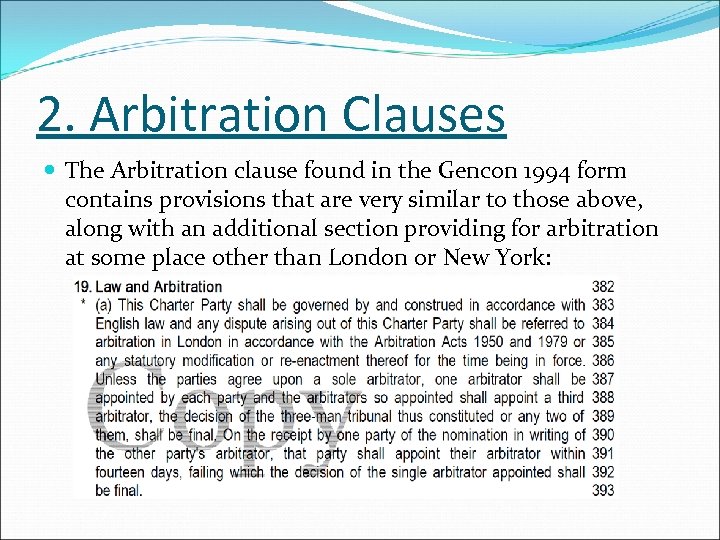 2. Arbitration Clauses The Arbitration clause found in the Gencon 1994 form contains provisions that are very similar to those above, along with an additional section providing for arbitration at some place other than London or New York:
 3. The Applicable Law One of the first questions a lawyer must ask himself or herself when attempting to interpret a charter is what law the parties have chosen to govern their contract. All the charters here under consideration make an express choice of law, and it is desirable that the choice of law is the same as the forum for arbitration.
 3. The Applicable Law English and US law generally dominate in ocean charter practice. However, since there is no particular legislation under either English or US law dealing specifically with charterparties, contractual disputes will generally be decided in the light of previous court judgements (precedents). As a result, even very old decisions may still have a great fundamental importance if no later case has changed their effect.
 Charterparty issues commonly encountered Bunkers Frustration Hire/Freight Laytime/Demurrage/Detention Law and jurisdiction Speed and consumption Stevedore damage Termination/cancellation Time bars Unsafe port/berth http: //www. gard. no/web/topics/charterparty-issues
 Bunker Bunkers and bunkering Bunker quality Effects of off-spec bunkers
 Hire - Freight English law - vessel remains on hire while detained by pirates. New decision on NYPE off-hire clause (The LACONIAN CONFIDENCE). Rejected sweeping by Bangladeshi aut. Vessel remains «in Hire» . Piracy and time charterparty clauses - risk shifting or risk sharing?
 Laytime/Demurrage/Detention Demurrage - lien and cesser clauses English law - Notice of readiness and the commencement of laytime Notice of readiness and a happy day for owners
 Slow Speed Slow steaming and virtual arrival Slow steaming on 2 -stroke engines
 Stevedore damage Algeria - recourse against stevedores Charterers' liability for damage to vessels Revised Himalaya Clause for Bills of Lading and other Contracts "No servant or agent or independent contractor from time to time employed by the carrier shall be liable to the owner of the goods for any loss or damage resulting from any act or negligence on his part while acting in the course of his employment. " Smoking can seriously damage your wealth Stevedore damage - damage to the own vessel caused by third parties
 Termination / Cancellation clauses and other means by which owners may protect against defaulting charterers English law - when is a seven year charter not a sevenyear charter? The decision The Court of Appeal was sympathetic to the owners’ arguments but ultimately agreed with the charterers’ approach. The Court of Appeal stated that although certainty and finality were important considerations in awarding damages, it was important also not to over-compensate a wronged party. Ultimately, the Court of Appeal took the view that the owners did not have the benefit of a seven-year charterparty, only of a seven year charterparty that could have been terminated in the event of war breaking out between certain nations.
 Time Bar Hague-Visby Rules - When does time start to run? A recent decision of the English High Court 1 looks at the question of whether under Article III (6) of the Hague-Visby Rules time starts to run on the actual delivery date or when the goods should have been delivered. Facts The vessel was chartered under a voyage charterparty to which the Hague-Visby Rules applied. She loaded her cargo of fuel oil in Saudi Arabia for delivery at Mombasa. Shortly after commencing her voyage, the destination was changed to Lagos, Nigeria. She arrived off Lagos on 2 nd February 2000. The receivers refused delivery, allegedly because the cargo was off-spec after having been contaminated by residues from a previous cargo of soya bean oil. The charterers then ordered the vessel to continue to Abidjan where she arrived on 13 th February 2000. On 7 th March 2000 the charterers informed owners of their intention to sell the cargo elsewhere to mitigate their loss. The parties entered into a new contract of carriage for discharge in Greece. As instructed, the vessel commenced her voyage from Abidjan on 11 th March 2000.
 Time Bar Submissions On 27 th March 2001 the charterer commenced proceedings against the shipowners at the English High Court. The claim under the voyage charterparty consisted of damages for the difference between the value of the goods at the original discharge port and the price obtained at the sale in Greece, additional costs, storage and freight, and was in excess of USD 3 million. The owners alleged that the claim was time-barred under Article III (6) of the Hague. Visby Rules, which provides: "…the carrier and the ship shall in any event be discharged from all liability whatsoever in respect of the goods, unless suit is brought within one year of their delivery or of the date when they should have been delivered". The owners contended that the claim was out of time because the suit had to be brought within one year of the date of delivery or when the cargo should have been delivered in Lagos, latest 6 th February 2000.
 Unsafe Port / Berth Charterers' liability for damage to vessels Charterers' liability for oil pollution English law - implied safe berth warranties English law - In search of a safe heaven Two divergent branches grow from a common law root - judicial interpretation of unsafe berth/port clauses in US and English law
 Example of C/P Conflicts
 Charter party Bank One Louisiana v. M/V Mr Dean Fifth Circuit Court of Appeals June 10, 2002 Maritime Liens/Charter Parties: A maritime lien for breach of a charter attaches when the owner places the vessel at the charterer's disposal and remains inchoate until perfected by a breach or discharged by the undisturbed end of the charter. Thus the charterer's maritime lien for breach of the charter had priority over the bank's preferred ship mortgage since the vessel was placed at the charterer's disposal before the mortgage was recorded, although the owner's breach of the charter occurred after the mortgage was recorded.
 Choice of Law Calhoun v. Yamaha Motor Co. Third Circuit Court of Appeals June 23, 2000 Admiralty Jurisdiction: the court had admiralty jurisdiction over a collision between a jet ski and an anchored vessel in Puerto Rican territorial waters, thus federal choice of law principles apply; Choice of Law: application of those principles results in the choice of Pennsylvania law to determine compensatory damages and Puerto Rican law to determine punitive damages; federal maritime law principles, however, apply in determining the liability of the defendant in this admiralty action for the death of a non-seaman brought pursuant to a state wrongful death/survival statute.
 General Average Folger Coffee Co. v. Olivebank Fifth Circuit Court of Appeals February 3, 2000 General Average: the vessel was seaworthy under COGSA at the commencement of the voyage, thus cargo interests had no defense to vessel's general average claim; Seaworthiness: open skylight and vent covers allowing entry of sea water that caused the emergency electrical system to fail constituted an error in management of the ship, not unseaworthiness.
 Collisions/Casualties Grosse Ile Bridge Co. v. American Steamship Sixth Circuit Court of Appeals September 9, 2002 Collisions/Casualties: On September 6, 1992, the M/V H. Lee White, a 700 -foot cargo vessel carrying 67 million pounds of iron ore, struck the Grosse Ile Toll Bridge, a pivot-swinging drawbridge on the Trenton Channel of the Detroit River. The district court properly found that the bridge was at fault for not timely swinging the bridge open. The district court erred, however, in absolving the vessel from any fault. Once the captain of the vessel decided to stop short of the bridge by reversing engines, it was unreasonable to delay dropping the port-bow anchor which could have stopped the vessel short of the bridge.