


 Скачать презентацию RESNET NEW REQUIREMENTS January 1 2007 RESNET STANDARD
4ee4e0e22b1b66a86db8bc248ff66893.ppt
- Количество слайдов: 42
 RESNET NEW REQUIREMENTS January 1, 2007 RESNET STANDARD 2004 – 03 BLOWER DOOR TEST PROCEDURES
 This Presentation Jointly Prepared by
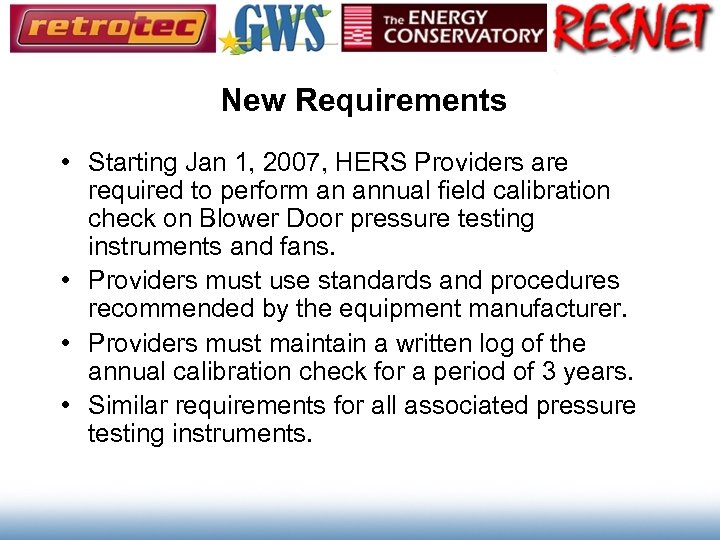 New Requirements • Starting Jan 1, 2007, HERS Providers are required to perform an annual field calibration check on Blower Door pressure testing instruments and fans. • Providers must use standards and procedures recommended by the equipment manufacturer. • Providers must maintain a written log of the annual calibration check for a period of 3 years. • Similar requirements for all associated pressure testing instruments.
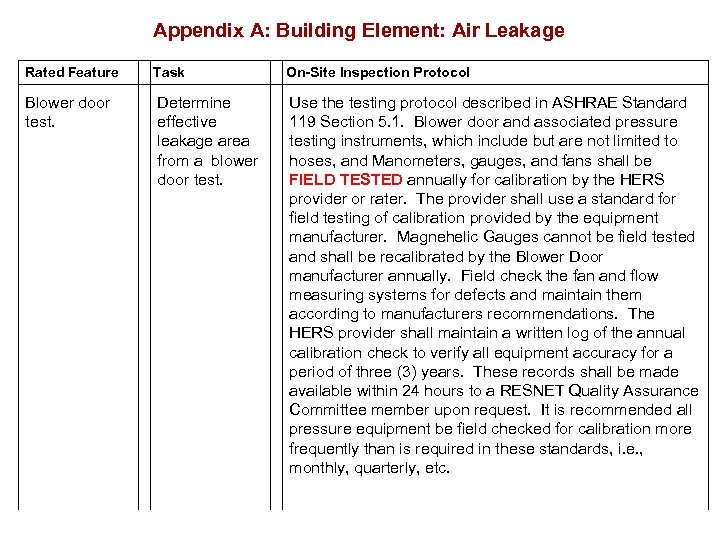 Appendix A: Building Element: Air Leakage Rated Feature Task On-Site Inspection Protocol Blower door test. xxxxxxxx Determine effective leakage area from a blower door test. Use the testing protocol described in ASHRAE Standard 119 Section 5. 1. Blower door and associated pressure testing instruments, which include but are not limited to hoses, and Manometers, gauges, and fans shall be FIELD TESTED annually for calibration by the HERS provider or rater. The provider shall use a standard for field testing of calibration provided by the equipment manufacturer. Magnehelic Gauges cannot be field tested and shall be recalibrated by the Blower Door manufacturer annually. Field check the fan and flow measuring systems for defects and maintain them according to manufacturers recommendations. The HERS provider shall maintain a written log of the annual calibration check to verify all equipment accuracy for a period of three (3) years. These records shall be made available within 24 hours to a RESNET Quality Assurance Committee member upon request. It is recommended all pressure equipment be field checked for calibration more frequently than is required in these standards, i. e. , monthly, quarterly, etc. xxxxxxxxxxxxxxxxxxxxxxx xxxxxxxxxxxxxxxxxxxxxxx xxxxxxxxxxxxxxxxxxxxxxx xxxxxxxxxxxxxxxxxxxxxxx xxxxxxxxxxxxxxxxxxxxxxx xxxxxxxxxxxxxxxxxxxxxxx xxxxxxxxxxxxxxxxxxxxxxx xxxxxxxxxxxxxxxxxxxxxxx xxxxxxxxxxxxxxxxxxxxxxx xxxxxxxxxxxxxxxxxxxxxxxxxxxxxxxxxxxxxxxxxxxxxxxxxxxxxxxxxxxxxxxxxxxxxxxxxxxxxxxxxxxxxxxxxxxxxxxxxxxxxxxxxxxxxxxxxxxxxxxxxxxxxxxxxxxxxxxxxxxxxxxxxxxxxxxxxxxxxxxxxxxxxxxxxxxxxxxxxxxxxxxxxxxxxxxxxxxxxxxxxxxxxxxxxxxxxxxxxxxxxxxxxxxxxxxxxxxxxxxxxxxxxxxxxxxxxxxxxxxxxxxxxxxxx
 “Just having a perfect gauge by no means ensures readings will be accurate” Colin Genge, Retrotec
 Field Testing May NOT Require Calibration
 Common Reasons for Inaccurate Readings 1. Using inappropriate flow ring on fan. (newer gauges help eliminate this mistake). 2. Tubing leaking, kinked or plugged up. 3. Tubing hooked up improperly. 4. Damaged fans (e. g. broken flow sensor, housing). 5. Gauges out of calibration. Note: If both channels have an identical error, the effect on the result is significantly reduced. 6. Incorrect test procedures.
 The Energy Conservatory (TEC) Recommended Calibration Check Procedures
 TEC Recommended Calibration Check Procedures Digital Pressure Gauges (choose either method) – Perform the digital gauge field calibration check procedure found at www. energyconservatory. com/support 7. htm or – Recalibrate gauge at TEC factory - $50.
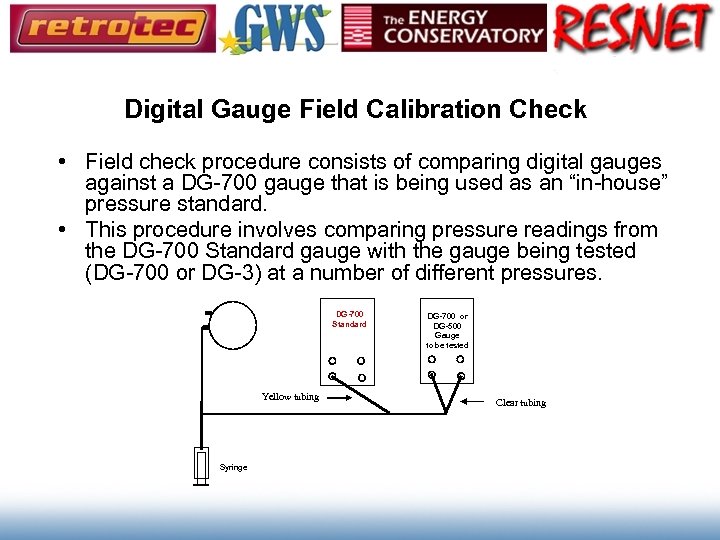 Digital Gauge Field Calibration Check • Field check procedure consists of comparing digital gauges against a DG-700 gauge that is being used as an “in-house” pressure standard. • This procedure involves comparing pressure readings from the DG-700 Standard gauge with the gauge being tested (DG-700 or DG-3) at a number of different pressures. DG-700 Standard Yellow tubing Syringe DG-700 or DG-500 Gauge to be tested Clear tubing
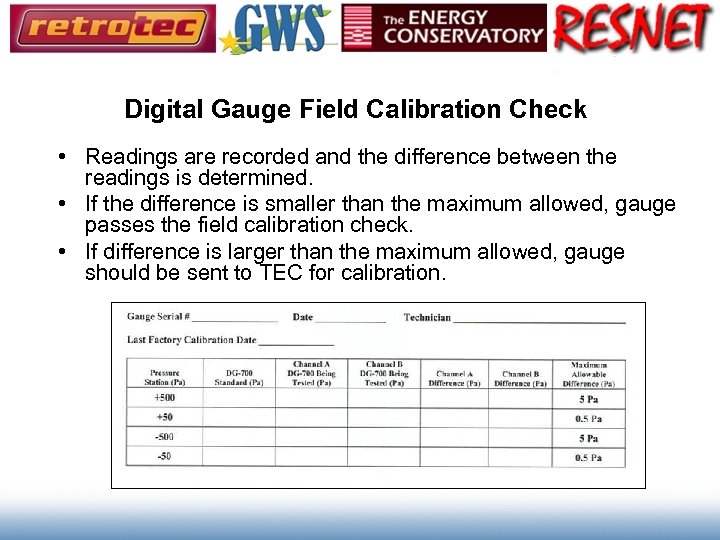 Digital Gauge Field Calibration Check • Readings are recorded and the difference between the readings is determined. • If the difference is smaller than the maximum allowed, gauge passes the field calibration check. • If difference is larger than the maximum allowed, gauge should be sent to TEC for calibration.
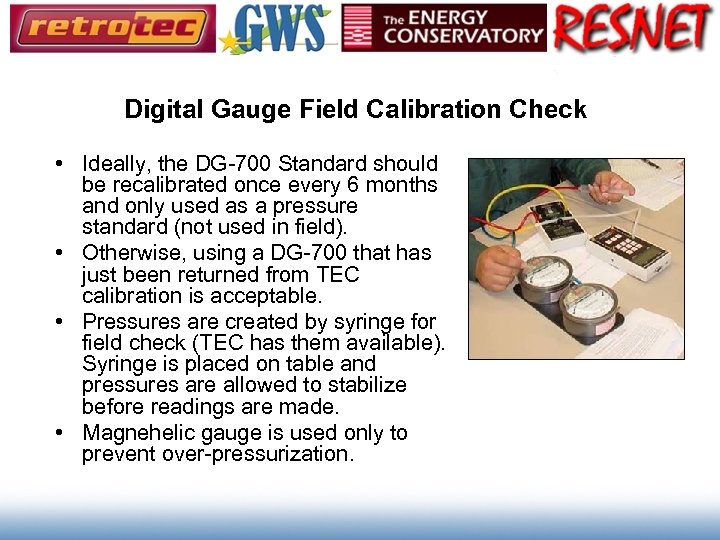 Digital Gauge Field Calibration Check • Ideally, the DG-700 Standard should be recalibrated once every 6 months and only used as a pressure standard (not used in field). • Otherwise, using a DG-700 that has just been returned from TEC calibration is acceptable. • Pressures are created by syringe for field check (TEC has them available). Syringe is placed on table and pressures are allowed to stabilize before readings are made. • Magnehelic gauge is used only to prevent over-pressurization.
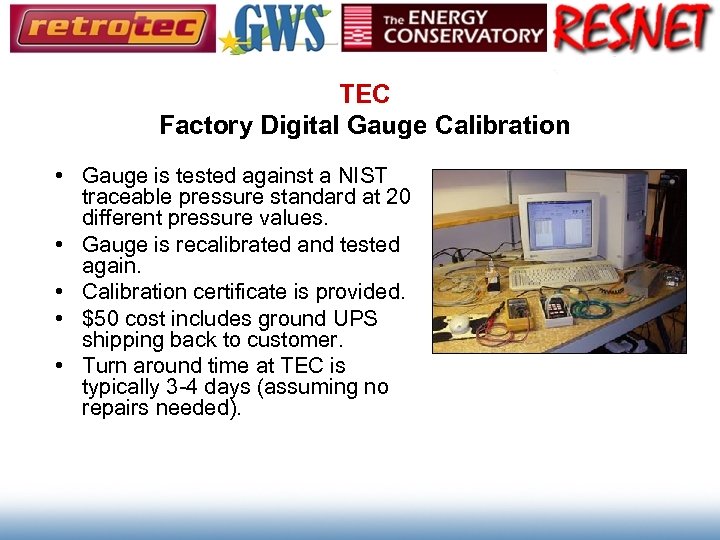 TEC Factory Digital Gauge Calibration • Gauge is tested against a NIST traceable pressure standard at 20 different pressure values. • Gauge is recalibrated and tested again. • Calibration certificate is provided. • $50 cost includes ground UPS shipping back to customer. • Turn around time at TEC is typically 3 -4 days (assuming no repairs needed).
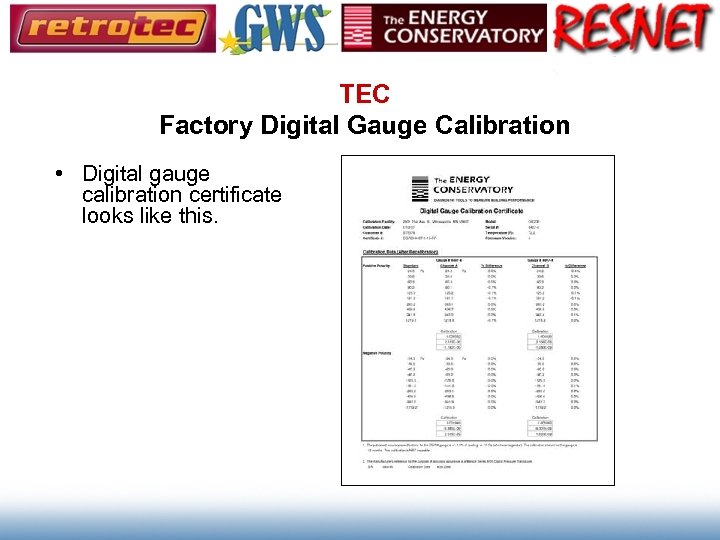 TEC Factory Digital Gauge Calibration • Digital gauge calibration certificate looks like this.
 TEC Recommended Calibration Check Procedures Blower Door and Duct Blaster Fans (choose either method) – Perform the fan field check procedure found at www. energyconservatory. com/support 7. htm or – Recalibrate fan at TEC factory - $200.
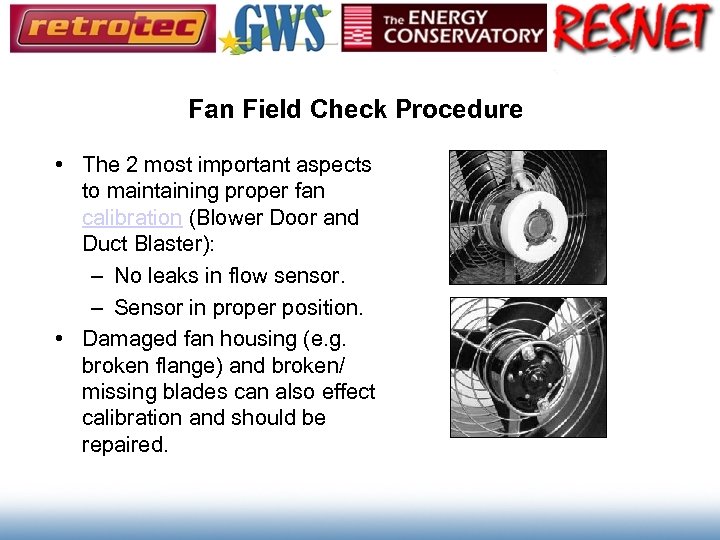 Fan Field Check Procedure • The 2 most important aspects to maintaining proper fan calibration (Blower Door and Duct Blaster): – No leaks in flow sensor. – Sensor in proper position. • Damaged fan housing (e. g. broken flange) and broken/ missing blades can also effect calibration and should be repaired.
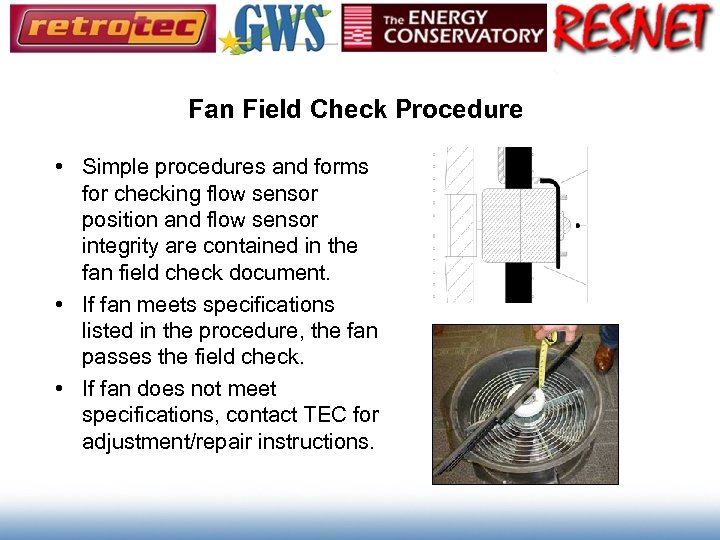 Fan Field Check Procedure • Simple procedures and forms for checking flow sensor position and flow sensor integrity are contained in the fan field check document. • If fan meets specifications listed in the procedure, the fan passes the field check. • If fan does not meet specifications, contact TEC for adjustment/repair instructions.
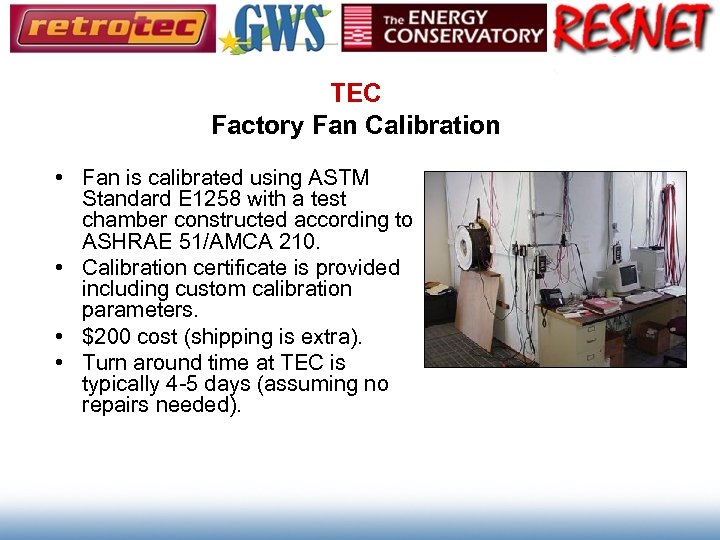 TEC Factory Fan Calibration • Fan is calibrated using ASTM Standard E 1258 with a test chamber constructed according to ASHRAE 51/AMCA 210. • Calibration certificate is provided including custom calibration parameters. • $200 cost (shipping is extra). • Turn around time at TEC is typically 4 -5 days (assuming no repairs needed).
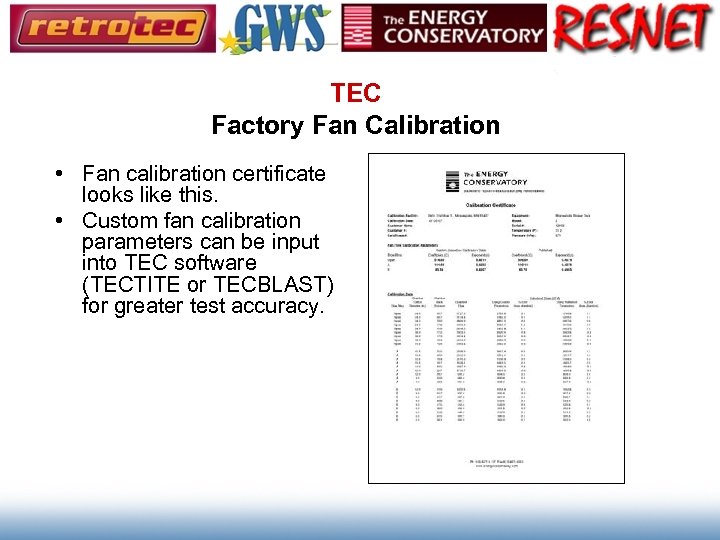 TEC Factory Fan Calibration • Fan calibration certificate looks like this. • Custom fan calibration parameters can be input into TEC software (TECTITE or TECBLAST) for greater test accuracy.
 TEC Recommended Calibration Check Procedures Duct Blaster System Field Check (meets requirements for both the Fan and Gauge) – Perform the Duct Blaster System field check procedure using an approved orifice plate. This procedure will be available on the TEC website in the Spring 07. Approved orifice plates will also be available at that time.
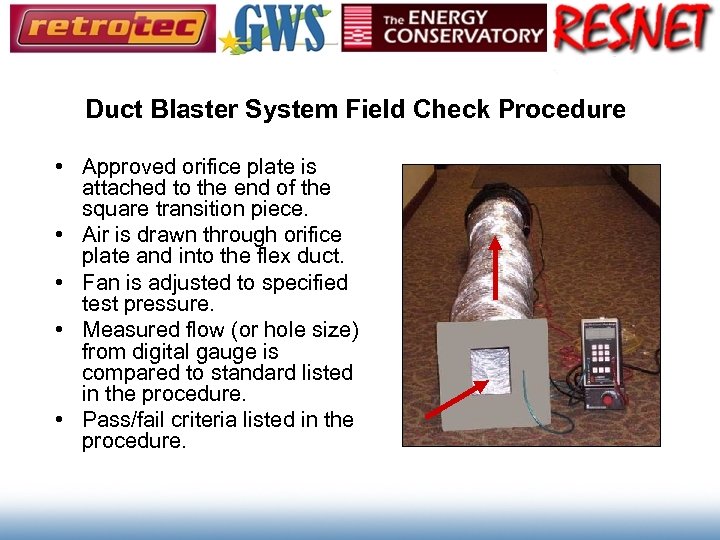 Duct Blaster System Field Check Procedure • Approved orifice plate is attached to the end of the square transition piece. • Air is drawn through orifice plate and into the flex duct. • Fan is adjusted to specified test pressure. • Measured flow (or hole size) from digital gauge is compared to standard listed in the procedure. • Pass/fail criteria listed in the procedure.
 TEC Recommended Calibration Check Procedures Magnehelic Gauges – TEC will perform an accuracy check on Magnehelic gauges for $15 per gauge (at the TEC factory). – The accuracy of the gauges will be tested and recorded, however, calibration adjustments on Magnehelic gauges will no longer be performed.
 TEC Recommended Calibration Check Procedures Check Tubing for Leaks or Obstructions – Tubing should be periodically checked for leaks and obstructions. – Periodically trim off ¼” off the ends of tubing to remove damaged ends. – If tubing leaks or is obstructed, replace it immediately.
 RETROTEC Recommended Calibration Check Procedures
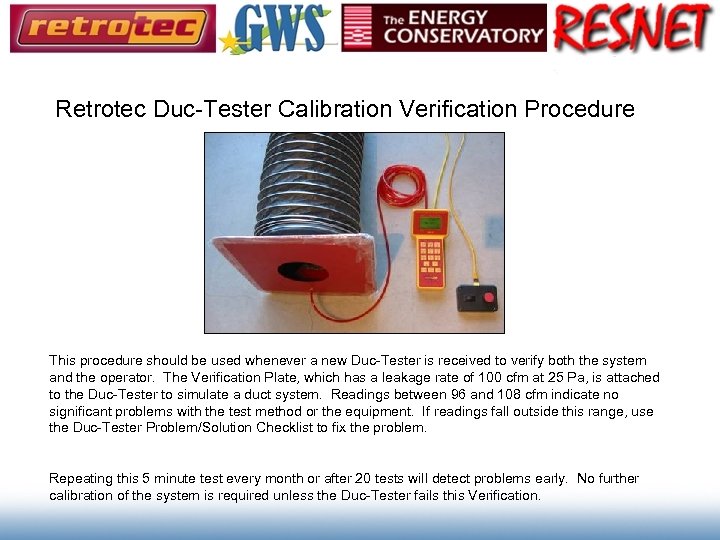 Retrotec Duc-Tester Calibration Verification Procedure This procedure should be used whenever a new Duc-Tester is received to verify both the system and the operator. The Verification Plate, which has a leakage rate of 100 cfm at 25 Pa, is attached to the Duc-Tester to simulate a duct system. Readings between 96 and 108 cfm indicate no significant problems with the test method or the equipment. If readings fall outside this range, use the Duc-Tester Problem/Solution Checklist to fix the problem. Repeating this 5 minute test every month or after 20 tests will detect problems early. No further calibration of the system is required unless the Duc-Tester fails this Verification.
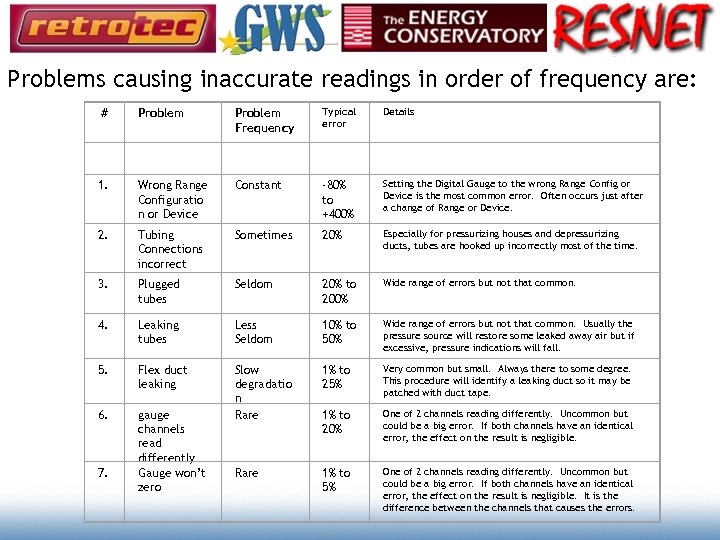 Problems causing inaccurate readings in order of frequency are: Problem Frequency Typical error Details 1. Wrong Range Configuratio n or Device Constant -80% to +400% Setting the Digital Gauge to the wrong Range Config or Device is the most common error. Often occurs just after a change of Range or Device. 2. Tubing Connections incorrect Sometimes 20% Especially for pressurizing houses and depressurizing ducts, tubes are hooked up incorrectly most of the time. 3. Plugged tubes Seldom 20% to 200% Wide range of errors but not that common. 4. Leaking tubes Less Seldom 10% to 50% Wide range of errors but not that common. Usually the pressure source will restore some leaked away air but if excessive, pressure indications will fall. 5. Flex duct leaking 1% to 25% Very common but small. Always there to some degree. This procedure will identify a leaking duct so it may be patched with duct tape. 6. gauge channels read differently Gauge won’t zero Slow degradatio n Rare 1% to 20% One of 2 channels reading differently. Uncommon but could be a big error. If both channels have an identical error, the effect on the result is negligible. Rare 1% to 5% One of 2 channels reading differently. Uncommon but could be a big error. If both channels have an identical error, the effect on the result is negligible. It is the difference between the channels that causes the errors. # 7.
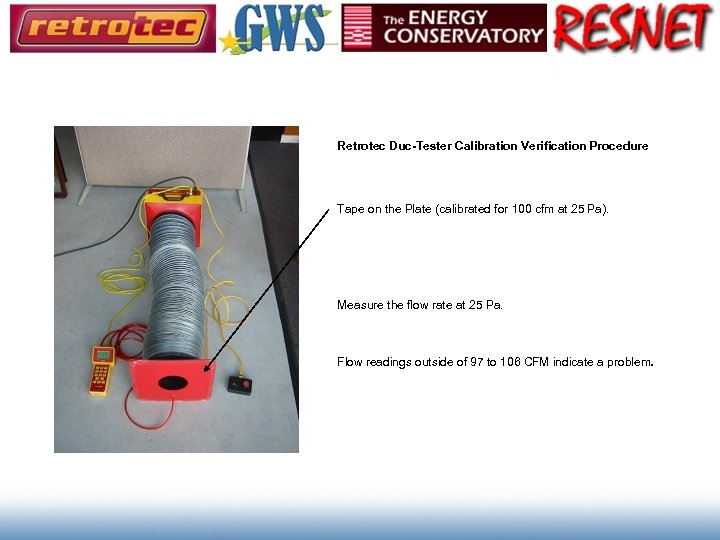 Retrotec Duc-Tester Calibration Verification Procedure Tape on the Plate (calibrated for 100 cfm at 25 Pa). Measure the flow rate at 25 Pa. Flow readings outside of 97 to 106 CFM indicate a problem.
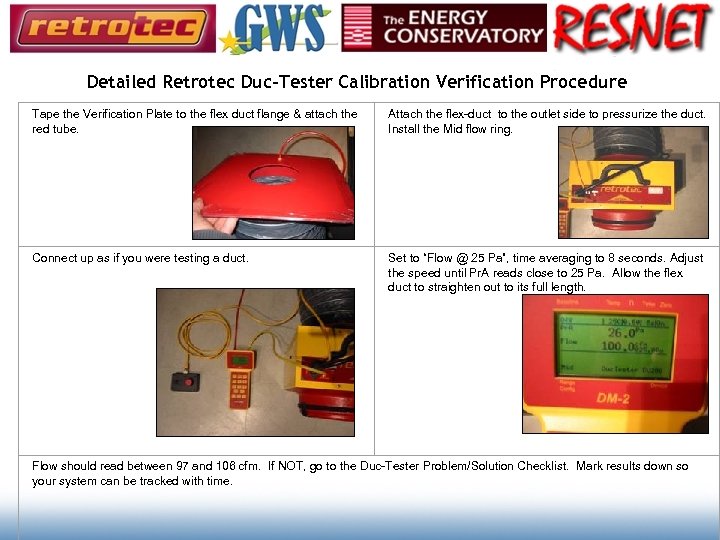 Detailed Retrotec Duc-Tester Calibration Verification Procedure Tape the Verification Plate to the flex duct flange & attach the red tube. Attach the flex-duct to the outlet side to pressurize the duct. Install the Mid flow ring. Connect up as if you were testing a duct. Set to “Flow @ 25 Pa”, time averaging to 8 seconds. Adjust the speed until Pr. A reads close to 25 Pa. Allow the flex duct to straighten out to its full length. Flow should read between 97 and 106 cfm. If NOT, go to the Duc-Tester Problem/Solution Checklist. Mark results down so your system can be tracked with time.
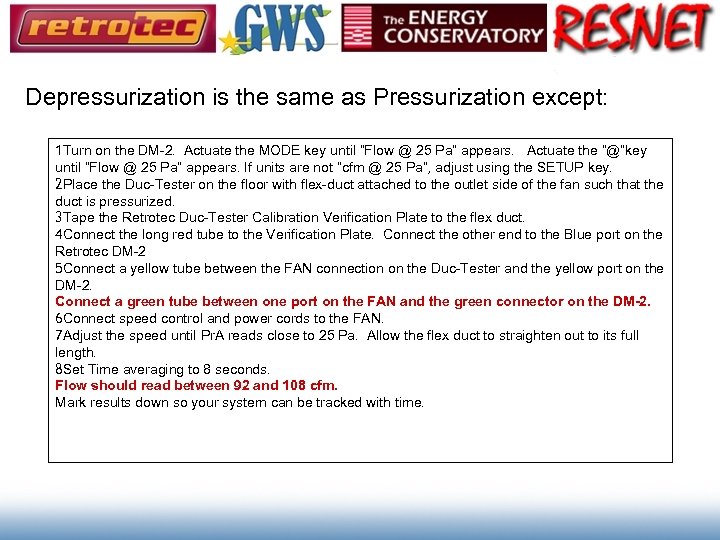 Depressurization is the same as Pressurization except: 1 Turn on the DM-2. Actuate the MODE key until “Flow @ 25 Pa” appears. Actuate the “@”key until “Flow @ 25 Pa” appears. If units are not “cfm @ 25 Pa”, adjust using the SETUP key. 2 Place the Duc-Tester on the floor with flex-duct attached to the outlet side of the fan such that the duct is pressurized. 3 Tape the Retrotec Duc-Tester Calibration Verification Plate to the flex duct. 4 Connect the long red tube to the Verification Plate. Connect the other end to the Blue port on the Retrotec DM-2 5 Connect a yellow tube between the FAN connection on the Duc-Tester and the yellow port on the DM-2. Connect a green tube between one port on the FAN and the green connector on the DM-2. 6 Connect speed control and power cords to the FAN. 7 Adjust the speed until Pr. A reads close to 25 Pa. Allow the flex duct to straighten out to its full length. 8 Set Time averaging to 8 seconds. Flow should read between 92 and 108 cfm. Mark results down so your system can be tracked with time.
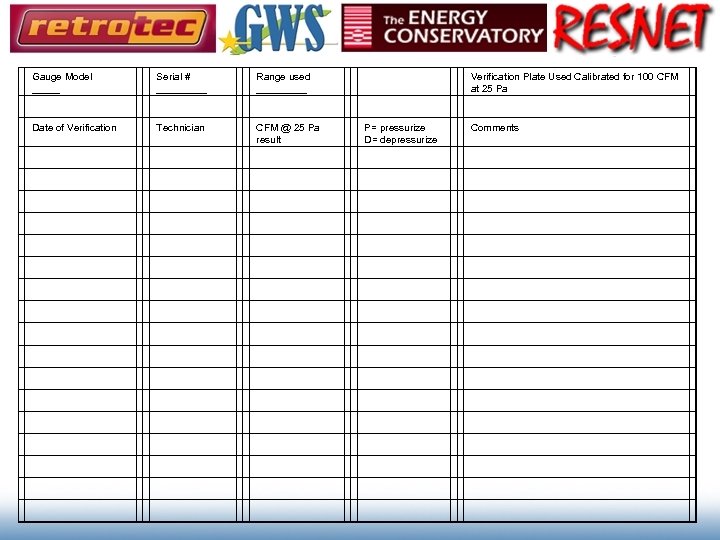 Gauge Model _____ Serial # _____ Range used _____ Verification Plate Used Calibrated for 100 CFM at 25 Pa Date of Verification Technician CFM @ 25 Pa result P= pressurize D= depressurize Comments
 Duc-Tester Problem/Solution Checklist Use this List if Flow is NOT between 97 and 106 cfm for pressurization or 92 and 108 cfm for depressurization. Note: even though the accuracy is within 3% of measured flow, this is a calibration check to see if something is wrong.
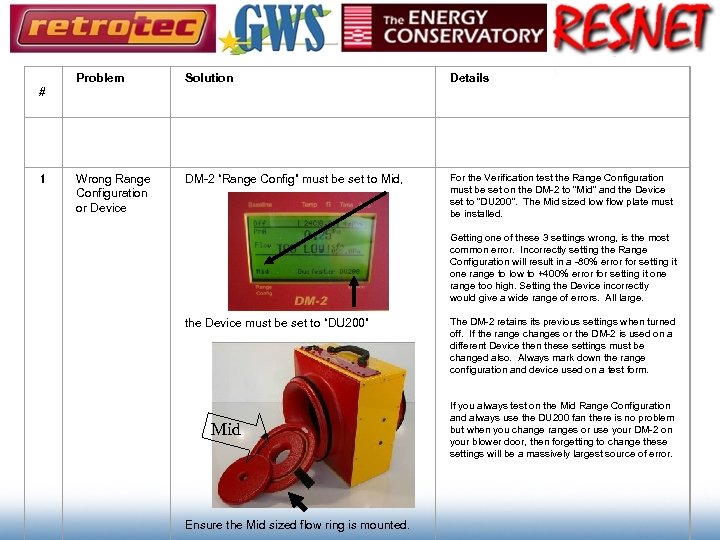 Problem Solution Details 1 Wrong Range Configuration or Device DM-2 “Range Config” must be set to Mid, For the Verification test the Range Configuration must be set on the DM-2 to “Mid” and the Device set to “DU 200”. The Mid sized low flow plate must be installed. Getting one of these 3 settings wrong, is the most common error. Incorrectly setting the Range Configuration will result in a -80% error for setting it one range to low to +400% error for setting it one range too high. Setting the Device incorrectly would give a wide range of errors. All large. The DM-2 retains its previous settings when turned off. If the range changes or the DM-2 is used on a different Device then these settings must be changed also. Always mark down the range configuration and device used on a test form. If you always test on the Mid Range Configuration and always use the DU 200 fan there is no problem but when you change ranges or use your DM-2 on your blower door, then forgetting to change these settings will be a massively largest source of error. # the Device must be set to “DU 200” Mid Ensure the Mid sized flow ring is mounted.
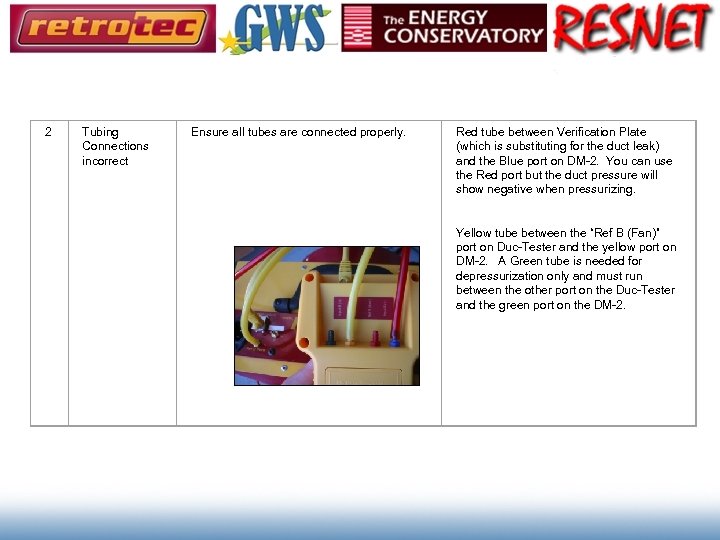 2 Tubing Connections incorrect Ensure all tubes are connected properly. Red tube between Verification Plate (which is substituting for the duct leak) and the Blue port on DM-2. You can use the Red port but the duct pressure will show negative when pressurizing. Yellow tube between the “Ref B (Fan)” port on Duc-Tester and the yellow port on DM-2. A Green tube is needed for depressurization only and must run between the other port on the Duc-Tester and the green port on the DM-2.
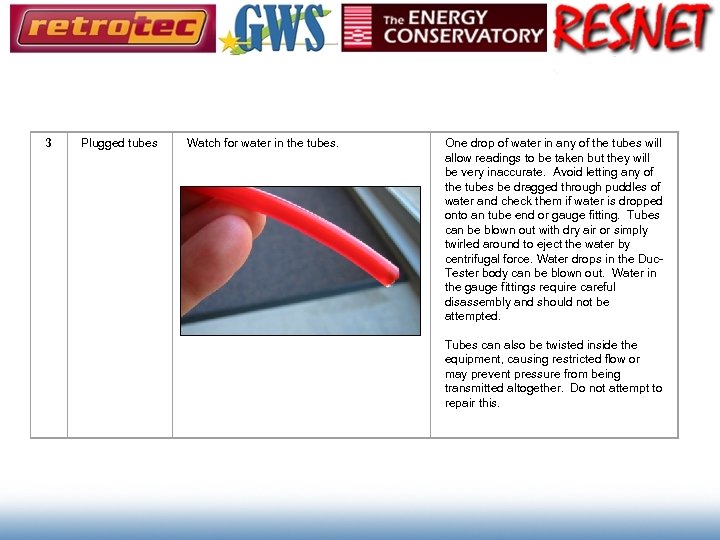 Plugged tubes Watch for water in the tubes. Water drop 3 One drop of water in any of the tubes will allow readings to be taken but they will be very inaccurate. Avoid letting any of the tubes be dragged through puddles of water and check them if water is dropped onto an tube end or gauge fitting. Tubes can be blown out with dry air or simply twirled around to eject the water by centrifugal force. Water drops in the Duc. Tester body can be blown out. Water in the gauge fittings require careful disassembly and should not be attempted. Tubes can also be twisted inside the equipment, causing restricted flow or may prevent pressure from being transmitted altogether. Do not attempt to repair this.
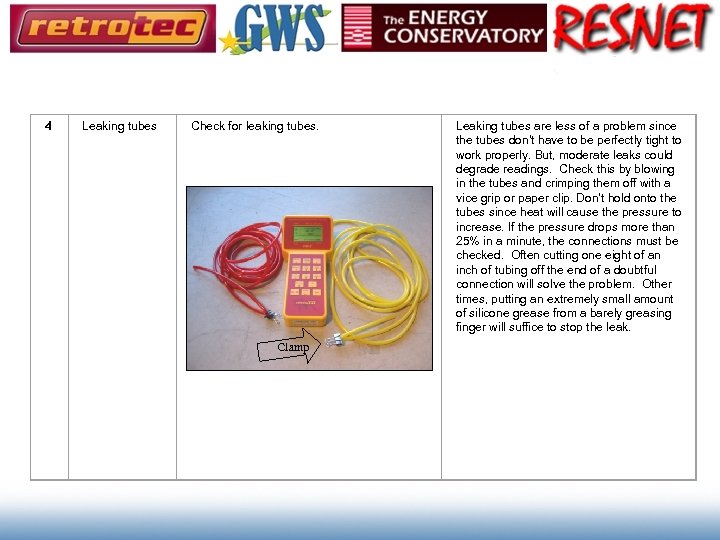 4 Leaking tubes Check for leaking tubes. Clamp Leaking tubes are less of a problem since the tubes don’t have to be perfectly tight to work properly. But, moderate leaks could degrade readings. Check this by blowing in the tubes and crimping them off with a vice grip or paper clip. Don’t hold onto the tubes since heat will cause the pressure to increase. If the pressure drops more than 25% in a minute, the connections must be checked. Often cutting one eight of an inch of tubing off the end of a doubtful connection will solve the problem. Other times, putting an extremely small amount of silicone grease from a barely greasing finger will suffice to stop the leak.
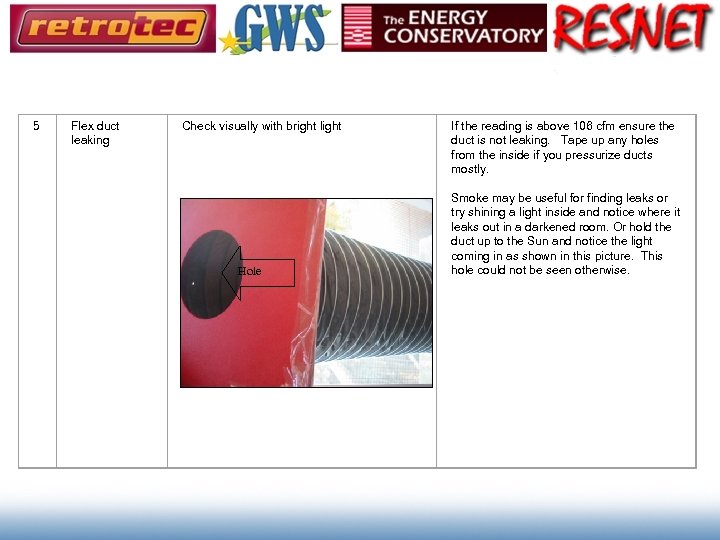 5 Flex duct leaking Check visually with bright light Hole If the reading is above 106 cfm ensure the duct is not leaking. Tape up any holes from the inside if you pressurize ducts mostly. Smoke may be useful for finding leaks or try shining a light inside and notice where it leaks out in a darkened room. Or hold the duct up to the Sun and notice the light coming in as shown in this picture. This hole could not be seen otherwise.
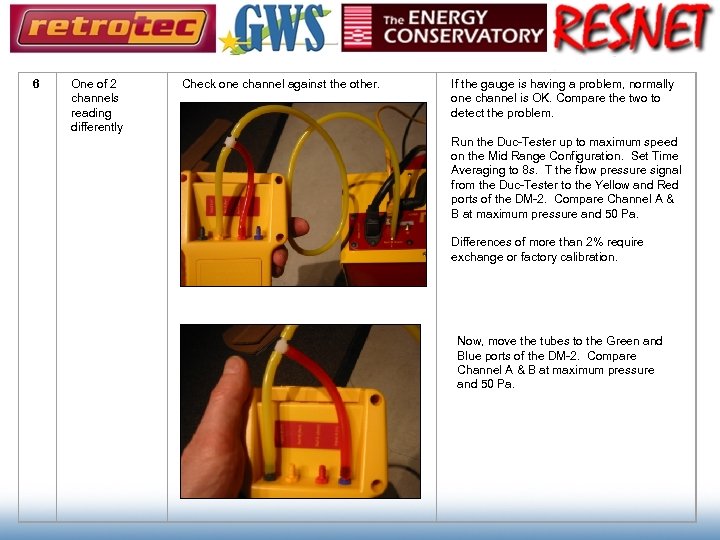 6 One of 2 channels reading differently Check one channel against the other. If the gauge is having a problem, normally one channel is OK. Compare the two to detect the problem. Run the Duc-Tester up to maximum speed on the Mid Range Configuration. Set Time Averaging to 8 s. T the flow pressure signal from the Duc-Tester to the Yellow and Red ports of the DM-2. Compare Channel A & B at maximum pressure and 50 Pa. Differences of more than 2% require exchange or factory calibration. Now, move the tubes to the Green and Blue ports of the DM-2. Compare Channel A & B at maximum pressure and 50 Pa.
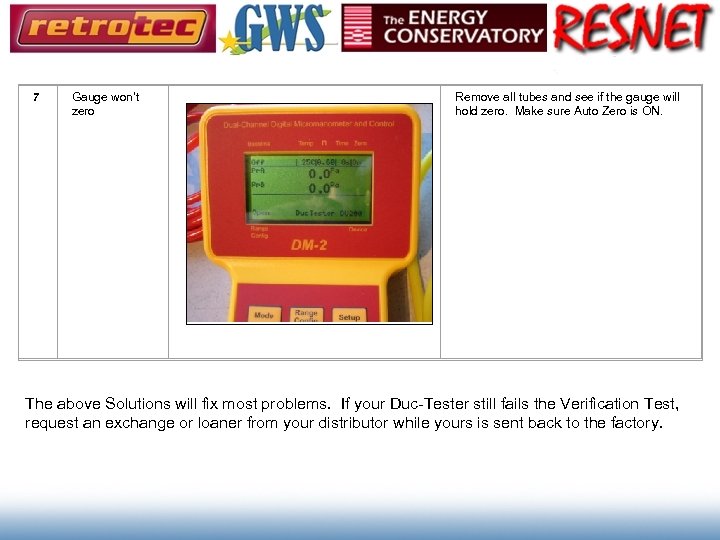 7 Gauge won’t zero Remove all tubes and see if the gauge will hold zero. Make sure Auto Zero is ON. The above Solutions will fix most problems. If your Duc-Tester still fails the Verification Test, request an exchange or loaner from your distributor while yours is sent back to the factory.
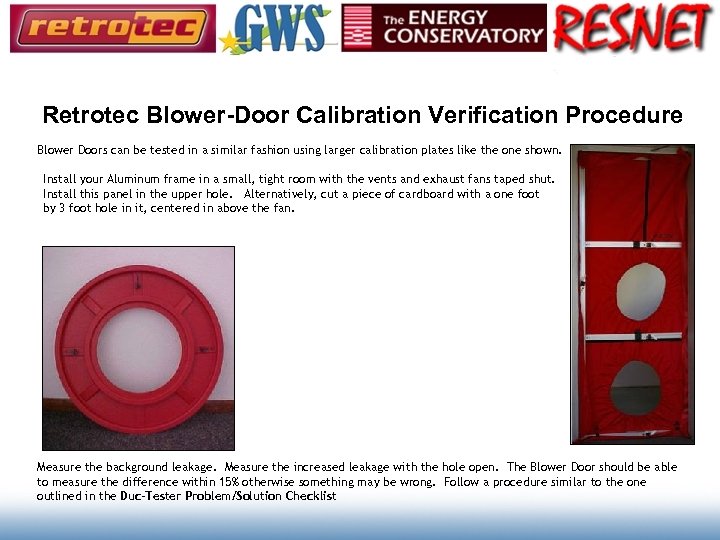 Retrotec Blower-Door Calibration Verification Procedure Blower Doors can be tested in a similar fashion using larger calibration plates like the one shown. Install your Aluminum frame in a small, tight room with the vents and exhaust fans taped shut. Install this panel in the upper hole. Alternatively, cut a piece of cardboard with a one foot by 3 foot hole in it, centered in above the fan. Measure the background leakage. Measure the increased leakage with the hole open. The Blower Door should be able to measure the difference within 15% otherwise something may be wrong. Follow a procedure similar to the one outlined in the Duc-Tester Problem/Solution Checklist
 HERS Provider Shall Maintain a Written Log of Annual Calibration. . . and Shall Be Made Available Within 24 Hours…
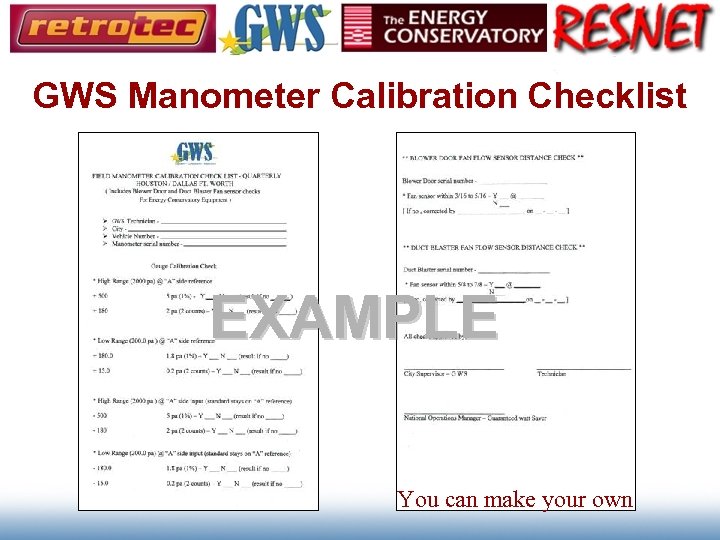 GWS Manometer Calibration Checklist EXAMPLE You can make your own
 QUESTIONS ?