 Скачать презентацию RESNET New Homes Tax Credit TIAP Webinar Steve
c318e09736c63a975def2dc3b813d0aa.ppt
- Количество слайдов: 59



RESNET New Homes Tax Credit TIAP Webinar Steve Baden - RESNET www. resnet. us
RESNET Federal Tax Credit for New Homes Site Built Homes $2, 000 to builder for each home whose performance is calculated to exceed Heating and Cooling Use of Section 404 of 2004 Supplement of the IECC by 50% (Does not count water heating/renewable energy production – covered by other incentives)
RESNET Federal Tax Credit for New Homes Effective Dates Homes built after August 2005 and purchased between January 1, 2006 and January 1, 2008
RESNET Federal Tax Credit for New Homes IRS Rule – IRS 2006 -27 + 3 rd Party Inspection Required – Certified by RESNET or Equivalent Rating Certification Organization + Software Tool Must Comply with RESNET Software Test Specifications
RESNET www. resnet. us/standards/tax_credits/procedures
RESNET Federal Tax Credit Software Specifications + Auto-Generation of the Reference Homes (2004 Supplement to IECC) + HERS BESTEST + RESNET HVAC Tests + Duct Distribution System Efficiencies Tests
RESNET Federal Tax Credit Software Tools Accredited by RESNET + Energy Gauge USA (Florida Solar Energy Center) + Micropas (Enercomp, Inc. ) + REM/Rate (Architectural Energy Corporation) + Builder Energy Solutions (ICF Resources)
RESNET Federal Tax Credit Inspection Specifications + Homes Shall be Independently Field Tested + Field Verification Shall Follow RESNET’s Home Energy Rating Procedures + Person Who Certify Home’s Qualification for Tax Credit Shall be Trained and Certified in Accordance with RESNET’s National Home Energy Rating Procedures
Tax Incentives for Home HVAC Equipment and Appliances Presented at Tax Incentives Assistance Project Webinar 21 July 2006 David B. Goldstein, Ph. D. Natural Resources Defense Council San Francisco dgoldstein@nrdc. org
Goals of the Tax Incentives ¢ Make highest efficiency products available to everyone l ¢ Attract market attention with multi-year incentives Harmonize with existing programs Consortium for Energy Efficiency (CEE) l Energy Star l
HVAC Program Status ¢ Original intent was a 4 -5 year program l Manufacturers have indicated that this is the time needed to justify major investments in production capacity for high-efficiency equipment ¢ EPAct Incentives were trimmed to 2 years (2006 -2007) ¢ Snow/Feinstein Bill, S. 3628 extends the program to 5 years (adds 2008 -2010)
How Do You Qualify? ¢ Manufacturer certifies eligibility ¢ Online resources show product availability: www. energytaxincentives. org l www. cee 1. org/resid/rs-acmain. php 3 l www. gamanet. org/gama/inforesources. nsf/v. Content. Entries/Product+Directorie s? Open. Document l www. energystar. gov/index. cfm? c=prod ucts. pr_tax_credits#1 l ¢ Limited to taxpayer’s principal residence
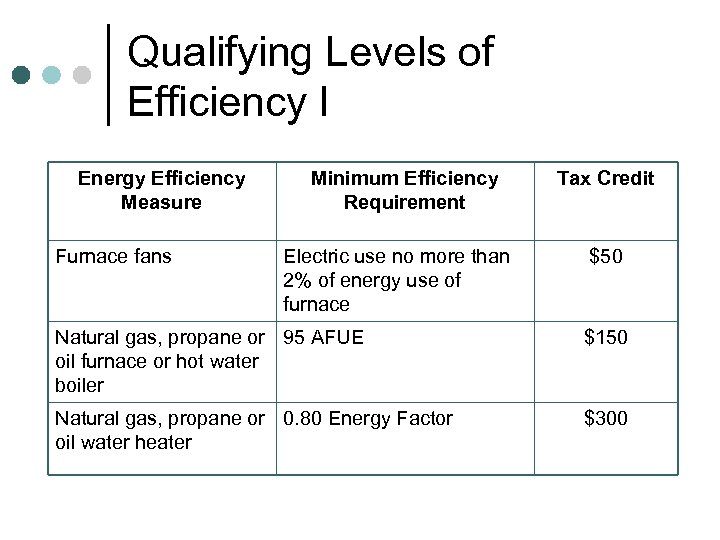
Qualifying Levels of Efficiency I Energy Efficiency Measure Furnace fans Minimum Efficiency Requirement Tax Credit Electric use no more than 2% of energy use of furnace $50 Natural gas, propane or 95 AFUE oil furnace or hot water boiler $150 Natural gas, propane or 0. 80 Energy Factor oil water heater $300
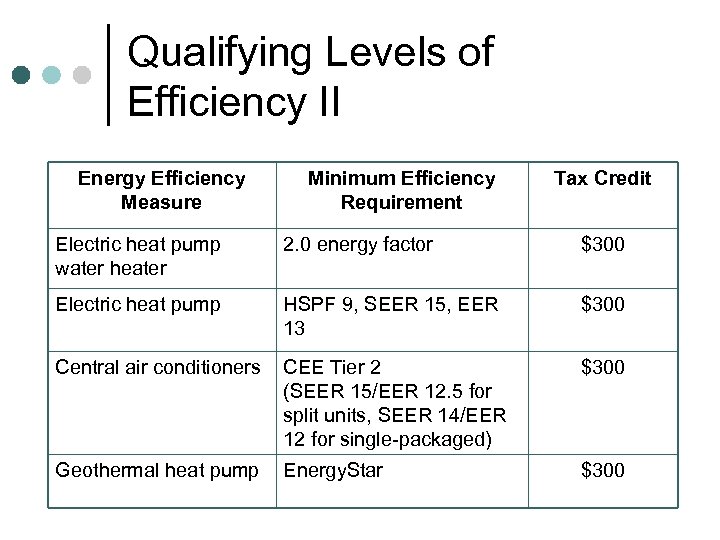
Qualifying Levels of Efficiency II Energy Efficiency Measure Minimum Efficiency Requirement Tax Credit Electric heat pump water heater 2. 0 energy factor $300 Electric heat pump HSPF 9, SEER 15, EER 13 $300 Central air conditioners CEE Tier 2 (SEER 15/EER 12. 5 for split units, SEER 14/EER 12 for single-packaged) $300 Geothermal heat pump Energy. Star $300
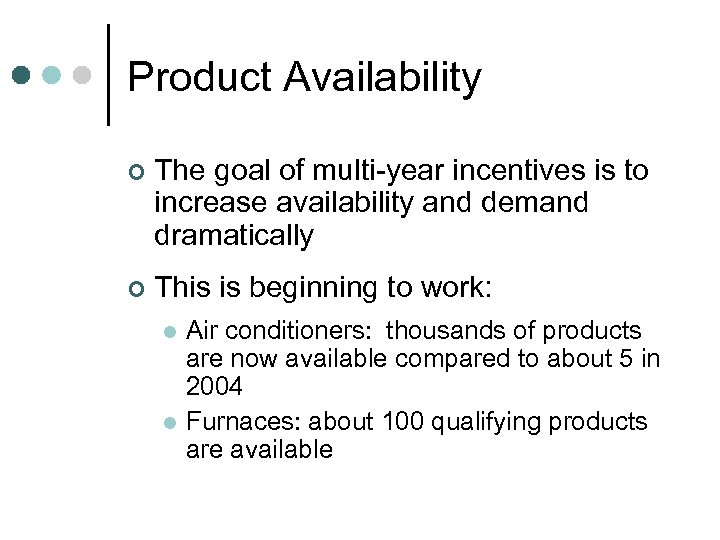
Product Availability ¢ The goal of multi-year incentives is to increase availability and demand dramatically ¢ This is beginning to work: Air conditioners: thousands of products are now available compared to about 5 in 2004 l Furnaces: about 100 qualifying products are available l
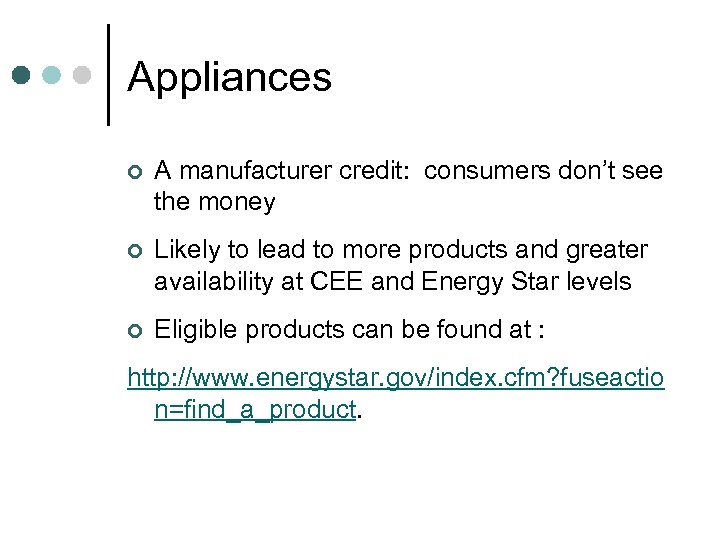
Appliances ¢ A manufacturer credit: consumers don’t see the money ¢ Likely to lead to more products and greater availability at CEE and Energy Star levels ¢ Eligible products can be found at : http: //www. energystar. gov/index. cfm? fuseactio n=find_a_product.
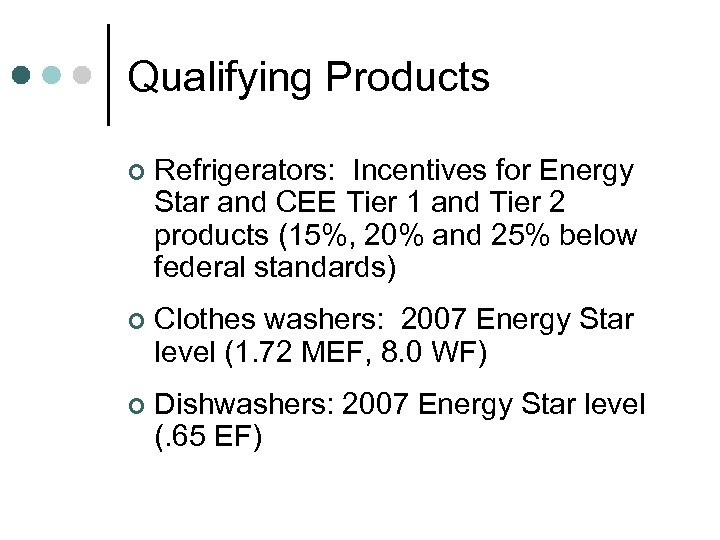
Qualifying Products ¢ Refrigerators: Incentives for Energy Star and CEE Tier 1 and Tier 2 products (15%, 20% and 25% below federal standards) ¢ Clothes washers: 2007 Energy Star level (1. 72 MEF, 8. 0 WF) ¢ Dishwashers: 2007 Energy Star level (. 65 EF)
Solar - Residential and Commercial ITC Colin Murchie, Director of Government Affairs Solar Energy Industries Association (202) 682 0556 x 2 cmurchie@seia. org www. seia. org
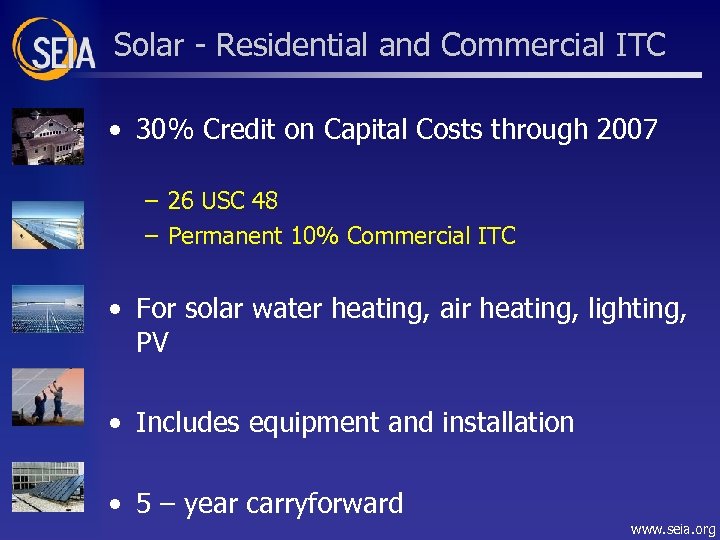
Solar - Residential and Commercial ITC • 30% Credit on Capital Costs through 2007 – 26 USC 48 – Permanent 10% Commercial ITC • For solar water heating, air heating, lighting, PV • Includes equipment and installation • 5 – year carryforward www. seia. org
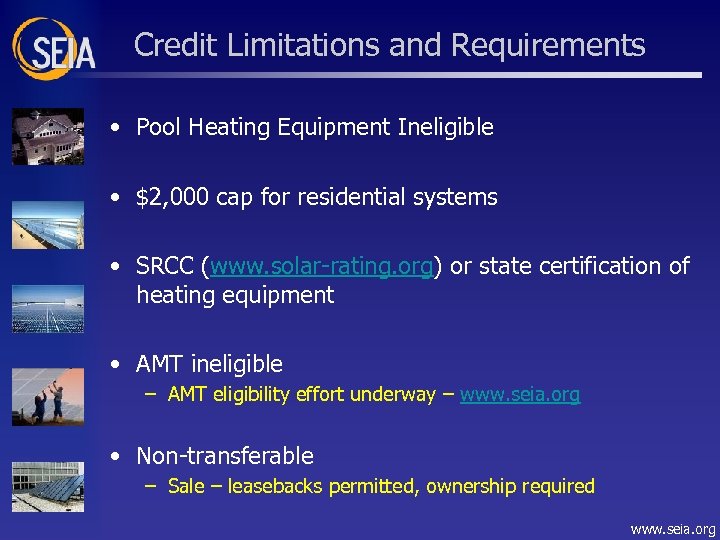
Credit Limitations and Requirements • Pool Heating Equipment Ineligible • $2, 000 cap for residential systems • SRCC (www. solar-rating. org) or state certification of heating equipment • AMT ineligible – AMT eligibility effort underway – www. seia. org • Non-transferable – Sale – leasebacks permitted, ownership required www. seia. org
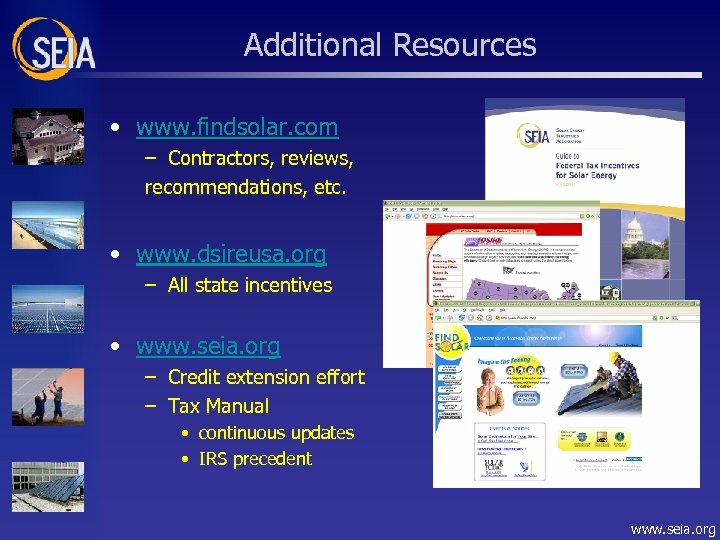
Additional Resources • www. findsolar. com – Contractors, reviews, recommendations, etc. • www. dsireusa. org – All state incentives • www. seia. org – Credit extension effort – Tax Manual • continuous updates • IRS precedent www. seia. org
FLORIDA SOLAR ENERGY CENTER A Research Institute of the University of Central Florida Qualifying for the New Home Tax Credit Examples in 9 U. S. Cities TIAP Web Seminar July 21, 2006 Philip Fairey
Introduction v v v Simulations and calculations performed using Energy. Gauge® USA – qualified through software tests required by RESNET Pub 005 -01 Only one of many possible solutions provided for each climate (best orientation) No mechanical ventilation – all homes with natural infiltration at 0. 35 ach All insulation is assumed installation Grade I Results indicate that many new homes, in all parts of the country, may ultimately qualify for federal tax credits.
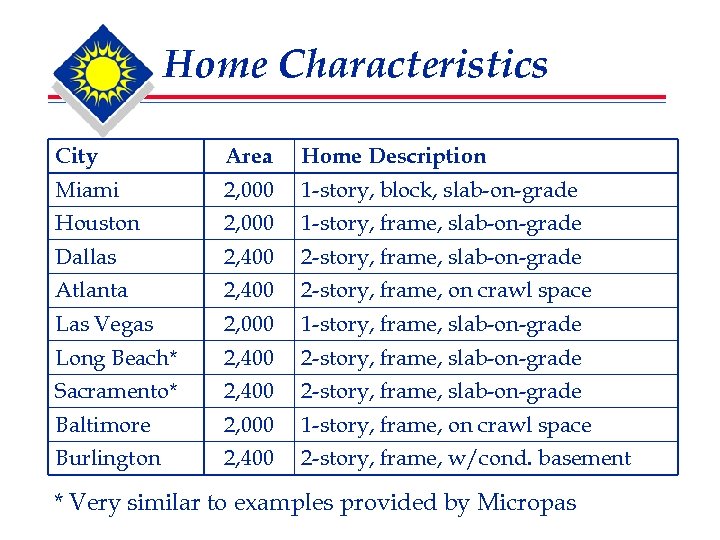
Home Characteristics City Area Home Description Miami 2, 000 1 -story, block, slab-on-grade Houston 2, 000 1 -story, frame, slab-on-grade Dallas 2, 400 2 -story, frame, slab-on-grade Atlanta 2, 400 2 -story, frame, on crawl space Las Vegas 2, 000 1 -story, frame, slab-on-grade Long Beach* 2, 400 2 -story, frame, slab-on-grade Sacramento* 2, 400 2 -story, frame, slab-on-grade Baltimore 2, 000 1 -story, frame, on crawl space Burlington 2, 400 2 -story, frame, w/cond. basement * Very similar to examples provided by Micropas
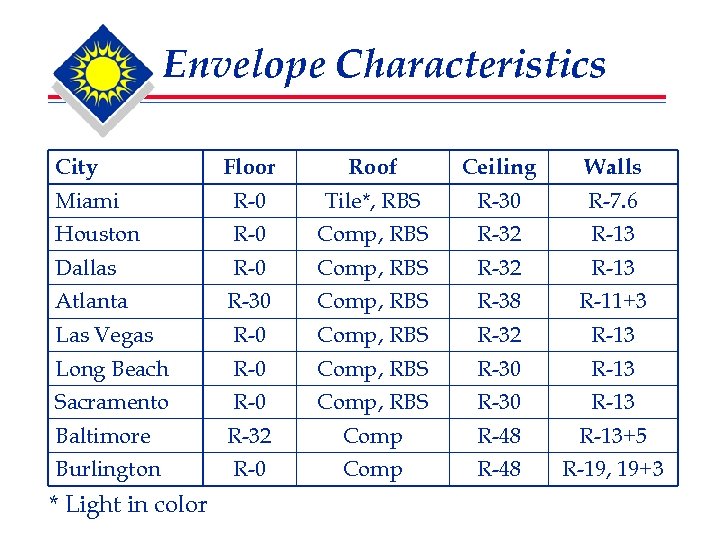
Envelope Characteristics City Floor Roof Ceiling Walls Miami R-0 Tile*, RBS R-30 R-7. 6 Houston R-0 Comp, RBS R-32 R-13 Dallas R-0 Comp, RBS R-32 R-13 Atlanta R-30 Comp, RBS R-38 R-11+3 Las Vegas R-0 Comp, RBS R-32 R-13 Long Beach R-0 Comp, RBS R-30 R-13 Sacramento R-0 Comp, RBS R-30 R-13 Baltimore R-32 Comp R-48 R-13+5 Burlington R-0 Comp R-48 R-19, 19+3 * Light in color
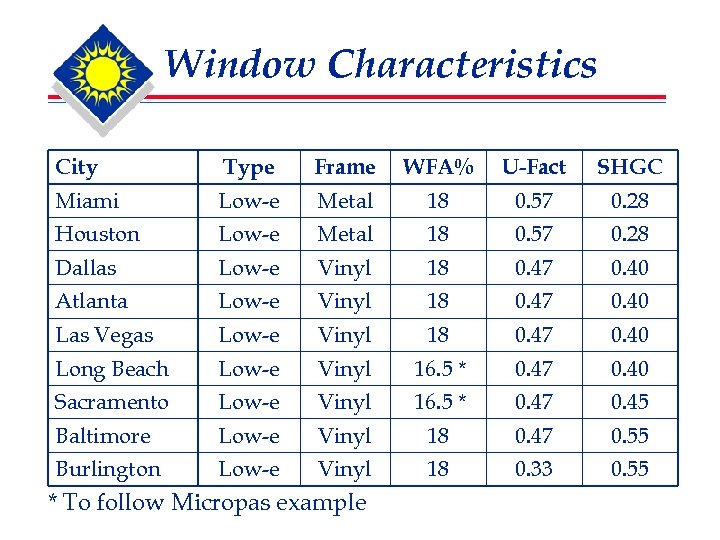
Window Characteristics City Type Frame WFA% U-Fact SHGC Miami Low-e Metal 18 0. 57 0. 28 Houston Low-e Metal 18 0. 57 0. 28 Dallas Low-e Vinyl 18 0. 47 0. 40 Atlanta Low-e Vinyl 18 0. 47 0. 40 Las Vegas Low-e Vinyl 18 0. 47 0. 40 Long Beach Low-e Vinyl 16. 5 * 0. 47 0. 40 Sacramento Low-e Vinyl 16. 5 * 0. 47 0. 45 Baltimore Low-e Vinyl 18 0. 47 0. 55 Burlington Low-e Vinyl 18 0. 33 0. 55 * To follow Micropas example
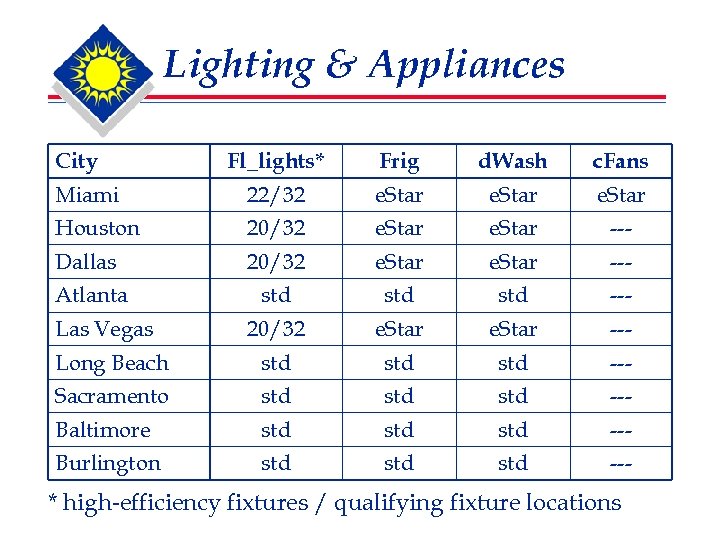
Lighting & Appliances City Fl_lights* Frig d. Wash c. Fans Miami 22/32 e. Star Houston 20/32 e. Star --- Dallas 20/32 e. Star --- Atlanta std std --- 20/32 e. Star --- Long Beach std std --- Sacramento std std --- Baltimore std std --- Burlington std std --- Las Vegas * high-efficiency fixtures / qualifying fixture locations
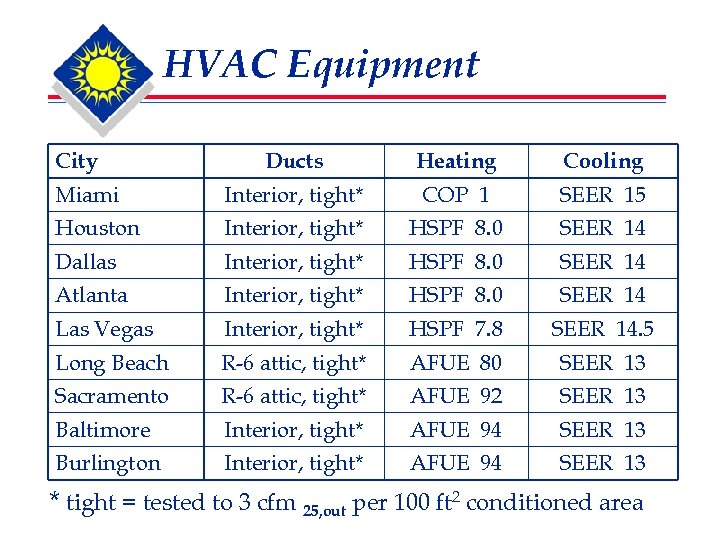
HVAC Equipment City Ducts Heating Cooling Miami Interior, tight* COP 1 SEER 15 Houston Interior, tight* HSPF 8. 0 SEER 14 Dallas Interior, tight* HSPF 8. 0 SEER 14 Atlanta Interior, tight* HSPF 8. 0 SEER 14 Las Vegas Interior, tight* HSPF 7. 8 SEER 14. 5 Long Beach R-6 attic, tight* AFUE 80 SEER 13 Sacramento R-6 attic, tight* AFUE 92 SEER 13 Baltimore Interior, tight* AFUE 94 SEER 13 Burlington Interior, tight* AFUE 94 SEER 13 * tight = tested to 3 cfm 25, out per 100 ft 2 conditioned area
Conclusions v v v Qualification not difficult in very mild climates Window selection is important, with changes in SHGC making a significant difference, even in northern climates Efficient lighting and appliances provide significant benefit in cooling dominated climates Relatively “standard” envelope features can make the goal with only “moderate” increases in HVAC efficiencies if ducts are good Tight ducts located in conditioned space provide significant benefit for both heating and cooling.
Tax Credit Software v v v Software providing for analysis for tax credit qualification available to anyone Software for “certification” purposes is only available to IRS “certifiers” ‘Try before You Buy’ Software is available online as a free downloadable at http: //Energy. Gauge. com
Integrating Tax Incentives into Energy Efficiency Programs Rick Gerardi Director, Residential Programs NYSERDA
New Homes • Planning on a “Better-Best” Strategy • “Better” = New York ENERGY STAR® Labeled Homes – core voluntary program - Continued training and technical assistance to builders - NY Incentives of $750 - $1000 per home - 13% market share • “ENERGY STAR Best of the Best” = tax credit-eligible homes and fulfill NYS requirements with additional specs - Additional training and technical assistance to builders and Raters - Combination of NY incentives and tax credit built into software - Targeted mid-stream marketing
Existing Homes • Home Performance with ENERGY STAR® – Program which promotes comprehensive retrofits to address comfort, health, safety and energy – Typically achieving 30% energy savings – $500 federal tax incentive a modest sweetener • We will tell homeowners about • Not a major part of promotion • A performance-based incentive with higher incentives for high savings will better complement our program – E. g. as in the new Snowe-Feinstein bill – Software documentation of energy percentage savings
ENERGY STAR® Labeled Products • Planning a “best of the best” campaign to promote high-efficiency appliances and other products which exceed Energy Star criteria - Will better align with tax credit eligibility in 2006 • In 2007, Energy Star and tax credits will align for clothes washers and dishwashers but not refrigerators - “Best of the best” will still be important for levels above ENERGY STAR
Moving Forward • Tax incentive levels and structure should be reexamined as part of extension discussions – Restructuring particularly needed for existing homes • ENERGY STAR should keep its specifications up-to-date – E. g. refrigerator specification needs updating • “ENERGY STAR Best of the Best” to increase specification levels when a state exceeds its ENERGY STAR market transformation goals • NY will continue fine-tuning programs to maximize savings and cost-effectiveness through market-based strategies
80 years of excellence Commercial Buildings Tax Deduction Ed Gray Director, Energy Infrastructure National Electrical Manufacturers Association
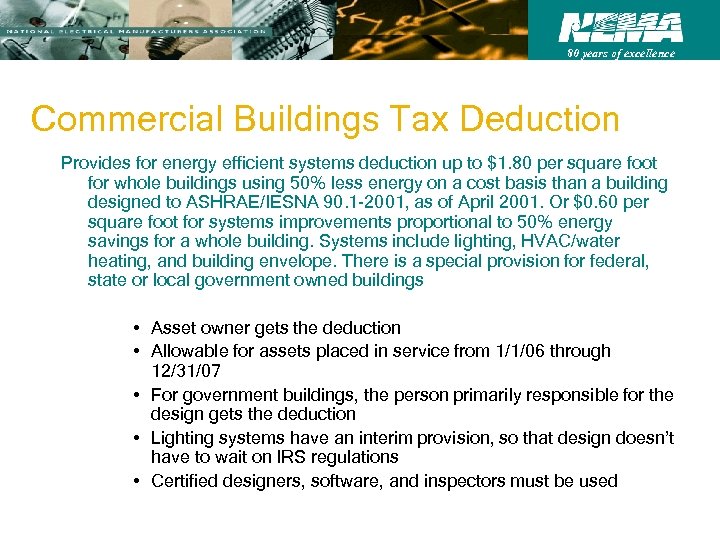
80 years of excellence Commercial Buildings Tax Deduction Provides for energy efficient systems deduction up to $1. 80 per square foot for whole buildings using 50% less energy on a cost basis than a building designed to ASHRAE/IESNA 90. 1 -2001, as of April 2001. Or $0. 60 per square foot for systems improvements proportional to 50% energy savings for a whole building. Systems include lighting, HVAC/water heating, and building envelope. There is a special provision for federal, state or local government owned buildings • Asset owner gets the deduction • Allowable for assets placed in service from 1/1/06 through 12/31/07 • For government buildings, the person primarily responsible for the design gets the deduction • Lighting systems have an interim provision, so that design doesn’t have to wait on IRS regulations • Certified designers, software, and inspectors must be used
80 years of excellence Tax Rule Schedule IRS Notice 2006 -52 includes self certification concept for design, software, inspection; forms showing technical basis to be retained by taxpayer, but not sent in with return Government buildings rules to be included in another Notice “Regulation” to be done later to include detailed rules “Certified” software likely to be available soon Interim lighting rules enable work to be done before regulations done Stakeholders need to review IRS work for potential comments
80 years of excellence IRS Clarified Issues International Revenue Service Notice 2006 -52 contains guidance; corrected version in Internal Revenue Bulletin 2006 -26 dated June 26, 2006 Certifier and inspector may be professional engineer or contractor licensed in the building’s jurisdiction Software to be self-certified, to be listed on DOE website Inspector cannot be an employee of asset owner
80 years of excellence Alternatives for Deduction 1. 2. 3. 4. 5. Whole building 50% energy cost reduction Partial Deduction – Lighting Target Partial Deduction – HVAC Target Partial Deduction – Envelope Target Interim Lighting Rules* using ASHRAE prescriptive lighting tables (9. 3. 1. 1 and 9. 3. 1. 2) *Interim Lighting Rules only in effect until final regulations are published in Federal Register, NEMA has requested that “interim” rule alternative be made permanent
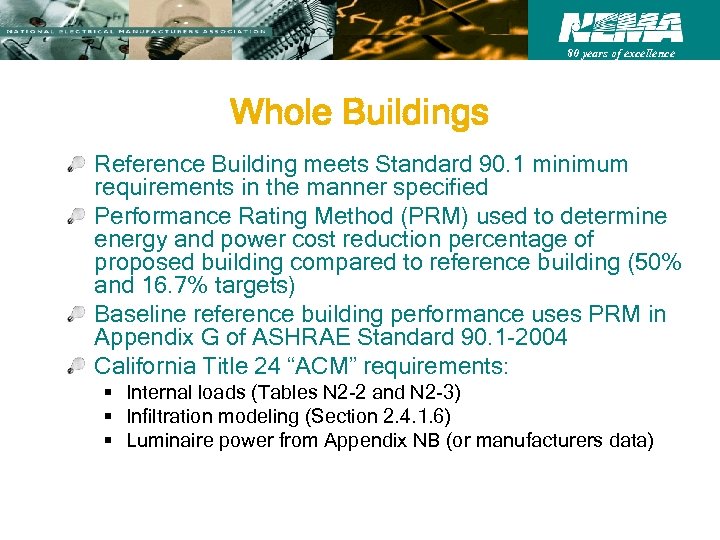
80 years of excellence Whole Buildings Reference Building meets Standard 90. 1 minimum requirements in the manner specified Performance Rating Method (PRM) used to determine energy and power cost reduction percentage of proposed building compared to reference building (50% and 16. 7% targets) Baseline reference building performance uses PRM in Appendix G of ASHRAE Standard 90. 1 -2004 California Title 24 “ACM” requirements: § Internal loads (Tables N 2 -2 and N 2 -3) § Infiltration modeling (Section 2. 4. 1. 6) § Luminaire power from Appendix NB (or manufacturers data)
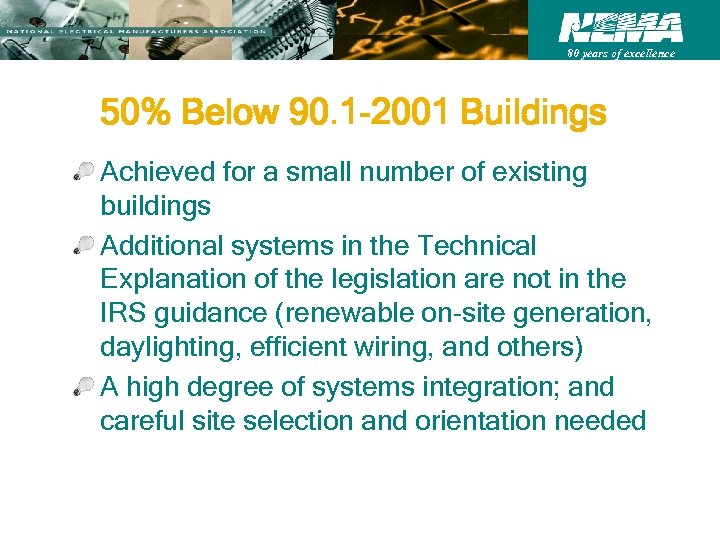
80 years of excellence 50% Below 90. 1 -2001 Buildings Achieved for a small number of existing buildings Additional systems in the Technical Explanation of the legislation are not in the IRS guidance (renewable on-site generation, daylighting, efficient wiring, and others) A high degree of systems integration; and careful site selection and orientation needed
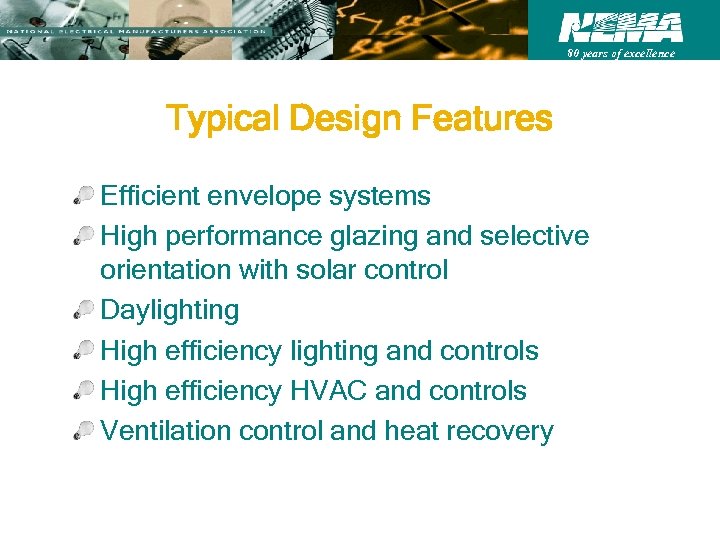
80 years of excellence Typical Design Features Efficient envelope systems High performance glazing and selective orientation with solar control Daylighting High efficiency lighting and controls High efficiency HVAC and controls Ventilation control and heat recovery
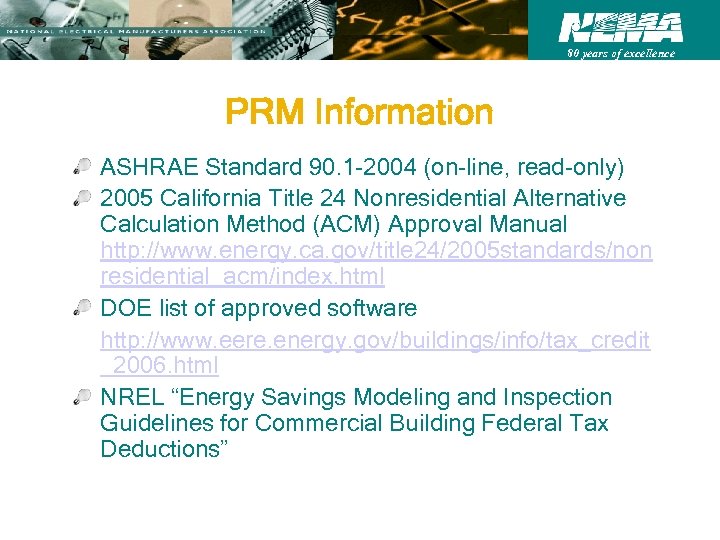
80 years of excellence PRM Information ASHRAE Standard 90. 1 -2004 (on-line, read-only) 2005 California Title 24 Nonresidential Alternative Calculation Method (ACM) Approval Manual http: //www. energy. ca. gov/title 24/2005 standards/non residential_acm/index. html DOE list of approved software http: //www. eere. energy. gov/buildings/info/tax_credit _2006. html NREL “Energy Savings Modeling and Inspection Guidelines for Commercial Building Federal Tax Deductions”
80 years of excellence EPAct 2005 System Deduction Provides for partial deduction for 3 major systems (lighting, HVAC/water heating, building envelope) that correspond to 50% reduction in building energy use IRS Notice 2006 -52 states that 16. 7% whole building savings are the system goal for each system Requires building modeling using certified software Software will be listed on a DOE website NEMA has commented that the reference building, from a lighting perspective, need only be based on the space use, LPD and square feet; it is not necessary to develop site specific references for lighting
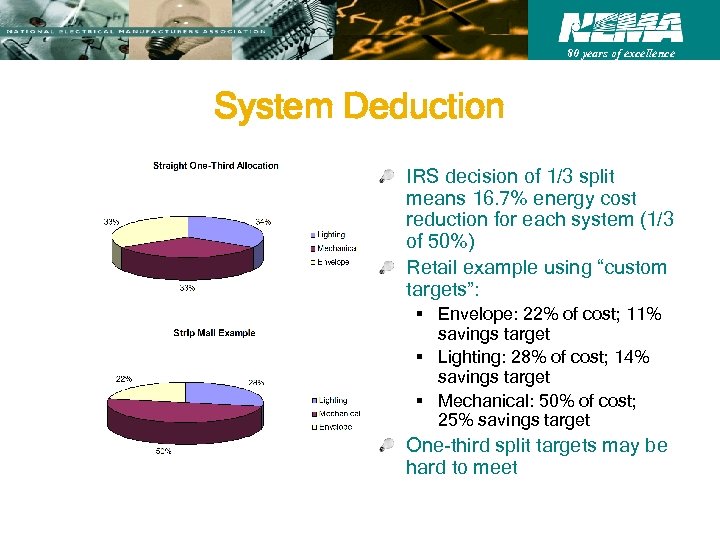
80 years of excellence System Deduction IRS decision of 1/3 split means 16. 7% energy cost reduction for each system (1/3 of 50%) Retail example using “custom targets”: § Envelope: 22% of cost; 11% savings target § Lighting: 28% of cost; 14% savings target § Mechanical: 50% of cost; 25% savings target One-third split targets may be hard to meet
80 years of excellence Interim Lighting Provision Until such time that final IRS rules are promulgated, lighting systems are eligible for a partial deduction. Key provisions: • Deduction is $0. 30 to $0. 60 for 25 to 40% under ASHRAE LPDs, respectively, from Table 9. 3. 1. 1 or 9. 3. 1. 2. “Use it or lose it” allowances are not to be considered in the LPD reduction • Warehouses must be 50% under to get $0. 60 (no sliding scale) • ASHRAE controls + “bi-level switching” required • Industry has asked that provision be made permanent as the lighting system deduction
80 years of excellence Continuing Actions Convene technical stakeholders group to resolve details of ASHRAE vs. California methods and reference building Extend tax provision (several bills already introduced in Congress) Determine if other provisions need legislative solutions Continue promotional program
80 years of excellence Further Information http: //www. efficientbuildings. org http: //www. lightingtaxdeduction. org http: //www. energytaxincentives. org/tiapcommercial-bldgs. html http: //www. advancedbuildings. net/
Vehicle Tax Incentives TIAP Webcast Therese Langer ACEEE Transportation Program July 21, 2006
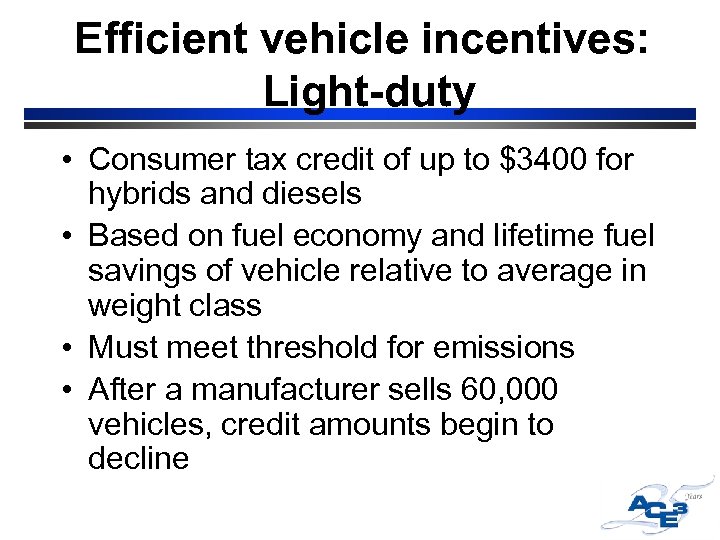
Efficient vehicle incentives: Light-duty • Consumer tax credit of up to $3400 for hybrids and diesels • Based on fuel economy and lifetime fuel savings of vehicle relative to average in weight class • Must meet threshold for emissions • After a manufacturer sells 60, 000 vehicles, credit amounts begin to decline
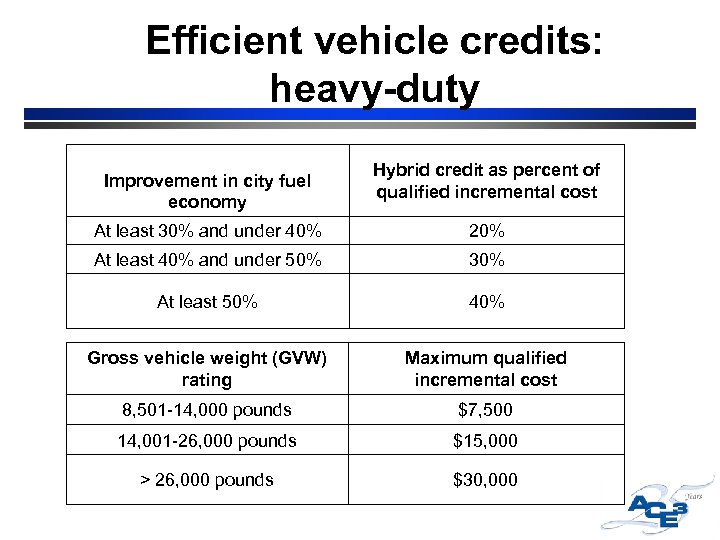
Efficient vehicle credits: heavy-duty Improvement in city fuel economy Hybrid credit as percent of qualified incremental cost At least 30% and under 40% At least 40% and under 50% 30% At least 50% 40% Gross vehicle weight (GVW) rating 20% Maximum qualified incremental cost 8, 501 -14, 000 pounds $7, 500 14, 001 -26, 000 pounds $15, 000 > 26, 000 pounds $30, 000
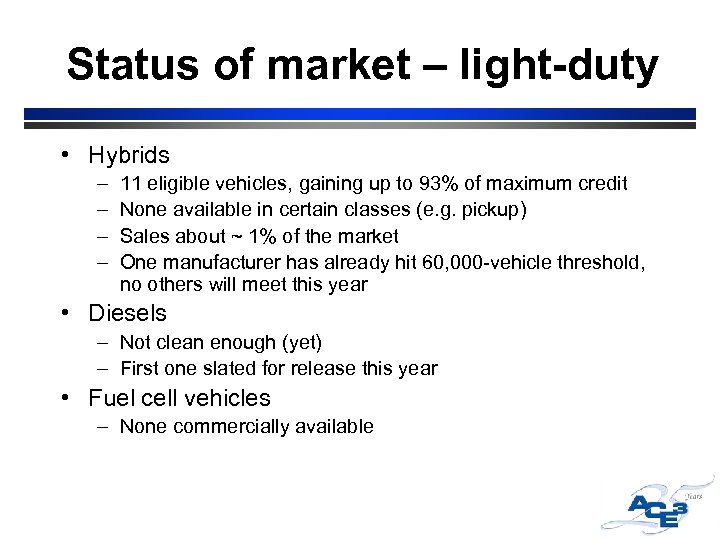
Status of market – light-duty • Hybrids – – 11 eligible vehicles, gaining up to 93% of maximum credit None available in certain classes (e. g. pickup) Sales about ~ 1% of the market One manufacturer has already hit 60, 000 -vehicle threshold, no others will meet this year • Diesels – Not clean enough (yet) – First one slated for release this year • Fuel cell vehicles – None commercially available
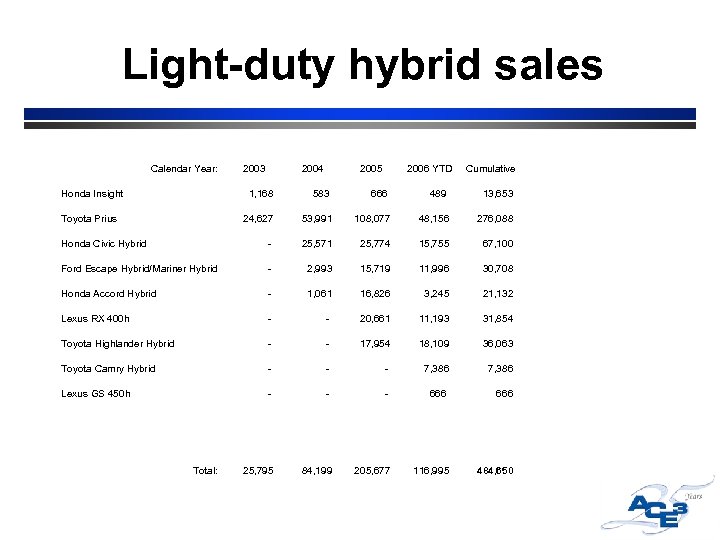
Light-duty hybrid sales Calendar Year: 2003 2004 2005 2006 YTD Cumulative Honda Insight 1, 168 583 666 489 13, 653 Toyota Prius 24, 627 53, 991 108, 077 48, 156 276, 088 Honda Civic Hybrid - 25, 571 25, 774 15, 755 67, 100 Ford Escape Hybrid/Mariner Hybrid - 2, 993 15, 719 11, 996 30, 708 Honda Accord Hybrid - 1, 061 16, 826 3, 245 21, 132 Lexus RX 400 h - 20, 661 11, 193 31, 854 Toyota Highlander Hybrid - 17, 954 18, 109 36, 063 Toyota Camry Hybrid - 7, 386 Lexus GS 450 h - 666 25, 795 84, 199 205, 677 116, 995 484, 650 Total:
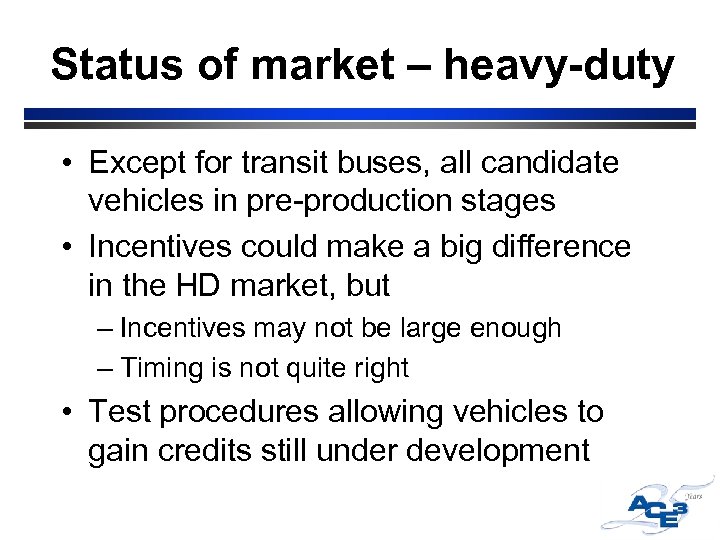
Status of market – heavy-duty • Except for transit buses, all candidate vehicles in pre-production stages • Incentives could make a big difference in the HD market, but – Incentives may not be large enough – Timing is not quite right • Test procedures allowing vehicles to gain credits still under development
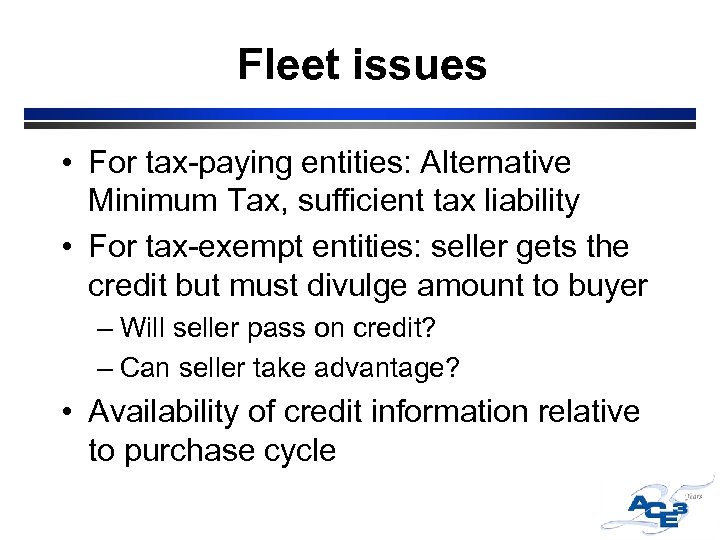
Fleet issues • For tax-paying entities: Alternative Minimum Tax, sufficient tax liability • For tax-exempt entities: seller gets the credit but must divulge amount to buyer – Will seller pass on credit? – Can seller take advantage? • Availability of credit information relative to purchase cycle
Fleet issues (cont. ) • For heavy-duty, most purchasers will be fleets and many, tax-exempt • First hybrid applications identified: transit buses, delivery trucks, waste haulers, and utility trucks • “Seller” will typically be the manufacturer; how does this affect efficacy of the credits?
Next steps • Light-duty – Find out how credits influence manufacturer production plans and in particular what limits domestic manufacturers’ interest – Improve fleet access to hybrids and test mechanism to accommodate tax-exempt purchasers and leasing
Next steps (cont. ) • Heavy-duty – Expedite test procedure adoption to reduce uncertainty re credit availability – Resolve tax-exempt, AMT issues – Extend credits?
Скачать презентацию RESNET New Homes Tax Credit TIAP Webinar Steve
c318e09736c63a975def2dc3b813d0aa.ppt