


 Скачать презентацию Resistance Is Futile Physics 2102 Spring 2007 Jonathan
afe65947e147f48ca4de39272329a76f.ppt
- Количество слайдов: 11
 Resistance Is Futile! Physics 2102 Spring 2007 Jonathan Dowling Lecture 14: FRI 13 FEB Current and Resistance Ch 26. 3– 7 Georg Simon Ohm (1789 -1854)
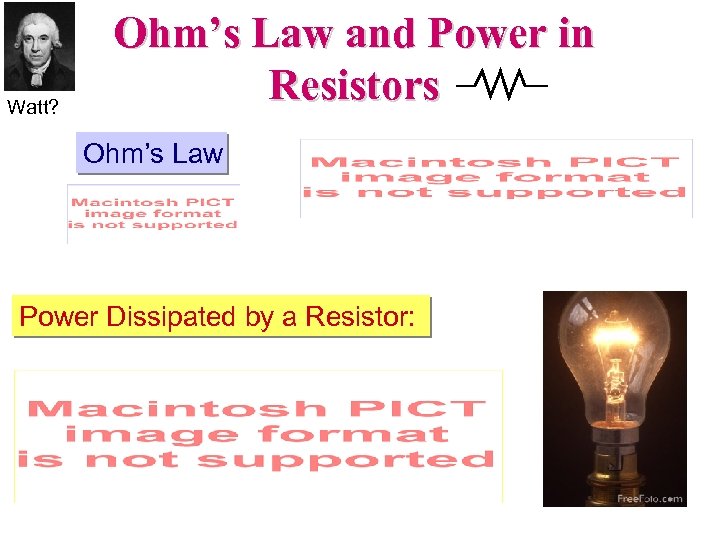 Watt? Ohm’s Law and Power in Resistors Ohm’s Law Power Dissipated by a Resistor:
![L A= r 2 A Current Density: J=i/A Units: [A/m 2] Resistance: R= L/A](https://present5.com/presentation/afe65947e147f48ca4de39272329a76f/image-3.jpg "L A= r 2 A Current Density: J=i/A Units: [A/m 2] Resistance: R= L/A") L A= r 2 A Current Density: J=i/A Units: [A/m 2] Resistance: R= L/A Resitivity: depends only on Material and Temperature. Units: [ • m]
L A= r 2 A Current Density: J=i/A Units: [A/m 2] Resistance: R= L/A Resitivity: depends only on Material and Temperature. Units: [ • m]
 Example A human being can be electrocuted if a current as small as i=100 m. A passes near the heart. An electrician working with sweaty hands makes good contact with the two conductors he is holding. If his resistance is R=1500 , what might the fatal voltage be? (Ans: 150 V) Use: V=i. R
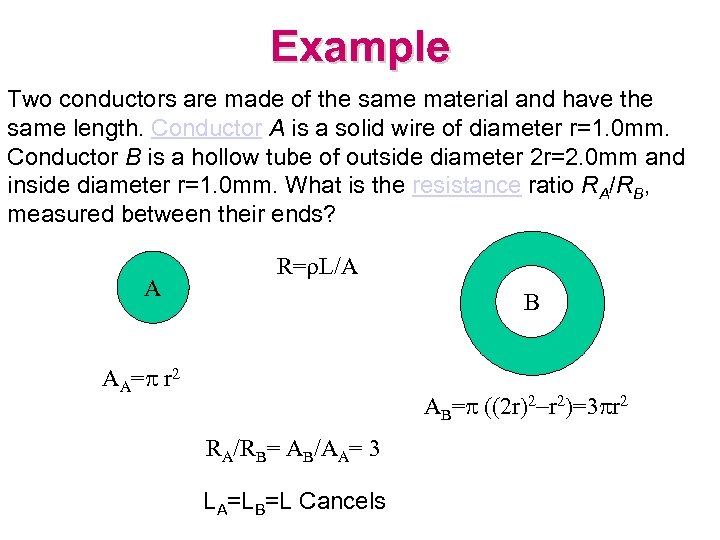 Example Two conductors are made of the same material and have the same length. Conductor A is a solid wire of diameter r=1. 0 mm. Conductor B is a hollow tube of outside diameter 2 r=2. 0 mm and inside diameter r=1. 0 mm. What is the resistance ratio RA/RB, measured between their ends? A R= L/A B AA= r 2 AB= ((2 r)2 -r 2)=3 r 2 RA/RB= AB/AA= 3 LA=LB=L Cancels
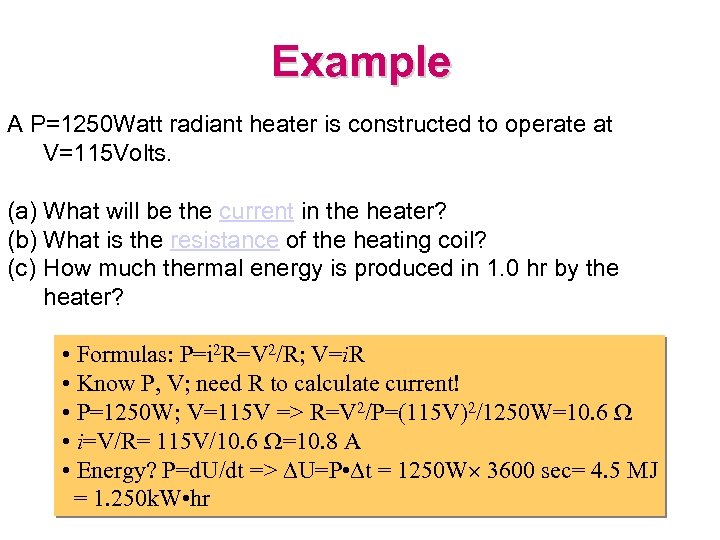 Example A P=1250 Watt radiant heater is constructed to operate at V=115 Volts. (a) What will be the current in the heater? (b) What is the resistance of the heating coil? (c) How much thermal energy is produced in 1. 0 hr by the heater? • Formulas: P=i 2 R=V 2/R; V=i. R • Know P, V; need R to calculate current! • P=1250 W; V=115 V => R=V 2/P=(115 V)2/1250 W=10. 6 • i=V/R= 115 V/10. 6 =10. 8 A • Energy? P=d. U/dt => U=P • t = 1250 W 3600 sec= 4. 5 MJ = 1. 250 k. W • hr
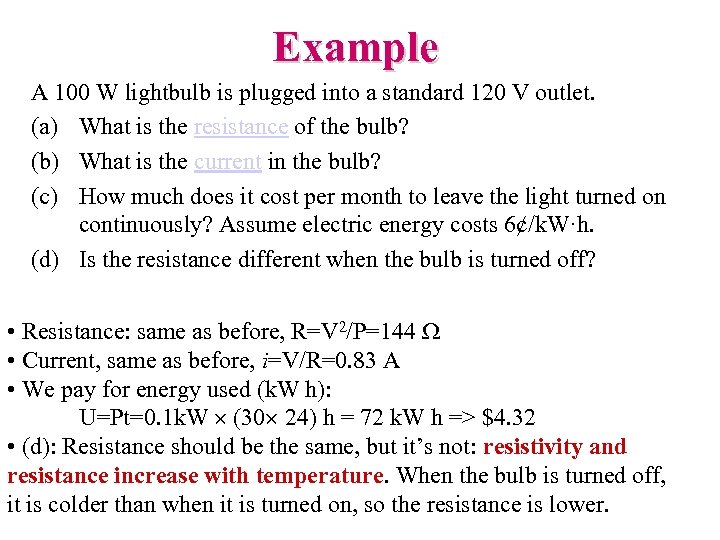 Example A 100 W lightbulb is plugged into a standard 120 V outlet. (a) What is the resistance of the bulb? (b) What is the current in the bulb? (c) How much does it cost per month to leave the light turned on continuously? Assume electric energy costs 6¢/k. W·h. (d) Is the resistance different when the bulb is turned off? • Resistance: same as before, R=V 2/P=144 • Current, same as before, i=V/R=0. 83 A • We pay for energy used (k. W h): U=Pt=0. 1 k. W (30 24) h = 72 k. W h => $4. 32 • (d): Resistance should be the same, but it’s not: resistivity and resistance increase with temperature. When the bulb is turned off, it is colder than when it is turned on, so the resistance is lower.
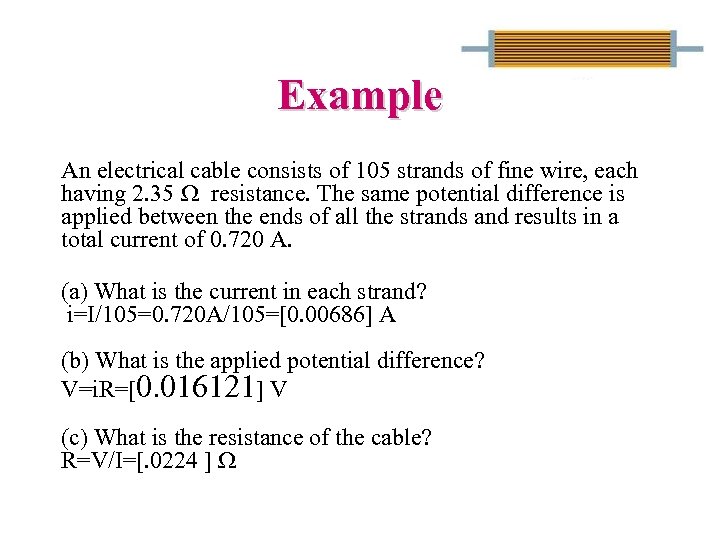 Example An electrical cable consists of 105 strands of fine wire, each having 2. 35 resistance. The same potential difference is applied between the ends of all the strands and results in a total current of 0. 720 A. (a) What is the current in each strand? i=I/105=0. 720 A/105=[0. 00686] A (b) What is the applied potential difference? V=i. R=[0. 016121] V (c) What is the resistance of the cable? R=V/I=[. 0224 ]
 i V P = i. V U = Pt t in seconds V i P = i. V [J/s is Watt] P = i. V [Watt is J/s]
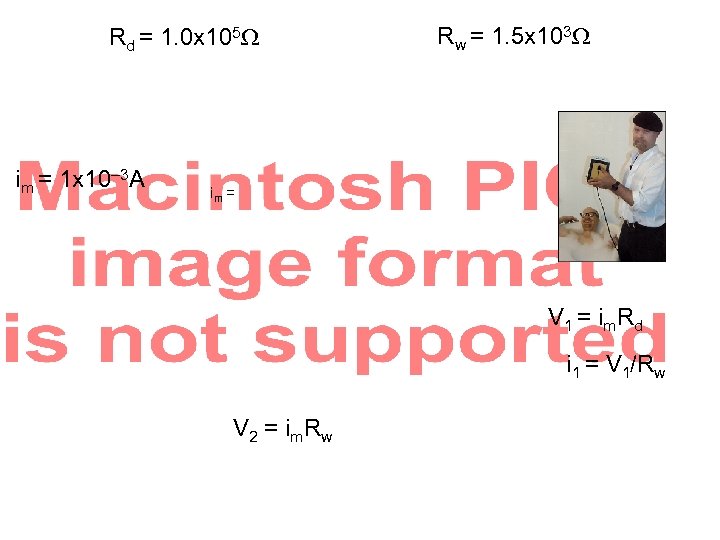 Rd = 1. 0 x 105 im = 1 x 10– 3 A Rw = 1. 5 x 10³ im = V 1 = im. Rd i 1 = V 1/Rw V 2 = im. Rw
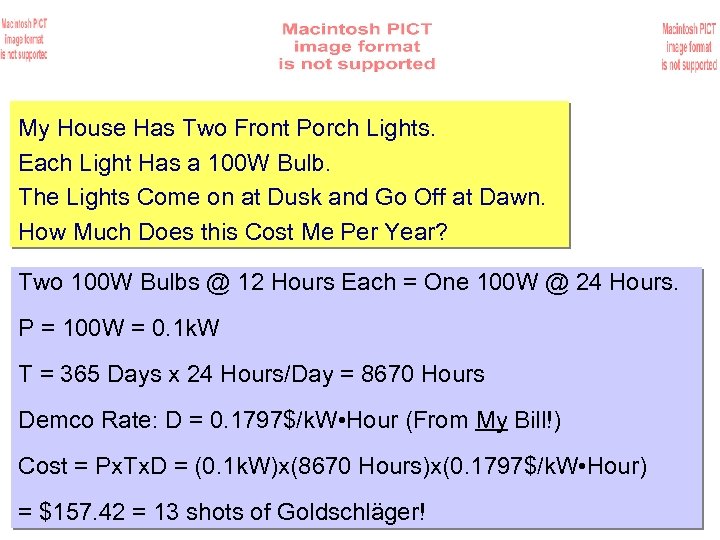 My House Has Two Front Porch Lights. Each Light Has a 100 W Bulb. The Lights Come on at Dusk and Go Off at Dawn. How Much Does this Cost Me Per Year? Two 100 W Bulbs @ 12 Hours Each = One 100 W @ 24 Hours. P = 100 W = 0. 1 k. W T = 365 Days x 24 Hours/Day = 8670 Hours Demco Rate: D = 0. 1797$/k. W • Hour (From My Bill!) Cost = Px. Tx. D = (0. 1 k. W)x(8670 Hours)x(0. 1797$/k. W • Hour) = $157. 42 = 13 shots of Goldschläger!