 Скачать презентацию Residential Reporting Hitting All of the Bases Chapter
3b1338f2bca4984bb242e7711cf0e266.ppt
- Количество слайдов: 68



Residential Reporting: Hitting All of the Bases Chapter 5 Common Issues in Appraisal Reporting Hondros Learning, © 2011 1
Residential Reporting: Hitting All of the Bases Chapter 5: Key Terms § Bracketing A process in which an appraiser identifies comparable data that is inferior and superior to the subject data. The appraiser then determines where to apply the indications within that range. § Gross Rent Multiplier (GRM) A factor derived from comparable rental data, which is then used to develop an opinion of value of the subject property. Hondros Learning, © 2011 2
Residential Reporting: Hitting All of the Bases Chapter 5: Key Terms § Market Rent What the subject property could rent for in the open market if currently vacant and available. § Paired Data Analysis The process of determining the value of specific property characteristics or features by comparing pairs of similar properties. Also called Matched Pair Analysis. Hondros Learning, © 2011 3
Residential Reporting: Hitting All of the Bases Chapter 5: Key Terms § Regression Analysis A statistical measure that attempts to ascertain the source of change in variables. § Transition A complete change of land use. Hondros Learning, © 2011 4
Residential Reporting: Hitting All of the Bases Introduction § This chapter will focus on two specific appraisal reporting issues and will be the topic of discussion in context of USPAP compliance and in observance of best practices. § A brief discussion of client direction and instruction in the reporting process § The discussion then turns to illustrate five of the most common reporting issues and how they should be handled in appraisal reporting Hondros Learning, © 2011 5
Residential Reporting: Hitting All of the Bases Client Direction § Most often these particular specifications or requests come in the form of assignment conditions—diligence over and above what might be required by USPAP § Additional specifications present themselves as requirements § There may be other requests or specifications that are not ethical or permitted by professional standards § This is where an appraiser must be vigilant, remaining steadfast by not accepting an assignment that is accompanied by unacceptable assignment conditions. Hondros Learning, © 2011 6
Residential Reporting: Hitting All of the Bases Client Direction (cont. ) § Some common examples of clearly, or potentially, unacceptable assignment conditions: § Not report a specific fact about the property, such as the actual zoning designation, zoning regulations, or zoning status or the property (or to state it differently than it is) § Not report a property defect or a highest and best use other than its current improved use § Misrepresent the property improvements as something they are not, such as report an obvious two-family property as a single-family property § Not include any adverse external conditions in the commentary or in photographs, such as an objectionable non-residential use (continues) Hondros Learning, © 2011 7
Residential Reporting: Hitting All of the Bases Client Direction (cont. ) § Not mention functional issues of the subject property, such as non-market acceptable floor plans or a unique design § Not make adjustments in the sales comparison approach, even when warranted § Make adjustments in the sales comparison approach, even when not warranted § Only report that the subject site contains a land area or dimensions that differ from its actual description, and not mention the remaining land area in the report Hondros Learning, © 2011 8
Residential Reporting: Hitting All of the Bases Client Direction (cont. ) § Appraisal reporting should present a true and precise picture of the property that is the subject of the assignment § Facts regarding the property should never be fraudulent, or for that matter, sugar-coated Hondros Learning, © 2011 9
Residential Reporting: Hitting All of the Bases Five Critical Reporting Issues 1. Failure to disclose and discuss physical deterioration and functional obsolescence 2. Failure to disclose and discuss locational issues or external obsolescence 3. Failure to adequately disclose and discuss prior sales and relevance 4. Failure to discuss the support for adjustments, or for not making adjustments in the sales comparison approach 5. Failure to adequately discuss how market rent potential and rates of capitalization were established Hondros Learning, © 2011 10
Residential Reporting: Hitting All of the Bases Issue #1—Failure to Disclose and Discuss Physical Deterioration and Functional Obsolescence § Physical deterioration is something to do with the condition of the structure, while functional obsolescence pertains to something about the design or functional acceptability of the structure. § Failure to provide a true picture of these characteristics will result in a misleading, or in some cases, a fraudulent appraisal report. Hondros Learning, © 2011 11
Residential Reporting: Hitting All of the Bases Chapter 5: Case Example § A residential dwelling is approximately 45 years old. The exterior had vinyl siding installed only on the front portion of the structure about three (3) years ago, while the sides and rear of the house have significant chipping and peeling paint, with much exposed wood siding and paint chip residue present on the ground. Four windows in the front of the house received insulated tilt-out replacement windows when the siding was installed. The remaining windows on the sides and rear are the original single-pane wood windows, which are deteriorating. (continues) Hondros Learning, © 2011 12
Residential Reporting: Hitting All of the Bases Chapter 5: Case Example (cont. ) § Inside, all rooms were repainted in the past six months. However, the bedrooms and living room are painted black, and the bath and kitchen are bright mustard yellow. The floor covering in the kitchen was removed, evidently some time ago, and only has the particle board subfloor exposed. The furnace was removed three months ago and a new furnace is in the box and sitting on the covered patio at the rear of the dwelling. (continues) Hondros Learning, © 2011 13
Residential Reporting: Hitting All of the Bases Chapter 5: Case Example (cont. ) § This is the appraiser’s commentary regarding the physical and functional characteristics… § The dwelling is approximately 45 years of age; however, the structure has undergone extensive renovations. The exterior recently received new vinyl siding and insulated tilt-out replacement windows. The interior has recently been redecorated in a contemporary color scheme. Kitchen floor coverings were in the process of being replaced at the time of the inspection. The furnace is also new. Hondros Learning, © 2011 14
Residential Reporting: Hitting All of the Bases Chapter 5: Case Study (cont. ) Acceptable narrative commentary might be: The subject’s dwelling is approximately 45 years of age. Portions of the exterior had been updated. On the front of the house, the vinyl siding had been replaced and the single-pane windows were replaced with tilt-out windows three years ago. However, the sides and rear of the structure did not receive those updates. Those areas still have the original painted wood siding and single-pane wood windows. Conditions were noted concerning significant chipping and peeling of those painted surfaces and paint chip residue on the ground. Also noted were the deteriorating wood windows. (continues) Hondros Learning, © 2011 15
Residential Reporting: Hitting All of the Bases Chapter 5: Case Study (cont. ) The interior of the structure was painted in the past six months. However, the living room and bedrooms are black, with the kitchen and bath painted in a bright shade of yellow. The color scheme will likely meet with market resistance. The kitchen floor covering has been removed, and a particle board subflooring serves as the primary floor surface, which will likely also affect marketability. The furnace serving the dwelling had been removed, which per the owner, was three months ago. A new furnace was on-site in its packing carton, stored on the rear covered patio. The replacement furnace is a chattel and has not been included in the value analysis. Note: Depending on the assignment conditions, the furnace or other conditions noted here could be valued “subject to completion or repair” (using a hypothetical condition). Hondros Learning, © 2011 16
Residential Reporting: Hitting All of the Bases Issue #2 - Failure to Disclose and Discuss Locational Issues or External Obsolescence § External obsolescence, also discussed in Chapter 2, reflects conditions outside a property’s boundaries and can present itself due to locational conditions that are objectionable to market participants § This is not as common with residential properties but might present itself with a property that is over-improved in comparison to properties surrounding it, or if the property is located in an area of transition, which is a complete change of land use Hondros Learning, © 2011 17
Residential Reporting: Hitting All of the Bases Chapter 5: Case Example § A single-family subject property is situated across the street from a chemical distribution plant. The side of the street on which the subject is situated consists of all residential homes. There also residential homes on each side of the chemical distribution plant. A rail line runs behind the chemical distribution plant and the houses on each side of it. In addition to a continuous odor emitting from the facility, heavy truck traffic proceeding in and out of the facility is constant— 24 hours per day. A freeway entrance ramp is at the end of the street, about 300 yards from the subject property. Properties in this particular block have consistently experienced lengthy marketing periods and a significant impact on selling prices. (continues) Hondros Learning, © 2011 18
Residential Reporting: Hitting All of the Bases Chapter 5: Case Example (cont. ) § This is the appraiser’s commentary regarding the external characteristics… § The subject property is located on a street that predominately consists of single-family residential dwellings with a mix of non-residential uses typical for the immediate area. Access of the area is considered to be good with convenient access to various modes of transportation and highways. Hondros Learning, © 2011 19
Residential Reporting: Hitting All of the Bases Chapter 5: Case Example (cont. ) Acceptable narrative commentary might be: The subject property is located across from a chemical distribution facility that produces a continuous odor and heavy truck traffic to and from the facility 24 hours per day. The side of the street on which the subject is located consists of residential dwellings. Residential dwellings are also located on each side of the chemical distribution facility. In addition, a rail line runs behind the distribution facility and to the rear of the houses on the opposite side of the street from the subject. A freeway entrance ramp is located approximately 300 yards from the subject at the end of the street. Properties in this particular block have historically experienced lengthy marketing periods with significant impact on selling prices. The value of the subject is considered to be influenced by external obsolescence. Hondros Learning, © 2011 20
Residential Reporting: Hitting All of the Bases Issue #3 - Failure to Adequately Disclose and Discuss Prior Sales and Relevance § All reporting options permitted by USPAP require a summary of the results of analyzing the subject sales, options, and listings in accordance with Standards Rule 1 -5. § If the information is unobtainable, a statement on the efforts undertaken by the appraiser to obtain the information is required. § If the information is irrelevant, a statement acknowledging the existence of the information and citing its lack of relevance is required (continues) Hondros Learning, © 2011 21
Residential Reporting: Hitting All of the Bases Issue #3 - Failure to Adequately Disclose and Discuss Prior Sales and Relevance (cont. ) § The portion of Standards Rule 1 -5, which is referenced in the preceding reporting obligation, applies to: § All agreements of sale § Options § Listings of the subject property, current as of the effective date of the appraisal § All sales of the subject property that occurred within the three (3) years prior to the effective date of the appraisal Hondros Learning, © 2011 22
Residential Reporting: Hitting All of the Bases Issue #3 - Failure to Adequately Disclose and Discuss Prior Sales and Relevance (cont. ) § Per USPAP Advisory Opinion 4, reporting of foreclosure sales and voluntary deeds in lieu of foreclosure is required and are considered sales. § The obligation for reporting other casual transfers, such as those between family members, etc. which are not arms-length, is not specifically addressed, but those transfers, in most cases, would likely not be relevant. However, these transfers should still be reported as such, and the lack of relevance noted. Hondros Learning, © 2011 23
Residential Reporting: Hitting All of the Bases Chapter 5: Case Example § A residential property is being appraised for the purpose of developing an opinion of market value for use by a lender client for mortgage financing in a purchase transaction. The purchase price in the current agreement to sell is $245, 000. The property transferred to the seller in the current transaction, James Green, two (2) months ago. No sale price was declared as the transfer was part of an estate with Mr. Green inheriting the property from his late uncle, John Frank. Another transfer occurred one (1) year prior – which was a transfer via a foreclosure sale. In this transaction, the late Mr. Frank purchased the property at a Sheriff’s auction for $105, 000. According to Mr. Green, the late Mr. Frank spent approximately $110, 000 renovating the property, which was in a distressed condition when he acquired it. Hondros Learning, © 2011 24
Residential Reporting: Hitting All of the Bases Chapter 5: Case Example (cont. ) § This is the appraiser’s commentary regarding the prior sales history of the subject property… § No arm’s-length transactions of the subject property were found in the three (3) years previous to the effective date of this appraisal. Hondros Learning, © 2011 25
Residential Reporting: Hitting All of the Bases Chapter 5: Case Example (cont. ) Acceptable narrative commentary might be: The current seller acquired the property two months ago as an inherited property from an estate. A previous transfer one year ago was via a Sherriff’s auction with a declared sales price of $105, 000. According to the seller in the current transaction, the individual in that transaction spent approximately $110, 000 renovating the property after acquisition. None of the transfers are considered arms-length, and therefore, are not indicative of market value. Hondros Learning, © 2011 26
Residential Reporting: Hitting All of the Bases Issue #4 - Failure to Discuss the Support for Adjustments or For Not Making Adjustments in the Sales Comparison Approach § The necessity for discussing the adjustments, or for not making adjustments in the sales comparison approach are integral with Standards Rule 2 -2(a)(viii), which (in part) obligates the appraiser to summarize the information analyzed, the appraisal methods and techniques employed, and the reasoning that supports the analyses, opinions, and conclusions. § For Restricted Appraisal Reports—Standards Rule 2 -2(b)(viii) requires only that the appraisal methods and techniques employed must be stated. Hondros Learning, © 2011 27
Residential Reporting: Hitting All of the Bases Issue #4 - Failure to Discuss the Support for Adjustments or For Not Making Adjustments in the Sales Comparison Approach (cont. ) § At a minimum, the appraisal report should discuss, at the appropriate level, the: § Methodology used for deriving adjustments and the necessity of doing so. § Rationale for not making an adjustment when there is a difference. Hondros Learning, © 2011 28
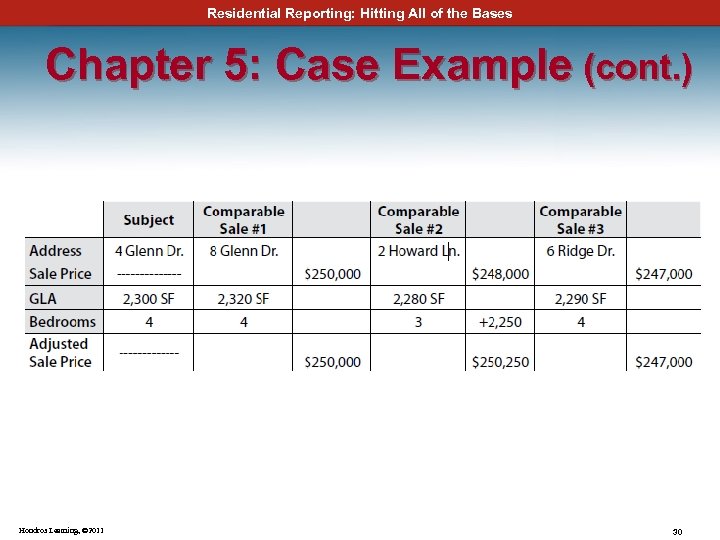
Residential Reporting: Hitting All of the Bases Chapter 5: Case Example § A 4 -bedroom residential dwelling is being appraised, which contains 2, 300 square feet of gross living area. Three comparable properties have been chosen, one which has 3 -bedrooms. All of properties have slightly differing gross living area than the subject. It is noted that the appraiser has applied an adjustment for the difference for the fourth bedroom for Comparable Sale #2 at $2, 250. No adjustments have been applied for the slight differences in gross living area. (continues) Hondros Learning, © 2011 29
Residential Reporting: Hitting All of the Bases Chapter 5: Case Example (cont. ) Hondros Learning, © 2011 30
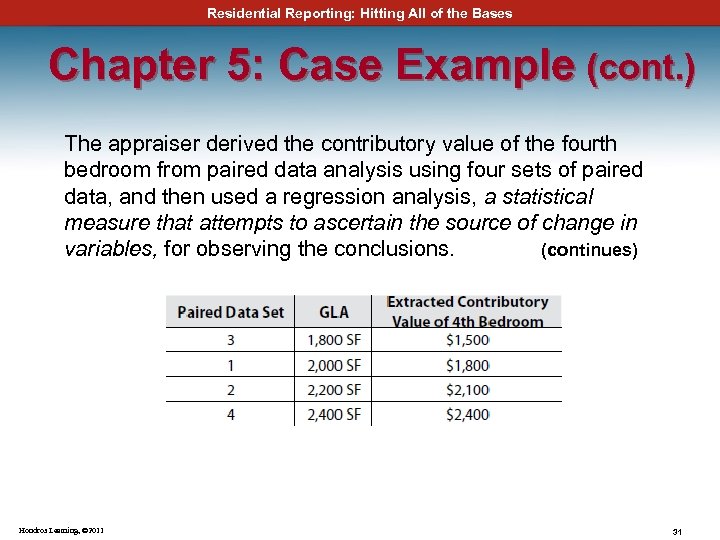
Residential Reporting: Hitting All of the Bases Chapter 5: Case Example (cont. ) The appraiser derived the contributory value of the fourth bedroom from paired data analysis using four sets of paired data, and then used a regression analysis, a statistical measure that attempts to ascertain the source of change in variables, for observing the conclusions. (continues) Hondros Learning, © 2011 31
Residential Reporting: Hitting All of the Bases Chapter 5: Case Example (cont. ) § The appraiser observed that since the subject property contained 2, 300 square feet of gross living area, the indicated support was at the halfway point between the conclusions of paired data set #2 and #4, which contained 2, 200 square feet and 2, 400 square feet, respectively. Thus, the appraiser’s conclusion for application to the subject was bracketed between the $2, 100 and $2, 400 contributory value indication as $2, 250. Bracketing, in this case, is demonstrated by the value indications that are superior and inferior to the subject, with the subject’s relevance positioned in between. § For the gross living area (GLA), the appraiser’s analysis indicated that small differences are not typically recognized by the market, and therefore no adjustment was required. Hondros Learning, © 2011 32
Residential Reporting: Hitting All of the Bases Chapter 5: Case Example (cont. ) § The appraiser offered no comments regarding the bedroom adjustment or the lack of an adjustment for differences in gross living area. Hondros Learning, © 2011 33
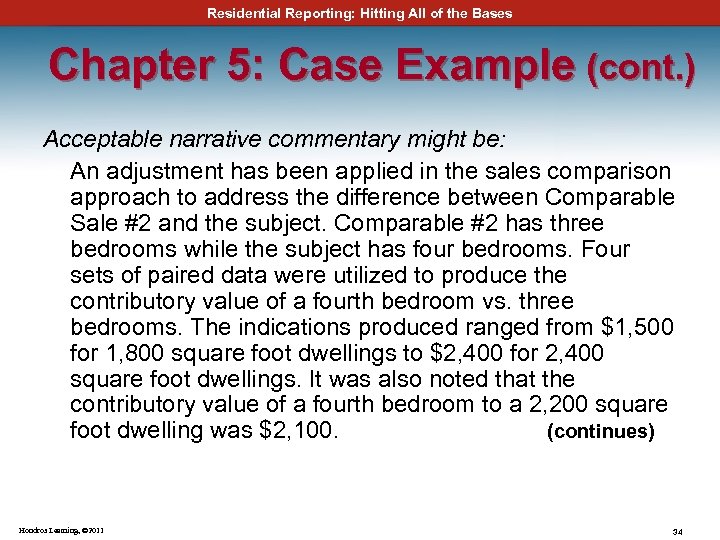
Residential Reporting: Hitting All of the Bases Chapter 5: Case Example (cont. ) Acceptable narrative commentary might be: An adjustment has been applied in the sales comparison approach to address the difference between Comparable Sale #2 and the subject. Comparable #2 has three bedrooms while the subject has four bedrooms. Four sets of paired data were utilized to produce the contributory value of a fourth bedroom vs. three bedrooms. The indications produced ranged from $1, 500 for 1, 800 square foot dwellings to $2, 400 for 2, 400 square foot dwellings. It was also noted that the contributory value of a fourth bedroom to a 2, 200 square foot dwelling was $2, 100. (continues) Hondros Learning, © 2011 34
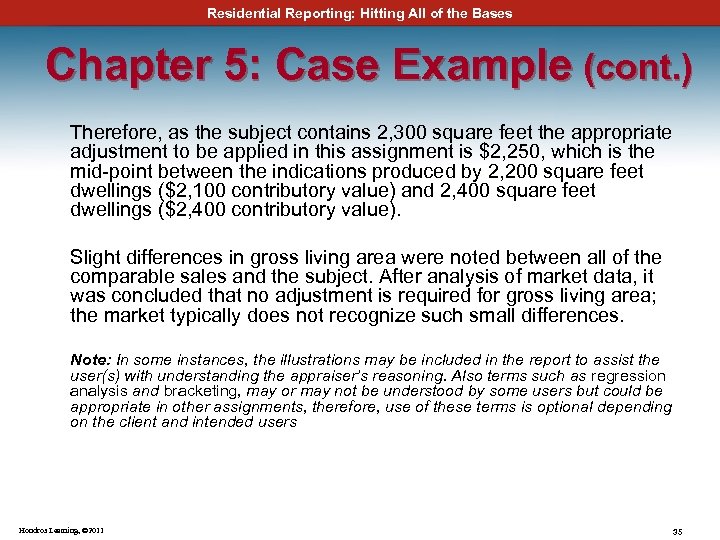
Residential Reporting: Hitting All of the Bases Chapter 5: Case Example (cont. ) Therefore, as the subject contains 2, 300 square feet the appropriate adjustment to be applied in this assignment is $2, 250, which is the mid-point between the indications produced by 2, 200 square feet dwellings ($2, 100 contributory value) and 2, 400 square feet dwellings ($2, 400 contributory value). Slight differences in gross living area were noted between all of the comparable sales and the subject. After analysis of market data, it was concluded that no adjustment is required for gross living area; the market typically does not recognize such small differences. Note: In some instances, the illustrations may be included in the report to assist the user(s) with understanding the appraiser’s reasoning. Also terms such as regression analysis and bracketing, may or may not be understood by some users but could be appropriate in other assignments, therefore, use of these terms is optional depending on the client and intended users Hondros Learning, © 2011 35
Residential Reporting: Hitting All of the Bases Issue #5 - Failure to Adequately Discuss How Market Rent Potential and Rates of Capitalization Were Established § When an income approach is necessary for credible assignment results, most residential appraisals employ the gross rent multiplier (GRM) technique of monthly market rent. The commentary for the income approach should include: § Information regarding the quality and quantity of data that was analyzed to determine market level rent; and the indications produced by the data, including the reasoning of the appraiser for the data chosen for analysis as well as his conclusions § How and why the market level rent concluded by the appraiser differs (or is similar to) the contract rent of the subject property § Methodology employed to derive a market level rate of capitalization to be used in the approach (typically a GRM or an overall capitalization rate) Hondros Learning, © 2011 36
Residential Reporting: Hitting All of the Bases Chapter 5: Case Example § A 3 -bedroom, single-family rental property is the subject of an appraisal. The subject property contains 1, 150 square feet, is equipped with central air-conditioning, and has a 1 -car detached garage. The appraiser has estimated monthly market rent of the subject at $600 and derived a GRM of 123. 34 to be applied in the assignment from the following data chart. Hondros Learning, © 2011 37
Residential Reporting: Hitting All of the Bases Chapter 5: Case Example (cont. ) Hondros Learning, © 2011 38
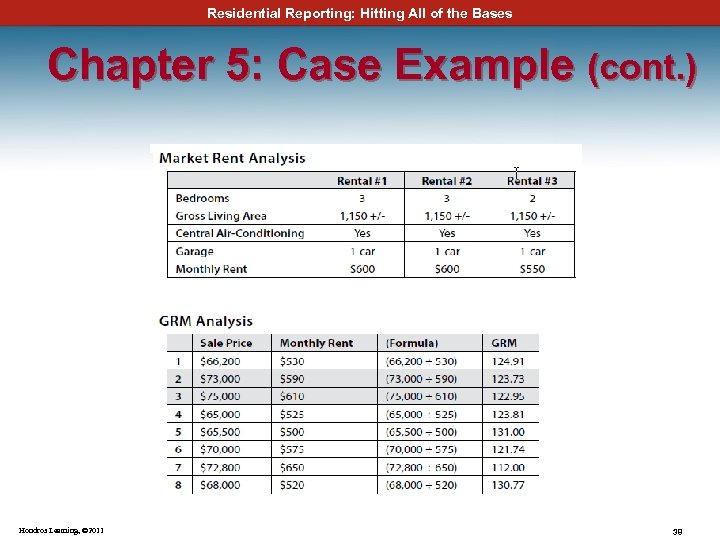
Residential Reporting: Hitting All of the Bases Chapter 5: Case Example (cont. ) § The appraiser’s analysis concluded that $600 per month was a reasonable market rental rate for 3 -bedroom dwellings, which have all other similarities with the subject (note the 2 -bedroom rental at $550), and 123. 34 was a reasonable GRM to be applied based on the data bracketing the subject’s estimated market rent. § (The value conclusion of the income approach was $74, 000 [123. 34 x $600], which is also bracketed within the sales analyzed. ) Hondros Learning, © 2011 39
Residential Reporting: Hitting All of the Bases Chapter 5: Case Example (cont. ) § The appraiser’s commentary regarding the summary of the income approach in support of the market rent and GRM used in the approach… § Market rent of the subject was estimated to be $600. A GRM of 123. 34 was deemed applicable. Hondros Learning, © 2011 40
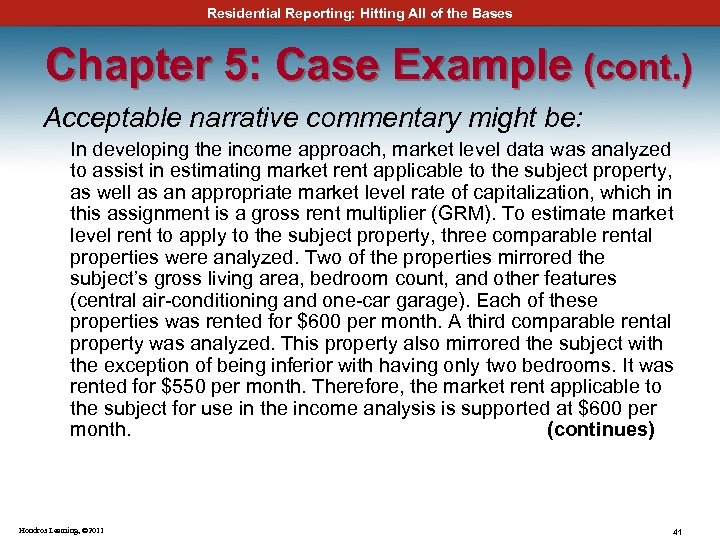
Residential Reporting: Hitting All of the Bases Chapter 5: Case Example (cont. ) Acceptable narrative commentary might be: In developing the income approach, market level data was analyzed to assist in estimating market rent applicable to the subject property, as well as an appropriate market level rate of capitalization, which in this assignment is a gross rent multiplier (GRM). To estimate market level rent to apply to the subject property, three comparable rental properties were analyzed. Two of the properties mirrored the subject’s gross living area, bedroom count, and other features (central air-conditioning and one-car garage). Each of these properties was rented for $600 per month. A third comparable rental property was analyzed. This property also mirrored the subject with the exception of being inferior with having only two bedrooms. It was rented for $550 per month. Therefore, the market rent applicable to the subject for use in the income analysis is supported at $600 per month. (continues) Hondros Learning, © 2011 41
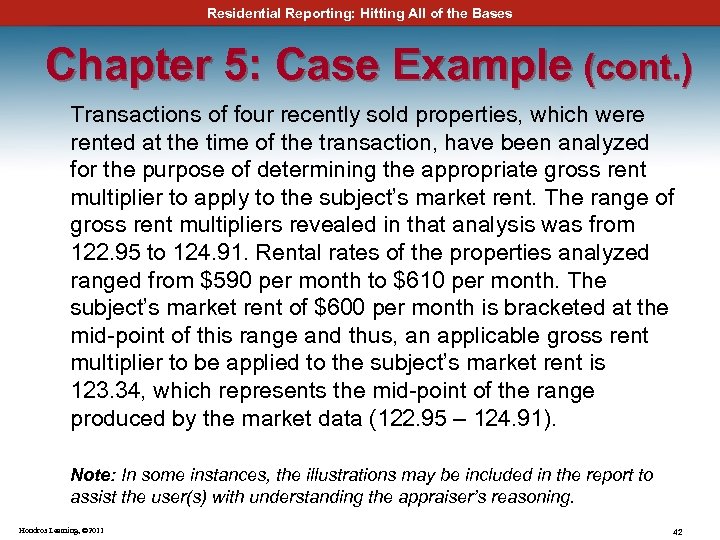
Residential Reporting: Hitting All of the Bases Chapter 5: Case Example (cont. ) Transactions of four recently sold properties, which were rented at the time of the transaction, have been analyzed for the purpose of determining the appropriate gross rent multiplier to apply to the subject’s market rent. The range of gross rent multipliers revealed in that analysis was from 122. 95 to 124. 91. Rental rates of the properties analyzed ranged from $590 per month to $610 per month. The subject’s market rent of $600 per month is bracketed at the mid-point of this range and thus, an applicable gross rent multiplier to be applied to the subject’s market rent is 123. 34, which represents the mid-point of the range produced by the market data (122. 95 – 124. 91). Note: In some instances, the illustrations may be included in the report to assist the user(s) with understanding the appraiser’s reasoning. Hondros Learning, © 2011 42
Residential Reporting: Hitting All of the Bases Chapter 5: Summary 1. The client may have certain requests regarding the appraisal report issued by a particular appraiser in a specific assignment, which are typical and part of many appraisal assignments, and therefore not an issue of concern. However, an appraiser must be vigilant and remain steadfast by not accepting an assignment that is accompanied by unacceptable assignment conditions. Hondros Learning, © 2011 43
Residential Reporting: Hitting All of the Bases Chapter 5: Summary 2. Appraisal reporting should present a true and precise picture of the property that is the subject of the assignment. The appraiser is doing a disservice to himself and to all involved when an appraisal report is misleading, and is participating in criminal activity when the report is fraudulent. Hondros Learning, © 2011 44
Residential Reporting: Hitting All of the Bases Chapter 5: Summary 3. Failure to provide a true picture of the physical and functional characteristics of a property of locational issues or external obsolescence will result in a misleading, or in some cases, a fraudulent appraisal report. Hondros Learning, © 2011 45
Residential Reporting: Hitting All of the Bases Chapter 5: Summary 4. Both reporting options permitted by USPAP, in a market value assignment, require a summary of the results of analyzing the subject sales, options, and listings in accordance with Standards Rule 1 -5. If the information is unobtainable, a statement on the efforts undertaken by the appraiser to obtain the information is required. If the information is irrelevant, a statement acknowledging the existence of the information and citing its lack of relevance is required. This also applies to all agreements of sale, options, and listings of the subject property current as of the effective date of the appraisal; and all sales of the subject property that occurred within the three (3) years prior to the effective date of the appraisal. Hondros Learning, © 2011 46
Residential Reporting: Hitting All of the Bases Chapter 5: Summary 5. When discussing the rationale in support of why and how an adjustment was derived and applied, as well as the reasoning supporting why an adjustment was not applied, an appraiser must discuss, at the appropriate level, the methodology used for deriving adjustments and the necessity of doing so; and discuss, at the appropriate level, the rationale for not making an adjustment when there is a difference. Hondros Learning, © 2011 47
Residential Reporting: Hitting All of the Bases Chapter 5: Summary 6. When an income approach is necessary for credible assignment results, most residential appraisals employ the gross rent multiplier (GRM) technique using monthly market rent. The commentary for the income approach should include information regarding the data that was analyzed and the indications produced by the data, including the reasoning of the appraiser for his conclusion of market level rent; and how and why the market level rent concluded by the appraiser differs (or is similar to) the contract rent of the subject property, as well as the methodology employed to derive a market level rate of capitalization to be used in the approach. Hondros Learning, © 2011 48
Residential Reporting: Hitting All of the Bases Chapter 5: Quiz 1. If a client requests additional exhibits, photographs, maps, and other documentation be included in an appraisal report, the request should be considered a. a reasonable and typical request. b. an unacceptable assignment condition. c. as a challenge to an appraiser’s objectivity and independence. d. contrary to the ETHICS RULE of USPAP. Hondros Learning, © 2011 49
Residential Reporting: Hitting All of the Bases Chapter 5: Quiz 1. If a client requests additional exhibits, photographs, maps, and other documentation be included in an appraisal report, the request should be considered a. a reasonable and typical request. b. an unacceptable assignment condition. c. as a challenge to an appraiser’s objectivity and independence. d. contrary to the ETHICS RULE of USPAP. Hondros Learning, © 2011 50
Residential Reporting: Hitting All of the Bases Chapter 5: Quiz 2. Advisory Opinion 19, which is bound with USPAP, addresses a. b. c. d. Hondros Learning, © 2011 deriving a gross rent multiplier. reporting options permitted by USPAP. unacceptable assignment conditions. updating an appraisal report. 51
Residential Reporting: Hitting All of the Bases Chapter 5: Quiz 2. Advisory Opinion 19, which is bound with USPAP, addresses a. b. c. d. Hondros Learning, © 2011 deriving a gross rent multiplier. reporting options permitted by USPAP. unacceptable assignment conditions. updating an appraisal report. 52
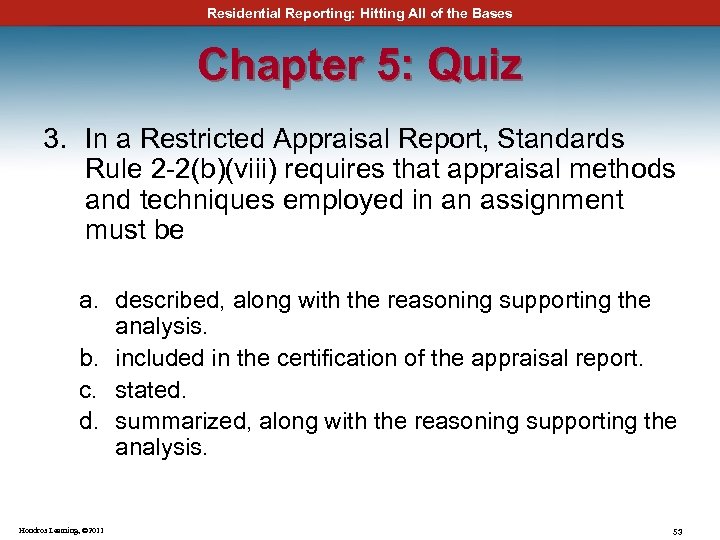
Residential Reporting: Hitting All of the Bases Chapter 5: Quiz 3. In a Restricted Appraisal Report, Standards Rule 2 -2(b)(viii) requires that appraisal methods and techniques employed in an assignment must be a. described, along with the reasoning supporting the analysis. b. included in the certification of the appraisal report. c. stated. d. summarized, along with the reasoning supporting the analysis. Hondros Learning, © 2011 53
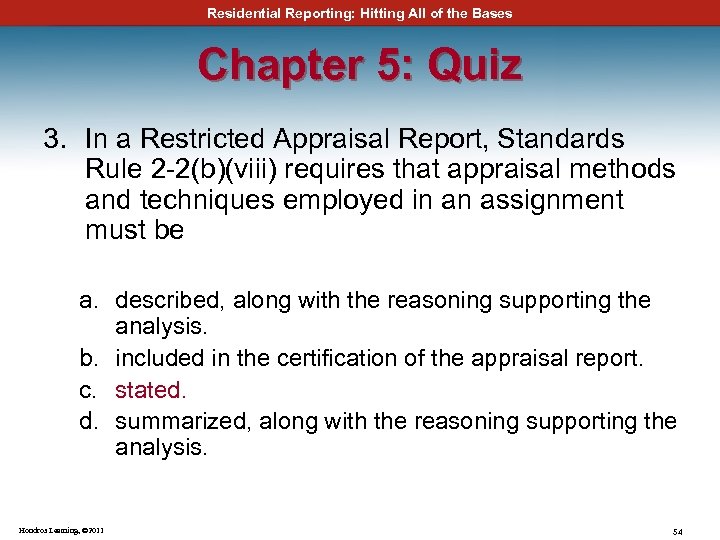
Residential Reporting: Hitting All of the Bases Chapter 5: Quiz 3. In a Restricted Appraisal Report, Standards Rule 2 -2(b)(viii) requires that appraisal methods and techniques employed in an assignment must be a. described, along with the reasoning supporting the analysis. b. included in the certification of the appraisal report. c. stated. d. summarized, along with the reasoning supporting the analysis. Hondros Learning, © 2011 54
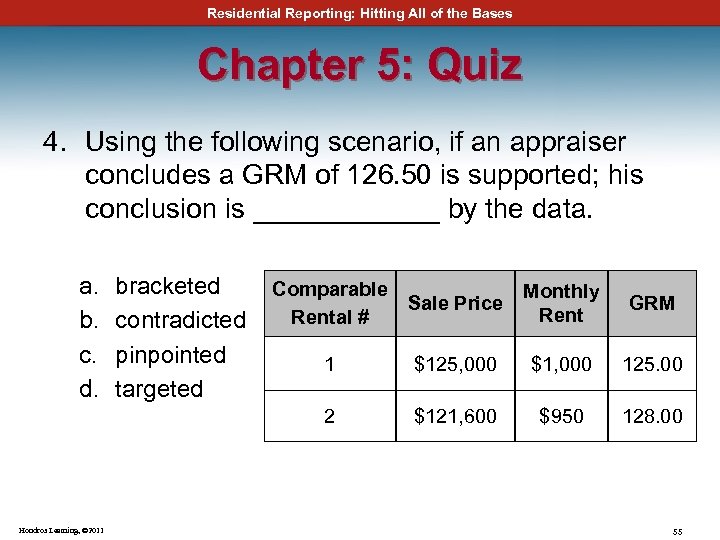
Residential Reporting: Hitting All of the Bases Chapter 5: Quiz 4. Using the following scenario, if an appraiser concludes a GRM of 126. 50 is supported; his conclusion is ______ by the data. a. b. c. d. bracketed contradicted pinpointed targeted Comparable Sale Price Rental # Monthly Rent GRM $125, 000 $1, 000 125. 00 2 Hondros Learning, © 2011 1 $121, 600 $950 128. 00 55
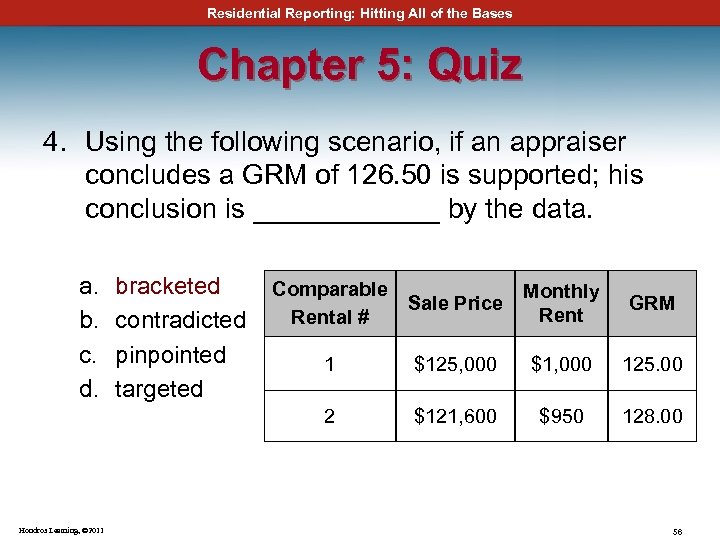
Residential Reporting: Hitting All of the Bases Chapter 5: Quiz 4. Using the following scenario, if an appraiser concludes a GRM of 126. 50 is supported; his conclusion is ______ by the data. a. b. c. d. bracketed contradicted pinpointed targeted Comparable Sale Price Rental # Monthly Rent GRM $125, 000 $1, 000 125. 00 2 Hondros Learning, © 2011 1 $121, 600 $950 128. 00 56
Residential Reporting: Hitting All of the Bases Chapter 5: Quiz 5. Which reporting option(s) require a summary of the results of analyzing subject sales, options, and listings in a market value assignment? a. Both reporting options b. Restricted Appraisal Reports only c. Appraisal Reports for mortgage lending purposes only d. Appraisal Report for any purpose only Hondros Learning, © 2011 57
Residential Reporting: Hitting All of the Bases Chapter 5: Quiz 5. Which reporting option(s) require a summary of the results of analyzing subject sales, options, and listings in a market value assignment? a. Both reporting options b. Restricted Appraisal Reports only c. Appraisal Reports for mortgage lending purposes only d. Appraisal Report for any purpose only Hondros Learning, © 2011 58
Residential Reporting: Hitting All of the Bases Chapter 5: Quiz 6. A particular neighborhood is undergoing a complete change of use from residential to commercial. An appraiser should refer to the occurrence in the appraisal report as a. b. c. d. Hondros Learning, © 2011 diminishing returns. gentrification. progression. transition. 59
Residential Reporting: Hitting All of the Bases Chapter 5: Quiz 6. A particular neighborhood is undergoing a complete change of use from residential to commercial. An appraiser should refer to the occurrence in the appraisal report as a. b. c. d. Hondros Learning, © 2011 diminishing returns. gentrification. progression. transition. 60
Residential Reporting: Hitting All of the Bases Chapter 5: Quiz 7. In the sales comparison approach, if there is a difference between the subject and a comparable sale and no adjustment has been made, to address the lack of an adjustment, the appraiser should a. apply a GRM instead. b. consider the assignment unacceptable. c. discuss, in the report, the rationale for not making an adjustment. d. place N/A next to the item in the sales comparison grid. Hondros Learning, © 2011 61
Residential Reporting: Hitting All of the Bases Chapter 5: Quiz 7. In the sales comparison approach, if there is a difference between the subject and a comparable sale and no adjustment has been made, to address the lack of an adjustment, the appraiser should a. apply a GRM instead. b. consider the assignment unacceptable. c. discuss, in the report, the rationale for not making an adjustment. d. place N/A next to the item in the sales comparison grid. Hondros Learning, © 2011 62
Residential Reporting: Hitting All of the Bases Chapter 5: Quiz 8. An appraiser accepted an assignment from a client who asked her to disregard the residential property’s commercial zoning and not report it. By accepting the assignment with this condition, it could cause the appraiser to a. b. c. d. Hondros Learning, © 2011 allow a hypothetical condition. lack independence. readdress the report. violate a jurisdictional exception. 63
Residential Reporting: Hitting All of the Bases Chapter 5: Quiz 8. An appraiser accepted an assignment from a client who asked her to disregard the residential property’s commercial zoning and not report it. By accepting the assignment with this condition, it could cause the appraiser to a. b. c. d. Hondros Learning, © 2011 allow a hypothetical condition. lack independence. readdress the report. violate a jurisdictional exception. 64
Residential Reporting: Hitting All of the Bases Chapter 5: Quiz 9. A residential dwelling is being appraised that is located across the street from a factory that the appraiser has determined is negatively affecting the value of the subject property. The appraiser applied a location adjustment in his sales comparison approach. However, the client asked that the factory not be discussed in the appraisal report. Since the appraiser addressed the condition with an adjustment, has he complied with USPAP? a. no, because USPAP requires explanation for each adjustment b. no, omitting the discussion could produce a misleading report c. yes, since an adjustment was included d. yes, since the client requested the omission Hondros Learning, © 2011 65
Residential Reporting: Hitting All of the Bases Chapter 5: Quiz 9. A residential dwelling is being appraised that is located across the street from a factory that the appraiser has determined is negatively affecting the value of the subject property. The appraiser applied a location adjustment in his sales comparison approach. However, the client asked that the factory not be discussed in the appraisal report. Since the appraiser addressed the condition with an adjustment, has he complied with USPAP? a. no, because USPAP requires explanation for each adjustment b. no, omitting the discussion could produce a misleading report c. yes, since an adjustment was included d. yes, since the client requested the omission Hondros Learning, © 2011 66
Residential Reporting: Hitting All of the Bases Chapter 5: Quiz 10. An observation using a statistical measure that attempts to ascertain the source of change in variables is being referenced in an appraisal report, which is more commonly known as a(n) a. b. c. d. Hondros Learning, © 2011 adjustment. GRM. paired data analysis. regression analysis. 67
Residential Reporting: Hitting All of the Bases Chapter 5: Quiz 10. An observation using a statistical measure that attempts to ascertain the source of change in variables is being referenced in an appraisal report, which is more commonly known as a(n) a. b. c. d. Hondros Learning, © 2011 adjustment. GRM. paired data analysis. regression analysis. 68
Скачать презентацию Residential Reporting Hitting All of the Bases Chapter
3b1338f2bca4984bb242e7711cf0e266.ppt