


 Скачать презентацию Residential Grid-tie Solar Power Systems 34 250
00f4b7c6c4b04c6ff8f39b6e82c372ad.ppt
- Количество слайдов: 35
 Residential Grid-tie Solar Power Systems
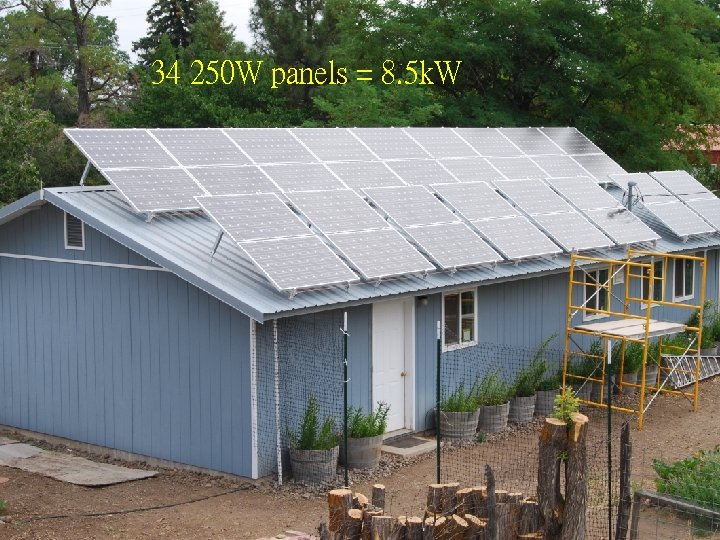 34 250 W panels = 8. 5 k. W
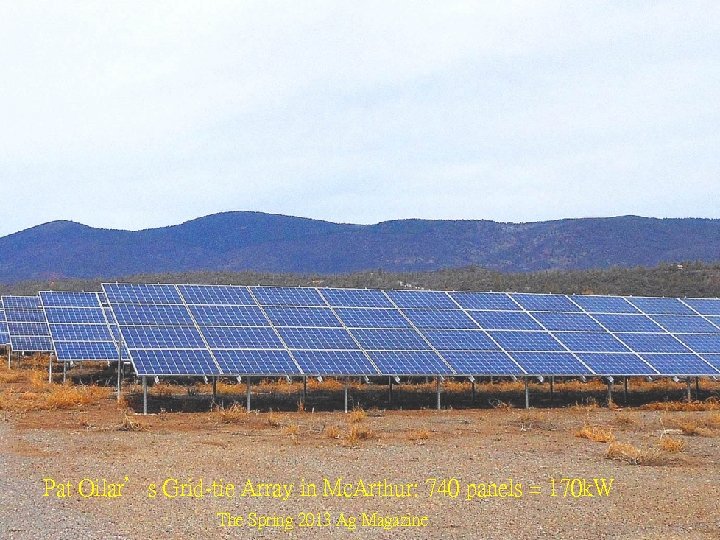 Pat Oilar’s Grid-tie Array in Mc. Arthur: 740 panels = 170 k. W The Spring 2013 Ag Magazine
 Grid-Tie vs Off-Grid Systems • Off-grid systems are independent from the power grid, and can provide electricity when there is otherwise no access to it. • They require a battery bank to store power since the sun isn’t always shining. • Batteries need to be maintained, have a limited lifetime, and raise the cost of the system.
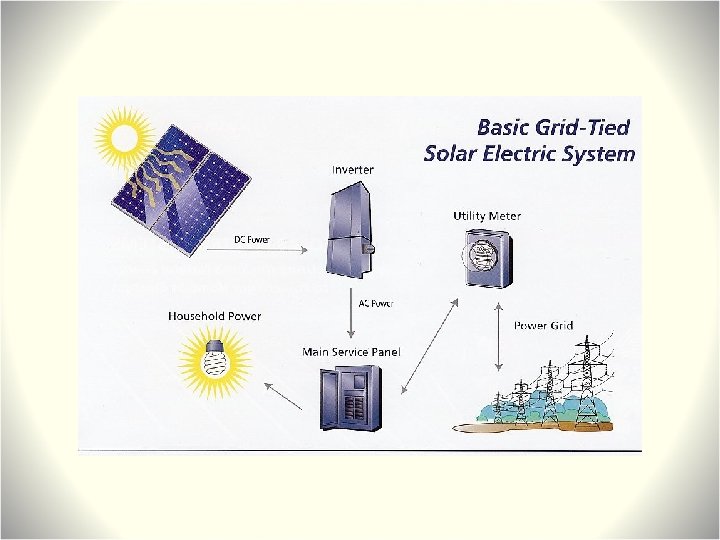
 Grid-Tie vs Off-Grid Systems • Grid-tie systems do not provide power when the grid is down, but when it’s up, you have power when the sun isn’t shining. No storage is required • They require a net-metering agreement with the power company, and there are several layers of bureaucracy to deal with.
 Grid-Tie vs Off-Grid Systems • The net-metering agreement requires the power company to buy back any excess power you produce, but (with PPL anyway) you’ll only get a wholesale price for it. So it is best to produce no more than you use.
 Sizing Your System • Obtain the energy production factor (EPF) for solar in your area (see next slide) and divide it into your annual usage in k. Wh. • Our usage in 2012 was 34, 858 k. Wh. • The EPF for Surprise Valley is 1700. • 34, 858 k. Wh / 1700 h = 20. 5 k. W • I could only fit 8. 5 k. W on my roof • Most households will need under 4 k. W
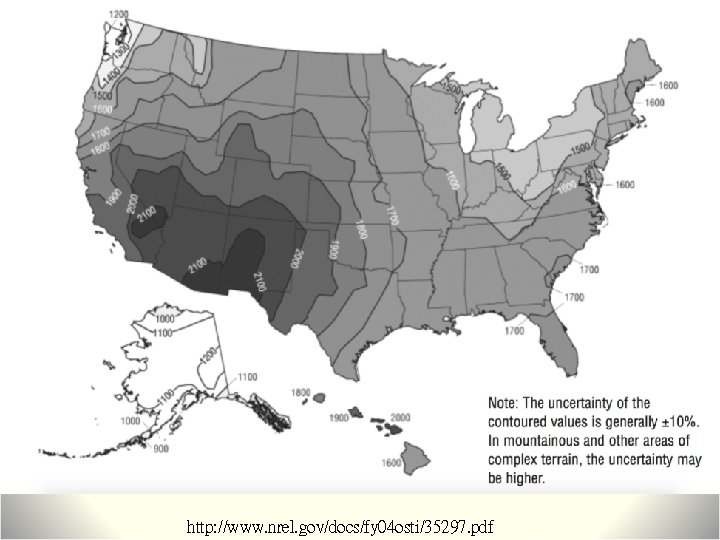 http: //www. nrel. gov/docs/fy 04 osti/35297. pdf
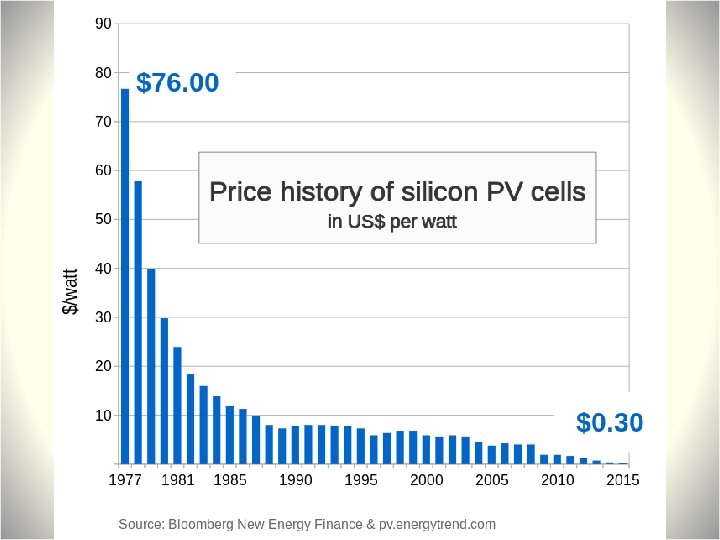
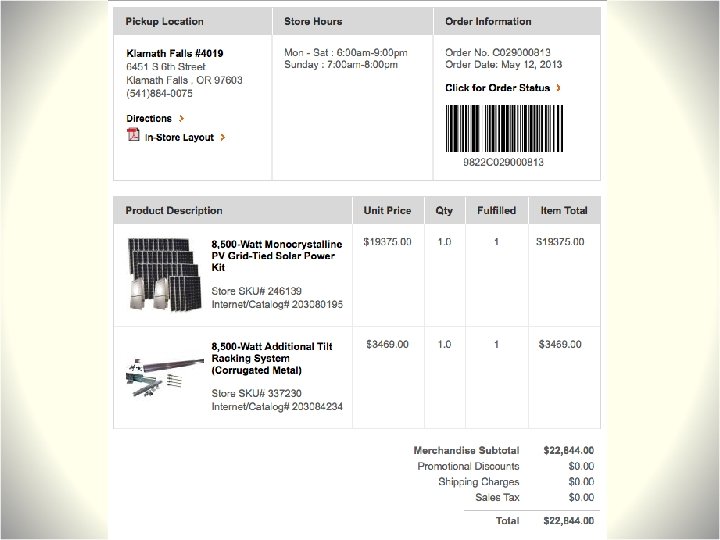
 System Costs • Our system cost roughly $25, 000 (I installed it myself). • If you don’t do the installation yourself, you need to at least double the cost, which would have raised my cost to $50, 000. The tax credit (discussed later) would increase proportionally, though. • The price of solar panels has decreased about 10% since my system was purchased.
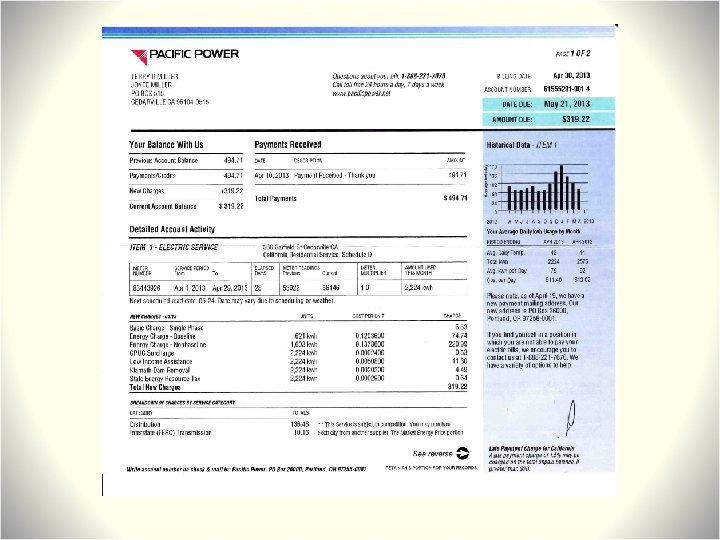
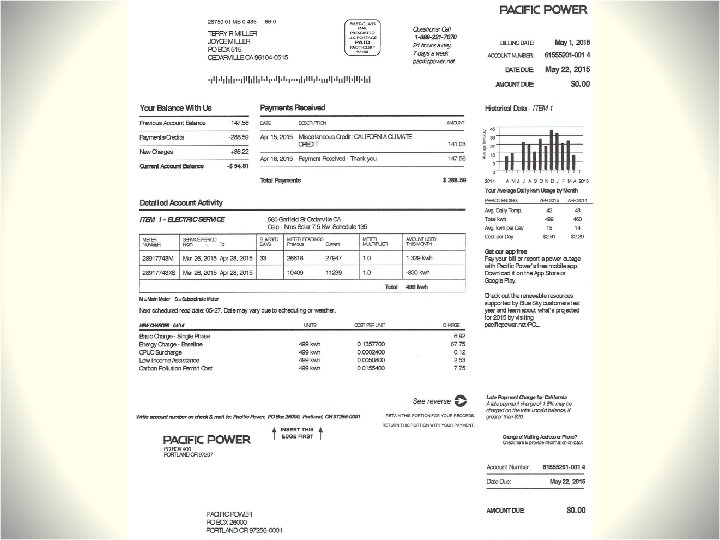
 Present Energy Use & Offset • Our 2012 total usage = 34, 858 k. Wh • Av. usage since installation = 23, 764 k. Wh/yr • Conservation measures have saved us $1664/yr ($0. 15/k. Wh) • About 58% of our power is now produced by the solar system. • Our system produces approximately 13, 800 k. Wh AC per year. • If we could install another 5. 5 k. W, we would produce all of our power.
 Return on Investment • The second tier cost per k. Wh for PPL is $0. 15 per k. Wh. • So our production value is $0. 15/k. Wh X 13, 800 k. Wh/year = $2070/year. • Return on investment is $2070/$25000 = 8. 3%/yr. • System pays for itself in $25000/$2070 = 12. 1 years. • This doesn’t include the California Rebate or the Federal tax credit.
 Return on Investment • The PPL California rebate paid $4, 457 • The Federal tax credit was $6, 448 (30% figured on cost after California rebate was subtracted out) • So the total outlay for the system was really $25, 000 - $10, 905 = $14, 095. • Return on investment is really: $2, 070/$14, 095 = 14. 7%/yr • The system is paid for in $14, 095/$2070 = 6. 8 years • It should be noted that the PPL California rebate program ended on March 10, 2016. See: http: //www. pacificpowercasolar. com/index. html.
 Surprise Valley Electrification Corp. • SVE is required by the state to do net-metering, but the are not presently required to provide a solar rebate through the state. • SVE residential power costs are $. 069/k. Wh, as opposed to PPL first tier cost presently around $. 13. 5/k. Wh and second tier cost of approx. $. 15/k. Wh. • The economics of doing a grid-tie with SVE are, therefore, not as compelling. • For any site outside of SVE’s service area, like Pat Oilar’s installation in Mc. Carthur (PG&E territory), however, they are very compelling.
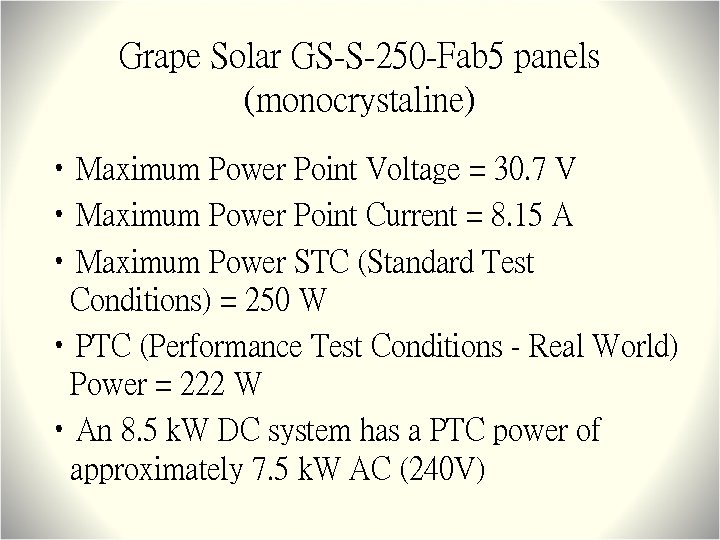 Grape Solar GS-S-250 -Fab 5 panels (monocrystaline) • Maximum Power Point Voltage = 30. 7 V • Maximum Power Point Current = 8. 15 A • Maximum Power STC (Standard Test Conditions) = 250 W • PTC (Performance Test Conditions - Real World) Power = 222 W • An 8. 5 k. W DC system has a PTC power of approximately 7. 5 k. W AC (240 V)
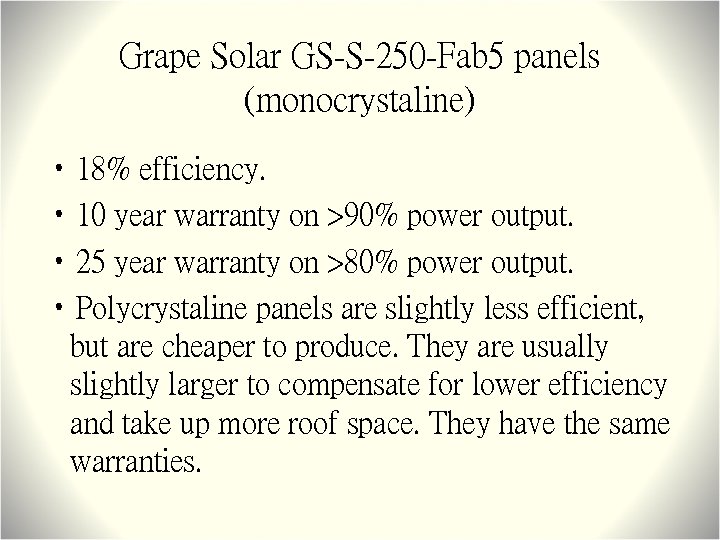 Grape Solar GS-S-250 -Fab 5 panels (monocrystaline) • 18% efficiency. • 10 year warranty on >90% power output. • 25 year warranty on >80% power output. • Polycrystaline panels are slightly less efficient, but are cheaper to produce. They are usually slightly larger to compensate for lower efficiency and take up more roof space. They have the same warranties.
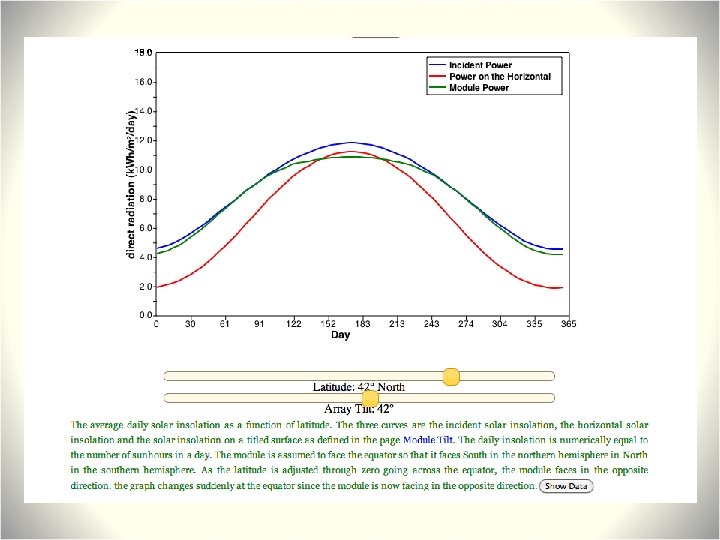
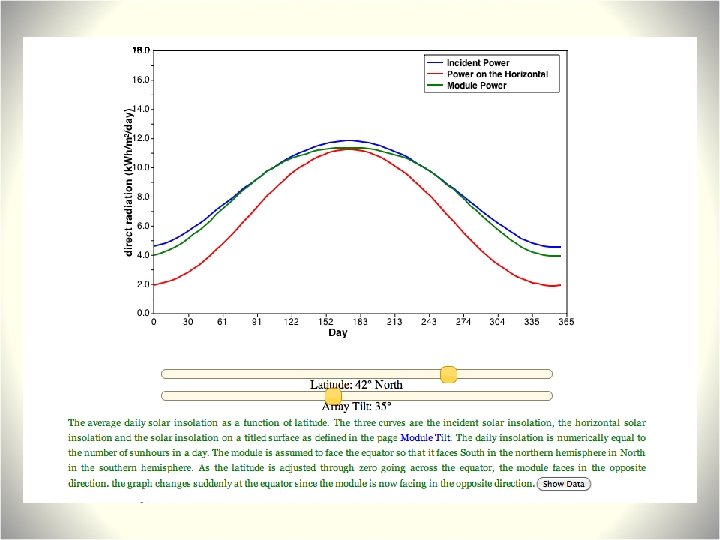
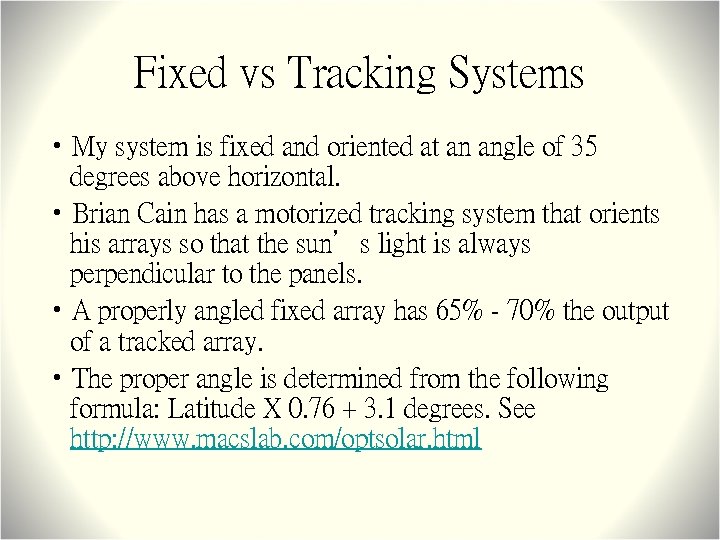 Fixed vs Tracking Systems • My system is fixed and oriented at an angle of 35 degrees above horizontal. • Brian Cain has a motorized tracking system that orients his arrays so that the sun’s light is always perpendicular to the panels. • A properly angled fixed array has 65% - 70% the output of a tracked array. • The proper angle is determined from the following formula: Latitude X 0. 76 + 3. 1 degrees. See http: //www. macslab. com/optsolar. html
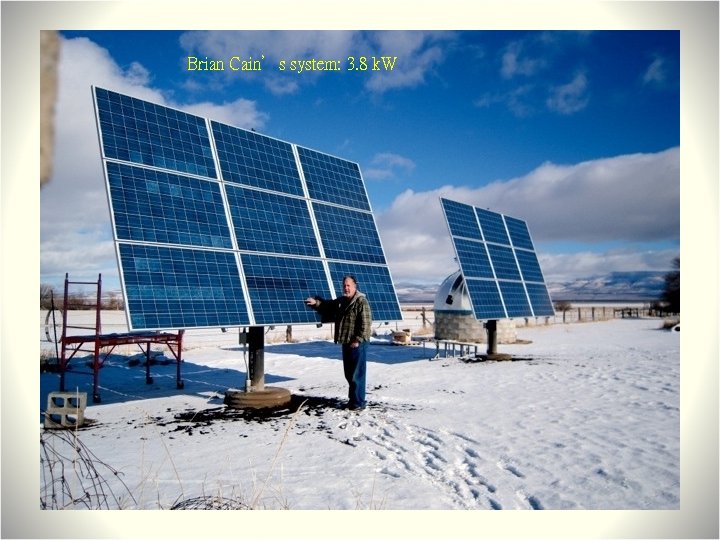 Brian Cain’s system: 3. 8 k. W Picture of Brian’s system
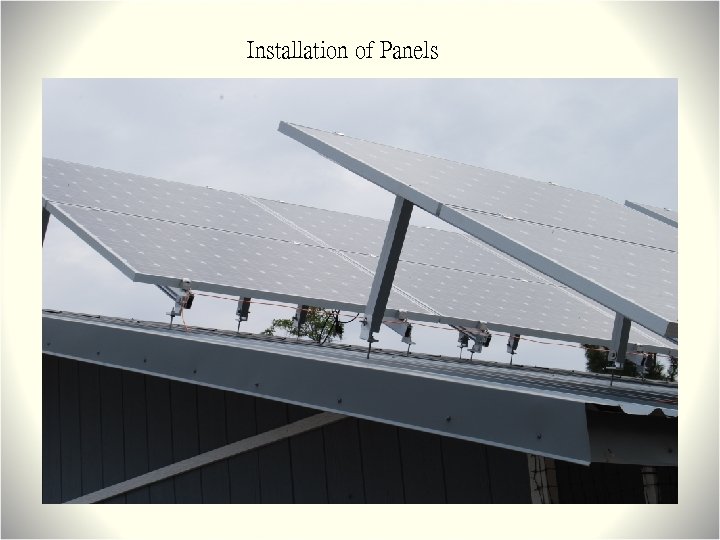 Installation of Panels
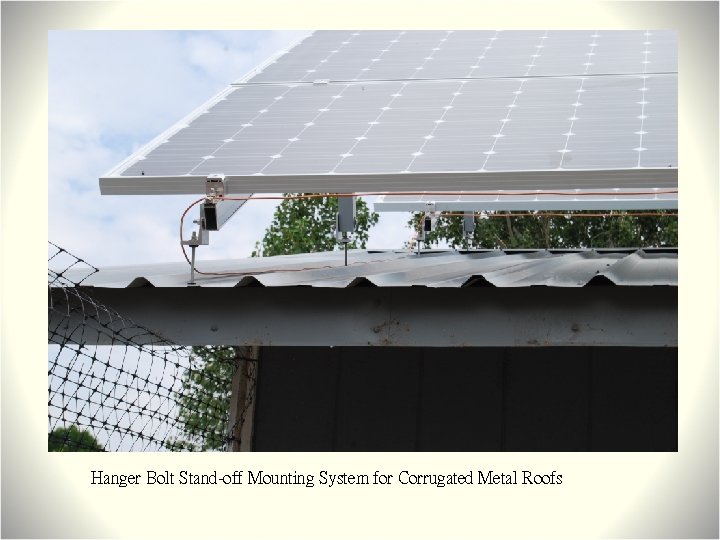 Hanger Bolt Stand-off Mounting System for Corrugated Metal Roofs
 String Inverters vs Microinverters • String inverters are the least costly, but if any panels are shaded, on any part, output is drastically reduced. • Microinverters are much more efficient than string inverters if a panel is shaded. The other panels continue to produce at their full output for that time of day.
 Power Optimizers • Like microinverters, power optimizers are located at each panel, usually integrated into the panels themselves. • instead of converting the DC electricity to AC electricity then and there, they instead ‘condition’ the DC electricity before sending it to a central inverter. More affordable than microinverters.
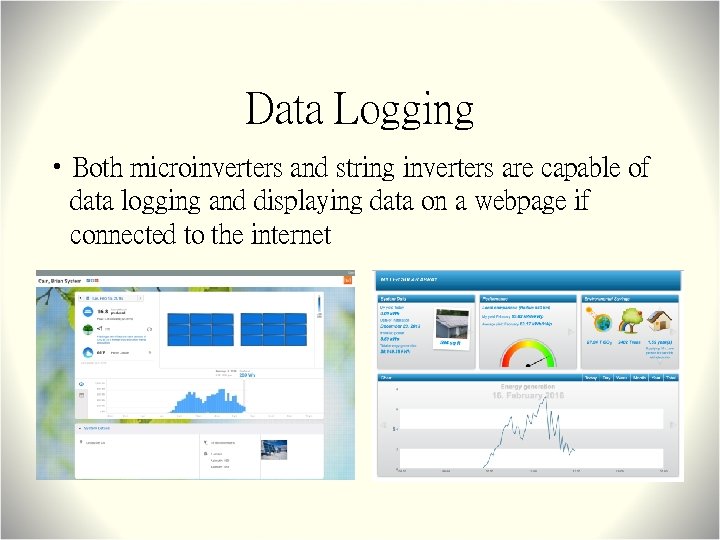 Data Logging • Both microinverters and string inverters are capable of data logging and displaying data on a webpage if connected to the internet
 Installation Caveats • Roof mounts are designed to be mounted solidly in the roof trusses (usually 24” on center). • If you need to mount the panels closer together, you’ll need to put in blocking between the trusses. • Ideally, rows of panels should not ever shade each other. The vertical spacing should be figured on the sun’s lowest angle in the sky in winter (25° above the horizon in Cedarville).
 Installation Caveats • The new Modoc county building code regulations now require 3 feet of clearance between the upper edge of the panels and the roof ridge if it’s a residential building. • A residential single ridge roof also requires two 3 foot wide walkways from the eave to the ridge. • If my shop were considered to be a residential building, the size of my system would have to be drastically reduced.
 Installation Caveats • For Oregon residents: that state requires that you hire a licensed installer, or get certified yourself if you want their tax credits. • County building departments in Oregon may also require a certified installer.
 PPL Requirements • PPL requires a labeled knife switch cutoff for the solar power output before it feeds into the main panel. • PPL also requires a separate production meter that solely records the AC output from the solar system. • They also require a rather elaborate application process that includes the panel and inverter specs, a plot diagram, and a system wiring diagram before they will approve a grid-tie.
 Solar Contractors (within 200 miles) • TOP HAT ENERGY: www. tophatenergy. com Montgomery Creek, CA — (530) 337 -6495) Appears to be highly rated. • B & B SOLAR: www. bnbsolar. com Redding, CA — (530) 365 -4180. No ratings • SOLAR CONNECTOR: www. getfelix. com/p/superpages/solar-connector-dorriscalifornia. html. Dorris, CA — (855) 548 -8765) No ratings
 Bibliography • http: //terryrmiller. com/solar • http: //pveducation. org/pvcdrom/properties-ofsunlight/calculation-of-solar-insolation • http: //www. homedepot. com/p/Grape-Solar-8 -500 -Watt. Monocrystalline-PV-Grid-Tied-Solar-Power-Kit-GS 8500 -KIT/203080195#. Ue_v. Hu. BL 3 Io • http: //www. solarpaneltilt. com • https: //enlighten. enphaseenergy. com/pv/public_systems/j WCz 3073/overview • http: //www. pacificpowercasolar. com/index. html • http: //www. nrel. gov/docs/fy 04 osti/35297. pdf