


 Скачать презентацию Reshef Meir Jeff Rosenschein Maria Polukarov Nick Jennings
def17442c059b9adaa894eb857b28d95.ppt
- Количество слайдов: 29
 Reshef Meir Jeff Rosenschein Maria Polukarov Nick Jennings Hebrew University of Jerusalem, Israel University of Southampton, United Kingdom COMSOC 2010, Dusseldorf
 What are we after? § Agents have to agree on a joint plan of action or allocation of resources § Their individual preferences over available alternatives may vary, so they vote ü Agents may have incentives to vote strategically § We study the convergence of strategic behavior to stable decisions from which no one will want to deviate – equilibria ü Agents may have no knowledge about the preferences of the others and no communication
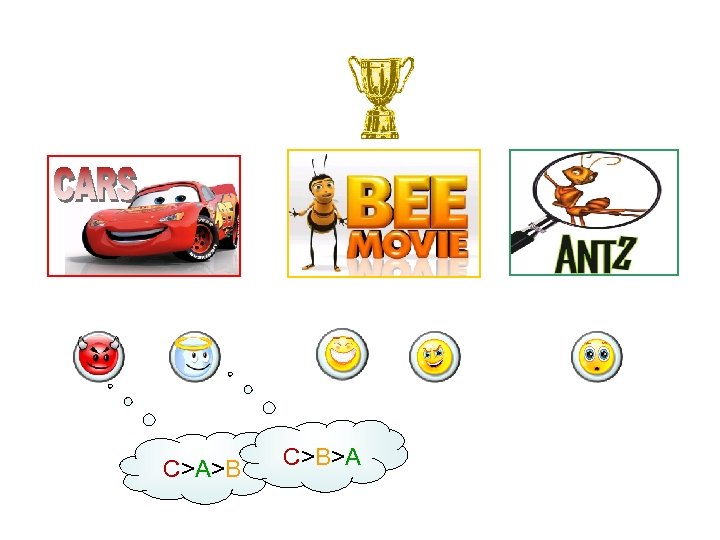 C>A>B C>B>A
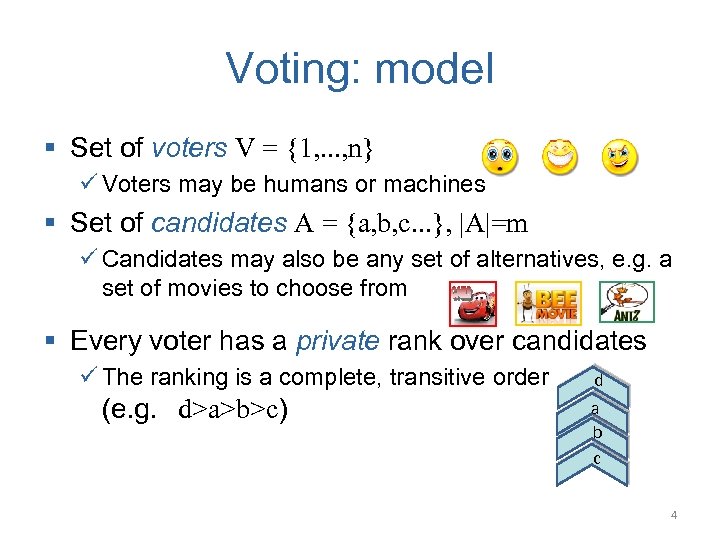 Voting: model § Set of voters V = {1, . . . , n} ü Voters may be humans or machines § Set of candidates A = {a, b, c. . . }, |A|=m ü Candidates may also be any set of alternatives, e. g. a set of movies to choose from § Every voter has a private rank over candidates ü The ranking is a complete, transitive order (e. g. d>a>b>c) d a b c 4
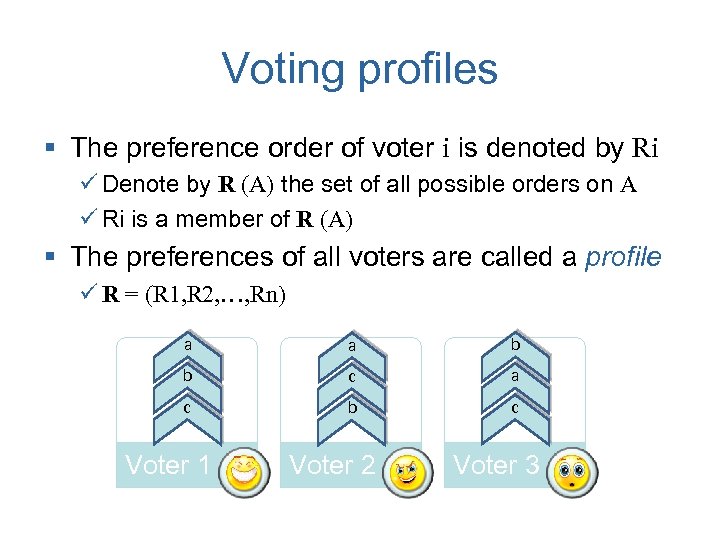 Voting profiles § The preference order of voter i is denoted by Ri ü Denote by R (A) the set of all possible orders on A ü Ri is a member of R (A) § The preferences of all voters are called a profile ü R = (R 1, R 2, …, Rn) a a b b c a c b c Voter 1 Voter 2 Voter 3
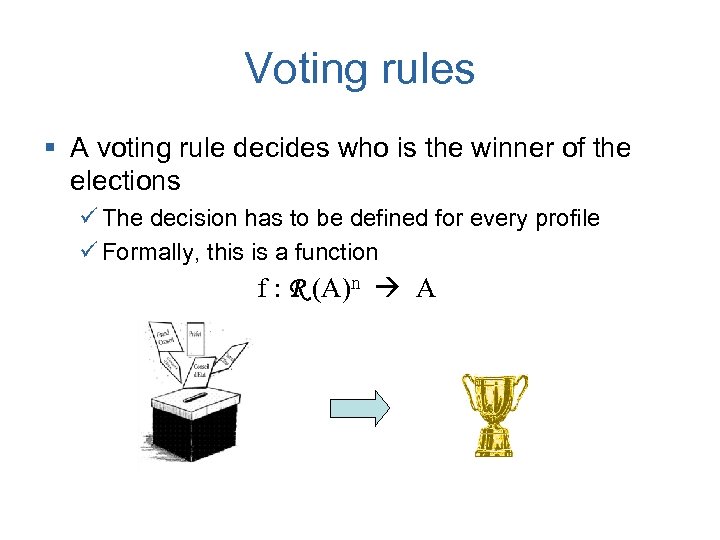 Voting rules § A voting rule decides who is the winner of the elections ü The decision has to be defined for every profile ü Formally, this is a function f : R (A)n A
 The Plurality rule üEach voter selects a candidate üVoters may have weights üThe candidate with most votes wins § Tie-breaking scheme ü Deterministic: the candidate with lower index wins ü Randomized: the winner is selected at random from candidates with highest score
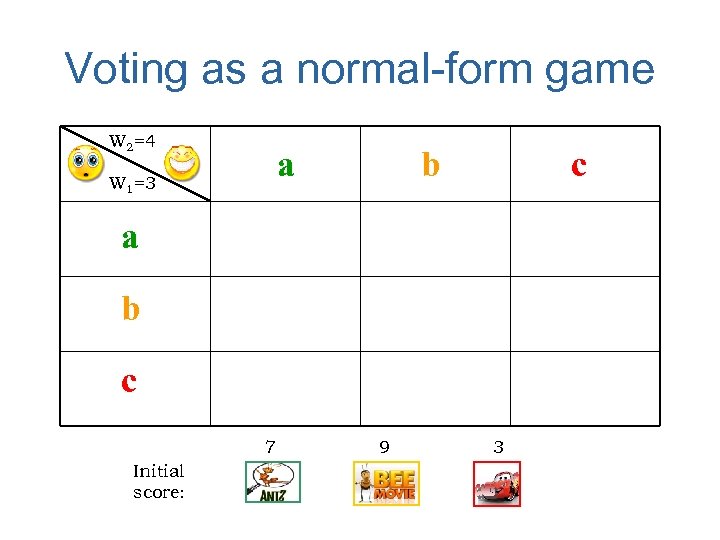 Voting as a normal-form game W 2=4 a W 1=3 b c a b c 7 Initial score: 9 3
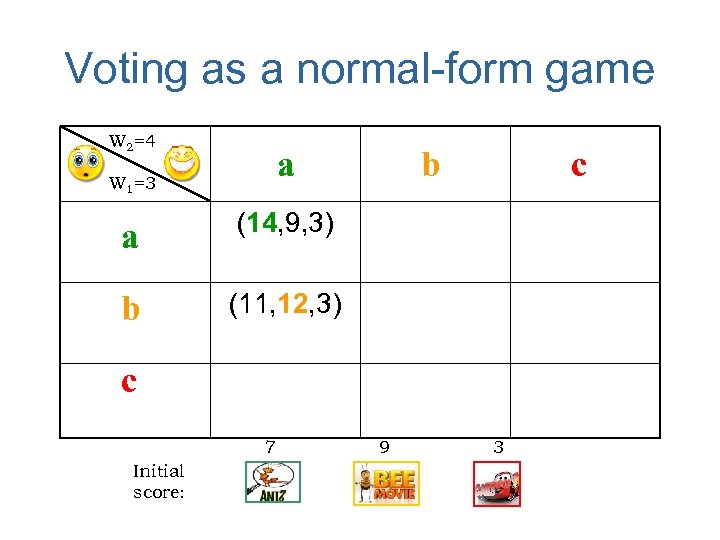 Voting as a normal-form game W 2=4 a W 1=3 a c (14, 9, 3) b b (11, 12, 3) c 7 Initial score: 9 3
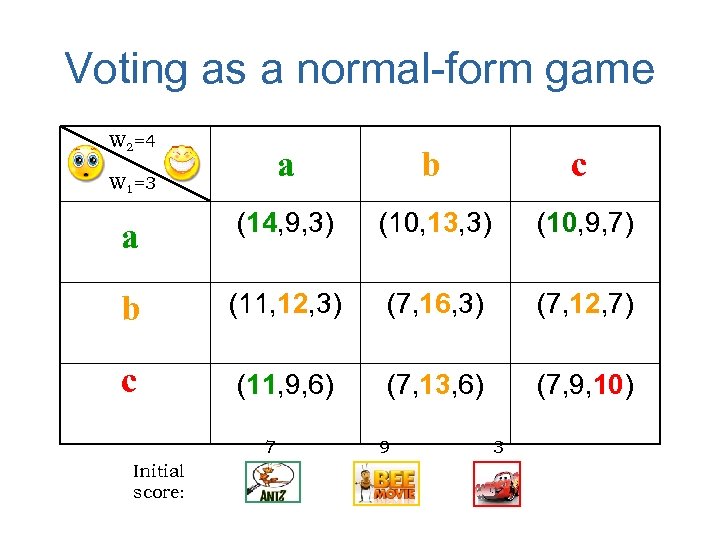 Voting as a normal-form game W 2=4 a b c a (14, 9, 3) (10, 13, 3) (10, 9, 7) b (11, 12, 3) (7, 16, 3) (7, 12, 7) c (11, 9, 6) (7, 13, 6) (7, 9, 10) W 1=3 7 Initial score: 9 3
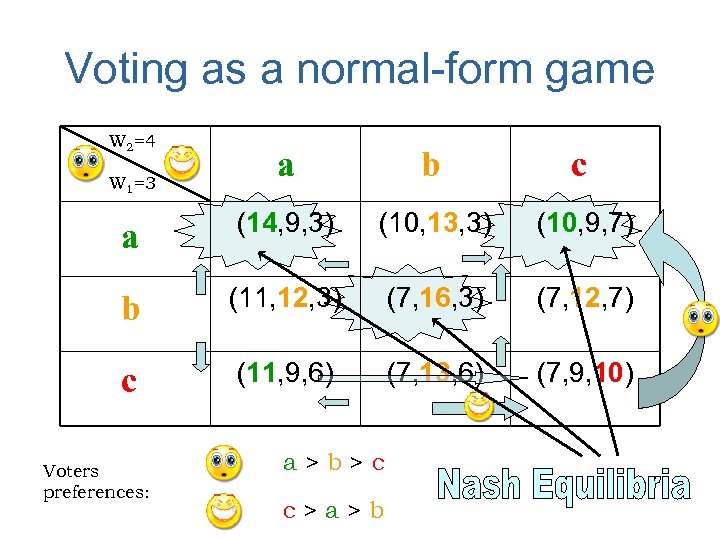 Voting as a normal-form game W 2=4 a b c a (14, 9, 3) (10, 13, 3) (10, 9, 7) b (11, 12, 3) (7, 16, 3) (7, 12, 7) c (11, 9, 6) (7, 13, 6) (7, 9, 10) W 1=3 Voters preferences: a>b>c c>a>b
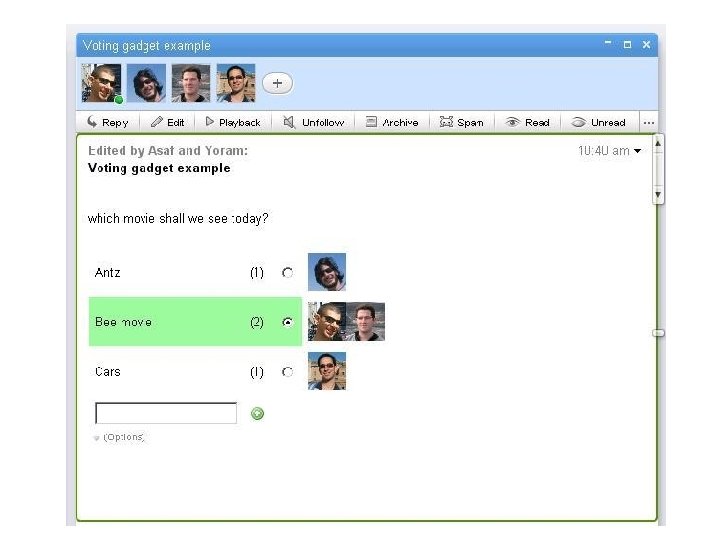
 Voting in turns § We allow each voter to change his vote § Only one voter may act at each step § The game ends when there are no objections ü This mechanism is implemented in some on-line voting systems, e. g. in Google Wave

 Rational moves We assume, that voters only make rational steps, but what is “rational”? § Voters do not know the preferences of others § Voters cannot collaborate with others ü Thus, improvement steps are myopic, or local.
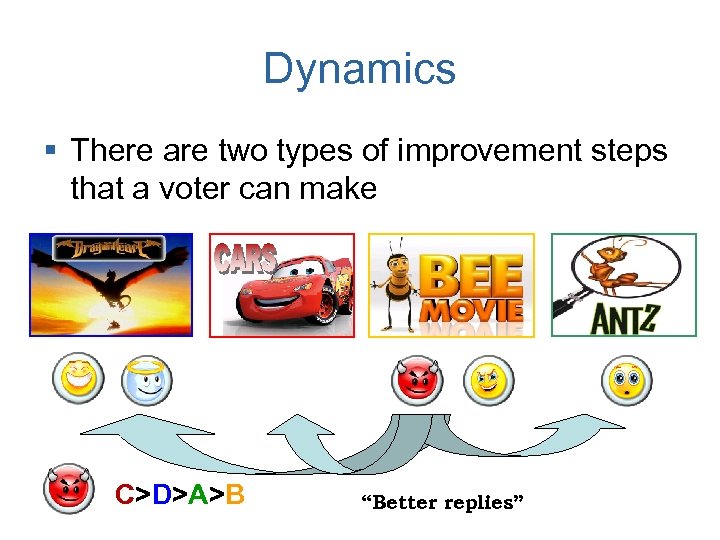 Dynamics § There are two types of improvement steps that a voter can make C>D>A>B “Better replies”
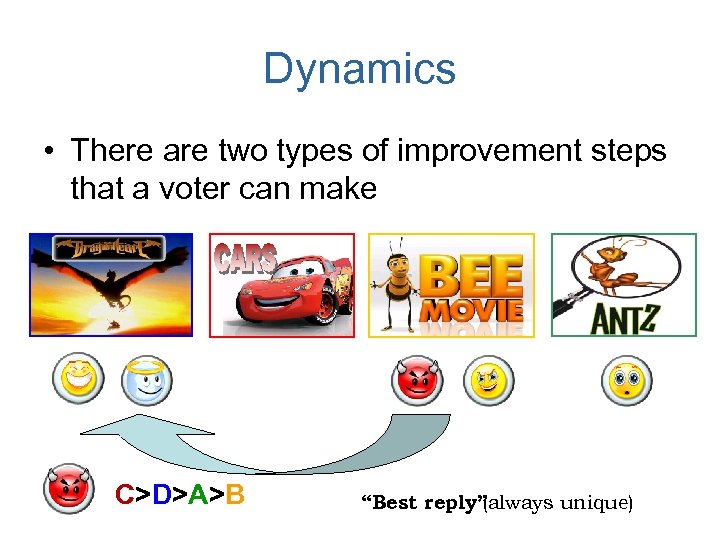 Dynamics • There are two types of improvement steps that a voter can make C>D>A>B “Best reply” (always unique)
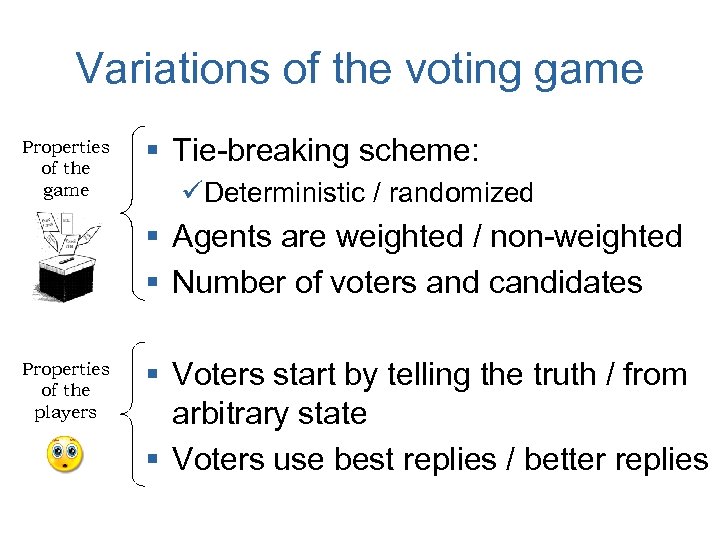 Variations of the voting game Properties of the game § Tie-breaking scheme: üDeterministic / randomized § Agents are weighted / non-weighted § Number of voters and candidates Properties of the players § Voters start by telling the truth / from arbitrary state § Voters use best replies / better replies
 Our results We have shown how the convergence depends on all of these game attributes
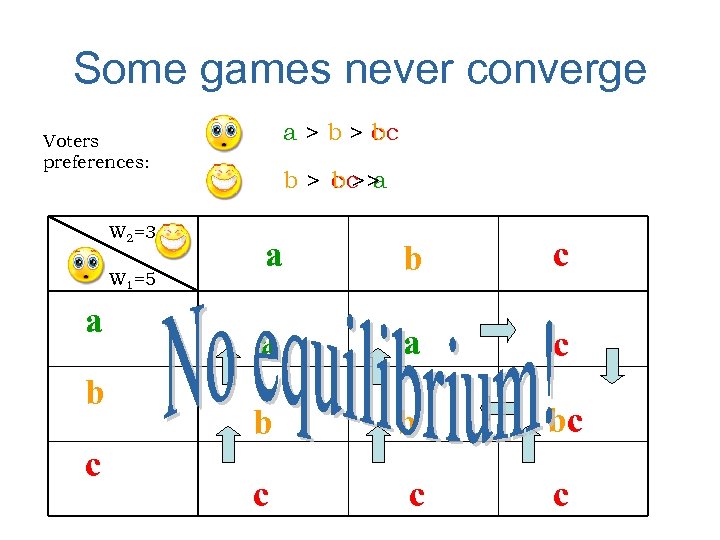
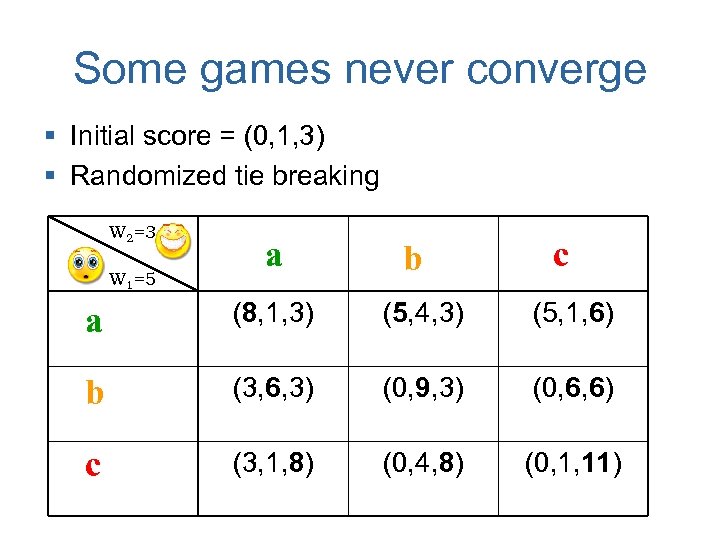 Some games never converge § Initial score = (0, 1, 3) § Randomized tie breaking W 2=3 W 1=5 a b c a (8, 1, 3) (5, 4, 3) (5, 1, 6) b (3, 6, 3) (0, 9, 3) (0, 6, 6) c (3, 1, 8) (0, 4, 8) (0, 1, 11)
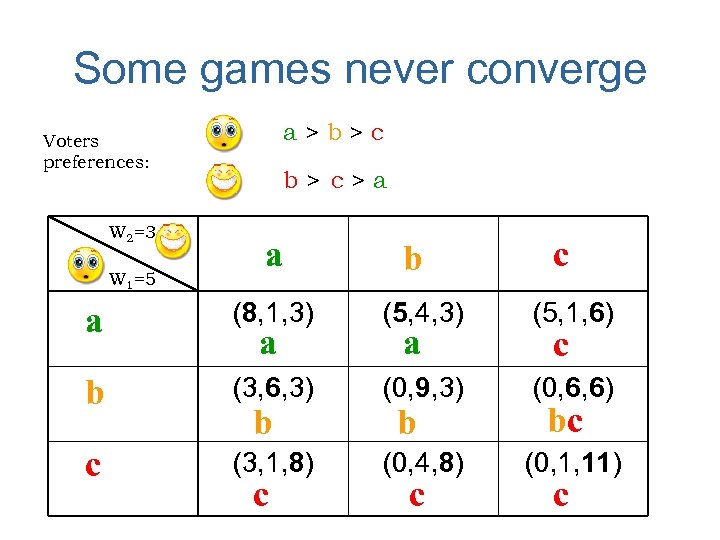 Some games never converge a>b>c Voters preferences: W 2=3 W 1=5 b> c>a a b c a (8, 1, 3) (5, 4, 3) (5, 1, 6) b (3, 6, 3) (0, 9, 3) (0, 6, 6) c (3, 1, 8) (0, 4, 8) (0, 1, 11) a b c c bc c
 Some games never converge a>b>c bc Voters preferences: W 2=3 W 1=5 a b c b > c >> bc a a b c a a c b b bc c
 Under which conditions the game is guaranteed to converge? And, if it does, then - How fast? - To what outcome?
 Is convergence guaranteed? Dynamics Tie breaking Agents Weighted Deterministic Non-weighted randomized Non-weighted Best Reply from truth anywhere Any better reply from truth anywhere
 Some games always converge Theorem: Let G be a Plurality game with deterministic tie-breaking. If voters have equal weights and always use best-reply, then the game will converge from any initial state. Furthermore, convergence occurs after a polynomial number of steps.
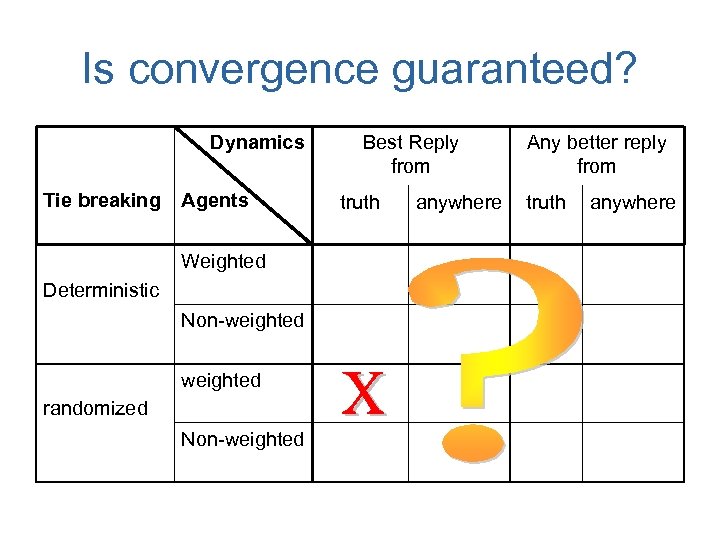
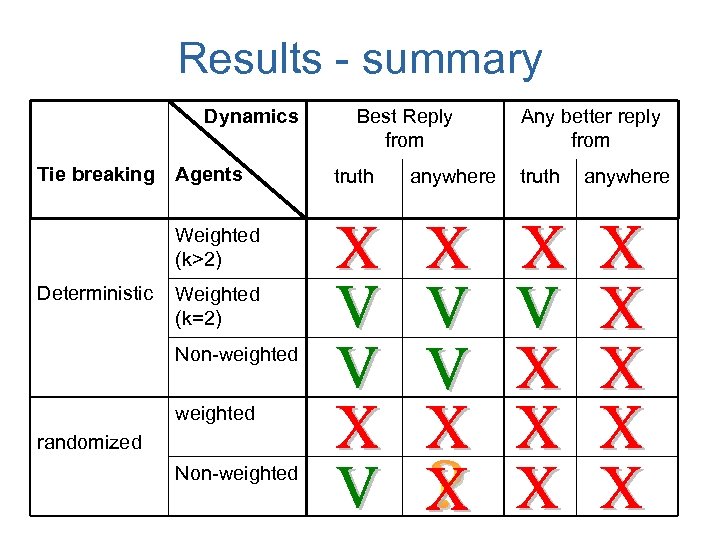 Results - summary Dynamics Tie breaking Agents Weighted (k>2) Deterministic Weighted (k=2) Non-weighted randomized Non-weighted Best Reply from truth anywhere Any better reply from truth anywhere
 Conclusions § The “best-reply” seems like the most important condition for convergence § The winner may depend on the order of players (even when convergence is guaranteed) § Iterative voting is a mechanism that allows all voters to agree on a candidate that is not too bad
 Future work § Extend to voting rules other than Plurality § Investigate theoretic properties of the newly induced voting rule (Iterative Plurality) § Study more far sighted behavior § In cases where convergence in not guaranteed, how common are cycles?
 Questions?