 Скачать презентацию RESERVOIR Resources and Services Virtualization without Boundaries Benny
7ebbc467241445cfb601e0e3655851c7.ppt
- Количество слайдов: 54



RESERVOIR Resources and Services Virtualization without Boundaries Benny Rochwerger Lead Architect IBM Haifa Research Lab. The research leading to these results is partially supported by the European Community's Seventh Framework Programme (FP 7/2007 -2013) under grant agreement n° 215605.
Cloud Computing: A style of computing where massively scalable IT-enabled capabilities are delivered as a service to external customers using Internet technologies. Premise: No single cloud can create a seemingly infinite infrastructure capable of serving massive amounts of users at all times, from all locations RESERVOIR: Investigate technologies for advanced Cloud Computing Focus on technologies that enable to build a federation of cooperating computing clouds 2 www. reservoir-fp 7. eu
3 www. reservoir-fp 7. eu
Goals of the Reservoir Project • Develop technologies for advanced Cloud Computing – Provide a software architecture where resources and services can be transparently and dynamically managed, provisioned and relocated like utilities – virtually “without borders” • Capabilities of service mobility and migration • Premise: No single cloud can create a seemingly infinite infrastructure capable of serving massive amounts of users at all times, from all locations – Federation of clouds – Leverage the diversity factor to achieve economies of scale – Leverage locality • Envisioned Impact – Optimize service delivery, relieving service consumers from awareness of IT attributes while providing Qo. S and security guarantees 4 www. reservoir-fp 7. eu
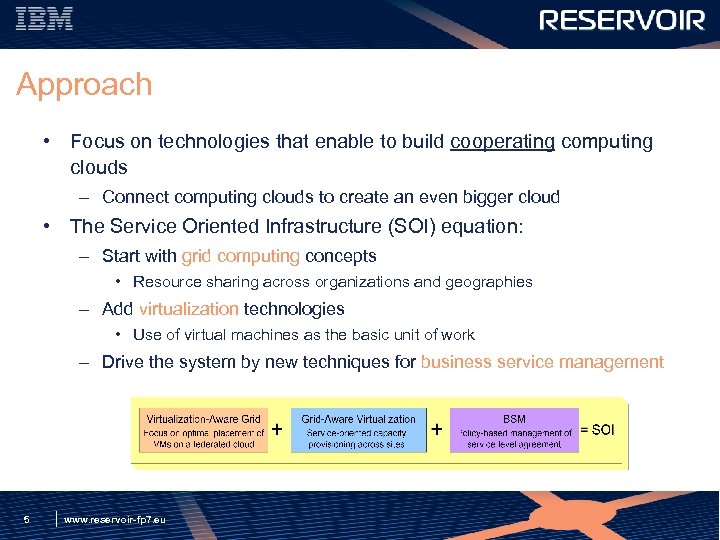
Approach • Focus on technologies that enable to build cooperating computing clouds – Connect computing clouds to create an even bigger cloud • The Service Oriented Infrastructure (SOI) equation: – Start with grid computing concepts • Resource sharing across organizations and geographies – Add virtualization technologies • Use of virtual machines as the basic unit of work – Drive the system by new techniques for business service management 5 www. reservoir-fp 7. eu
Design Driven by Real-World Scenarios • Scenario 1: SAP business application (SAP) – Business application oriented use cases and the opportunities to execute them on a flexible infrastructure. • Scenario 2: Telco application (TID) – Hosting web sites that deals with massive access (e. g. , the Olympics games) – High degree of personalization and support for mashups • Scenario 3: Utility computing (Sun) – Classical grid computing on top of cloud infrastructure • Scenario 4: e. Gov application (Thales) – Automatic adjustment of resources and domains cooperation 6 www. reservoir-fp 7. eu
Project Profile • 3 Years EU FP 7 project started in February • Budget: € 17 million • 13 partners from across industry, academia and standards bodies • Selected as a NESSI strategic project – The Networked European Software and Services Initiative (NESSI) is an industrial consortium focusing on advancing research in the area Services Architectures and Software Infrastructures • Public web site – http: //www. reservoir-fp 7. eu/ 7 www. reservoir-fp 7. eu
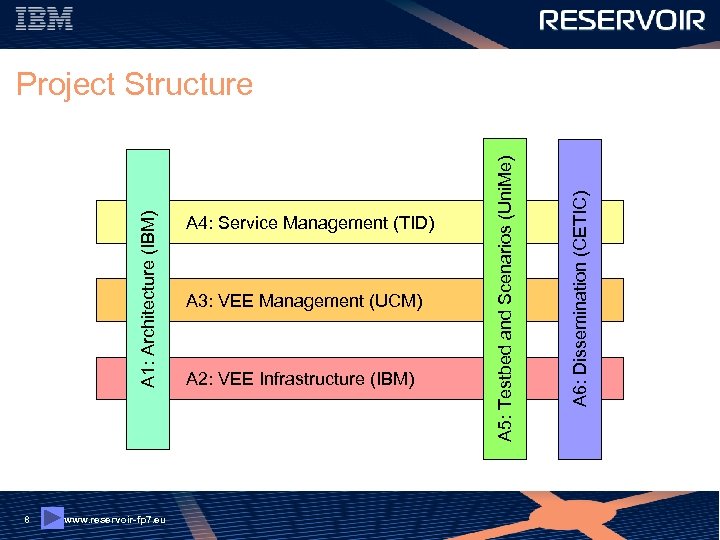
8 www. reservoir-fp 7. eu A 3: VEE Management (UCM) A 2: VEE Infrastructure (IBM) A 6: Dissemination (CETIC) A 4: Service Management (TID) A 5: Testbed and Scenarios (Uni. Me) A 1: Architecture (IBM) Project Structure
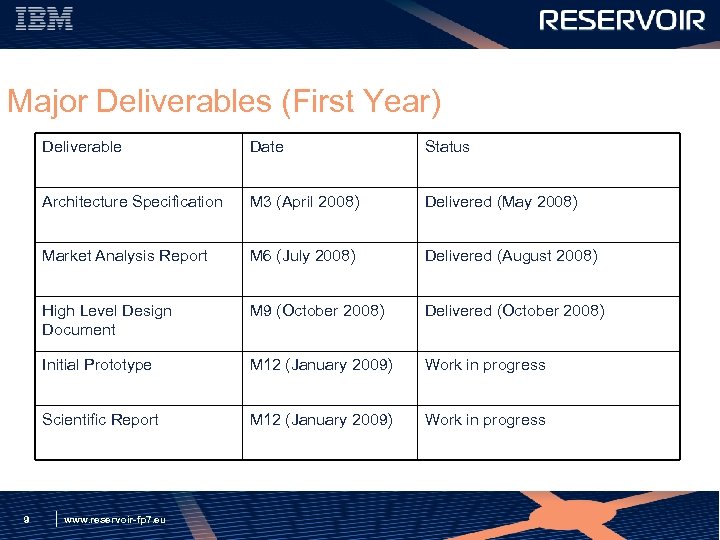
Major Deliverables (First Year) Deliverable Status Architecture Specification M 3 (April 2008) Delivered (May 2008) Market Analysis Report M 6 (July 2008) Delivered (August 2008) High Level Design Document M 9 (October 2008) Delivered (October 2008) Initial Prototype M 12 (January 2009) Work in progress Scientific Report 9 Date M 12 (January 2009) Work in progress www. reservoir-fp 7. eu
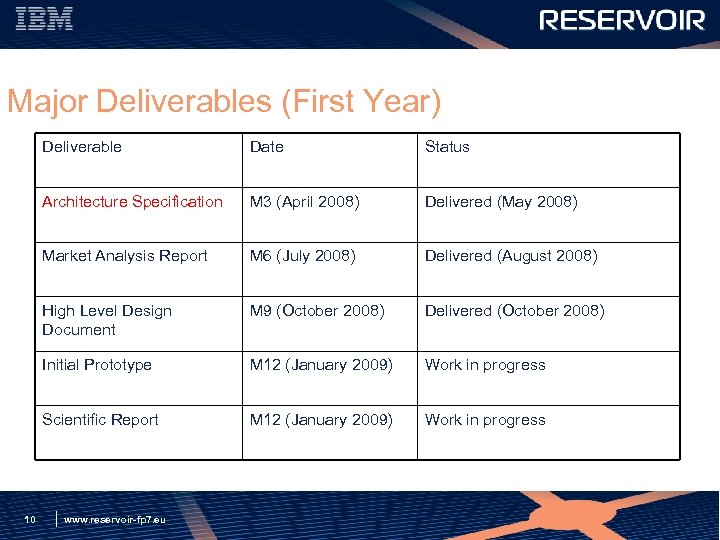
Major Deliverables (First Year) Deliverable Status Architecture Specification M 3 (April 2008) Delivered (May 2008) Market Analysis Report M 6 (July 2008) Delivered (August 2008) High Level Design Document M 9 (October 2008) Delivered (October 2008) Initial Prototype M 12 (January 2009) Work in progress Scientific Report 10 Date M 12 (January 2009) Work in progress www. reservoir-fp 7. eu
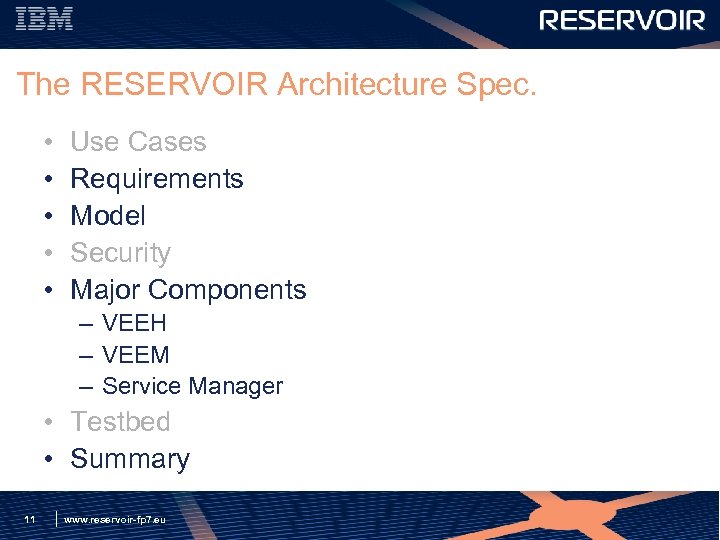
The RESERVOIR Architecture Spec. • • • Use Cases Requirements Model Security Major Components – VEEH – VEEM – Service Manager • Testbed • Summary 11 www. reservoir-fp 7. eu
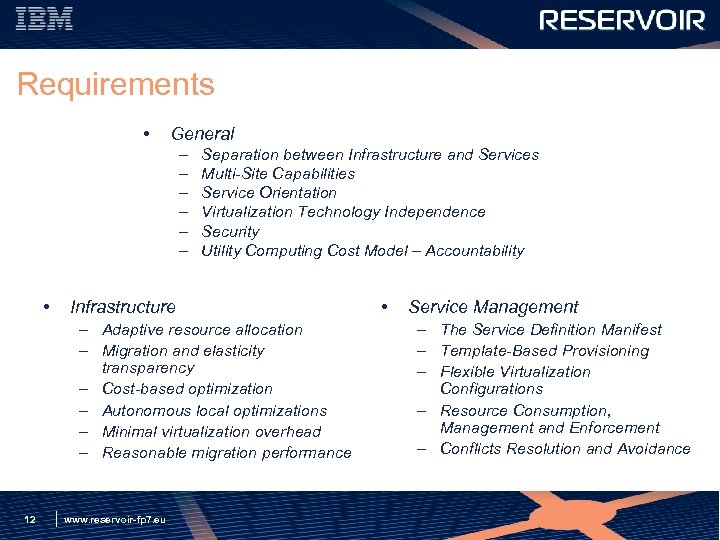
Requirements • General – – – • Separation between Infrastructure and Services Multi-Site Capabilities Service Orientation Virtualization Technology Independence Security Utility Computing Cost Model – Accountability Infrastructure – Adaptive resource allocation – Migration and elasticity transparency – Cost-based optimization – Autonomous local optimizations – Minimal virtualization overhead – Reasonable migration performance 12 www. reservoir-fp 7. eu • Service Management – The Service Definition Manifest – Template-Based Provisioning – Flexible Virtualization Configurations – Resource Consumption, Management and Enforcement – Conflicts Resolution and Avoidance
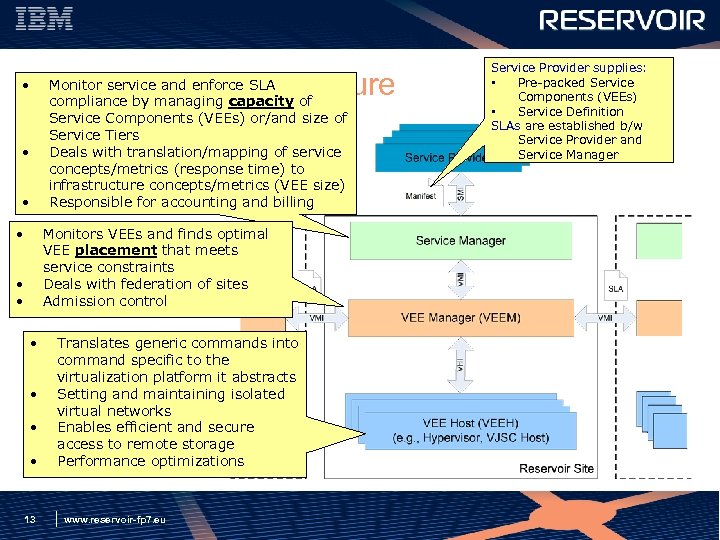
• Monitor service and enforce SLA The Reservoir Architecture compliance by managing capacity of Service Components (VEEs) or/and size of Service Tiers Deals with translation/mapping of service concepts/metrics (response time) to infrastructure concepts/metrics (VEE size) Responsible for accounting and billing • • • Monitors VEEs and finds optimal VEE placement that meets service constraints Deals with federation of sites Admission control • • • 13 Translates generic commands into command specific to the virtualization platform it abstracts Setting and maintaining isolated virtual networks Enables efficient and secure access to remote storage Performance optimizations www. reservoir-fp 7. eu Service Provider supplies: • Pre-packed Service Components (VEEs) • Service Definition SLAs are established b/w Service Provider and Service Manager
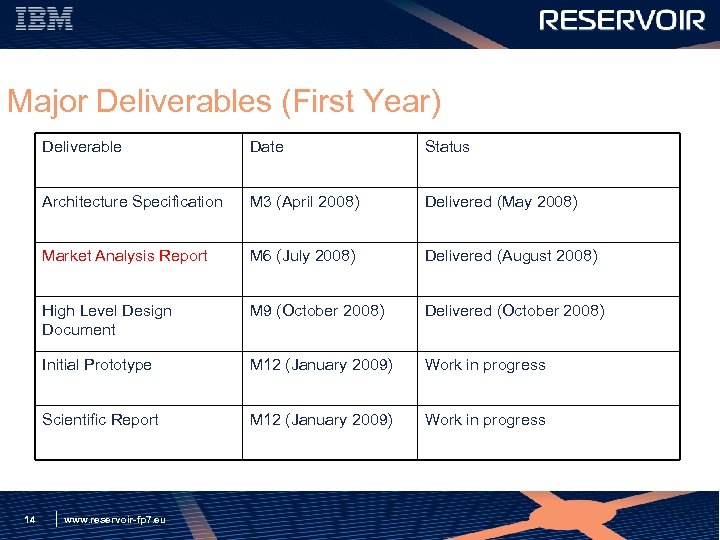
Major Deliverables (First Year) Deliverable Status Architecture Specification M 3 (April 2008) Delivered (May 2008) Market Analysis Report M 6 (July 2008) Delivered (August 2008) High Level Design Document M 9 (October 2008) Delivered (October 2008) Initial Prototype M 12 (January 2009) Work in progress Scientific Report 14 Date M 12 (January 2009) Work in progress www. reservoir-fp 7. eu
Market Analysis Report • Trends • Players • Challenges 15 www. reservoir-fp 7. eu
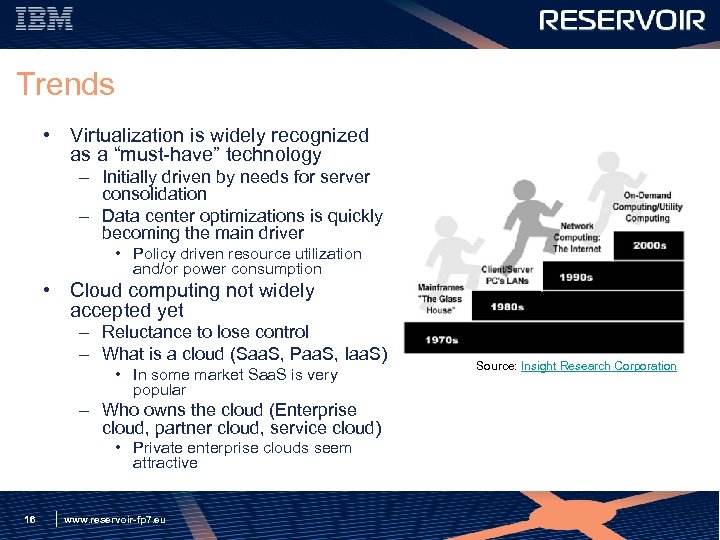
Trends • Virtualization is widely recognized as a “must-have” technology – Initially driven by needs for server consolidation – Data center optimizations is quickly becoming the main driver • Policy driven resource utilization and/or power consumption • Cloud computing not widely accepted yet – Reluctance to lose control – What is a cloud (Saa. S, Paa. S, Iaa. S) • In some market Saa. S is very popular – Who owns the cloud (Enterprise cloud, partner cloud, service cloud) • Private enterprise clouds seem attractive 16 www. reservoir-fp 7. eu Source: Insight Research Corporation
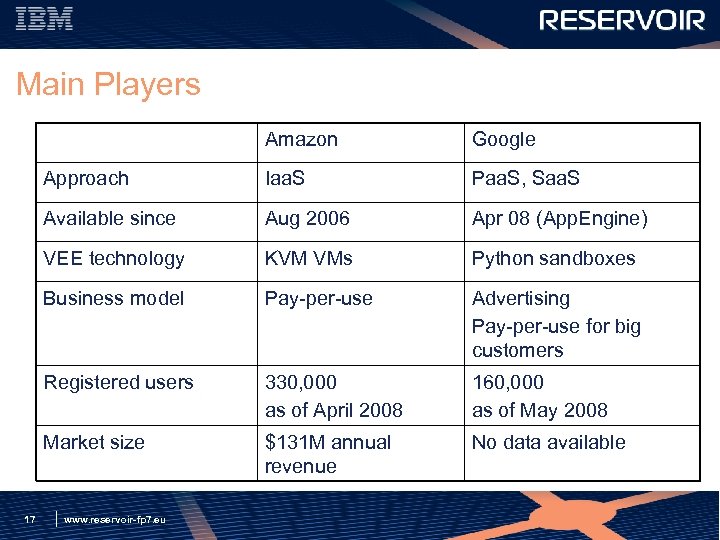
Main Players Amazon Approach Iaa. S Paa. S, Saa. S Available since Aug 2006 Apr 08 (App. Engine) VEE technology KVM VMs Python sandboxes Business model Pay-per-use Advertising Pay-per-use for big customers Registered users 330, 000 as of April 2008 160, 000 as of May 2008 Market size 17 Google $131 M annual revenue No data available www. reservoir-fp 7. eu
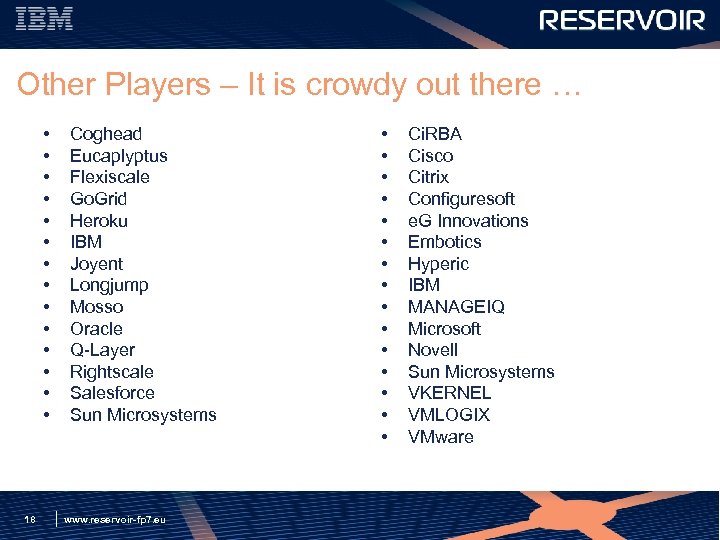
Other Players – It is crowdy out there … • • • • 18 Coghead Eucaplyptus Flexiscale Go. Grid Heroku IBM Joyent Longjump Mosso Oracle Q-Layer Rightscale Salesforce Sun Microsystems www. reservoir-fp 7. eu • • • • Ci. RBA Cisco Citrix Configuresoft e. G Innovations Embotics Hyperic IBM MANAGEIQ Microsoft Novell Sun Microsystems VKERNEL VMLOGIX VMware
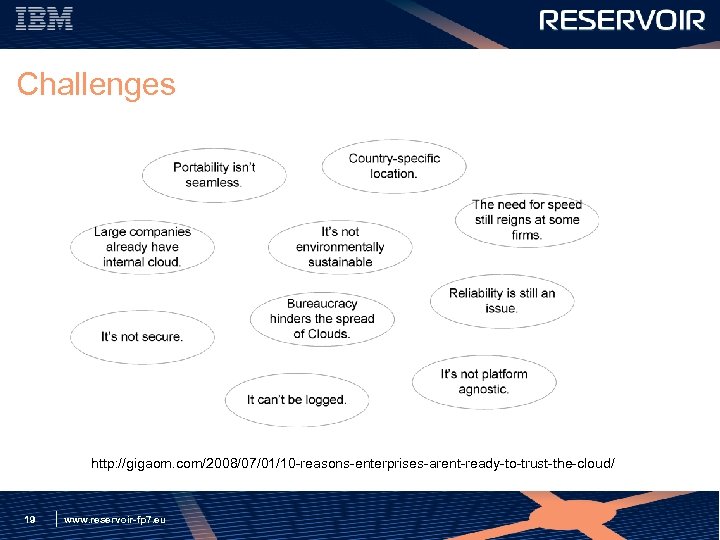
Challenges http: //gigaom. com/2008/07/01/10 -reasons-enterprises-arent-ready-to-trust-the-cloud/ 19 www. reservoir-fp 7. eu
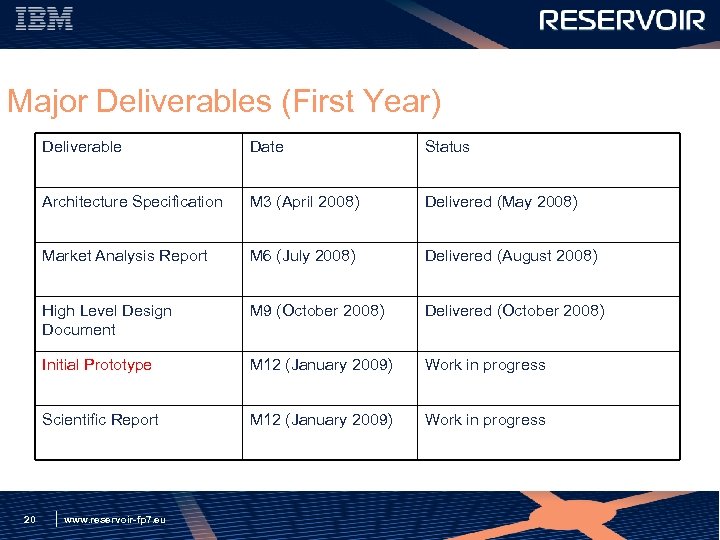
Major Deliverables (First Year) Deliverable Status Architecture Specification M 3 (April 2008) Delivered (May 2008) Market Analysis Report M 6 (July 2008) Delivered (August 2008) High Level Design Document M 9 (October 2008) Delivered (October 2008) Initial Prototype M 12 (January 2009) Work in progress Scientific Report 20 Date M 12 (January 2009) Work in progress www. reservoir-fp 7. eu
First Year Prototype (Jan 09) • Focus on the integration between the different layers – Show end-to-end functionality even if it is partial • Selected use case – Sun Grid Engine on KVM • Scenarios – Initial deployment of complex service • Highlight separation of concerns between SP and IP – Smart placement • Move VEEs around to make room for new “big” VEE – Automatic capacity adjustment (elasticity) • Monitor application, add VEE when application is “in trouble” 21 www. reservoir-fp 7. eu
Summary • Very aggressive project to create the next generation infrastructure for services – Bridge the gap between the services and infrastructure worlds – Focus on technologies that enable to build cooperating computing clouds – Explore, merge and extend technologies • Grid computing concepts (large scale federation) • Virtualization • Business Service Management • Status – Done with the documents … • Architectural spec. (M 4) • Integration plan (M 6) • High level design (M 9) – Initial testbed in place • Sites in UNIME (Italy), UCM (Spain) and IBM (Israel) – Full speed with implementation first year prototype • On track to first official demo (1 Q 09) 22 www. reservoir-fp 7. eu
23 www. reservoir-fp 7. eu
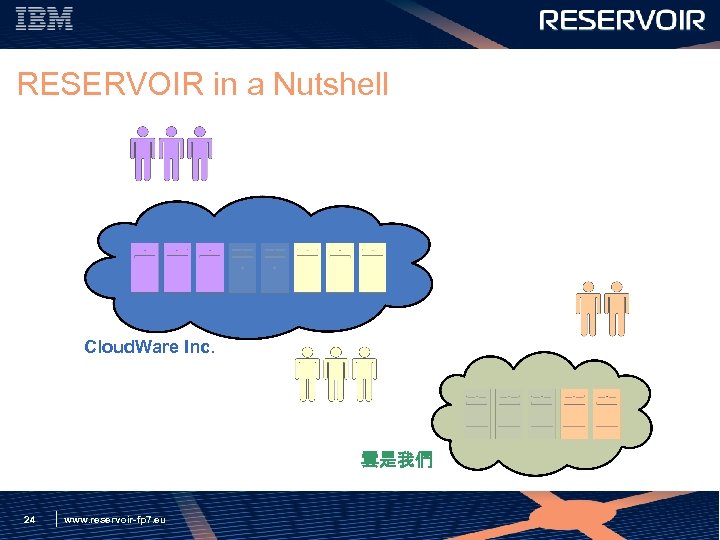
RESERVOIR in a Nutshell Cloud. Ware Inc. 雲是我們 24 www. reservoir-fp 7. eu
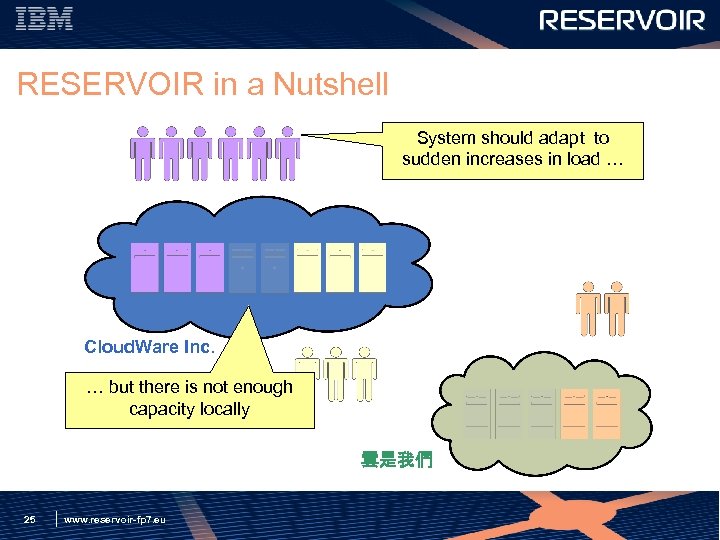
RESERVOIR in a Nutshell System should adapt to sudden increases in load … Cloud. Ware Inc. … but there is not enough capacity locally 雲是我們 25 www. reservoir-fp 7. eu
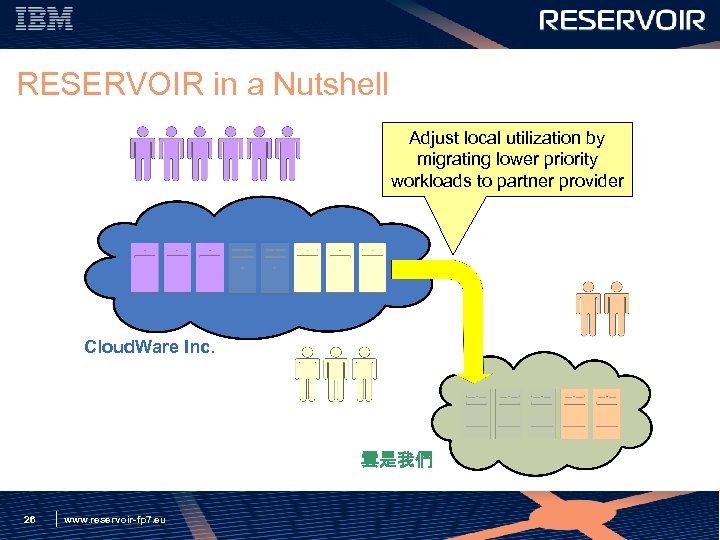
RESERVOIR in a Nutshell Adjust local utilization by migrating lower priority workloads to partner provider Cloud. Ware Inc. 雲是我們 26 www. reservoir-fp 7. eu
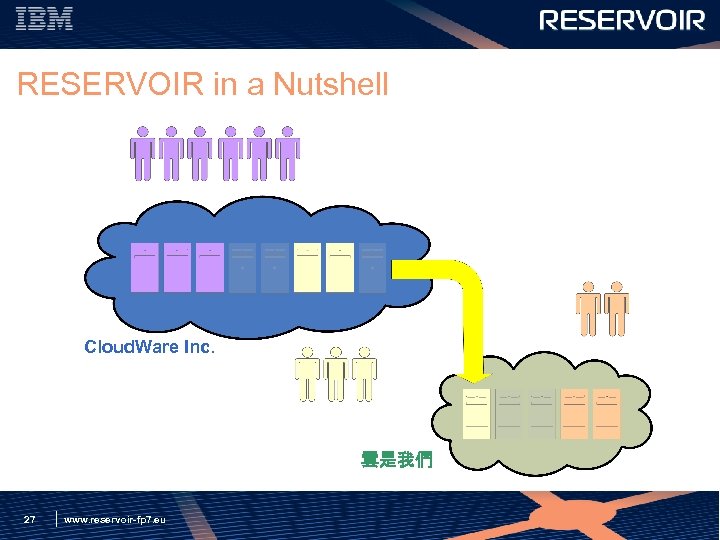
RESERVOIR in a Nutshell Cloud. Ware Inc. 雲是我們 27 www. reservoir-fp 7. eu
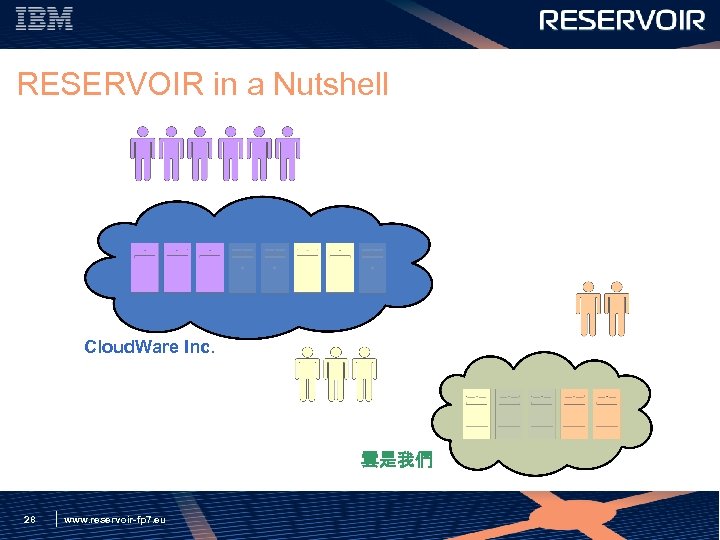
RESERVOIR in a Nutshell Cloud. Ware Inc. 雲是我們 28 www. reservoir-fp 7. eu
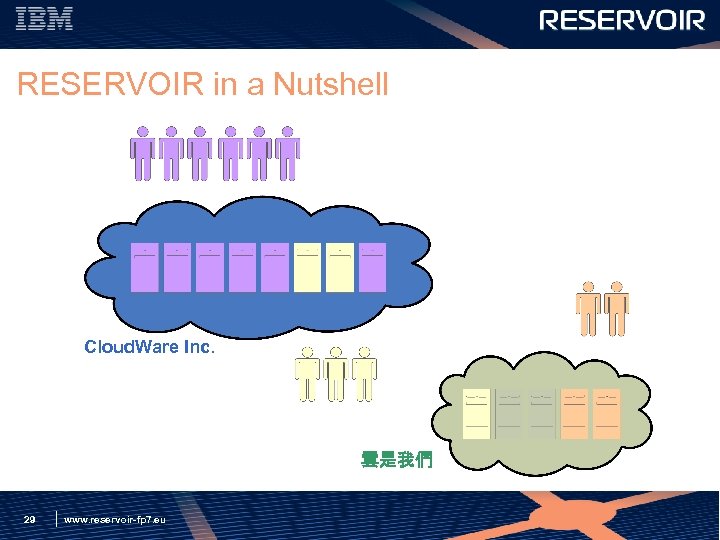
RESERVOIR in a Nutshell Cloud. Ware Inc. 雲是我們 29 www. reservoir-fp 7. eu
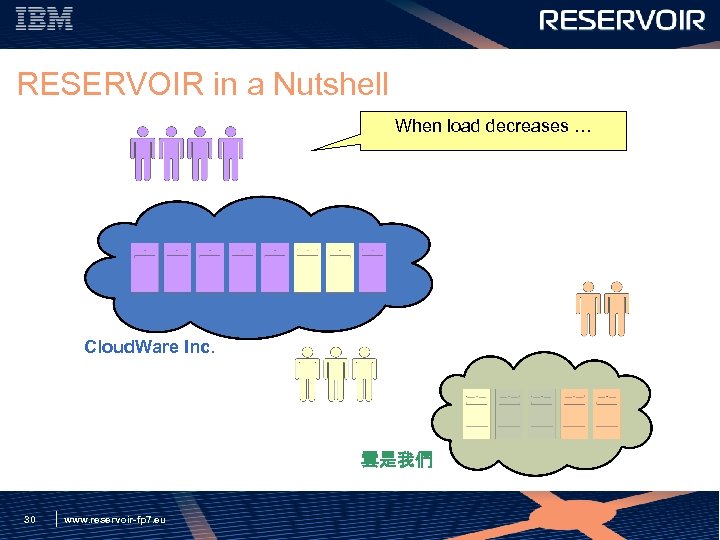
RESERVOIR in a Nutshell When load decreases … Cloud. Ware Inc. 雲是我們 30 www. reservoir-fp 7. eu
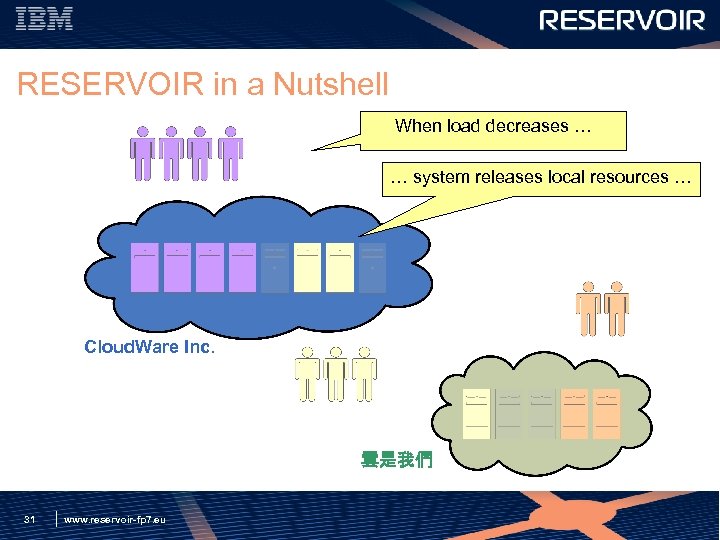
RESERVOIR in a Nutshell When load decreases … … system releases local resources … Cloud. Ware Inc. 雲是我們 31 www. reservoir-fp 7. eu
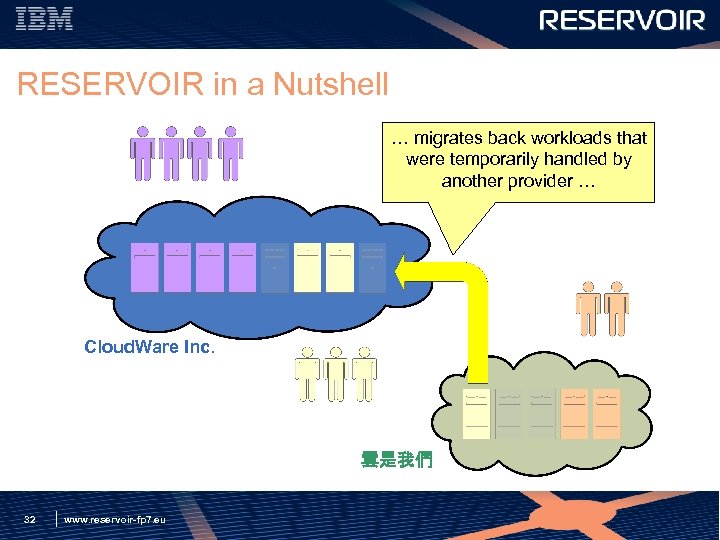
RESERVOIR in a Nutshell … migrates back workloads that were temporarily handled by another provider … Cloud. Ware Inc. 雲是我們 32 www. reservoir-fp 7. eu
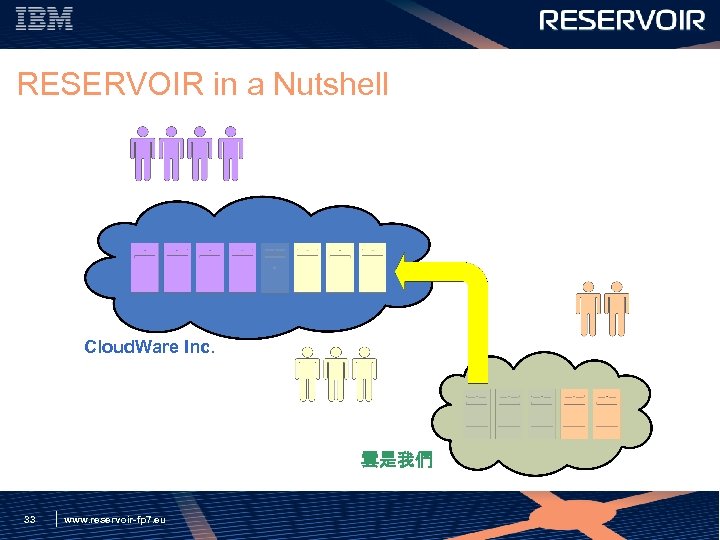
RESERVOIR in a Nutshell Cloud. Ware Inc. 雲是我們 33 www. reservoir-fp 7. eu
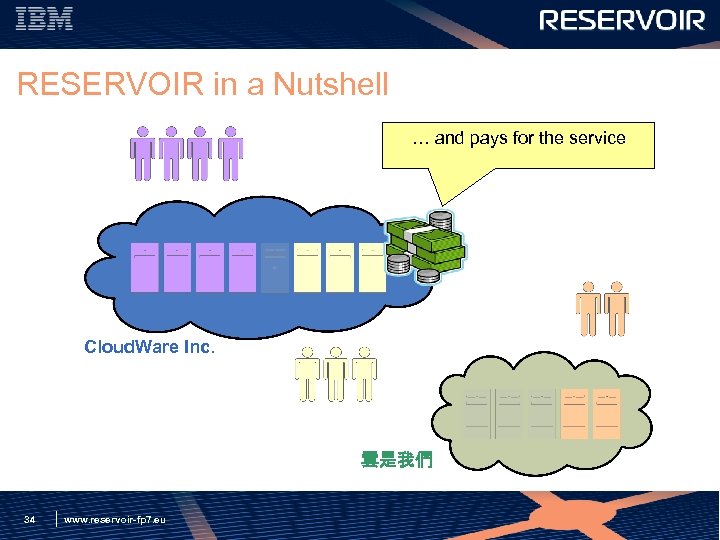
RESERVOIR in a Nutshell … and pays for the service Cloud. Ware Inc. 雲是我們 34 www. reservoir-fp 7. eu
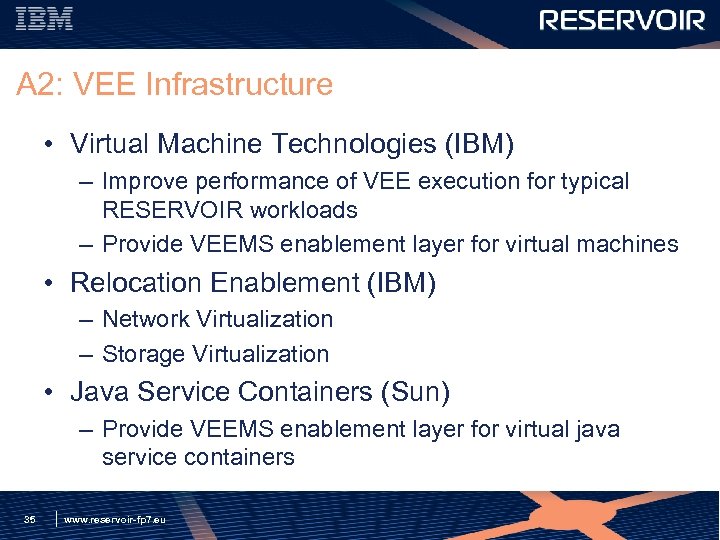
A 2: VEE Infrastructure • Virtual Machine Technologies (IBM) – Improve performance of VEE execution for typical RESERVOIR workloads – Provide VEEMS enablement layer for virtual machines • Relocation Enablement (IBM) – Network Virtualization – Storage Virtualization • Java Service Containers (Sun) – Provide VEEMS enablement layer for virtual java service containers 35 www. reservoir-fp 7. eu
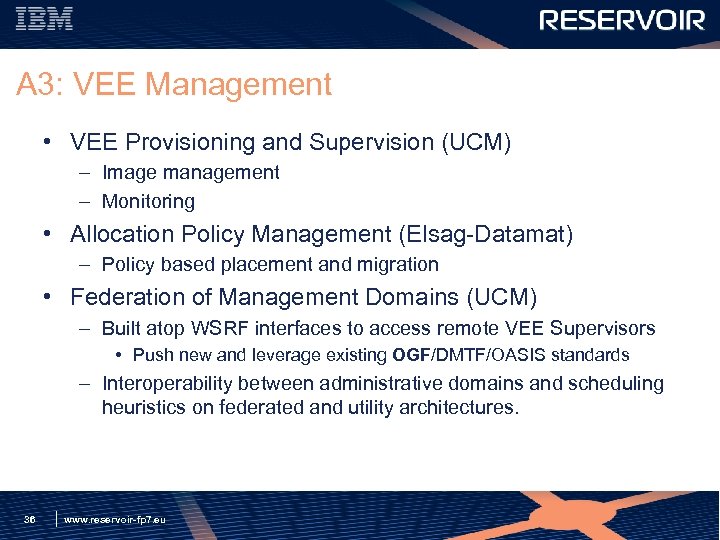
A 3: VEE Management • VEE Provisioning and Supervision (UCM) – Image management – Monitoring • Allocation Policy Management (Elsag-Datamat) – Policy based placement and migration • Federation of Management Domains (UCM) – Built atop WSRF interfaces to access remote VEE Supervisors • Push new and leverage existing OGF/DMTF/OASIS standards – Interoperability between administrative domains and scheduling heuristics on federated and utility architectures. 36 www. reservoir-fp 7. eu
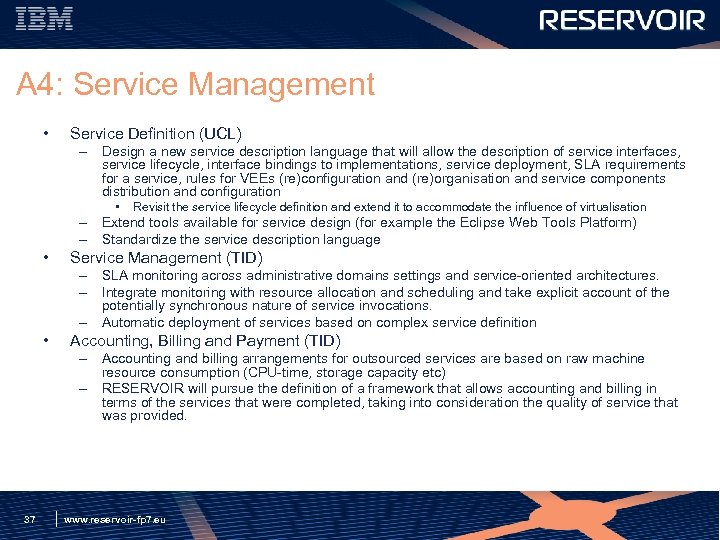
A 4: Service Management • Service Definition (UCL) – Design a new service description language that will allow the description of service interfaces, service lifecycle, interface bindings to implementations, service deployment, SLA requirements for a service, rules for VEEs (re)configuration and (re)organisation and service components distribution and configuration • Revisit the service lifecycle definition and extend it to accommodate the influence of virtualisation – Extend tools available for service design (for example the Eclipse Web Tools Platform) – Standardize the service description language • Service Management (TID) – SLA monitoring across administrative domains settings and service-oriented architectures. – Integrate monitoring with resource allocation and scheduling and take explicit account of the potentially synchronous nature of service invocations. – Automatic deployment of services based on complex service definition • Accounting, Billing and Payment (TID) – Accounting and billing arrangements for outsourced services are based on raw machine resource consumption (CPU-time, storage capacity etc) – RESERVOIR will pursue the definition of a framework that allows accounting and billing in terms of the services that were completed, taking into consideration the quality of service that was provided. 37 www. reservoir-fp 7. eu
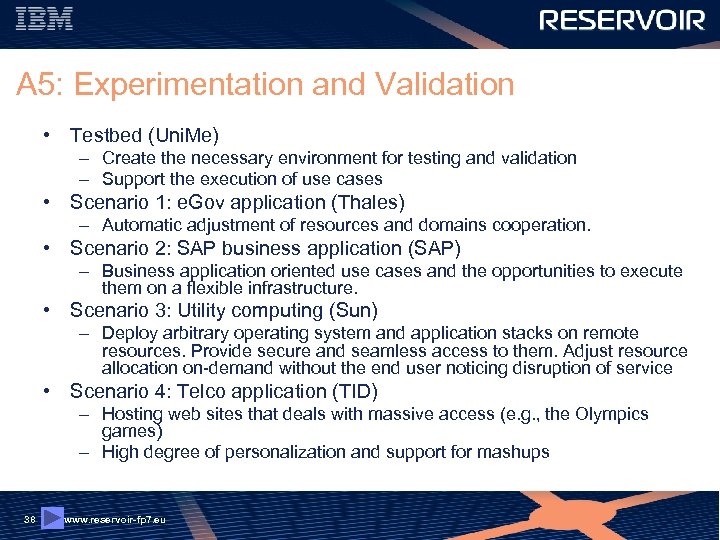
A 5: Experimentation and Validation • Testbed (Uni. Me) – Create the necessary environment for testing and validation – Support the execution of use cases • Scenario 1: e. Gov application (Thales) – Automatic adjustment of resources and domains cooperation. • Scenario 2: SAP business application (SAP) – Business application oriented use cases and the opportunities to execute them on a flexible infrastructure. • Scenario 3: Utility computing (Sun) – Deploy arbitrary operating system and application stacks on remote resources. Provide secure and seamless access to them. Adjust resource allocation on-demand without the end user noticing disruption of service • Scenario 4: Telco application (TID) – Hosting web sites that deals with massive access (e. g. , the Olympics games) – High degree of personalization and support for mashups 38 www. reservoir-fp 7. eu
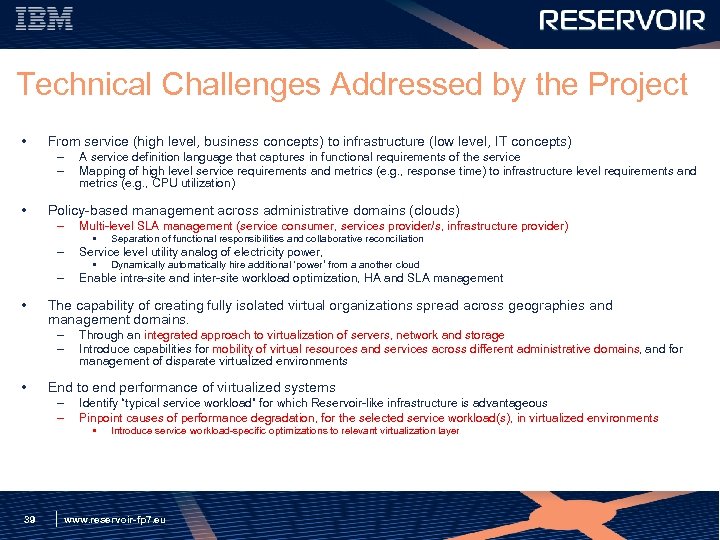
Technical Challenges Addressed by the Project • From service (high level, business concepts) to infrastructure (low level, IT concepts) – – • A service definition language that captures in functional requirements of the service Mapping of high level service requirements and metrics (e. g. , response time) to infrastructure level requirements and metrics (e. g. , CPU utilization) Policy-based management across administrative domains (clouds) – Multi-level SLA management (service consumer, services provider/s, infrastructure provider) • Separation of functional responsibilities and collaborative reconciliation – Service level utility analog of electricity power, – Enable intra-site and inter-site workload optimization, HA and SLA management • • The capability of creating fully isolated virtual organizations spread across geographies and management domains. – – • Through an integrated approach to virtualization of servers, network and storage Introduce capabilities for mobility of virtual resources and services across different administrative domains, and for management of disparate virtualized environments End to end performance of virtualized systems – – Identify “typical service workload” for which Reservoir-like infrastructure is advantageous Pinpoint causes of performance degradation, for the selected service workload(s), in virtualized environments • 39 Dynamically automatically hire additional 'power‘ from a another cloud Introduce service workload-specific optimizations to relevant virtualization layer www. reservoir-fp 7. eu
The RESERVOIR Architecture Spec. • • • Model Use Cases Requirements Security Major Components – VEEH – VEEM – Service Manager • Testbed • Summary 40 www. reservoir-fp 7. eu
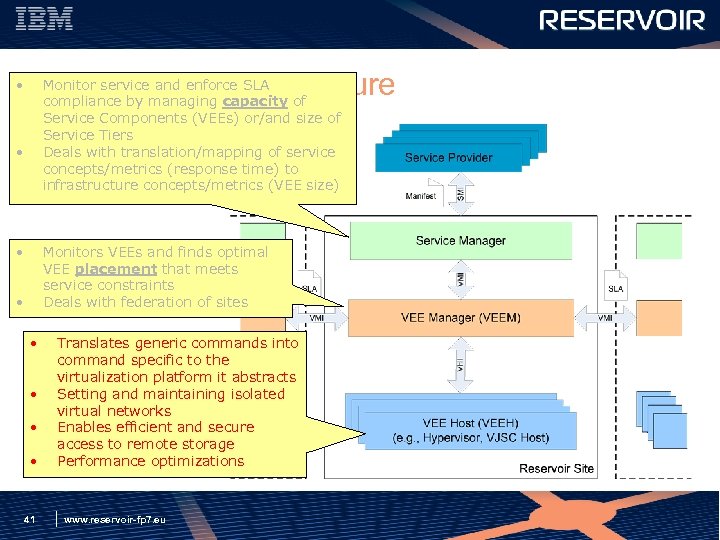
Monitor service and enforce SLA The Reservoir capacity of Architecture compliance by managing • Service Components (VEEs) or/and size of Service Tiers Deals with translation/mapping of service concepts/metrics (response time) to infrastructure concepts/metrics (VEE size) • • Monitors VEEs and finds optimal VEE placement that meets service constraints Deals with federation of sites • • • 41 Translates generic commands into command specific to the virtualization platform it abstracts Setting and maintaining isolated virtual networks Enables efficient and secure access to remote storage Performance optimizations www. reservoir-fp 7. eu
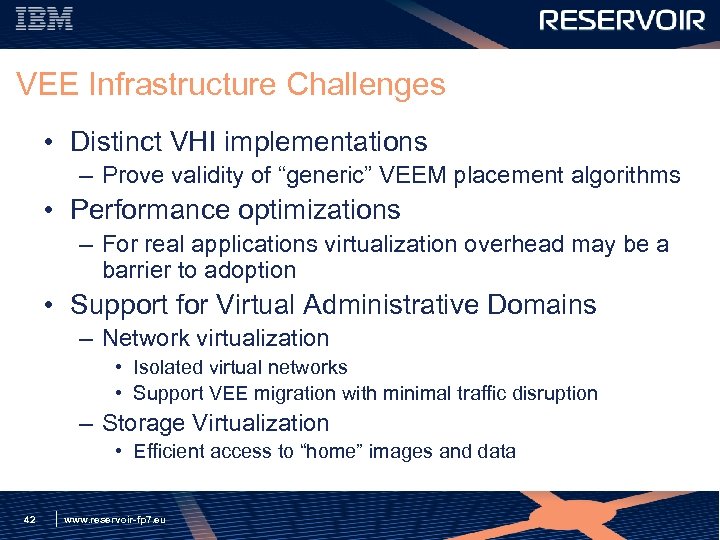
VEE Infrastructure Challenges • Distinct VHI implementations – Prove validity of “generic” VEEM placement algorithms • Performance optimizations – For real applications virtualization overhead may be a barrier to adoption • Support for Virtual Administrative Domains – Network virtualization • Isolated virtual networks • Support VEE migration with minimal traffic disruption – Storage Virtualization • Efficient access to “home” images and data 42 www. reservoir-fp 7. eu
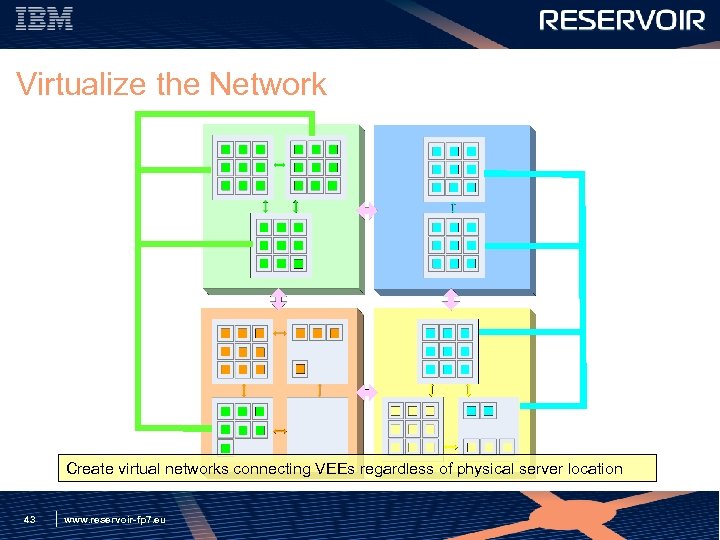
Virtualize the Network Create virtual networks connecting VEEs regardless of physical server location 43 www. reservoir-fp 7. eu
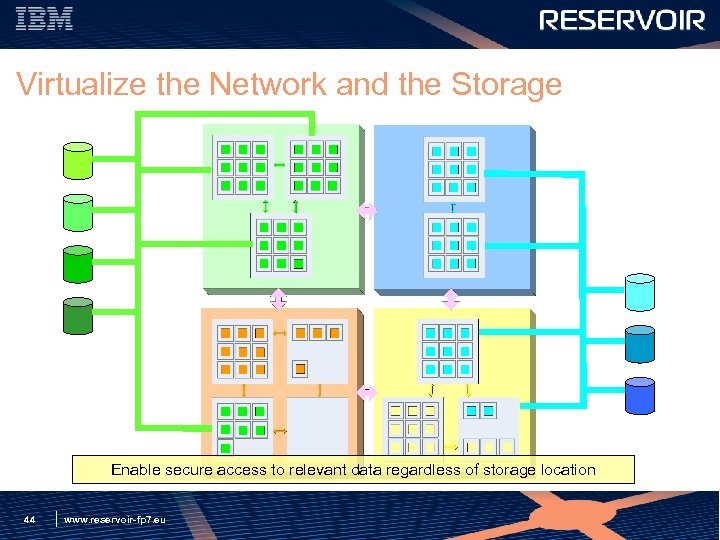
Virtualize the Network and the Storage Enable secure access to relevant data regardless of storage location 44 www. reservoir-fp 7. eu
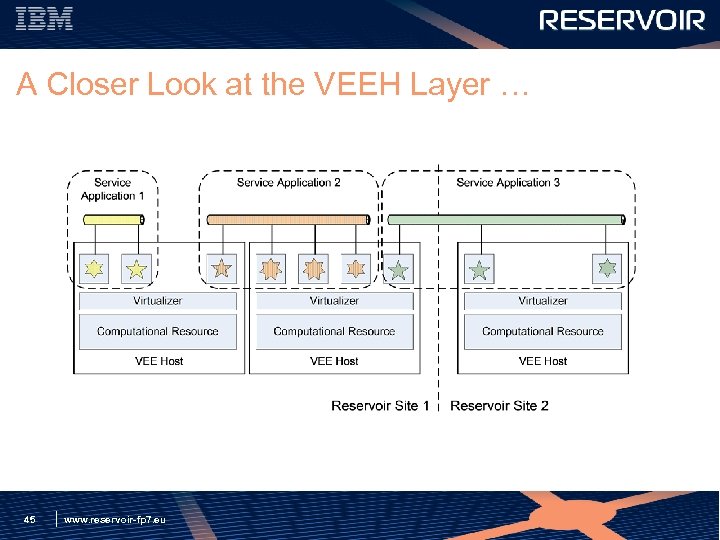
A Closer Look at the VEEH Layer … 45 www. reservoir-fp 7. eu
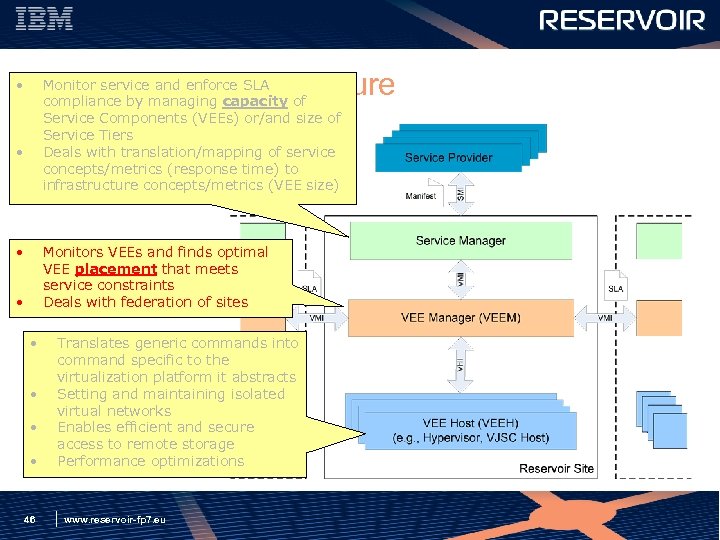
Monitor service and enforce SLA The Reservoir capacity of Architecture compliance by managing • Service Components (VEEs) or/and size of Service Tiers Deals with translation/mapping of service concepts/metrics (response time) to infrastructure concepts/metrics (VEE size) • • Monitors VEEs and finds optimal VEE placement that meets service constraints Deals with federation of sites • • • 46 Translates generic commands into command specific to the virtualization platform it abstracts Setting and maintaining isolated virtual networks Enables efficient and secure access to remote storage Performance optimizations www. reservoir-fp 7. eu
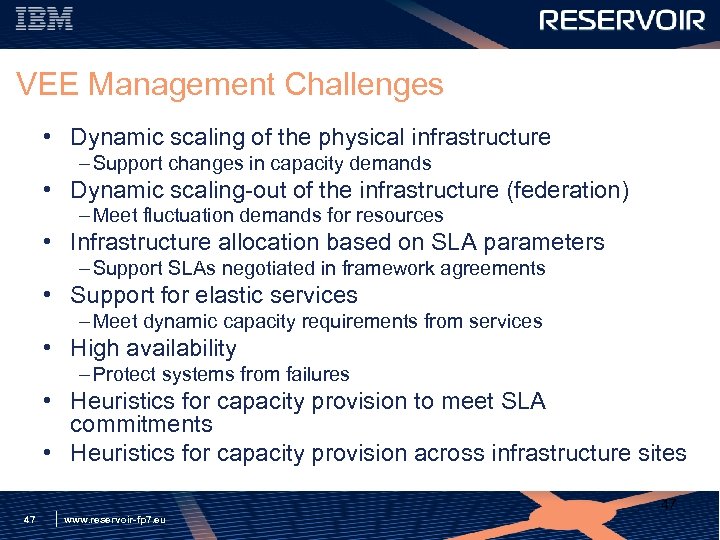
VEE Management Challenges • Dynamic scaling of the physical infrastructure – Support changes in capacity demands • Dynamic scaling-out of the infrastructure (federation) – Meet fluctuation demands for resources • Infrastructure allocation based on SLA parameters – Support SLAs negotiated in framework agreements • Support for elastic services – Meet dynamic capacity requirements from services • High availability – Protect systems from failures • Heuristics for capacity provision to meet SLA commitments • Heuristics for capacity provision across infrastructure sites 47 47 www. reservoir-fp 7. eu
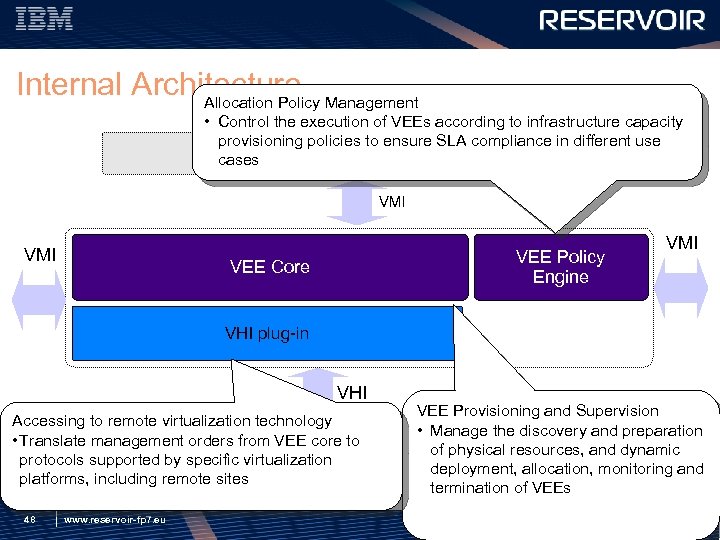
Internal Architecture Management Allocation Policy • Control the execution of VEEs according to infrastructure capacity provisioning policies to ensure SLA compliance in different use Activity 4: Service Management cases VMI VEE Policy Engine VEE Core VMI VHI plug-in VHI VEE Provisioning and Supervision Accessing to remote virtualization technology Virtualizer • Manage the discovery and preparation • Translate management orders from VEE core to Activity 2: VEE of physical resources, and dynamic protocols supported by specific virtualization Infrastructure deployment, allocation, monitoring and platforms, including remote sites Enablement termination of VEEs Presentation Title 48 www. reservoir-fp 7. eu 48
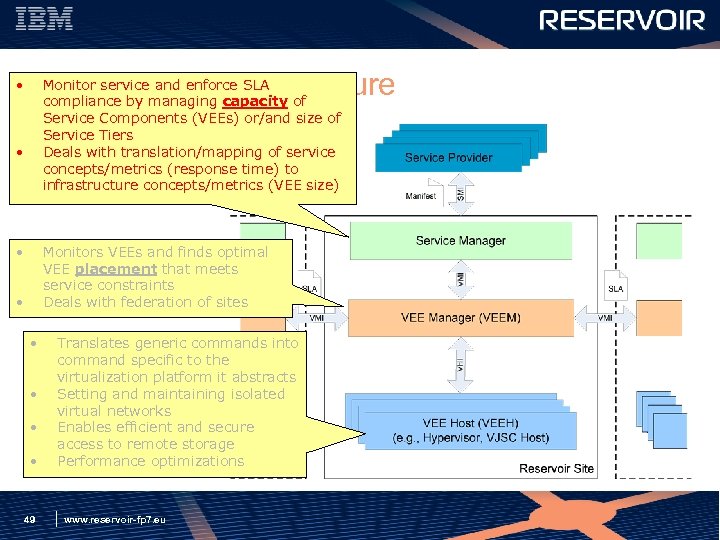
Monitor service and enforce SLA The Reservoir capacity of Architecture compliance by managing • Service Components (VEEs) or/and size of Service Tiers Deals with translation/mapping of service concepts/metrics (response time) to infrastructure concepts/metrics (VEE size) • • Monitors VEEs and finds optimal VEE placement that meets service constraints Deals with federation of sites • • • 49 Translates generic commands into command specific to the virtualization platform it abstracts Setting and maintaining isolated virtual networks Enables efficient and secure access to remote storage Performance optimizations www. reservoir-fp 7. eu
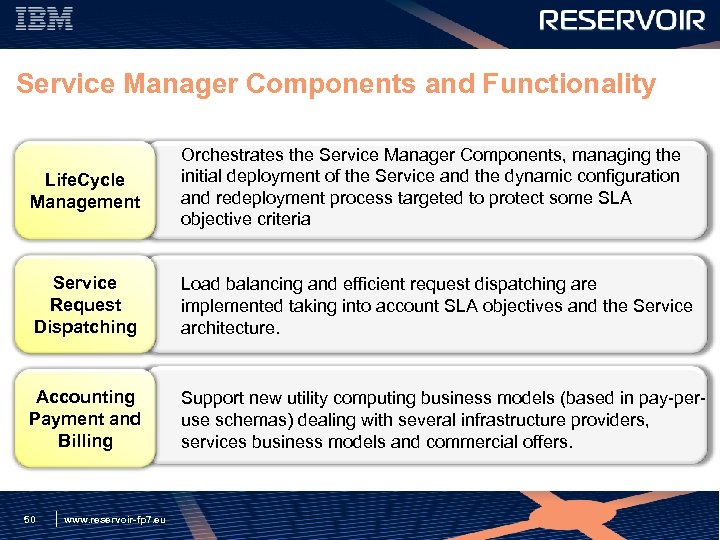
Service Manager Components and Functionality Life. Cycle Management Orchestrates the Service Manager Components, managing the initial deployment of the Service and the dynamic configuration and redeployment process targeted to protect some SLA objective criteria Service Request Dispatching Load balancing and efficient request dispatching are implemented taking into account SLA objectives and the Service architecture. Accounting Payment and Billing Support new utility computing business models (based in pay-peruse schemas) dealing with several infrastructure providers, services business models and commercial offers. 50 www. reservoir-fp 7. eu
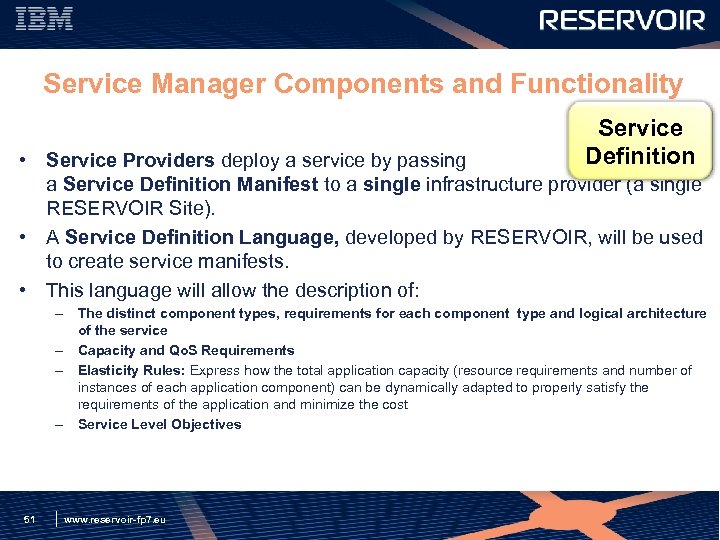
Service Manager Components and Functionality Service Definition • Service Providers deploy a service by passing a Service Definition Manifest to a single infrastructure provider (a single RESERVOIR Site). • A Service Definition Language, developed by RESERVOIR, will be used to create service manifests. • This language will allow the description of: – The distinct component types, requirements for each component type and logical architecture of the service – Capacity and Qo. S Requirements – Elasticity Rules: Express how the total application capacity (resource requirements and number of instances of each application component) can be dynamically adapted to properly satisfy the requirements of the application and minimize the cost – Service Level Objectives 51 www. reservoir-fp 7. eu
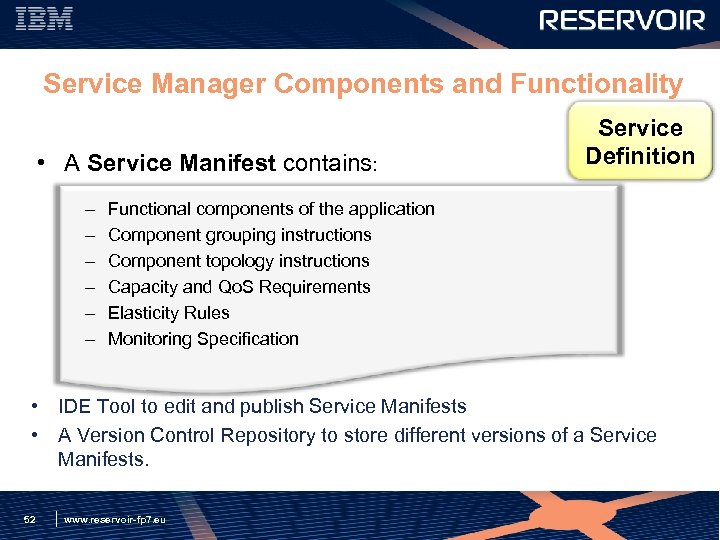
Service Manager Components and Functionality • A Service Manifest contains: – – – Service Definition Functional components of the application Component grouping instructions Component topology instructions Capacity and Qo. S Requirements Elasticity Rules Monitoring Specification • IDE Tool to edit and publish Service Manifests • A Version Control Repository to store different versions of a Service Manifests. 52 www. reservoir-fp 7. eu
Service Manager Components and Functionality • Framework Agreements are contracts that formalize the relationships in the RESERVOIR federated infrastructure: – – • Between Infrastructure Providers and Service Providers Between Infrastructure Providers This contract agreement is transformed into Common Data Model, shared by all the components of the RESEVOIR architecture. It includes: – – Resource Catalogue: Defines the type and characteristics of the resources that are under the agreement control (VEE, virtual networks, firewalls, load balancers, etc. ) SLA Definitions: • • • 53 Service Framework Agreements Key Performance Indicators (KPI): For example, RTO (Return to Operation Time) of a VEE or a network link, throughput in operations per second of a service etc. SLO and KPI threshold mappings: For example, a SLO named “GOLD” would mean that VEE has a RTO threshold of 5 minutes or that a Service Component throughput is 100 operations per second. Business Model Definitions: Costs and accounting directives, Infrastructure Provider Relationship www. reservoir-fp 7. eu
Service Manager Components and Functionality • SLA Monitoring: SLA Monitoring – Once a Service is deployed, monitoring components collect useful data to prevent and detect SLA violations. • SLA Protection : – Components that dynamically detect SLA violations and predict future SLA violations based in historical and heuristic knowledge. – They generate events to the Lifecycle Components that start the process of reconfiguration of the services when need in order to resolve problems with SLA fulfillment. • Monitoring Mechanisms: – Non-Intrusive Service Component Probes that gather and process network data – VEE Monitoring Interface that allows the monitoring components to collect VEE usage statistics (CPU, memory. . ) 54 www. reservoir-fp 7. eu
Скачать презентацию RESERVOIR Resources and Services Virtualization without Boundaries Benny
7ebbc467241445cfb601e0e3655851c7.ppt