


 Скачать презентацию Réseau Introduction cours 1 Sommaire du cours
e2c4fd8173650e2c5d729fe08a66e016.ppt
- Количество слайдов: 71
 Réseau: Introduction (cours 1)
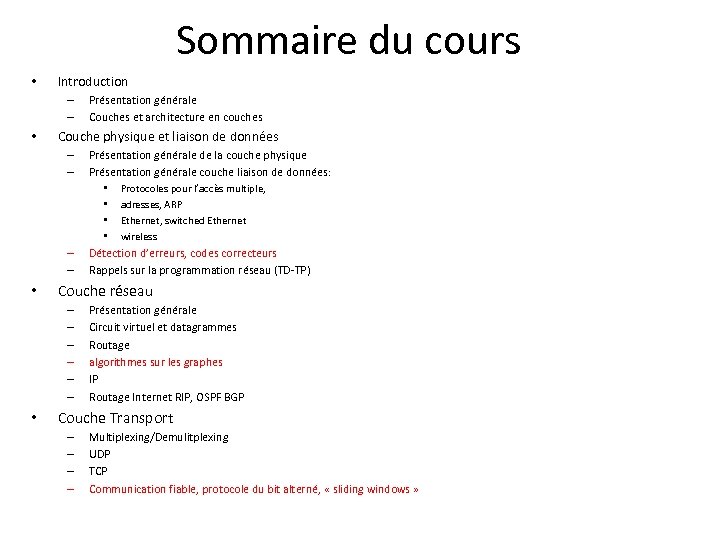 Sommaire du cours • Introduction – – • Couche physique et liaison de données – – • Présentation générale de la couche physique Présentation générale couche liaison de données: • Protocoles pour l’accès multiple, • adresses, ARP • Ethernet, switched Ethernet • wireless Détection d’erreurs, codes correcteurs Rappels sur la programmation réseau (TD-TP) Couche réseau – – – • Présentation générale Couches et architecture en couches Présentation générale Circuit virtuel et datagrammes Routage algorithmes sur les graphes IP Routage Internet RIP, OSPF BGP Couche Transport – – Multiplexing/Demulitplexing UDP TCP Communication fiable, protocole du bit alterné, « sliding windows »
 Bibliographie Computer Networking. J. F. Kurose, K. W. Ross (Pearson) Computer Networks. A. S. Tannenbaum, D. J. Wetherall (Pearson) TCP-IP Illustrated Vol 1: the protocols. R. Stevens (Addison-Wesley) Introduction to Distributed Algorithms. G. Tel (Cambridge) Design and Analysis of Distributed Algorithms. N Santoro (Wiley-Interscience)
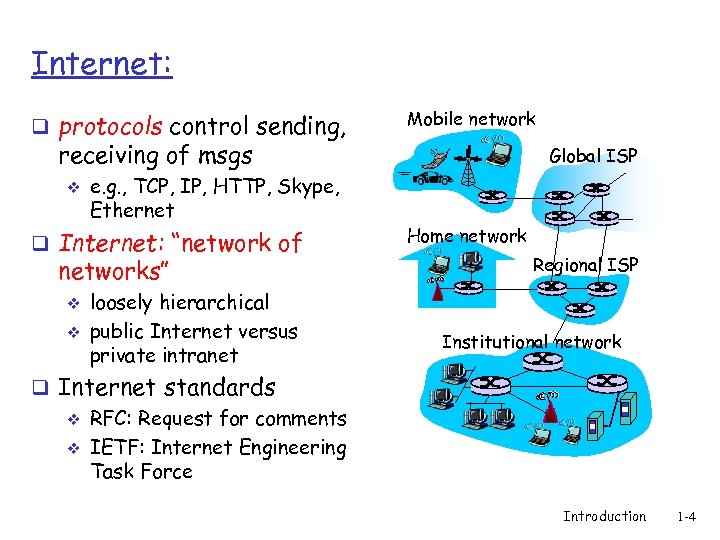 Internet: q protocols control sending, Mobile network receiving of msgs v e. g. , TCP, IP, HTTP, Skype, Ethernet q Internet: “network of networks” v v loosely hierarchical public Internet versus private intranet Global ISP Home network Regional ISP Institutional network q Internet standards v RFC: Request for comments v IETF: Internet Engineering Task Force Introduction 1 -4
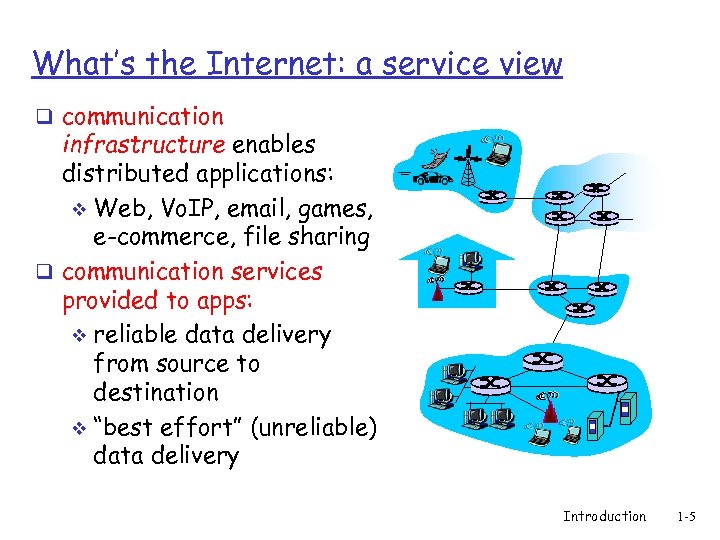 What’s the Internet: a service view q communication infrastructure enables distributed applications: v Web, Vo. IP, email, games, e-commerce, file sharing q communication services provided to apps: v reliable data delivery from source to destination v “best effort” (unreliable) data delivery Introduction 1 -5
 What’s a protocol? human protocols: q “what’s the time? ” q “I have a question” q introductions … specific msgs sent … specific actions taken when msgs received, or other events network protocols: q machines rather than humans q all communication activity in Internet governed by protocols define format, order of msgs sent and received among network entities, and actions taken on msg transmission, receipt Introduction 1 -6
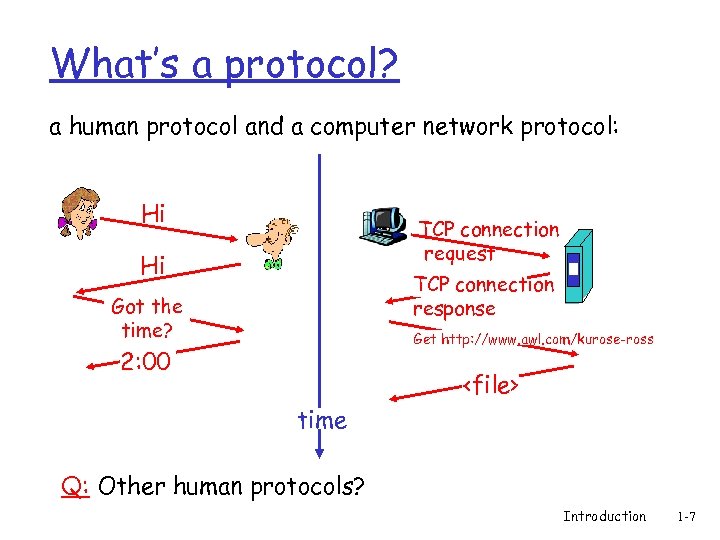 What’s a protocol? a human protocol and a computer network protocol: Hi TCP connection request Hi TCP connection response Got the time? Get http: //www. awl. com/kurose-ross 2: 00
 Introduction 1. 2. Internet? Bordure du réseau (network edge) q end systems, access networks, links 3. Coeur du réseau q circuit switching, packet switching, structure du réseau 4. 5. 6. Retards, pertes, débit dans les packet-switched networks Protocoles en couches (layer), modèles de services Historique Introduction 1 -8
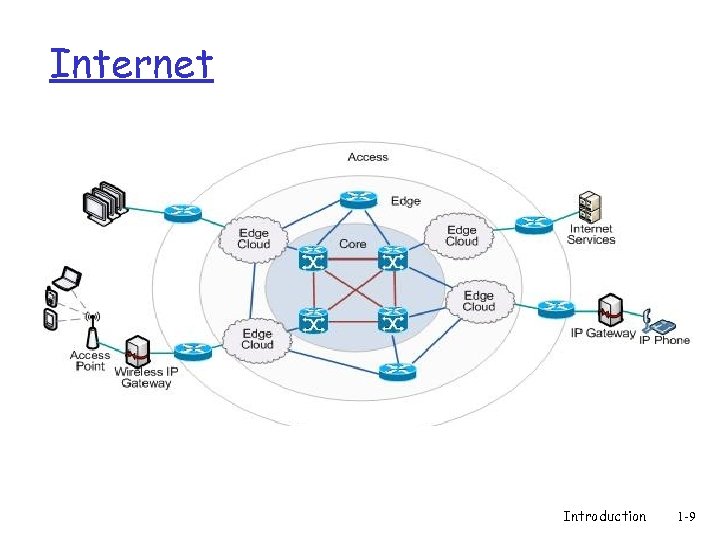 Internet Introduction 1 -9
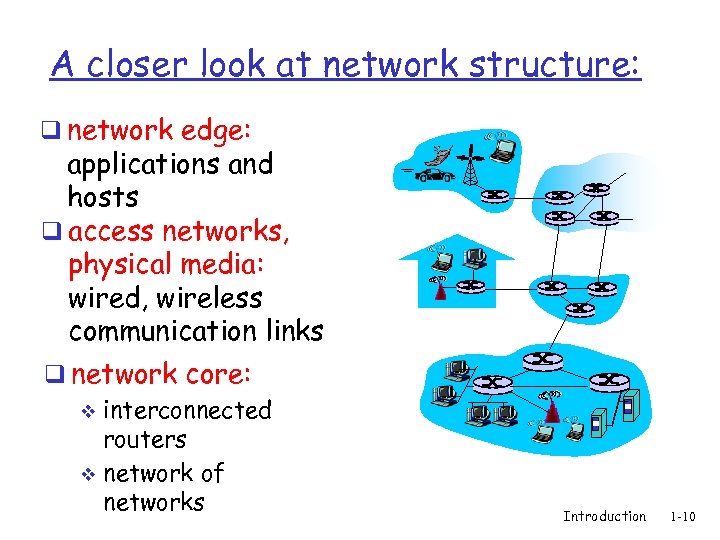 A closer look at network structure: q network edge: applications and hosts q access networks, physical media: wired, wireless communication links q network core: v interconnected routers v network of networks Introduction 1 -10
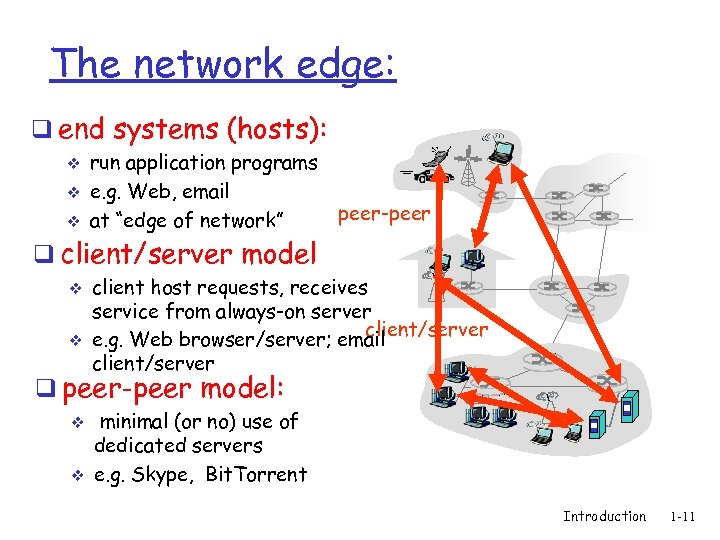 The network edge: q end systems (hosts): v v v run application programs e. g. Web, email at “edge of network” peer-peer q client/server model v v client host requests, receives service from always-on server client/server e. g. Web browser/server; email client/server q peer-peer model: v v minimal (or no) use of dedicated servers e. g. Skype, Bit. Torrent Introduction 1 -11
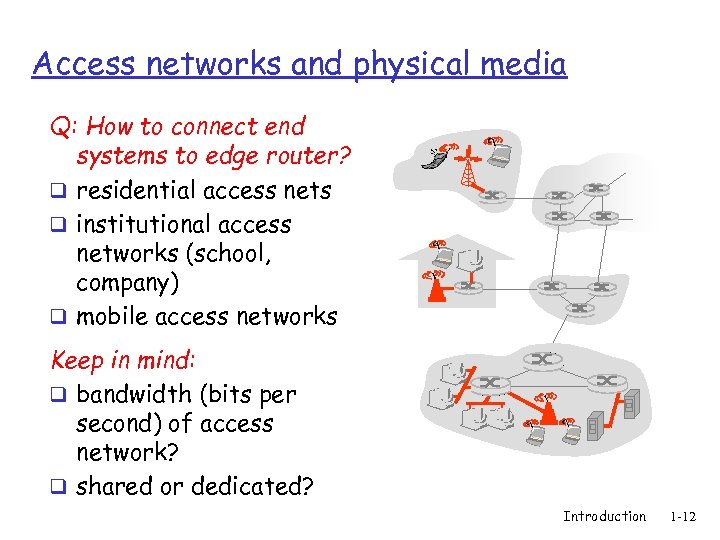 Access networks and physical media Q: How to connect end systems to edge router? q residential access nets q institutional access networks (school, company) q mobile access networks Keep in mind: q bandwidth (bits per second) of access network? q shared or dedicated? Introduction 1 -12
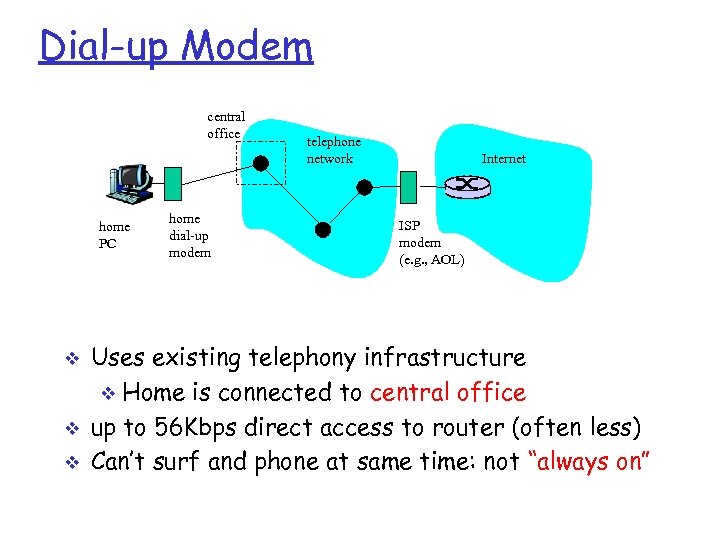 Dial-up Modem central office home PC v v v home dial-up modem telephone network Internet ISP modem (e. g. , AOL) Uses existing telephony infrastructure v Home is connected to central office up to 56 Kbps direct access to router (often less) Can’t surf and phone at same time: not “always on”
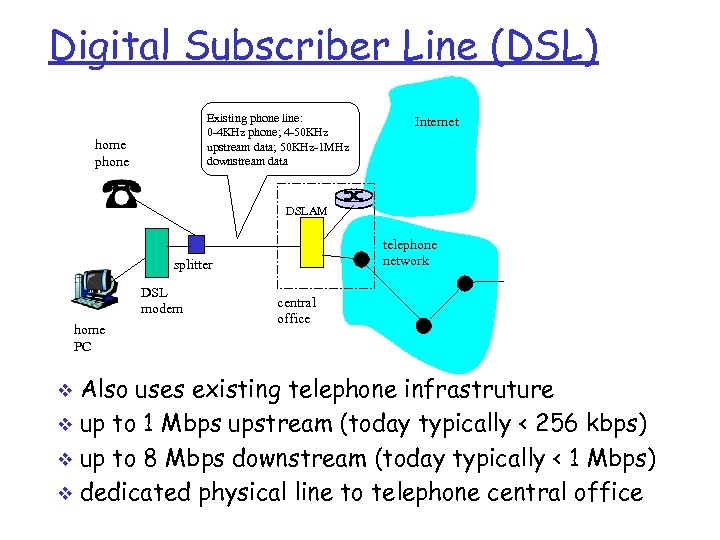 Digital Subscriber Line (DSL) Existing phone line: 0 -4 KHz phone; 4 -50 KHz upstream data; 50 KHz-1 MHz downstream data home phone Internet DSLAM telephone network splitter DSL modem home PC central office Also uses existing telephone infrastruture v up to 1 Mbps upstream (today typically < 256 kbps) v up to 8 Mbps downstream (today typically < 1 Mbps) v dedicated physical line to telephone central office v
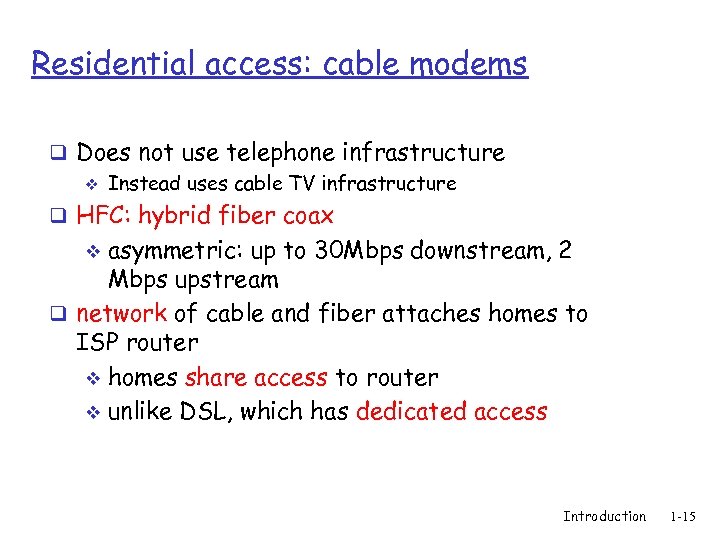 Residential access: cable modems q Does not use telephone infrastructure v Instead uses cable TV infrastructure q HFC: hybrid fiber coax asymmetric: up to 30 Mbps downstream, 2 Mbps upstream q network of cable and fiber attaches homes to ISP router v homes share access to router v unlike DSL, which has dedicated access v Introduction 1 -15
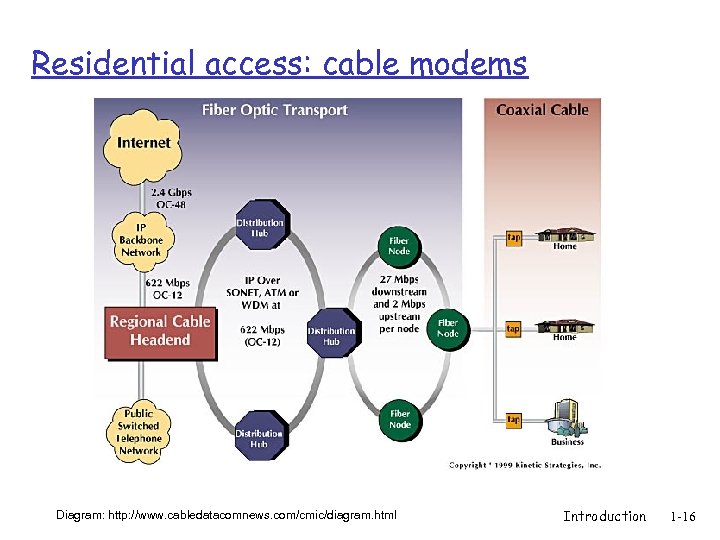 Residential access: cable modems Diagram: http: //www. cabledatacomnews. com/cmic/diagram. html Introduction 1 -16
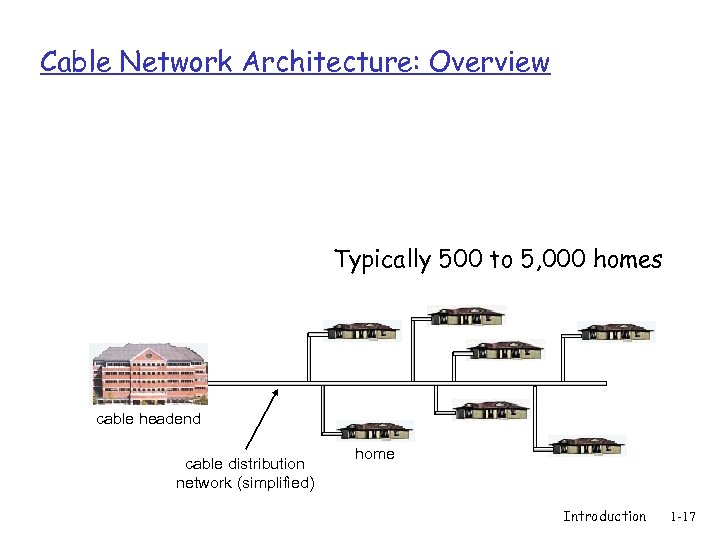 Cable Network Architecture: Overview Typically 500 to 5, 000 homes cable headend cable distribution network (simplified) home Introduction 1 -17
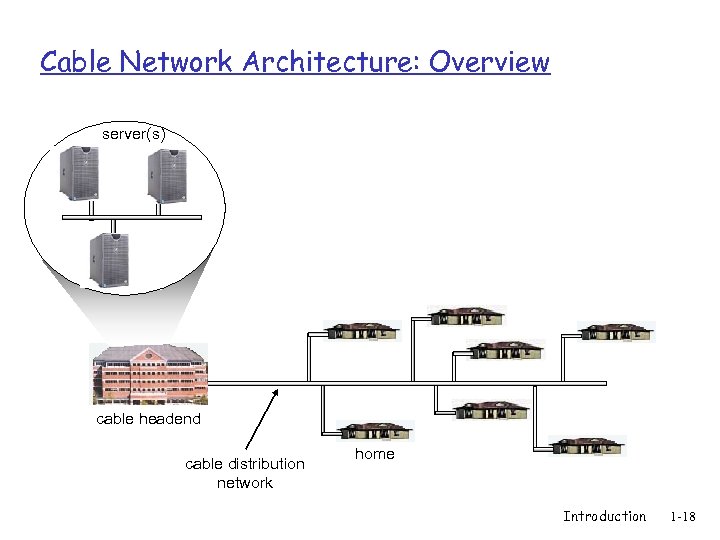 Cable Network Architecture: Overview server(s) cable headend cable distribution network home Introduction 1 -18
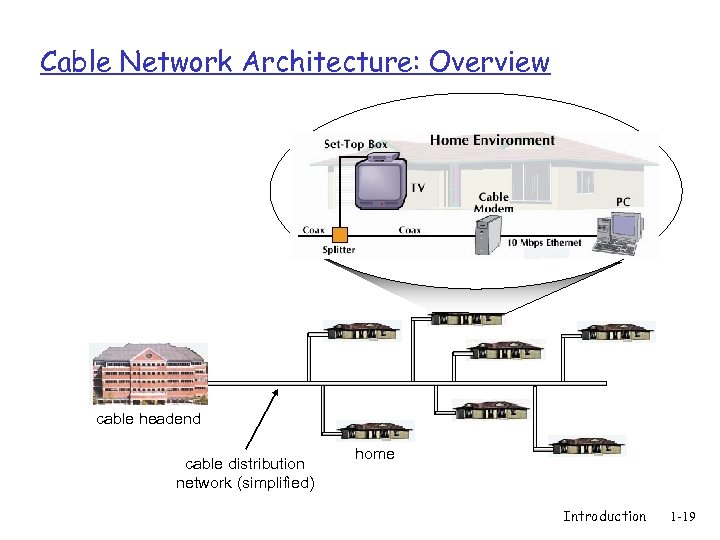 Cable Network Architecture: Overview cable headend cable distribution network (simplified) home Introduction 1 -19
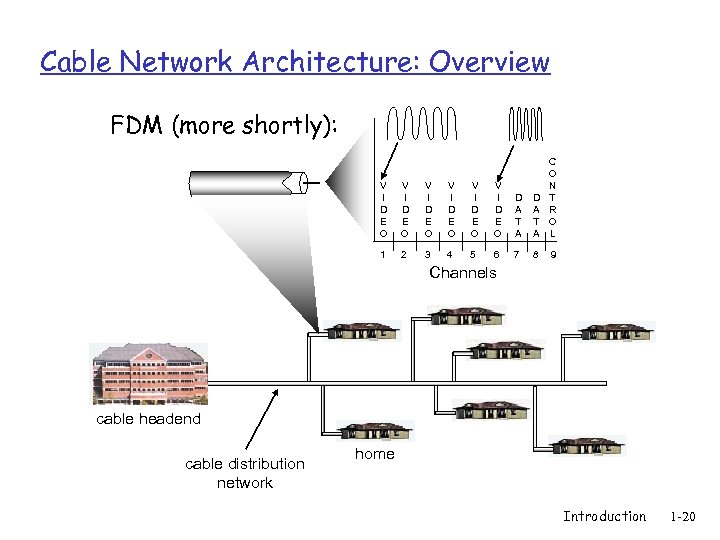 Cable Network Architecture: Overview FDM (more shortly): V I D E O V I D E O D A T A C O N T R O L 1 2 3 4 5 6 7 8 9 Channels cable headend cable distribution network home Introduction 1 -20
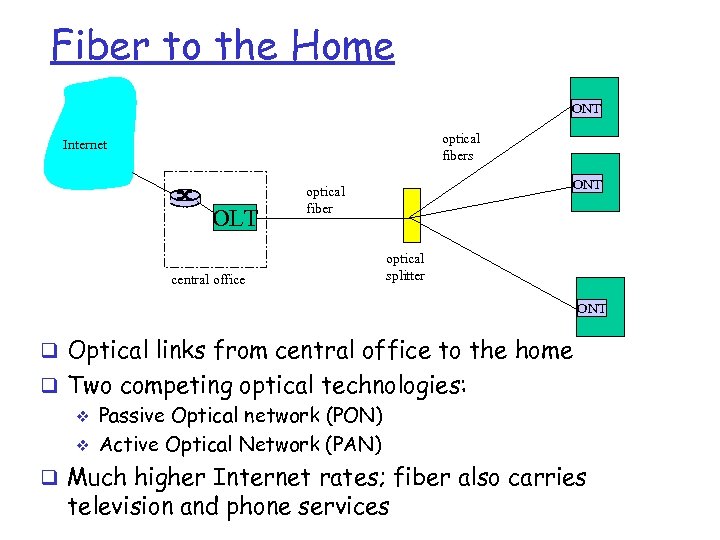 Fiber to the Home ONT optical fibers Internet OLT central office ONT optical fiber optical splitter ONT q Optical links from central office to the home q Two competing optical technologies: v Passive Optical network (PON) v Active Optical Network (PAN) q Much higher Internet rates; fiber also carries television and phone services
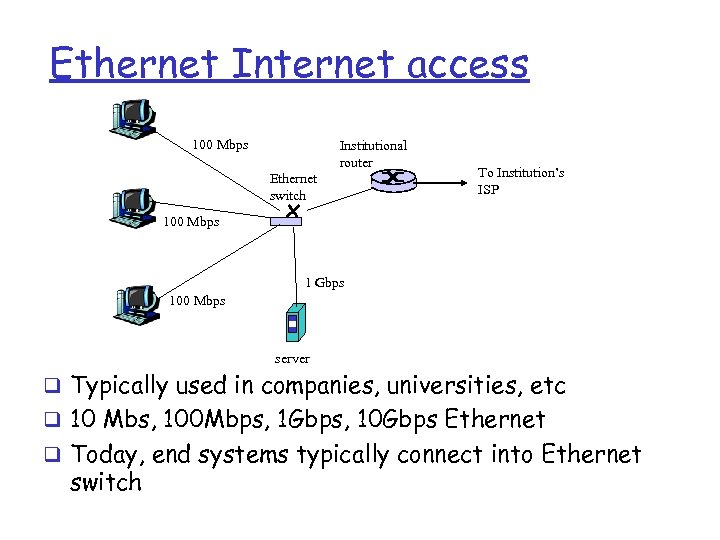 Ethernet Internet access 100 Mbps Institutional router Ethernet switch To Institution’s ISP 100 Mbps 1 Gbps 100 Mbps server q Typically used in companies, universities, etc q 10 Mbs, 100 Mbps, 1 Gbps, 10 Gbps Ethernet q Today, end systems typically connect into Ethernet switch
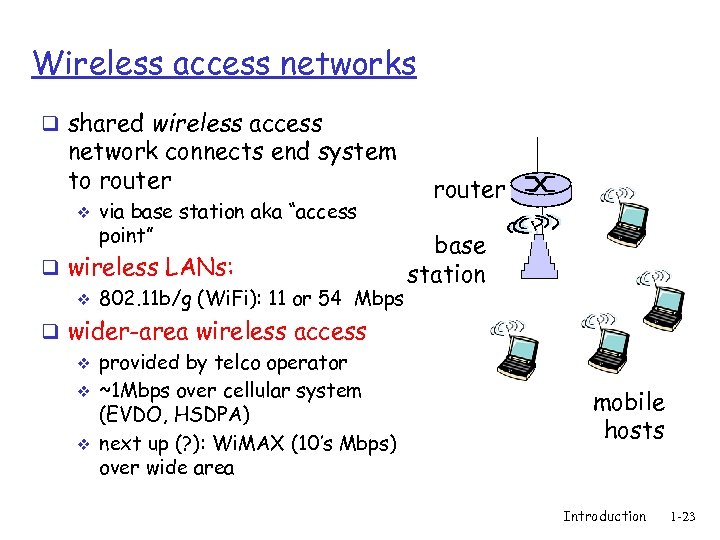 Wireless access networks q shared wireless access network connects end system to router v via base station aka “access point” q wireless LANs: v 802. 11 b/g (Wi. Fi): 11 or 54 Mbps q wider-area wireless access v provided by telco operator v ~1 Mbps over cellular system (EVDO, HSDPA) v next up (? ): Wi. MAX (10’s Mbps) over wide area router base station mobile hosts Introduction 1 -23
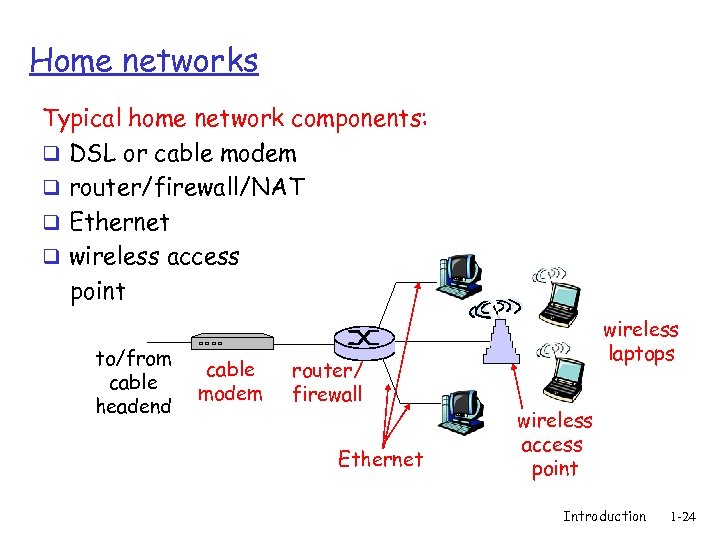 Home networks Typical home network components: q DSL or cable modem q router/firewall/NAT q Ethernet q wireless access point to/from cable headend cable modem router/ firewall Ethernet wireless laptops wireless access point Introduction 1 -24
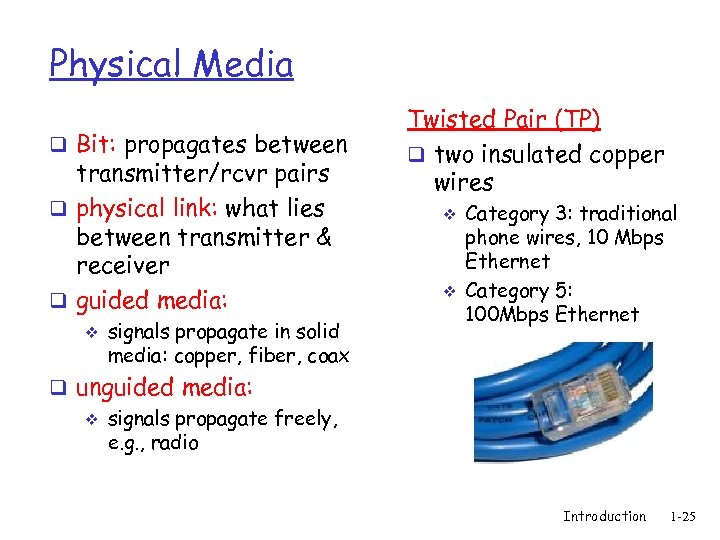 Physical Media q Bit: propagates between transmitter/rcvr pairs q physical link: what lies between transmitter & receiver q guided media: v signals propagate in solid media: copper, fiber, coax Twisted Pair (TP) q two insulated copper wires v v Category 3: traditional phone wires, 10 Mbps Ethernet Category 5: 100 Mbps Ethernet q unguided media: v signals propagate freely, e. g. , radio Introduction 1 -25
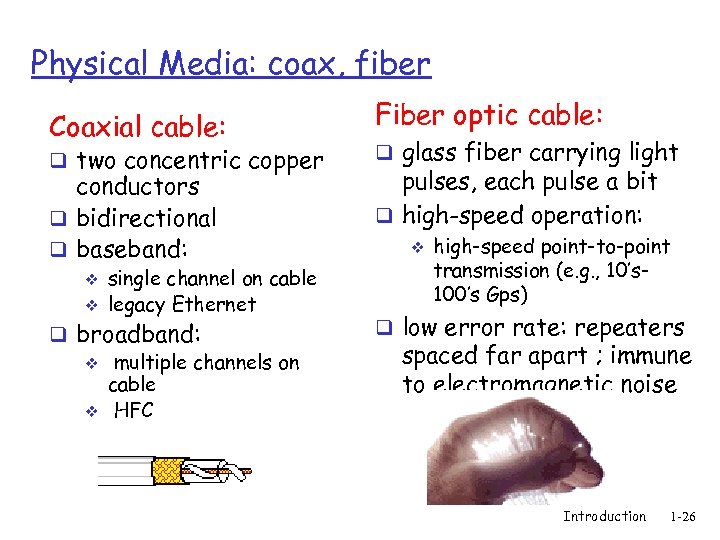 Physical Media: coax, fiber Coaxial cable: Fiber optic cable: conductors q bidirectional q baseband: pulses, each pulse a bit q high-speed operation: q two concentric copper v v single channel on cable legacy Ethernet q broadband: v multiple channels on cable v HFC q glass fiber carrying light v high-speed point-to-point transmission (e. g. , 10’s 100’s Gps) q low error rate: repeaters spaced far apart ; immune to electromagnetic noise Introduction 1 -26
 Physical media: radio q signal carried in electromagnetic spectrum q no physical “wire” q bidirectional q propagation environment effects: v v v reflection obstruction by objects interference Radio link types: q terrestrial microwave v e. g. up to 45 Mbps channels q LAN (e. g. , Wifi) v 11 Mbps, 54 Mbps q wide-area (e. g. , cellular) v 3 G cellular: ~ 1 Mbps q satellite v Kbps to 45 Mbps channel (or multiple smaller channels) v 270 msec end-end delay v geosynchronous versus low altitude Introduction 1 -27
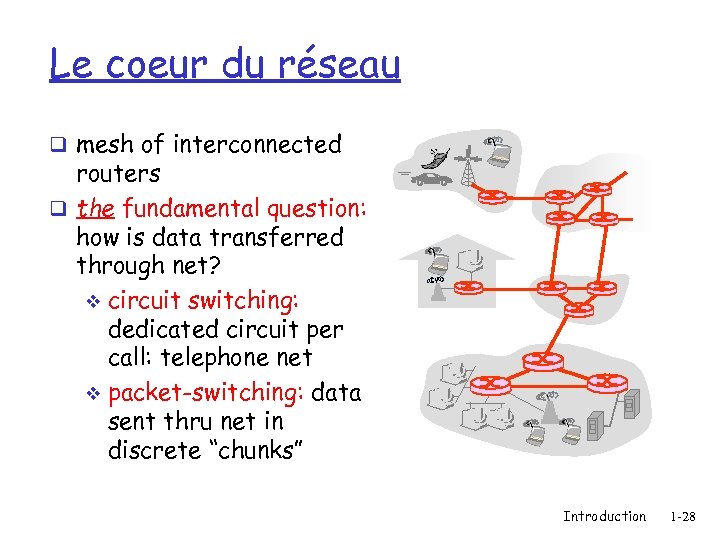 Le coeur du réseau q mesh of interconnected routers q the fundamental question: how is data transferred through net? v circuit switching: dedicated circuit per call: telephone net v packet-switching: data sent thru net in discrete “chunks” Introduction 1 -28
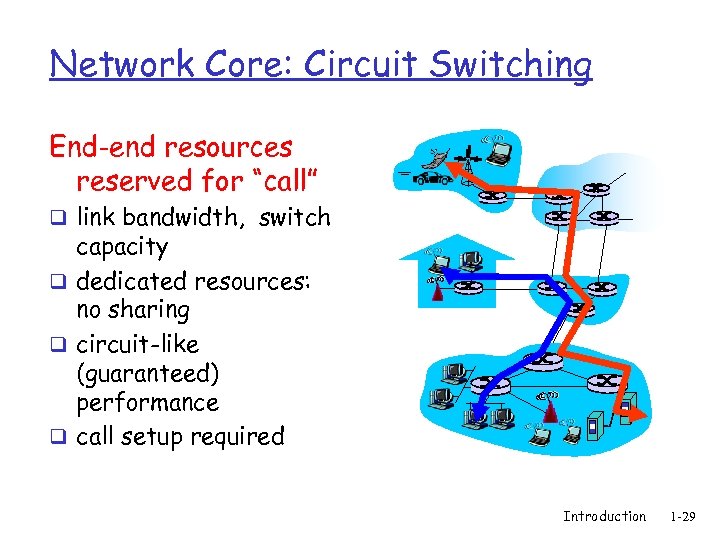 Network Core: Circuit Switching End-end resources reserved for “call” q link bandwidth, switch capacity q dedicated resources: no sharing q circuit-like (guaranteed) performance q call setup required Introduction 1 -29
 Network Core: Circuit Switching network resources (e. g. , bandwidth) divided into “pieces” q pieces allocated to calls q dividing link bandwidth into “pieces” v frequency division v time division q resource piece idle if not used by owning call (no sharing) Introduction 1 -30
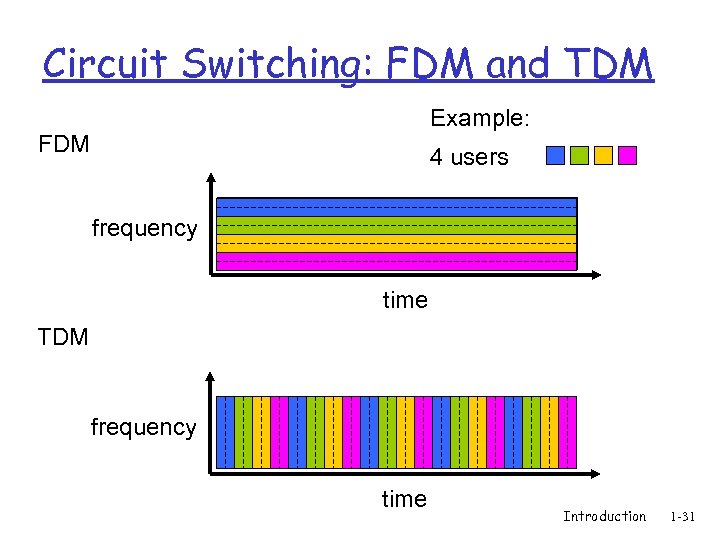 Circuit Switching: FDM and TDM Example: FDM 4 users frequency time TDM frequency time Introduction 1 -31
 Numerical example q How long does it take to send a file of 640, 000 bits from host A to host B over a circuit-switched network? All links are 1. 536 Mbps v Each link uses TDM with 24 slots/sec v 500 msec to establish end-to-end circuit v Let’s work it out! Introduction 1 -32
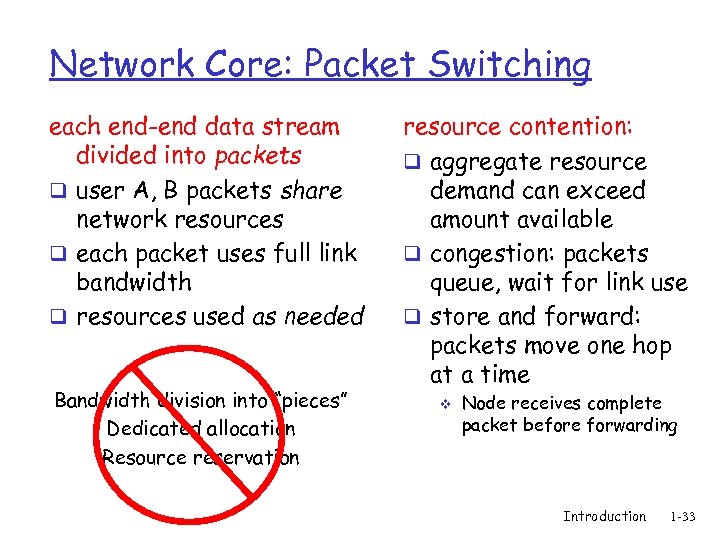 Network Core: Packet Switching each end-end data stream divided into packets q user A, B packets share network resources q each packet uses full link bandwidth q resources used as needed Bandwidth division into “pieces” Dedicated allocation Resource reservation resource contention: q aggregate resource demand can exceed amount available q congestion: packets queue, wait for link use q store and forward: packets move one hop at a time v Node receives complete packet before forwarding Introduction 1 -33
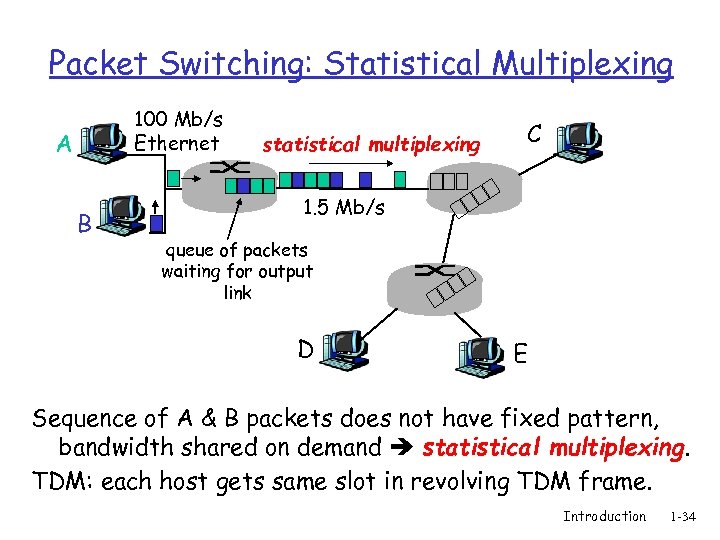 Packet Switching: Statistical Multiplexing 100 Mb/s Ethernet A B statistical multiplexing C 1. 5 Mb/s queue of packets waiting for output link D E Sequence of A & B packets does not have fixed pattern, bandwidth shared on demand statistical multiplexing. TDM: each host gets same slot in revolving TDM frame. Introduction 1 -34
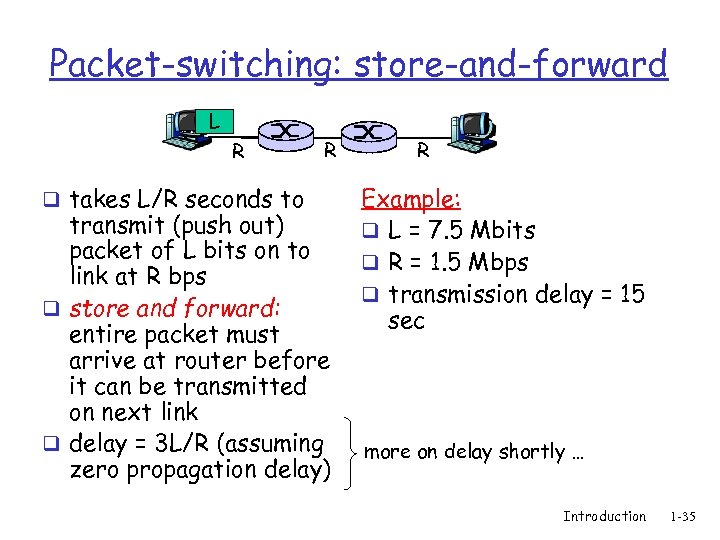 Packet-switching: store-and-forward L R q takes L/R seconds to R transmit (push out) packet of L bits on to link at R bps q store and forward: entire packet must arrive at router before it can be transmitted on next link q delay = 3 L/R (assuming zero propagation delay) R Example: q L = 7. 5 Mbits q R = 1. 5 Mbps q transmission delay = 15 sec more on delay shortly … Introduction 1 -35
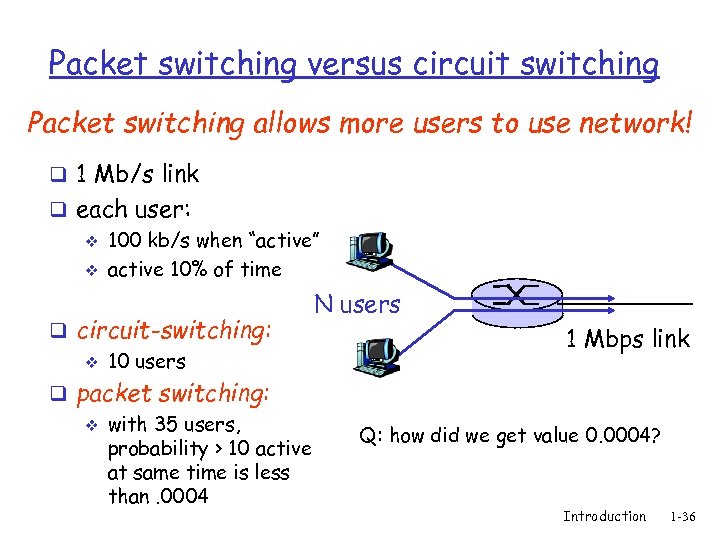 Packet switching versus circuit switching Packet switching allows more users to use network! q 1 Mb/s link q each user: v 100 kb/s when “active” v active 10% of time q circuit-switching: v 10 users q packet switching: v with 35 users, probability > 10 active at same time is less than. 0004 N users 1 Mbps link Q: how did we get value 0. 0004? Introduction 1 -36
 Packet switching versus circuit switching Is packet switching the definitive winner? q great for bursty data resource sharing v simpler, no call setup q excessive congestion: packet delay and loss v protocols needed for reliable data transfer, congestion control q Q: How to provide circuit-like behavior? v bandwidth guarantees needed for audio/video apps v Q: human analogies of reserved resources (circuit switching) versus on-demand allocation (packet-switching)? Introduction 1 -37
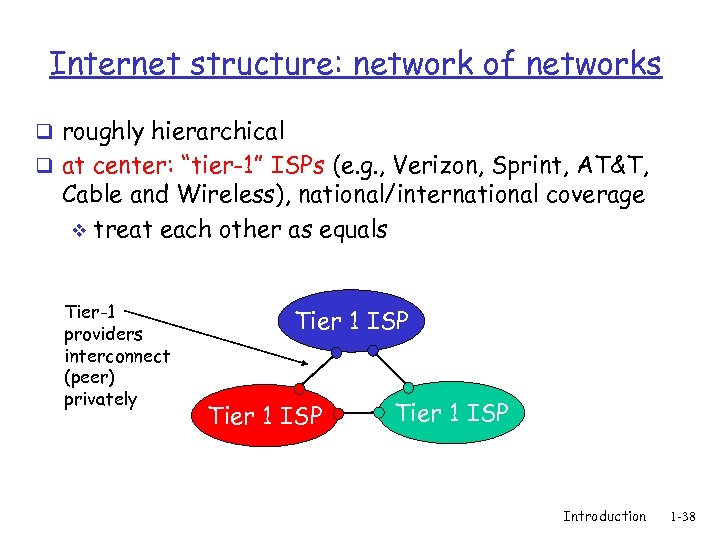 Internet structure: network of networks q roughly hierarchical q at center: “tier-1” ISPs (e. g. , Verizon, Sprint, AT&T, Cable and Wireless), national/international coverage v treat each other as equals Tier-1 providers interconnect (peer) privately Tier 1 ISP Introduction 1 -38
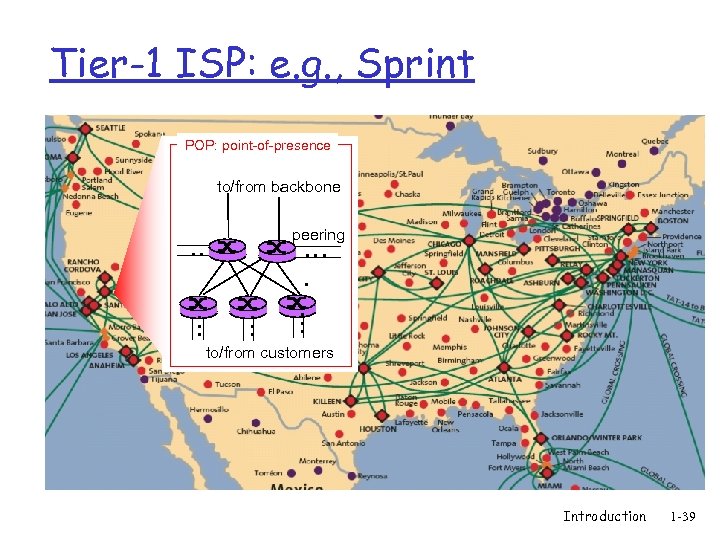 Tier-1 ISP: e. g. , Sprint POP: point-of-presence to/from backbone peering … … … to/from customers Introduction 1 -39
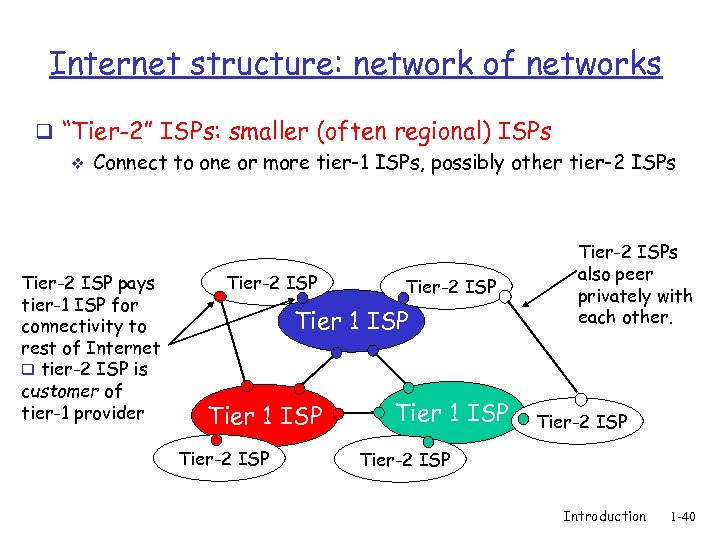 Internet structure: network of networks q “Tier-2” ISPs: smaller (often regional) ISPs v Connect to one or more tier-1 ISPs, possibly other tier-2 ISPs Tier-2 ISP pays tier-1 ISP for connectivity to rest of Internet q tier-2 ISP is customer of tier-1 provider Tier-2 ISP Tier 1 ISP Tier-2 ISPs also peer privately with each other. Tier-2 ISP Introduction 1 -40
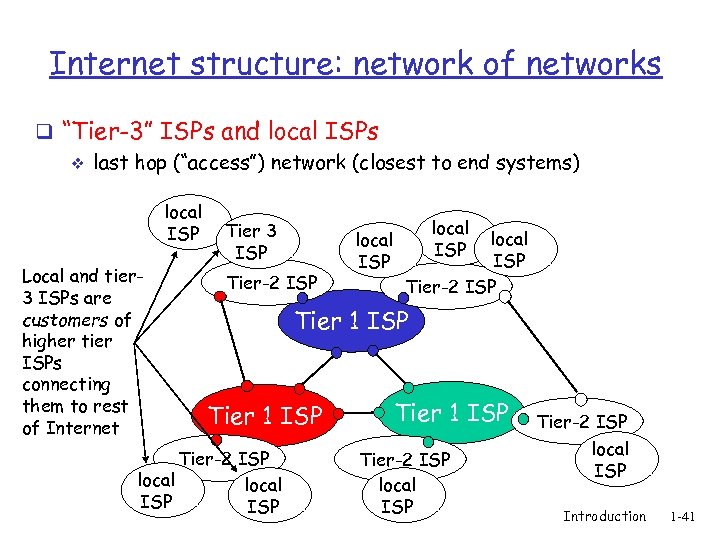 Internet structure: network of networks q “Tier-3” ISPs and local ISPs v last hop (“access”) network (closest to end systems) local ISP Local and tier 3 ISPs are customers of higher tier ISPs connecting them to rest of Internet Tier 3 ISP Tier-2 ISP local ISP Tier-2 ISP Tier 1 ISP Tier-2 ISP local ISP Introduction 1 -41
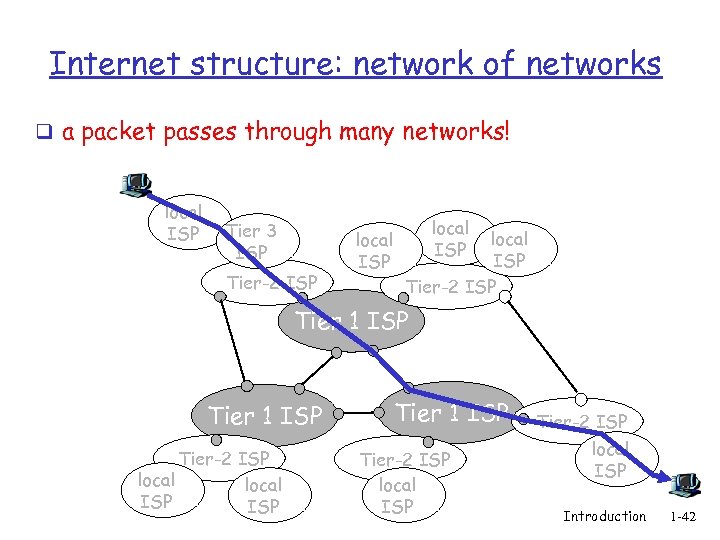 Internet structure: network of networks q a packet passes through many networks! local ISP Tier 3 ISP Tier-2 ISP local ISP Tier-2 ISP Tier 1 ISP Tier-2 ISP local ISP Introduction 1 -42
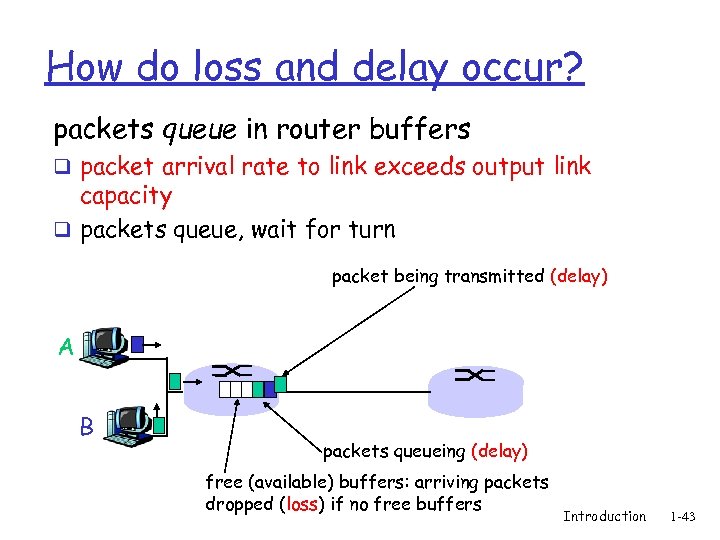 How do loss and delay occur? packets queue in router buffers q packet arrival rate to link exceeds output link capacity q packets queue, wait for turn packet being transmitted (delay) A B packets queueing (delay) free (available) buffers: arriving packets dropped (loss) if no free buffers Introduction 1 -43
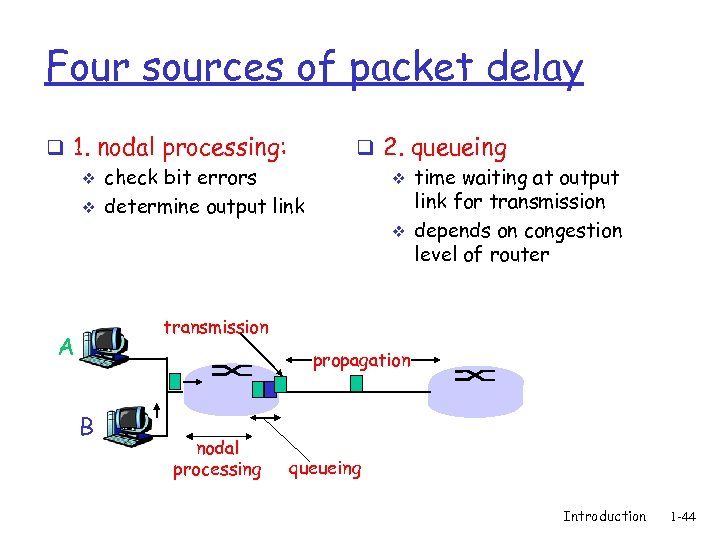 Four sources of packet delay q 1. nodal processing: v check bit errors v determine output link q 2. queueing v time waiting at output link for transmission v depends on congestion level of router transmission A propagation B nodal processing queueing Introduction 1 -44
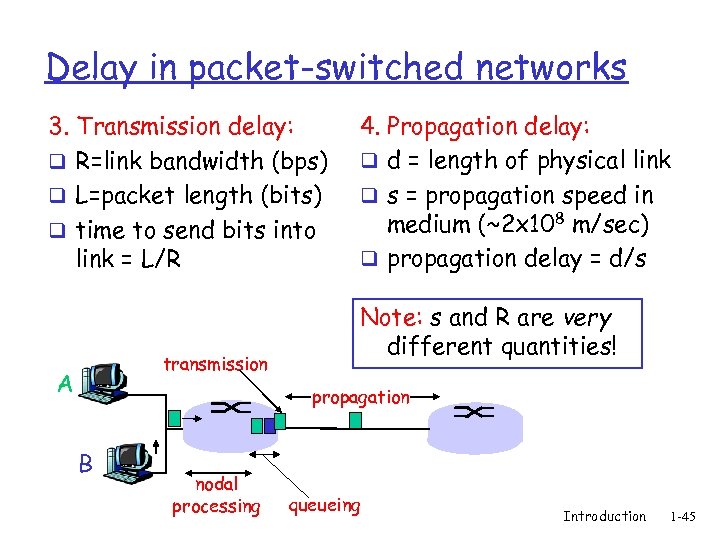 Delay in packet-switched networks 3. Transmission delay: q R=link bandwidth (bps) q L=packet length (bits) q time to send bits into link = L/R transmission A 4. Propagation delay: q d = length of physical link q s = propagation speed in medium (~2 x 10⁸ m/sec) q propagation delay = d/s Note: s and R are very different quantities! propagation B nodal processing queueing Introduction 1 -45
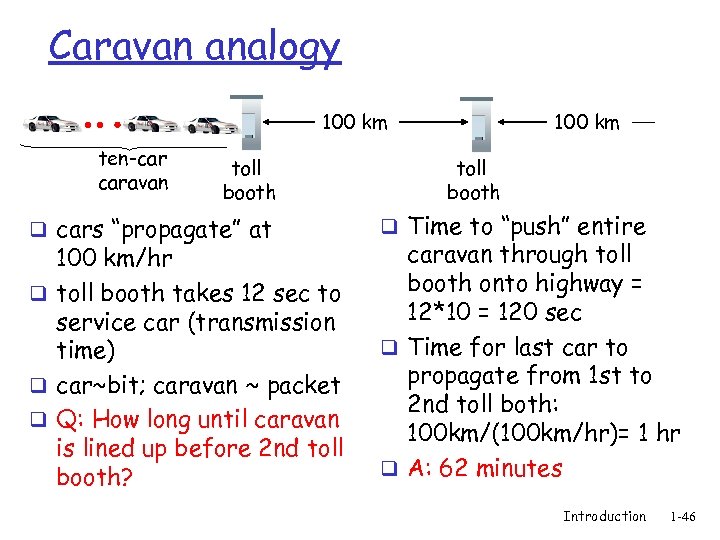 Caravan analogy 100 km ten-car caravan toll booth q cars “propagate” at 100 km/hr q toll booth takes 12 sec to service car (transmission time) q car~bit; caravan ~ packet q Q: How long until caravan is lined up before 2 nd toll booth? 100 km toll booth q Time to “push” entire caravan through toll booth onto highway = 12*10 = 120 sec q Time for last car to propagate from 1 st to 2 nd toll both: 100 km/(100 km/hr)= 1 hr q A: 62 minutes Introduction 1 -46
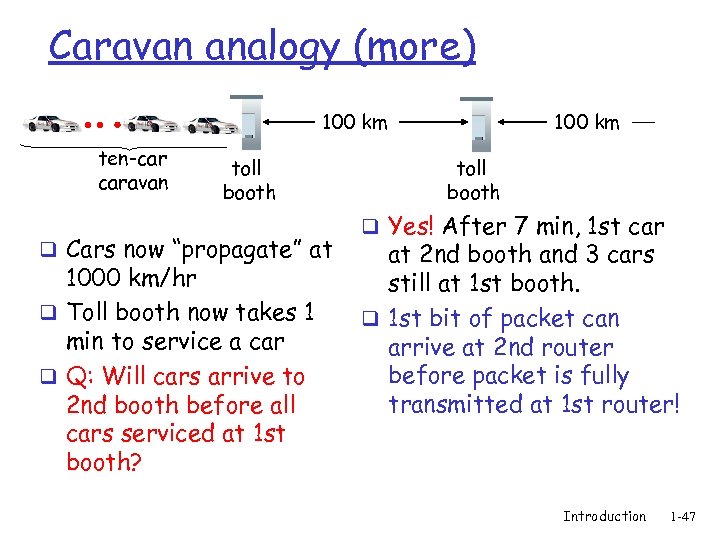 Caravan analogy (more) 100 km ten-car caravan toll booth q Cars now “propagate” at 1000 km/hr q Toll booth now takes 1 min to service a car q Q: Will cars arrive to 2 nd booth before all cars serviced at 1 st booth? 100 km toll booth q Yes! After 7 min, 1 st car at 2 nd booth and 3 cars still at 1 st booth. q 1 st bit of packet can arrive at 2 nd router before packet is fully transmitted at 1 st router! Introduction 1 -47
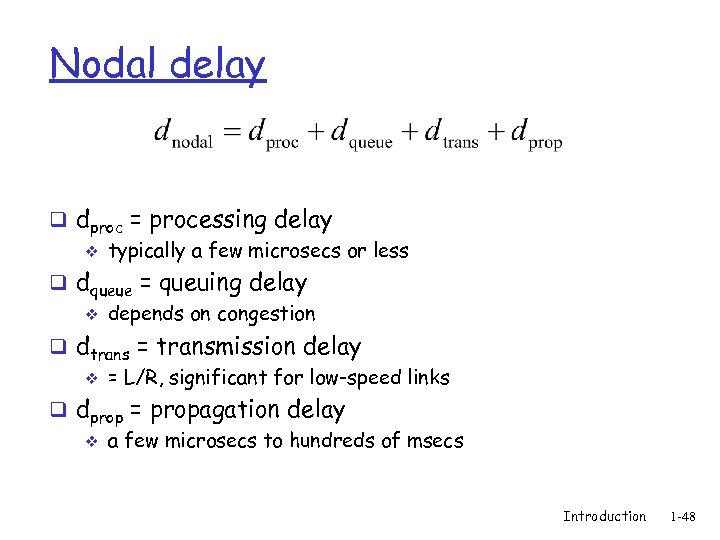 Nodal delay q dproc = processing delay v typically a few microsecs or less q dqueue = queuing delay v depends on congestion q dtrans = transmission delay v = L/R, significant for low-speed links q dprop = propagation delay v a few microsecs to hundreds of msecs Introduction 1 -48
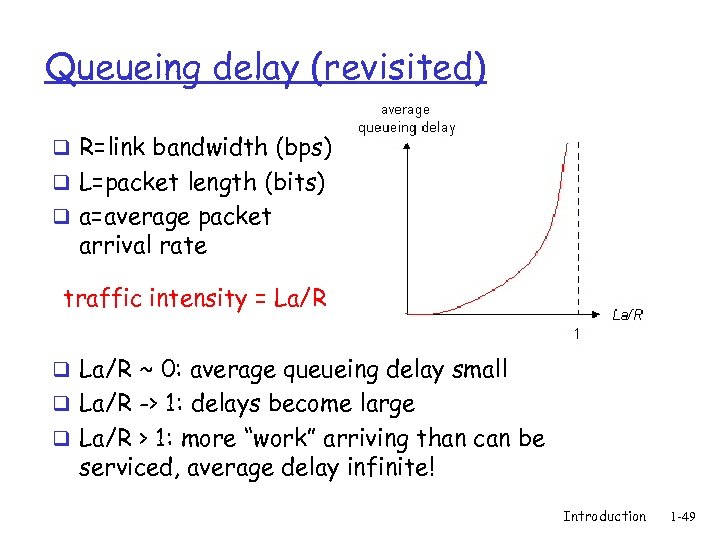 Queueing delay (revisited) q R=link bandwidth (bps) q L=packet length (bits) q a=average packet arrival rate traffic intensity = La/R q La/R ~ 0: average queueing delay small q La/R -> 1: delays become large q La/R > 1: more “work” arriving than can be serviced, average delay infinite! Introduction 1 -49
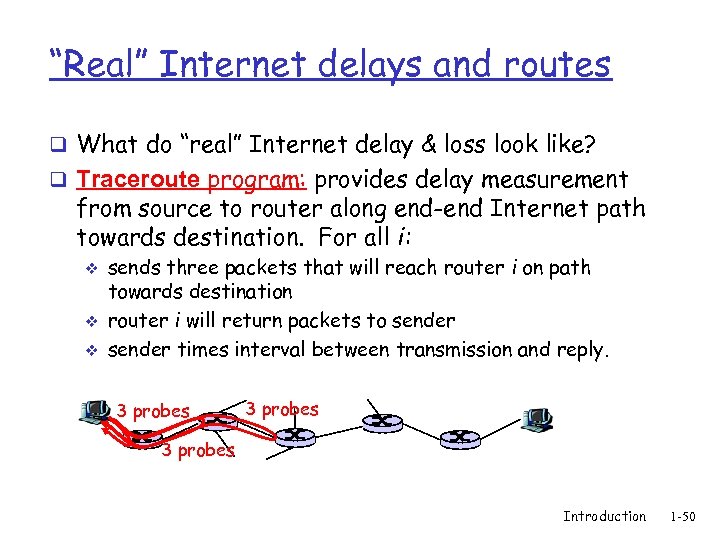 “Real” Internet delays and routes q What do “real” Internet delay & loss look like? q Traceroute program: provides delay measurement from source to router along end-end Internet path towards destination. For all i: v v v sends three packets that will reach router i on path towards destination router i will return packets to sender times interval between transmission and reply. 3 probes Introduction 1 -50
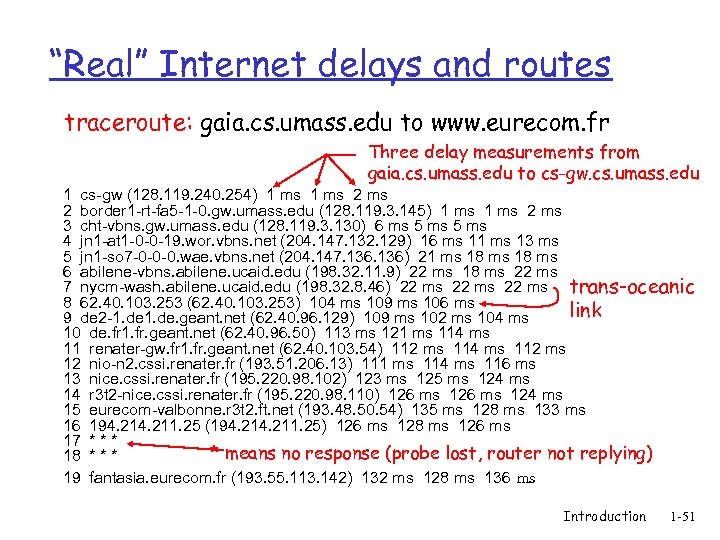 “Real” Internet delays and routes traceroute: gaia. cs. umass. edu to www. eurecom. fr Three delay measurements from gaia. cs. umass. edu to cs-gw. cs. umass. edu 1 cs-gw (128. 119. 240. 254) 1 ms 2 border 1 -rt-fa 5 -1 -0. gw. umass. edu (128. 119. 3. 145) 1 ms 2 ms 3 cht-vbns. gw. umass. edu (128. 119. 3. 130) 6 ms 5 ms 4 jn 1 -at 1 -0 -0 -19. wor. vbns. net (204. 147. 132. 129) 16 ms 11 ms 13 ms 5 jn 1 -so 7 -0 -0 -0. wae. vbns. net (204. 147. 136) 21 ms 18 ms 6 abilene-vbns. abilene. ucaid. edu (198. 32. 11. 9) 22 ms 18 ms 22 ms 7 nycm-wash. abilene. ucaid. edu (198. 32. 8. 46) 22 ms trans-oceanic 8 62. 40. 103. 253 (62. 40. 103. 253) 104 ms 109 ms 106 ms link 9 de 2 -1. de. geant. net (62. 40. 96. 129) 109 ms 102 ms 104 ms 10 de. fr 1. fr. geant. net (62. 40. 96. 50) 113 ms 121 ms 114 ms 11 renater-gw. fr 1. fr. geant. net (62. 40. 103. 54) 112 ms 114 ms 112 ms 12 nio-n 2. cssi. renater. fr (193. 51. 206. 13) 111 ms 114 ms 116 ms 13 nice. cssi. renater. fr (195. 220. 98. 102) 123 ms 125 ms 124 ms 14 r 3 t 2 -nice. cssi. renater. fr (195. 220. 98. 110) 126 ms 124 ms 15 eurecom-valbonne. r 3 t 2. ft. net (193. 48. 50. 54) 135 ms 128 ms 133 ms 16 194. 211. 25 (194. 211. 25) 126 ms 128 ms 126 ms 17 * * means no response (probe lost, router not replying) 18 * * * 19 fantasia. eurecom. fr (193. 55. 113. 142) 132 ms 128 ms 136 ms Introduction 1 -51
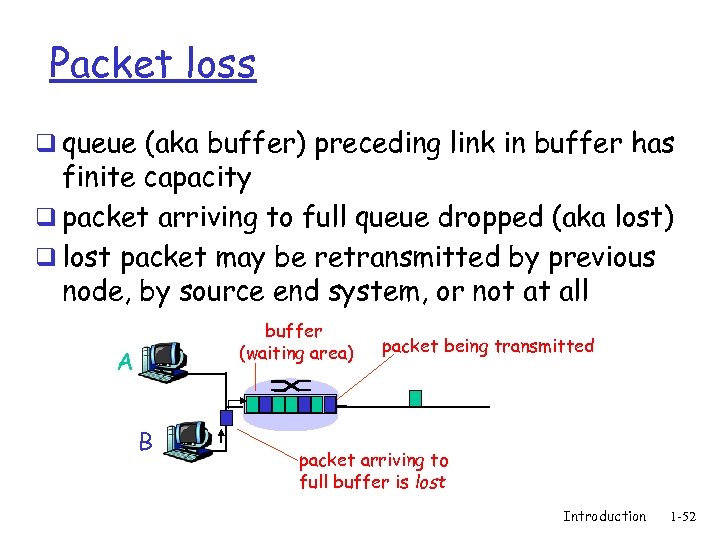 Packet loss q queue (aka buffer) preceding link in buffer has finite capacity q packet arriving to full queue dropped (aka lost) q lost packet may be retransmitted by previous node, by source end system, or not at all buffer (waiting area) A B packet being transmitted packet arriving to full buffer is lost Introduction 1 -52
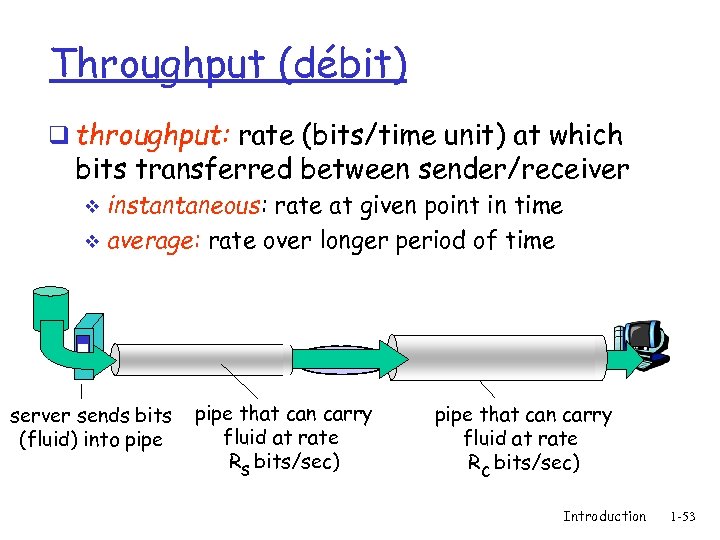 Throughput (débit) q throughput: rate (bits/time unit) at which bits transferred between sender/receiver instantaneous: rate at given point in time v average: rate over longer period of time v link capacity server, with server sends bits pipe that can carry Rs bits/sec fluid at rate file into pipe (fluid) of F bits Rs bits/sec) to send to client link capacity pipe that can carry Rfluid at rate c bits/sec Rc bits/sec) Introduction 1 -53
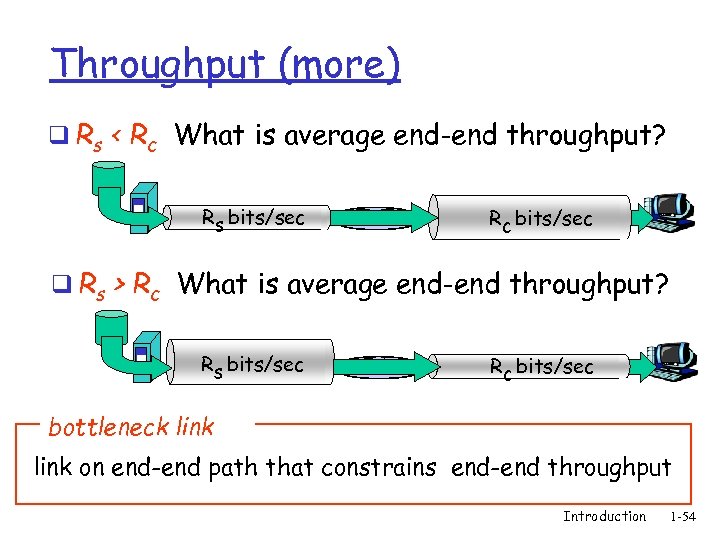 Throughput (more) q Rs < Rc What is average end-end throughput? Rs bits/sec Rc bits/sec q Rs > Rc What is average end-end throughput? Rs bits/sec Rc bits/sec bottleneck link on end-end path that constrains end-end throughput Introduction 1 -54
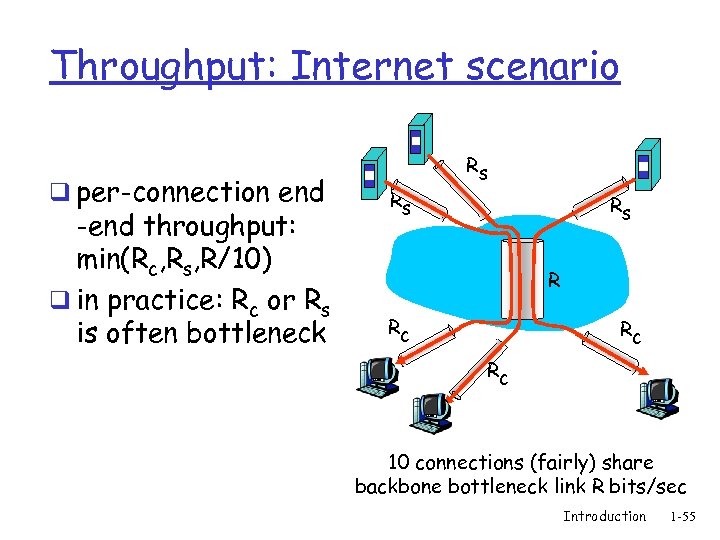 Throughput: Internet scenario q per-connection end -end throughput: min(Rc, Rs, R/10) q in practice: Rc or Rs is often bottleneck Rs Rs Rs R Rc Rc Rc 10 connections (fairly) share backbone bottleneck link R bits/sec Introduction 1 -55
 Chapter 1: roadmap 1. 1 What is the Internet? 1. 2 Network edge q end systems, access networks, links 1. 3 Network core q circuit switching, packet switching, network structure 1. 4 Delay, loss and throughput in packet-switched networks 1. 5 Protocol layers, service models 1. 6 Networks under attack: security 1. 7 History Introduction 1 -56
 Protocol “Layers” Networks are complex! q many “pieces”: v hosts v routers v links of various media v applications v protocols v hardware, software Question: Is there any hope of organizing structure of network? Or at least our discussion of networks? Introduction 1 -57
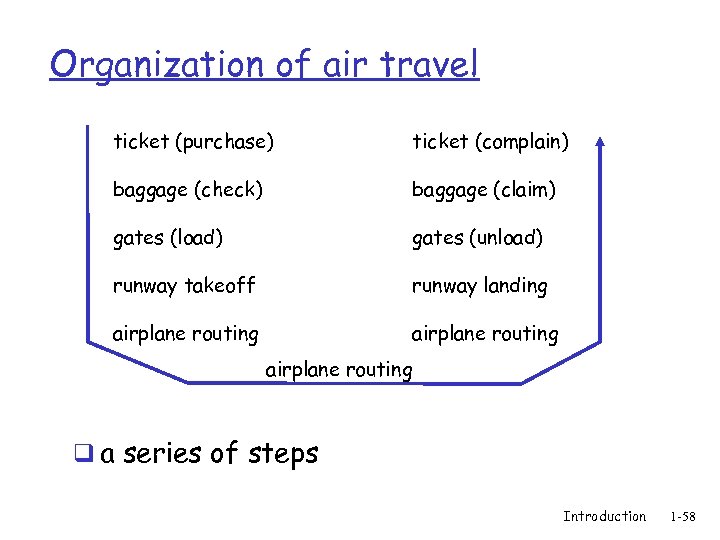 Organization of air travel ticket (purchase) ticket (complain) baggage (check) baggage (claim) gates (load) gates (unload) runway takeoff runway landing airplane routing q a series of steps Introduction 1 -58
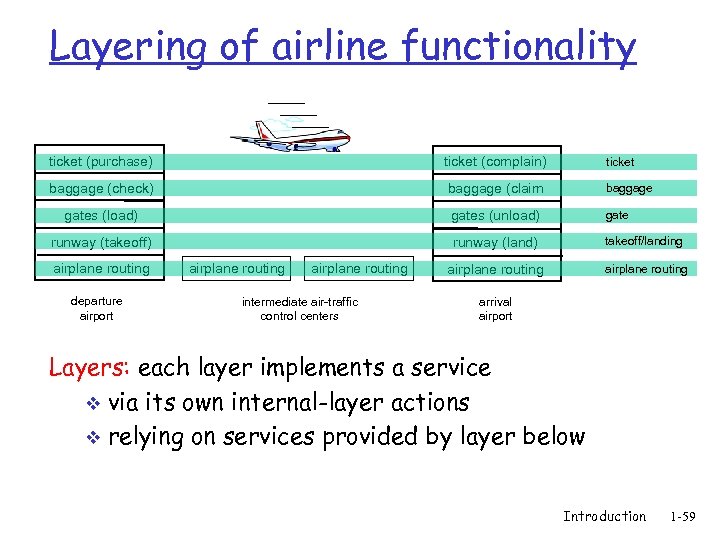 Layering of airline functionality ticket (purchase) ticket (complain) ticket baggage (check) baggage (claim baggage gates (load) gates (unload) gate runway (takeoff) runway (land) takeoff/landing airplane routing departure airport airplane routing intermediate air-traffic control centers arrival airport Layers: each layer implements a service v via its own internal-layer actions v relying on services provided by layer below Introduction 1 -59
 Why layering? Dealing with complex systems: q explicit structure allows identification, relationship of complex system’s pieces v layered reference model for discussion q modularization eases maintenance, updating of system v change of implementation of layer’s service transparent to rest of system v e. g. , change in gate procedure doesn’t affect rest of system q layering considered harmful? Introduction 1 -60
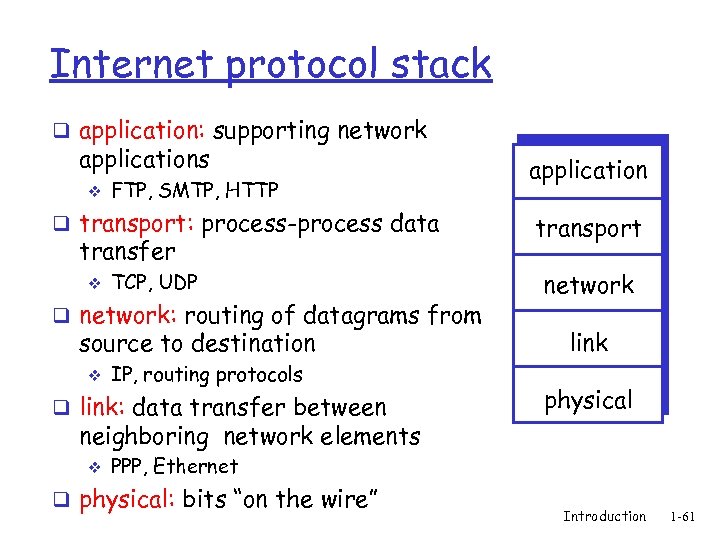 Internet protocol stack q application: supporting network applications v FTP, SMTP, HTTP q transport: process-process data transfer v TCP, UDP q network: routing of datagrams from source to destination v IP, routing protocols q link: data transfer between application transport network link physical neighboring network elements v PPP, Ethernet q physical: bits “on the wire” Introduction 1 -61
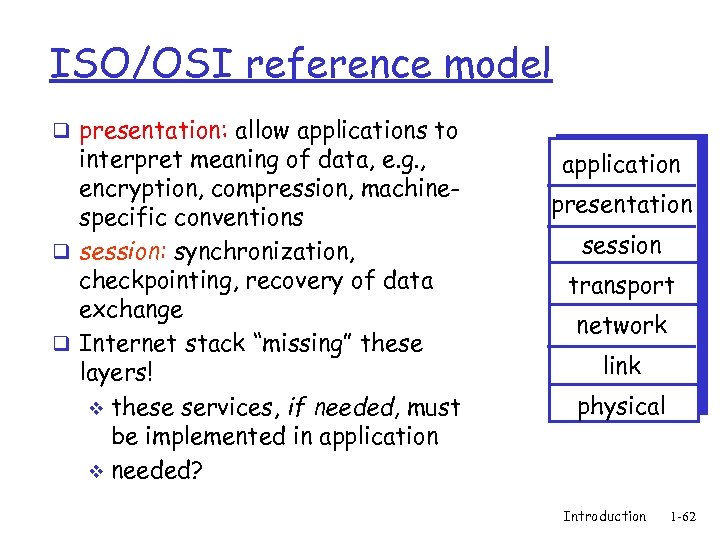 ISO/OSI reference model q presentation: allow applications to interpret meaning of data, e. g. , encryption, compression, machinespecific conventions q session: synchronization, checkpointing, recovery of data exchange q Internet stack “missing” these layers! v these services, if needed, must be implemented in application v needed? application presentation session transport network link physical Introduction 1 -62
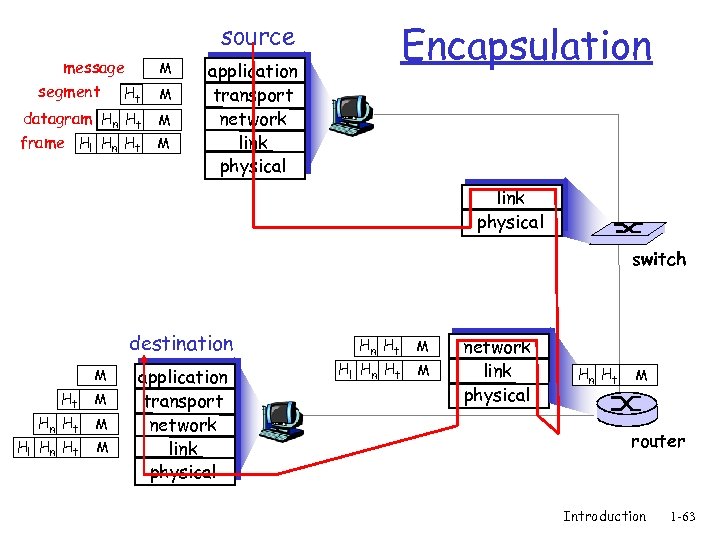 Encapsulation source message segment Ht M datagram Hn Ht M frame Hl Hn Ht M M application transport network link physical switch destination M Ht M Hn Ht Hl Hn Ht M M application transport network link physical Hn Ht Hl Hn Ht M M network link physical Hn Ht M router Introduction 1 -63
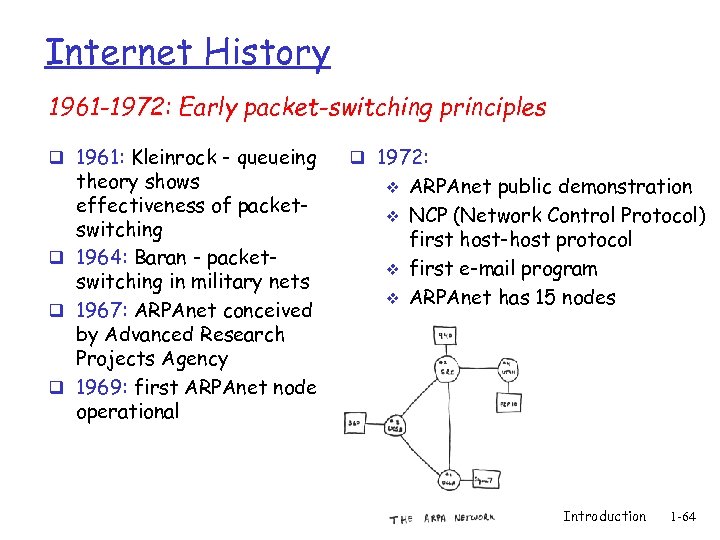 Internet History 1961 -1972: Early packet-switching principles q 1961: Kleinrock - queueing theory shows effectiveness of packetswitching q 1964: Baran - packetswitching in military nets q 1967: ARPAnet conceived by Advanced Research Projects Agency q 1969: first ARPAnet node operational q 1972: v v ARPAnet public demonstration NCP (Network Control Protocol) first host-host protocol first e-mail program ARPAnet has 15 nodes Introduction 1 -64
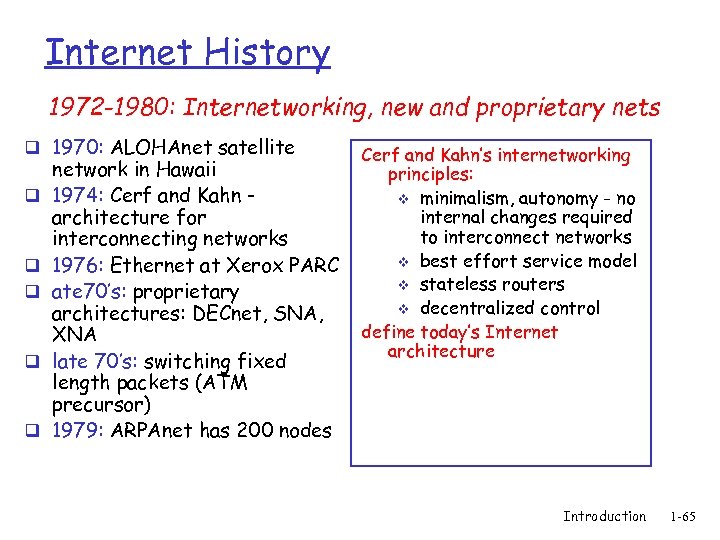 Internet History 1972 -1980: Internetworking, new and proprietary nets q 1970: ALOHAnet satellite q q q network in Hawaii 1974: Cerf and Kahn architecture for interconnecting networks 1976: Ethernet at Xerox PARC ate 70’s: proprietary architectures: DECnet, SNA, XNA late 70’s: switching fixed length packets (ATM precursor) 1979: ARPAnet has 200 nodes Cerf and Kahn’s internetworking principles: v minimalism, autonomy - no internal changes required to interconnect networks v best effort service model v stateless routers v decentralized control define today’s Internet architecture Introduction 1 -65
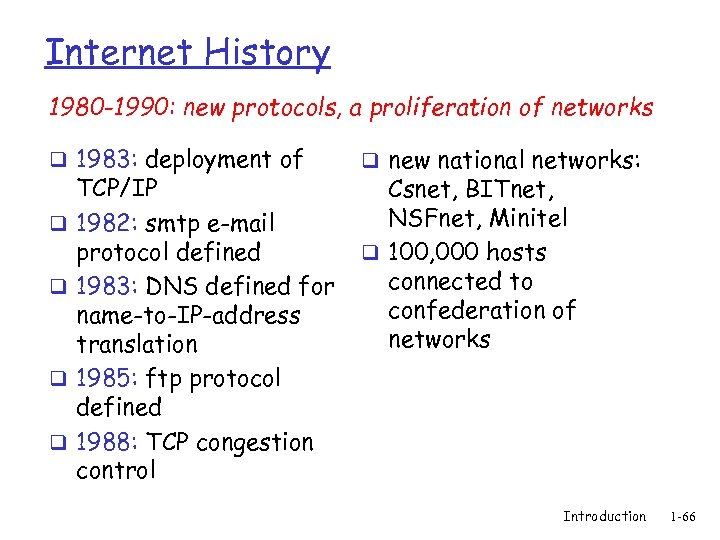 Internet History 1980 -1990: new protocols, a proliferation of networks q 1983: deployment of q q TCP/IP 1982: smtp e-mail protocol defined 1983: DNS defined for name-to-IP-address translation 1985: ftp protocol defined 1988: TCP congestion control q new national networks: Csnet, BITnet, NSFnet, Minitel q 100, 000 hosts connected to confederation of networks Introduction 1 -66
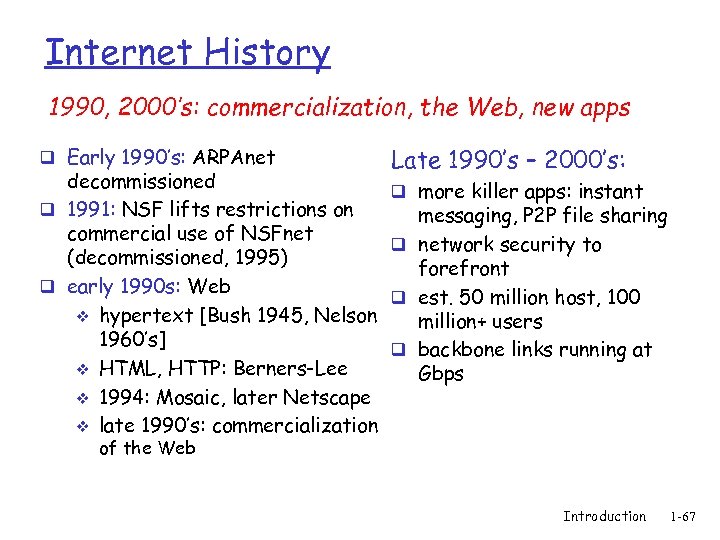 Internet History 1990, 2000’s: commercialization, the Web, new apps q Early 1990’s: ARPAnet decommissioned q 1991: NSF lifts restrictions on commercial use of NSFnet (decommissioned, 1995) q early 1990 s: Web v hypertext [Bush 1945, Nelson 1960’s] v HTML, HTTP: Berners-Lee v 1994: Mosaic, later Netscape v late 1990’s: commercialization Late 1990’s – 2000’s: q more killer apps: instant messaging, P 2 P file sharing q network security to forefront q est. 50 million host, 100 million+ users q backbone links running at Gbps of the Web Introduction 1 -67
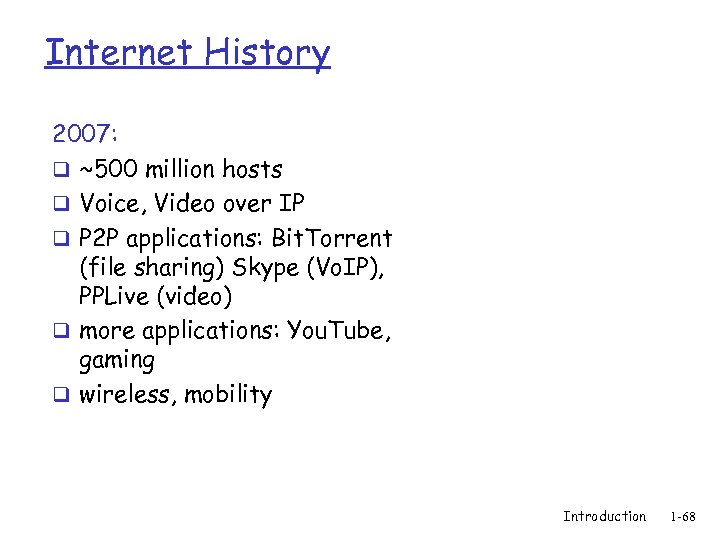 Internet History 2007: q ~500 million hosts q Voice, Video over IP q P 2 P applications: Bit. Torrent (file sharing) Skype (Vo. IP), PPLive (video) q more applications: You. Tube, gaming q wireless, mobility Introduction 1 -68
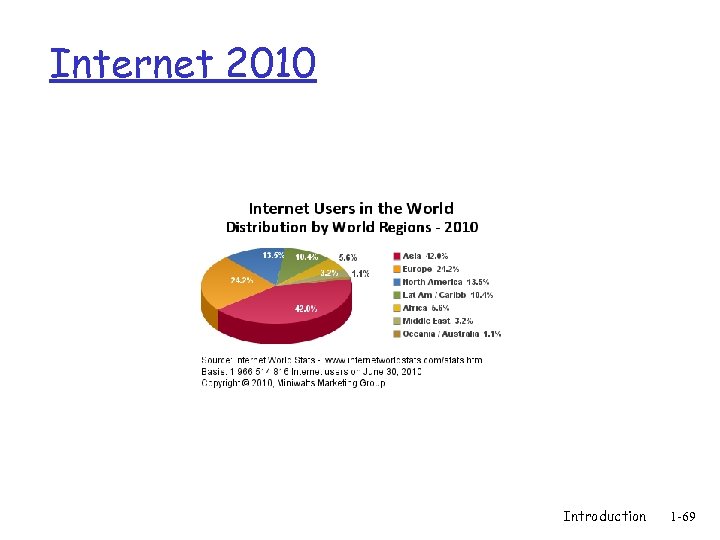 Internet 2010 Introduction 1 -69
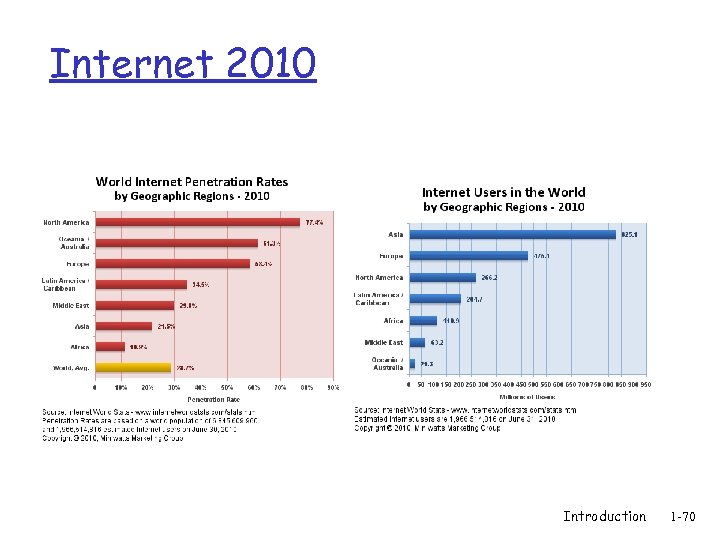 Internet 2010 Introduction 1 -70
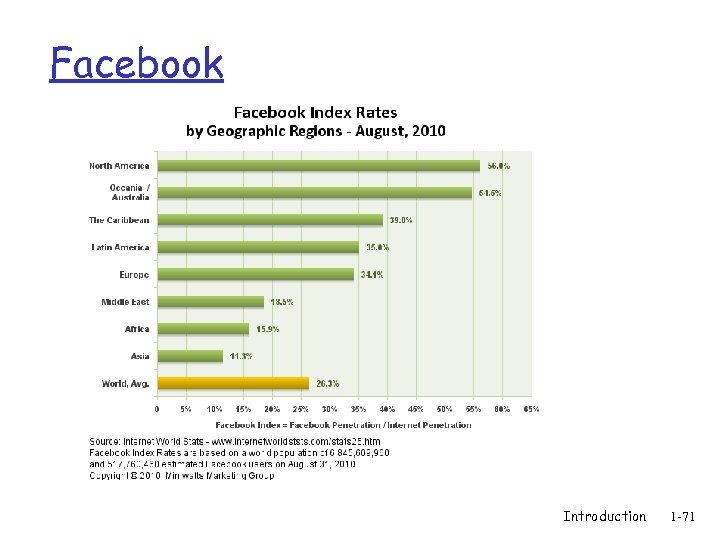 Facebook Introduction 1 -71