


 Скачать презентацию Researching your topic Lecture 5 Researching your
Researching your topic.pptx
- Количество слайдов: 30
 Researching your topic Lecture 5
 Researching your topic • Acquiring responsible knowledge • Evaluating research materials • Conducting strategic research • Interviewing for information • Taking notes on your research

 Acquiring responsible knowledge • The main issues of your topic • What respected authorities say about it • The latest developments related to it • Related local applications of special interest to your audience
 Acquiring responsible knowledge Begin work well beforehand Otherwise – may miss valuable information Discover both sides of an issue Earn the right to speak Enrich the lives of listeners with good information • Enhance your ethos in terms of competence and character • • •
 Acquiring responsible knowledge – three-step strategy 1. Assess your personal knowledge and experience – determine what information you need 2. Collect this material using library, internet and interviews 3. Take careful notes to use during the speech
 Personal knowledge and experience • Credibility • Authenticity • Interest • Personal stories suggest that you have unique insights • Make it easier for an audience to identify with you
 Personal knowledge and experience • Personal experience can enrich your speech • It is seldom sufficient – Information – Facts and figures – Testimony • Use it as a starting point
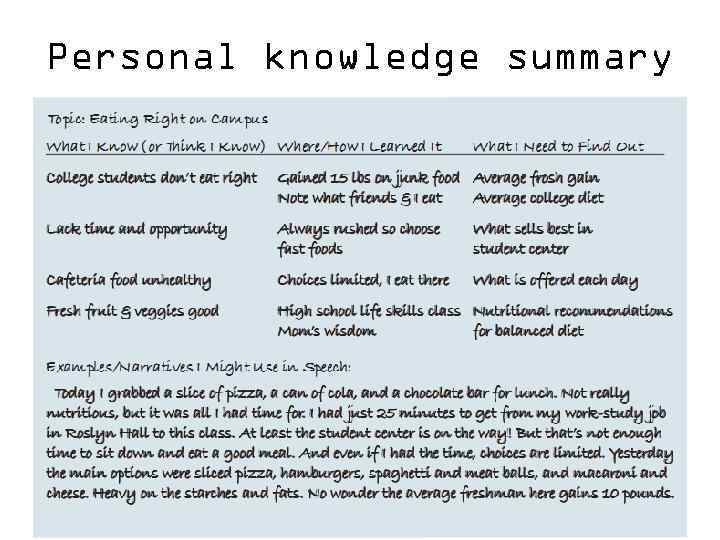 Personal knowledge summary
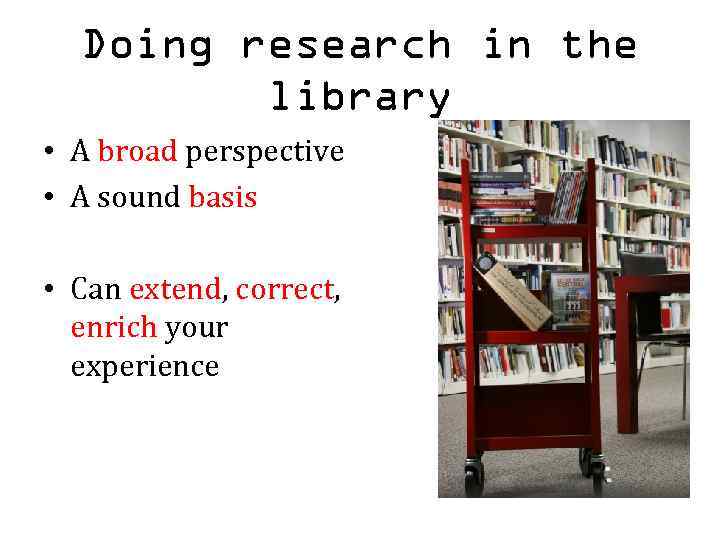 Doing research in the library • A broad perspective • A sound basis • Can extend, correct, enrich your experience
 Doing research in the library • Reference or research librarian • Online catalog • General periodical databases • Special area databases • News resources • Reference area
 Doing research on the internet • Excellent source of – Breaking news – Contemporary speech texts – Other time-sensitive material • Helpful source of local news • Available 24/7
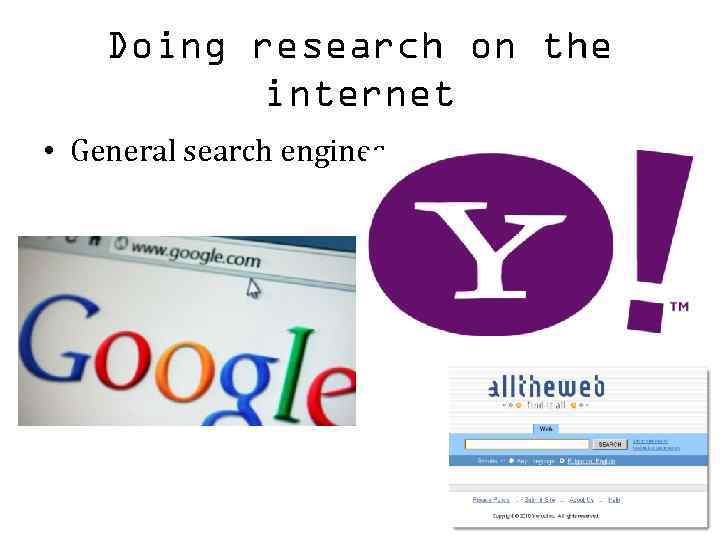 Doing research on the internet • General search engines
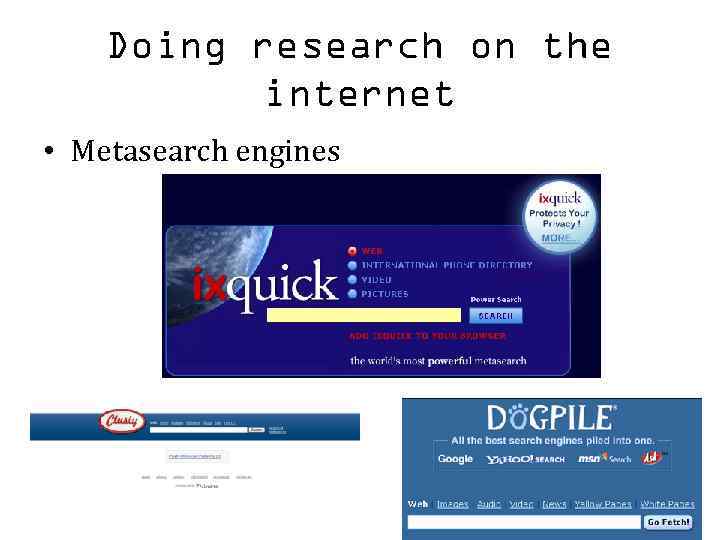 Doing research on the internet • Metasearch engines
 Doing research on the internet • Invisible web gateways
 Doing research on the internet • To get best result – try at least 3 search engines • Make use of “advanced search” option • When you access the article, make note of – Author’s name – Sponsoring source – Date of publication – Date you accessed it – URL
 Evaluating research materials • Does the article contain relevant and useful information? • Does the article cite experts that I can quote in my speech? • Are there interesting examples that can make my speech clearer? • Are there stories that can bring my topic to life?
 Evaluating library resources • Consider the credibility – Is this author an expert on my topic? – The ethos of the publication • Search for most recent information – Timeliness is essential for some information • The more sensitive your topic, the more important the credibility of your sources
 Evaluating material from the internet • Anyone can put anything on the internet • Determine the site – Advocacy web sites – Information web sites – Personal web sites
 Criteria for internet evaluation • Authority – Source / sponsor / author • Accuracy – Correctness of the information / free from errors • Objectivity – Freedom from bias / personal feelings • Currency – Date of posting material • Coverage – Breadth / depth of information
 Conducting strategic research • Develop an overview of your subject • Build a bibliography on your topic • Acquire in-depth knowledge from reputable sources
 Develop an overview • Consult sources of background information – Your knowledge may be incomplete – Areas that you had overlooked • Encyclopedias (www. libraryspot. com) • Specialized dictionaries (Oxford English Dictionary) • Read / take notes / identify key-terms
 Build a bibliography • Quick access to information • Save research time • Keep a record of all materials • Identify those most relevant to your puspose
 Acquire in-depth knowledge • • • Facts and figures Testimony Examples Ideas for narratives Materials for presentation aids • The articles you find do not provide you with a speech!
 Interviewing for information • Commitment to creating a speech with value • Stories and information to make speeches come to life
 Interviewing for information • Make it the final phase of your research • Identify nearby people for interviews • Verify information by e-mail or telephone interviews • Look for possibilities on campus
 Interviewing for information • Establish contact • Prepare for the interview • Conduct the interview • Record what you learn • Follow up on what you learn
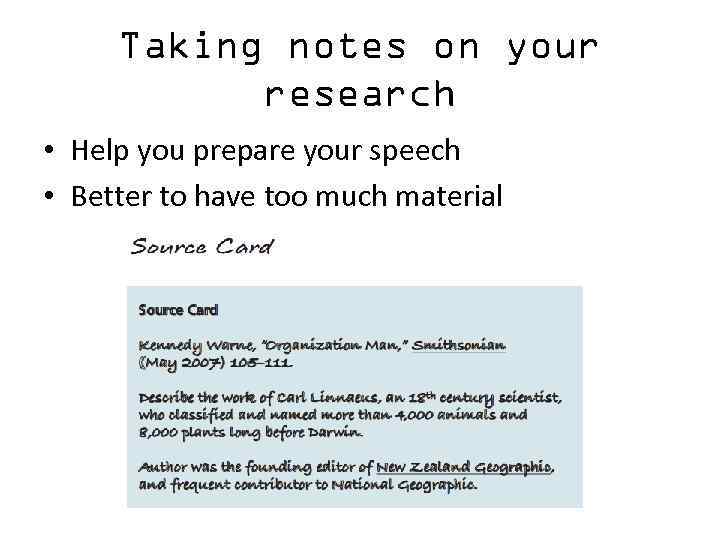 Taking notes on your research • Help you prepare your speech • Better to have too much material
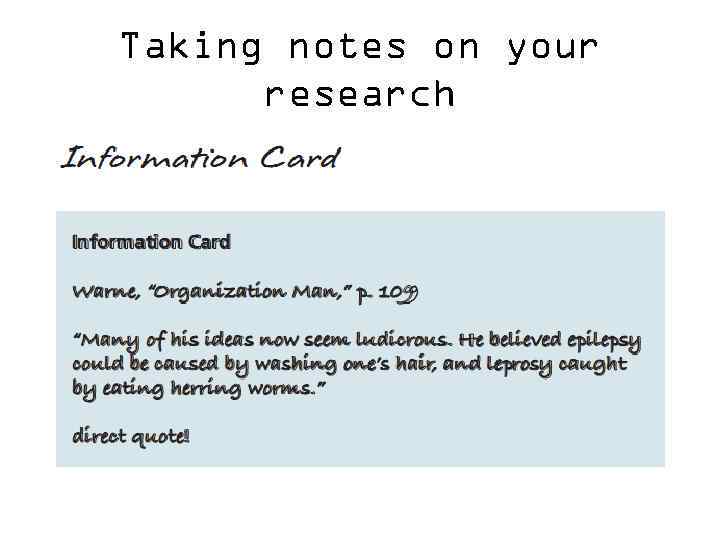 Taking notes on your research
 Taking notes on your computer • Book – Author, edition number, full title, publisher, copyright date, page numbers • Article – Author, full title, title of periodical, volume number, issue date, page numbers • Web-page – Author, full title, sponsor, date it was posted, date you accessed it, URL • Interview – Name of the person, professional title, contact information, date of the interview