 Скачать презентацию Researching the Efficacy of Online Learning A Collaborative
ce6cf8169cc197f7699020643c64f041.ppt
- Количество слайдов: 58




Researching the Efficacy of Online Learning: A Collaborative Effort among Scholars in Asian Open Universities Weiyuan Zhang , Kirk Perris & Teresa Poon The Open University of Hong Kong

Project Team Members Dr. Weiyuan Zhang Dr. David Murphy Mr. Kirk Perris Dr. Teresa Poon Ms. Elaine Kwok Funded by the PACRD The Open University of Hong Kong

Partnership 1. 2. 3. 4. 5. Shanghai Television University, China (SHTVU) Guangzhou Radio & Television University, China (GZRTVU) Open University of Hong Kong (OUHK) National Open University in Taiwan (NOU) Singapore Institute of Management: Open University Centre (SIM: OUC) 6. Korea National Open University (KNOU) 7. University of Philippines Open University (UPOU) 8. Open University of Israel (OUI) 9. Yashwantrao Chavan Maharashtra Open University (YCMOU) 10. Indira Gandhi National Open University (IGNOU) 11. Sukhothai Thammathirat Open University (STOU)

Internet & ODL in Asia • The Internet is growing exponentially in Asia • Internet technologies are becoming an effective means to enhance ODL • To date, several small scale studies on online learning in ODL institutions
Comparative Study • Few comparative studies in ODL • Distance education researchers are working in isolation • Share ideas and resources across institutions
Purpose To conduct a cross-national and cross-institutional study on online learning among scholars in Asia through online collaboration Report on: • Online collaboration among 11 OUs • Significant developments in online learning • Differences and similarities in online learning

Methodology Comparative Study • Cross national research • Cross institutional research (Cookson, 2000) Online collaboration and survey • Collaborative email exchange • Online questionnaire data collection
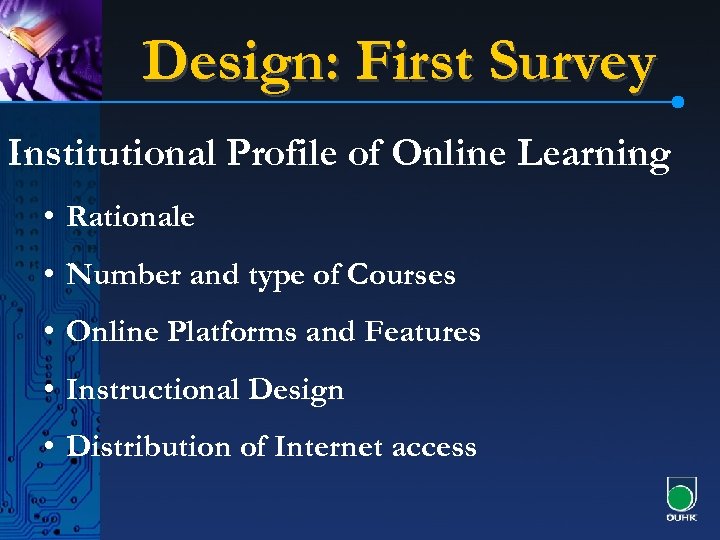
Design: First Survey Institutional Profile of Online Learning • Rationale • Number and type of Courses • Online Platforms and Features • Instructional Design • Distribution of Internet access
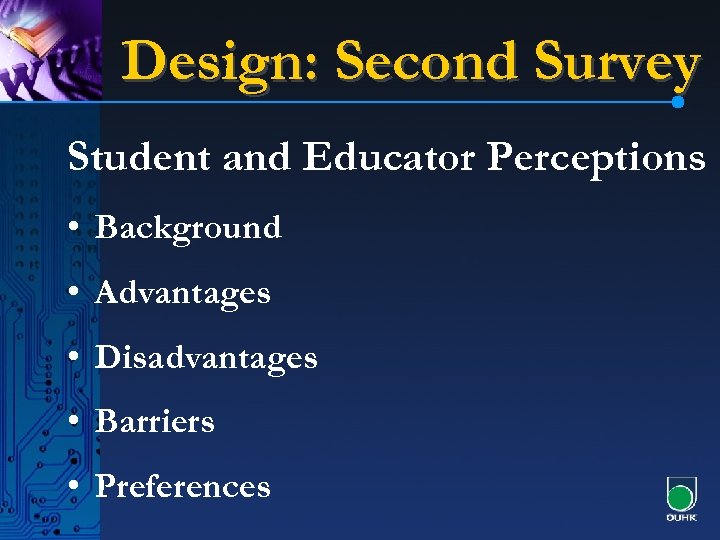
Design: Second Survey Student and Educator Perceptions • Background • Advantages • Disadvantages • Barriers • Preferences
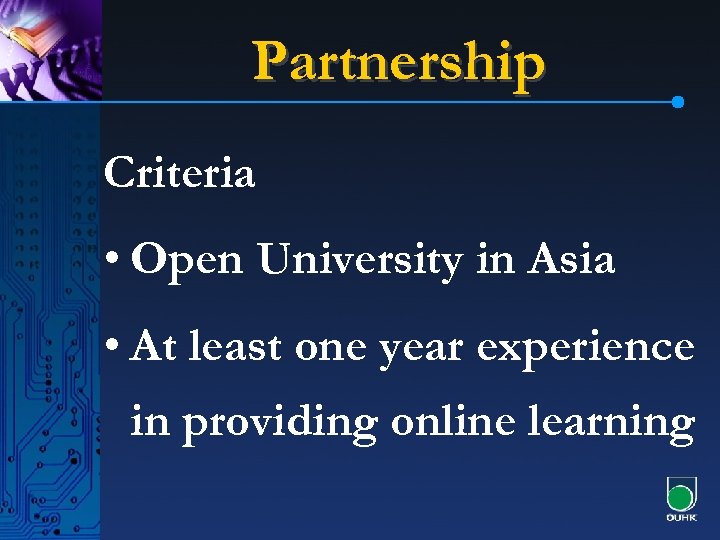
Partnership Criteria • Open University in Asia • At least one year experience in providing online learning
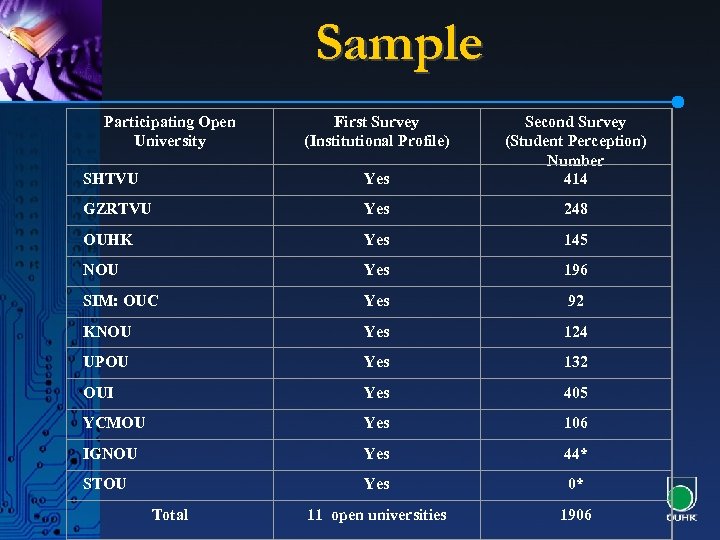
Sample Participating Open University SHTVU Yes Second Survey (Student Perception) Number 414 GZRTVU Yes 248 OUHK Yes 145 NOU Yes 196 SIM: OUC Yes 92 KNOU Yes 124 UPOU Yes 132 OUI Yes 405 YCMOU Yes 106 IGNOU Yes 44* STOU Yes 0* 11 open universities 1906 Total First Survey (Institutional Profile)
Student Questionnaire Four versions • 1 English • 2 Chinese o Hong Kong/Taiwan o Mainland China • 1 Korean
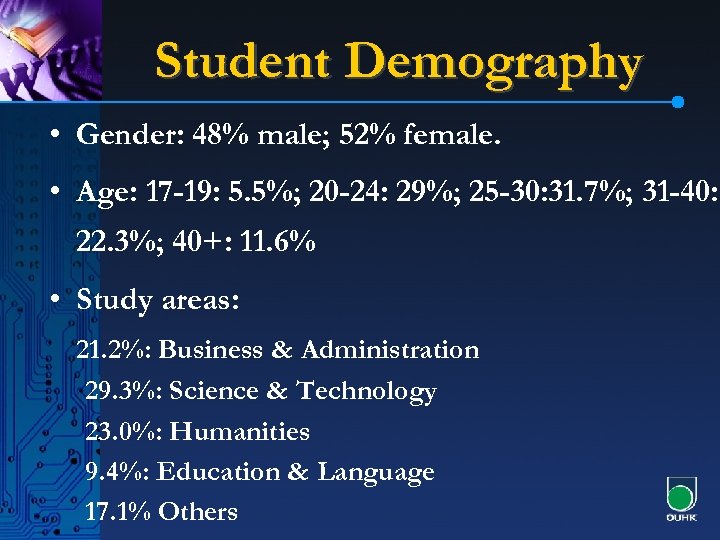
Student Demography • Gender: 48% male; 52% female. • Age: 17 -19: 5. 5%; 20 -24: 29%; 25 -30: 31. 7%; 31 -40: 22. 3%; 40+: 11. 6% • Study areas: 21. 2%: Business & Administration 29. 3%: Science & Technology 23. 0%: Humanities 9. 4%: Education & Language 17. 1% Others

Procedures Major steps: • Invitation and collaboration with external team members Obligations and benefits were agreed upon • First Questionnaire – Institutional profile: Design and survey • Second Questionnaire – Student & Educator: Design, validation, pilot study, survey • Data collection & analysis, reporting

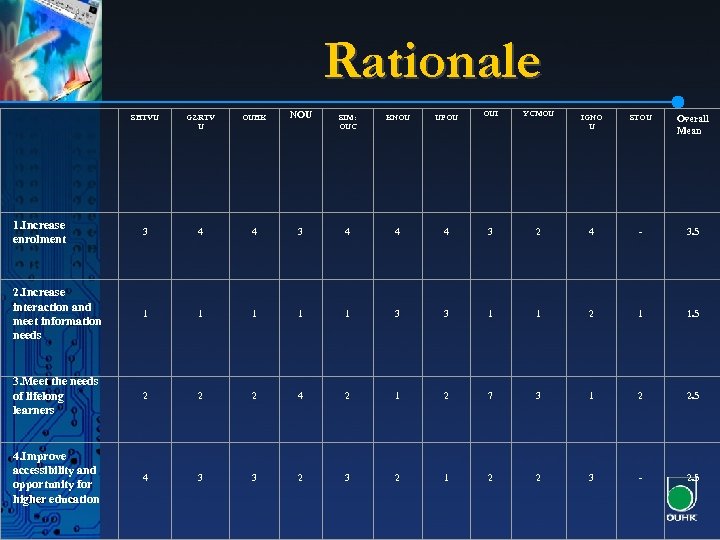
Rationale SHTVU GZRTV U OUHK NOU SIM: OUC KNOU UPOU OUI YCMOU IGNO U STOU Overall Mean 1. Increase enrolment 3 4 4 4 3 2 4 - 3. 5 2. Increase interaction and meet information needs 1 1 1 3 3 1 1 2 1 1. 5 3. Meet the needs of lifelong learners 2 2 2 4 2 1 2 7 3 1 2 2. 5 4. Improve accessibility and opportunity for higher education 4 3 3 2 1 2 2 3 - 2. 5
Rationale • Increase interaction and meet information needs • Improve accessibility and opportunity for higher education
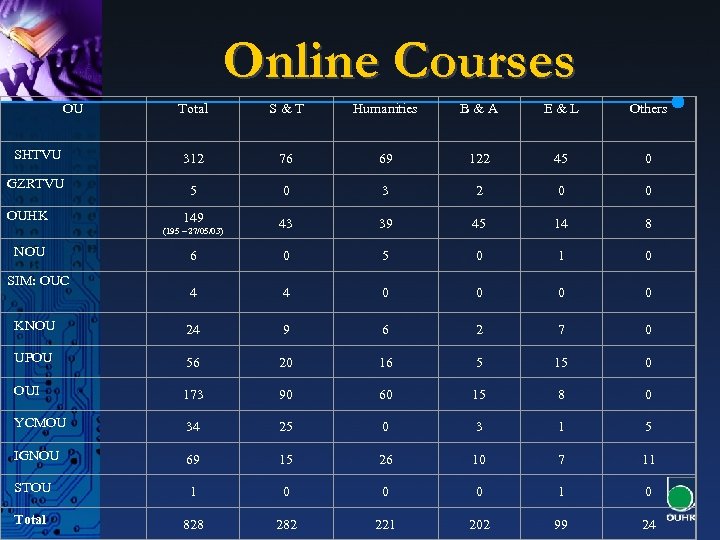
Online Courses OU Total S & T Humanities B & A E & L Others 312 76 69 122 45 0 3 2 0 0 149 43 39 45 14 8 6 0 5 0 1 0 4 4 0 0 KNOU 24 9 6 2 7 0 UPOU 56 20 16 5 15 0 OUI 173 90 60 15 8 0 YCMOU 34 25 0 3 1 5 IGNOU 69 15 26 10 7 11 STOU 1 0 0 0 1 0 Total 828 282 221 202 99 24 SHTVU GZRTVU OUHK (195 – 27/05/03) NOU SIM: OUC

Online Courses • SHTVU, OUI & OUHK each offer over 100 online courses • Science & Technology followed by Humanities were most common courses offered
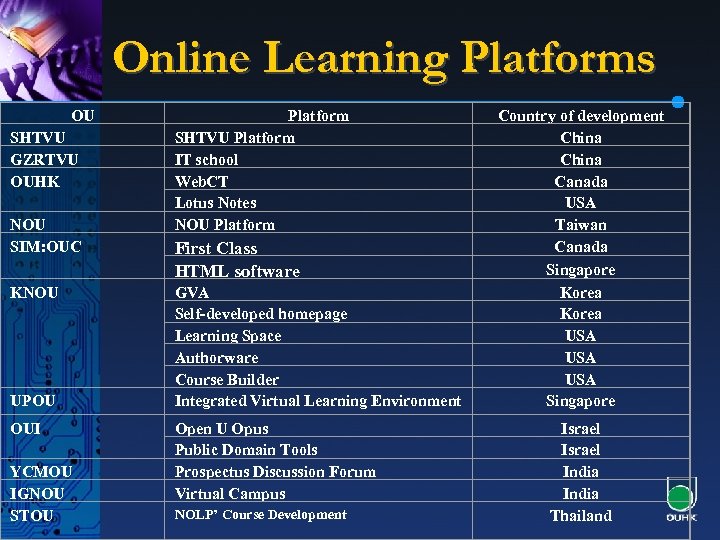
Online Learning Platforms OU SHTVU GZRTVU OUHK NOU SIM: OUC KNOU UPOU OUI YCMOU IGNOU STOU Platform SHTVU Platform IT school Web. CT Lotus Notes NOU Platform First Class HTML software GVA Self-developed homepage Learning Space Authorware Course Builder Integrated Virtual Learning Environment Open U Opus Public Domain Tools Prospectus Discussion Forum Virtual Campus NOLP’ Course Development Country of development China Canada USA Taiwan Canada Singapore Korea USA USA Singapore Israel India Thailand
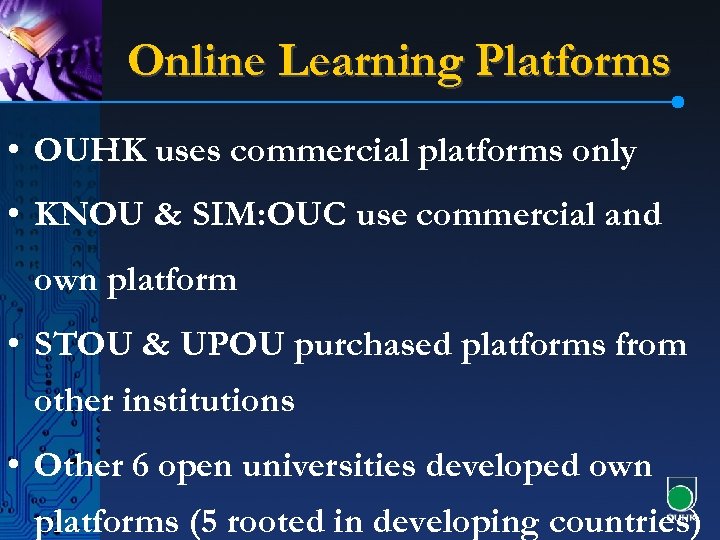
Online Learning Platforms • OUHK uses commercial platforms only • KNOU & SIM: OUC use commercial and own platform • STOU & UPOU purchased platforms from other institutions • Other 6 open universities developed own platforms (5 rooted in developing countries)
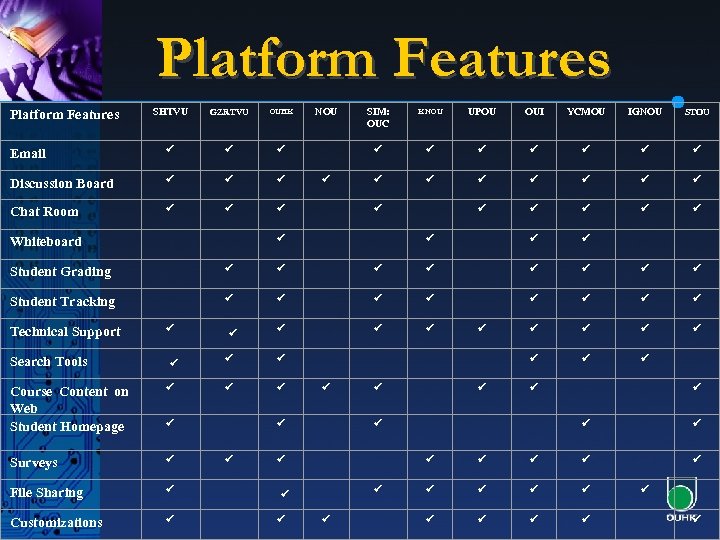
Platform Features SHTVU GZRTVU OUHK NOU SIM: OUC KNOU UPOU OUI YCMOU IGNOU STOU Email Discussion Board Chat Room Whiteboard Student Grading Student Tracking Technical Support Course Content on Web Student Homepage Surveys File Sharing Customizations Platform Features Search Tools
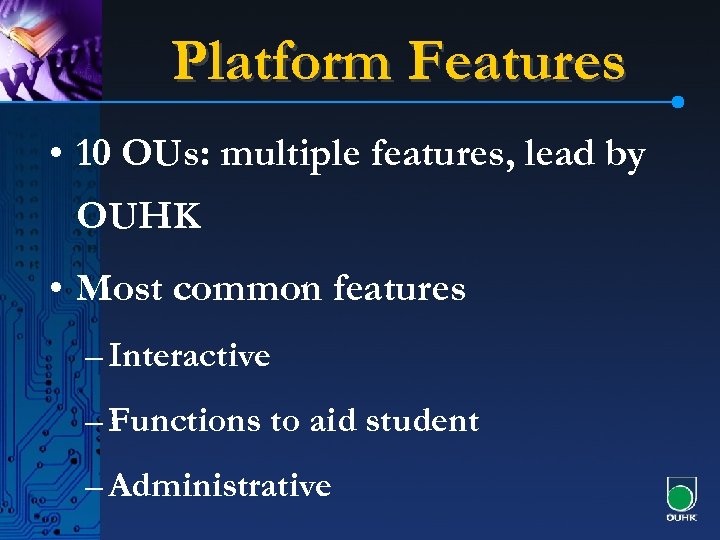
Platform Features • 10 OUs: multiple features, lead by OUHK • Most common features – Interactive – Functions to aid student – Administrative
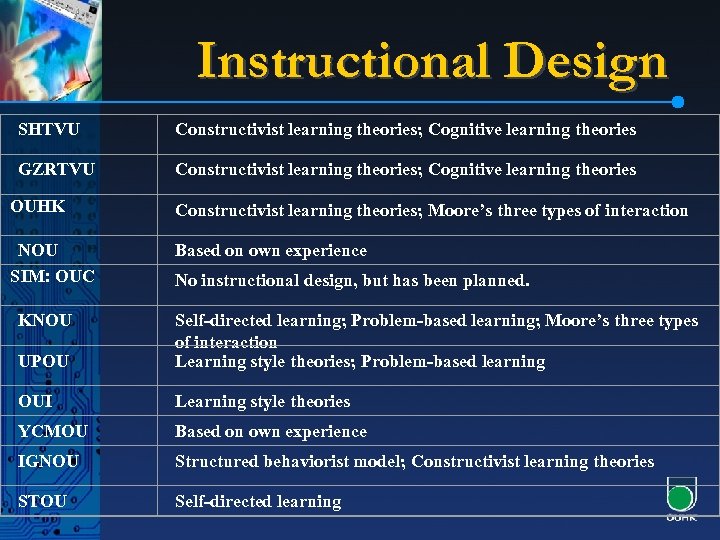
Instructional Design SHTVU Constructivist learning theories; Cognitive learning theories GZRTVU Constructivist learning theories; Cognitive learning theories OUHK Constructivist learning theories; Moore’s three types of interaction NOU SIM: OUC Based on own experience KNOU No instructional design, but has been planned. UPOU Self-directed learning; Problem-based learning; Moore’s three types of interaction Learning style theories; Problem-based learning OUI Learning style theories YCMOU Based on own experience IGNOU Structured behaviorist model; Constructivist learning theories STOU Self-directed learning
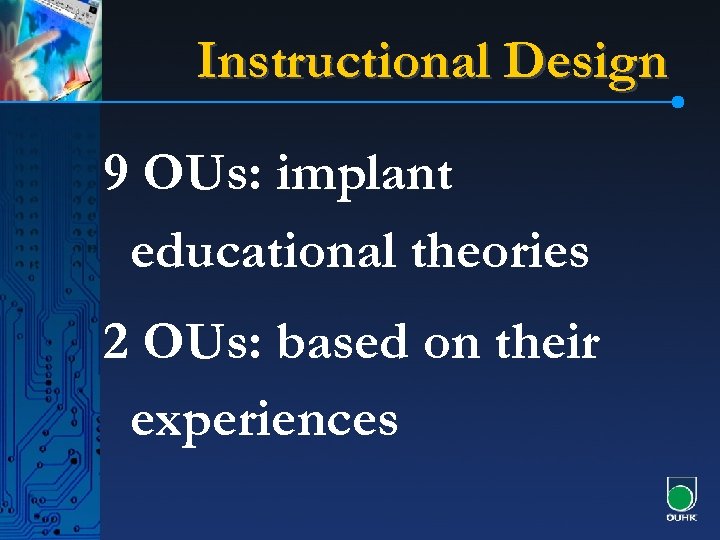
Instructional Design 9 OUs: implant educational theories 2 OUs: based on their experiences
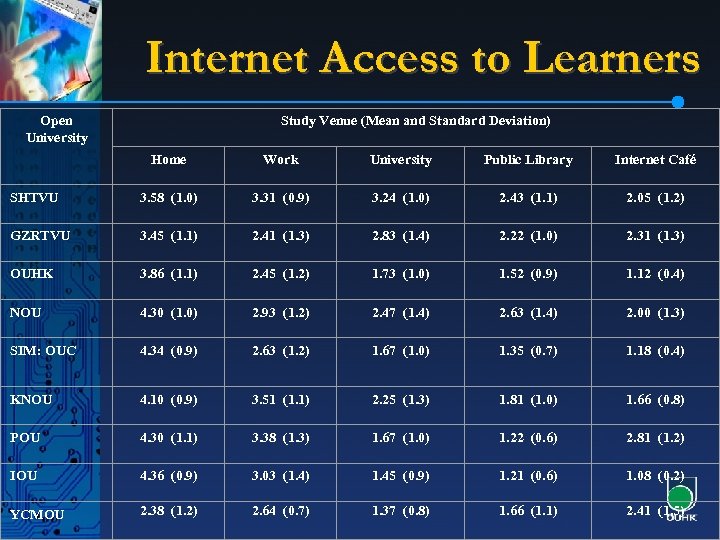
Internet Access to Learners Open University Study Venue (Mean and Standard Deviation) Home Work University Public Library Internet Café SHTVU 3. 58 (1. 0) 3. 31 (0. 9) 3. 24 (1. 0) 2. 43 (1. 1) 2. 05 (1. 2) GZRTVU 3. 45 (1. 1) 2. 41 (1. 3) 2. 83 (1. 4) 2. 22 (1. 0) 2. 31 (1. 3) OUHK 3. 86 (1. 1) 2. 45 (1. 2) 1. 73 (1. 0) 1. 52 (0. 9) 1. 12 (0. 4) NOU 4. 30 (1. 0) 2. 93 (1. 2) 2. 47 (1. 4) 2. 63 (1. 4) 2. 00 (1. 3) SIM: OUC 4. 34 (0. 9) 2. 63 (1. 2) 1. 67 (1. 0) 1. 35 (0. 7) 1. 18 (0. 4) KNOU 4. 10 (0. 9) 3. 51 (1. 1) 2. 25 (1. 3) 1. 81 (1. 0) 1. 66 (0. 8) POU 4. 30 (1. 1) 3. 38 (1. 3) 1. 67 (1. 0) 1. 22 (0. 6) 2. 81 (1. 2) IOU 4. 36 (0. 9) 3. 03 (1. 4) 1. 45 (0. 9) 1. 21 (0. 6) 1. 08 (0. 2) YCMOU 2. 38 (1. 2) 2. 64 (0. 7) 1. 37 (0. 8) 1. 66 (1. 1) 2. 41 (1. 5)
Internet Access to Learners • Access is most frequently from home followed by work • Even less access Internet from University • Also noteworthy – only 3 OU’s have an e-library
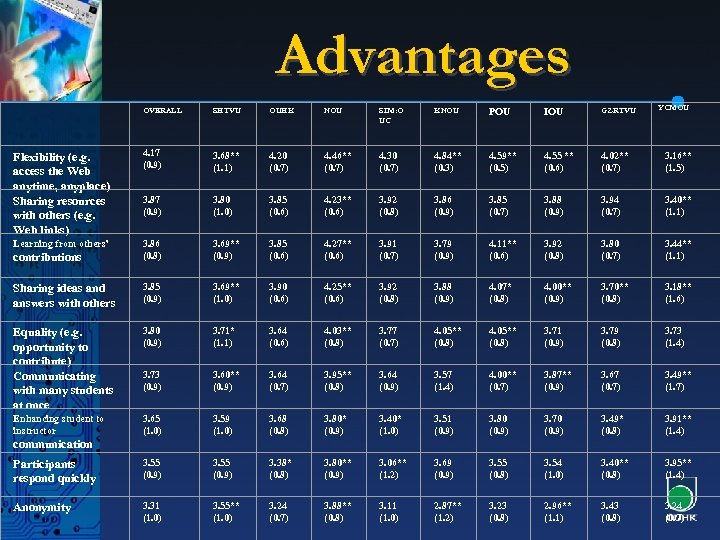
Advantages YCMOU OVERALL SHTVU OUHK NOU SIM: O UC KNOU POU IOU GZRTVU Flexibility (e. g. access the Web anytime, anyplace) Sharing resources with others (e. g. Web links) 4. 17 (0. 9) 3. 68** (1. 1) 4. 20 (0. 7) 4. 46** (0. 7) 4. 30 (0. 7) 4. 84** (0. 3) 4. 59** (0. 5) 4. 55 ** (0. 6) 4. 02** (0. 7) 3. 16** (1. 5) 3. 87 (0. 9) 3. 80 (1. 0) 3. 85 (0. 6) 4. 23** (0. 6) 3. 92 (0. 8) 3. 86 (0. 9) 3. 85 (0. 7) 3. 88 (0. 9) 3. 94 (0. 7) 3. 40** (1. 1) Learning from others’ contributions 3. 86 (0. 8) 3. 69** (0. 9) 3. 85 (0. 6) 4. 27** (0. 6) 3. 91 (0. 7) 3. 79 (0. 9) 4. 11** (0. 6) 3. 92 (0. 8) 3. 80 (0. 7) 3. 44** (1. 1) Sharing ideas and answers with others 3. 85 (0. 9) 3. 69** (1. 0) 3. 90 (0. 6) 4. 25** (0. 6) 3. 92 (0. 8) 3. 88 (0. 9) 4. 07* (0. 8) 4. 00** (0. 9) 3. 70** (0. 8) 3. 18** (1. 6) Equality (e. g. opportunity to contribute) Communicating with many students at once 3. 80 (0. 9) 3. 71* (1. 1) 3. 64 (0. 6) 4. 03** (0. 8) 3. 77 (0. 7) 4. 05** (0. 8) 3. 71 (0. 9) 3. 79 (0. 8) 3. 73 (1. 4) 3. 73 (0. 9) 3. 60** (0. 9) 3. 64 (0. 7) 3. 95** (0. 8) 3. 64 (0. 9) 3. 57 (1. 4) 4. 00** (0. 7) 3. 87** (0. 9) 3. 67 (0. 7) 3. 49** (1. 7) Enhancing student to instructor 3. 65 (1. 0) 3. 59 (1. 0) 3. 68 (0. 8) 3. 80* (0. 9) 3. 40* (1. 0) 3. 51 (0. 9) 3. 80 (0. 9) 3. 70 (0. 9) 3. 49* (0. 8) 3. 91** (1. 4) Participants respond quickly 3. 55 (0. 9) 3. 38* (0. 8) 3. 80** (0. 9) 3. 06** (1. 2) 3. 69 (0. 9) 3. 55 (0. 8) 3. 54 (1. 0) 3. 40** (0. 8) 3. 95** (1. 4) Anonymity 3. 31 (1. 0) 3. 55** (1. 0) 3. 24 (0. 7) 3. 88** (0. 8) 3. 11 (1. 0) 2. 87** (1. 2) 3. 23 (0. 8) 2. 96** (1. 1) 3. 43 (0. 8) 3. 24 (0. 7) communication
Advantages • Flexibility • Collaboration • Democratization
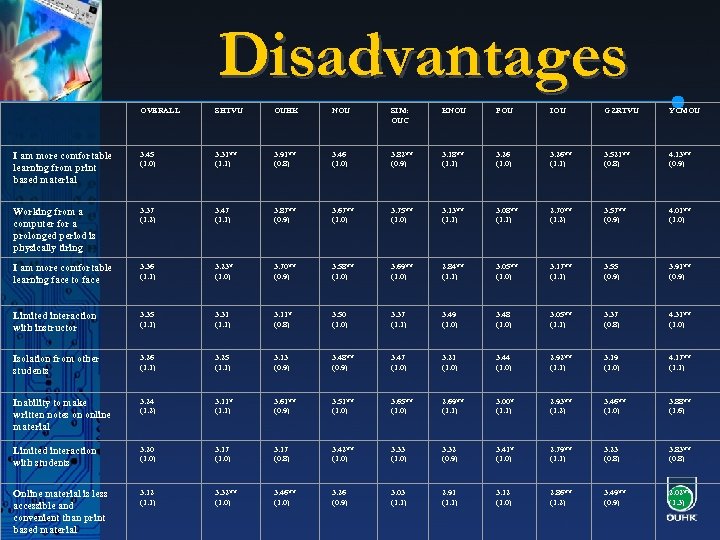
Disadvantages OVERALL SHTVU OUHK NOU SIM: OUC KNOU POU IOU GZRTVU YCMOU I am more comfortable learning from print based material 3. 45 (1. 0) 3. 31** (1. 1) 3. 91** (0. 8) 3. 46 (1. 0) 3. 82** (0. 9) 3. 18** (1. 1) 3. 26 (1. 0) 3. 26** (1. 1) 3. 521** (0. 8) 4. 13** (0. 9) Working from a computer for a prolonged period is physically tiring 3. 37 (1. 2) 3. 47 (1. 1) 3. 87** (0. 9) 3. 67** (1. 0) 3. 75** (1. 0) 3. 13** (1. 1) 3. 08** (1. 1) 2. 70** (1. 2) 3. 57** (0. 9) 4. 01** (1. 0) I am more comfortable learning face to face 3. 36 (1. 1) 3. 23* (1. 0) 3. 70** (0. 9) 3. 58** (1. 0) 3. 69** (1. 0) 2. 84** (1. 1) 3. 05** (1. 0) 3. 17** (1. 1) 3. 55 (0. 9) 3. 91** (0. 9) Limited interaction with instructor 3. 35 (1. 1) 3. 31 (1. 1) 3. 11* (0. 8) 3. 50 (1. 0) 3. 37 (1. 1) 3. 49 (1. 0) 3. 48 (1. 0) 3. 05** (1. 1) 3. 37 (0. 8) 4. 31** (1. 0) Isolation from other students 3. 26 (1. 1) 3. 25 (1. 1) 3. 13 (0. 9) 3. 48** (0. 9) 3. 47 (1. 0) 3. 21 (1. 0) 3. 44 (1. 0) 2. 92** (1. 1) 3. 19 (1. 0) 4. 17** (1. 1) Inability to make written notes on online material 3. 24 (1. 2) 3. 11* (1. 1) 3. 61** (0. 9) 3. 51** (1. 0) 3. 65** (1. 0) 2. 69** (1. 1) 3. 00* (1. 1) 2. 93** (1. 2) 3. 46** (1. 0) 3. 88** (1. 6) Limited interaction with students 3. 20 (1. 0) 3. 17 (0. 8) 3. 42** (1. 0) 3. 33 (1. 0) 3. 32 (0. 9) 3. 41* (1. 0) 2. 79** (1. 1) 3. 23 (0. 8) 3. 83** (0. 8) Online material is less accessible and convenient than print based material 3. 12 (1. 1) 3. 32** (1. 0) 3. 46** (1. 0) 3. 26 (0. 9) 3. 03 (1. 1) 2. 91 (1. 1) 3. 12 (1. 0) 2. 86** (1. 2) 3. 49** (0. 9) 2. 02** (1. 3)
Disadvantages • Accustomed to conventional methods • Desire face to face contact and interaction • Inexperience with the medium
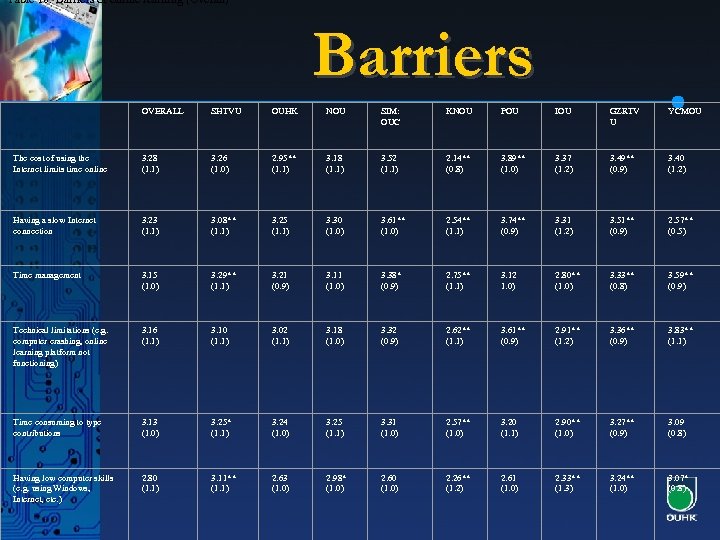
Table 10: Barriers of online learning (Overall) Barriers OVERALL SHTVU OUHK NOU SIM: OUC KNOU POU IOU GZRTV U YCMOU The cost of using the Internet limits time online 3. 28 (1. 1) 3. 26 (1. 0) 2. 95** (1. 1) 3. 18 (1. 1) 3. 52 (1. 1) 2. 14** (0. 8) 3. 89** (1. 0) 3. 37 (1. 2) 3. 49** (0. 9) 3. 40 (1. 2) Having a slow Internet connection 3. 23 (1. 1) 3. 08** (1. 1) 3. 25 (1. 1) 3. 30 (1. 0) 3. 61** (1. 0) 2. 54** (1. 1) 3. 74** (0. 9) 3. 31 (1. 2) 3. 51** (0. 9) 2. 57** (0. 5) Time management 3. 15 (1. 0) 3. 29** (1. 1) 3. 21 (0. 9) 3. 11 (1. 0) 3. 38* (0. 9) 2. 75** (1. 1) 3. 12 1. 0) 2. 80** (1. 0) 3. 33** (0. 8) 3. 59** (0. 9) Technical limitations (e. g. computer crashing, online learning platform not functioning) 3. 16 (1. 1) 3. 10 (1. 1) 3. 02 (1. 1) 3. 18 (1. 0) 3. 32 (0. 9) 2. 62** (1. 1) 3. 61** (0. 9) 2. 91** (1. 2) 3. 36** (0. 9) 3. 83** (1. 1) Time consuming to type contributions 3. 13 (1. 0) 3. 25* (1. 1) 3. 24 (1. 0) 3. 25 (1. 1) 3. 31 (1. 0) 2. 57** (1. 0) 3. 20 (1. 1) 2. 90** (1. 0) 3. 27** (0. 9) 3. 09 (0. 8) Having low computer skills (e. g. using Windows, Internet, etc. ) 2. 80 (1. 1) 3. 11** (1. 1) 2. 63 (1. 0) 2. 98* (1. 0) 2. 60 (1. 0) 2. 26** (1. 2) 2. 61 (1. 0) 2. 33** (1. 3) 3. 24** (1. 0) 3. 07* (0. 8)
Barriers • Cost of Internet access • Speed, connectivity online • Likely more common in Asia compared to the West • Low computer skills not a significant barrier
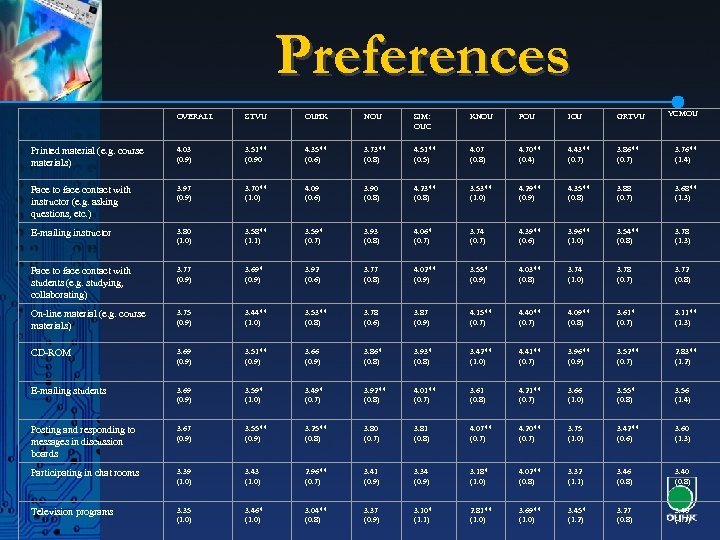
Preferences YCMOU OVERALL STVU OUHK NOU SIM: OUC KNOU POU IOU GRTVU Printed material (e. g. course materials) 4. 03 (0. 9) 3. 51** (0. 90 4. 35** (0. 6) 3. 73** (0. 8) 4. 51** (0. 5) 4. 07 (0. 8) 4. 70** (0. 4) 4. 43** (0. 7) 3. 86** (0. 7) 3. 76** (1. 4) Face to face contact with instructor (e. g. asking questions, etc. ) 3. 97 (0. 9) 3. 70** (1. 0) 4. 09 (0. 6) 3. 90 (0. 8) 4. 23** (0. 8) 3. 53** (1. 0) 4. 29** (0. 9) 4. 35** (0. 8) 3. 88 (0. 7) 3. 68** (1. 3) E-mailing instructor 3. 80 (1. 0) 3. 58** (1. 1) 3. 59* (0. 7) 3. 93 (0. 8) 4. 06* (0. 7) 3. 74 (0. 7) 4. 39** (0. 6) 3. 96** (1. 0) 3. 54** (0. 8) 3. 78 (1. 3) Face to face contact with students (e. g. studying, collaborating) 3. 77 (0. 9) 3. 69* (0. 9) 3. 92 (0. 6) 3. 77 (0. 8) 4. 02** (0. 9) 3. 55* (0. 9) 4. 03** (0. 8) 3. 74 (1. 0) 3. 78 (0. 7) 3. 72 (0. 8) On-line material (e. g. course materials) 3. 75 (0. 9) 3. 44** (1. 0) 3. 53** (0. 8) 3. 78 (0. 6) 3. 87 (0. 9) 4. 15** (0. 7) 4. 40** (0. 7) 4. 09** (0. 8) 3. 61* (0. 7) 3. 11** (1. 3) CD-ROM 3. 69 (0. 9) 3. 51** (0. 9) 3. 66 (0. 9) 3. 86* (0. 8) 3. 93* (0. 8) 3. 42** (1. 0) 4. 41** (0. 7) 3. 96** (0. 9) 3. 52** (0. 7) 2. 83** (1. 2) 3. 69 (0. 9) 3. 59* (1. 0) 3. 49* (0. 7) 3. 92** (0. 8) 4. 01** (0. 7) 3. 61 (0. 8) 4. 21** (0. 7) 3. 66 (1. 0) 3. 55* (0. 8) 3. 56 (1. 4) Posting and responding to messages in discussion boards 3. 67 (0. 9) 3. 55** (0. 9) 3. 25** (0. 8) 3. 80 (0. 7) 3. 81 (0. 8) 4. 07** (0. 7) 4. 20** (0. 7) 3. 75 (1. 0) 3. 42** (0. 6) 3. 60 (1. 3) Participating in chat rooms 3. 39 (1. 0) 3. 43 (1. 0) 2. 96** (0. 7) 3. 41 (0. 9) 3. 34 (0. 9) 3. 18* (1. 0) 4. 02** (0. 8) 3. 32 (1. 1) 3. 46 (0. 8) 3. 40 (0. 8) 3. 35 (1. 0) 3. 46* (1. 0) 3. 04** (0. 8) 3. 37 (0. 9) 3. 10* (1. 1) 2. 81** (1. 0) 3. 69** (1. 0) 3. 45* (1. 2) 3. 27 (0. 8) 3. 46 (1. 1) E-mailing students Television programs
Preferences • Printed materials, contact (F 2 F or email) with instructor • F 2 F with students, working online in general • Relatively high scores, indicating preference for variance in study options

Sample 145 returned and valid questionnaires (returned percentage: 28. 2%) 4 English and 3 Chinese courses in 4 schools Female: 48. 3%; male: 51. 7%
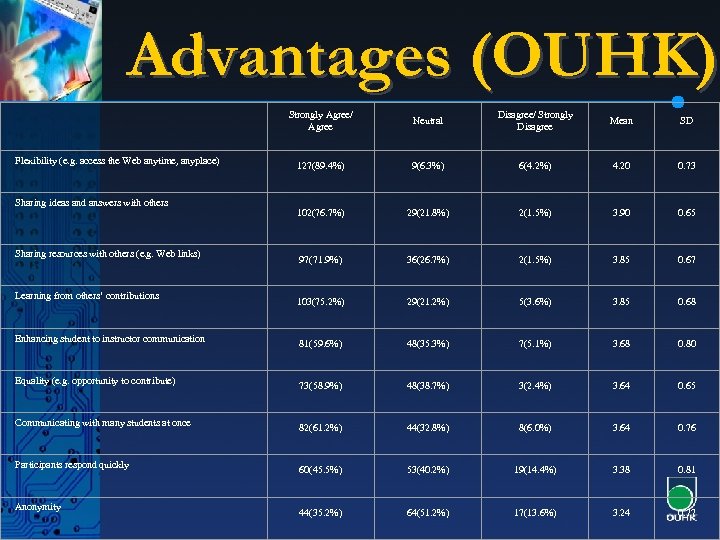
Advantages (OUHK) Strongly Agree/ Agree Neutral Disagree/ Strongly Disagree Mean SD 127(89. 4%) 9(6. 3%) 6(4. 2%) 4. 20 0. 73 102(76. 7%) 29(21. 8%) 2(1. 5%) 3. 90 0. 65 97(71. 9%) 36(26. 7%) 2(1. 5%) 3. 85 0. 67 103(75. 2%) 29(21. 2%) 5(3. 6%) 3. 85 0. 68 81(59. 6%) 48(35. 3%) 7(5. 1%) 3. 68 0. 80 73(58. 9%) 48(38. 7%) 3(2. 4%) 3. 64 0. 65 82(61. 2%) 44(32. 8%) 8(6. 0%) 3. 64 0. 76 Participants respond quickly 60(45. 5%) 53(40. 2%) 19(14. 4%) 3. 38 0. 81 Anonymity 44(35. 2%) 64(51. 2%) 17(13. 6%) 3. 24 0. 77 Flexibility (e. g. access the Web anytime, anyplace) Sharing ideas and answers with others Sharing resources with others (e. g. Web links) Learning from others’ contributions Enhancing student to instructor communication Equality (e. g. opportunity to contribute) Communicating with many students at once

Advantages (OUHK) • Flexibility • Collaboration • Democratization • Is this feasible in all OUHK courses?
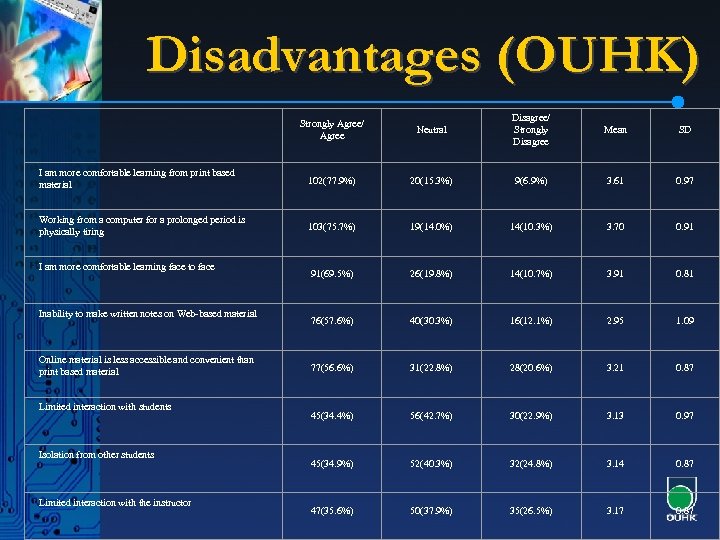
Disadvantages (OUHK) Strongly Agree/ Agree Neutral Disagree/ Strongly Disagree Mean SD I am more comfortable learning from print based material 102(77. 9%) 20(15. 3%) 9(6. 9%) 3. 61 0. 97 Working from a computer for a prolonged period is physically tiring 103(75. 7%) 19(14. 0%) 14(10. 3%) 3. 70 0. 91 91(69. 5%) 26(19. 8%) 14(10. 7%) 3. 91 0. 81 76(57. 6%) 40(30. 3%) 16(12. 1%) 2. 95 1. 09 Online material is less accessible and convenient than print based material 77(56. 6%) 31(22. 8%) 28(20. 6%) 3. 21 0. 87 Limited interaction with students 45(34. 4%) 56(42. 7%) 30(22. 9%) 3. 13 0. 97 Isolation from other students 45(34. 9%) 52(40. 3%) 32(24. 8%) 3. 14 0. 87 47(35. 6%) 50(37. 9%) 35(26. 5%) 3. 17 0. 87 I am more comfortable learning face to face Inability to make written notes on Web-based material Limited interaction with the instructor
Disadvantages (OUHK) • Students are more comfortable learning via print, F 2 F • Inexperience with the medium • But, interaction online is adequate – likely due in part to opportunities to meet F 2 F
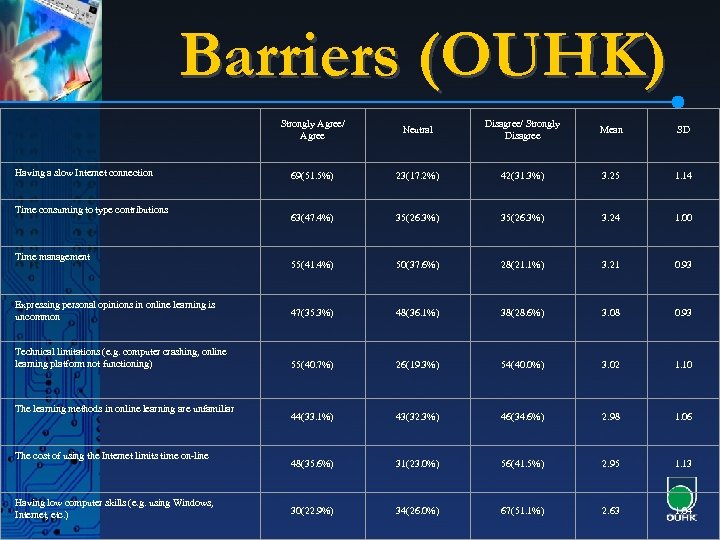
Barriers (OUHK) Strongly Agree/ Agree Neutral Disagree/ Strongly Disagree Mean SD 69(51. 5%) 23(17. 2%) 42(31. 3%) 3. 25 1. 14 63(47. 4%) 35(26. 3%) 3. 24 1. 00 Time management 55(41. 4%) 50(37. 6%) 28(21. 1%) 3. 21 0. 93 Expressing personal opinions in online learning is uncommon 47(35. 3%) 48(36. 1%) 38(28. 6%) 3. 08 0. 93 Technical limitations (e. g. computer crashing, online learning platform not functioning) 55(40. 7%) 26(19. 3%) 54(40. 0%) 3. 02 1. 10 44(33. 1%) 43(32. 3%) 46(34. 6%) 2. 98 1. 06 48(35. 6%) 31(23. 0%) 56(41. 5%) 2. 95 1. 13 30(22. 9%) 34(26. 0%) 67(51. 1%) 2. 63 1. 04 Having a slow Internet connection Time consuming to type contributions The learning methods in online learning are unfamiliar The cost of using the Internet limits time on-line Having low computer skills (e. g. using Windows, Internet, etc. )
Barriers (OUHK) • Slow connection • Time consuming • Computer skills were not a barrier
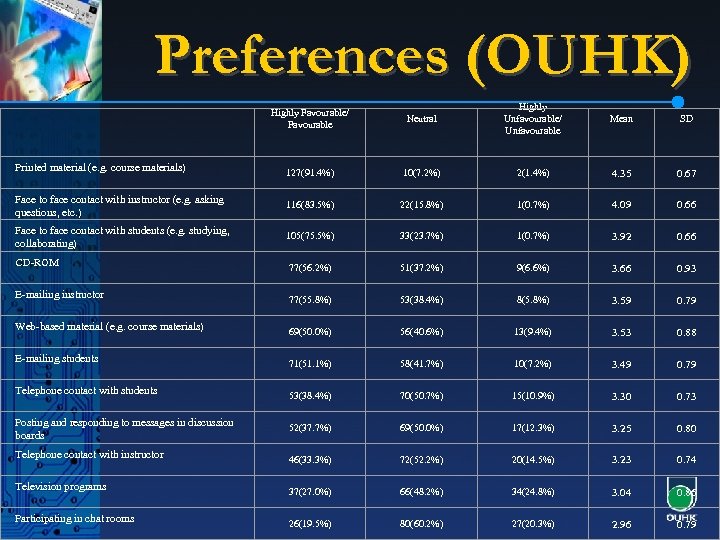
Preferences (OUHK) Highly Favourable/ Favourable Neutral Highly Unfavourable/ Unfavourable Mean SD 127(91. 4%) 10(7. 2%) 2(1. 4%) 4. 35 0. 67 Face to face contact with instructor (e. g. asking questions, etc. ) 116(83. 5%) 22(15. 8%) 1(0. 7%) 4. 09 0. 66 Face to face contact with students (e. g. studying, collaborating) 105(75. 5%) 33(23. 7%) 1(0. 7%) 3. 92 0. 66 77(56. 2%) 51(37. 2%) 9(6. 6%) 3. 66 0. 93 77(55. 8%) 53(38. 4%) 8(5. 8%) 3. 59 0. 79 69(50. 0%) 56(40. 6%) 13(9. 4%) 3. 53 0. 88 71(51. 1%) 58(41. 7%) 10(7. 2%) 3. 49 0. 79 53(38. 4%) 70(50. 7%) 15(10. 9%) 3. 30 0. 73 52(37. 7%) 69(50. 0%) 17(12. 3%) 3. 25 0. 80 46(33. 3%) 72(52. 2%) 20(14. 5%) 3. 23 0. 74 37(27. 0%) 66(48. 2%) 34(24. 8%) 3. 04 0. 86 26(19. 5%) 80(60. 2%) 27(20. 3%) 2. 96 0. 79 Printed material (e. g. course materials) CD-ROM E-mailing instructor Web-based material (e. g. course materials) E-mailing students Telephone contact with students Posting and responding to messages in discussion boards Telephone contact with instructor Television programs Participating in chat rooms
Preferences (OUHK) • Students have a preference for print, F 2 F • CD-ROM/E-mail valued as well • Telephone not as popular

Experiences This collaborative research enabled: • A contribution to knowledge about online learning in Asia • An increase in mutual understanding • A sharing of expertise and resources • The reinforcement of research skills of team members • The saving of cost for printing/postage, data inputting (environmental protection)
Difficulties • Representatives left their post or withdrew for other reasons • Different work speed and style • Repetitive tasks - reminders • Some students were unaccustomed to completing questionnaires online

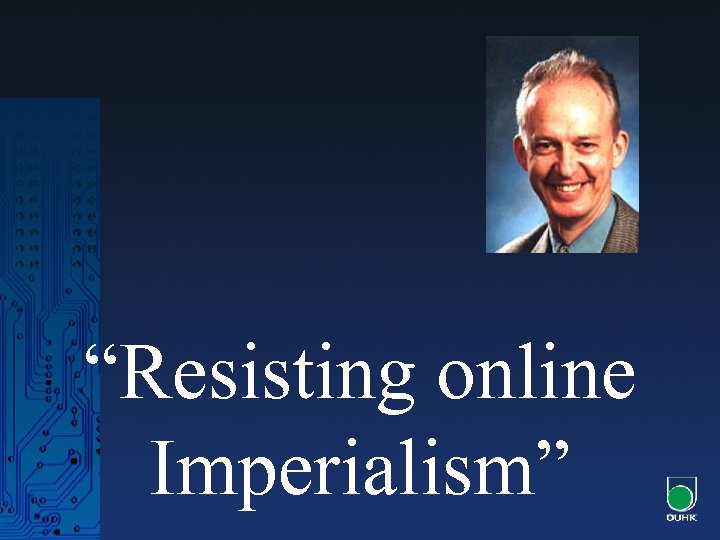
Is this the case? “The reality is that the developing countries of the world are largely being bypassed by the surging developments in virtual education (Farrell, 2001)”
“Resisting online Imperialism”
Technology Online learning platforms • 10 OU’s used a platform designed by itself or from a local/regional designer of online platforms • To suit economic circumstance, local context (e. g. language, etc. ) An Eastern emergence? • IVLE (Singapore), Flex. Education (Hong Kong) adopted overseas
Instructional Design “There is little discussion of the pedagogical elements of online learning in journal articles (Jung, 2002)” The majority of OU’s in this study integrate educational theories into instructional design.
Instructional Design - How does this work in practice? - What specific conditions may be best suited to local contexts? Disciplines?
Mode of online learning • Few students desire a learning environment exclusively online • Matter of adaptation? Experience? Acceptance? • Story of Shanghai TVU

 Скачать презентацию Researching the Efficacy of Online Learning A Collaborative
ce6cf8169cc197f7699020643c64f041.ppt