


 Скачать презентацию Researching Delivering Non-Traditional Systems Engineering Education Jenna
187ee70a17b2381149ccc1e6646cae87.ppt
- Количество слайдов: 10
 Researching & Delivering Non-Traditional Systems Engineering Education Jenna Whitney Program Manager, Impact Innovations Group NDIA 6 th Annual Systems Engineering Conference October 20 -23, 2003
 Agenda n n n Not-so-unique SE training requirements In-depth analysis of US SE curriculum Quality SE curriculum in non-traditional delivery Implementing SE training Future Challenges
 Background n n DOD Agency working to quickly build program management and systems engineering skills in order to succeed in its modernization efforts – mandated by Congress Systems Engineering Training Program funded as R&D effort to build a robust SE curriculum for DOD employees
 Program Requirements A Systems Engineering Training Program that is: n Commercially provided n Portable in nature n Flexible in delivery n Modular in formatting … That also provides: n Links to industry-recognized certification n An option for graduate-level credit
 Findings Additional requirements identified through multiple interviews with Systems Engineers, Acquisition Managers, Managers of Engineers and other Technical Staff Members: n n Local, lecture-based training Short classes and minimal time out of the office Separate and distinct training for SE Practitioners and their Managers/Facilitators External certification
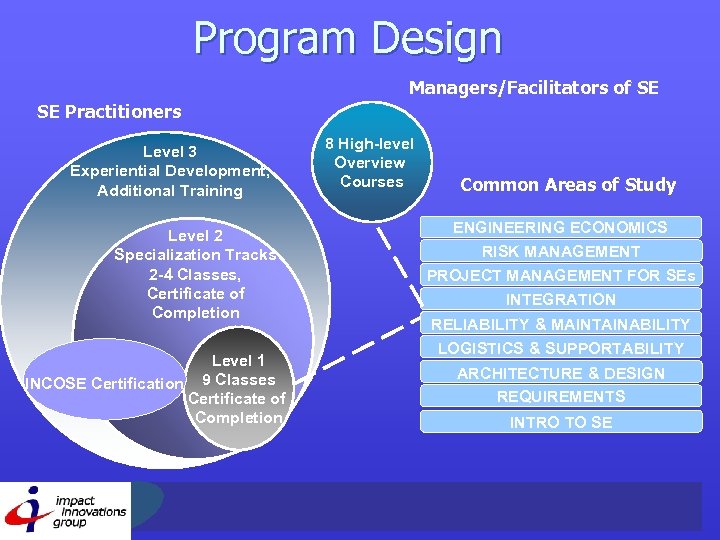 Program Design Managers/Facilitators of SE SE Practitioners Level 3 Experiential Development, Additional Training Level 2 Specialization Tracks 2 -4 Classes, Certificate of Completion Level 1 INCOSE Certification 9 Classes Certificate of Completion 8 High-level Overview Courses Common Areas of Study ENGINEERING ECONOMICS RISK MANAGEMENT PROJECT MANAGEMENT FOR SEs INTEGRATION RELIABILITY & MAINTAINABILITY LOGISTICS & SUPPORTABILITY ARCHITECTURE & DESIGN REQUIREMENTS INTRO TO SE
 Research US study of sources for SE education & training; both commercial and private, accredited and non-accredited; focused on agency-specific requirements n n n 85 training sources initially reviewed 28 sources found to have relevant SE training Further analysis and source interviews produced a final “Top 10” that could meet all or some of the client’s requirements
 Source Selection Additional interviews of remaining training sources conducted; client approval of program that: n n Provides portable, modular & flexible SE training in nine areas of study Incorporates curriculum from four of the top five SE schools identified in the study Entails two tracks of training – Practitioner and Manager/Facilitator tracks Possibly ties to INCOSE Certification
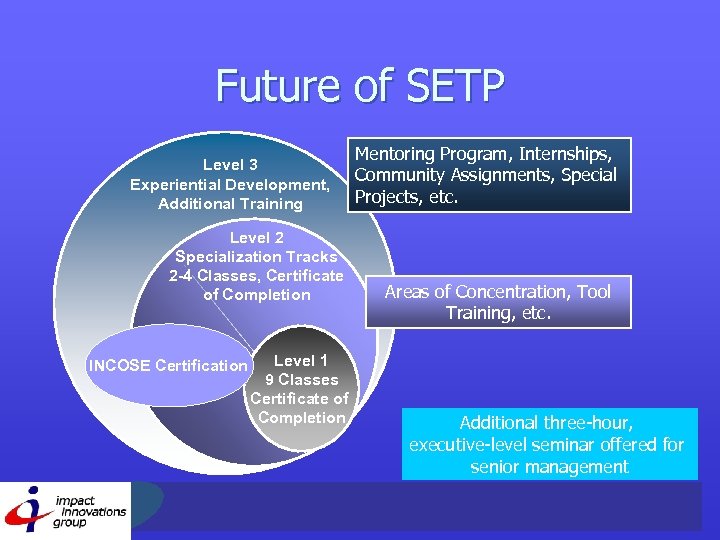 Future of SETP Level 3 Experiential Development, Additional Training Level 2 Specialization Tracks 2 -4 Classes, Certificate of Completion INCOSE Certification Level 1 9 Classes Certificate of Completion Mentoring Program, Internships, Community Assignments, Special Projects, etc. Areas of Concentration, Tool Training, etc. Additional three-hour, executive-level seminar offered for senior management
 Challenges n n n Limited number of training sources available that meet agency requirements Dependence on instructor availability Difficulty in engaging mid-level management