


 Скачать презентацию Research Skills Week 3 Designing a questionnaire
547b7d509cc806e8cc47ff8979ff5eac.ppt
- Количество слайдов: 21
 Research Skills Week 3: Designing a questionnaire
 Last Week Decided on a subject area Performed a literature search Started to think about your research question and hypotheses This week: Designing a questionnaire to test your hypotheses.
 Today Sampling Consent Question types Answer types Questionnaire design Coding
 Sampling Who to ask: your target population How many people: 20 (5 per group member) Avoid a biased sample, e. g. if asking about drinking behaviour in men and women: ◦ Don’t just ask women ◦ Don’t just ask people in a bar ◦ Don’t just ask tee-totallers
 Consent You must adhere to a strict code of ethics in your research: http: //www. bps. org. uk/the-society/code-of-conduct/ Participants must: ◦ give consent to take part ◦ not be coerced into participating ◦ be free to withdraw at any time Administering your questionnaires already has ethics approval.
 Question Types: Open-Ended Participants create their own answers ◦ “What is your age? ” ◦ “Are you a smoker? ” ◦ “What are your favourite TV programmes? ” ◦ “How much do you like biscuits? ” To make data analysis easier DO NOT use open-ended questions that allow participants to write long responses
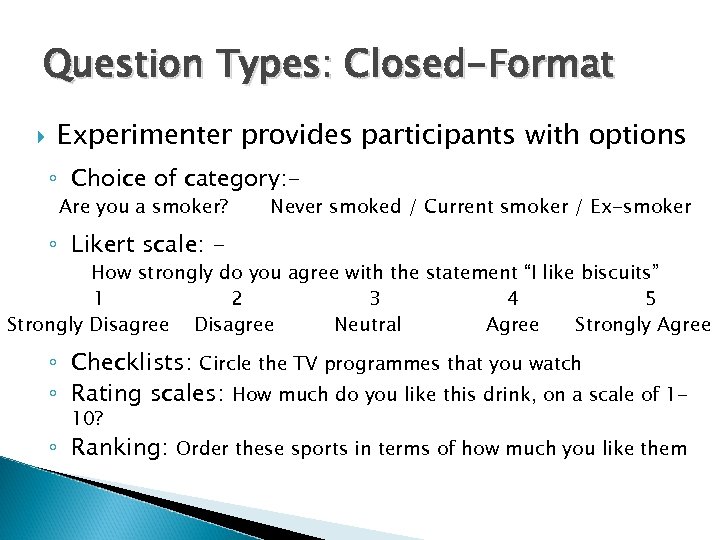 Question Types: Closed-Format Experimenter provides participants with options ◦ Choice of category: Are you a smoker? Never smoked / Current smoker / Ex-smoker ◦ Likert scale: - How strongly do you agree with the statement “I like biscuits” 1 2 3 4 5 Strongly Disagree Neutral Agree Strongly Agree ◦ Checklists: Circle the TV programmes that you watch ◦ Rating scales: How much do you like this drink, on a scale of 110? ◦ Ranking: Order these sports in terms of how much you like them
 Advantages and Disadvantages Open-Ended ◦ Exploratory ◦ Useful when you can’t cover all the possible answers ◦ Impractical in terms of analysis Closed-Format ◦ Easy and quick to fill in ◦ Doesn’t matter how literate or articulate you are ◦ Easy to code, record, and analyse results quantitatively ◦ Easy to report results
 Answer Types: Continuous Data If the answer to the question is a number that represents an amount, e. g. ◦ ◦ ◦ IQ score Height How long it takes to complete a jigsaw puzzle Likert scale responses Ranks Top tip: Calculating a mean makes sense with continuous data (but not with categorical data)
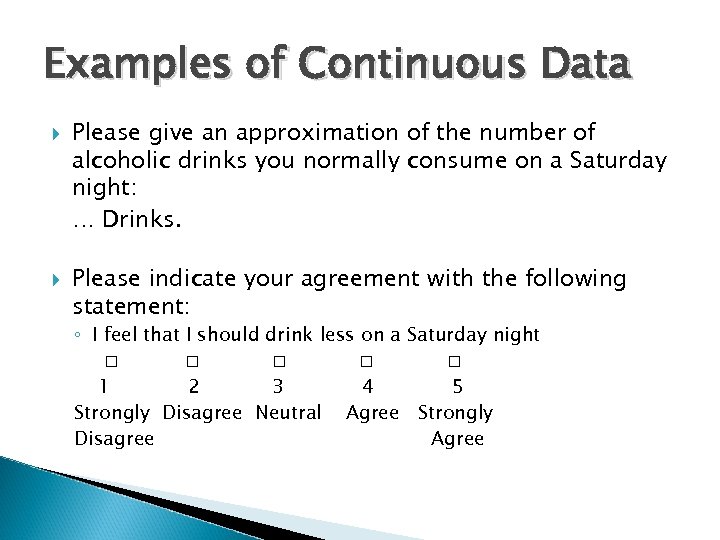 Examples of Continuous Data Please give an approximation of the number of alcoholic drinks you normally consume on a Saturday night: … Drinks. Please indicate your agreement with the following statement: ◦ I feel that I should drink less on a Saturday night □ □ □ 1 2 3 4 5 Strongly Disagree Neutral Agree Strongly Disagree Agree
 Answer Types: Categorical Data If the answer to the question is: ◦ a word “Yes” ◦ a sentence “I think that biscuits are tasty” ◦ a description “Physics student” ◦ a code that represents a category 1 = undergraduate, 2 = postgraduate NB: Numerical codes can be used to represent categorical responses BUT this does not transform categorical data into continuous data.
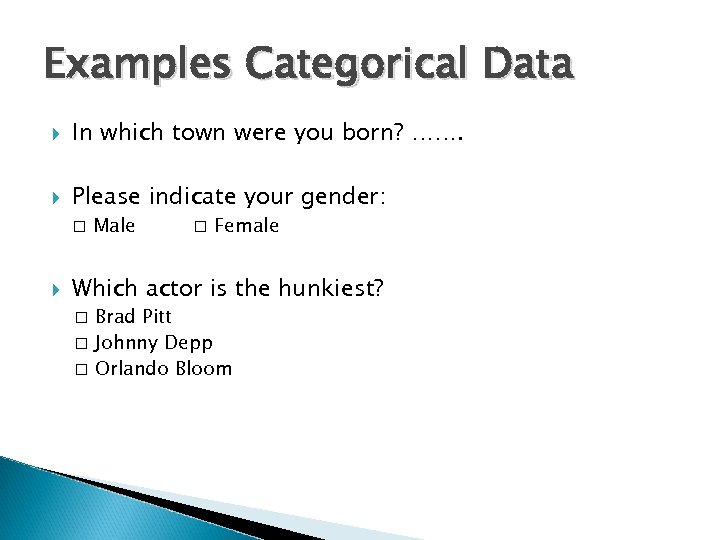 Examples Categorical Data In which town were you born? ……. Please indicate your gender: □ Male □ Female Which actor is the hunkiest? □ Brad Pitt □ Johnny Depp □ Orlando Bloom
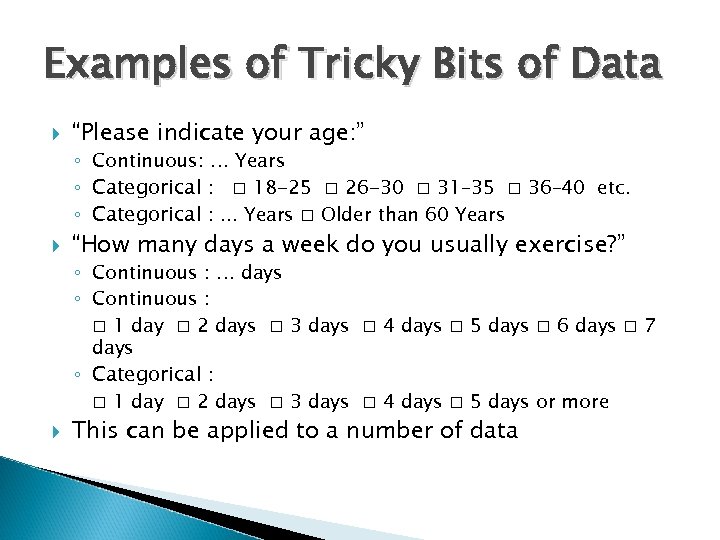 Examples of Tricky Bits of Data “Please indicate your age: ” ◦ Continuous: … Years ◦ Categorical : □ 18 -25 □ 26 -30 □ 31– 35 □ 36– 40 etc. ◦ Categorical : . . . Years □ Older than 60 Years “How many days a week do you usually exercise? ” ◦ Continuous : … days ◦ Continuous : □ 1 day □ 2 days □ 3 days □ 4 days □ 5 days □ 6 days □ 7 days ◦ Categorical : □ 1 day □ 2 days □ 3 days □ 4 days □ 5 days or more This can be applied to a number of data
 Questionnaire Design Keep it short and simple Start with an introduction/ welcome message Allow not applicable responses to all possibly relevant questions Say thank you to your participants
 Questionnaire Design Go from general to particular Go from easy to difficult Go from factual to abstract Do not start with demographic and personal questions (put these at the end)
 Questionnaire Design Start with a title Assure anonymity Avoid personal and sensitive questions ◦ Assign each questionnaire a number instead of asking for names Be aware that you may bias answers simply by being there Try to avoid biased wording ◦ e. g. “Would you agree that the death penalty is a bad idea? ”
 Coding Giving numbers to categories in categorical data is called coding ◦ e. g. “Yes” becomes 1 and “No” becomes 2 Codes can be allocated either before the question is answered (pre-coding) or afterwards (post-coding) You should agree on codes with the rest of your group before you enter any data We will come back to this in Week 5
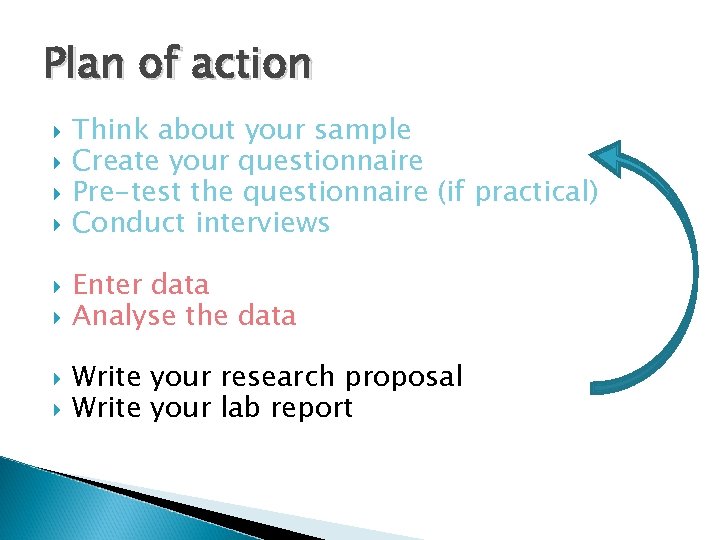 Plan of action Think about your sample Create your questionnaire Pre-test the questionnaire (if practical) Conduct interviews Enter data Analyse the data Write your research proposal Write your lab report
 Hypotheses 2 Categorical Hypotheses: ◦ Should be tested with 2 categorical questions ◦ e. g. “Men prefer to buy fast food at Burger King, while women prefer to buy fast food at Mc. Donalds” 2 Continuous Hypotheses: ◦ Should be tested with a categorical question and a continuous question ◦ e. g. “Males consume a larger quantity of alcoholic beverages per week than females”
 By the time you leave class Put together your group questionnaire ◦ 10 questions in total ◦ 5 Categorical questions ◦ 5 Continuous questions Try to consider your hypotheses while creating the questions Get a tutor to check it over
 By next week Try to have asked 20 people to fill out your questionnaire Top tip: If psychology students are a suitable sample, swap questionnaires with each other