


 Скачать презентацию Research report MENA telecoms market strategies and opportunities
2b17b174784825b7c31374d339374f9f.ppt
- Количество слайдов: 60
 Research report MENA telecoms market: strategies and opportunities 2008– Daniel Jones 2013 l October 2008
![MENA telecoms market: strategies and opportunities 2008– 2013 2 Contents [1] Slide no. 4.](https://present5.com/presentation/2b17b174784825b7c31374d339374f9f/image-2.jpg "MENA telecoms market: strategies and opportunities 2008– 2013 2 Contents [1] Slide no. 4.") MENA telecoms market: strategies and opportunities 2008– 2013 2 Contents [1] Slide no. 4. Document map – Executive summary 5. The MENA region’s telecoms industry will become more complex during the next five years 6. Document map – Introduction and scope 7. This report provides strategic analysis, case studies and forecasts for the MENA region 8. Document map – Market review 9. Market review: Investment opportunities 10. MENA mobile markets have attracted heavy investment following liberalisation, and are growing rapidly 11. New MNO licence awards have become scarce, but other investment opportunities remain 12. A climate of political or regulatory uncertainty surrounds the major investment opportunities 13. Broadband presents the largest opportunity in markets where mobile penetration is reaching saturation 14. Market review: Wi. MAX 15. Wi. MAX licensing offers an effective means of entering the broadband market in some countries in the MENA region 16. Wi. MAX enables MNOs to develop triple play offers 17. Limited fixed line competition improves the business case for Wi. MAX 18. Market review: MVNOs Slide no. 19. Some regulators in the region are considering MVNO licence awards as a means of increasing competition 20. Oman could become the first country in the region in which MVNOs launch operations 21. The market conditions for MVNOs are more attractive in the MENA region than in Europe 22. Market review: Pan-regional operators 23. A small number of operators are becoming increasingly dominant in the market 24. Zain’s launch of the ‘One Network’ puts it in a strong position in the region 25. Etisalat is investing in expansion throughout the MENA region and beyond 26. After a slow start, Saudi Telecom may begin to make an impact outside its home market 27. Qtel’s strategy focuses on investments in mobile, broadband corporate managed services 28. Document map – Country case studies 29. Country case studies: Egypt 30. The Egyptian mobile market will grow strongly, but operators must avoid intense price competition 31. A focus on reducing the cost of mobile ownership will attract new subscribers without sacrificing ARPU 32. Operators must pay attention to the small, but lucrative, contract subscriber base © Analysys Mason Limited 2008
MENA telecoms market: strategies and opportunities 2008– 2013 2 Contents [1] Slide no. 4. Document map – Executive summary 5. The MENA region’s telecoms industry will become more complex during the next five years 6. Document map – Introduction and scope 7. This report provides strategic analysis, case studies and forecasts for the MENA region 8. Document map – Market review 9. Market review: Investment opportunities 10. MENA mobile markets have attracted heavy investment following liberalisation, and are growing rapidly 11. New MNO licence awards have become scarce, but other investment opportunities remain 12. A climate of political or regulatory uncertainty surrounds the major investment opportunities 13. Broadband presents the largest opportunity in markets where mobile penetration is reaching saturation 14. Market review: Wi. MAX 15. Wi. MAX licensing offers an effective means of entering the broadband market in some countries in the MENA region 16. Wi. MAX enables MNOs to develop triple play offers 17. Limited fixed line competition improves the business case for Wi. MAX 18. Market review: MVNOs Slide no. 19. Some regulators in the region are considering MVNO licence awards as a means of increasing competition 20. Oman could become the first country in the region in which MVNOs launch operations 21. The market conditions for MVNOs are more attractive in the MENA region than in Europe 22. Market review: Pan-regional operators 23. A small number of operators are becoming increasingly dominant in the market 24. Zain’s launch of the ‘One Network’ puts it in a strong position in the region 25. Etisalat is investing in expansion throughout the MENA region and beyond 26. After a slow start, Saudi Telecom may begin to make an impact outside its home market 27. Qtel’s strategy focuses on investments in mobile, broadband corporate managed services 28. Document map – Country case studies 29. Country case studies: Egypt 30. The Egyptian mobile market will grow strongly, but operators must avoid intense price competition 31. A focus on reducing the cost of mobile ownership will attract new subscribers without sacrificing ARPU 32. Operators must pay attention to the small, but lucrative, contract subscriber base © Analysys Mason Limited 2008
![MENA telecoms market: strategies and opportunities 2008– 2013 3 Contents [2] Slide no. 33.](https://present5.com/presentation/2b17b174784825b7c31374d339374f9f/image-3.jpg "MENA telecoms market: strategies and opportunities 2008– 2013 3 Contents [2] Slide no. 33.") MENA telecoms market: strategies and opportunities 2008– 2013 3 Contents [2] Slide no. 33. Uncertainties about the competitive environment will affect the outlook for the broadband market 34. Several factors will affect the development of the Egyptian broadband market 35. Country case studies: Morocco 36. A third GSM licence will alter the competitive dynamics of the mobile market in Morocco 37. Limited mobility wireless services are proving popular 38. Intense competition between DSL and wireless access will drive the development of the broadband market 39. Country case studies: Saudi Arabia 40. Zain has become third major MNO to enter the mobile market in Saudi Arabia 41. The further increase in competition will have a small but negative impact on ARPU 42. Mobily has rolled out Wi. MAX based broadband services, following its unsuccessful bid for a fixed licence 43. Three fixed line market entrants are expected to launch services soon in Saudi Arabia 44. Country case studies: United Arab Emirates 45. Penetration in the UAE mobile market is reaching very high levels Slide no. 46. du has secured a significant share of the mobile market in a short amount of time 47. The broadband market in the UAE is more developed than that of many other countries in the MENA region 48. Further market liberalisation in the UAE is unlikely in the short term 49. Document map – Author, copyright and key to acronyms 50. Author and acknowledgements 51. Copyright and disclaimer 52. Key to acronyms 53. Document map – List of figures and tables 54. List of figures and tables [1] 55. List of figures and tables [2] 56. Document map – About Analysys reports and services 57. About Analysys Mason 58. Reports from Analysys Mason 59. Market intelligence services from Analysys Mason 60. Custom Research from Analysys Mason © Analysys Mason Limited 2008
MENA telecoms market: strategies and opportunities 2008– 2013 3 Contents [2] Slide no. 33. Uncertainties about the competitive environment will affect the outlook for the broadband market 34. Several factors will affect the development of the Egyptian broadband market 35. Country case studies: Morocco 36. A third GSM licence will alter the competitive dynamics of the mobile market in Morocco 37. Limited mobility wireless services are proving popular 38. Intense competition between DSL and wireless access will drive the development of the broadband market 39. Country case studies: Saudi Arabia 40. Zain has become third major MNO to enter the mobile market in Saudi Arabia 41. The further increase in competition will have a small but negative impact on ARPU 42. Mobily has rolled out Wi. MAX based broadband services, following its unsuccessful bid for a fixed licence 43. Three fixed line market entrants are expected to launch services soon in Saudi Arabia 44. Country case studies: United Arab Emirates 45. Penetration in the UAE mobile market is reaching very high levels Slide no. 46. du has secured a significant share of the mobile market in a short amount of time 47. The broadband market in the UAE is more developed than that of many other countries in the MENA region 48. Further market liberalisation in the UAE is unlikely in the short term 49. Document map – Author, copyright and key to acronyms 50. Author and acknowledgements 51. Copyright and disclaimer 52. Key to acronyms 53. Document map – List of figures and tables 54. List of figures and tables [1] 55. List of figures and tables [2] 56. Document map – About Analysys reports and services 57. About Analysys Mason 58. Reports from Analysys Mason 59. Market intelligence services from Analysys Mason 60. Custom Research from Analysys Mason © Analysys Mason Limited 2008
 MENA telecoms market: strategies and opportunities 2008– 2013 4 Document map: Executive summary Document map Executive summary Introduction and scope Market review Country case studies Author, copyright and key to acronyms List of figures and tables About Analysys Mason reports and services © Analysys Mason Limited 2008
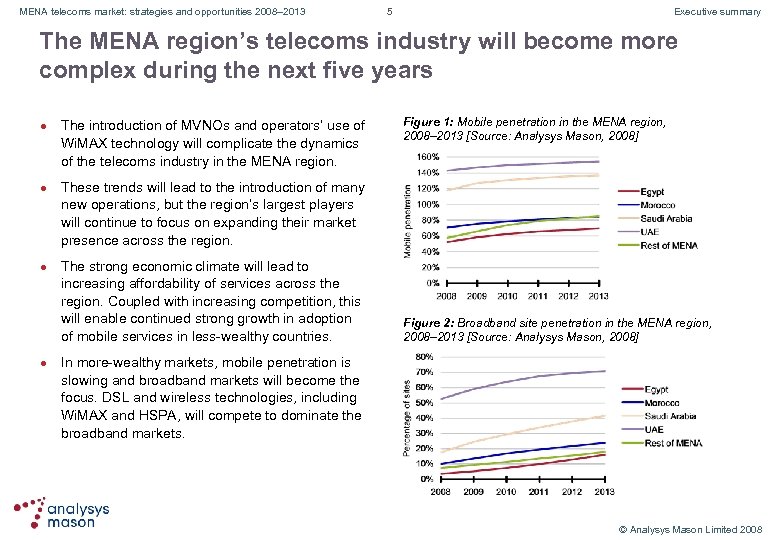 MENA telecoms market: strategies and opportunities 2008– 2013 5 Executive summary The MENA region’s telecoms industry will become more complex during the next five years l l The introduction of MVNOs and operators’ use of Wi. MAX technology will complicate the dynamics of the telecoms industry in the MENA region. Figure 1: Mobile penetration in the MENA region, 2008– 2013 [Source: Analysys Mason, 2008] These trends will lead to the introduction of many new operations, but the region’s largest players will continue to focus on expanding their market presence across the region. The strong economic climate will lead to increasing affordability of services across the region. Coupled with increasing competition, this will enable continued strong growth in adoption of mobile services in less wealthy countries. Figure 2: Broadband site penetration in the MENA region, 2008– 2013 [Source: Analysys Mason, 2008] In more wealthy markets, mobile penetration is slowing and broadband markets will become the focus. DSL and wireless technologies, including Wi. MAX and HSPA, will compete to dominate the broadband markets. © Analysys Mason Limited 2008
 MENA telecoms market: strategies and opportunities 2008– 2013 6 Document map: Introduction and scope Document map Executive summary Introduction and scope Market review Country case studies Author, copyright and key to acronyms List of figures and tables About Analysys Mason reports and services © Analysys Mason Limited 2008
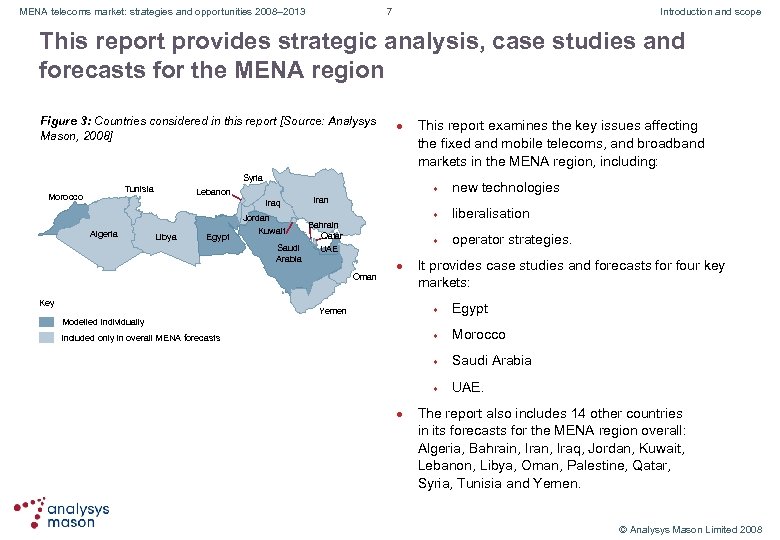 7 MENA telecoms market: strategies and opportunities 2008– 2013 Introduction and scope This report provides strategic analysis, case studies and forecasts for the MENA region Figure 3: Countries considered in this report [Source: Analysys Mason, 2008] l This report examines the key issues affecting the fixed and mobile telecoms, and broadband markets in the MENA region, including: Syria Tunisia Morocco w Lebanon Iraq Algeria Libya Egypt w liberalisation w Jordan Kuwait Bahrain Qatar Saudi UAE Arabia l Oman Key new technologies operator strategies. Iran It provides case studies and forecasts for four key markets: w Egypt w Morocco w Saudi Arabia w Yemen UAE. Modelled individually Included only in overall MENA forecasts l The report also includes 14 other countries in its forecasts for the MENA region overall: Algeria, Bahrain, Iraq, Jordan, Kuwait, Lebanon, Libya, Oman, Palestine, Qatar, Syria, Tunisia and Yemen. © Analysys Mason Limited 2008
 MENA telecoms market: strategies and opportunities 2008– 2013 8 Document map: Market review Document map Executive summary Introduction and scope Market review Country case studies Author, copyright and key to acronyms List of figures and tables About Analysys Mason reports and services © Analysys Mason Limited 2008
 MENA telecoms market: strategies and opportunities 2008– 2013 9 Market review: Investment opportunities Document map Market review Investment opportunities Wi. MAX MVNOs Pan-regional operators © Analysys Mason Limited 2008
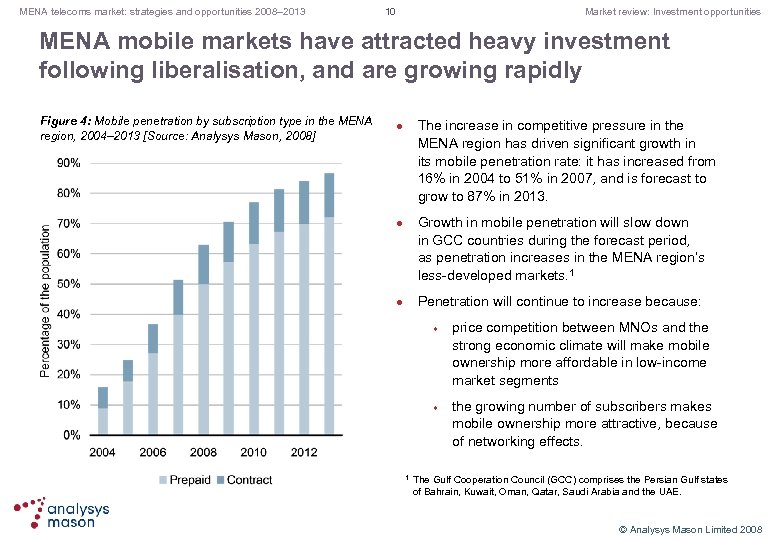 MENA telecoms market: strategies and opportunities 2008– 2013 10 Market review: Investment opportunities MENA mobile markets have attracted heavy investment following liberalisation, and are growing rapidly Figure 4: Mobile penetration by subscription type in the MENA region, 2004– 2013 [Source: Analysys Mason, 2008] The increase in competitive pressure in the MENA region has driven significant growth in its mobile penetration rate: it has increased from 16% in 2004 to 51% in 2007, and is forecast to grow to 87% in 2013. l Growth in mobile penetration will slow down in GCC countries during the forecast period, as penetration increases in the MENA region’s less developed markets. 1 l Penetration will continue to increase because: l w w 1 price competition between MNOs and the strong economic climate will make mobile ownership more affordable in low income market segments the growing number of subscribers makes mobile ownership more attractive, because of networking effects. The Gulf Cooperation Council (GCC) comprises the Persian Gulf states of Bahrain, Kuwait, Oman, Qatar, Saudi Arabia and the UAE. © Analysys Mason Limited 2008
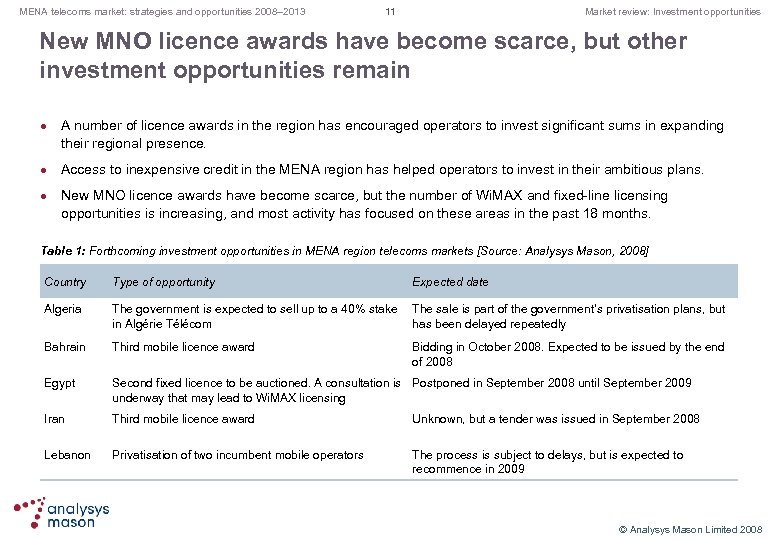 MENA telecoms market: strategies and opportunities 2008– 2013 11 Market review: Investment opportunities New MNO licence awards have become scarce, but other investment opportunities remain l l l A number of licence awards in the region has encouraged operators to invest significant sums in expanding their regional presence. Access to inexpensive credit in the MENA region has helped operators to invest in their ambitious plans. New MNO licence awards have become scarce, but the number of Wi. MAX and fixed line licensing opportunities is increasing, and most activity has focused on these areas in the past 18 months. Table 1: Forthcoming investment opportunities in MENA region telecoms markets [Source: Analysys Mason, 2008] Country Type of opportunity Expected date Algeria The government is expected to sell up to a 40% stake The sale is part of the government’s privatisation plans, but in Algérie Télécom has been delayed repeatedly Bahrain Third mobile licence award Egypt Second fixed licence to be auctioned. A consultation is Postponed in September 2008 until September 2009 underway that may lead to Wi. MAX licensing Iran Third mobile licence award Unknown, but a tender was issued in September 2008 Lebanon Privatisation of two incumbent mobile operators The process is subject to delays, but is expected to recommence in 2009 Bidding in October 2008. Expected to be issued by the end of 2008 © Analysys Mason Limited 2008
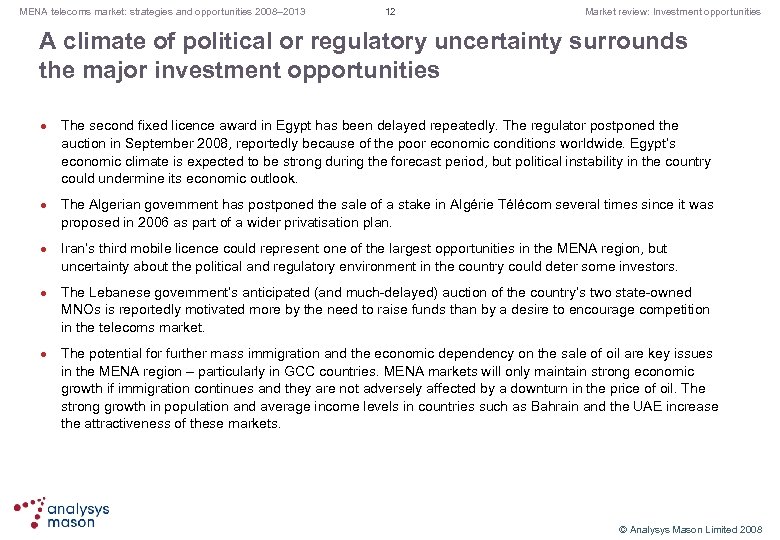 MENA telecoms market: strategies and opportunities 2008– 2013 12 Market review: Investment opportunities A climate of political or regulatory uncertainty surrounds the major investment opportunities l l l The second fixed licence award in Egypt has been delayed repeatedly. The regulator postponed the auction in September 2008, reportedly because of the poor economic conditions worldwide. Egypt’s economic climate is expected to be strong during the forecast period, but political instability in the country could undermine its economic outlook. The Algerian government has postponed the sale of a stake in Algérie Télécom several times since it was proposed in 2006 as part of a wider privatisation plan. Iran’s third mobile licence could represent one of the largest opportunities in the MENA region, but uncertainty about the political and regulatory environment in the country could deter some investors. The Lebanese government’s anticipated (and much delayed) auction of the country’s two state owned MNOs is reportedly motivated more by the need to raise funds than by a desire to encourage competition in the telecoms market. The potential for further mass immigration and the economic dependency on the sale of oil are key issues in the MENA region – particularly in GCC countries. MENA markets will only maintain strong economic growth if immigration continues and they are not adversely affected by a downturn in the price of oil. The strong growth in population and average income levels in countries such as Bahrain and the UAE increase the attractiveness of these markets. © Analysys Mason Limited 2008
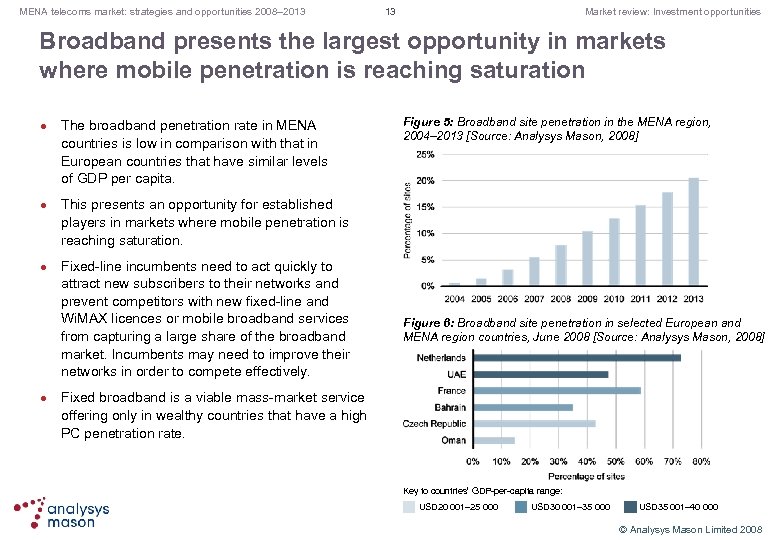 MENA telecoms market: strategies and opportunities 2008– 2013 13 Market review: Investment opportunities Broadband presents the largest opportunity in markets where mobile penetration is reaching saturation l l The broadband penetration rate in MENA countries is low in comparison with that in European countries that have similar levels of GDP per capita. Figure 5: Broadband site penetration in the MENA region, 2004– 2013 [Source: Analysys Mason, 2008] This presents an opportunity for established players in markets where mobile penetration is reaching saturation. Fixed line incumbents need to act quickly to attract new subscribers to their networks and prevent competitors with new fixed line and Wi. MAX licences or mobile broadband services from capturing a large share of the broadband market. Incumbents may need to improve their networks in order to compete effectively. Figure 6: Broadband site penetration in selected European and MENA region countries, June 2008 [Source: Analysys Mason, 2008] Fixed broadband is a viable mass market service offering only in wealthy countries that have a high PC penetration rate. Key to countries’ GDP per capita range: USD 20 001– 25 000 USD 30 001– 35 000 USD 35 001– 40 000 © Analysys Mason Limited 2008
 MENA telecoms market: strategies and opportunities 2008– 2013 14 Market review: Wi. MAX Document map Market review Investment opportunities Wi. MAX MVNOs Pan-regional operators © Analysys Mason Limited 2008
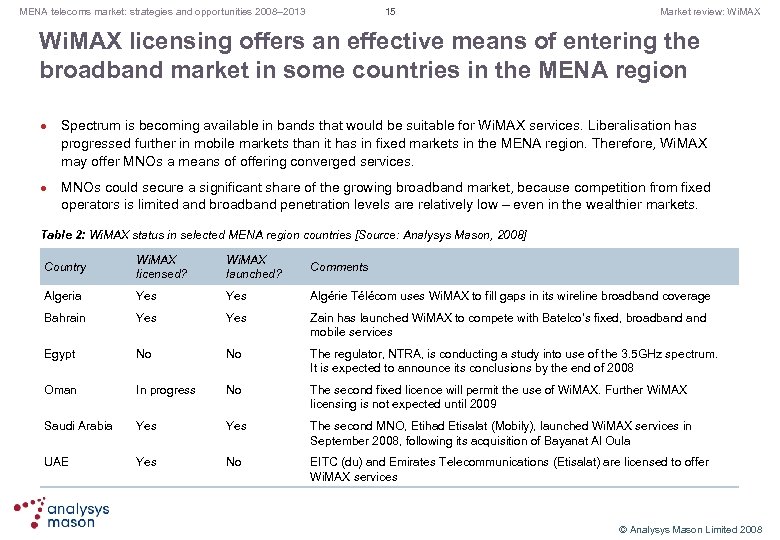 15 MENA telecoms market: strategies and opportunities 2008– 2013 Market review: Wi. MAX licensing offers an effective means of entering the broadband market in some countries in the MENA region l l Spectrum is becoming available in bands that would be suitable for Wi. MAX services. Liberalisation has progressed further in mobile markets than it has in fixed markets in the MENA region. Therefore, Wi. MAX may offer MNOs a means of offering converged services. MNOs could secure a significant share of the growing broadband market, because competition from fixed operators is limited and broadband penetration levels are relatively low – even in the wealthier markets. Table 2: Wi. MAX status in selected MENA region countries [Source: Analysys Mason, 2008] Country Wi. MAX licensed? Wi. MAX launched? Comments Algeria Yes Algérie Télécom uses Wi. MAX to fill gaps in its wireline broadband coverage Bahrain Yes Zain has launched Wi. MAX to compete with Batelco’s fixed, broadband mobile services Egypt No No The regulator, NTRA, is conducting a study into use of the 3. 5 GHz spectrum. It is expected to announce its conclusions by the end of 2008 Oman In progress No The second fixed licence will permit the use of Wi. MAX. Further Wi. MAX licensing is not expected until 2009 Saudi Arabia Yes The second MNO, Etihad Etisalat (Mobily), launched Wi. MAX services in September 2008, following its acquisition of Bayanat Al Oula UAE Yes No EITC (du) and Emirates Telecommunications (Etisalat) are licensed to offer Wi. MAX services © Analysys Mason Limited 2008
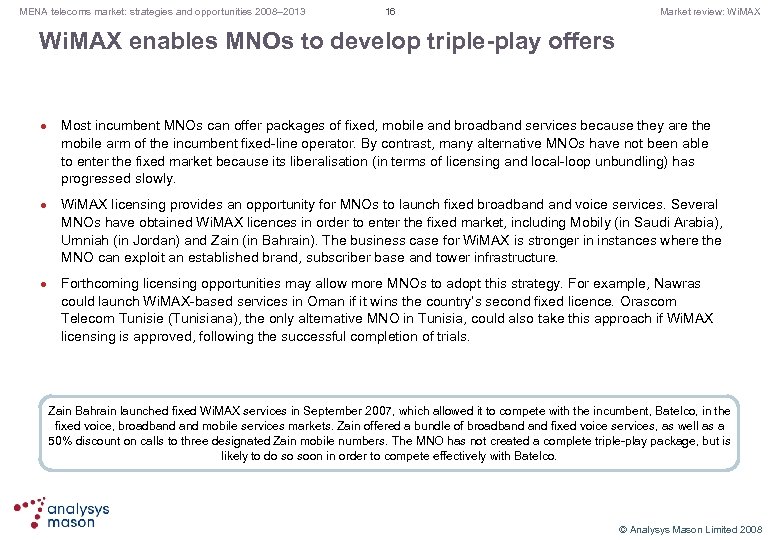 MENA telecoms market: strategies and opportunities 2008– 2013 16 Market review: Wi. MAX enables MNOs to develop triple-play offers l l l Most incumbent MNOs can offer packages of fixed, mobile and broadband services because they are the mobile arm of the incumbent fixed line operator. By contrast, many alternative MNOs have not been able to enter the fixed market because its liberalisation (in terms of licensing and local loop unbundling) has progressed slowly. Wi. MAX licensing provides an opportunity for MNOs to launch fixed broadband voice services. Several MNOs have obtained Wi. MAX licences in order to enter the fixed market, including Mobily (in Saudi Arabia), Umniah (in Jordan) and Zain (in Bahrain). The business case for Wi. MAX is stronger in instances where the MNO can exploit an established brand, subscriber base and tower infrastructure. Forthcoming licensing opportunities may allow more MNOs to adopt this strategy. For example, Nawras could launch Wi. MAX based services in Oman if it wins the country’s second fixed licence. Orascom Telecom Tunisie (Tunisiana), the only alternative MNO in Tunisia, could also take this approach if Wi. MAX licensing is approved, following the successful completion of trials. Zain Bahrain launched fixed Wi. MAX services in September 2007, which allowed it to compete with the incumbent, Batelco, in the fixed voice, broadband mobile services markets. Zain offered a bundle of broadband fixed voice services, as well as a 50% discount on calls to three designated Zain mobile numbers. The MNO has not created a complete triple play package, but is likely to do so soon in order to compete effectively with Batelco. © Analysys Mason Limited 2008
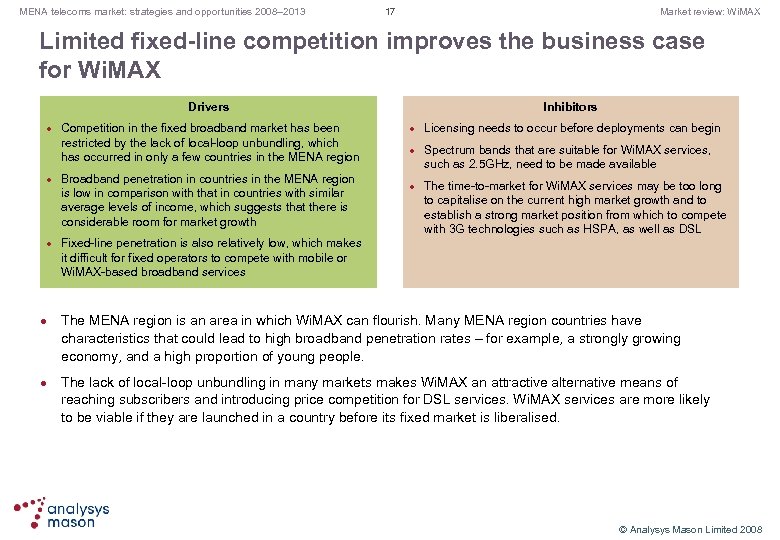 MENA telecoms market: strategies and opportunities 2008– 2013 17 Market review: Wi. MAX Limited fixed-line competition improves the business case for Wi. MAX Drivers l l l Competition in the fixed broadband market has been restricted by the lack of local loop unbundling, which has occurred in only a few countries in the MENA region Broadband penetration in countries in the MENA region is low in comparison with that in countries with similar average levels of income, which suggests that there is considerable room for market growth Inhibitors l l l Licensing needs to occur before deployments can begin Spectrum bands that are suitable for Wi. MAX services, such as 2. 5 GHz, need to be made available The time to market for Wi. MAX services may be too long to capitalise on the current high market growth and to establish a strong market position from which to compete with 3 G technologies such as HSPA, as well as DSL Fixed line penetration is also relatively low, which makes it difficult for fixed operators to compete with mobile or Wi. MAX based broadband services The MENA region is an area in which Wi. MAX can flourish. Many MENA region countries have characteristics that could lead to high broadband penetration rates – for example, a strongly growing economy, and a high proportion of young people. The lack of local loop unbundling in many markets makes Wi. MAX an attractive alternative means of reaching subscribers and introducing price competition for DSL services. Wi. MAX services are more likely to be viable if they are launched in a country before its fixed market is liberalised. © Analysys Mason Limited 2008
 MENA telecoms market: strategies and opportunities 2008– 2013 18 Market review: MVNOs Document map Market review Investment opportunities Wi. MAX MVNOs Pan-regional operators © Analysys Mason Limited 2008
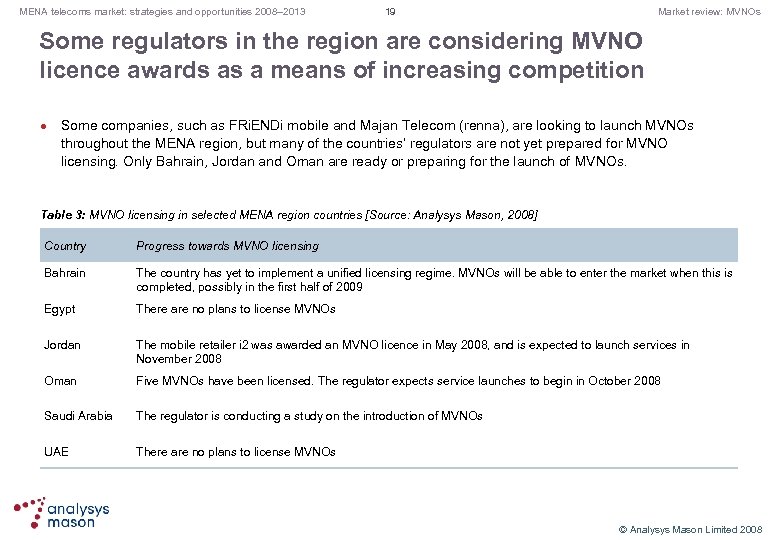 MENA telecoms market: strategies and opportunities 2008– 2013 19 Market review: MVNOs Some regulators in the region are considering MVNO licence awards as a means of increasing competition l Some companies, such as FRi. ENDi mobile and Majan Telecom (renna), are looking to launch MVNOs throughout the MENA region, but many of the countries’ regulators are not yet prepared for MVNO licensing. Only Bahrain, Jordan and Oman are ready or preparing for the launch of MVNOs. Table 3: MVNO licensing in selected MENA region countries [Source: Analysys Mason, 2008] Country Progress towards MVNO licensing Bahrain The country has yet to implement a unified licensing regime. MVNOs will be able to enter the market when this is completed, possibly in the first half of 2009 Egypt There are no plans to license MVNOs Jordan The mobile retailer i 2 was awarded an MVNO licence in May 2008, and is expected to launch services in November 2008 Oman Five MVNOs have been licensed. The regulator expects service launches to begin in October 2008 Saudi Arabia The regulator is conducting a study on the introduction of MVNOs UAE There are no plans to license MVNOs © Analysys Mason Limited 2008
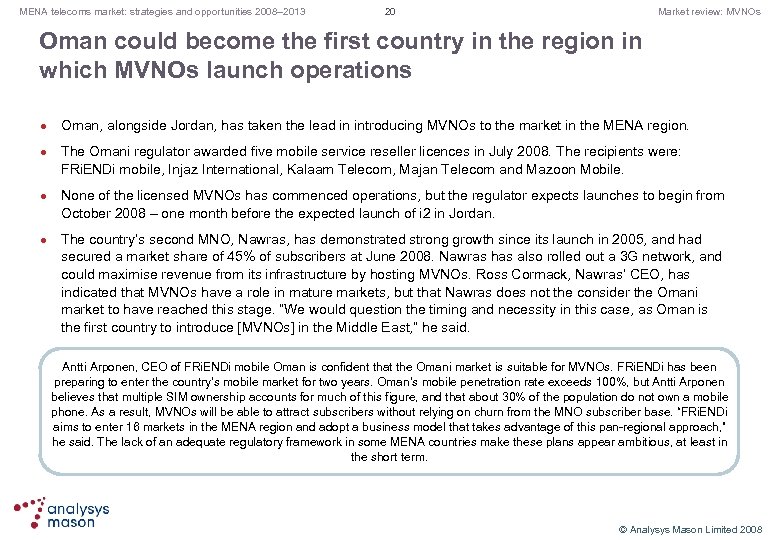 MENA telecoms market: strategies and opportunities 2008– 2013 20 Market review: MVNOs Oman could become the first country in the region in which MVNOs launch operations l l Oman, alongside Jordan, has taken the lead in introducing MVNOs to the market in the MENA region. The Omani regulator awarded five mobile service reseller licences in July 2008. The recipients were: FRi. ENDi mobile, Injaz International, Kalaam Telecom, Majan Telecom and Mazoon Mobile. None of the licensed MVNOs has commenced operations, but the regulator expects launches to begin from October 2008 – one month before the expected launch of i 2 in Jordan. The country’s second MNO, Nawras, has demonstrated strong growth since its launch in 2005, and had secured a market share of 45% of subscribers at June 2008. Nawras has also rolled out a 3 G network, and could maximise revenue from its infrastructure by hosting MVNOs. Ross Cormack, Nawras’ CEO, has indicated that MVNOs have a role in mature markets, but that Nawras does not the consider the Omani market to have reached this stage. “We would question the timing and necessity in this case, as Oman is the first country to introduce [MVNOs] in the Middle East, ” he said. Antti Arponen, CEO of FRi. ENDi mobile Oman is confident that the Omani market is suitable for MVNOs. FRi. ENDi has been preparing to enter the country’s mobile market for two years. Oman’s mobile penetration rate exceeds 100%, but Antti Arponen believes that multiple SIM ownership accounts for much of this figure, and that about 30% of the population do not own a mobile phone. As a result, MVNOs will be able to attract subscribers without relying on churn from the MNO subscriber base. “FRi. ENDi aims to enter 16 markets in the MENA region and adopt a business model that takes advantage of this pan regional approach, ” he said. The lack of an adequate regulatory framework in some MENA countries make these plans appear ambitious, at least in the short term. © Analysys Mason Limited 2008
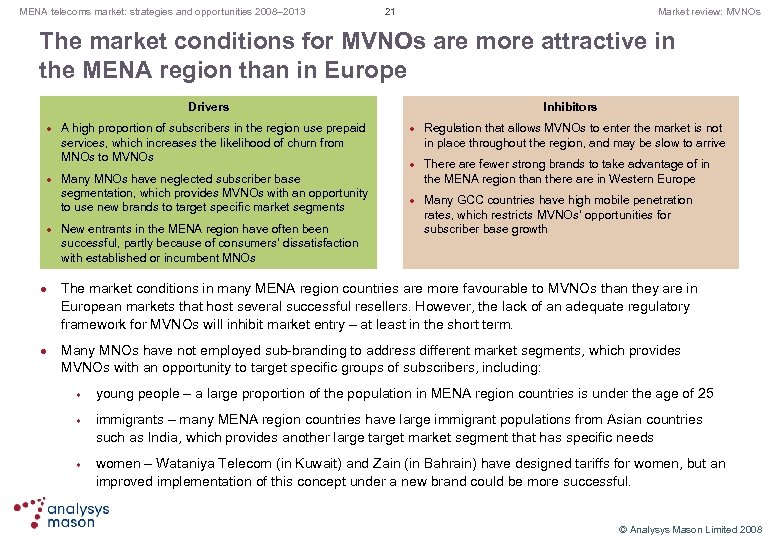 MENA telecoms market: strategies and opportunities 2008– 2013 21 Market review: MVNOs The market conditions for MVNOs are more attractive in the MENA region than in Europe Drivers l l l A high proportion of subscribers in the region use prepaid services, which increases the likelihood of churn from MNOs to MVNOs Many MNOs have neglected subscriber base segmentation, which provides MVNOs with an opportunity to use new brands to target specific market segments New entrants in the MENA region have often been successful, partly because of consumers’ dissatisfaction with established or incumbent MNOs Inhibitors l l l Regulation that allows MVNOs to enter the market is not in place throughout the region, and may be slow to arrive There are fewer strong brands to take advantage of in the MENA region than there are in Western Europe Many GCC countries have high mobile penetration rates, which restricts MVNOs’ opportunities for subscriber base growth The market conditions in many MENA region countries are more favourable to MVNOs than they are in European markets that host several successful resellers. However, the lack of an adequate regulatory framework for MVNOs will inhibit market entry – at least in the short term. Many MNOs have not employed sub branding to address different market segments, which provides MVNOs with an opportunity to target specific groups of subscribers, including: w w w young people – a large proportion of the population in MENA region countries is under the age of 25 immigrants – many MENA region countries have large immigrant populations from Asian countries such as India, which provides another large target market segment that has specific needs women – Wataniya Telecom (in Kuwait) and Zain (in Bahrain) have designed tariffs for women, but an improved implementation of this concept under a new brand could be more successful. © Analysys Mason Limited 2008
 MENA telecoms market: strategies and opportunities 2008– 2013 22 Market review: Pan regional operators Document map Market review Investment opportunities Wi. MAX MVNOs Pan-regional operators © Analysys Mason Limited 2008
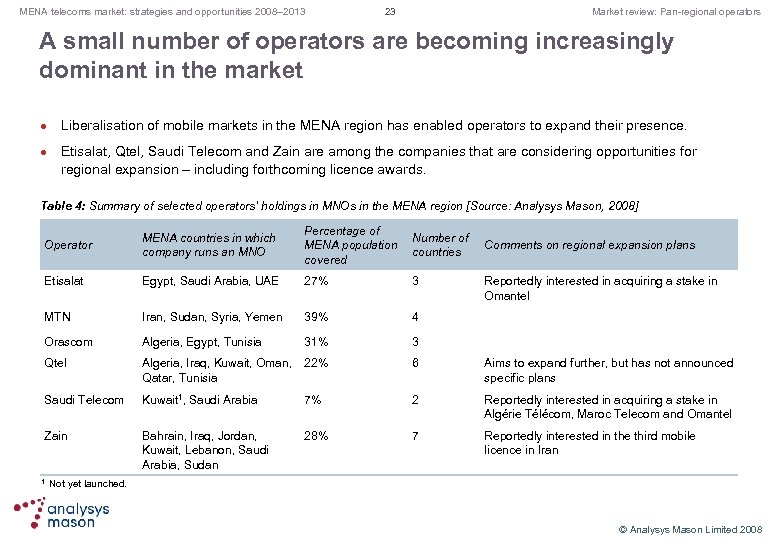 MENA telecoms market: strategies and opportunities 2008– 2013 23 Market review: Pan regional operators A small number of operators are becoming increasingly dominant in the market l l Liberalisation of mobile markets in the MENA region has enabled operators to expand their presence. Etisalat, Qtel, Saudi Telecom and Zain are among the companies that are considering opportunities for regional expansion – including forthcoming licence awards. Table 4: Summary of selected operators’ holdings in MNOs in the MENA region [Source: Analysys Mason, 2008] Operator MENA countries in which company runs an MNO Percentage of Number of MENA population countries covered Etisalat Egypt, Saudi Arabia, UAE 27% 3 MTN Iran, Sudan, Syria, Yemen 39% 4 Orascom Algeria, Egypt, Tunisia 31% 3 Qtel Algeria, Iraq, Kuwait, Oman, 22% Qatar, Tunisia 6 Aims to expand further, but has not announced specific plans Saudi Telecom Kuwait 1, Saudi Arabia 7% 2 Reportedly interested in acquiring a stake in Algérie Télécom, Maroc Telecom and Omantel Zain Bahrain, Iraq, Jordan, Kuwait, Lebanon, Saudi Arabia, Sudan 28% 7 Reportedly interested in the third mobile licence in Iran 1 Comments on regional expansion plans Reportedly interested in acquiring a stake in Omantel Not yet launched. © Analysys Mason Limited 2008
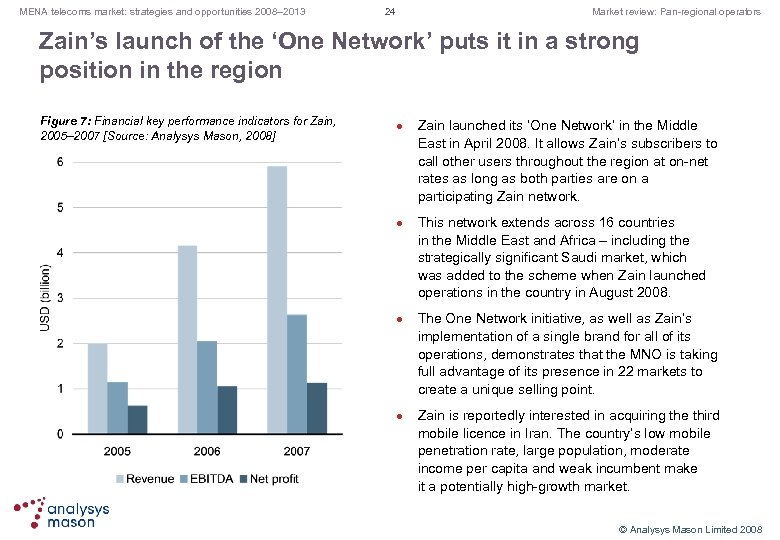 MENA telecoms market: strategies and opportunities 2008– 2013 24 Market review: Pan regional operators Zain’s launch of the ‘One Network’ puts it in a strong position in the region Figure 7: Financial key performance indicators for Zain, 2005– 2007 [Source: Analysys Mason, 2008] l l Zain launched its ‘One Network’ in the Middle East in April 2008. It allows Zain’s subscribers to call other users throughout the region at on net rates as long as both parties are on a participating Zain network. This network extends across 16 countries in the Middle East and Africa – including the strategically significant Saudi market, which was added to the scheme when Zain launched operations in the country in August 2008. The One Network initiative, as well as Zain’s implementation of a single brand for all of its operations, demonstrates that the MNO is taking full advantage of its presence in 22 markets to create a unique selling point. Zain is reportedly interested in acquiring the third mobile licence in Iran. The country’s low mobile penetration rate, large population, moderate income per capita and weak incumbent make it a potentially high growth market. © Analysys Mason Limited 2008
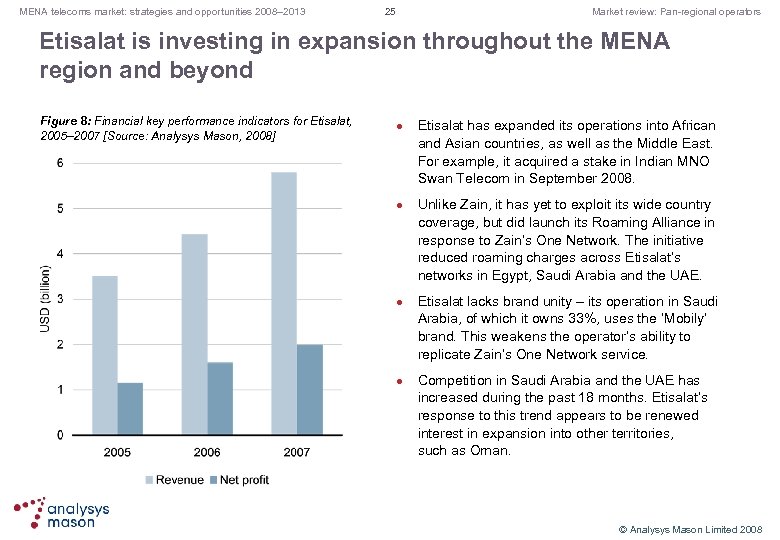 MENA telecoms market: strategies and opportunities 2008– 2013 25 Market review: Pan regional operators Etisalat is investing in expansion throughout the MENA region and beyond Figure 8: Financial key performance indicators for Etisalat, 2005– 2007 [Source: Analysys Mason, 2008] l l Etisalat has expanded its operations into African and Asian countries, as well as the Middle East. For example, it acquired a stake in Indian MNO Swan Telecom in September 2008. Unlike Zain, it has yet to exploit its wide country coverage, but did launch its Roaming Alliance in response to Zain’s One Network. The initiative reduced roaming charges across Etisalat’s networks in Egypt, Saudi Arabia and the UAE. Etisalat lacks brand unity – its operation in Saudi Arabia, of which it owns 33%, uses the ‘Mobily’ brand. This weakens the operator’s ability to replicate Zain’s One Network service. Competition in Saudi Arabia and the UAE has increased during the past 18 months. Etisalat’s response to this trend appears to be renewed interest in expansion into other territories, such as Oman. © Analysys Mason Limited 2008
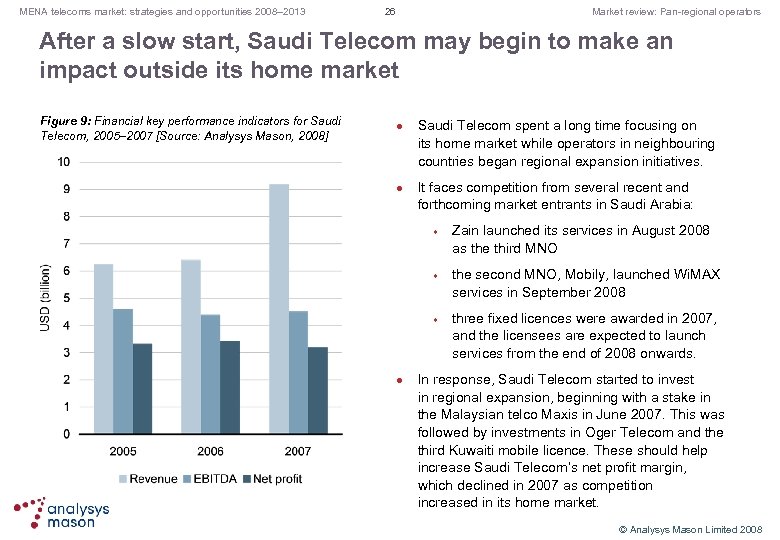 MENA telecoms market: strategies and opportunities 2008– 2013 26 Market review: Pan regional operators After a slow start, Saudi Telecom may begin to make an impact outside its home market Figure 9: Financial key performance indicators for Saudi Telecom, 2005– 2007 [Source: Analysys Mason, 2008] l l Saudi Telecom spent a long time focusing on its home market while operators in neighbouring countries began regional expansion initiatives. It faces competition from several recent and forthcoming market entrants in Saudi Arabia: w w w l Zain launched its services in August 2008 as the third MNO the second MNO, Mobily, launched Wi. MAX services in September 2008 three fixed licences were awarded in 2007, and the licensees are expected to launch services from the end of 2008 onwards. In response, Saudi Telecom started to invest in regional expansion, beginning with a stake in the Malaysian telco Maxis in June 2007. This was followed by investments in Oger Telecom and the third Kuwaiti mobile licence. These should help increase Saudi Telecom’s net profit margin, which declined in 2007 as competition increased in its home market. © Analysys Mason Limited 2008
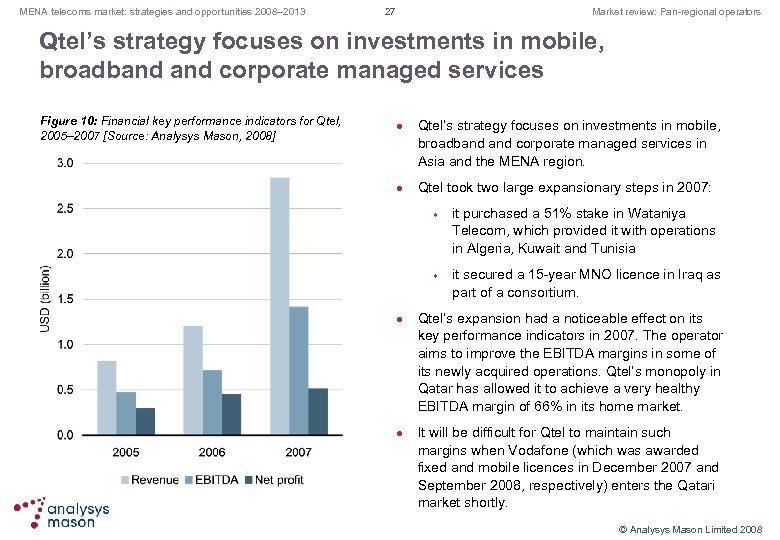 MENA telecoms market: strategies and opportunities 2008– 2013 27 Market review: Pan regional operators Qtel’s strategy focuses on investments in mobile, broadband corporate managed services Figure 10: Financial key performance indicators for Qtel, 2005– 2007 [Source: Analysys Mason, 2008] l l Qtel’s strategy focuses on investments in mobile, broadband corporate managed services in Asia and the MENA region. Qtel took two large expansionary steps in 2007: w w l l it purchased a 51% stake in Wataniya Telecom, which provided it with operations in Algeria, Kuwait and Tunisia it secured a 15 year MNO licence in Iraq as part of a consortium. Qtel’s expansion had a noticeable effect on its key performance indicators in 2007. The operator aims to improve the EBITDA margins in some of its newly acquired operations. Qtel’s monopoly in Qatar has allowed it to achieve a very healthy EBITDA margin of 66% in its home market. It will be difficult for Qtel to maintain such margins when Vodafone (which was awarded fixed and mobile licences in December 2007 and September 2008, respectively) enters the Qatari market shortly. © Analysys Mason Limited 2008
 MENA telecoms market: strategies and opportunities 2008– 2013 28 Document map: Country case studies Document map Executive summary Introduction and scope Market review Country case studies Author, copyright and key to acronyms List of figures and tables About Analysys Mason reports and services © Analysys Mason Limited 2008
 MENA telecoms market: strategies and opportunities 2008– 2013 29 Country case studies: Egypt Document map Country case studies Egypt Morocco Saudi Arabia United Arab Emirates © Analysys Mason Limited 2008
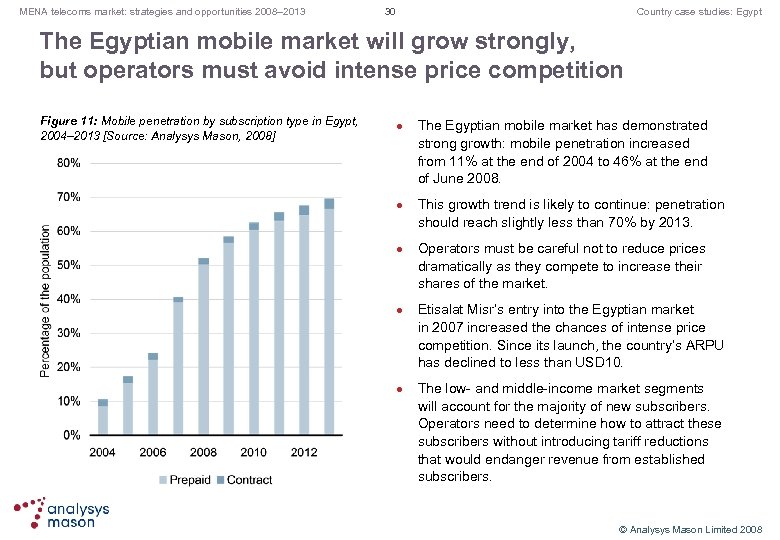 MENA telecoms market: strategies and opportunities 2008– 2013 30 Country case studies: Egypt The Egyptian mobile market will grow strongly, but operators must avoid intense price competition Figure 11: Mobile penetration by subscription type in Egypt, 2004– 2013 [Source: Analysys Mason, 2008] l l l The Egyptian mobile market has demonstrated strong growth: mobile penetration increased from 11% at the end of 2004 to 46% at the end of June 2008. This growth trend is likely to continue: penetration should reach slightly less than 70% by 2013. Operators must be careful not to reduce prices dramatically as they compete to increase their shares of the market. Etisalat Misr’s entry into the Egyptian market in 2007 increased the chances of intense price competition. Since its launch, the country’s ARPU has declined to less than USD 10. The low and middle income market segments will account for the majority of new subscribers. Operators need to determine how to attract these subscribers without introducing tariff reductions that would endanger revenue from established subscribers. © Analysys Mason Limited 2008
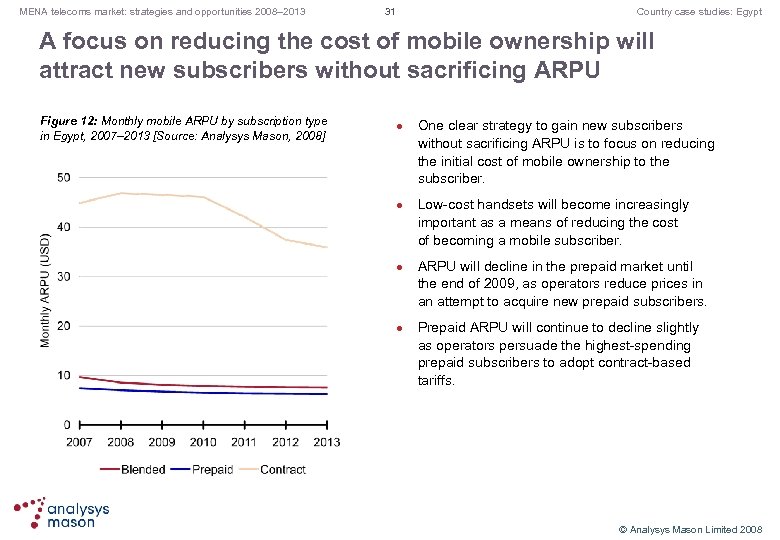 MENA telecoms market: strategies and opportunities 2008– 2013 31 Country case studies: Egypt A focus on reducing the cost of mobile ownership will attract new subscribers without sacrificing ARPU Figure 12: Monthly mobile ARPU by subscription type in Egypt, 2007– 2013 [Source: Analysys Mason, 2008] l l One clear strategy to gain new subscribers without sacrificing ARPU is to focus on reducing the initial cost of mobile ownership to the subscriber. Low cost handsets will become increasingly important as a means of reducing the cost of becoming a mobile subscriber. ARPU will decline in the prepaid market until the end of 2009, as operators reduce prices in an attempt to acquire new prepaid subscribers. Prepaid ARPU will continue to decline slightly as operators persuade the highest spending prepaid subscribers to adopt contract based tariffs. © Analysys Mason Limited 2008
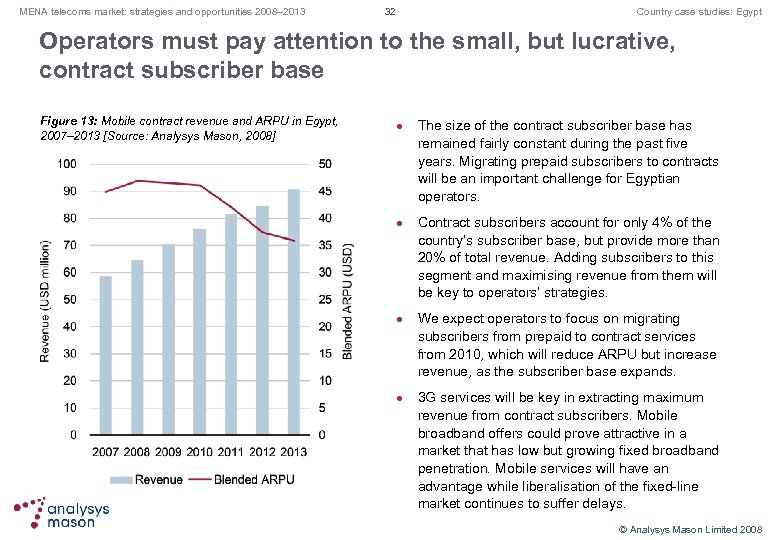 MENA telecoms market: strategies and opportunities 2008– 2013 32 Country case studies: Egypt Operators must pay attention to the small, but lucrative, contract subscriber base Figure 13: Mobile contract revenue and ARPU in Egypt, 2007– 2013 [Source: Analysys Mason, 2008] l l The size of the contract subscriber base has remained fairly constant during the past five years. Migrating prepaid subscribers to contracts will be an important challenge for Egyptian operators. Contract subscribers account for only 4% of the country’s subscriber base, but provide more than 20% of total revenue. Adding subscribers to this segment and maximising revenue from them will be key to operators’ strategies. We expect operators to focus on migrating subscribers from prepaid to contract services from 2010, which will reduce ARPU but increase revenue, as the subscriber base expands. 3 G services will be key in extracting maximum revenue from contract subscribers. Mobile broadband offers could prove attractive in a market that has low but growing fixed broadband penetration. Mobile services will have an advantage while liberalisation of the fixed line market continues to suffer delays. © Analysys Mason Limited 2008
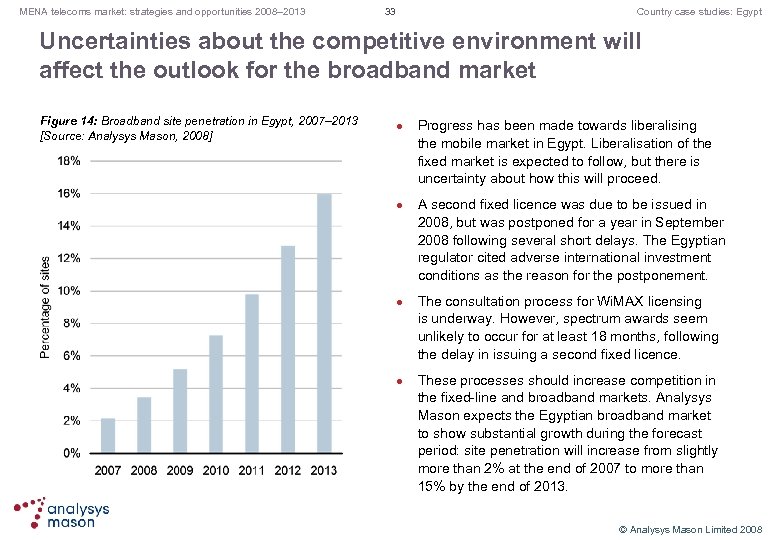 MENA telecoms market: strategies and opportunities 2008– 2013 33 Country case studies: Egypt Uncertainties about the competitive environment will affect the outlook for the broadband market Figure 14: Broadband site penetration in Egypt, 2007– 2013 [Source: Analysys Mason, 2008] l l Progress has been made towards liberalising the mobile market in Egypt. Liberalisation of the fixed market is expected to follow, but there is uncertainty about how this will proceed. A second fixed licence was due to be issued in 2008, but was postponed for a year in September 2008 following several short delays. The Egyptian regulator cited adverse international investment conditions as the reason for the postponement. The consultation process for Wi. MAX licensing is underway. However, spectrum awards seem unlikely to occur for at least 18 months, following the delay in issuing a second fixed licence. These processes should increase competition in the fixed line and broadband markets. Analysys Mason expects the Egyptian broadband market to show substantial growth during the forecast period: site penetration will increase from slightly more than 2% at the end of 2007 to more than 15% by the end of 2013. © Analysys Mason Limited 2008
 MENA telecoms market: strategies and opportunities 2008– 2013 34 Country case studies: Egypt Several factors will affect the development of the Egyptian broadband market Drivers l l l An increase in competition between different types of broadband provider, including mobile operators with 3 G based services and fixed operators with fixed line and Wi. MAX based services, will lead to price competition and drive adoption. Inhibitors l l The country has a large base of PC and Internet users that are likely to be attracted to broadband services. Bundles of mobile and broadband services could make broadband more attractive to consumers. Telecom Egypt and Vodafone Egypt have indicated that they intend to launch such packages. l Uncertainties about further licensing and the competitive environment in the fixed broadband market will inhibit its development. A second fixed line operator is unlikely to enter the market before 2010. The regulator’s choice of spectrum bands for potential Wi. MAX licences (in the 3. 5 GHz and 5. 8 GHz range) could damage the business case for a widespread network roll out because high frequencies tend to deliver poor indoor coverage. Broadband is unlikely to be adopted by a significant segment of the country’s population because of several socio economic factors, such as relatively low incomes, and literacy and PC penetration rates. Providers of mobile broadband services have an opportunity to secure a strong position in the Egyptian market because further fixed broadband competition is unlikely to enter the market for several years. MNOs are taking advantage of the capacity of their 3 G networks to provide attractively priced services. Their ability to provide high speed Internet access services that are competitively priced in comparison with many DSL based offers will help them to attract subscribers in high spending market segments, such as business users. © Analysys Mason Limited 2008
 MENA telecoms market: strategies and opportunities 2008– 2013 35 Country case studies: Morocco Document map Country case studies Egypt Morocco Saudi Arabia United Arab Emirates © Analysys Mason Limited 2008
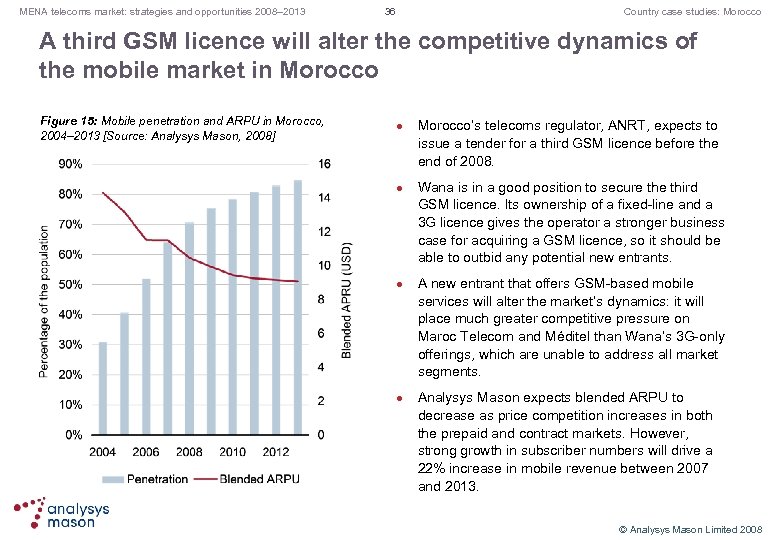 MENA telecoms market: strategies and opportunities 2008– 2013 36 Country case studies: Morocco A third GSM licence will alter the competitive dynamics of the mobile market in Morocco Figure 15: Mobile penetration and ARPU in Morocco, 2004– 2013 [Source: Analysys Mason, 2008] l l Morocco’s telecoms regulator, ANRT, expects to issue a tender for a third GSM licence before the end of 2008. Wana is in a good position to secure third GSM licence. Its ownership of a fixed line and a 3 G licence gives the operator a stronger business case for acquiring a GSM licence, so it should be able to outbid any potential new entrants. A new entrant that offers GSM based mobile services will alter the market’s dynamics: it will place much greater competitive pressure on Maroc Telecom and Méditel than Wana’s 3 G only offerings, which are unable to address all market segments. Analysys Mason expects blended ARPU to decrease as price competition increases in both the prepaid and contract markets. However, strong growth in subscriber numbers will drive a 22% increase in mobile revenue between 2007 and 2013. © Analysys Mason Limited 2008
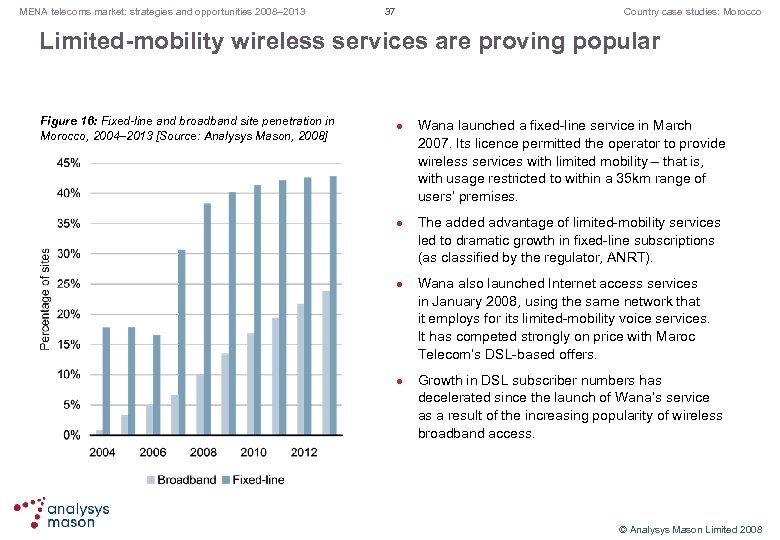 MENA telecoms market: strategies and opportunities 2008– 2013 37 Country case studies: Morocco Limited-mobility wireless services are proving popular Figure 16: Fixed-line and broadband site penetration in Morocco, 2004– 2013 [Source: Analysys Mason, 2008] l l Wana launched a fixed line service in March 2007. Its licence permitted the operator to provide wireless services with limited mobility – that is, with usage restricted to within a 35 km range of users’ premises. The added advantage of limited mobility services led to dramatic growth in fixed line subscriptions (as classified by the regulator, ANRT). Wana also launched Internet access services in January 2008, using the same network that it employs for its limited mobility voice services. It has competed strongly on price with Maroc Telecom’s DSL based offers. Growth in DSL subscriber numbers has decelerated since the launch of Wana’s service as a result of the increasing popularity of wireless broadband access. © Analysys Mason Limited 2008
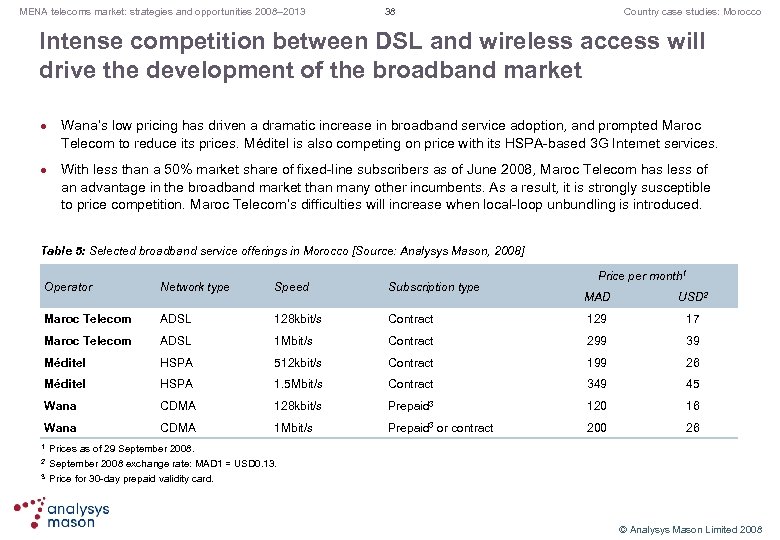 MENA telecoms market: strategies and opportunities 2008– 2013 38 Country case studies: Morocco Intense competition between DSL and wireless access will drive the development of the broadband market l l Wana’s low pricing has driven a dramatic increase in broadband service adoption, and prompted Maroc Telecom to reduce its prices. Méditel is also competing on price with its HSPA based 3 G Internet services. With less than a 50% market share of fixed line subscribers as of June 2008, Maroc Telecom has less of an advantage in the broadband market than many other incumbents. As a result, it is strongly susceptible to price competition. Maroc Telecom’s difficulties will increase when local loop unbundling is introduced. Table 5: Selected broadband service offerings in Morocco [Source: Analysys Mason, 2008] Operator Network type Speed Subscription type Maroc Telecom ADSL 128 kbit/s Maroc Telecom ADSL Méditel Price per month 1 MAD USD 2 Contract 129 17 1 Mbit/s Contract 299 39 HSPA 512 kbit/s Contract 199 26 Méditel HSPA 1. 5 Mbit/s Contract 349 45 Wana CDMA 128 kbit/s Prepaid 3 120 16 Wana CDMA 1 Mbit/s Prepaid 3 or contract 200 26 1 2 3 Prices as of 29 September 2008 exchange rate: MAD 1 = USD 0. 13. Price for 30 day prepaid validity card. © Analysys Mason Limited 2008
 MENA telecoms market: strategies and opportunities 2008– 2013 39 Country case studies: Saudi Arabia Document map Country case studies Egypt Morocco Saudi Arabia United Arab Emirates © Analysys Mason Limited 2008
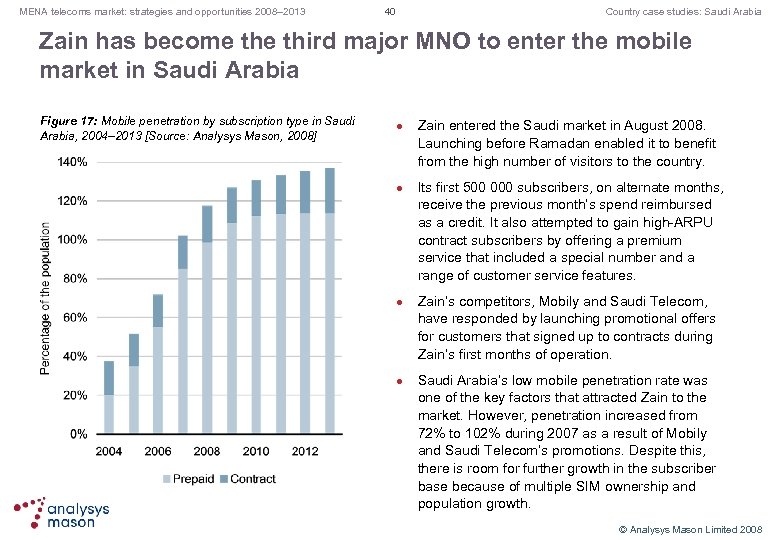 MENA telecoms market: strategies and opportunities 2008– 2013 40 Country case studies: Saudi Arabia Zain has become third major MNO to enter the mobile market in Saudi Arabia Figure 17: Mobile penetration by subscription type in Saudi Arabia, 2004– 2013 [Source: Analysys Mason, 2008] l l Zain entered the Saudi market in August 2008. Launching before Ramadan enabled it to benefit from the high number of visitors to the country. Its first 500 000 subscribers, on alternate months, receive the previous month’s spend reimbursed as a credit. It also attempted to gain high ARPU contract subscribers by offering a premium service that included a special number and a range of customer service features. Zain’s competitors, Mobily and Saudi Telecom, have responded by launching promotional offers for customers that signed up to contracts during Zain’s first months of operation. Saudi Arabia’s low mobile penetration rate was one of the key factors that attracted Zain to the market. However, penetration increased from 72% to 102% during 2007 as a result of Mobily and Saudi Telecom’s promotions. Despite this, there is room for further growth in the subscriber base because of multiple SIM ownership and population growth. © Analysys Mason Limited 2008
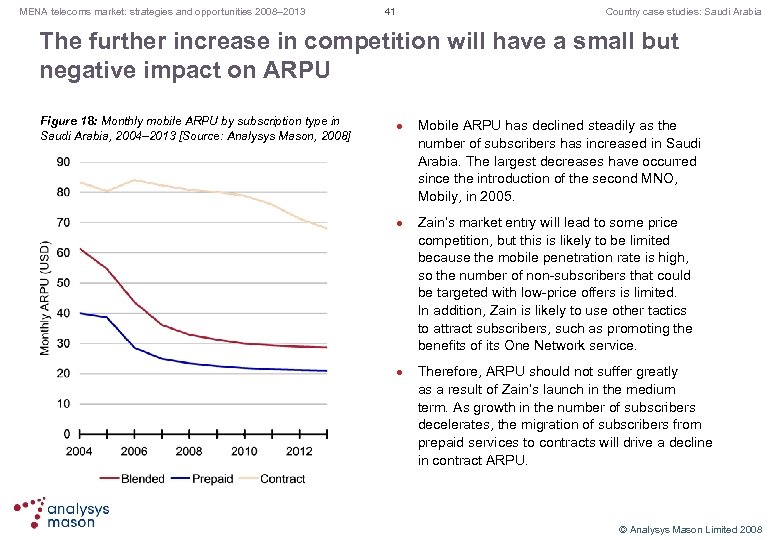 MENA telecoms market: strategies and opportunities 2008– 2013 41 Country case studies: Saudi Arabia The further increase in competition will have a small but negative impact on ARPU Figure 18: Monthly mobile ARPU by subscription type in Saudi Arabia, 2004– 2013 [Source: Analysys Mason, 2008] l l l Mobile ARPU has declined steadily as the number of subscribers has increased in Saudi Arabia. The largest decreases have occurred since the introduction of the second MNO, Mobily, in 2005. Zain’s market entry will lead to some price competition, but this is likely to be limited because the mobile penetration rate is high, so the number of non subscribers that could be targeted with low price offers is limited. In addition, Zain is likely to use other tactics to attract subscribers, such as promoting the benefits of its One Network service. Therefore, ARPU should not suffer greatly as a result of Zain’s launch in the medium term. As growth in the number of subscribers decelerates, the migration of subscribers from prepaid services to contracts will drive a decline in contract ARPU. © Analysys Mason Limited 2008
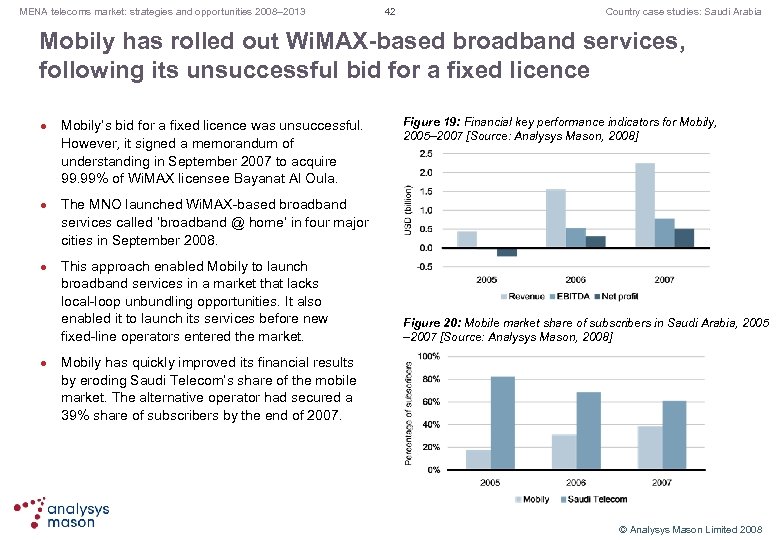 MENA telecoms market: strategies and opportunities 2008– 2013 42 Country case studies: Saudi Arabia Mobily has rolled out Wi. MAX-based broadband services, following its unsuccessful bid for a fixed licence l l Mobily’s bid for a fixed licence was unsuccessful. However, it signed a memorandum of understanding in September 2007 to acquire 99. 99% of Wi. MAX licensee Bayanat Al Oula. Figure 19: Financial key performance indicators for Mobily, 2005– 2007 [Source: Analysys Mason, 2008] The MNO launched Wi. MAX based broadband services called ‘broadband @ home’ in four major cities in September 2008. This approach enabled Mobily to launch broadband services in a market that lacks local loop unbundling opportunities. It also enabled it to launch its services before new fixed line operators entered the market. Figure 20: Mobile market share of subscribers in Saudi Arabia, 2005 – 2007 [Source: Analysys Mason, 2008] Mobily has quickly improved its financial results by eroding Saudi Telecom’s share of the mobile market. The alternative operator had secured a 39% share of subscribers by the end of 2007. © Analysys Mason Limited 2008
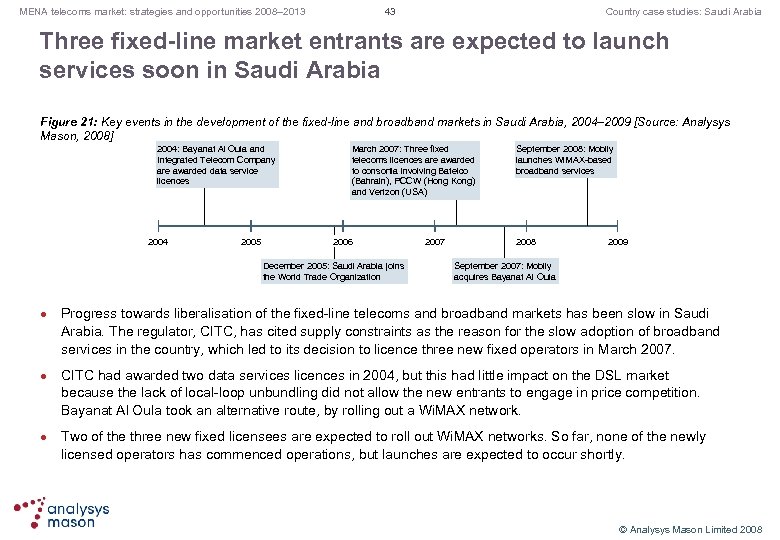 43 MENA telecoms market: strategies and opportunities 2008– 2013 Country case studies: Saudi Arabia Three fixed-line market entrants are expected to launch services soon in Saudi Arabia Figure 21: Key events in the development of the fixed-line and broadband markets in Saudi Arabia, 2004– 2009 [Source: Analysys Mason, 2008] 2004: Bayanat Al Oula and Integrated Telecom Company are awarded data service licences 2004 2005 March 2007: Three fixed telecoms licences are awarded to consortia involving Batelco (Bahrain), PCCW (Hong Kong) and Verizon (USA) 2006 December 2005: Saudi Arabia joins the World Trade Organization l l l 2007 September 2008: Mobily launches Wi. MAX based broadband services 2008 2009 September 2007: Mobily acquires Bayanat Al Oula Progress towards liberalisation of the fixed line telecoms and broadband markets has been slow in Saudi Arabia. The regulator, CITC, has cited supply constraints as the reason for the slow adoption of broadband services in the country, which led to its decision to licence three new fixed operators in March 2007. CITC had awarded two data services licences in 2004, but this had little impact on the DSL market because the lack of local loop unbundling did not allow the new entrants to engage in price competition. Bayanat Al Oula took an alternative route, by rolling out a Wi. MAX network. Two of the three new fixed licensees are expected to roll out Wi. MAX networks. So far, none of the newly licensed operators has commenced operations, but launches are expected to occur shortly. © Analysys Mason Limited 2008
 MENA telecoms market: strategies and opportunities 2008– 2013 44 Country case studies: United Arab Emirates Document map Country case studies Egypt Morocco Saudi Arabia United Arab Emirates © Analysys Mason Limited 2008
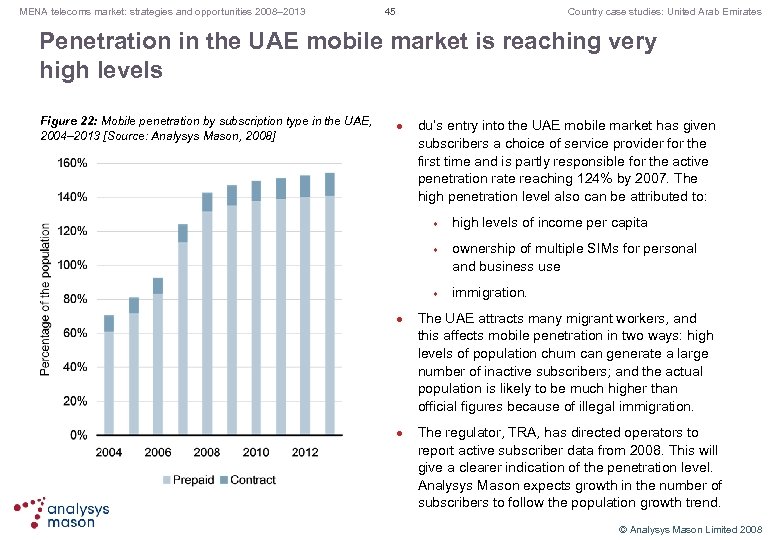 MENA telecoms market: strategies and opportunities 2008– 2013 45 Country case studies: United Arab Emirates Penetration in the UAE mobile market is reaching very high levels Figure 22: Mobile penetration by subscription type in the UAE, 2004– 2013 [Source: Analysys Mason, 2008] l du’s entry into the UAE mobile market has given subscribers a choice of service provider for the first time and is partly responsible for the active penetration rate reaching 124% by 2007. The high penetration level also can be attributed to: w w w l l high levels of income per capita ownership of multiple SIMs for personal and business use immigration. The UAE attracts many migrant workers, and this affects mobile penetration in two ways: high levels of population churn can generate a large number of inactive subscribers; and the actual population is likely to be much higher than official figures because of illegal immigration. The regulator, TRA, has directed operators to report active subscriber data from 2008. This will give a clearer indication of the penetration level. Analysys Mason expects growth in the number of subscribers to follow the population growth trend. © Analysys Mason Limited 2008
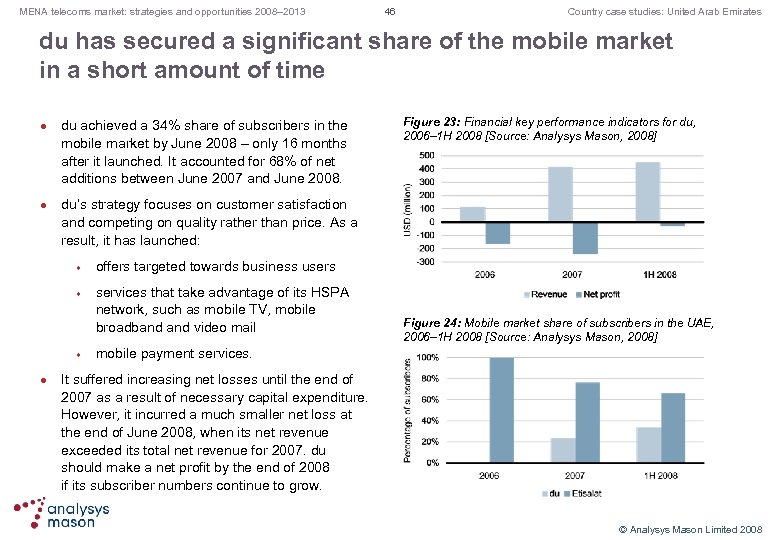 MENA telecoms market: strategies and opportunities 2008– 2013 46 Country case studies: United Arab Emirates du has secured a significant share of the mobile market in a short amount of time l l du achieved a 34% share of subscribers in the mobile market by June 2008 – only 16 months after it launched. It accounted for 68% of net additions between June 2007 and June 2008. du’s strategy focuses on customer satisfaction and competing on quality rather than price. As a result, it has launched: w w w l Figure 23: Financial key performance indicators for du, 2006– 1 H 2008 [Source: Analysys Mason, 2008] offers targeted towards business users services that take advantage of its HSPA network, such as mobile TV, mobile broadband video mail Figure 24: Mobile market share of subscribers in the UAE, 2006– 1 H 2008 [Source: Analysys Mason, 2008] mobile payment services. It suffered increasing net losses until the end of 2007 as a result of necessary capital expenditure. However, it incurred a much smaller net loss at the end of June 2008, when its net revenue exceeded its total net revenue for 2007. du should make a net profit by the end of 2008 if its subscriber numbers continue to grow. © Analysys Mason Limited 2008
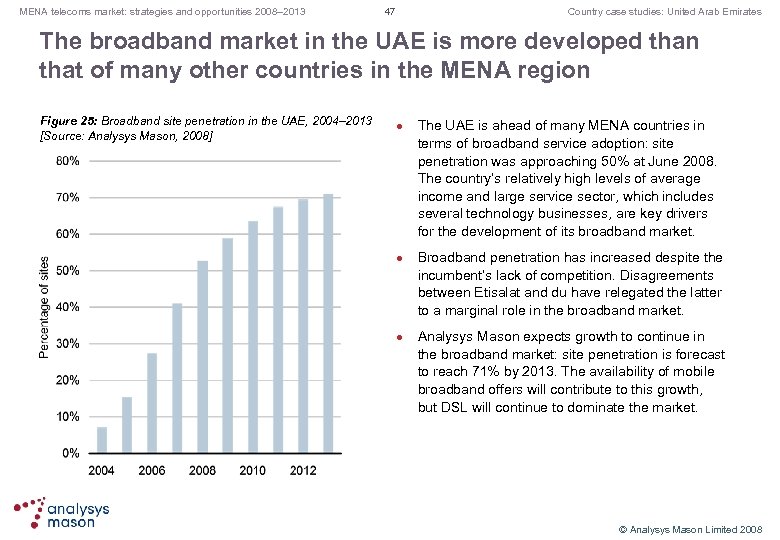 MENA telecoms market: strategies and opportunities 2008– 2013 47 Country case studies: United Arab Emirates The broadband market in the UAE is more developed than that of many other countries in the MENA region Figure 25: Broadband site penetration in the UAE, 2004– 2013 [Source: Analysys Mason, 2008] l l l The UAE is ahead of many MENA countries in terms of broadband service adoption: site penetration was approaching 50% at June 2008. The country’s relatively high levels of average income and large service sector, which includes several technology businesses, are key drivers for the development of its broadband market. Broadband penetration has increased despite the incumbent’s lack of competition. Disagreements between Etisalat and du have relegated the latter to a marginal role in the broadband market. Analysys Mason expects growth to continue in the broadband market: site penetration is forecast to reach 71% by 2013. The availability of mobile broadband offers will contribute to this growth, but DSL will continue to dominate the market. © Analysys Mason Limited 2008
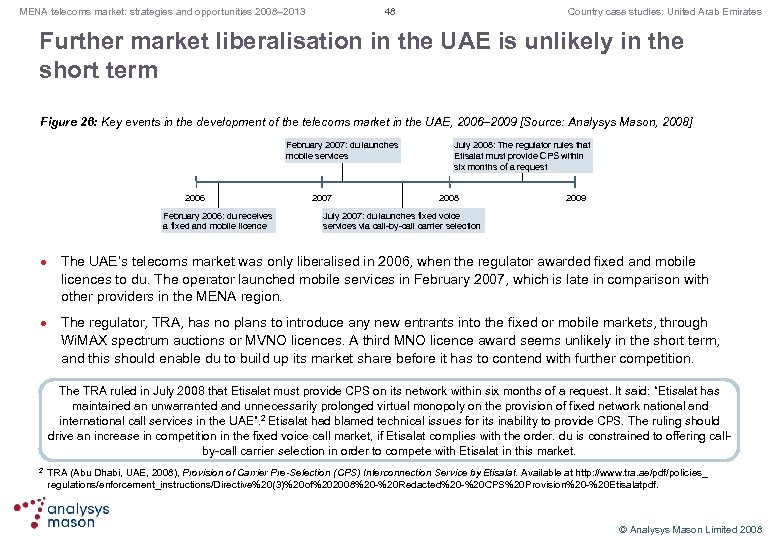 48 MENA telecoms market: strategies and opportunities 2008– 2013 Country case studies: United Arab Emirates Further market liberalisation in the UAE is unlikely in the short term Figure 26: Key events in the development of the telecoms market in the UAE, 2006– 2009 [Source: Analysys Mason, 2008] February 2007: du launches mobile services 2006 February 2006: du receives a fixed and mobile licence l l 2007 July 2008: The regulator rules that Etisalat must provide CPS within six months of a request 2008 2009 July 2007: du launches fixed voice services via call by call carrier selection The UAE’s telecoms market was only liberalised in 2006, when the regulator awarded fixed and mobile licences to du. The operator launched mobile services in February 2007, which is late in comparison with other providers in the MENA region. The regulator, TRA, has no plans to introduce any new entrants into the fixed or mobile markets, through Wi. MAX spectrum auctions or MVNO licences. A third MNO licence award seems unlikely in the short term, and this should enable du to build up its market share before it has to contend with further competition. The TRA ruled in July 2008 that Etisalat must provide CPS on its network within six months of a request. It said: “Etisalat has maintained an unwarranted and unnecessarily prolonged virtual monopoly on the provision of fixed network national and international call services in the UAE”. 2 Etisalat had blamed technical issues for its inability to provide CPS. The ruling should drive an increase in competition in the fixed voice call market, if Etisalat complies with the order. du is constrained to offering call by call carrier selection in order to compete with Etisalat in this market. 2 TRA (Abu Dhabi, UAE, 2008), Provision of Carrier Pre-Selection (CPS) Interconnection Service by Etisalat. Available at http: //www. tra. ae/pdf/policies_ regulations/enforcement_instructions/Directive%20(3)%20 of%202008%20 %20 Redacted%20 %20 CPS%20 Provision%20 %20 Etisalat. df. p © Analysys Mason Limited 2008
 MENA telecoms market: strategies and opportunities 2008– 2013 49 Document map: Author, copyright and key to acronyms Document map Executive summary Introduction and scope Market review Country case studies Author, copyright and key to acronyms List of figures and tables About Analysys Mason reports and services © Analysys Mason Limited 2008
 MENA telecoms market: strategies and opportunities 2008– 2013 50 Author, copyright and key to acronyms Author Daniel Jones (Analyst) is a regular contributor to the Analysys Mason Mobile Networks and Services online market intelligence service, and specialises in emerging markets. He is the author of The Middle Eastern Mobile Market: trends and forecasts 2007– 12 and co author of The Western European mobile market: trends and forecasts 2008– 2013. He holds a degree in Economics from the University of Nottingham and a Master’s degree in Development Economics from the Universidad Autónoma de Madrid. Acknowledgements The author would like to thank the many companies and individuals who have contributed to this report by sharing their insights on the MENA telecoms market – particularly Antti Arponen, CEO, FRi. ENDi mobile Oman and Ross Cormack, CEO, Nawras. In addition, the author would like to acknowledge the invaluable help contributed by colleagues within Analysys Mason, including Matt Hatton, as well as Mark Chambers and Claire Varley for editorial assistance. © Analysys Mason Limited 2008
 MENA telecoms market: strategies and opportunities 2008– 2013 51 Author, copyright and key to acronyms Copyright Published by Analysys Mason Limited, St Giles Court, 24 Castle Street, Cambridge, CB 3 0 AJ, UK Tel: +44 (0)1223 460600; Fax: +44 (0)1223 452800; Email: research@analysysmason. com; Web: http: //www. analysysmason. com/research Registered in England No. 5177472 © Analysys Mason Limited 2008 All rights reserved. No part of this publication may be reproduced, stored in a retrieval system or transmitted in any form or by any means – electronic, mechanical, photocopying, recording or otherwise – without the prior written permission of the publisher. ISBN 1 905495 78 1 Disclaimer Analysys Mason Limited maintains that all reasonable care and skill have been used in the compilation of this publication. However, Analysys Mason Limited shall not be under any liability for loss or damage (including consequential loss) whatsoever or howsoever arising as a result of the use of this publication by the customer, his servants, agents or any third party. Analysys Mason Limited recognises that many terms appearing in this report are proprietary; all such trademarks are acknowledged and every effort has been made to indicate them by the normal UK publishing practice of capitalisation. However, the presence of a term, in whatever form, does not affect its legal status as a trademark. The opinions expressed are those of the stated author only. © Analysys Mason Limited 2008
 MENA telecoms market: strategies and opportunities 2008– 2013 52 Author, copyright and key to acronyms Key to acronyms 3 G Third generation HSPA High Speed Packet Access ADSL Asymmetric digital subscriber line kbit/s Kilobits per second ARPU Average revenue per user km Kilometre CDMA Code Division Multiple Access Mbit/s Megabits per second CEO Chief executive officer MENA Middle East and North Africa CPS Carrier preselection service MNO Mobile network operator DSL Digital subscriber line MVNO Mobile virtual network operator EBITDA Earnings before interest, taxation, depreciation and amortisation PC Personal computer SIM Subscriber identity module TV Television UAE United Arab Emirates Wi. MAX Worldwide Interoperability for Microwave Access GCC Gulf Cooperation Council GDP Gross domestic product GHz Gigahertz GSM Global System for Mobile Communications © Analysys Mason Limited 2008
 MENA telecoms market: strategies and opportunities 2008– 2013 53 Document map: List of figures and tables Document map Executive summary Introduction and scope Market review Country case studies Author, copyright and key to acronyms List of figures and tables About Analysys Mason reports and services © Analysys Mason Limited 2008
 MENA telecoms market: strategies and opportunities 2008– 2013 54 List of figures and tables [1] Figure 1: Mobile penetration in the MENA region, 2008– 2013 Figure 2: Broadband site penetration in the MENA region, 2008– 2013 Figure 3: Countries considered in this report Figure 4: Mobile penetration by subscription type in the MENA region, 2004– 2013 Figure 5: Broadband site penetration in the MENA region, 2004– 2013 Figure 6: Broadband site penetration in selected European and MENA region countries, June 2008 Figure 7: Financial key performance indicators for Zain, 2005– 2007 Figure 8: Financial key performance indicators for Etisalat, 2005– 2007 Figure 9: Financial key performance indicators for Saudi Telecom, 2005– 2007 Figure 10: Financial key performance indicators for Qtel, 2005– 2007 Figure 11: Mobile penetration by subscription type in Egypt, 2004– 2013 Figure 12: Monthly mobile ARPU by subscription type in Egypt, 2007– 2013 Figure 13: Mobile contract revenue and ARPU in Egypt, 2007– 2013 Figure 14: Broadband site penetration in Egypt, 2007– 2013 Figure 15: Mobile penetration and ARPU in Morocco, 2004– 2013 Figure 16: Fixed line and broadband site penetration in Morocco, 2004– 2013 © Analysys Mason Limited 2008
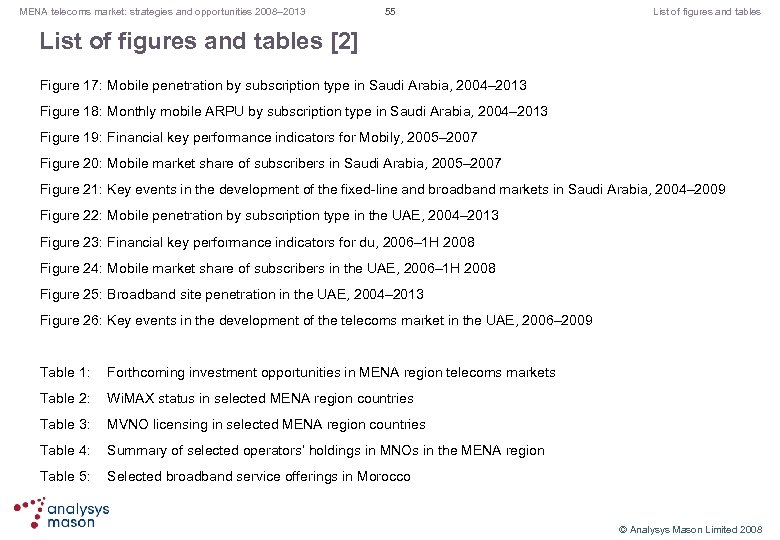 MENA telecoms market: strategies and opportunities 2008– 2013 55 List of figures and tables [2] Figure 17: Mobile penetration by subscription type in Saudi Arabia, 2004– 2013 Figure 18: Monthly mobile ARPU by subscription type in Saudi Arabia, 2004– 2013 Figure 19: Financial key performance indicators for Mobily, 2005– 2007 Figure 20: Mobile market share of subscribers in Saudi Arabia, 2005– 2007 Figure 21: Key events in the development of the fixed line and broadband markets in Saudi Arabia, 2004– 2009 Figure 22: Mobile penetration by subscription type in the UAE, 2004– 2013 Figure 23: Financial key performance indicators for du, 2006– 1 H 2008 Figure 24: Mobile market share of subscribers in the UAE, 2006– 1 H 2008 Figure 25: Broadband site penetration in the UAE, 2004– 2013 Figure 26: Key events in the development of the telecoms market in the UAE, 2006– 2009 Table 1: Forthcoming investment opportunities in MENA region telecoms markets Table 2: Wi. MAX status in selected MENA region countries Table 3: MVNO licensing in selected MENA region countries Table 4: Summary of selected operators’ holdings in MNOs in the MENA region Table 5: Selected broadband service offerings in Morocco © Analysys Mason Limited 2008
 MENA telecoms market: strategies and opportunities 2008– 2013 56 Document map: About Analysys Mason reports and services Document map Executive summary Introduction and scope Market review Country case studies Author, copyright and key to acronyms List of figures and tables About Analysys Mason reports and services © Analysys Mason Limited 2008
 MENA telecoms market: strategies and opportunities 2008– 2013 57 About Analysys Mason reports and services About Analysys Mason is the world’s premier specialist advisor in telecoms, IT and media. Through our global presence, we deliver strategy advice, operations support and market intelligence to leading commercial and public sector organisations in more than 80 countries. The intellectual rigour, operational experience and insight of our people have helped our clients to meet some of the toughest challenges they face within the industry. Analysys Mason has consistently delivered significant and sustainable business benefits to our clients during the past twenty years on issues ranging from advising on operator strategy and tactics, development of national sector regulation, through execution of major financial transactions, to the deployment of public and private network infrastructure. We are respected worldwide for the exceptional quality of our work, our independence and the flexibility of our teams in responding to client needs. We are passionate about what we do and are committed to delivering excellence to our clients. The company has more than 300 staff worldwide, with headquarters in London and offices in Cambridge, Dubai, Dublin, Edinburgh, Madrid, Manchester, Milan, Paris, Singapore and Washington DC. Analysys Mason offers two types of service: l l Consulting: We work with our clients to provide bespoke advice and support throughout the business cycle, helping major players to set strategy, plan for change, and implement that change. Research: We offer market intelligence services, publications and custom research to help our clients to identify key strategic issues, formulate strategies, identify trends and opportunities, and measure performance. For more information visit our Web site at www. analysysmason. com. © Analysys Mason Limited 2008
 MENA telecoms market: strategies and opportunities 2008– 2013 58 About Analysys Mason reports and services Reports from Analysys Mason’s reports are designed to keep you up to date with industry developments and how they affect players in the telecoms value chain – from fixed and mobile network operators, to software and equipment vendors, and content providers and distributors. Our reports will help you to: l l l explore the factors that are driving market evolution understand how industry trends will affect your business define and evaluate your strategic options using decision frameworks and scenarios l identify where opportunities lie for growth l find out which players are successful and why. Our publication programme offers more than 25 reports each year, covering all the key issues affecting the telecoms industry and the latest hot topics. Recent reports have provided expert analysis of such topics as mobile broadband, pay TV, next generation networks, mobile media and entertainment, 3 G infrastructure sharing, picocells and femtocells, fixed–mobile convergence and mobile advertising, and have included country market forecasts for fixed and mobile telecoms. Each report is accompanied by an Excel spreadsheet containing the forecasts or other key data discussed in the report, presented in an easy to use format. All reports are offered with Analyst Support, allowing you direct consultation with the author. Shop online at: http: //www. analysysmason. com/research. For information about our report subscription packages, please contact our Sales and Customer Service team on +44 (0)1223 460600 or email us at research@analysysmason. com. © Analysys Mason Limited 2008
 MENA telecoms market: strategies and opportunities 2008– 2013 59 About Analysys Mason reports and services Market intelligence services from Analysys Mason’s online market intelligence services help you keep track of the latest developments in major telecoms markets worldwide. l All our services are regularly updated and include a sophisticated range of interactive search, benchmarking and download tools. l l Analysys Mason Fixed Networks and Services provides analysis of European operators and ISPs, country reports for more than 30 markets, country market forecasts, commentary on industry trends and a module on the broadband market. Analysys Mason Mobile Networks and Services provides insight into the strategies of key players worldwide, country reports for more than 30 markets, country market forecasts and analysis of industry trends, and the Wireless Technology Tracker section, which keeps you up to date on cellular network and other wireless technologies. l Analysys Mason Telecoms Software provides market share and forecast data, as well as in depth analysis of trends in the global telecoms software market. We cover billing, customer care, assurance, fulfilment, service delivery platforms and network management. Analysys Mason Telecoms Market Matrix provides a detailed and coherent quarterly view of the overall size, in operational and financial terms, of the main markets enumerated by the EU framework for telecoms regulation and of the incumbent’s and other operators’ shares of those markets. Our Analyst Support package, which allows you direct consultation with our telecoms experts, is an ideal complement to your chosen market intelligence service. For more information on our services or a guided demonstration, please contact our Sales and Customer Service team on +44 (0)1223 460600, email us at research@analysysmason. com or visit our Web site at: http: //www. analysysmason. com/research. © Analysys Mason Limited 2008
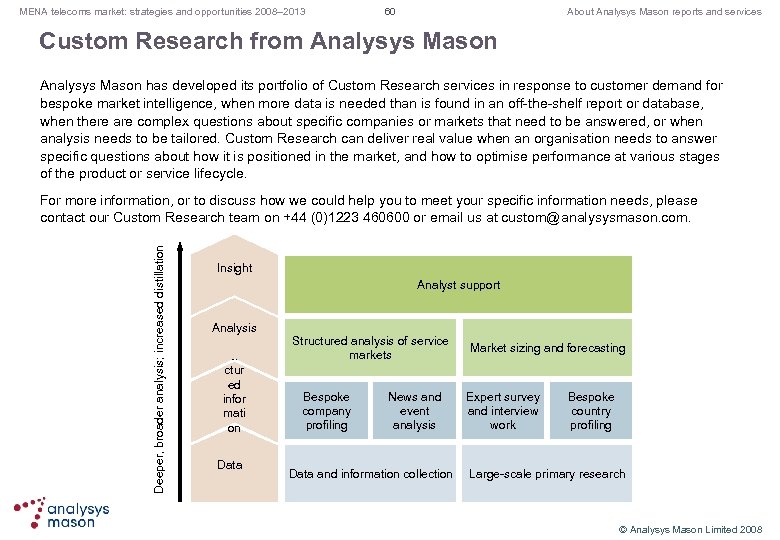 MENA telecoms market: strategies and opportunities 2008– 2013 60 About Analysys Mason reports and services Custom Research from Analysys Mason has developed its portfolio of Custom Research services in response to customer demand for bespoke market intelligence, when more data is needed than is found in an off the shelf report or database, when there are complex questions about specific companies or markets that need to be answered, or when analysis needs to be tailored. Custom Research can deliver real value when an organisation needs to answer specific questions about how it is positioned in the market, and how to optimise performance at various stages of the product or service lifecycle. Deeper, broader analysis; increased distillation For more information, or to discuss how we could help you to meet your specific information needs, please contact our Custom Research team on +44 (0)1223 460600 or email us at custom@analysysmason. com. Insight Analyst support Analysis Stru ctur ed infor mati on Data Structured analysis of service markets Bespoke company profiling News and event analysis Data and information collection Market sizing and forecasting Expert survey and interview work Bespoke country profiling Large scale primary research © Analysys Mason Limited 2008