 Скачать презентацию Research on the IB International Baccalaureate Organization
e2d9f53f62ff9d4f8d766afa72f5d373.ppt
- Количество слайдов: 19



Research on the IB © International Baccalaureate Organization 2007
Research on the IB • Overview of the IB programs • Research on the impact of IB programs • Other education research that supports the strengths of the IB program © International Baccalaureate Organization 2007 © IBO 2003
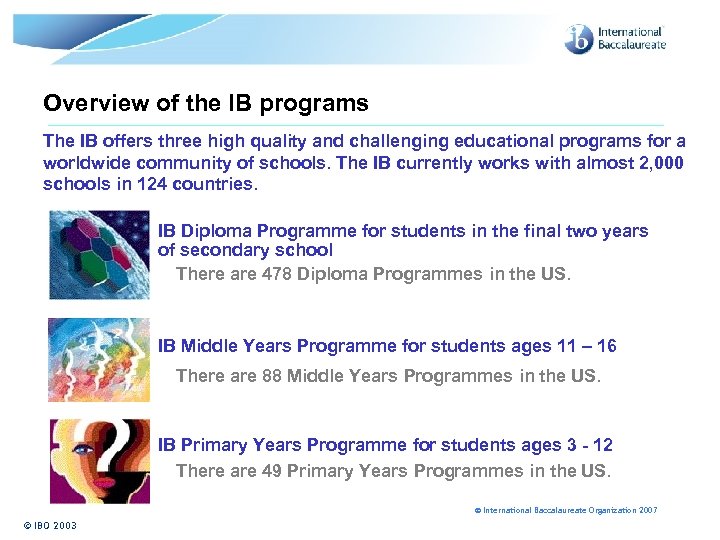
Overview of the IB programs The IB offers three high quality and challenging educational programs for a worldwide community of schools. The IB currently works with almost 2, 000 schools in 124 countries. IB Diploma Programme for students in the final two years of secondary school There are 478 Diploma Programmes in the US. IB Middle Years Programme for students ages 11 – 16 There are 88 Middle Years Programmes in the US. IB Primary Years Programme for students ages 3 - 12 There are 49 Primary Years Programmes in the US. © International Baccalaureate Organization 2007 © IBO 2003
Overview of the IB programs The IB offers comprehensive, research-based curricula, aligned with rigorous international standards. Each of the three academic programs emphasizes: Flexible, yet comprehensive curriculum with rigorous international standards Unique approach to transdiscplinary learning using multiple instructional methodologies and teaching strategies Global focus with an emphasis on intercultural understanding Development of the whole child, including requirements for arts and community service © International Baccalaureate Organization 2007 © IBO 2003
Overview of the IB programs support the development of effective and rewarding learning communities through services and professional networks focused on best practice in education. International standards for measuring teaching and learning Challenging academic programs A global professional network for educators to learn effective classroom practices and teaching strategies Professional development opportunities in school leadership, curriculum writing, program evaluation and mentoring A culture of continual improvement © International Baccalaureate Organization 2007 © IBO 2003
Research on the impact of IB programs Various studies have been conducted on the performance of IB students, the standards of the IB program, the effect of the implementation of the program on a school. Results show that: ü IB students outperform their peers on state assessments ü IB Diploma students have higher acceptance rates to colleges ü IB Diploma students perform better in post-secondary education than their peers ü IB standards are aligned with best practice in education and support effective teaching practices ü IB has a positive impact on the culture of a school © International Baccalaureate Organization 2007 © IBO 2003
IB students outperform their peers on state assessments Academy School District 20 in Colorado Springs, Colorado § Academy School District offers the continuum of IB, PYP, MYP and DP. § A study of the 2003 results on the Colorado State Assessment Program (CSAP) compared the performance of IB students and non-IB students in the district and in the state from grade 3 through grade 10. § Found that a greater number of IB students score at the proficient and advanced levels with the difference between IB students and their peers increasing at the higher grades. © International Baccalaureate Organization 2007 © IBO 2003
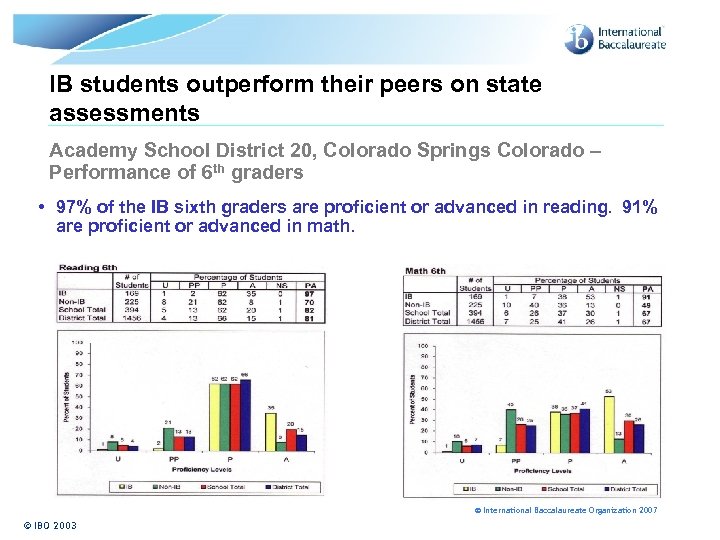
IB students outperform their peers on state assessments Academy School District 20, Colorado Springs Colorado – Performance of 6 th graders • 97% of the IB sixth graders are proficient or advanced in reading. 91% are proficient or advanced in math. © International Baccalaureate Organization 2007 © IBO 2003
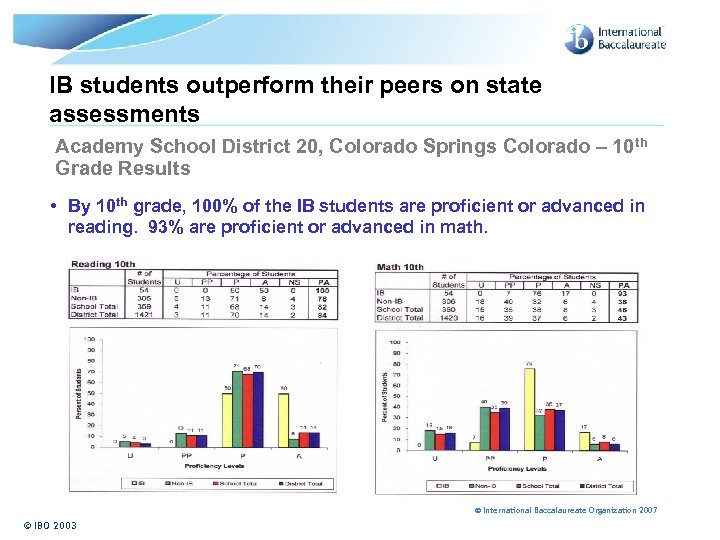
IB students outperform their peers on state assessments Academy School District 20, Colorado Springs Colorado – 10 th Grade Results • By 10 th grade, 100% of the IB students are proficient or advanced in reading. 93% are proficient or advanced in math. © International Baccalaureate Organization 2007 © IBO 2003
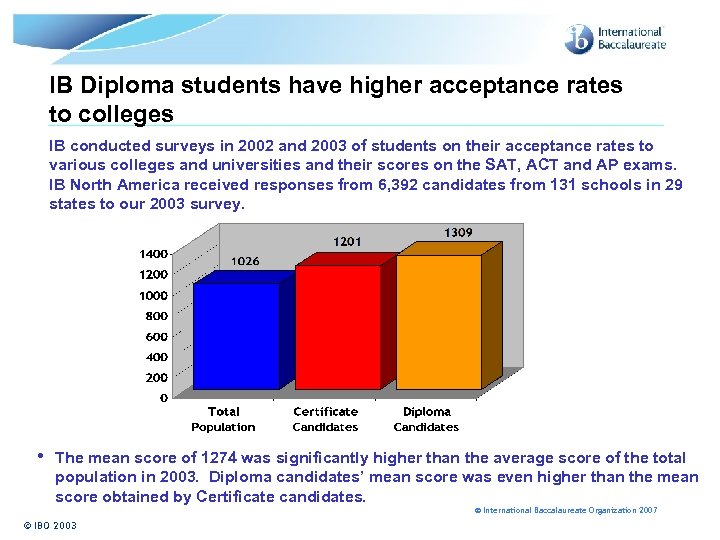
IB Diploma students have higher acceptance rates to colleges IB conducted surveys in 2002 and 2003 of students on their acceptance rates to various colleges and universities and their scores on the SAT, ACT and AP exams. IB North America received responses from 6, 392 candidates from 131 schools in 29 states to our 2003 survey. • The mean score of 1274 was significantly higher than the average score of the total population in 2003. Diploma candidates’ mean score was even higher than the mean score obtained by Certificate candidates. © International Baccalaureate Organization 2007 © IBO 2003
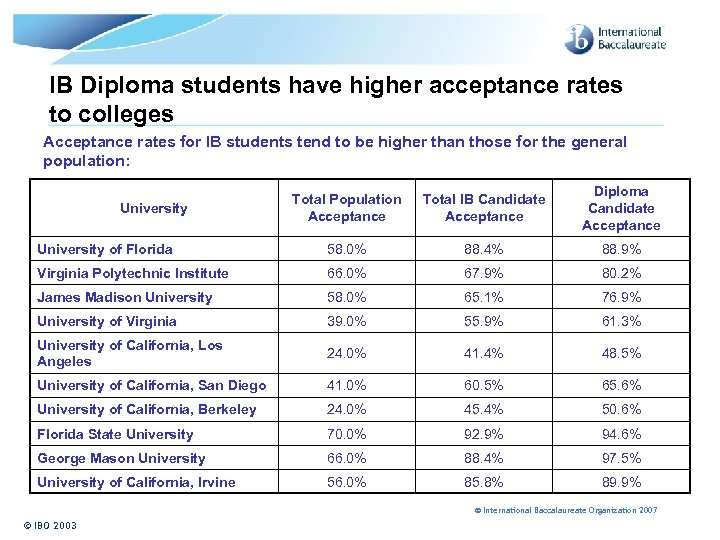
IB Diploma students have higher acceptance rates to colleges Acceptance rates for IB students tend to be higher than those for the general population: Total Population Acceptance Total IB Candidate Acceptance Diploma Candidate Acceptance University of Florida 58. 0% 88. 4% 88. 9% Virginia Polytechnic Institute 66. 0% 67. 9% 80. 2% James Madison University 58. 0% 65. 1% 76. 9% University of Virginia 39. 0% 55. 9% 61. 3% University of California, Los Angeles 24. 0% 41. 4% 48. 5% University of California, San Diego 41. 0% 60. 5% 65. 6% University of California, Berkeley 24. 0% 45. 4% 50. 6% Florida State University 70. 0% 92. 9% 94. 6% George Mason University 66. 0% 88. 4% 97. 5% University of California, Irvine 56. 0% 85. 8% 89. 9% University © International Baccalaureate Organization 2007 © IBO 2003
IB Diploma students have higher acceptance rates to colleges Independent studies by universities confirm that IB students are accepted at higher rates The Director of International Admissions at University of Pennsylvania in 1990 found that admissions professionals at 68 of the 115 most selective and highly selective universities give preference to IB students. In 1997/98, the College of William and Mary admitted 64% of the IB Diploma candidates. In 1997, Smith College admitted 68% of the IB Diploma candidates. © International Baccalaureate Organization 2007 © IBO 2003
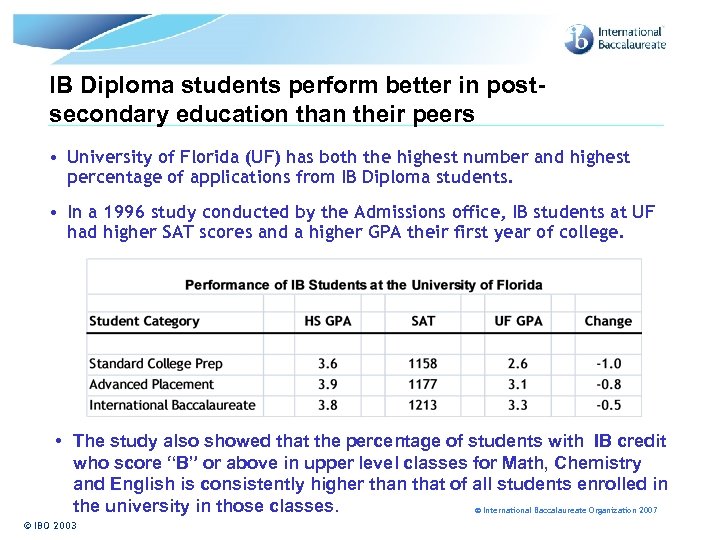
IB Diploma students perform better in postsecondary education than their peers • University of Florida (UF) has both the highest number and highest percentage of applications from IB Diploma students. • In a 1996 study conducted by the Admissions office, IB students at UF had higher SAT scores and a higher GPA their first year of college. • The study also showed that the percentage of students with IB credit who score “B” or above in upper level classes for Math, Chemistry and English is consistently higher than that of all students enrolled in the university in those classes. © International Baccalaureate Organization 2007 © IBO 2003
IB Diploma students perform better in postsecondary education than their peers Dissertation at Purdue University § Duevel analyzed participation in the IB program as a predictor of college success. § 92% of students to hold an IB Diploma earned a Bachelor’s degree and 87% of IB Diploma holders earned their degrees in five years or less. § 59% of the students receiving IB Diplomas advanced to graduate school. § Most IB Diploma holders believed their IB experience had a positive impact on their global awareness, understanding of complex assignments, critical thinking and time management skills. © International Baccalaureate Organization 2007 © IBO 2003
IB standards are aligned with best practice in education and support effective teaching practices Dissertation College of William and Mary § In this study, Hutchinson analyzed the IB program as an advanced academic option, comparing the curricular goals of the IB program to 21 recommended practices for gifted and general education. § Hutchinson found that the IB curricular goals and the 21 recommended practices aligned with one another. § IB teachers implement a variety of instructional strategies with high levels of instructional clarity and complexity and high expectations for student learning in and out of class § According to the Teachers’ Sense of Efficacy Scale, designed by Tschannen-Moran & Hoy (2001), and the Teachers’ Effectiveness Behavior Scale, designed by Strong & Tucker (2001), IB teachers had strong feelings of efficacy and effectively used their teaching time. © International Baccalaureate Organization 2007 © IBO 2003
IB has a positive impact on the culture of a school Dissertation from Oxford University included case studies on the implementation of IB at several schools in the US. As a result of IB program, schools were able to: § Raise academic standards and change perceptions towards academic achievement § Increase diversity within the school § Bring an international perspectives to the classroom and raise awareness around intercultural understanding § Improve the reputation of the school in the community © International Baccalaureate Organization 2007 © IBO 2003
Other education research that supports the strengths of the IB program • Answers in the Toolbox by Clifford Adelman studied longitudinal data on students and identified academic resources, or the intensity and quality of the curriculum, as the strongest predictor of college success. • College Knowledge by David Conley Standards for Success is a research project that identified the skills students need for success in college and whether state assessments are aligned with these standards. The study found that most students enter college unprepared. Students may face setbacks based on their intellectual immaturity. • From High School to College: Improving Opportunities for Success in Post-Secondary Education by Michael Kirst and Andrea Venezia Examines the poor alignment in standards and communications about expectations for post-secondary study. Authors point to the need for stronger standards in curriculum development and assessment. © International Baccalaureate Organization 2007 © IBO 2003
Other education research that supports the strengths of the IB program Each of the three programs offers a comprehensive curriculum, aligned with rigorous international standards. Studies on the performance of IB students in elementary, secondary and post-secondary education have shown that IB students: • Possess the knowledge, skills and attitudes for success in advanced courses • Perform better than their peers on various assessments © International Baccalaureate Organization 2007 © IBO 2003
For more information on these studies, contact the IB North America Office: IB North America 475 Riverside Drive Suite 240 New York, NY 10115 Ibna@ibo. org (212) 696 4464 © International Baccalaureate Organization 2007 © IBO 2003
Скачать презентацию Research on the IB International Baccalaureate Organization
e2d9f53f62ff9d4f8d766afa72f5d373.ppt