


 Скачать презентацию Research on SN contrast ratio for SGII-PW laser
6f9a6114714a9ebdbbd4dce94843c1ea.ppt
- Количество слайдов: 48
 Research on SN contrast ratio for SGII-PW laser System Jianqiang Zhu, Guang Xu, Xiaoping Ouyang 2018/3/15 and Xinglong Xie
 Outline ØIntroduction ØSG-II PW laser facility and recent achievements ØSN contrast ratio study in SG-II PW laser facility ØPrograms of ultra short lasers in NLPLP ØConclusion 2
 Outline ØIntroduction ØSG-II PW laser facility and recent achievements ØSN contrast ratio study in SG-II PW laser facility ØPrograms of ultra short lasers in NLPLP ØConclusion 3
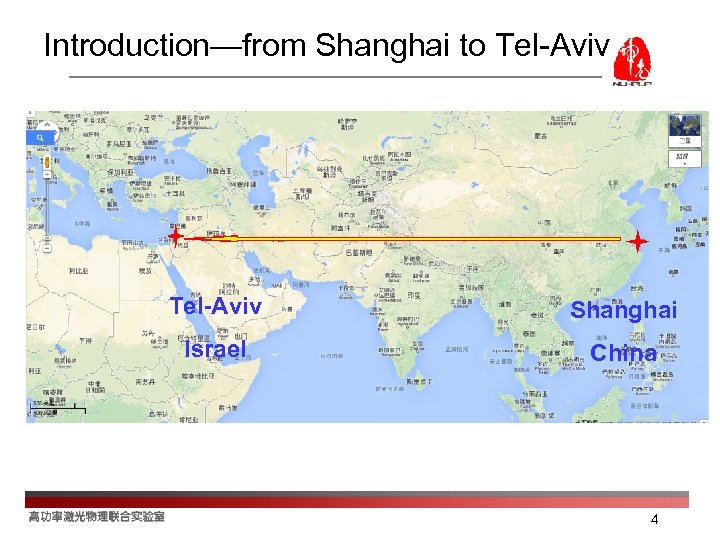 Introduction—from Shanghai to Tel-Aviv Shanghai Israel China 4
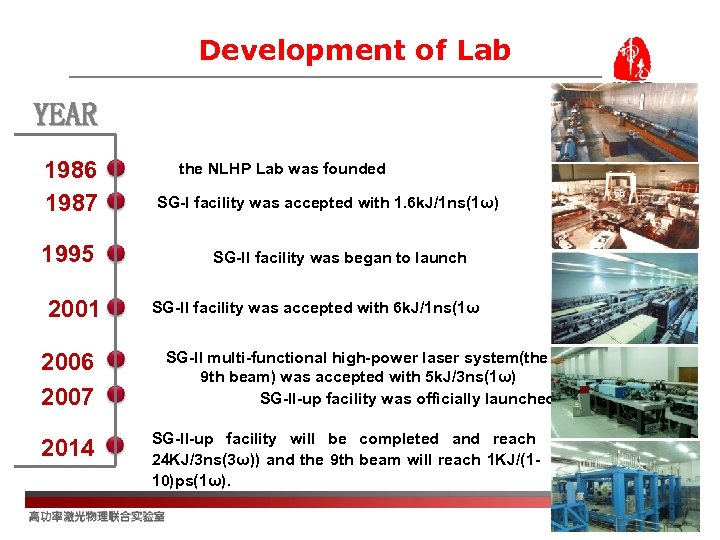 Development of Lab YEAR 1986 1987 1995 2001 2006 2007 2014 the NLHP Lab was founded SG-I facility was accepted with 1. 6 k. J/1 ns(1ω) SG-II facility was began to launch SG-II facility was accepted with 6 k. J/1 ns(1ω SG-II multi-functional high-power laser system(the 9 th beam) was accepted with 5 k. J/3 ns(1ω) SG-II-up facility was officially launched SG-II-up facility will be completed and reach 24 KJ/3 ns(3ω)) and the 9 th beam will reach 1 KJ/(110)ps(1ω). 5
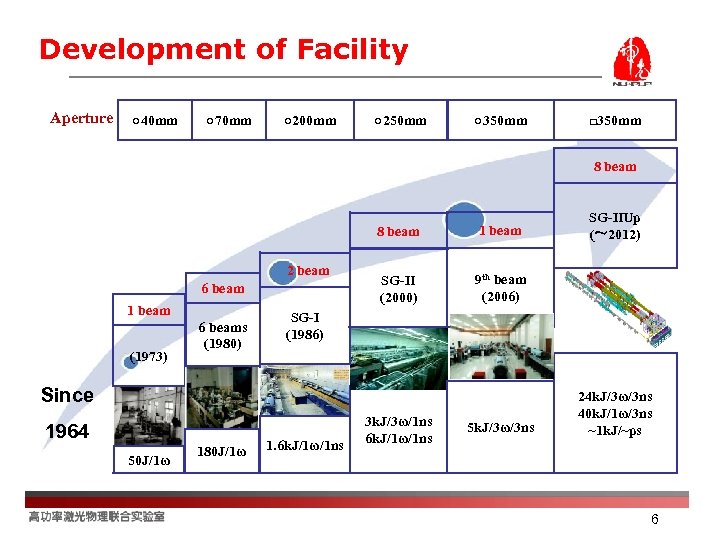 Development of Facility Aperture ○40 mm ○70 mm ○200 mm ○250 mm ○350 mm □ 350 mm 8 beam 2 beam 6 beam 1 beam (1973) 6 beams (1980) 1 beam SG-Ⅱ (2000) 9 th beam (2006) SG-Ⅰ (1986) Since 1964 50 J/1ω 180 J/1ω SG-ⅡUp (~ 2012) 1. 6 k. J/1ω/1 ns 3 k. J/3ω/1 ns 6 k. J/1ω/1 ns 5 k. J/3ω/3 ns 24 k. J/3ω/3 ns 40 k. J/1ω/3 ns ~1 k. J/~ps 6
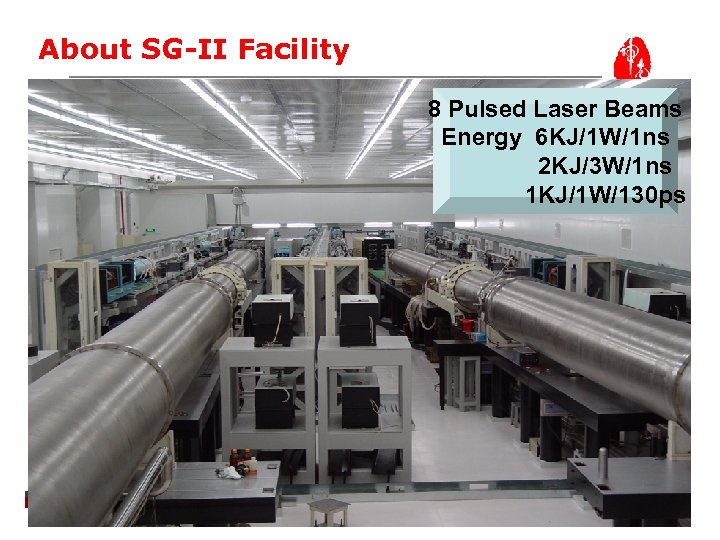 About SG-II Facility 8 Pulsed Laser Beams Energy 6 KJ/1 W/1 ns 2 KJ/3 W/1 ns 1 KJ/1 W/130 ps 7
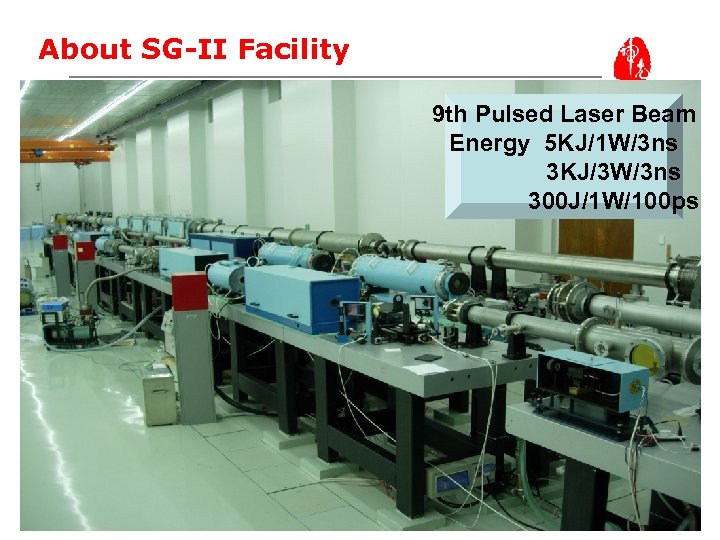 About SG-II Facility 9 th Pulsed Laser Beam Energy 5 KJ/1 W/3 ns 3 KJ/3 W/3 ns 300 J/1 W/100 ps 8
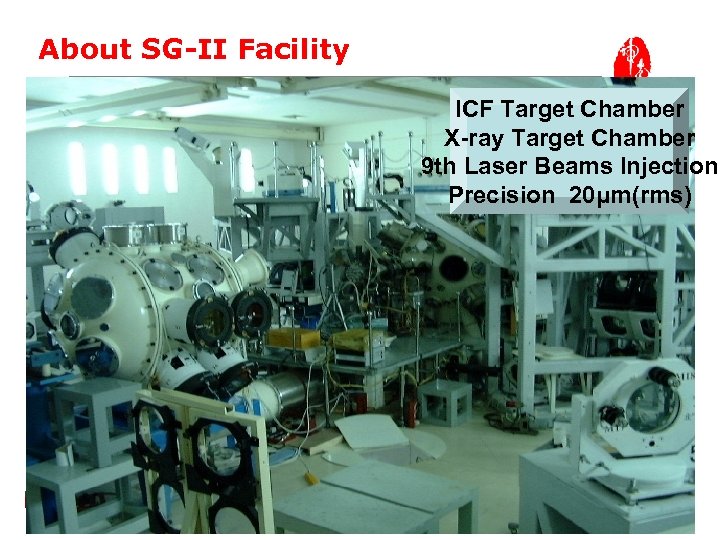 About SG-II Facility ICF Target Chamber X-ray Target Chamber 9 th Laser Beams Injection Precision 20μm(rms) 9
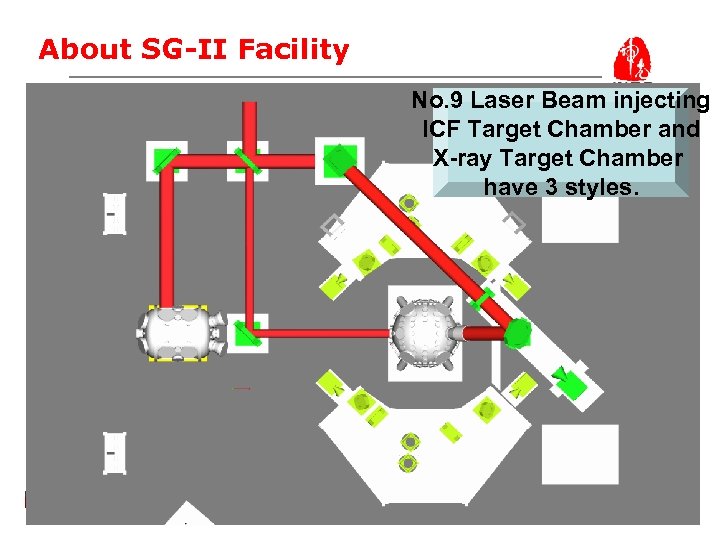 About SG-II Facility No. 9 Laser Beam injecting ICF Target Chamber and X-ray Target Chamber have 3 styles. 10
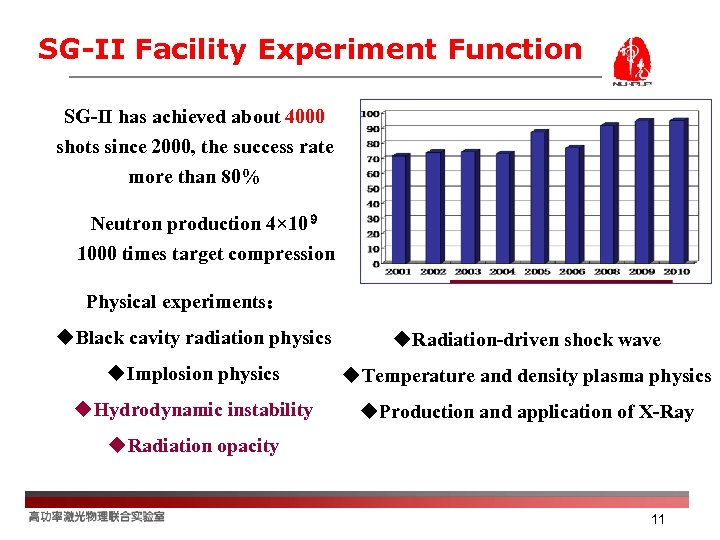 SG-II Facility Experiment Function SG-II has achieved about 4000 shots since 2000, the success rate more than 80% Neutron production 4× 10⁹ 1000 times target compression Physical experiments: u Black cavity radiation physics u. Radiation-driven shock wave u Implosion physics u. Temperature and density plasma physics u Hydrodynamic instability u. Production and application of X-Ray u Radiation opacity 11
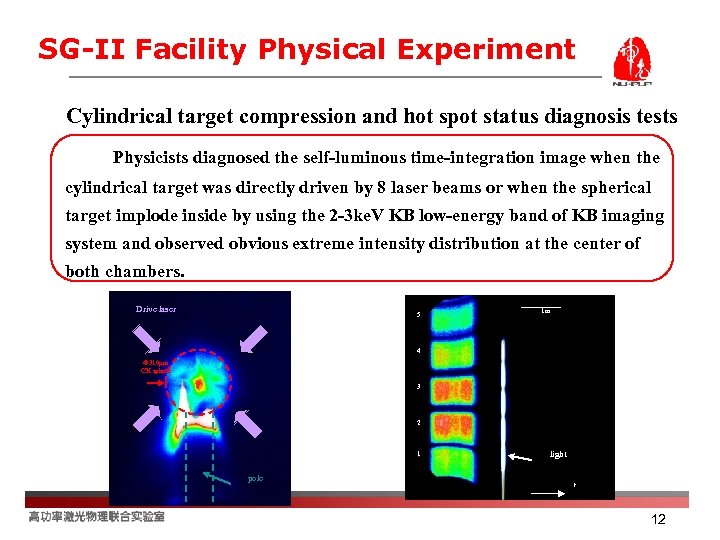 SG-II Facility Physical Experiment Cylindrical target compression and hot spot status diagnosis tests Physicists diagnosed the self-luminous time-integration image when the cylindrical target was directly driven by 8 laser beams or when the spherical target implode inside by using the 2 -3 ke. V KB low-energy band of KB imaging system and observed obvious extreme intensity distribution at the center of both chambers. Drive laser 5 1 ns 4 310 m CH sphere 3 2 1 pole light t 12
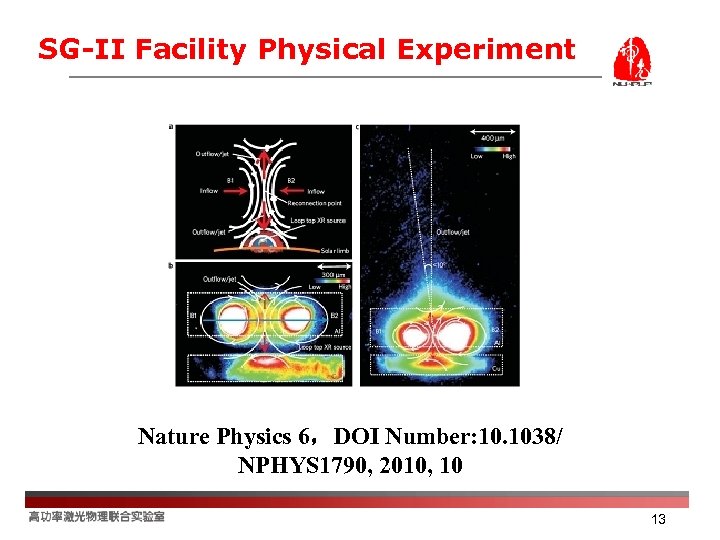 SG-II Facility Physical Experiment Nature Physics 6,DOI Number: 10. 1038/ NPHYS 1790, 2010, 10 13
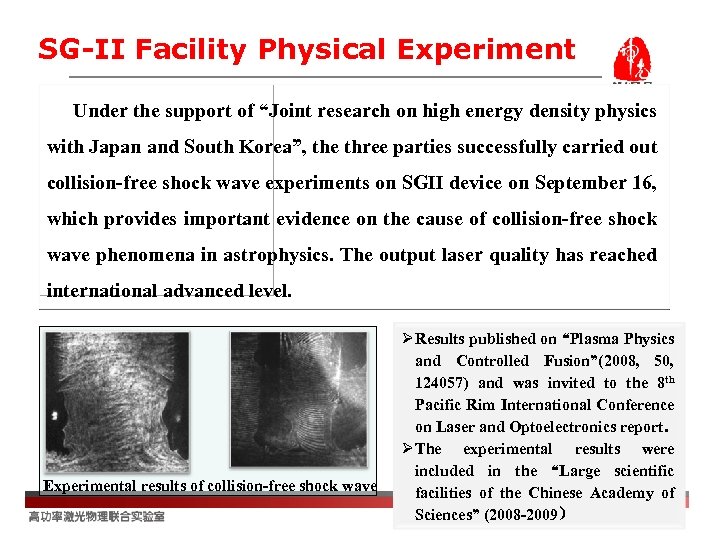 SG-II Facility Physical Experiment Under the support of “Joint research on high energy density physics with Japan and South Korea”, the three parties successfully carried out collision-free shock wave experiments on SGⅡ device on September 16, which provides important evidence on the cause of collision-free shock wave phenomena in astrophysics. The output laser quality has reached international advanced level. Experimental results of collision-free shock wave Ø Results published on “Plasma Physics and Controlled Fusion”(2008, 50, 124057) and was invited to the 8 th Pacific Rim International Conference on Laser and Optoelectronics report. Ø The experimental results were included in the “Large scientific facilities of the Chinese Academy of Sciences” (2008 -2009) 14
 Summary ——SG-II facility is an important platform for inertial confinement fusion (ICF) research and national physical researches, which also represents the general technology achievement in high power laser physics. ——SG-II facility have 9 laser beams, provide: 8 laser beams: 750 J/beam/1 w/1 ns, 250 J/beam/3 w/1 ns, 120 J/beam/1 w/130 ps No. 9 laser beam: 5000 J/beam/1 w/3 ns, 3000 J/beam/3 w/3 ns 500 J/beam/1 w/300 ps 10 J/beam/1 w or 3 w/30 ps ——SG-II up facility will be completed and reach 24 KJ/3 ns(3ω)) ,and the 9 th beam will reach 1 KJ/(1 -10)ps(1ω). 15
 Outline ØIntroduction ØSG-II PW laser facility and recent achievements ØSN contrast ratio study in SG-II PW laser facility ØPrograms of ultra short lasers in NLPLP ØConclusion 16
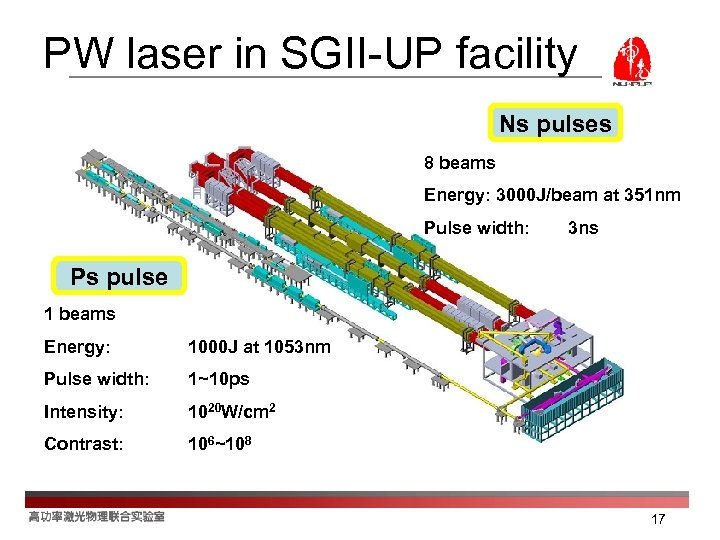 PW laser in SGII-UP facility Ns pulses 8 beams Energy: 3000 J/beam at 351 nm Pulse width: 3 ns Ps pulse 1 beams Energy: 1000 J at 1053 nm Pulse width: 1~10 ps Intensity: 1020 W/cm 2 Contrast: 106~108 17
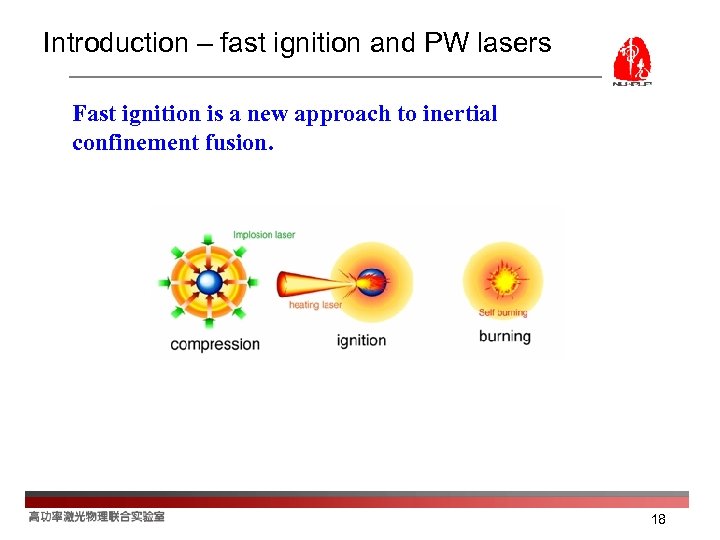 Introduction – fast ignition and PW lasers Fast ignition is a new approach to inertial confinement fusion. 18
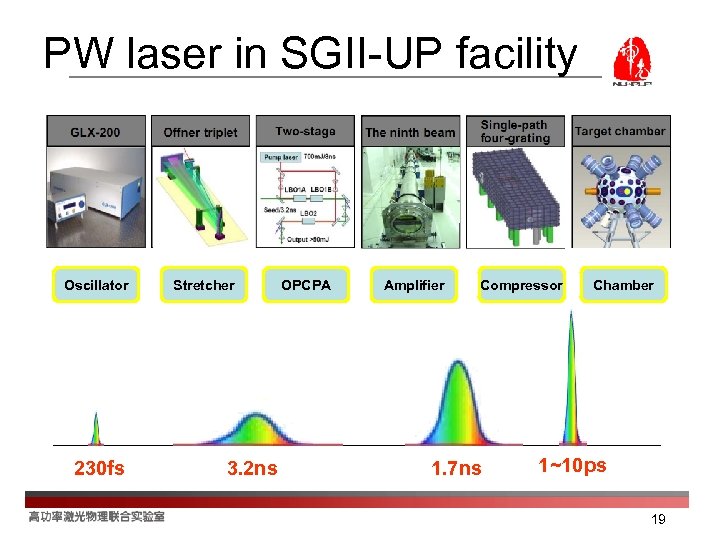 PW laser in SGII-UP facility Oscillator 230 fs Stretcher 3. 2 ns OPCPA Amplifier Compressor 1. 7 ns Chamber 1~10 ps 19
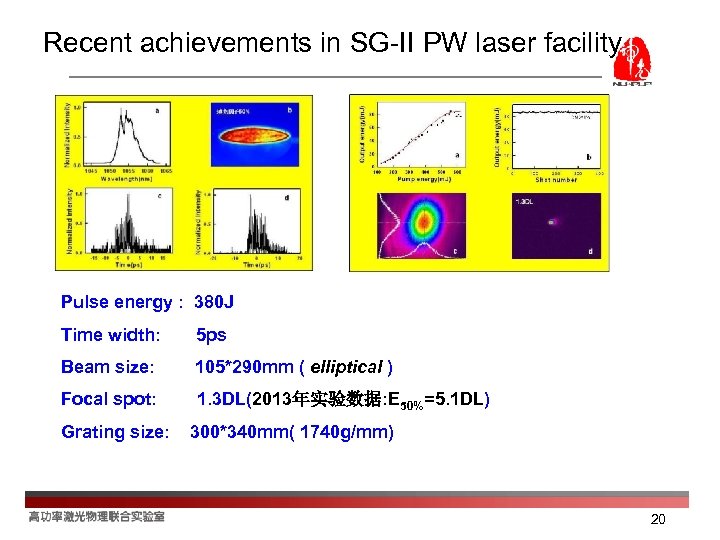 Recent achievements in SG-II PW laser facility Pulse energy : 380 J Time width: 5 ps Beam size: 105*290 mm ( elliptical ) Focal spot: 1. 3 DL(2013年实验数据: E 50%=5. 1 DL) Grating size: 300*340 mm( 1740 g/mm) 20
 Outline ØIntroduction ØSG-II PW laser facility and recent achievements ØSN contrast ratio study in SG-II PW laser facility u. SN contrast ratio simulations for PW laser pulses u. SN contrast ratio test for SG-II PW laser u. SN contrast ratio improvement for SG-II PW laser ØPrograms of ultra short lasers in NLPLP ØConclusion 21
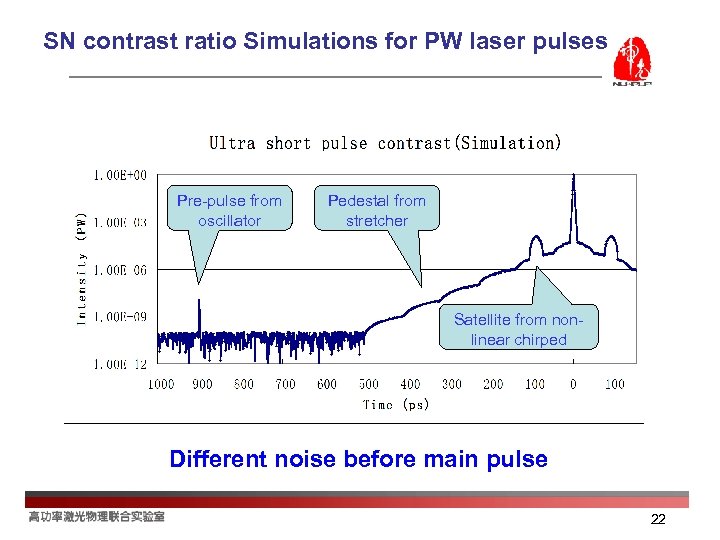 SN contrast ratio Simulations for PW laser pulses Pre-pulse from oscillator Pedestal from stretcher Satellite from nonlinear chirped Different noise before main pulse 22
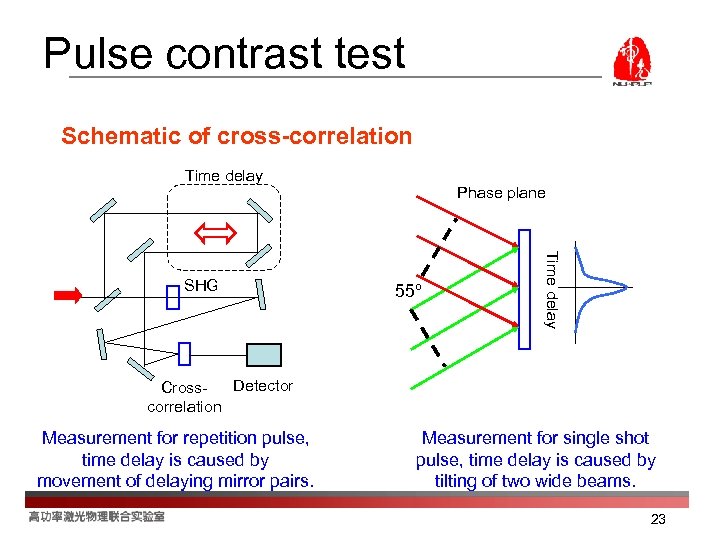 Pulse contrast test Schematic of cross-correlation Time delay 55º Time delay SHG Phase plane Detector Crosscorrelation Measurement for repetition pulse, time delay is caused by movement of delaying mirror pairs. Measurement for single shot pulse, time delay is caused by tilting of two wide beams. 23
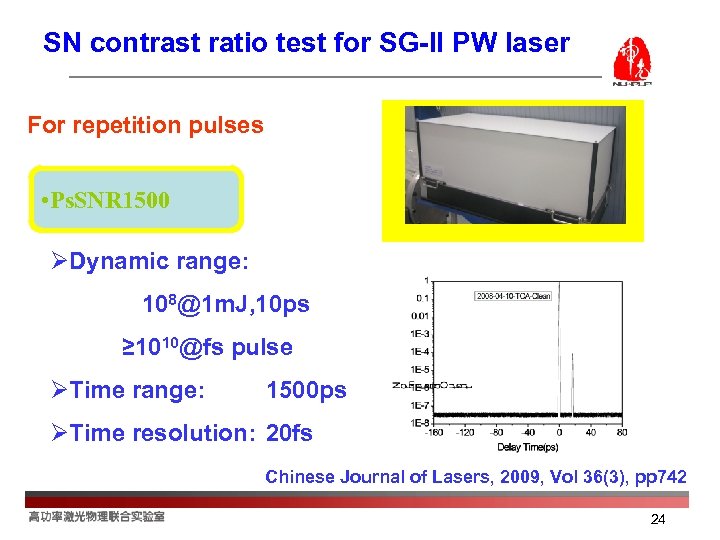 SN contrast ratio test for SG-II PW laser For repetition pulses • Ps. SNR 1500 ØDynamic range: 108@1 m. J, 10 ps ≥ 1010@fs pulse ØTime range: 1500 ps ØTime resolution: 20 fs Chinese Journal of Lasers, 2009, Vol 36(3), pp 742 24
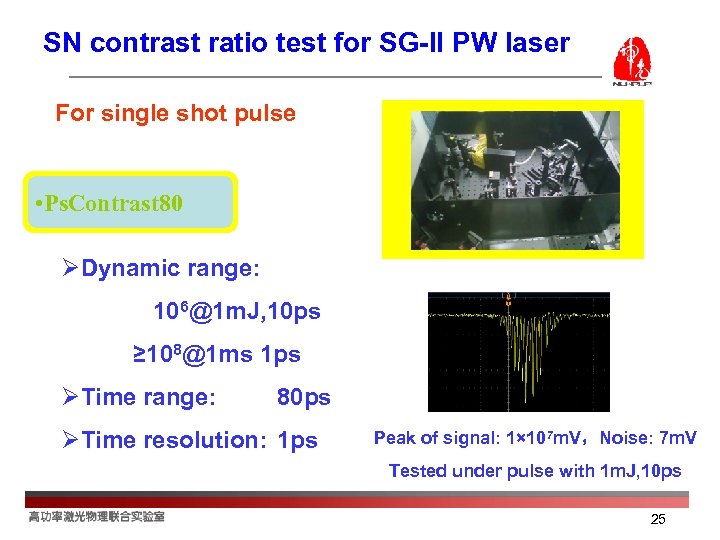 SN contrast ratio test for SG-II PW laser For single shot pulse • Ps. Contrast 80 ØDynamic range: 106@1 m. J, 10 ps ≥ 108@1 ms 1 ps ØTime range: 80 ps ØTime resolution: 1 ps Peak of signal: 1× 10⁷ m. V,Noise: 7 m. V Tested under pulse with 1 m. J, 10 ps 25
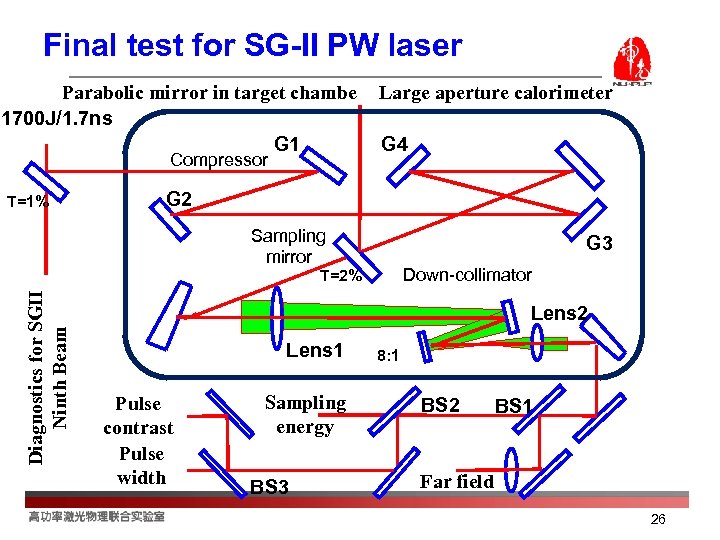 Final test for SG-II PW laser Parabolic mirror in target chambe 1700 J/1. 7 ns G 1 Compressor T=1% Large aperture calorimeter G 4 G 2 Sampling mirror G 3 Down-collimator Diagnostics for SGII Ninth Beam T=2% Lens 2 Lens 1 Pulse contrast Pulse width Sampling energy BS 3 8: 1 BS 2 BS 1 Far field 26
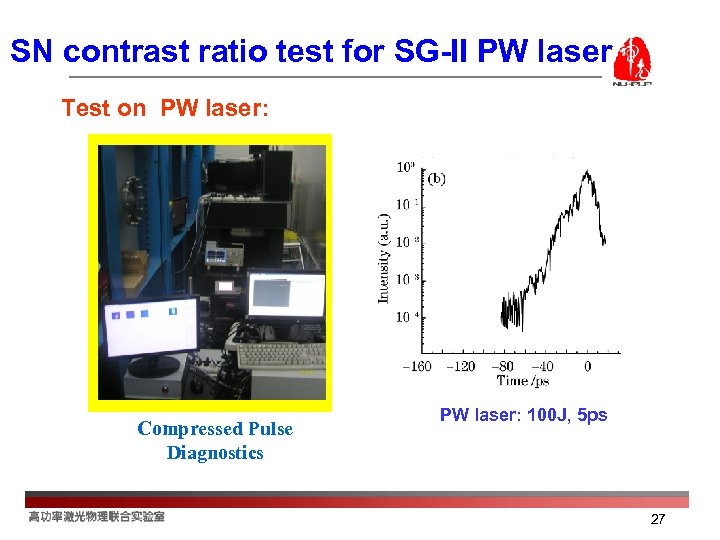 SN contrast ratio test for SG-II PW laser Test on PW laser: Compressed Pulse Diagnostics PW laser: 100 J, 5 ps 27
 SN contrast ratio improvement for SG-II PW laser 1 SN contrast ratio control in pulse stretcher 2 SN contrast ratio control in OPCPA preamplifier 3 Spectrum shape for chirped laser pulse 4 Controlling smoothness of the optics surface 5 Plasma mirror 28
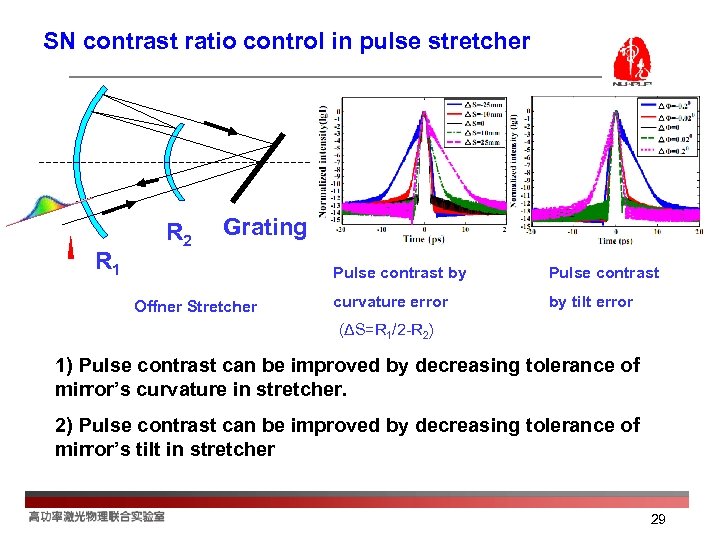 SN contrast ratio control in pulse stretcher R 1 R 2 Grating Pulse contrast by Offner Stretcher Pulse contrast curvature error by tilt error (ΔS=R 1/2 -R 2) 1) Pulse contrast can be improved by decreasing tolerance of mirror’s curvature in stretcher. 2) Pulse contrast can be improved by decreasing tolerance of mirror’s tilt in stretcher 29
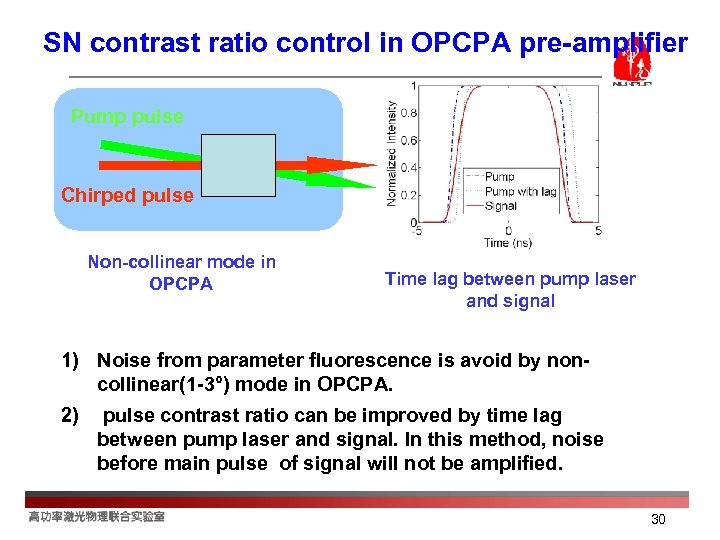 SN contrast ratio control in OPCPA pre-amplifier Pump pulse Chirped pulse Non-collinear mode in OPCPA Time lag between pump laser and signal 1) Noise from parameter fluorescence is avoid by noncollinear(1 -3°) mode in OPCPA. 2) pulse contrast ratio can be improved by time lag between pump laser and signal. In this method, noise before main pulse of signal will not be amplified. 30
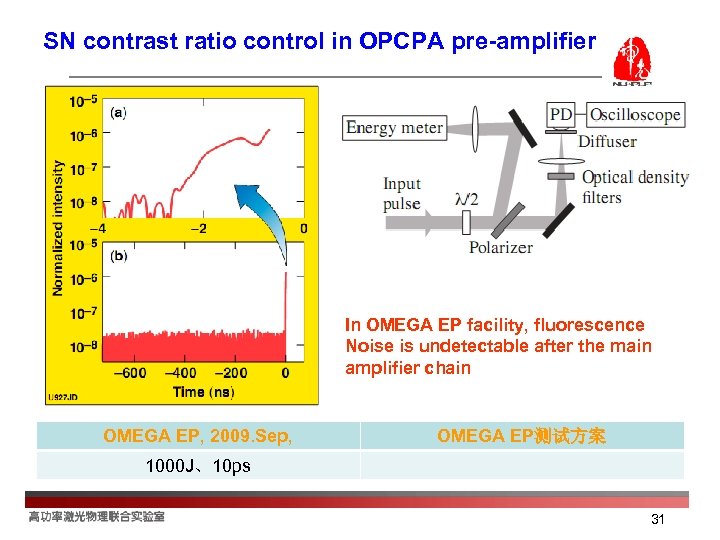 SN contrast ratio control in OPCPA pre-amplifier In OMEGA EP facility, fluorescence Noise is undetectable after the main amplifier chain OMEGA EP, 2009. Sep, OMEGA EP测试方案 1000 J、10 ps 31
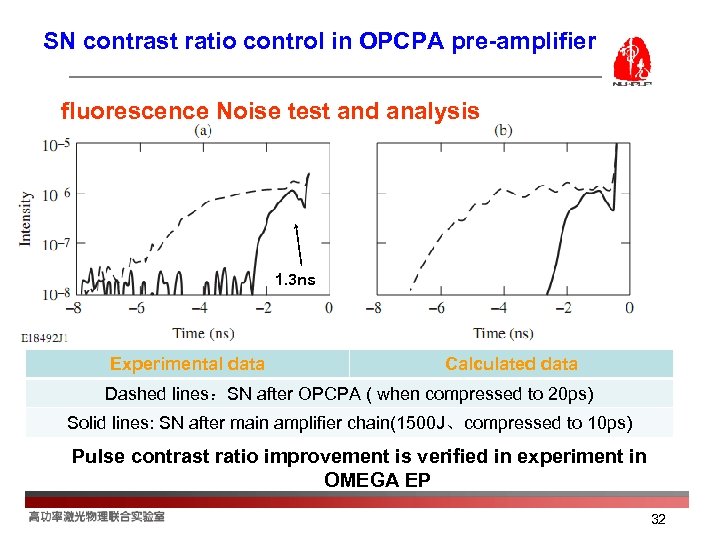 SN contrast ratio control in OPCPA pre-amplifier fluorescence Noise test and analysis 1. 3 ns Experimental data Calculated data Dashed lines:SN after OPCPA ( when compressed to 20 ps) Solid lines: SN after main amplifier chain(1500 J、compressed to 10 ps) Pulse contrast ratio improvement is verified in experiment in OMEGA EP 32
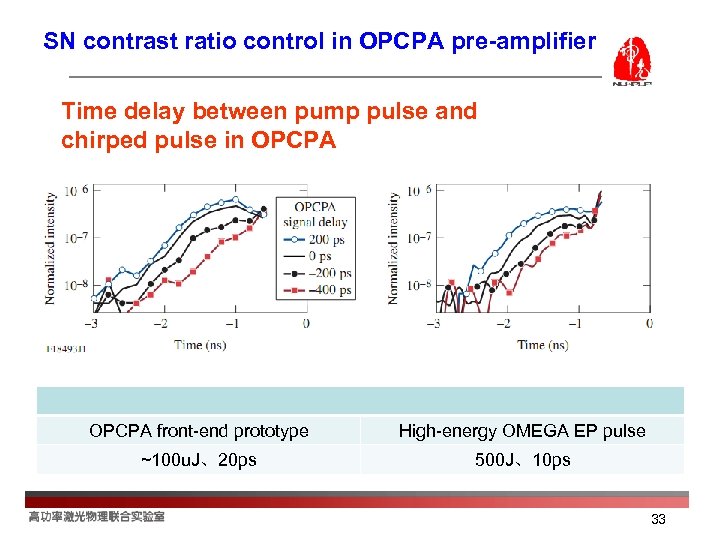 SN contrast ratio control in OPCPA pre-amplifier Time delay between pump pulse and chirped pulse in OPCPA front-end prototype High-energy OMEGA EP pulse ~100 u. J、20 ps 500 J、10 ps 33
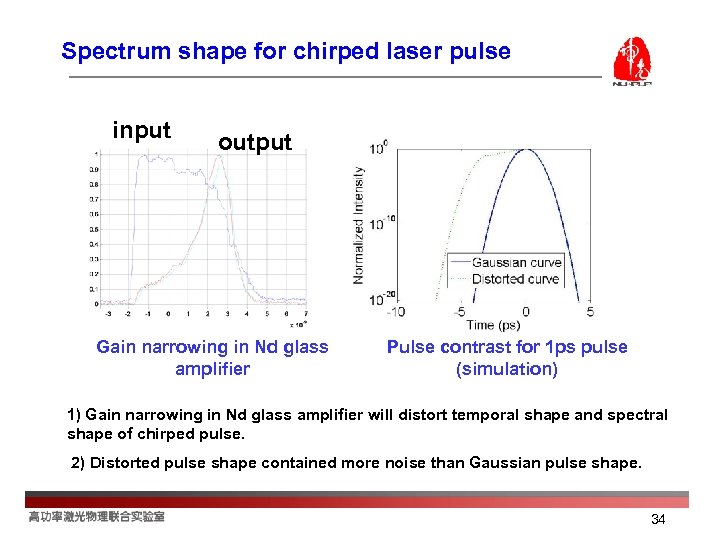 Spectrum shape for chirped laser pulse input output Gain narrowing in Nd glass amplifier Pulse contrast for 1 ps pulse (simulation) 1) Gain narrowing in Nd glass amplifier will distort temporal shape and spectral shape of chirped pulse. 2) Distorted pulse shape contained more noise than Gaussian pulse shape. 34
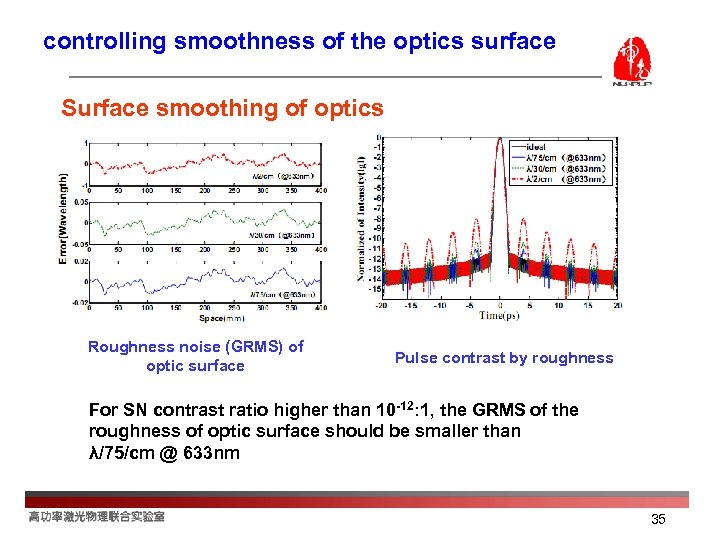 controlling smoothness of the optics surface Surface smoothing of optics Roughness noise (GRMS) of optic surface Pulse contrast by roughness For SN contrast ratio higher than 10 -12: 1, the GRMS of the roughness of optic surface should be smaller than λ/75/cm @ 633 nm 35
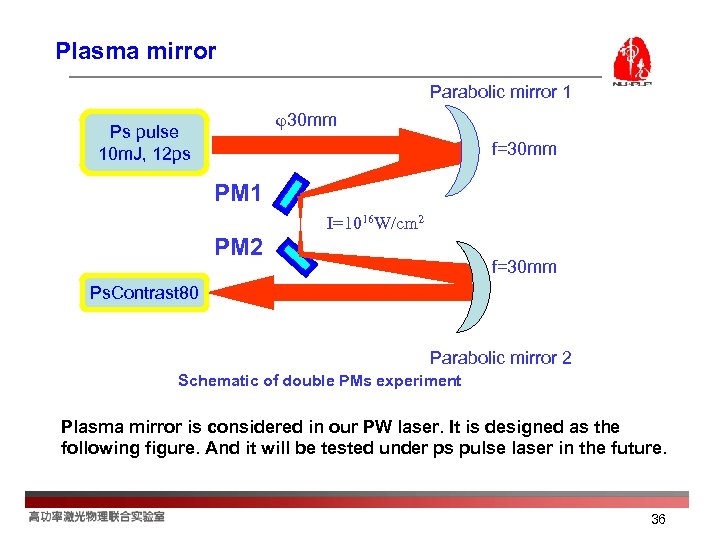 Plasma mirror Parabolic mirror 1 φ30 mm Ps pulse 10 m. J, 12 ps f=30 mm PM 1 I=1016 W/cm 2 PM 2 f=30 mm Ps. Contrast 80 Parabolic mirror 2 Schematic of double PMs experiment Plasma mirror is considered in our PW laser. It is designed as the following figure. And it will be tested under ps pulse laser in the future. 36
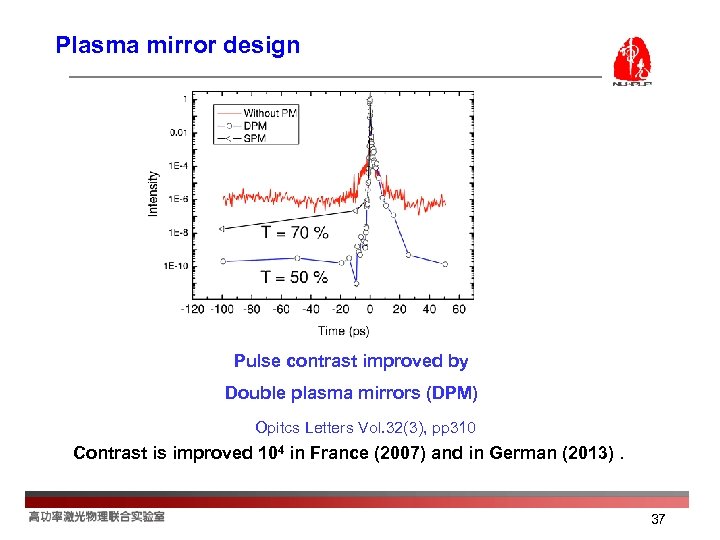 Plasma mirror design Pulse contrast improved by Double plasma mirrors (DPM) Opitcs Letters Vol. 32(3), pp 310 Contrast is improved 104 in France (2007) and in German (2013). 37
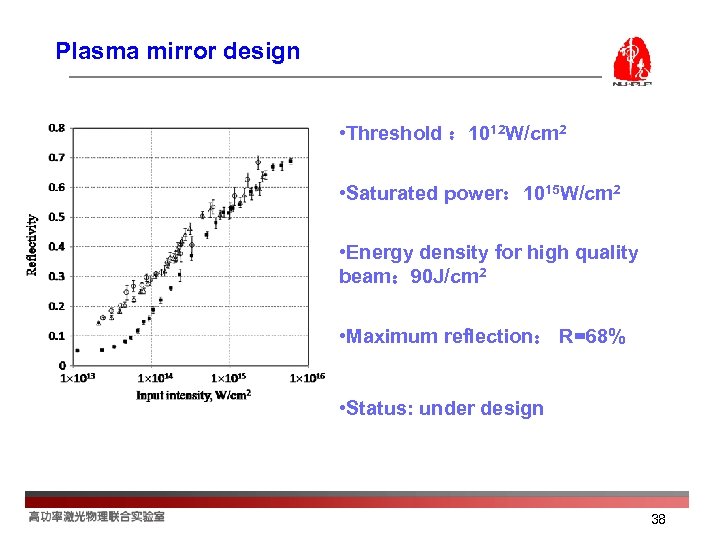 Plasma mirror design • Threshold : 1012 W/cm 2 • Saturated power: 1015 W/cm 2 • Energy density for high quality beam: 90 J/cm 2 • Maximum reflection: R=68% • Status: under design 38
 Outline ØIntroduction ØSG-II PW laser facility and recent achievements ØSN contrast ratio study in SG-II PW laser facility ØPrograms of ultra short lasers in NLPLP ØConclusion 39
 Programs of ultra short lasers in NLPLP Project of 10 PW 808 nm Laser 10 PW (30 fs/300 J) 808 nm laser project has been supported Goals: In the following 2 or 3 years – 10 PW facility provided for fundamental physical experiments 40
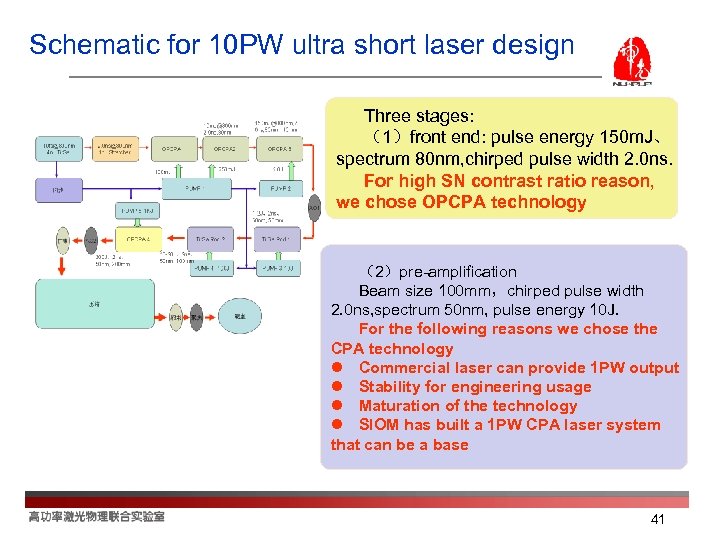 Schematic for 10 PW ultra short laser design Three stages: (1)front end: pulse energy 150 m. J、 spectrum 80 nm, chirped pulse width 2. 0 ns. For high SN contrast ratio reason, we chose OPCPA technology (2)pre-amplification Beam size 100 mm,chirped pulse width 2. 0 ns, spectrum 50 nm, pulse energy 10 J. For the following reasons we chose the CPA technology l Commercial laser can provide 1 PW output l Stability for engineering usage l Maturation of the technology l SIOM has built a 1 PW CPA laser system that can be a base 41
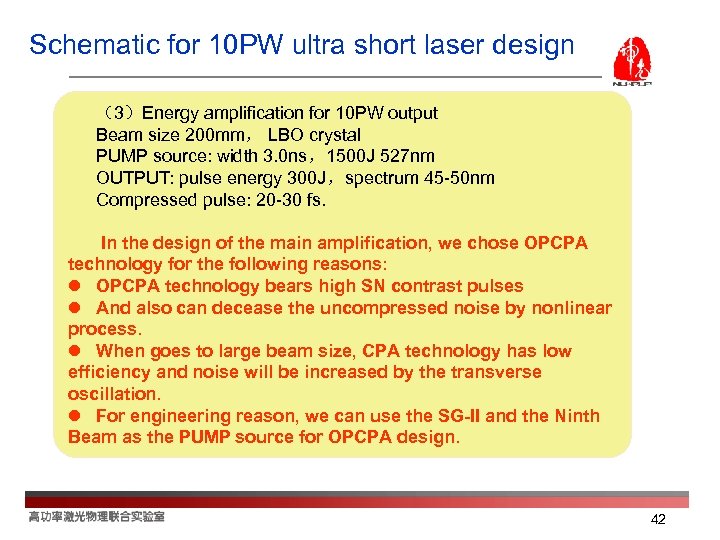 Schematic for 10 PW ultra short laser design (3)Energy amplification for 10 PW output Beam size 200 mm, LBO crystal PUMP source: width 3. 0 ns,1500 J 527 nm OUTPUT: pulse energy 300 J,spectrum 45 -50 nm Compressed pulse: 20 -30 fs. In the design of the main amplification, we chose OPCPA technology for the following reasons: l OPCPA technology bears high SN contrast pulses l And also can decease the uncompressed noise by nonlinear process. l When goes to large beam size, CPA technology has low efficiency and noise will be increased by the transverse oscillation. l For engineering reason, we can use the SG-II and the Ninth Beam as the PUMP source for OPCPA design. 42
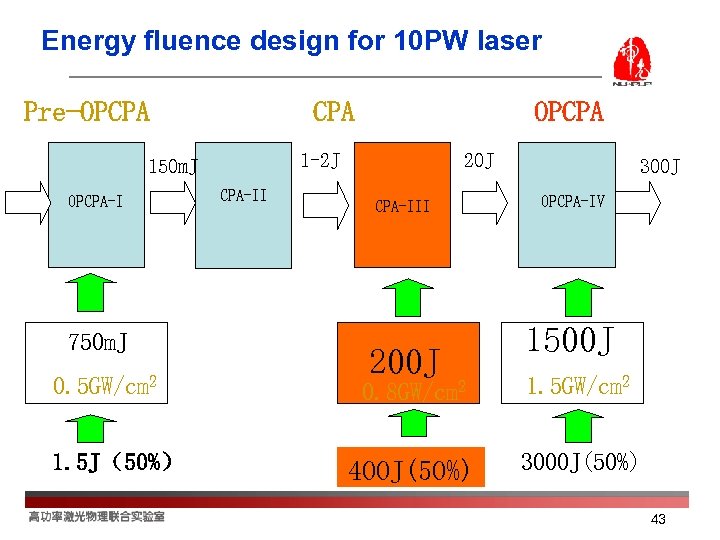 Energy fluence design for 10 PW laser Pre-OPCPA 1 -2 J 150 m. J OPCPA-I 750 m. J 0. 5 GW/cm 2 1. 5 J(50%) OPCPA CPA-II 20 J CPA-III 200 J 300 J OPCPA-IV 1500 J 0. 8 GW/cm 2 1. 5 GW/cm 2 400 J(50%) 3000 J(50%) 43
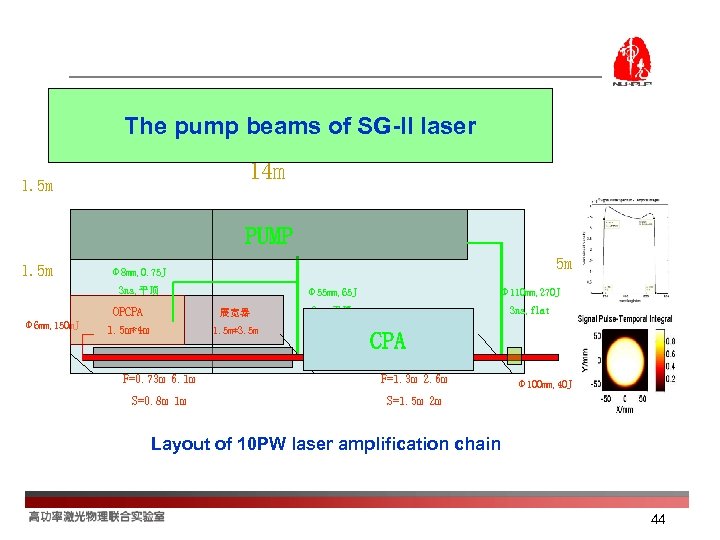 The pump beams of SG-II laser 14 m 1. 5 m PUMP 1. 5 m 5 m Φ 8 mm, 0. 75 J 3 ns, 平顶 Φ 6 mm, 150 m. J OPCPA 1. 5 m*4 m Φ 55 mm, 65 J 展宽器 1. 5 m*3. 5 m Φ 110 mm, 270 J 3 ns, 平顶 3 ns, flat Φ 50 mm, 10 J CPA F=0. 73 m 6. 1 m F=1. 3 m 2. 6 m S=0. 8 m 1 m S=1. 5 m 2 m Φ 100 mm, 40 J Layout of 10 PW laser amplification chain 44
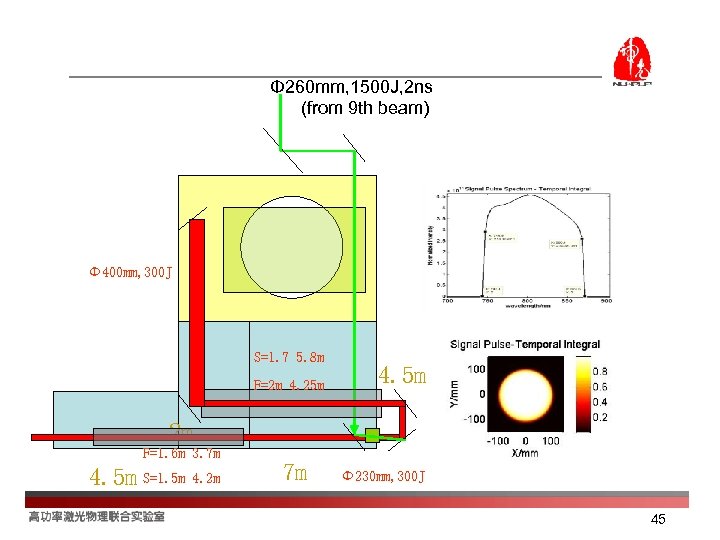 Φ 260 mm, 1500 J, 2 ns (from 9 th beam) Φ 400 mm, 300 J S=1. 7 5. 8 m F=2 m 4. 25 m 4. 5 m 2 m F=1. 6 m 3. 7 m 4. 5 m S=1. 5 m 4. 2 m 7 m Φ 230 mm, 300 J 45
 Outline ØIntroduction ØSG-II PW laser facility and recent achievements ØSN contrast ratio study in SG-II PW laser facility ØPrograms of ultra short lasers in NLPLP ØConclusion 46
 Conclusion In conclusion u. SG-II PW laser and recent progress are introduced. u. Factors that affect the SN contrast ratio of SG-II PW laser are discussed. u. We have measured the SN contrast ratio for the output of SG-II PW laser at 100 J@5 ps. u. Program of ultra short and ultra high power 10 PW laser has been designed based on SG-II and SG-Ninth beam, our goal is in three to five years the laser can be provided for fundamental physical experiments. 47
 Thank You for Your Attention ! 48