


 Скачать презентацию Research Methods for the Learning Sciences Ken Koedinger
e5d0a96a2eebd15fc8ace265243e2890.ppt
- Количество слайдов: 59
 Research Methods for the Learning Sciences Ken Koedinger Thanks to Ryan Baker for prior version of the slides 1
 Course Goals • To learn data collection, design, and analysis methodologies that are particularly useful for scientific research in education. • To learn to evaluate uses of these methods 2
 Overview • • • Introductions Course overview/logistics Unpacking course title Trochim Chapter 1 Good research questions 3
 Me • Ken Koedinger – Ph. D in Cognitive Psychology, MS in Computer Science – Faculty in Human-Computer Interaction & Psychology – Research: Cognitive & learning science, educational technology 4
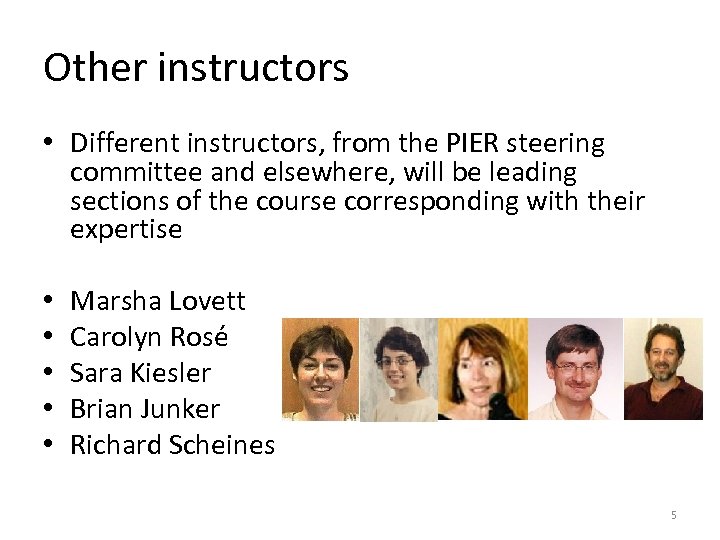 Other instructors • Different instructors, from the PIER steering committee and elsewhere, will be leading sections of the course corresponding with their expertise • • • Marsha Lovett Carolyn Rosé Sara Kiesler Brian Junker Richard Scheines 5
 Your turn Please: • Tell us your name • Your degree program • A sentence describing an interest you have in research: either – to contribute to educational science or – to improve educational practice 6
 Overview • • • Introductions Course overview/logistics Unpacking course title Trochim Chapter 1 Good research questions 7
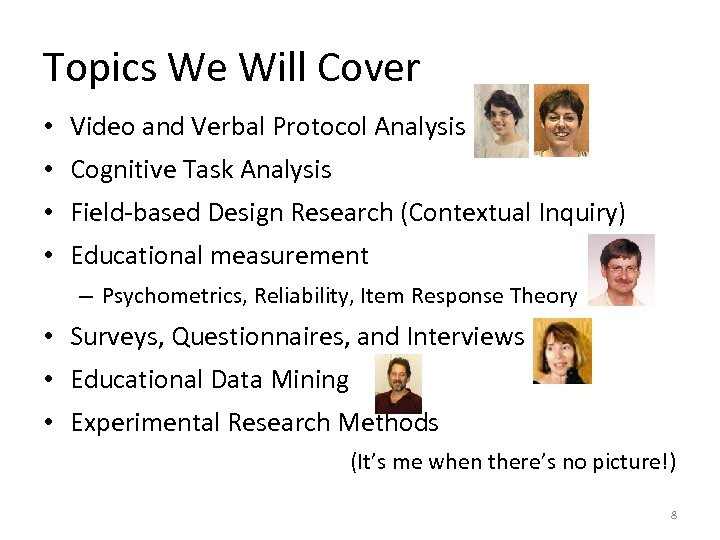 Topics We Will Cover • Video and Verbal Protocol Analysis • Cognitive Task Analysis • Field-based Design Research (Contextual Inquiry) • Educational measurement – Psychometrics, Reliability, Item Response Theory • Surveys, Questionnaires, and Interviews • Educational Data Mining • Experimental Research Methods (It’s me when there’s no picture!) 8
 Textbook & Readings • Textbook: "The Research Methods Knowledge Base: 3 rd edition" by William M. K. Trochim and James P. Donnelly (2007) – http: //www. atomicdogpublishing. com/Book. Details. asp? Book. Edition. ID =160 – It is not in the campus bookstore – The used bookstore may have the wrong version – Publisher has both an online and printed version, so you can get started right away • Use course registration ID 1620032912010 • Readings will be assigned in class & made available on the web site – Next class reading: Chpt 6 of Trochim 9
 Assignments • Most class segments will have at least one assignment – Goal is to practice with methods relevant to that segment • Final project rather than final exam • Apply a method in detail to a topic of your choosing 10
 Reading Reports • Posts to class discussion board – Goals: • Help you learn from active application of knowledge, from observing others, and from feedback from others • Give instructors feedback on your interests & struggles • Extra motivation to do readings before class – Default Procedure • See description in the syllabus – Alternative specific guidance will be given for some course sections • watch the wiki and announcements on blackboard 11
 Overview • • • Introductions Course overview/logistics Unpacking course title Trochim Chapter 1 Good research questions 12
 Research Methods for the Learning Sciences • This class is on Research Methods for the Learning Sciences • Break-down – Research – Methods – for the – Learning Sciences 13
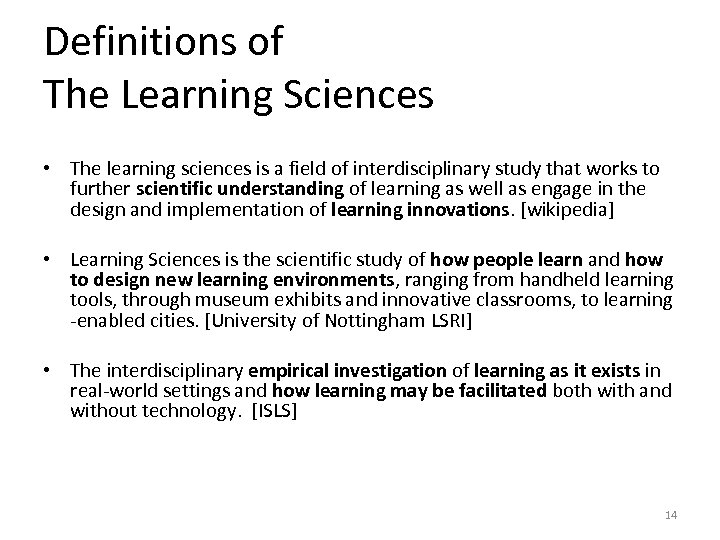 Definitions of The Learning Sciences • The learning sciences is a field of interdisciplinary study that works to further scientific understanding of learning as well as engage in the design and implementation of learning innovations. [wikipedia] • Learning Sciences is the scientific study of how people learn and how to design new learning environments, ranging from handheld learning tools, through museum exhibits and innovative classrooms, to learning -enabled cities. [University of Nottingham LSRI] • The interdisciplinary empirical investigation of learning as it exists in real-world settings and how learning may be facilitated both with and without technology. [ISLS] 14
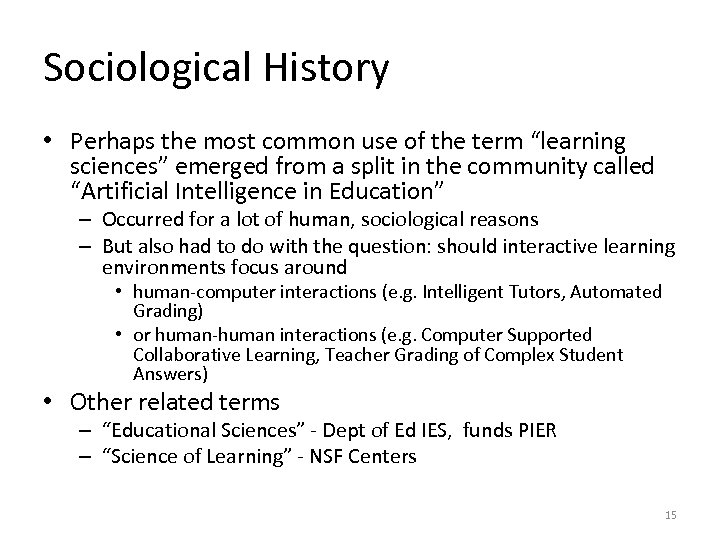 Sociological History • Perhaps the most common use of the term “learning sciences” emerged from a split in the community called “Artificial Intelligence in Education” – Occurred for a lot of human, sociological reasons – But also had to do with the question: should interactive learning environments focus around • human-computer interactions (e. g. Intelligent Tutors, Automated Grading) • or human-human interactions (e. g. Computer Supported Collaborative Learning, Teacher Grading of Complex Student Answers) • Other related terms – “Educational Sciences” - Dept of Ed IES, funds PIER – “Science of Learning” - NSF Centers 15
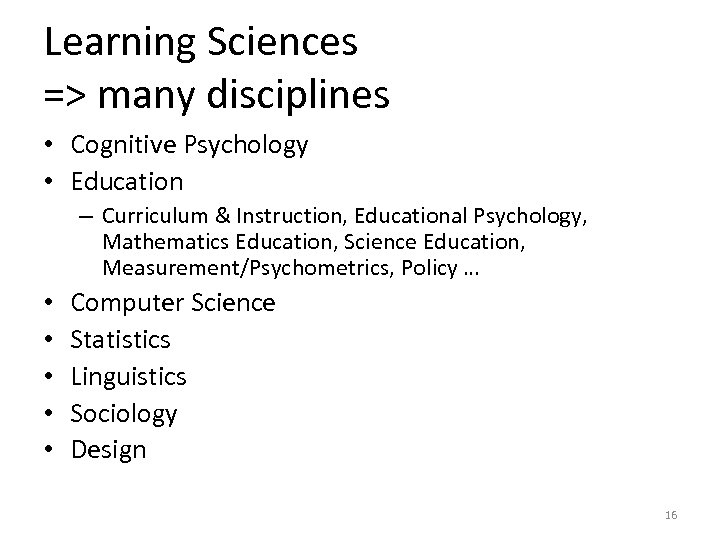 Learning Sciences => many disciplines • Cognitive Psychology • Education – Curriculum & Instruction, Educational Psychology, Mathematics Education, Science Education, Measurement/Psychometrics, Policy … • • • Computer Science Statistics Linguistics Sociology Design 16
 Definition: Methods • Trochim: “specific ways. . . you can use to understand the world better” (p. 18) 17
 Research • I think we can skip a definition of “research”! • But let’s explore: What is the difference between – Applied Research – Pure Research ? 18
 Is it possible? • Can research be both applied and pure? • Yes or no? – What’s your reasoning? 19
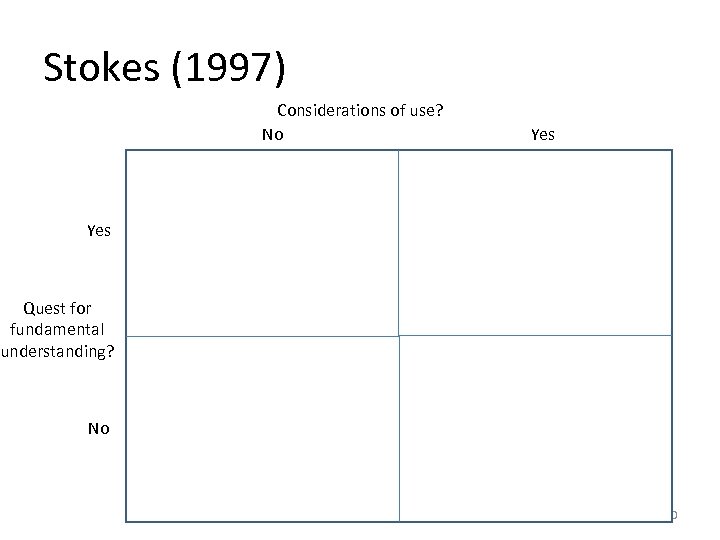 Stokes (1997) Considerations of use? No Yes Quest for fundamental understanding? No 20
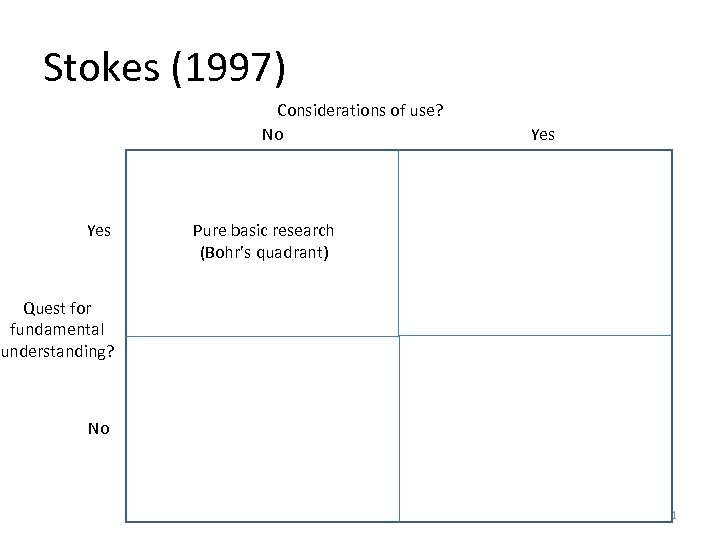 Stokes (1997) Considerations of use? No Yes Pure basic research (Bohr’s quadrant) Quest for fundamental understanding? No 21
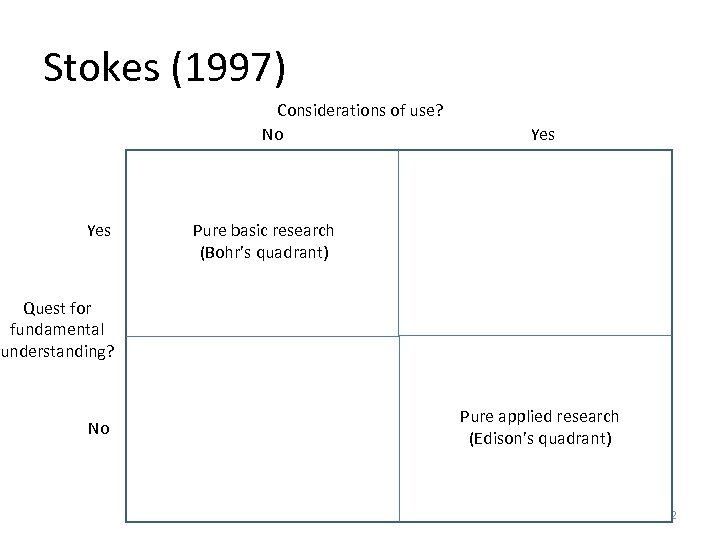 Stokes (1997) Considerations of use? No Yes Pure basic research (Bohr’s quadrant) Quest for fundamental understanding? No Pure applied research (Edison’s quadrant) 22
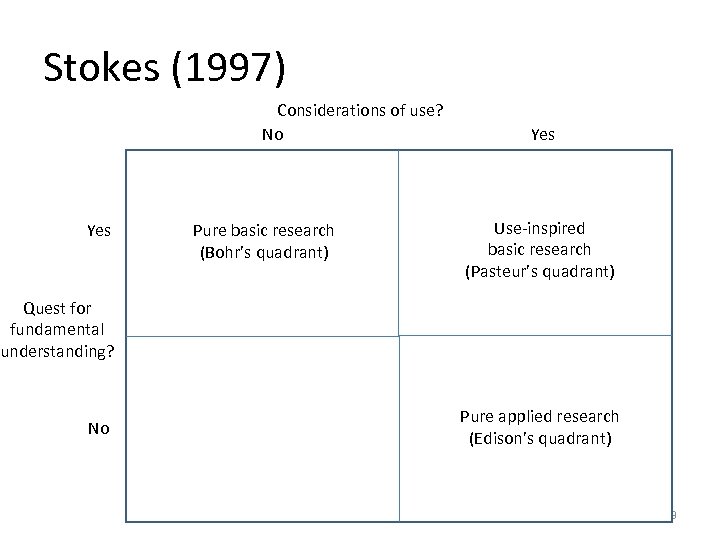 Stokes (1997) Considerations of use? No Yes Pure basic research (Bohr’s quadrant) Yes Use-inspired basic research (Pasteur’s quadrant) Quest for fundamental understanding? No Pure applied research (Edison’s quadrant) 23
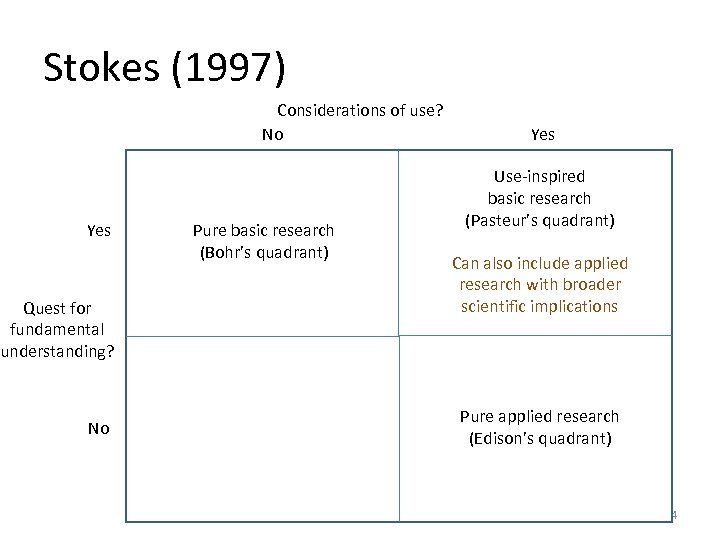 Stokes (1997) Considerations of use? No Yes Quest for fundamental understanding? No Pure basic research (Bohr’s quadrant) Yes Use-inspired basic research (Pasteur’s quadrant) Can also include applied research with broader scientific implications Pure applied research (Edison’s quadrant) 24
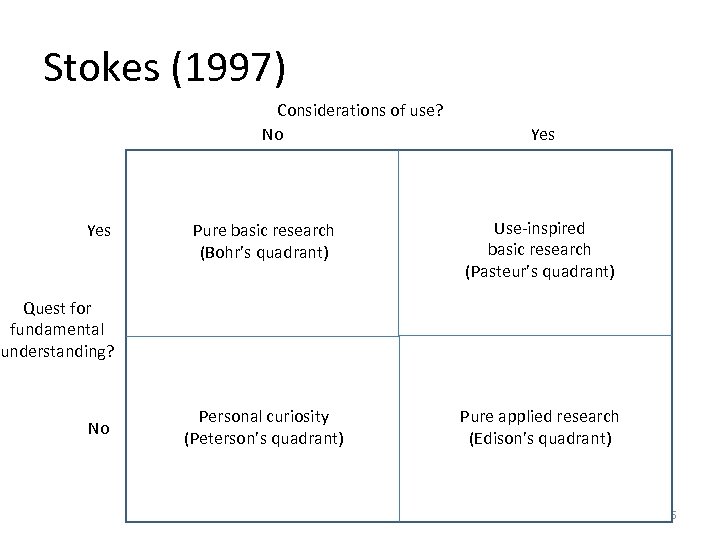 Stokes (1997) Considerations of use? No Yes Pure basic research (Bohr’s quadrant) Use-inspired basic research (Pasteur’s quadrant) Personal curiosity (Peterson’s quadrant) Pure applied research (Edison’s quadrant) Quest for fundamental understanding? No 25
 Overview • • • Introductions Course overview/logistics Unpacking course title Trochim Chapter 1 Good research questions 26
 Trochim Chpt 1 Discussion • Which of these terms are new? Review? • Language of research – Relationships, types of data, unit of analysis, research fallacies • Philosophy of Research – Hourglass structure, difference between a research question and a hypothesis, kinds of validity • Conceptualizing – Concept mapping, logic models – “Problem formulation” – we’ll talk about next 27
 How do you do good research? • Whether it is pure or applied • Recipe – Good research directions – Good research methods 28
 The rest of the class • The rest of the semester is all about good research methods • So I’d like to say a few words about good research directions/questions – Note: Some of the research methods we will discuss, like Cognitive Task Analysis, can help generate better research questions 29
 Good research directions, goals, or questions • Write down a “research goal” – It could be one of your research goals, or a product development goal, or a goal you could imagine someone else having • Remember to write the goal, not the solution – Goal: Increase people’s leisure time by reducing the time spent washing dishes – Solution: Build a dish-washing robot 30
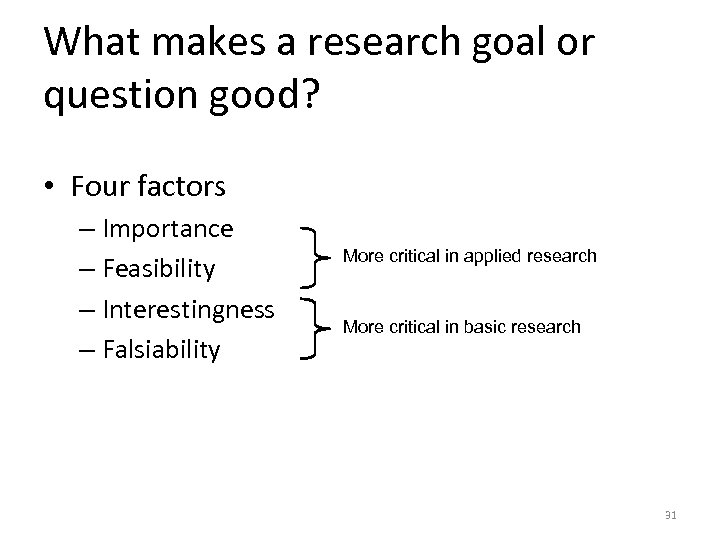 What makes a research goal or question good? • Four factors – Importance – Feasibility – Interestingness – Falsiability More critical in applied research More critical in basic research 31
 Importance • Will the world be changed for the better if this research goal is accomplished? 32
 Which of these research goals achieve the “Importance” criterion? • Build an intelligent tutoring system to help students learn to differentiate Bruce Springsteen songs from Billy Joel songs • Curing déjà vu • Build an intelligent tutoring system for introductory neurobiology • Help more students pass introductory neurobiology 33
 Which of these research goals achieve the “Importance” criterion? • Help students reach mastery with introductory neurobiology material faster • Curing déjà vu • Determine which kinds of self-explanation lead to better retention and transfer • Develop teleportation 34
 The research goal you wrote down • Is it important? • Take 30 seconds to reflect 35
 Feasibility • Sometimes called “Opportunity”, like when you’re writing a grant proposal – Grant section formula: 1) Problem, 2) Opportunity, 3) Solution • How feasible is solving this problem now? • Do you have a special new approach to the problem that will enable you to solve it? – Do you have a unique team? A new technology? A ready user base/participant pool? • If the problem is (or seems) easy, why hasn’t anyone solved it yet (or why is it harder than people seem to think)? 36
 Which of these important research goals are also feasible? Teleportation Antigravity Time Travel An intelligent tutor that takes natural language typed input, and responds with speech Maybe this is attackable for some of you, but not for others • • – This is one reason why interdisciplinary collaboration is so great 37
 Which of these important research goals are also feasible? Building an intelligent tutor that • can teach any topic in human understanding, with no prior preparation • responds as sensitively to differences in student affect as a human tutor and can be used in existing middle school computer labs Last goal is less feasible than previous one • But which goal is more important? 38
 The research goal you wrote down • Do you have a good attack on the feasibility challenge? • Is there an attack you don’t have but: – You could develop – Somebody else you know has it (and you could learn or team up with them) • Take 30 seconds to reflect. 39
 Importance and Attackability • Two very important ways to assess an applied research goal • Not the only ways! 40
 How do you know? • Which goals are important • Which new methods can provide more powerful attacks on an important problem 41
 Advice • Attend lots of talks • Skim lots of papers • Talk to lots of people • And most importantly, do it both within and outside your area, whatever that area is • You will learn important things in your area • But it is by knowing other areas that you can develop entirely new approaches and attacks for your area 42
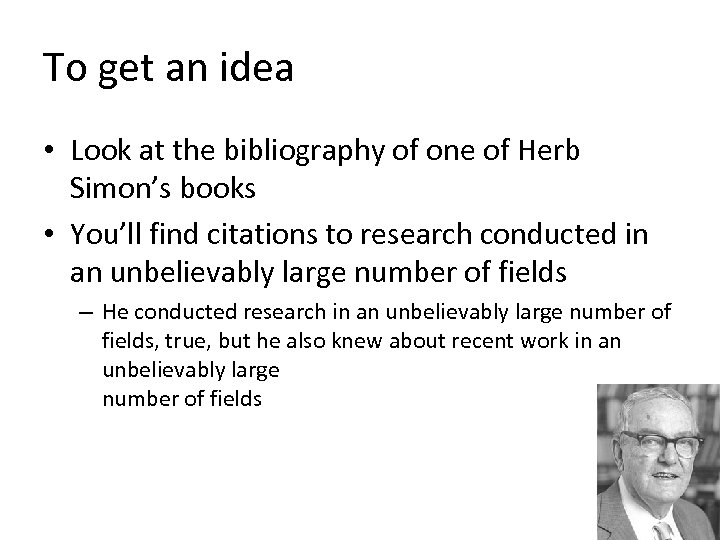 To get an idea • Look at the bibliography of one of Herb Simon’s books • You’ll find citations to research conducted in an unbelievably large number of fields – He conducted research in an unbelievably large number of fields, true, but he also knew about recent work in an unbelievably large number of fields 43
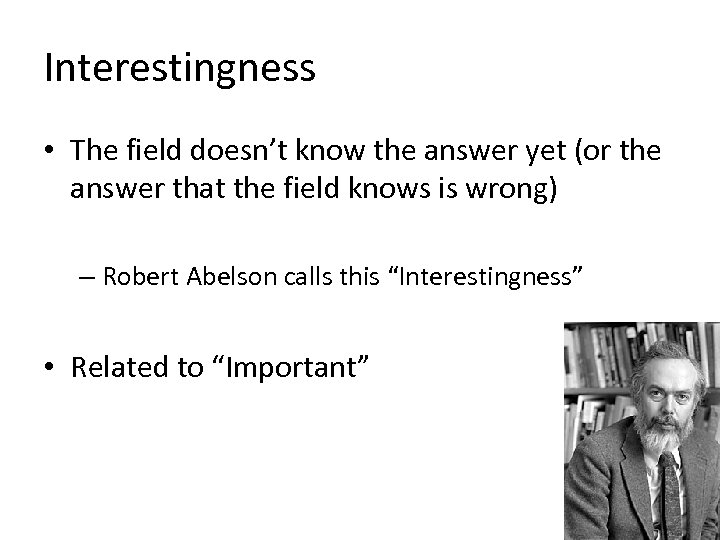 Interestingness • The field doesn’t know the answer yet (or the answer that the field knows is wrong) – Robert Abelson calls this “Interestingness” • Related to “Important” 44
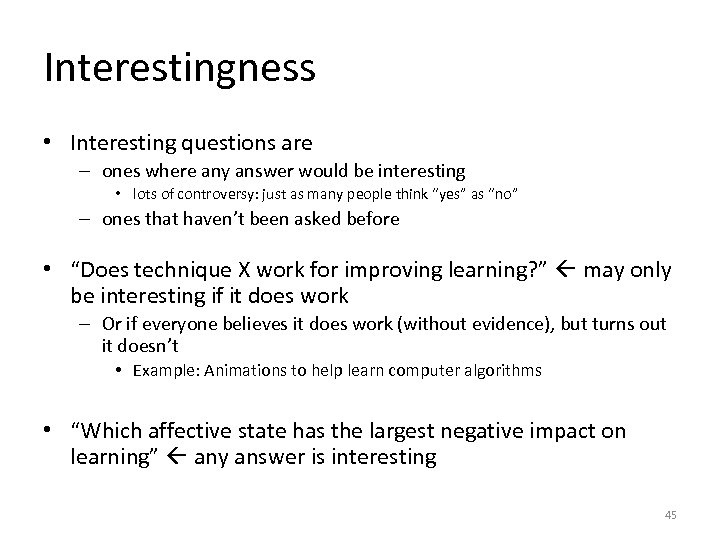 Interestingness • Interesting questions are – ones where any answer would be interesting • lots of controversy: just as many people think “yes” as “no” – ones that haven’t been asked before • “Does technique X work for improving learning? ” may only be interesting if it does work – Or if everyone believes it does work (without evidence), but turns out it doesn’t • Example: Animations to help learn computer algorithms • “Which affective state has the largest negative impact on learning” any answer is interesting 45
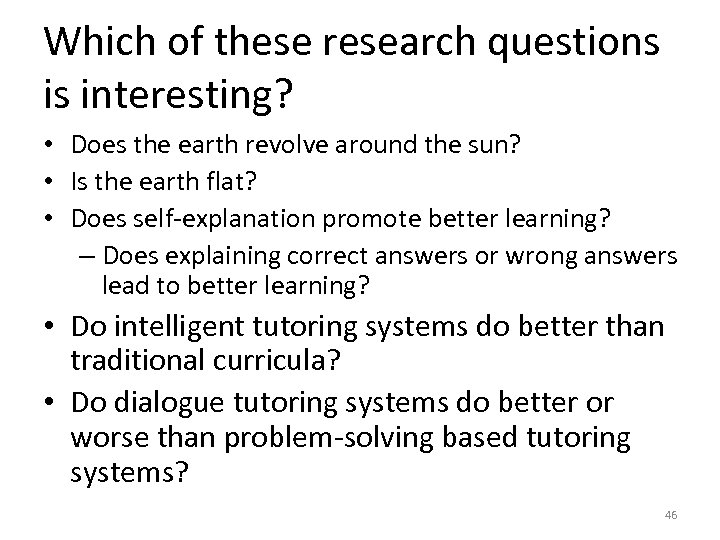 Which of these research questions is interesting? • Does the earth revolve around the sun? • Is the earth flat? • Does self-explanation promote better learning? – Does explaining correct answers or wrong answers lead to better learning? • Do intelligent tutoring systems do better than traditional curricula? • Do dialogue tutoring systems do better or worse than problem-solving based tutoring systems? 46
 The research goal/question you wrote down • Is it interesting? • Take 30 seconds to reflect. 47
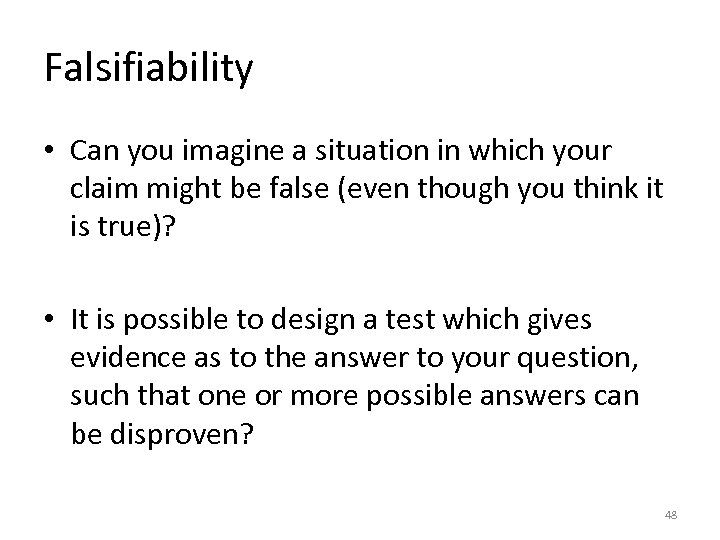 Falsifiability • Can you imagine a situation in which your claim might be false (even though you think it is true)? • It is possible to design a test which gives evidence as to the answer to your question, such that one or more possible answers can be disproven? 48
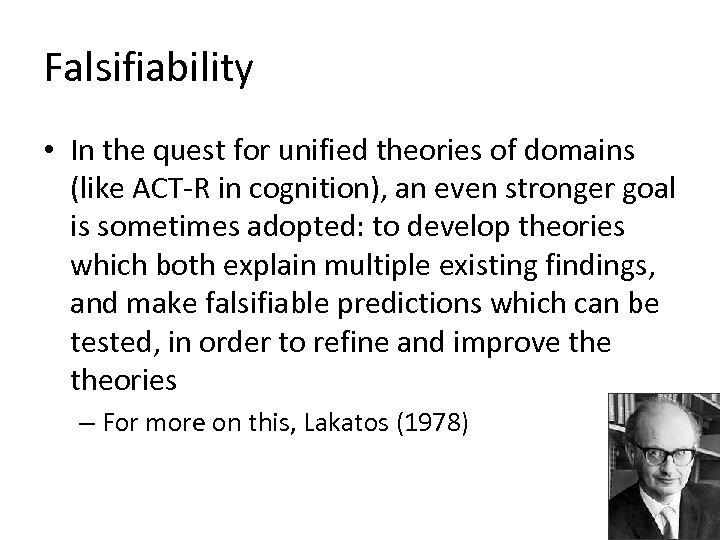 Falsifiability • In the quest for unified theories of domains (like ACT-R in cognition), an even stronger goal is sometimes adopted: to develop theories which both explain multiple existing findings, and make falsifiable predictions which can be tested, in order to refine and improve theories – For more on this, Lakatos (1978) 49
 The research goal/question you wrote down • Is it possible to falsify your hypothesized answer to this research question? Could it be wrong? Can you test where or not it is wrong? • Take 30 seconds to reflect. 50
 How do you know? • Which questions are interesting? • Whether a research question is testable? 51
 Interestingness • Think about: – What would be different in the world of research if I answered this question and the answer was known? – Would it inspire new work by others? – Would it alter work that would occur? – Would people talk about it at conferences when you weren’t there 52
 Testability/Falsifiability • Come up with a research design that can give valid evidence on the question • The existence of at least one valid test is evidence that the question is testable 53
 Testability/Falsifiability • And remember, the test does not need to be perfect – a first study can be imperfect, paving the way for more thorough later studies • In the famous words of Herbert Simon “Anything worth doing is worth doing badly” 54
 Testability/Falsifiability • In the following weeks, we will discuss a variety of research methods that can be used to make valid inferences about the research questions you are interested in 55
 NSF proposals • The executive summary on an NSF proposal must address both the “broad impact” and “intellectual merit” of the proposed project • Which of the 4 factors is broad impact? – Importance, feasibility, interestingness, or falsifiability? • Which of the 4 factors is intellectual merit? – Importance, feasibility, interestingness, or falsifiability? 56
 Summary • Course overview • We unpacked: “Research Methods in the Learning Sciences” • Four criteria for a good research question: – Importance – Feasibility/Opportunity – Interestingness – Falsifiability 57
 Some resources for reading more about coming up with good research questions Simon, H. A. (1996) The Sciences of the Artificial Lakatos, I. (1970) Falsification and the Methodology of Scientific Research Programmes. In Lakatos, I. , Musgrave, A. (Eds. ) Criticism and the Growth of Knowledge. Abelson, R. P. (1995) Statistics as Principled Argument. Hamming, R. (1986) You and Your Research. http: //www. cs. virginia. edu/~robins/You. And. Your. Research. html Feynman, R. (1997) Surely You’re Joking, Mr. Feynman: Adventures of a Curious Character. Simon, H. (1996) Models of My Life 58
 For Thursday • If you have not already, do the Trochim Chapter 1 reading & do the quiz • Read Trochim Chapter 6 reading – Do the quiz • Read “Instructional Complexity” paper 59