


 Скачать презентацию Research Methods AIM What is Science To Do
463b8d1b4acc026c24749f5d3a1574bf.ppt
- Количество слайдов: 77
 Research Methods AIM: What is Science? To Do List: 1. Assign Seating 2. Course Overview A. Grading B. Goals 3. Assign computers - Introduce methods website (bookmark it!!) 4. Set up Lab notebook (Evernote) 5. Join Edmodo Page (code: 9 pg 2 c 2) 6. Add name, preferred email and computer # to google doc 7. Begin Training
 Research Methods AIM: What is Science? What is Science
 Chapter 1 - Introduction: Exploring Life AIM: What is Science? It’s all about making observations. . . Ex. The structure of DNA
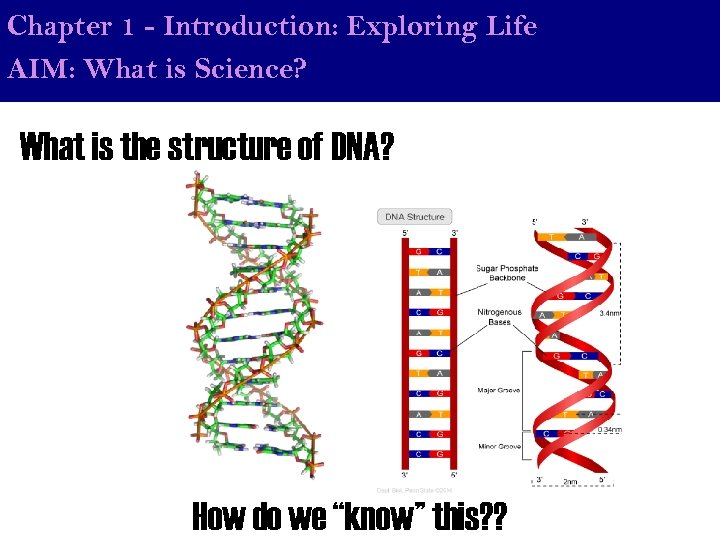 Chapter 1 - Introduction: Exploring Life AIM: What is Science? What is the structure of DNA? How do we “know” this? ?
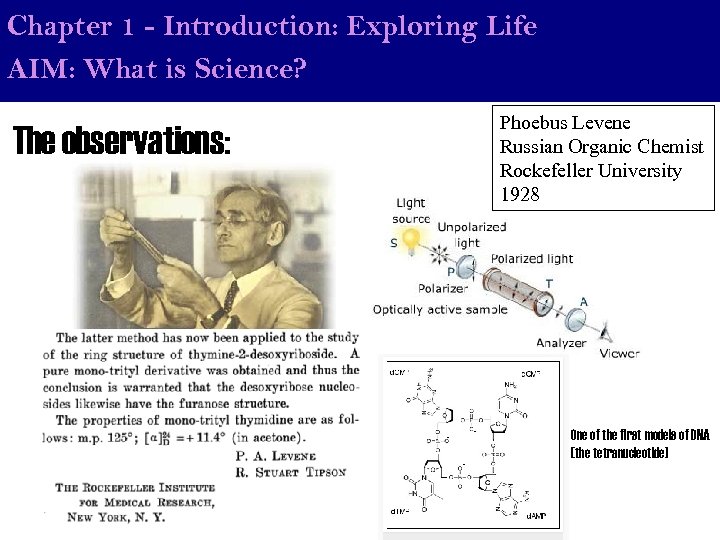 Chapter 1 - Introduction: Exploring Life AIM: What is Science? The observations: Phoebus Levene Russian Organic Chemist Rockefeller University 1928 One of the first models of DNA (the tetranucleotide)
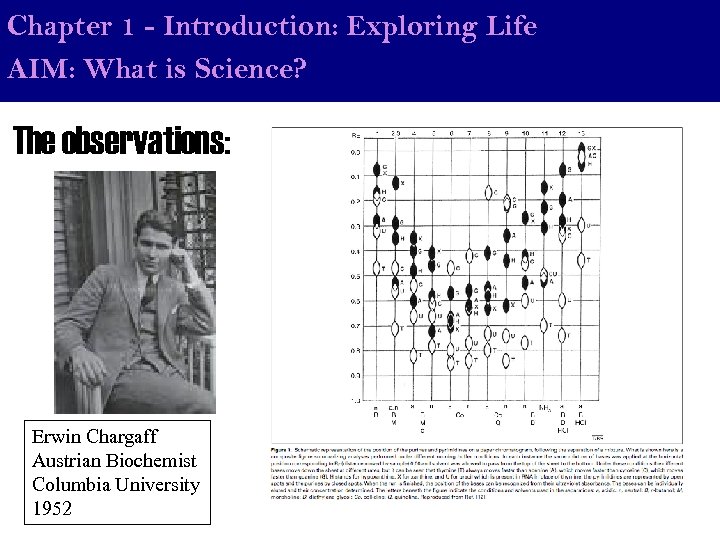 Chapter 1 - Introduction: Exploring Life AIM: What is Science? The observations: Erwin Chargaff Austrian Biochemist Columbia University 1952
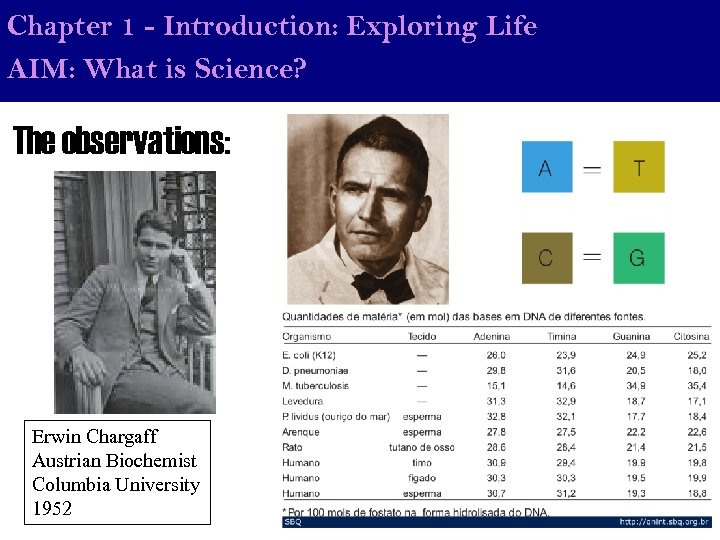 Chapter 1 - Introduction: Exploring Life AIM: What is Science? The observations: Erwin Chargaff Austrian Biochemist Columbia University 1952
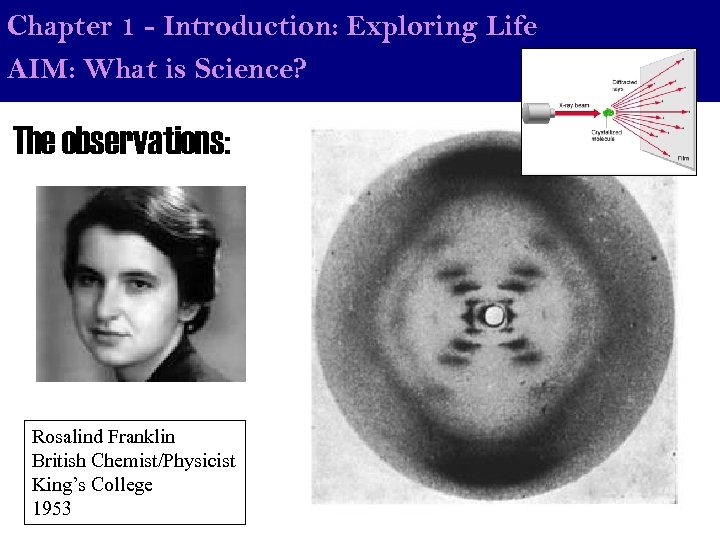 Chapter 1 - Introduction: Exploring Life AIM: What is Science? The observations: Rosalind Franklin British Chemist/Physicist King’s College 1953
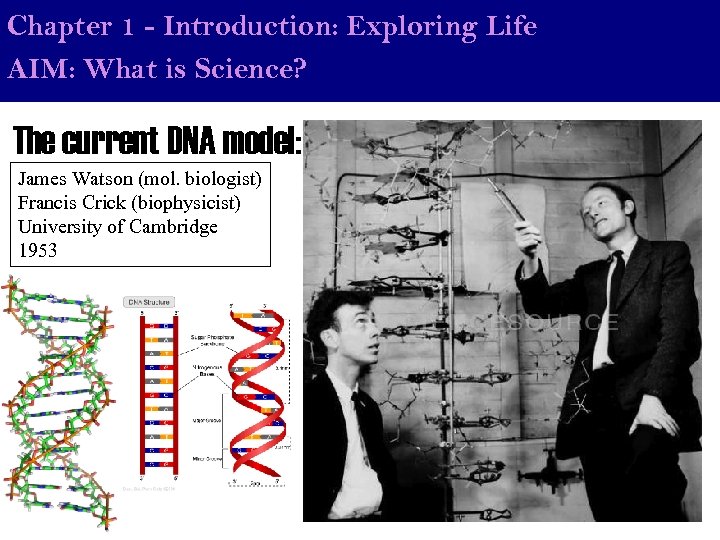 Chapter 1 - Introduction: Exploring Life AIM: What is Science? The current DNA model: James Watson (mol. biologist) Francis Crick (biophysicist) University of Cambridge 1953
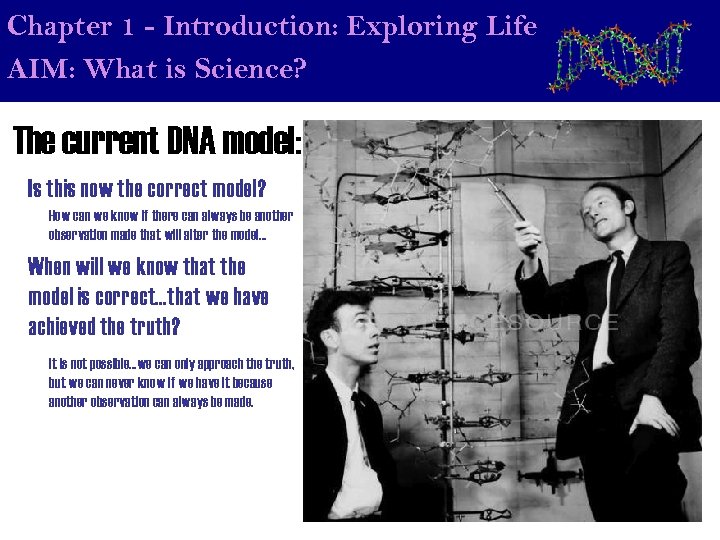 Chapter 1 - Introduction: Exploring Life AIM: What is Science? The current DNA model: Is this now the correct model? How can we know if there can always be another observation made that will alter the model… When will we know that the model is correct…that we have achieved the truth? It is not possible…we can only approach the truth, but we can never know if we have it because another observation can always be made.
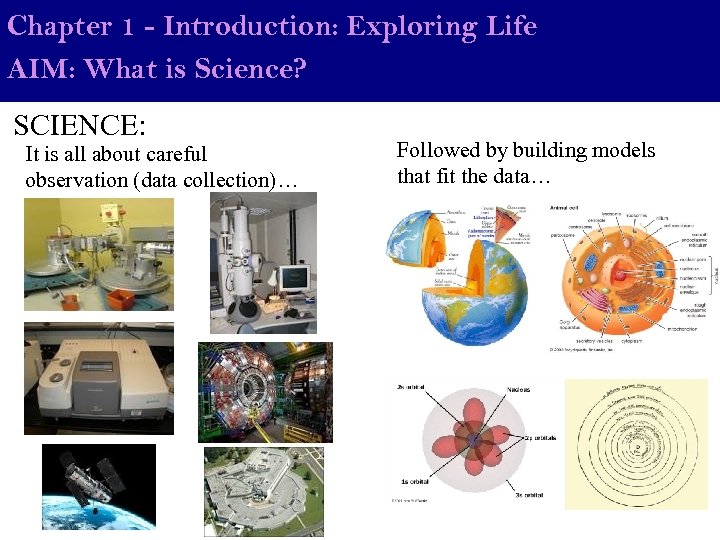 Chapter 1 - Introduction: Exploring Life AIM: What is Science? SCIENCE: It is all about careful observation (data collection)… Followed by building models that fit the data…
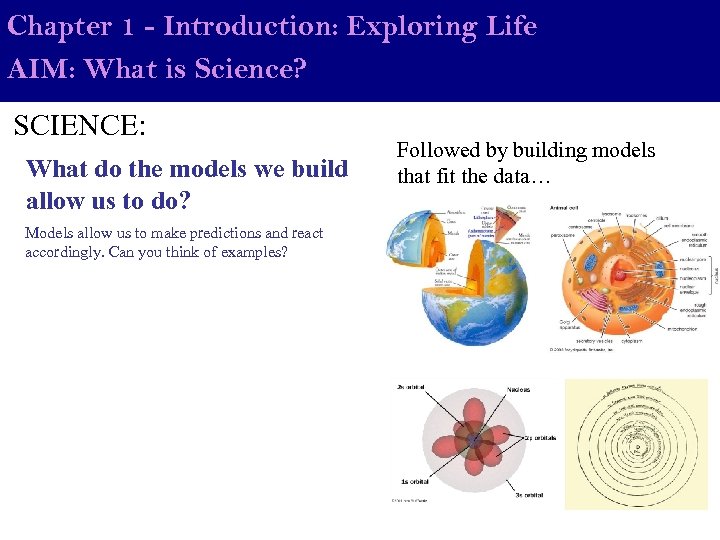 Chapter 1 - Introduction: Exploring Life AIM: What is Science? SCIENCE: What do the models we build allow us to do? Models allow us to make predictions and react accordingly. Can you think of examples? Followed by building models that fit the data…
 Chapter 1 - Introduction: Exploring Life AIM: What is Science? OK, make a prediction…will the pen fall?
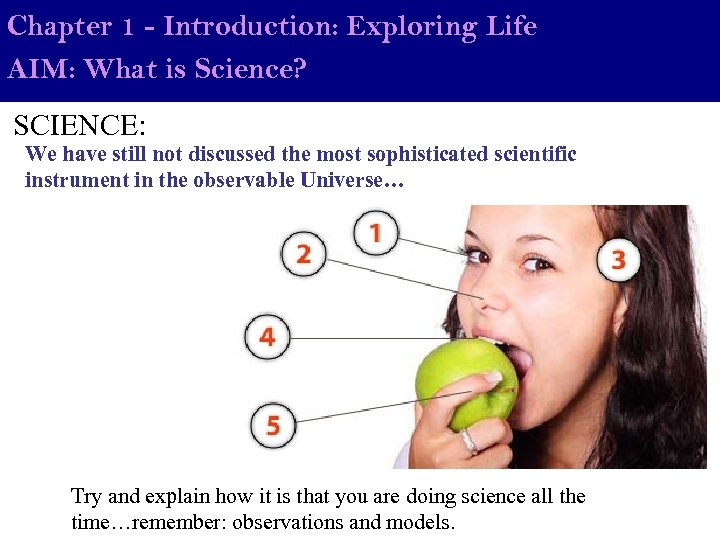 Chapter 1 - Introduction: Exploring Life AIM: What is Science? SCIENCE: We have still not discussed the most sophisticated scientific instrument in the observable Universe… Try and explain how it is that you are doing science all the time…remember: observations and models.
 Chapter 1 - Introduction: Exploring Life AIM: What is Science? SCIENCE: You make observations using your five senses (aka collect data)… …but what is the model being built with this data? ? ?
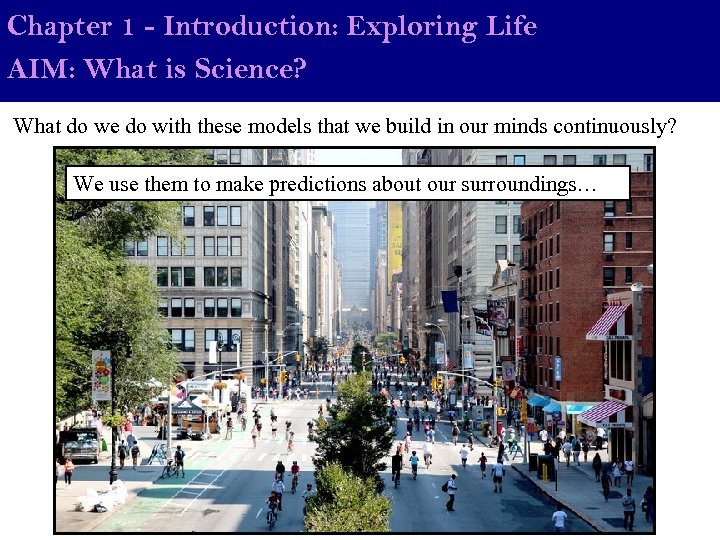 Chapter 1 - Introduction: Exploring Life AIM: What is Science? What do we do with these models that we build in our minds continuously? We use them to make predictions about our surroundings…
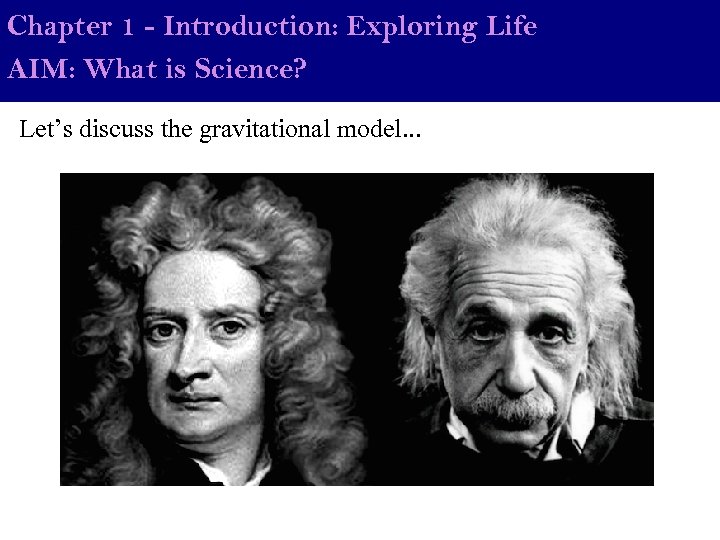 Chapter 1 - Introduction: Exploring Life AIM: What is Science? Let’s discuss the gravitational model. . .
 Chapter 1 - Introduction: Exploring Life AIM: What is Science? Therefore, what can we say about models?
 Chapter 1 - Introduction: Exploring Life AIM: What is Science? Am I standing here?
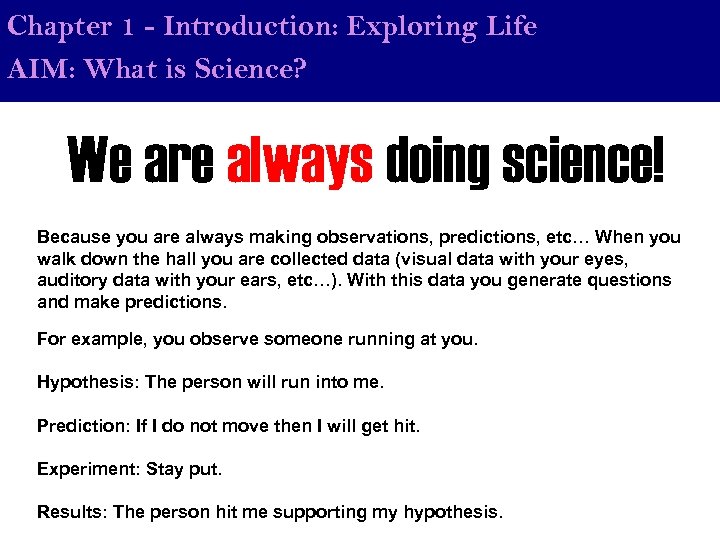 Chapter 1 - Introduction: Exploring Life AIM: What is Science? We are always doing science! Because you are always making observations, predictions, etc… When you walk down the hall you are collected data (visual data with your eyes, auditory data with your ears, etc…). With this data you generate questions and make predictions. For example, you observe someone running at you. Hypothesis: The person will run into me. Prediction: If I do not move then I will get hit. Experiment: Stay put. Results: The person hit me supporting my hypothesis.
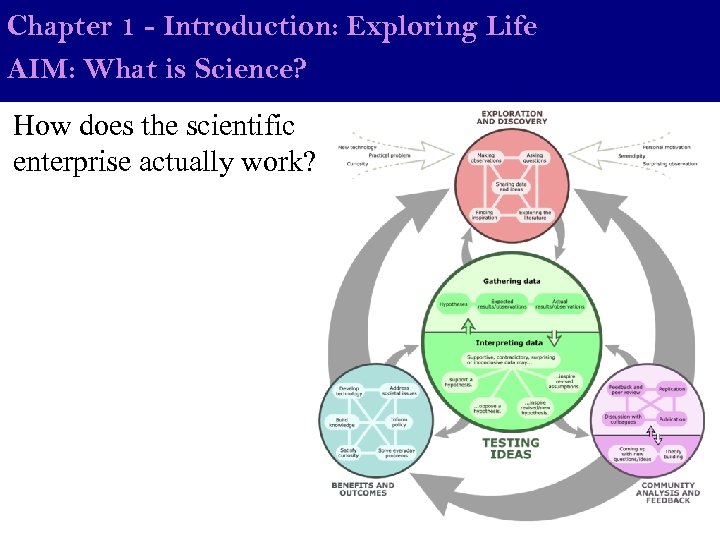 Chapter 1 - Introduction: Exploring Life AIM: What is Science? How does the scientific enterprise actually work?
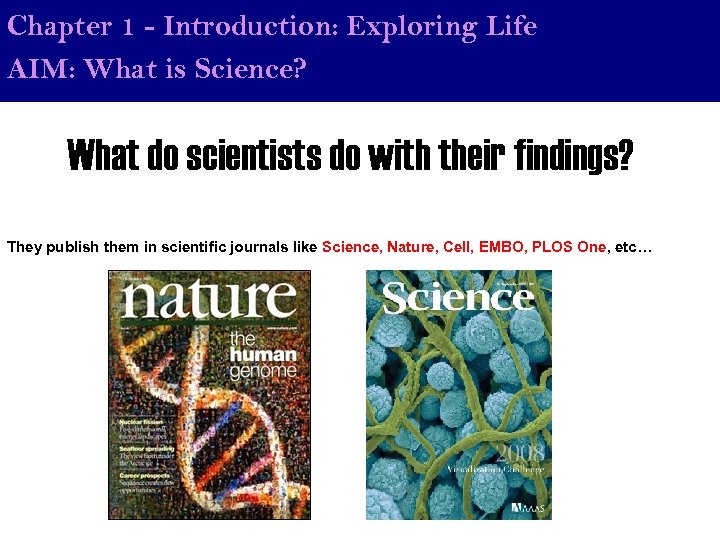 Chapter 1 - Introduction: Exploring Life AIM: What is Science? What do scientists do with their findings? They publish them in scientific journals like Science, Nature, Cell, EMBO, PLOS One, etc…
 Chapter 1 - Introduction: Exploring Life AIM: What is Science? Tentative and Fallible The findings of science are based on observation, but the observations could be misleading. For example, the Earth appears to be flat… Likewise, people thought Newton’s law of gravity was correct, but Einstein came along and revised it. This type of thing happens all the time. In addition, it was originally thought that water was HO. All of the observations pointed to HO at the time… The more reliable observations you make, the closer one gets to knowing the truth…
 Chapter 1 - Introduction: Exploring Life AIM: What is Science? Theory 1. Very broad in nature (describe many, many different phenomenon). 2. Supported by enormous numbers of observations 3. Examples: Theory of Evolution Cell Theory Law 1. Very concise in nature (describes a very specific phenomenon). 2. Supported by enormous numbers of observations 3. Examples: Law of Gravity Laws of thermodynamics Laws of motion
 Chapter 1 - Introduction: Exploring Life AIM: What is Science? GOD and Science
 Chapter 1 - Introduction: Exploring Life AIM: What is Science? So is this class really about science ?
 Research Methods AIM: What is Science? What do we think we know and why do we think w
 Research Methods AIM: What is Science? Will it fall ?
 Research Methods AIM: What is Science? Can you PROVE it ?
 Research Methods AIM: What is Science? Levels of Uncertainty
 Research Methods AIM: What is Science? Can you prove that I am standing here ?
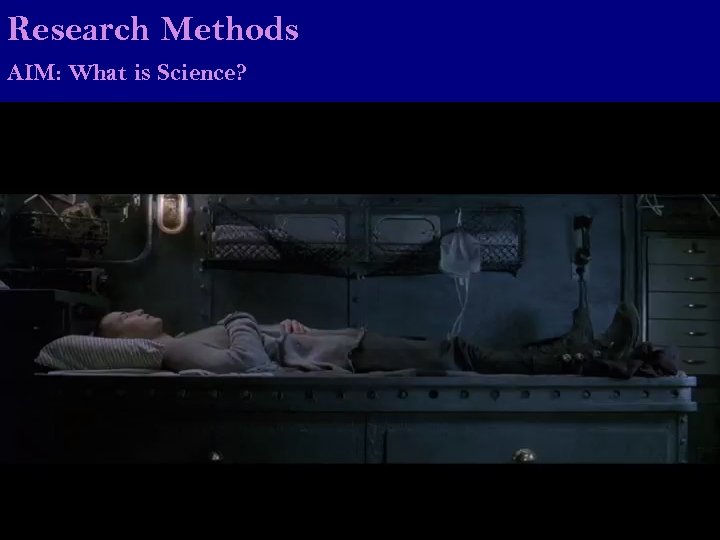 Research Methods AIM: What is Science?
 Research Methods AIM: What is Science? Can you prove that I am standing here ?
 Research Methods AIM: What is Science? How do we get as close to the truth as possible?
 Research Methods AIM: What is Science? The scientific method
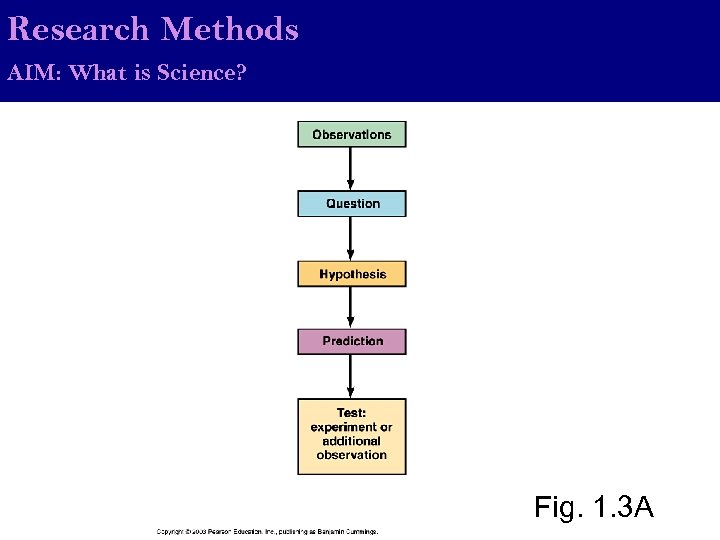 Research Methods AIM: What is Science? Fig. 1. 3 A
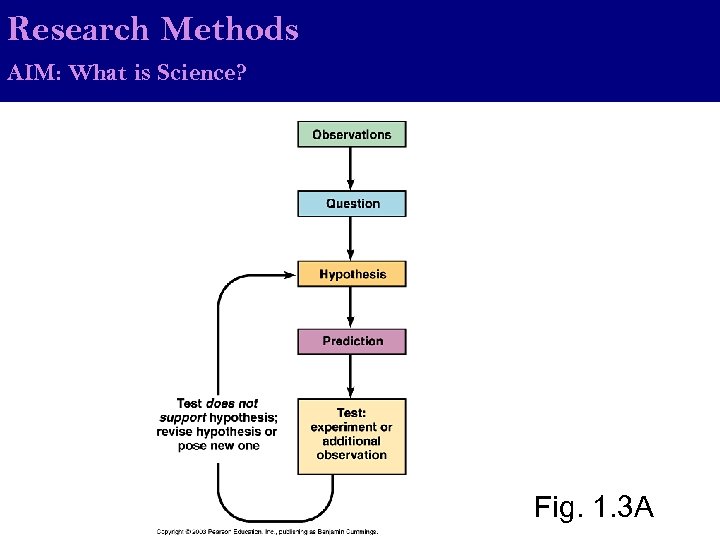 Research Methods AIM: What is Science? Fig. 1. 3 A
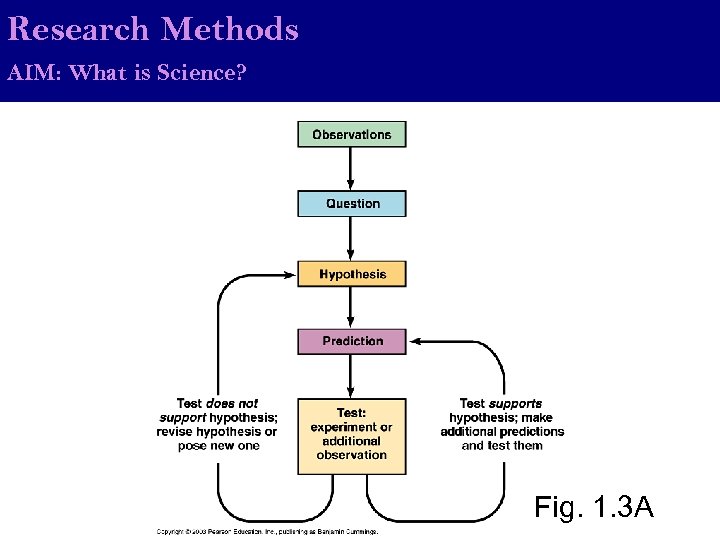 Research Methods AIM: What is Science? Fig. 1. 3 A
 Research Methods AIM: What is Science? We are always doing science…
 Research Methods AIM: What is Science? The Earth sure looks flat…
 Research Methods AIM: What is Science? Tentative and Fallible
 Research Methods AIM: What is Science? Conclusions Scientific finding are tentative and can be incorrect
 Research Methods AIM: What is Science? Conclusions The more data we collect to support a hypothesis, The less uncertain we are about its correctness.
 Research Methods AIM: What is Science? Conclusions Because the level of uncertainty can NEVER be zero We can never be certain of anything and therefore…
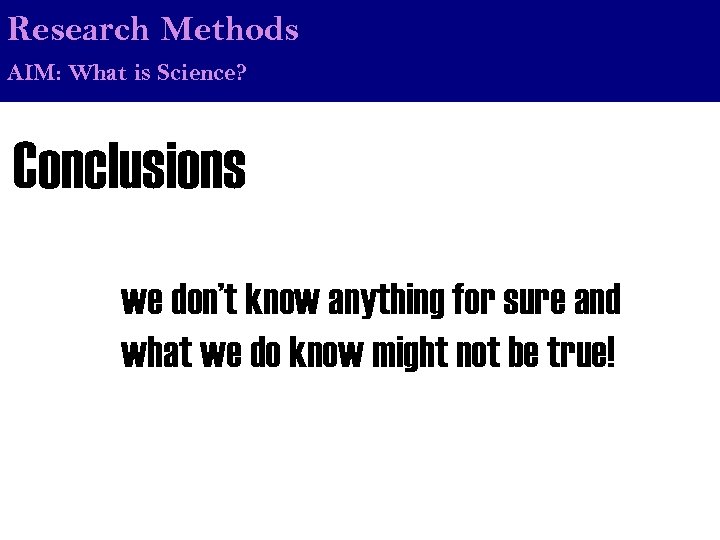 Research Methods AIM: What is Science? Conclusions we don’t know anything for sure and what we do know might not be true!
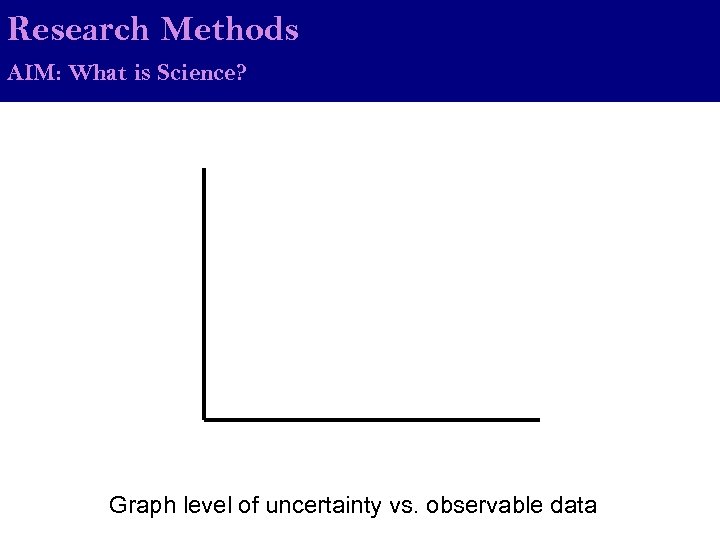 Research Methods AIM: What is Science? Graph level of uncertainty vs. observable data
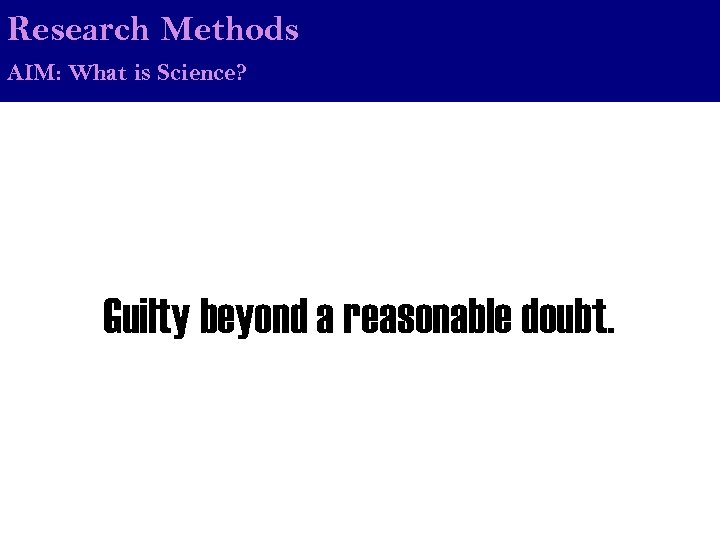 Research Methods AIM: What is Science? Guilty beyond a reasonable doubt.
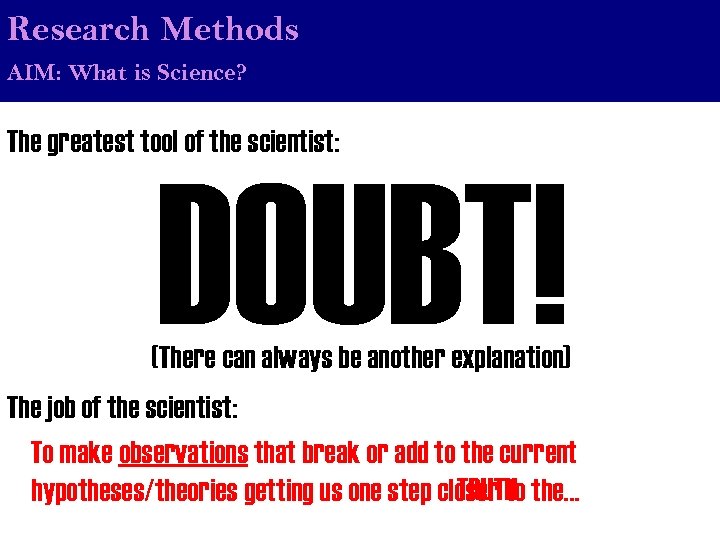 Research Methods AIM: What is Science? The greatest tool of the scientist: DOUBT! (There can always be another explanation) The job of the scientist: To make observations that break or add to the current TRUTH hypotheses/theories getting us one step closer to the…
 Research Methods AIM: What is Science? So is this class really about science ?
 Research Methods AIM: What is Science? GOD and Science
 Research Methods AIM: What is Science? Basic vs. Applied Research
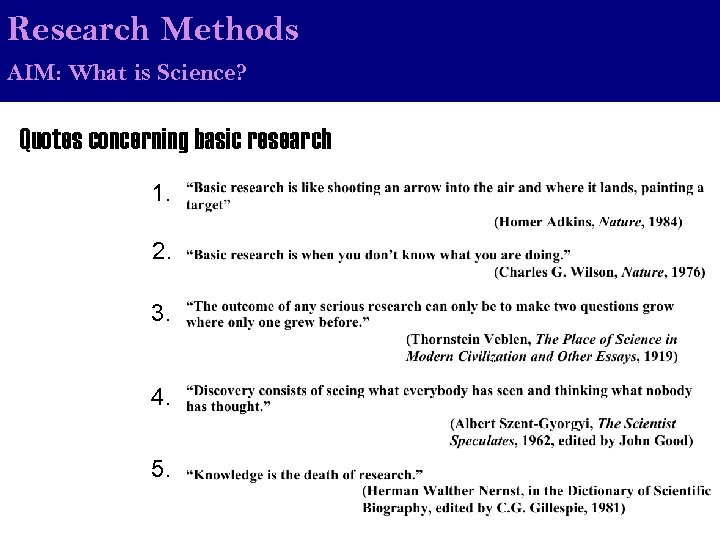 Research Methods AIM: What is Science? Quotes concerning basic research 1. 2. 3. 4. 5.
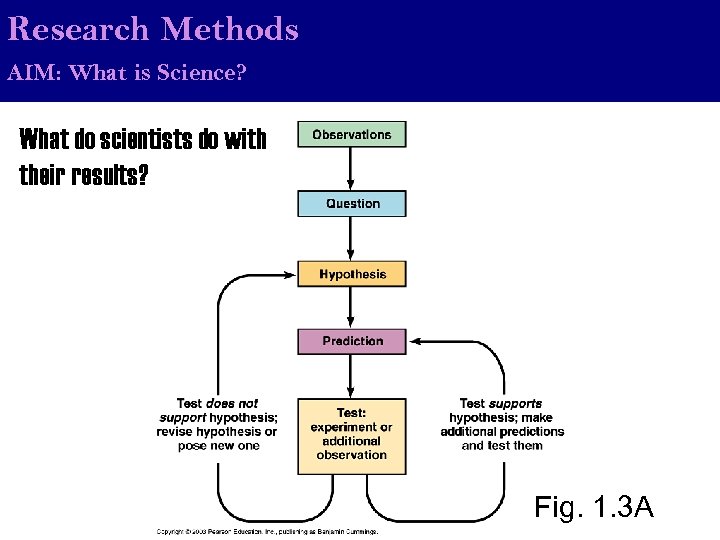 Research Methods AIM: What is Science? What do scientists do with their results? Fig. 1. 3 A
 Research Methods AIM: What is Science? Primary, Secondary, and Tertiary scientific literature
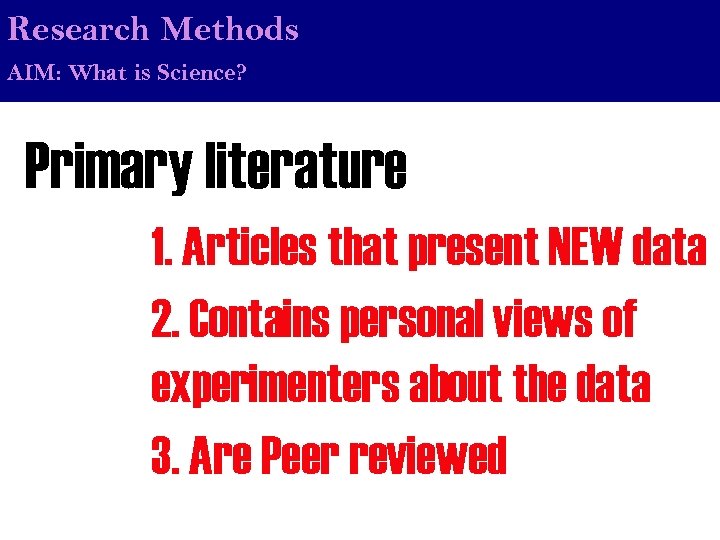 Research Methods AIM: What is Science? Primary literature 1. Articles that present NEW data 2. Contains personal views of experimenters about the data 3. Are Peer reviewed
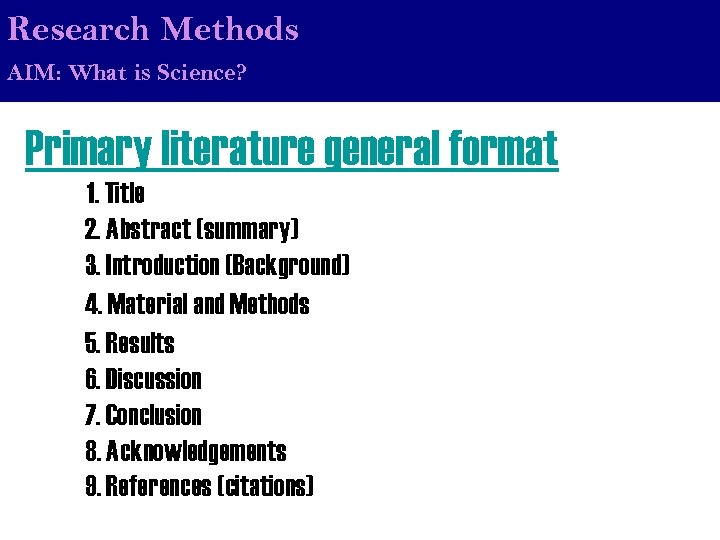 Research Methods AIM: What is Science? Primary literature general format 1. Title 2. Abstract (summary) 3. Introduction (Background) 4. Material and Methods 5. Results 6. Discussion 7. Conclusion 8. Acknowledgements 9. References (citations)
 Research Methods AIM: What is Science? The process to get published
 Research Methods AIM: What is Science? The author list and the order of the authors, what does it mean?
 Research Methods AIM: What is Science? If you found one paper, you really found dozens….
 Research Methods AIM: What is Science? How to get into a summer lab… Guest speaker? Student who has done this.
 Research Methods AIM: What is Science? The process to become a professor/scientist
 Research Methods AIM: What is Science? The hierarchy of scientific journals and impact factors
 Research Methods AIM: What is Science? Getting funding – Grants, grants “Publish or perish”
 Research Methods AIM: What is Science? Secondary literature 1. Derived from primary literature Ex. Reviews, textbooks 2. NOT Peer reviewed – less reliable
 Research Methods AIM: What is Science? Tertiary literature 1. Derived from primary literature and secondary literature Ex. Reference books 2. NOT Peer reviewed
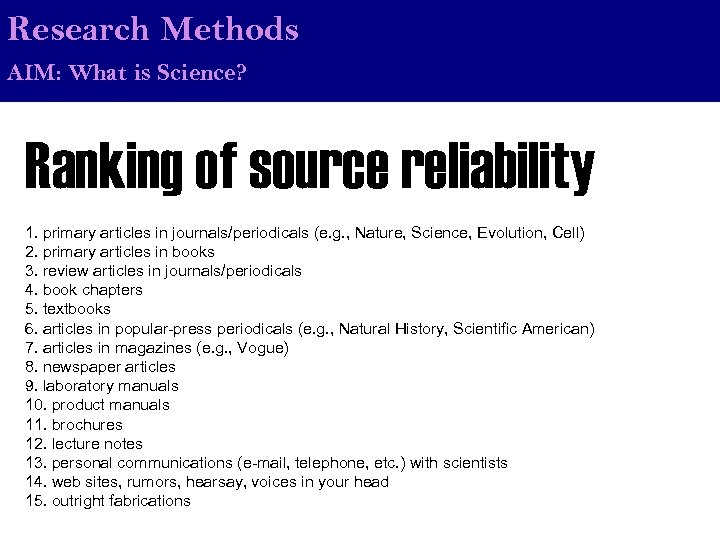 Research Methods AIM: What is Science? Ranking of source reliability 1. primary articles in journals/periodicals (e. g. , Nature, Science, Evolution, Cell) 2. primary articles in books 3. review articles in journals/periodicals 4. book chapters 5. textbooks 6. articles in popular-press periodicals (e. g. , Natural History, Scientific American) 7. articles in magazines (e. g. , Vogue) 8. newspaper articles 9. laboratory manuals 10. product manuals 11. brochures 12. lecture notes 13. personal communications (e-mail, telephone, etc. ) with scientists 14. web sites, rumors, hearsay, voices in your head 15. outright fabrications
 Research Methods AIM: What is Science? How do we find primary/secondary journal articles? 1. Electronic Databases 2. Searching in a specific journal 3. Use citations from another paper
 Research Methods AIM: What is Science? Obtaining articles: 1. Check if the online journal offers free articles If not… 2. Interlibrary loan system
 Research Methods AIM: What is Science? How to use the Interlibrary loan system: 1. Print out ONLY the abstract of the article with volume/issue information (1 page)
 Research Methods AIM: What is Science? How to use the Interlibrary loan system: 2. Put your full name and period on the print out 3. Bring to Dr. T for approval signature 4. Turn in to Mr. Reader (Librarian) DO NOT BUY ARTICLES!!
 Research Methods AIM: What is Science? Citing sources…why? 1. It is someone else’s intellectual property 2. It lends credibility to your work 3. Enables readers to locate your information sources
 Research Methods AIM: What is Science? Citing sources…what? Whenever you use someone else’s intellectual property: * Exact words (quoting) * Paraphrasing * Concepts and ideas * Facts that are not common knowledge * Pictures, photos, poems, cartoons, or other artwork you did not create yourself
 Research Methods AIM: What is Science? Citing sources…kinds of sources? * Books * Articles (from print sources or from online article databases) * Interviews * E-mail or any other correspondence * Web pages * Government documents * Non-print media (videotapes, audiotapes, pictures and images) * Software or any digital formats
 Research Methods AIM: What is Science? Citing sources…how? We will use the APA (American Psychological Association) format in research methods Example in text citation: It has been shown that apes do not actually understand the syntax and structure of ASL (Smith, 1994, p. 345). Example reference: Smith, J. A. (1994). Finding ways to overcome college stress. Stress Reliever, 24, 12 -16.
 Research Methods AIM: What is Science? What about Wikipedia?
 Research Methods AIM: What is Science? Plagiarism * to steal and pass off (the ideas or words of another) as one's own * to use (another's production) without crediting the source * to commit literary theft * to present as new and original an idea or product derived from an existing source. Plagiarism is an act of fraud. It involves stealing someone else's work and lying about it afterward.
 Research Methods AIM: What is Science? All of the following are considered plagiarism: * turning in someone else's work as your own * copying words or ideas from someone else without giving credit * failing to put a quotation in quotation marks * giving incorrect information about the source of a quotation * changing words but copying the sentence structure of a source without giving credit * copying so many words or ideas from a source that it makes up the majority of your work, whether you give credit or not Most cases of plagiarism can be avoided by citing sources.